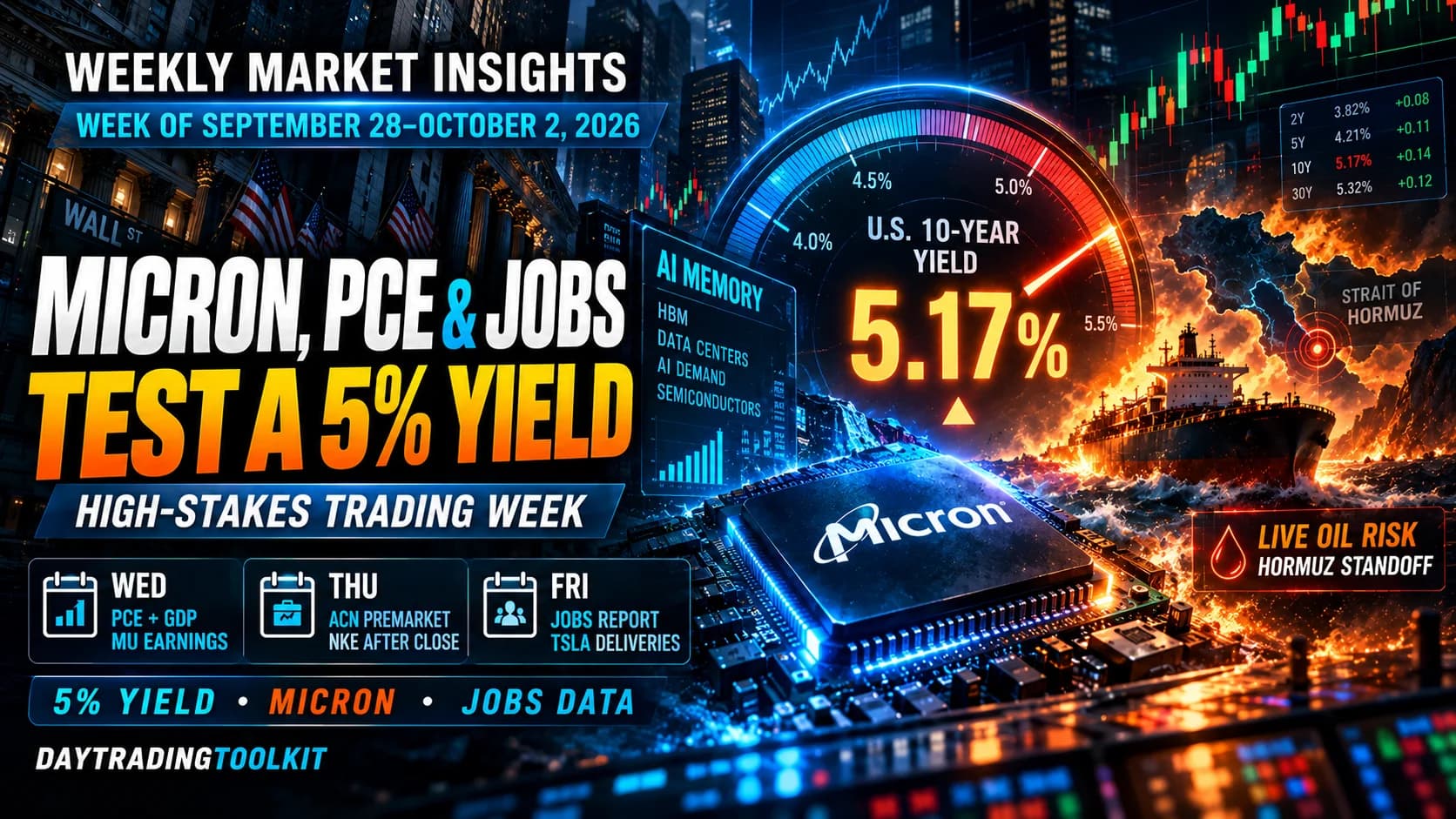
Micron, PCE, and Friday's Jobs Report Test a 10-Year Yield Above 5 Percent: Weekly Market Insights, September 28-October 2

In this article14 sections
The 10-year Treasury yield touched its highest level since June 2007 on Thursday, and the S and P 500 still finished the week up 1.2 percent. That is the tension you are trading into on Monday.
Last week had almost no data and a lot of noise. This week flips it. The Fed's preferred inflation gauge lands Wednesday morning, the most important earnings report on the AI calendar lands Wednesday night, and the September jobs report closes the week on Friday. Rate futures are pricing roughly a 70 percent chance of another hike on October 28, and every one of those releases can move that number.
On top of the schedule sits a live geopolitical story. Oil fell Friday on an Iranian proposal to reopen the Strait of Hormuz within seven days. On Saturday, President Trump said he had rejected it. Markets have not traded a single regular session since.
This guide's research cutoff is Sunday, September 27, at 5:00 PM ET. All prices below are Friday, September 25 closes unless stated otherwise. Futures reopen Sunday evening, after this cutoff, and oil in particular can open far from Friday's settle, so re-check live quotes before you act on any level mentioned here.
What to Know This Week
Wednesday is the pivot of the whole week. August PCE inflation and the third estimate of Q2 GDP both arrive at 8:30 AM ET, ADP payrolls at 8:15 AM, and Micron ($MU) reports after the close. Consensus has headline PCE rising to 3.8 percent year over year from 3.7 percent, with core PCE edging up to 3.4 percent from 3.3 percent. It is the first Fed-preferred inflation reading since the September 16 hike.
Friday's jobs report is the other half of the October decision. The Bureau of Labor Statistics releases September payrolls at 8:30 AM ET. Forecasts cluster around 90,000 to 100,000 new jobs, down sharply from August's 162,000, with unemployment expected to hold near 4.1 percent. Tesla ($TSLA) is also expected to release Q3 deliveries that day.
October hike odds sit near 70 percent. Fed Governor Barr said Wednesday that more increases will likely be needed. New York Fed President Williams called another hike by year-end a reasonable expectation. The fed funds target range is 3.75 to 4.00 percent, and 16 of 18 officials projected at least one more hike this year at the September meeting.
The bond market, not the Fed decision, drove last week. The 10-year yield hit roughly 5.22 percent intraday Thursday, its highest since June 2007, and closed Friday near 5.17 percent. The 30-year touched 5.50 percent, its highest since 2004. The average 30-year fixed mortgage rate climbed to 7.45 percent, per Mortgage News Daily.
Trump rejected Iran's Hormuz plan on Saturday. Iran offered to reopen the Strait within seven days if the US lifted its naval blockade, waived oil sanctions, and observed a ceasefire. WTI crude fell 2.33 percent Friday to $92.41 on the proposal. Iran's foreign minister says no rejection has come through official channels. Sunday night's energy futures open is the first real read on how much of Friday's drop survives.
The US-China truce got two more months, not a deal. Thursday's Trump-Xi summit extended the tariff truce through January 10. Treasury Secretary Bessent framed it as more time to negotiate, which pushes tariffs, chip rules, and rare earths into a later round rather than resolving them.
Four consumer and AI reports frame the earnings calendar. Carnival ($CCL) reports Tuesday morning, Micron Wednesday night, Accenture ($ACN) Thursday morning, and Nike ($NKE) Thursday after the close. Several watchlists circulating this weekend list Nike on Wednesday. Nike's own investor relations page says Thursday, October 1.
Week at a Glance
Monday, September 28
- Time (ET)
- Sunday 6:00 PM
- Event
- Futures reopen
- Why It Matters
- First trade after Trump's rejection of the Iran plan
- Time (ET)
- 8:15 AM
- Event
- Fed Vice Chair for Supervision Bowman speaks
- Why It Matters
- Bank supervision topic, virtual
- Time (ET)
- 10:05 AM
- Event
- Fed Governor Barr speaks
- Why It Matters
- Economic outlook and housing, days after calling for more hikes
- Time (ET)
- 10:30 AM
- Event
- Dallas Fed Manufacturing Survey
- Why It Matters
- Regional factory read
- Time (ET)
- After close
- Event
- $JEF, $MTN earnings
- Why It Matters
- Jefferies is an early read on dealmaking and trading revenue
| Time (ET) | Event | Why It Matters |
|---|---|---|
| Sunday 6:00 PM | Futures reopen | First trade after Trump's rejection of the Iran plan |
| 8:15 AM | Fed Vice Chair for Supervision Bowman speaks | Bank supervision topic, virtual |
| 10:05 AM | Fed Governor Barr speaks | Economic outlook and housing, days after calling for more hikes |
| 10:30 AM | Dallas Fed Manufacturing Survey | Regional factory read |
| After close | $JEF, $MTN earnings | Jefferies is an early read on dealmaking and trading revenue |
Tuesday, September 29
- Time (ET)
- Overnight
- Event
- Reserve Bank of Australia decision
- Why It Matters
- All four major Australian banks expect a hike to 4.6 percent
- Time (ET)
- Before open
- Event
- $CCL, $KMX earnings
- Why It Matters
- Carnival call at 10:00 AM; CarMax carries the week's widest implied move
- Time (ET)
- 9:00 AM
- Event
- FHFA House Price Index (July)
- Why It Matters
- Housing with mortgage rates at 7.45 percent
- Time (ET)
- 10:00 AM
- Event
- Conference Board Consumer Confidence (September)
- Why It Matters
- Sentiment after the yield spike
- Time (ET)
- 10:00 AM
- Event
- JOLTS job openings (August)
- Why It Matters
- First labor data of the week
- Time (ET)
- 12:40 PM
- Event
- Barr speaks
- Why It Matters
- Second Barr appearance
- Time (ET)
- 3:00 PM
- Event
- Fed Governor Waller speaks
- Why It Matters
- Payments topic, but any policy comment moves futures
| Time (ET) | Event | Why It Matters |
|---|---|---|
| Overnight | Reserve Bank of Australia decision | All four major Australian banks expect a hike to 4.6 percent |
| Before open | $CCL, $KMX earnings | Carnival call at 10:00 AM; CarMax carries the week's widest implied move |
| 9:00 AM | FHFA House Price Index (July) | Housing with mortgage rates at 7.45 percent |
| 10:00 AM | Conference Board Consumer Confidence (September) | Sentiment after the yield spike |
| 10:00 AM | JOLTS job openings (August) | First labor data of the week |
| 12:40 PM | Barr speaks | Second Barr appearance |
| 3:00 PM | Fed Governor Waller speaks | Payments topic, but any policy comment moves futures |
Wednesday, September 30
- Time (ET)
- Before open
- Event
- $JBL, $FDS, $CAG, $CALM earnings
- Why It Matters
- Jabil is an AI hardware read tied directly to Akamai's memory order
- Time (ET)
- 8:15 AM
- Event
- ADP National Employment Report
- Why It Matters
- Private payroll preview for Friday
- Time (ET)
- 8:30 AM
- Event
- Personal Income and Outlays (August), including PCE
- Why It Matters
- The Fed's preferred inflation measure
- Time (ET)
- 8:30 AM
- Event
- GDP, Q2 third estimate
- Why It Matters
- Backward-looking, lower impact than PCE
- Time (ET)
- 9:45 AM
- Event
- Chicago PMI (September)
- Why It Matters
- Regional business activity
- Time (ET)
- 3:25 PM
- Event
- Fed Governor Cook speaks
- Why It Matters
- Rural economy topic
- Time (ET)
- After close
- Event
- $MU earnings; call at 4:30 PM
- Why It Matters
- The week's most important single report
- Time (ET)
- All day
- Event
- Quarter-end and federal fiscal year-end
- Why It Matters
- Rebalancing flows; government funded through December 11
| Time (ET) | Event | Why It Matters |
|---|---|---|
| Before open | $JBL, $FDS, $CAG, $CALM earnings | Jabil is an AI hardware read tied directly to Akamai's memory order |
| 8:15 AM | ADP National Employment Report | Private payroll preview for Friday |
| 8:30 AM | Personal Income and Outlays (August), including PCE | The Fed's preferred inflation measure |
| 8:30 AM | GDP, Q2 third estimate | Backward-looking, lower impact than PCE |
| 9:45 AM | Chicago PMI (September) | Regional business activity |
| 3:25 PM | Fed Governor Cook speaks | Rural economy topic |
| After close | $MU earnings; call at 4:30 PM | The week's most important single report |
| All day | Quarter-end and federal fiscal year-end | Rebalancing flows; government funded through December 11 |
Thursday, October 1
- Time (ET)
- Before open
- Event
- $ACN (call 8:00 AM), $MKC, $AYI earnings
- Why It Matters
- Accenture is the week's enterprise AI spending read
- Time (ET)
- 8:30 AM
- Event
- Weekly jobless claims
- Why It Matters
- Last print was 197,000
- Time (ET)
- 9:45 AM
- Event
- S and P Global Manufacturing PMI, final (September)
- Why It Matters
- Revision to last week's hot flash reading
- Time (ET)
- 10:00 AM
- Event
- ISM Manufacturing (September)
- Why It Matters
- Prices paid is the inflation line to watch
- Time (ET)
- 10:00 AM
- Event
- Construction spending (August)
- Why It Matters
- Rate-sensitive activity
- Time (ET)
- 10:00 AM
- Event
- Waller speaks
- Why It Matters
- Second Waller appearance
- Time (ET)
- 1:30 PM
- Event
- Fed Vice Chair Jefferson speaks
- Why It Matters
- Economy and monetary policy, the most direct policy topic of the week
- Time (ET)
- 4:15 PM
- Event
- $NKE earnings; call at 5:00 PM
- Why It Matters
- Fiscal Q1 results after an S and P 100 exit and a Friday downgrade
- Time (ET)
- Time not confirmed
- Event
- Tesla Roadster reveal
- Why It Matters
- Product event the day before deliveries
| Time (ET) | Event | Why It Matters |
|---|---|---|
| Before open | $ACN (call 8:00 AM), $MKC, $AYI earnings | Accenture is the week's enterprise AI spending read |
| 8:30 AM | Weekly jobless claims | Last print was 197,000 |
| 9:45 AM | S and P Global Manufacturing PMI, final (September) | Revision to last week's hot flash reading |
| 10:00 AM | ISM Manufacturing (September) | Prices paid is the inflation line to watch |
| 10:00 AM | Construction spending (August) | Rate-sensitive activity |
| 10:00 AM | Waller speaks | Second Waller appearance |
| 1:30 PM | Fed Vice Chair Jefferson speaks | Economy and monetary policy, the most direct policy topic of the week |
| 4:15 PM | $NKE earnings; call at 5:00 PM | Fiscal Q1 results after an S and P 100 exit and a Friday downgrade |
| Time not confirmed | Tesla Roadster reveal | Product event the day before deliveries |
Friday, October 2
- Time (ET)
- European morning
- Event
- Eurozone flash CPI (September)
- Why It Matters
- Forecast at 3.7 percent, a three-year high
- Time (ET)
- 8:30 AM
- Event
- Employment Situation (September)
- Why It Matters
- Payrolls, unemployment, and wages for the October decision
- Time (ET)
- Time not confirmed
- Event
- Tesla Q3 production and deliveries
- Why It Matters
- Consensus roughly 454,000 to 461,000
| Time (ET) | Event | Why It Matters |
|---|---|---|
| European morning | Eurozone flash CPI (September) | Forecast at 3.7 percent, a three-year high |
| 8:30 AM | Employment Situation (September) | Payrolls, unemployment, and wages for the October decision |
| Time not confirmed | Tesla Q3 production and deliveries | Consensus roughly 454,000 to 461,000 |
All Week, Unscheduled
The US-Iran standoff has no calendar. A mediator response, a strike, or a Houthi attack on Saudi infrastructure can move oil before the US open on any day. Anthropic's public S-1 has not yet posted to EDGAR, and it can drop without warning. Fed regional bank presidents add their own appearances beyond the Board calendar above, so check the day's schedule each morning. There are no Treasury note or bond auctions this week, only bills, which removes one scheduled source of pressure on long-term yields.
Priority Stocks at a Glance
- Stock
- $MU
- Catalyst and Timing
- Fiscal Q4 earnings Wednesday after the close
- Why It's Here
- Up 276 percent this year; options price an 8.06 percent move
- Stock
- $NKE
- Catalyst and Timing
- Fiscal Q1 earnings Thursday at 4:15 PM
- Why It's Here
- Exited the S and P 100, downgraded Friday, down about 44 percent this year
- Stock
- $CCL
- Catalyst and Timing
- Q3 earnings Tuesday before the open
- Why It's Here
- 16-month low Thursday, reporting in an oil-price whipsaw
- Stock
- $ACN
- Catalyst and Timing
- Fiscal Q4 earnings Thursday before the open
- Why It's Here
- Down 33 percent this year on AI disruption fears; 9.31 percent implied move
- Stock
- $KMX
- Catalyst and Timing
- Fiscal Q2 earnings Tuesday before the open
- Why It's Here
- Widest implied move of the week at 11.76 percent, with mortgage rates at 7.45 percent
- Stock
- $TSLA
- Catalyst and Timing
- Q3 deliveries Friday, time not confirmed
- Why It's Here
- Lands the same morning as the jobs report
- Stock
- $AKAM
- Catalyst and Timing
- $11.6 billion Anthropic deal announced Thursday
- Why It's Here
- Gapped up as much as 16 percent Friday, then gave most of it back
- Stock
- $META
- Catalyst and Timing
- Muse AI agent rally, no scheduled event
- Why It's Here
- Up about 13 percent on the week and roughly 30 percent in a month
| Stock | Catalyst and Timing | Why It's Here |
|---|---|---|
| $MU | Fiscal Q4 earnings Wednesday after the close | Up 276 percent this year; options price an 8.06 percent move |
| $NKE | Fiscal Q1 earnings Thursday at 4:15 PM | Exited the S and P 100, downgraded Friday, down about 44 percent this year |
| $CCL | Q3 earnings Tuesday before the open | 16-month low Thursday, reporting in an oil-price whipsaw |
| $ACN | Fiscal Q4 earnings Thursday before the open | Down 33 percent this year on AI disruption fears; 9.31 percent implied move |
| $KMX | Fiscal Q2 earnings Tuesday before the open | Widest implied move of the week at 11.76 percent, with mortgage rates at 7.45 percent |
| $TSLA | Q3 deliveries Friday, time not confirmed | Lands the same morning as the jobs report |
| $AKAM | $11.6 billion Anthropic deal announced Thursday | Gapped up as much as 16 percent Friday, then gave most of it back |
| $META | Muse AI agent rally, no scheduled event | Up about 13 percent on the week and roughly 30 percent in a month |
This is a preparation shortlist, not a buy list or a ranked forecast. The Broader Weekly Radar section further down covers the real catalysts that did not make this table.
Market Setup Entering the Week
Friday's closes tell a cleaner story than the week's headlines did. The S and P 500 finished at 7,743.41, up 0.51 percent on the day and 1.21 percent for the week. The Nasdaq Composite closed at 27,068.72, up 2.06 percent on the week. The Dow ended at 51,828.62, up 0.28 percent for the week and snapping a three-week losing streak. The Russell 2000 closed at 2,837.55, down 0.80 percent.
Read those together and the market is telling you something specific. Large-cap technology rallied through a bond selloff. Small caps, which borrow at floating rates and depend on cheaper financing, did not.
Sector numbers make the split sharper. Technology gained about 3.1 percent on the week, led by Meta ($META). Utilities fell about 3.0 percent and energy fell about 3.1 percent. Utilities are the classic bond-substitute sector, so a 5 percent 10-year yield is direct competition for their dividends. Energy fell because crude cooled into Friday.
The VIX closed at 14.87, down 5.11 percent on the day. Think of that like a smoke detector reading quiet while the kitchen is warm. Options traders are not pricing a crisis, even with the long bond at a 22-year high and a Fed that just signaled more hikes. That can stay true for a long time. It can also mean protection is cheap right before the heaviest data week in a month.
Rates are where the real move happened. The 10-year yield hit roughly 5.22 percent intraday Thursday and closed Friday near 5.17 percent, a level last seen in 2007. The 30-year closed near 5.46 percent after touching 5.50 percent. The 2-year finished around 4.9 percent. Long yields rising faster than short ones is called bear steepening, and it usually means investors want more compensation to lock money up for decades, not just a response to the next Fed meeting.
What drove it: a hot flash PMI report on Wednesday, hawkish Fed commentary, an oil spike on Thursday, and heavy bond supply. Corporate AI borrowing has become part of that supply story. DayTradingToolkit's guide to what a 5 percent 10-year Treasury yield means for day traders covers the mechanism and which sectors react first.
Gold closed at $4,321.20 and bitcoin near $84,745, up from roughly $80,800 a week earlier. Both held up into rising real yields, which is not the textbook reaction.
Economy, Fed, and Global Policy
Here is the setup in one sentence. The Fed hiked on September 16, told you it expects to hike again, and now gets its first inflation reading and its first jobs report since that decision inside the same four days.
Wednesday's PCE report. The Personal Consumption Expenditures price index is the inflation measure the Fed officially targets at 2 percent. Consensus has August headline PCE at 3.8 percent year over year, up from 3.7 percent, and core at 3.4 percent, up from 3.3 percent. Real consumer spending is expected to rise about 0.5 percent, which would be the largest gain in over a year.
That combination matters more than either number alone. Hotter inflation plus stronger spending is exactly the mix that argues for October. A soft core number with weak spending gives the doves their first real opening since the hike.
The Fed's own September projections already put 2026 core PCE at 3.4 percent. A print in line with consensus confirms the Fed's view rather than challenging it. The market-moving outcome is a surprise in either direction on the monthly core figure.
Friday's jobs report. August payrolls rose 162,000 against a 53,000 consensus, with unemployment at 4.1 percent and average hourly earnings up 3.1 percent from a year earlier. That surprise helped push the Fed to hike. September forecasts sit near 90,000 to 100,000 jobs. The detail worth checking is wages: 3.1 percent wage growth against 3.8 percent headline inflation means real wages are falling, which is part of why consumer names are on this week's list.
The rest of the labor picture. JOLTS job openings arrive Tuesday at 10:00 AM, ADP on Wednesday at 8:15 AM, and weekly claims Thursday. Claims printed 197,000 last week, a low level that supports the "slowing but not breaking" read. Our jobs report playbook walks through why the first minutes after an 8:30 AM release are the most dangerous part of the session to trade.
ISM Manufacturing on Thursday. The headline tells you whether factories are expanding (above 50) or contracting (below 50). The prices paid component matters more this week, because oil above $90 flows into input costs quickly.
Fed speakers. The Board calendar lists Bowman and Barr on Monday, Barr and Waller on Tuesday, Cook on Wednesday, and Waller and Jefferson on Thursday. Jefferson's Thursday talk on the economy and monetary policy is the most directly policy-relevant. Barr already said more hikes are likely, so a repeat is not news. A softer tone from Waller or Jefferson after PCE would be.
Global policy. The Reserve Bank of Australia decides Tuesday, with all four major Australian banks expecting a hike to 4.6 percent, its fourth this year. Eurozone flash inflation Friday is forecast at 3.7 percent, a three-year high, feeding speculation of another European Central Bank hike. Central banks tightening together is part of why the bond selloff has been global, with Japanese, UK, and German long-term yields also at multi-year highs last week.
Fiscal year-end. The federal fiscal year ends Wednesday. The House passed a continuing resolution on September 1 funding the government through December 11, so there is no shutdown deadline this week.
Oil After Saturday: Friday's Drop Was Priced on a Plan That Just Got Rejected
This is the most time-sensitive thread in the guide, because the market has not had a chance to react to it.
On Thursday, Brent hit a session high of $108.23 after Houthi missiles targeted Saudi Arabia, then pulled back on reports of US-Iran talks. On Friday, Iran's foreign minister detailed a seven-day plan: the US lifts its naval blockade, waives oil sanctions, and observes a ceasefire including Lebanon, and the Strait reopens on the sixth day. WTI settled at $92.41, down 2.33 percent, and Brent at $104.32, down 2.14 percent.
On Saturday, Trump told reporters he had rejected the deal. Iran's foreign minister responded that no rejection had come through the mediators. Both statements can be true at once, and that ambiguity is the setup.
Two supply facts cut against a simple bullish oil read. Kpler data shows Saudi Arabia exporting about 6 million barrels per day in September, the most since the war began seven months ago, despite the East-West pipeline closure. JPMorgan estimated total Middle East oil flows at about 17 million barrels per day, more than 70 percent of the 2025 average. The physical market is tight, but it is not as tight as the headlines suggest.
Brent is still up more than 17 percent in September. Airlines, cruise lines, truckers, and chemical makers pay for that. Energy producers collect it. The geopolitical oil shock framework explains why crude reprices on headlines within minutes while equities often take a session or two to follow.
What to watch Monday morning: whether energy stocks open above Friday's close with crude, and whether the transport and travel names that rallied on Friday's drop give it back. Carnival reports Tuesday into exactly that crosscurrent.
Stocks to Watch
$MU: the AI memory cycle gets its report card
Micron reports fiscal Q4 results after Wednesday's close, with its conference call at 4:30 PM ET, confirmed on the company's investor relations site. The stock closed the week near $1,085, up 276 percent this year and coming off its second straight weekly gain.
The company guided in June to revenue of $50.0 billion, plus or minus $1.0 billion, and non-GAAP earnings of $31.00 per share, plus or minus $1.00. Consensus sits at about $50.75 billion and $31.45, above the midpoint. The options market is pricing a move of about 8.06 percent in either direction, according to Benzinga Pro data.
Here is the part most previews underweight. For Micron, next-quarter guidance has historically driven the reaction more than the quarter itself. The questions that matter are how long high-bandwidth memory (HBM, the stacked memory used in AI accelerators) stays sold out, and how long DRAM pricing holds. Bank of America reported that hyperscalers agreed to pay more for memory in the first half of 2027 than in the fourth quarter of 2026, which is the kind of forward pricing evidence the call will be pressed on.
There is also fresh demand evidence from last week. Akamai's ($AKAM) filing disclosed it authorized contract manufacturer Jabil ($JBL) to buy roughly $1.7 billion of memory components to support its Anthropic buildout. That is one customer, but it shows memory showing up as a named line item in someone else's capex plan.
What would strengthen the case for continued attention: guidance above the $31.45 consensus bar with explicit comments that 2027 HBM capacity is booked. What would weaken it: any hint that supply is catching up or that pricing growth is slowing, since a stock up 276 percent is priced for the cycle to keep running. The reaction arrives in Wednesday's after-hours session and Thursday's premarket, before most of the day's liquidity shows up.
$NKE: an index exit, a downgrade, and a report on Thursday
Nike reports fiscal Q1 2027 results Thursday, October 1, at about 4:15 PM ET, with the call at 5:00 PM. That date comes from Nike's own investor relations release. Several weekend previews list Wednesday, which is wrong by a day and matters if you are planning around it.
The stock closed near $36, down roughly 44 percent this year. The last month stacked three separate blows on top of each other. Nike left the S and P 100 on September 21 after an 18-year run. Kylian Mbappe left for competitor On ($ONON) on September 18. On Friday, Bank of America downgraded the stock to Underperform, expecting sales declines through the rest of fiscal 2027.
Consensus calls for earnings of $0.44 per share on $11.33 billion of revenue, a 10.2 percent EPS decline from a year ago. The options market is pricing about a 7.49 percent move. The last report showed a 12 percent decline in China sales, so China, direct-to-consumer trends, gross margin, and inventory are the lines to read.
A stock this far down with this much negative news already public can react violently in either direction on a report that is merely less bad. What would support a reversal attempt: stabilizing China sales and clean inventory. What would extend the downtrend: a guidance cut that validates the Bank of America call. Thursday's after-hours session competes with nothing else on the calendar, which makes Nike the cleanest single-stock event of the night.
$CCL: a cruise line reporting into an oil whipsaw
Carnival releases Q3 results Tuesday morning, with its call at 10:00 AM ET, per the company's September 15 announcement. Consensus sits near $1.36 per share on about $8.30 billion of revenue, and options price about a 6.98 percent move.
The stock hit a 16-month low of $21.45 on Thursday and closed the week near $22.30, down about 28 percent this year. TD Cowen, Wells Fargo, Stifel, and Barclays all trimmed price targets this month, with Wells Fargo citing Caribbean pricing pressure.
Two outside forces land on this report at once. Fuel is one of a cruise line's largest costs, and Brent is up more than 17 percent in September. The consumer is the other: real wages are falling and mortgage rates just hit 7.45 percent. Summer cruise spending held up well, so the forward booking commentary and fuel guidance matter more than the quarter already sailed.
Watch for the oil move Monday. If crude rebounds on the rejected Iran plan, Carnival walks into Tuesday with a fresh cost headwind the stock already had to absorb once in September.
$ACN: the AI disruption debate, in one earnings report
Accenture reports fiscal Q4 and full-year results before Thursday's open, with the call at 8:00 AM ET. Consensus calls for $3.18 per share on $18.03 billion of revenue, and options price a 9.31 percent move, unusually large for a company this size.
The stock is down about 33 percent this year, near $176. The market's fear is specific: that AI agents will do much of the work consulting firms bill for by the hour. Earlier in the week, Accenture announced a five-year, $1 billion AI safety partnership with Anthropic, and the stock spiked on it before giving the gain back.
That round trip tells you how the market is treating AI partnership headlines at consulting firms right now. It wants bookings and margins, not announcements. The numbers to read Thursday are new bookings, the generative AI project pipeline, and fiscal 2027 guidance.
What would strengthen the case for attention: bookings growth that shows AI work replacing, not just cannibalizing, traditional projects. What would weaken it: guidance that implies headcount-based revenue is shrinking faster than AI revenue is growing. Accenture reports into the ISM release at 10:00 AM, so the first hour Thursday has two separate stories on the tape.
$KMX: the widest implied move on the board
CarMax reports fiscal Q2 results before Tuesday's open. Consensus is $0.71 per share on $6.98 billion of revenue. The options market is pricing an 11.76 percent move, the widest among stocks with at least $2 billion in market value this week, according to Benzinga Pro data.
The stock is up about 46 percent this year near $57, which makes it an outlier among consumer names. The company confirmed 145 corporate job cuts last week as part of a cost reduction push, and an activist investor pressed it earlier this year to consider lower used-vehicle prices.
The macro link is direct. Used cars are mostly bought on credit, and CarMax runs its own auto finance arm. With the 10-year above 5 percent, both the buyer's monthly payment and CarMax's funding cost are rising at the same time. Watch used-vehicle unit sales, gross profit per unit, and finance income. An 11.76 percent implied move means the market expects a large gap; the gap and go strategy covers how to judge whether a gap like that has follow-through, and the gap fill and gap fade strategy covers the more common outcome, which is a reversal.
$TSLA: deliveries on the same morning as payrolls
Tesla is expected to release Q3 production and delivery figures on Friday, October 2. The company has not published an exact time. Estimates range widely: Visible Alpha's consensus is about 454,000 deliveries, other compilations sit near 461,000, Goldman Sachs is at 435,000, and Barclays at 475,000. Tesla delivered 480,126 vehicles in Q2.
The stock closed near $372 on Friday. It also has a Roadster reveal scheduled for Thursday, October 1, one day before the numbers.
The problem for a day trader is timing, not direction. If Tesla releases before the open as it usually does, its numbers hit the tape the same morning the jobs report moves every rate-sensitive asset at 8:30 AM. A Tesla gap on Friday may be half Tesla and half payrolls, and separating the two in the first 15 minutes is harder than it sounds.
The number some analysts are watching besides deliveries is inventory. Production running well ahead of deliveries means cars piling up, which is a margin problem even if the headline delivery figure beats.
$AKAM: a 16 percent gap that mostly filled
Akamai announced a seven-year, $11.6 billion commitment from Anthropic after Thursday's close, the largest deal in its history, according to the company's press release. It can expand by up to $9 billion more. Akamai also issued Anthropic a warrant for up to about 5 percent of its stock at $111.33 per share, with about 2 percent vesting on the initial commitment.
The price action is the lesson here. The stock closed Thursday's regular session at $110.41, down 6.78 percent before the news. It rose as much as 22 percent after hours. On Friday it touched $128.46, up 16.4 percent, then pared the gain through the session and closed up roughly 3 percent, per CNBC's end-of-day report.
Why fade a record contract? The filing answers part of it. Akamai expects about $5.5 billion in total capital spending tied to the commitment, including roughly $1.7 billion of extra 2026 capex to pre-buy components like memory. It reiterated 2026 revenue guidance, and Bloomberg reported revenue from the deal is expected to start in the second half of 2027. Spend now, revenue later, with the 10-year above 5 percent, is a harder sell than the headline number.
Short interest was about 13.5 percent of float in the latest report, per Schaeffer's, which means a renewed push higher could be amplified by short covering. It is now an unscheduled mover with no event this week. What would strengthen the case: holding above Thursday's $110.41 close on volume. What would weaken it: a break back below that level, which would erase the entire deal reaction.
$META: a 30 percent month with no catalyst this week
Meta rose about 13 percent last week and roughly 30 percent over the past month, putting it on pace for its best month since July 2013. The driver is Muse, a personal AI agent launched September 8 that can book travel, fill out forms, and shop on a user's behalf. It climbed to the top of Apple's App Store, and Meta Connect on September 23-24 extended it to smart glasses and a new wearable.
The stock closed at a 52-week high Thursday, then slipped about 3 percent Friday. Dozens of analysts raised targets last week.
Here is the honest caveat. Meta has not disclosed Muse usage or revenue figures, and many download numbers circulating last week are unconfirmed. Its Q2 free cash flow fell to $784 million from $8.55 billion a year earlier as AI capex climbed, per 24/7 Wall St. The next hard data point is October earnings, not anything in these five sessions.
That makes $META a momentum and positioning story this week. It trades on AI sentiment, Micron's read on memory demand from agentic AI, and rates. Friday's 3 percent pullback after a near-vertical run is worth watching: a stock that ran this far this fast has two common next steps, sideways consolidation or a meaningful giveback, and the tape usually shows which one within a few sessions.
Earnings and Company Events
Beyond the priority names, the week's reports cluster around two themes: the consumer under rising rates, and AI hardware.
Monday after the close. Jefferies ($JEF) carries a 10.94 percent implied move, the second-widest of the week, and is the first read on investment banking fees and trading revenue before the big banks open Q3 season on October 13. Vail Resorts ($MTN) gives a read on premium leisure spending through Epic Pass sales.
Wednesday before the open. Jabil ($JBL) is up about 41 percent this year, closed near $321, and carries a 9.77 percent implied move. Akamai's filing makes it a direct AI hardware read this quarter. FactSet ($FDS) prices a 9.70 percent move, large for a data provider, after a 6.7 percent single-session swing two weeks ago. Conagra ($CAG) and Cal-Maine ($CALM) cover packaged food and egg prices.
Thursday before the open. McCormick ($MKC) prices a 7.79 percent move after being removed from the FTSE All-World Index last week, which added technical selling days before earnings. Acuity ($AYI) prices an 8.94 percent move after rising 4.7 percent last week.
Those implied moves are unusually large for the companies involved. That is partly company-specific and partly a sign that options markets are pricing a more volatile macro backdrop into every single-stock event. If you want the general framework for trading around these, the earnings report playbook covers the gap-and-go and gap-fill setups.
The full quarter starts in earnest two weeks from now. DayTradingToolkit's Q3 earnings season trading calendar maps the bank kickoff on October 13 and the Big Tech cluster that follows.
Sectors, Commodities, and Ongoing Developments
AI agents and CPUs. Meta's Muse and Akamai's Anthropic contract point at the same shift. AI agents run many small tasks, and a lot of that work runs on general-purpose CPUs rather than only on GPUs. Intel ($INTC) jumped 13 percent on September 21 as that idea spread, and AMD ($AMD) hit an all-time high the same day. For the underlying mechanism of why a big AI spending plan can lift suppliers and pressure the spender, see our guide to how AI capex disclosures move chip and memory stocks.
Rate-sensitive sectors. Utilities fell about 3 percent last week and small caps lost 0.8 percent while the Nasdaq gained 2 percent. Homebuilders, regional banks, and unprofitable growth companies all face the same arithmetic: when a risk-free Treasury pays over 5 percent, every other asset has to offer more. Wednesday's PCE and Friday's payrolls decide whether that pressure builds or eases.
Energy and travel. These two groups moved in opposite directions on Friday's oil drop and will likely reverse together if Monday's crude open reflects Saturday's rejection. Energy fell about 3 percent on the week, while passenger transportation was among the week's best groups on easing fuel costs.
Crypto. Bitcoin climbed to about $84,745 from roughly $80,800 a week earlier. Over the past two weeks it has absorbed a Fed hike, the failed Senate vote on the CLARITY Act, and a 5 percent 10-year yield without breaking down. That resilience is worth noting, not explaining away with a tidy story.
US-China. The truce extension to January 10 removes the November cliff that was on the calendar last week. It does not resolve chip export rules or rare earths. Expect China headlines to matter less this week than last, unless implementation details leak.
Market Structure and Special Situations
Quarter-end. Wednesday is the last day of Q3. Fund managers sometimes buy the quarter's winners and sell its losers before reporting holdings, a practice called window dressing. With technology up sharply and utilities down, that would favor the names already leading. The evidence that window dressing reliably moves prices is mixed, and the window dressing playbook covers what the research actually supports. Pension funds rebalancing after a strong equity quarter can push the other way, selling stocks to buy bonds, which is one reason quarter-end sessions can look strange.
The first trading day of Q4. Thursday, October 1 starts a new quarter with fresh inflows and a new reporting period. It also carries ISM, Accenture, Jefferson, and Nike. It is the most crowded day of the week.
No coupon auctions. Treasury's schedule shows only bill auctions this week. That removes one recurring source of pressure on long-term yields, where weak demand at a 10-year or 30-year auction can push yields higher intraday. It also means any yield move this week is coming from the data, not from supply.
Anthropic's IPO timing. The company confidentially submitted its S-1 on June 1. A public filing must post at least 15 days before a roadshow begins, and it has not appeared yet. Our Anthropic IPO preparation guide covers the Nasdaq-100 fast entry rule and lockup math for when it does. Akamai's warrant makes it one of several listed companies with a direct financial link to Anthropic's growth.
Broader Weekly Radar
These are real, verified threads that did not clear the bar for a full entry. Each needs its own verification before you act on it, and appearing here is not an endorsement of any of them as a liquid trading candidate.
Additional earnings with large implied moves. $JEF (Monday after close, 10.94 percent), $JBL (Wednesday before open, 9.77 percent), $FDS (Wednesday before open, 9.70 percent), $AYI (Thursday before open, 8.94 percent), and $MKC (Thursday before open, 7.79 percent). Figures are Benzinga Pro implied moves.
$ZS. Zscaler fell about 9 percent Friday on a sales leadership transition. No scheduled event this week.
$SNPS. Synopsys gained after HSBC upgraded it to Buy on Friday, calling it an AI beneficiary under its new business model.
$INTC and $AMD. Both rallied on the AI agent and CPU demand theme on September 21. No dated catalyst this week, so they trade on Micron's read-through and rates.
$BE and $SNDK. Both joined new indices on September 21, covered in last week's issue. SanDisk fell 3.44 percent Thursday; its earnings are November 5. Micron's report is the next memory catalyst for it.
$SPCX. SpaceX's staggered lockup released a tranche of up to 328.4 million shares on September 24. The next large release is expected after its Q3 earnings, not this week.
$ONON. On signed Kylian Mbappe away from Nike on September 18. No scheduled event, but it will trade in sympathy with Nike's report Thursday.
What Could Change the Week
A core PCE surprise on Wednesday. A monthly core figure above consensus likely pushes October hike odds from roughly 70 percent toward certainty and lifts the 2-year yield. A soft print gives the first real dovish opening since the hike. The 2-year yield is the cleanest single read on which way it went.
Micron's guidance on Wednesday night. A strong guide supports the whole AI hardware chain, including Jabil, SanDisk, and the CPU names. A cautious one lands on a group that is extended into the report, and on a Nasdaq that just outperformed the Russell 2000 by nearly 3 percentage points in a week.
Iran and oil, any day. Saturday's rejection has not been priced. If mediators confirm it, crude likely recovers Friday's drop and energy reverses higher while travel names reverse lower. If talks continue quietly despite Trump's comments, Friday's lower range can hold. Nobody knows which path arrives first.
Payrolls on Friday. A number far above the 90,000 to 100,000 range, like August's surprise, makes October close to a done deal. A number near zero or negative raises the question of whether the Fed is hiking into a slowdown, which would likely pull long yields lower and small caps higher.
The 10-year at 5.2 percent. A close above Thursday's roughly 5.22 percent high would be a new 19-year high and would pressure every capital-intensive story in this guide at once, from Akamai's capex plan to CarMax's financing costs. A move back under 5 percent would do the reverse.
Trader Preparation
A few genuine overlaps are worth mapping before Monday.
Wednesday is doing four jobs: ADP at 8:15 AM, PCE and GDP at 8:30 AM, the quarter's final session, and Micron after the close. If you trade Micron's reaction, remember the morning's inflation data will already have moved rates, and the stock's starting point after hours reflects both.
Friday stacks the jobs report and Tesla deliveries in the same premarket window. A Tesla gap that morning is not purely a Tesla story.
Thursday is the most crowded day: Accenture before the open, ISM at 10:00 AM, Jefferson at 1:30 PM, and Nike at 4:15 PM, on the first day of a new quarter.
Several names on this list are wired to the same underlying variable. $CCL, energy producers, and airlines all respond to Monday's oil open. $KMX, small caps, and homebuilders all respond to Friday's payrolls through yields. $MU, $JBL, $AKAM, and $META all respond to Micron's guidance. Having more than one of them open at once is a larger single-event exposure than the number of positions suggests.
With this many scheduled catalysts stacked into four days, a real-time scanner earns its place. Running an unusual-volume scan in Trade Ideas across the memory, consumer, and energy names above tells you which story is actually driving flow in a given session, rather than which one is loudest in your feed.
Finally, the VIX at 14.87 heading into PCE, payrolls, and a live Iran standoff is a statement about how options are priced, not a forecast about what happens. Cheap protection before a heavy data week is worth knowing about.
None of the above is a reason to change a stop, a size, or a direction in advance. It is a reason to know which headlines matter before they hit your screen.
Frequently Asked Questions
Why did stocks rise last week when the 10-year Treasury yield hit its highest level since 2007?
The S and P 500 rose 1.21 percent and the Nasdaq 2.06 percent, but the Russell 2000 fell 0.80 percent and utilities dropped about 3 percent. Cash-rich megacaps like Meta can fund AI spending from earnings, so a higher risk-free rate hurts them less than it hurts borrowers. The index numbers hid a clear split between companies that need cheap financing and companies that do not.
Key Takeaway: Watch the Russell 2000 against the Nasdaq this week for the honest read on how much 5 percent yields are hurting.
The Fed already hiked in September. Why does Wednesday's PCE report matter so much?
Consensus has August headline PCE at 3.8 percent and core at 3.4 percent, both slightly higher than July. The Fed's own projections already assume 3.4 percent core PCE for 2026, so an in-line print mostly confirms the path. A monthly core surprise in either direction is what moves the 2-year yield and October pricing.
Key Takeaway: Read the monthly core PCE change, not the headline, and check the 2-year yield for the market's verdict.
Could a weak jobs report on Friday stop an October rate hike?
Forecasts sit around 90,000 to 100,000 jobs with unemployment near 4.1 percent. Fed officials have repeatedly described the labor market as less of a concern than inflation, and August's 162,000 beat helped push them to hike. A weak payroll number alongside a hot PCE would leave the Fed choosing between its two mandates, which is when rate futures swing hardest.
Key Takeaway: The combination of Wednesday's PCE and Friday's payrolls matters more than either report alone.
Oil fell Friday on Iran's Hormuz proposal. What happens now that Trump has rejected it?
WTI settled at $92.41 Friday after falling 2.33 percent on Iran's seven-day plan. Trump said Saturday he rejected it, while Iran's foreign minister said no rejection had come through mediators. Saudi exports near 6 million barrels per day and Middle East flows above 70 percent of normal limit how far supply fears can run, but the headline risk runs both directions.
Key Takeaway: Watch how energy and travel stocks open Monday relative to Friday's close before assuming either Friday's move or Saturday's headline wins.
Is Nike reporting Wednesday or Thursday?
Several weekend previews list Wednesday, which is incorrect. The difference matters because Thursday's after-hours session is otherwise quiet, making Nike the cleanest single-stock event that evening. Options price about a 7.49 percent move after a Bank of America downgrade on Friday and an S and P 100 exit on September 21.
Key Takeaway: Always confirm an earnings date on the company's investor relations page before building a plan around it.
Micron's options imply an 8 percent move. What in the report matters most?
Micron guided to $50.0 billion in revenue and $31.00 in earnings per share, plus or minus a margin, and consensus sits above that at about $50.75 billion and $31.45. For a stock up 276 percent this year, meeting the quarter is not enough. The market will focus on forward pricing and any sign that supply is catching up with AI demand.
Key Takeaway: A beat with cautious guidance can still produce a sharp drop in a stock priced for the cycle to continue.
Why did Akamai give back most of its gain after announcing an $11.6 billion Anthropic deal?
Akamai expects about $5.5 billion in total capex tied to the deal, including $1.7 billion of extra 2026 spending, while revenue is reportedly expected to begin in the second half of 2027. With the 10-year above 5 percent, money spent now is worth more than money received later. The stock touched $128.46 Friday before closing up roughly 3 percent.
Key Takeaway: A headline contract value and the timing of the cash flows behind it are two different things, and the second one decides where a gap settles.
Tesla deliveries and the jobs report both land Friday. How do you tell which one moved the stock?
Tesla has not confirmed a release time, but it typically reports deliveries before the open, and payrolls land at 8:30 AM ET. A strong jobs number that lifts yields can drag growth stocks lower at the same moment a delivery beat pushes Tesla higher. Comparing Tesla's move to the Nasdaq 100 in the same window helps isolate the company-specific part.
Key Takeaway: On overlapping catalyst mornings, measure a stock against its index before crediting the move to its own news.
Is quarter-end window dressing a reliable trade this week?
Wednesday is the final session of Q3. Window dressing theory says managers buy the quarter's leaders before reporting holdings, which would favor technology after its strong run. Pension funds rebalancing after an equity rally may sell stocks at the same time. The net effect varies from quarter to quarter and is hard to predict in advance.
Key Takeaway: Treat quarter-end as a source of unusual closing volume, not a directional signal.
Disclaimer
Article Sources
- Micron Investor Relations - fiscal Q4 earnings date and call time
- NIKE Investor Relations - fiscal Q1 2027 release and call time
- Akamai Newsroom - Anthropic agreement terms, warrant, and capex outlook
- Bureau of Labor Statistics - August employment situation, payrolls, unemployment, and wages
- CNBC - Treasury yield levels and weekly bond market moves
- NPR - Trump's rejection of Iran's Strait of Hormuz proposal
Was this helpful?
Be the first to weigh in

Written by
Kazi Mezanur RahmanFounder, independent researcher, and editor of DayTradingToolkit. A one-person publication focused on risk-first trading education and documented tool research. He trades his own capital as a retail trader and combines personal market experience with systematic primary-source research.
Keep Reading
Market Analysis & Insights
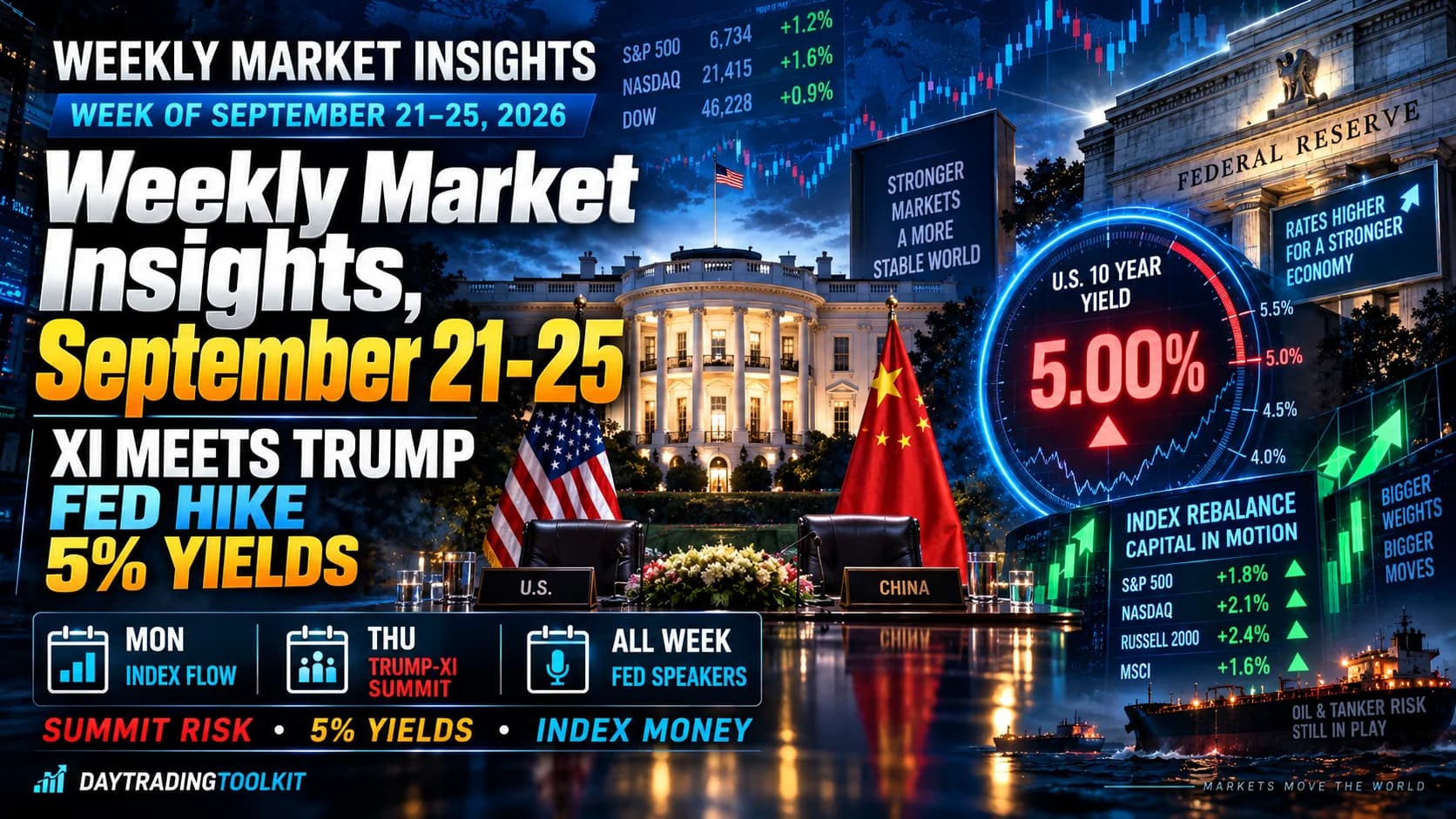
Xi Comes to Washington, the Fed's First Hike Lands, and Index Money Moves Before Monday's Open: Weekly Market Insights, September 21-25
Xi Jinping arrives at the White House Thursday for the first Chinese state visit since 2015, the Fed just hiked to 3.75-4.00 percent with more projected, the 10-year is sitting on 5 percent, and Bloom Energy and SanDisk join their new indices before Monday's open. The full catalyst map, watchlist, and scenario tree for September 21-25.
Market Analysis & Insights
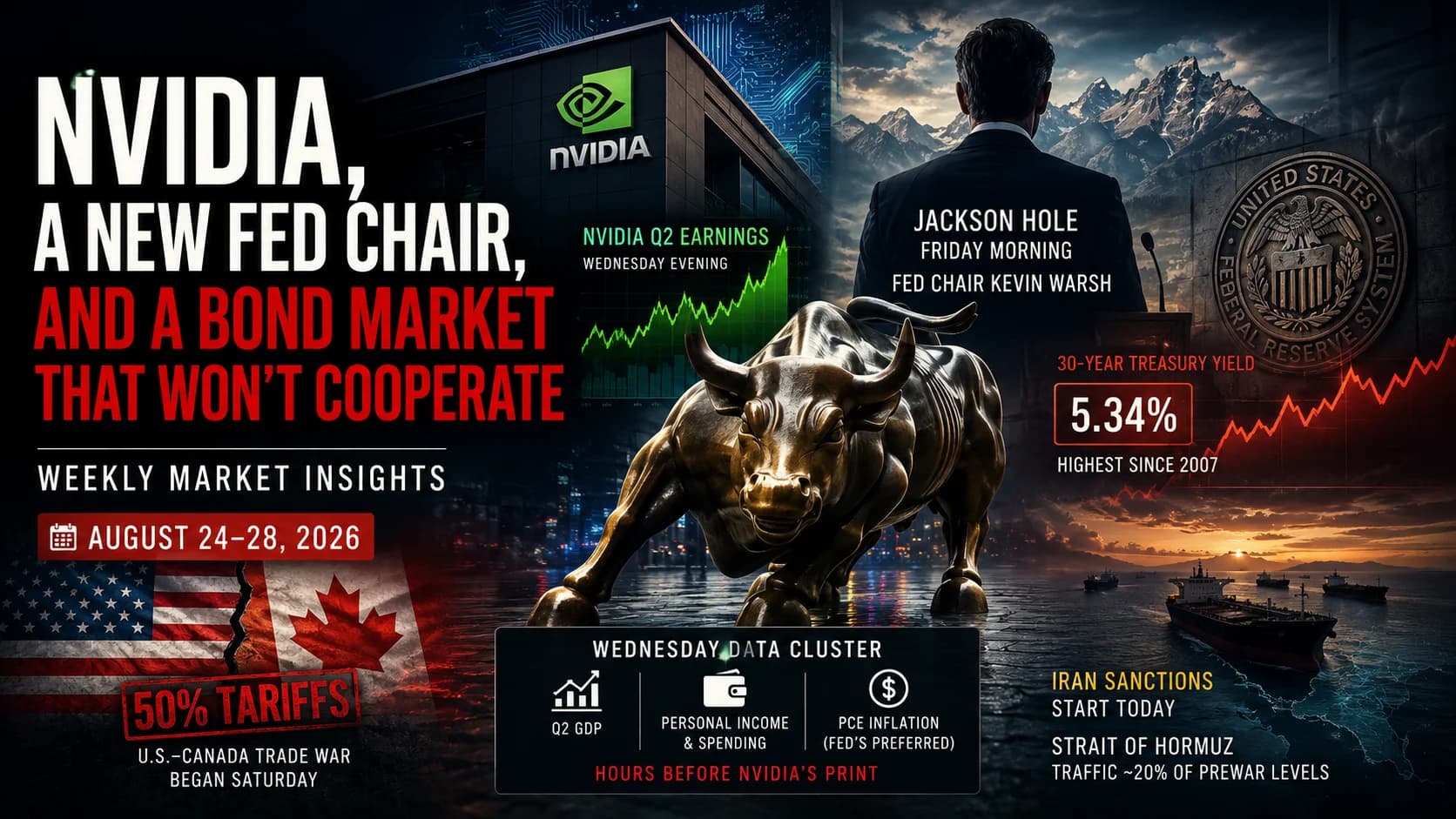
Nvidia, a New Fed Chair, and a Bond Market That Won't Cooperate: Weekly Market Insights, August 24-28
Warsh's first Jackson Hole speech, Nvidia's earnings, and fresh Iran and Canada shocks collide this week. The full Aug 24-28 catalyst map, stock watchlist, and scenario tree for traders.

Market Analysis & Insights
Two Wars, a Trade Fight, and CPI Still Has to Land Clean: Weekly Market Insights, September 7-11
A blowout jobs report already pushed rate-hike odds above 58%. Now a widening Middle East war and a new US-Canada trade fight collide with the last inflation data before the Fed's September 15-16 decision, while Nokia, Compass Pathways, Qualcomm, and Amgen all move on stories the calendar never saw coming.

Market Analysis & Insights
An AI Slowdown Call, a Live Fed Hike, and $108 Oil Collide in One Week: Weekly Market Insights, September 14-18
CME FedWatch has Wednesday's hike odds near 90 percent after a weekend AI slowdown call from Anthropic's CEO hit chip stocks, oil spiked past $107 on a Saudi pipeline shutdown, and Friday's quad witching sets up next Monday's S&P rebalance.
Comments
No comments yet. Be the first to share your thoughts.