
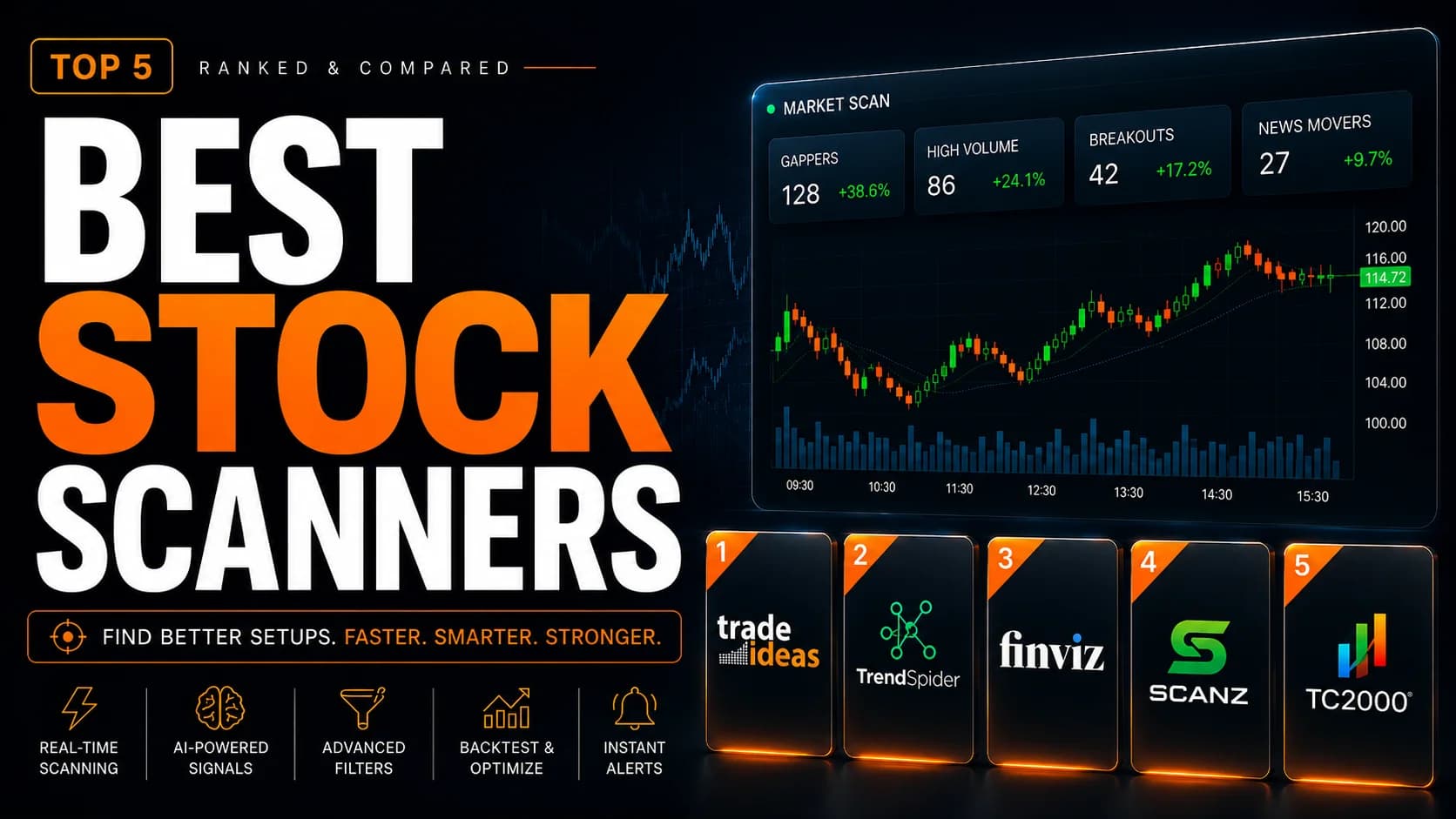
Most "best stock scanner" articles rank the same five tools nobody actually asked about, because half of them are paid placements dressed up as objective advice. That's the real reason this category feels so confusing. It's not that good scanners are hard to find — it's that most roundups aren't built to help you pick the right one for how you actually trade.
This guide is built differently. Five of the best stock scanners for day trading, ranked against each other on scan speed, filter depth, AI signal quality, and price — based on each platform's own documented features and pricing, not marketing copy. Where a tool earns its reputation, this guide says so plainly. Where it's the wrong fit for a specific kind of trader, that gets said just as plainly.
What is a stock scanner? A stock scanner is software that monitors the market in real time and alerts you when a stock meets specific criteria you set — price, VolumeVolume is the total number of shares (or contracts) traded during a given time period — it's the primary confirmation tool for all price action, because a price move accompanied by high volume indicates genuine market participation, while tRead definition →, volatility, technical setup, or news CatalystA catalyst is the specific event or news item that triggers unusual price movement in a stock — earnings reports, FDA decisions, analyst upgrades, acquisition announcements, product launches, and short squeeze setups are all catalysts. WithRead definition →. Unlike a static screener that returns a snapshot, a scanner keeps watching and fires the moment a condition triggers.
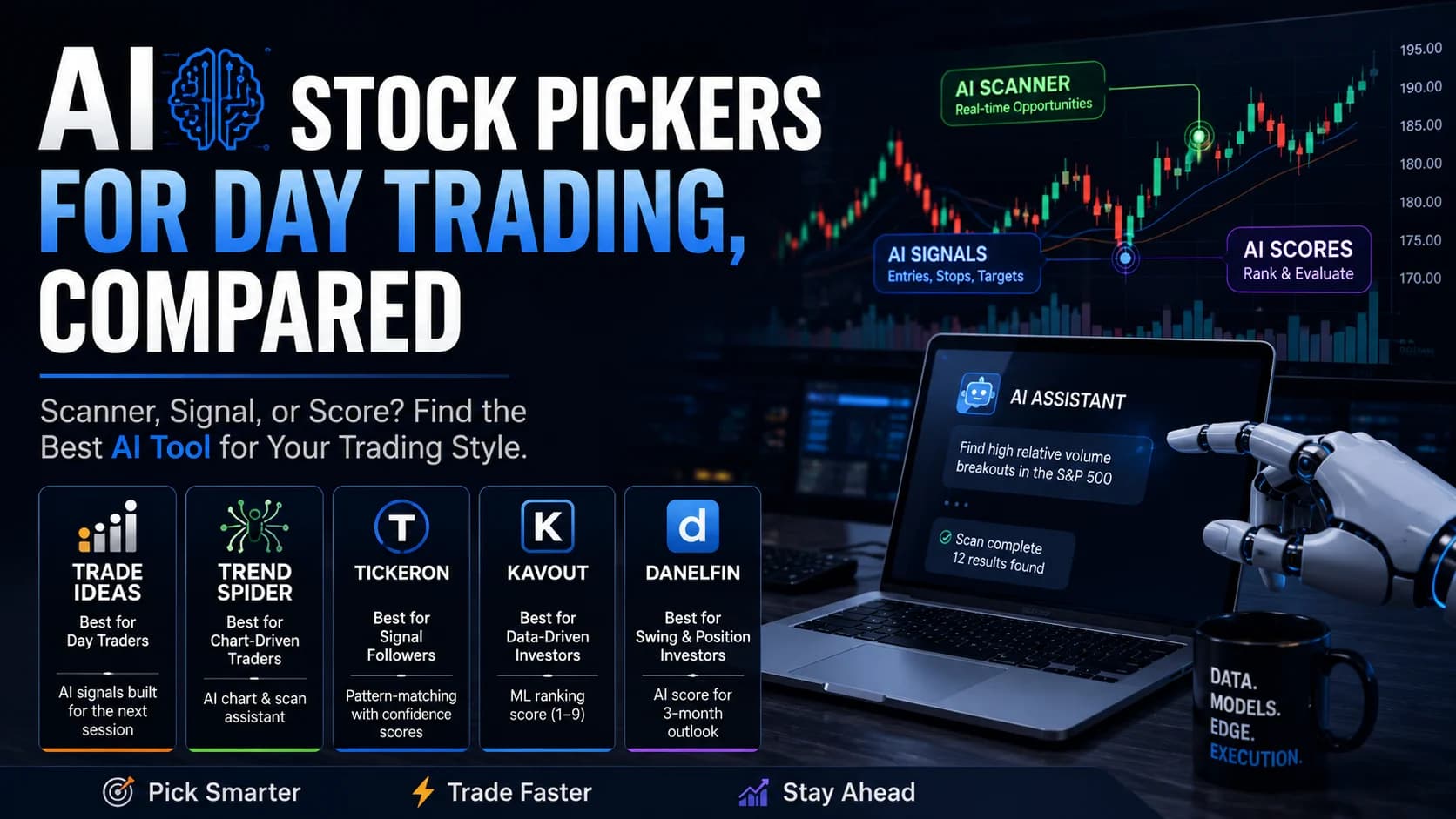
The short version: Trade Ideas is the best overall stock scanner for day trading if you want AI-generated signals and one-click execution alongside your scans — try Trade Ideas. TrendSpider is the pick if your workflow leans on automated chart analysis and no-code BacktestingThe process of running a defined trading strategy against historical price data to evaluate how it would have performed before risking real capital. A well-constructed backtest gives you a statistical baseline — win rate, profit factor, maxRead definition → as much as scanning — see current TrendSpider pricing. Finviz is the best free stock screener for day trading if you're not ready to pay for anything yet — read the full Finviz review. Keep reading for the full breakdown, plus two more scanners worth knowing about.
Here's how all five stack up at a glance:
- Scanner
- Trade Ideas
- Best For
- AI-assisted day traders
- Starting Price
- $127/mo*
- AI Signals
- Yes — Holly AI
- Real-Time Data
- Yes (tick-by-tick)
- Backtesting
- Yes — OddsMaker
- Get It
- Try Trade Ideas →
- Scanner
- TrendSpider
- Best For
- Systematic swing & automation
- Starting Price
- $89/mo
- AI Signals
- Yes — Sidekick AI
- Real-Time Data
- Yes
- Backtesting
- Yes — Strategy Tester
- Get It
- See Pricing →
- Scanner
- Finviz
- Best For
- Budget-conscious screeners
- Starting Price
- $39.50/mo
- AI Signals
- No
- Real-Time Data
- Elite tier only
- Backtesting
- Elite tier only
- Get It
- Read Review →
- Scanner
- Scanz
- Best For
- News & OTC momentum traders
- Starting Price
- $89/mo
- AI Signals
- No
- Real-Time Data
- Yes
- Backtesting
- No
- Get It
- Read Scanz Review →
- Scanner
- TC2000
- Best For
- Technical equities & options traders
- Starting Price
- Free–$49.99/mo
- AI Signals
- No
- Real-Time Data
- Yes (server-side)
- Backtesting
- Historical check only
- Get It
- Read TC2000 Review →
| Scanner | Best For | Starting Price | AI Signals | Real-Time Data | Backtesting | Get It |
|---|---|---|---|---|---|---|
| Trade Ideas | AI-assisted day traders | $127/mo* | Yes — Holly AI | Yes (tick-by-tick) | Yes — OddsMaker | Try Trade Ideas → |
| TrendSpider | Systematic swing & automation | $89/mo | Yes — Sidekick AI | Yes | Yes — Strategy Tester | See Pricing → |
| Finviz | Budget-conscious screeners | $39.50/mo | No | Elite tier only | Elite tier only | Read Review → |
| Scanz | News & OTC momentum traders | $89/mo | No | Yes | No | Read Scanz Review → |
| TC2000 | Technical equities & options traders | Free–$49.99/mo | No | Yes (server-side) | Historical check only | Read TC2000 Review → |
*Trade Ideas' $127/mo entry price is the Basic tier ("The Core"), which covers scanning and manual execution only. Holly's AI signals require the $254/mo Premium tier ("The Apex") — see the pricing breakdown before assuming the starting price includes the AI.
How We Ranked the Best Stock Scanners for Day Trading
Five criteria decide where each tool lands: real-time scan speed, filter and indicator depth, whether there's a genuine AI signal layer or just a manual filter list, how easy the platform is to actually use under pressure, and value relative to what you're getting for the price. None of these tools is "best" in a vacuum — a $127-a-month AI platform is a bad deal for someone trading twice a week, and a free screener is the wrong call for someone whose edge depends on catching a gapper in the first ninety seconds of the session.
That's the lens for everything below: not "which scanner is objectively superior," but "which scanner is built for which trader." If you already know your trading style, skip to the section that matches it. If you're still figuring that out, our introduction to stock scanners covers the fundamentals before you spend anything.
Most searches for the best stock screener for day trading and the best day trading scanners 2026 has to offer turn up this same short list — the comparison table above breaks down which of these five plays which role for your setup.
Trade Ideas: Best Overall Stock Scanner for Day Trading
Trade Ideas takes the top spot for one reason: nothing else on this list pairs real-time, tick-by-tick scanning with a genuine AI signal engine and a path straight through to execution. It's not just a stock scanner — it's a scan-test-simulate-execute pipeline, and that pipeline is why active traders keep paying for it.
The scanning engine processes every market tick on Trade Ideas' own servers against 500+ configurable filters — gaps, volume spikes, VWAPVWAP (Volume Weighted Average Price) is the average price a security has traded at throughout the session, weighted by volume — it's the most important intraday indicator for day traders, serving as a real-time measure of fair value and theRead definition → crosses, relative-strength shifts, breakouts. For Momentum TradingMomentum trading is an approach that identifies stocks moving strongly in one direction — usually driven by a catalyst, high relative volume, and expanding price range — and enters in that direction, riding the move for as long as momentum Read definition →, that's the whole game: alerts fire in real time, not on a 15-second browser refresh. It's also one of the stronger picks if you're hunting a best premarket scanner, since the same real-time engine runs through the pre-market session rather than waking up at 9:30.
Holly, the platform's AI engine, re-evaluates over 60 strategies every night and issues 5–25 intraday signals the next session — each with an entry, stop, and target already attached. What makes this the best AI stock scanner on this list rather than a rebranded filter list is transparency: Trade Ideas publishes Holly's full live trade log, losers included. And a July 2026 release, the AI Assistant, now lets you build a scan from a plain-English sentence instead of hand-configuring filters — a real fix for what used to be the platform's biggest complaint.
If your watchlist skews toward small caps, the 500+ filter library covers float, short interest, and relative volume conditions well enough to double as a best scanner for low float stocks pick, though Scanz (below) is the sharper tool if OTC and penny names are your entire focus.
The honest limits: Trade Ideas covers U.S. stocks and ETFs only, no futures or forex or crypto. The advanced features live in a Windows-native desktop app — Mac users need virtualization. And the billing policy is all sales final, no refunds, which makes the free trading room and Test Drive the smart way to evaluate before you commit a card number.
TrendSpider: Best Scanner for Automated Charting and Backtesting
TrendSpider earns the runner-up spot by being genuinely excellent at something Trade Ideas doesn't try to do: turning a scan result into a fully automated, backtested trading system without writing a line of code.
The Market Scanner itself takes plain-English prompts — "stocks breaking out of an ascending triangle with bullish unusual options activity above the 50-day SMA" becomes a running scan in seconds, courtesy of Sidekick, TrendSpider's AI assistant. Once a scan finds a candidate, the same platform draws the trendlines and support/resistance zones automatically, backtests the setup across decades of data through the Strategy Tester, and — if you want — deploys it as a live Strategy Bot that routes orders to 30+ brokers through SignalStack.
That combination is why TrendSpider is the strongest scanner pick for systematic swing traders and anyone building repeatable, rules-based strategies rather than reacting to the tape in real time. It covers U.S. equities, options, futures, forex, and crypto, which is broader asset coverage than anything else on this list.
The catch is price and ramp time. TrendSpider isn't cheap — Standard starts around $89/mo billed monthly ($47/mo annual), and most serious users land on Premium or Enhanced above that. Budget two to four weeks before you're getting full value out of the tool set, and know going in that the 14-day trial now costs $19–$49 rather than being free. The full TrendSpider review covers every tier in more detail.
Finviz: Best Free Stock Screener for Day Trading
Finviz wins this list's budget category for a simple reason: the free tier isn't a crippled trial. It's a genuinely useful 60+ filter screener with sector heat maps, insider trading data, and analyst ratings — all in a browser tab, no account required. If you're searching for the best stock scanner for beginners, this is where to start before spending a dollar.
The catch on the free tier is a 15-minute data delay, which is a real handicap for same-session intraday decisions but a non-issue for swing traders working multi-day setups. Finviz Elite removes the delay entirely — real-time quotes, pre-market and after-hours data (4:00 AM–8:00 PM ET), and a screener-based backtester — for $39.50/month, or $299.50/year (about $24.96/month, a 37% discount versus paying monthly).
What Finviz isn't is a real-time scanning engine in the Trade Ideas or Scanz sense — it's a screener you refresh, not a stream that alerts you the instant a condition triggers. Most traders who outgrow Finviz pair it with a dedicated scanner rather than replacing it: Finviz for the morning watchlist, something faster for intraday execution. Our guide to stock screener filters walks through building that morning watchlist step by step.
Scanz: Best Scanner for News-Driven and Small-Cap Trading
Scanz doesn't try to be an all-in-one platform. It does one thing — real-time scanning across 50,000+ stocks paired with one of the fastest news feeds in retail trading — and it does that one thing extremely well.
The news scanner aggregates 100+ sources, including live SEC filings, with keyword and ticker filtering that puts the catalyst and the price move in the same window. For traders whose edge depends on reacting to a headline before the crowd, that's a genuine advantage most competitors don't match — which is what makes Scanz the strongest pick here if you're looking for the best stock screener for penny stocks or thinly-traded OTC names specifically, since its coverage extends across NYSE, NASDAQ, AMEX, and OTC alike. It's also a legitimate best scanner for small cap stocks option for the same reason: dollar-volume data (not just share count) helps separate a real institutional move in a small name from a thin spike that reverses on you.
Scanz restructured its pricing in 2026 into three tiers: Starter at $89/month (one scan at a time), Pro at $199/month (unlimited scans, the plan most active traders actually want), and Ultra at $999/month for concierge scan-building and API access. There's no AI signal layer here — you build every scan yourself — and no backtesting engine, so validating an edge happens somewhere else. Scanz isn't currently a DayTradingToolkit affiliate partner, so there's no discount link to offer; the full Scanz review has the complete breakdown if the news-and-speed angle fits your trading style.
TC2000: Best Value for Scanning and Charting Together
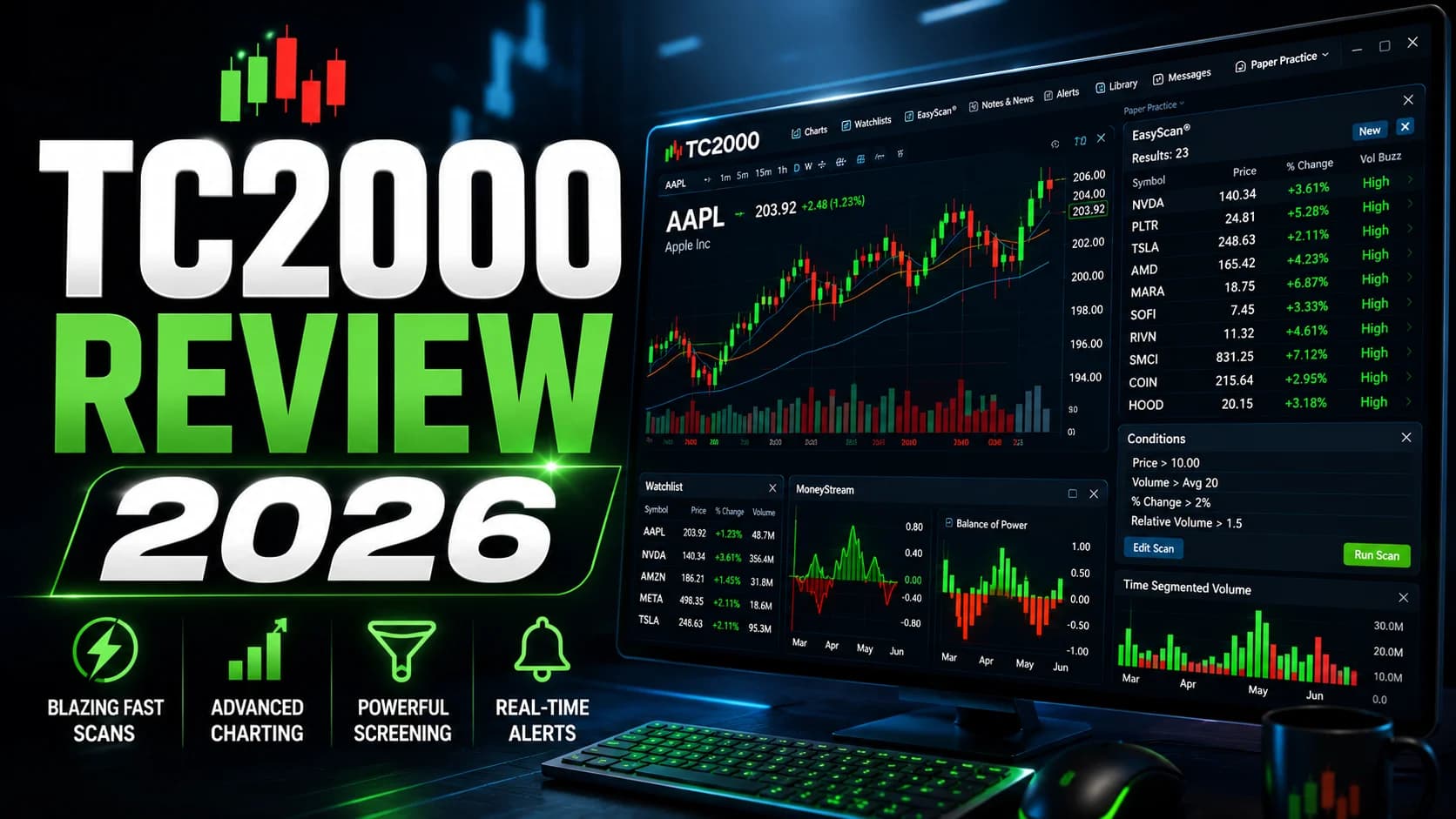
TC2000 has topped Stocks & Commodities Magazine's software rankings for 25 consecutive years running, which is a documented voting record, not a marketing claim. The reason: EasyScan, its server-side scan engine, processes the entire U.S. equity universe in roughly two seconds — genuinely one of the best real-time stock scanner engines available, and fast enough that the S&P 500 alone scans in under 160 milliseconds.
Where TC2000 pulls ahead of a pure scanner is the charting side bolted onto the same platform: 240+ indicators, 129+ fundamental variables you can overlay directly on a price chart, and PCF (Personal Criteria Formula), a proprietary scripting language that lets you build almost any technical condition as a custom scan, indicator, or alert — including gap-up and gap-down conditions, which makes it a solid best gap scanner pick for traders who want that logic built into a formula rather than a pre-set filter. Pre-built EasyScan templates cover the common setups (VWAP reclaims, volume surges, breakouts) so you're not starting from a blank formula on day one.
The pricing structure trips people up: base plans run free to about $49.99/month, but real-time equity data ($14.99/mo) and real-time options data ($9.99/mo) are separate add-ons. Active traders running both should budget $70–$100+/month total, not the advertised base price. TC2000 isn't a DayTradingToolkit affiliate partner either, so — same as Scanz — there's no discount to route you to, but the full TC2000 review covers the PCF learning curve and the rest of the fine print in depth.
Stock Scanner vs. Stock Screener: What's the Real Difference
A screener returns a snapshot — you set your criteria, hit search, and get a list of stocks matching those conditions right now. A scanner does the same filtering, but it keeps running continuously and alerts you the moment a new stock meets your criteria, even mid-session.
The practical difference shows up in how you use each one. Finviz's free tier is a screener: great for building a pre-market watchlist you'll actively monitor yourself. Trade Ideas and Scanz are scanners in the fuller sense: they watch the market for you and push an alert the instant a gap, breakout, or volume spike happens, which matters enormously if your strategy depends on catching a move in its first thirty seconds rather than noticing it five minutes later. Most experienced day traders eventually use both — a screener for the morning list, a scanner for real-time intraday alerts.
Which Stock Scanner Should You Actually Choose
If you want the platform to help generate ideas — not just filter for them — Trade Ideas is the one to start with. Holly's nightly-backtested signals and the new AI Assistant make it the most complete answer to "what scanner do day traders use" when the trader in question wants AI doing real work, not just a filter list with a chatbot bolted on front.
If you already have a strategy and want to systematize, backtest, and automate it, TrendSpider is the stronger fit — the Strategy Tester and Sidekick's plain-English scan-building are built for exactly that workflow, and the broker automation through SignalStack closes the loop end to end.
If you're not ready to pay for anything yet, or you're a swing trader who doesn't need same-session real-time data, start with Finviz's free tier and upgrade only when the 15-minute delay actually costs you a trade. And if speed on breaking news or thinly-traded OTC names is the entire job, Scanz's news scanner is hard to beat — just go in knowing you're buying a precision instrument, not an autopilot.
There's no universally correct best stock scanner for day trading — there's a correct pick for how you trade, and the five breakdowns above should make that call obvious.
Trade Ideas Is the Best Overall Pick — TrendSpider Is Best for Automation
For most active day traders, Trade Ideas is the strongest all-around stock scanner on this list — real-time scanning, a genuinely AI-driven signal engine in Holly, and a direct path to execution in one platform. TrendSpider is the better call specifically if your edge depends on systematic backtesting and automation rather than real-time discovery, and Finviz remains the smartest free starting point for anyone not ready to pay yet.
Active U.S. equities day traders who want real-time scanning and AI-generated trade ideas in a single platform.
Frequently Asked Questions
What scanner do day traders use?
There's no single tool every day trader runs — the right scanner depends on whether you want AI-generated signals (Trade Ideas), automated backtesting (TrendSpider), raw scanning-and-news speed (Scanz), or a free starting point (Finviz). Many experienced traders run two tools at once: one for pre-market research, one for real-time intraday alerts.
Key Takeaway: There's no universal answer — match the scanner to your trading style using the full comparison above.
Which stock screener should I use for day trading?
If you're building a screener-based routine rather than reacting to real-time alerts, Finviz's combination of speed, filter depth, and heat maps covers the research side well. Traders who need same-session data should budget for the Elite upgrade rather than relying on the free tier's 15-minute delay.
Key Takeaway: Start with Finviz free, upgrade to Elite once delayed data starts costing you real trades.
What is the best scanner for finding gappers?
Trade Ideas' 500+ filter library includes pre-built gap and volume-spike alerts that run through the pre-market session. TC2000's EasyScan ships pre-built gap-up and gap-down templates built on its PCF formula language. Scanz's session coverage runs from pre-market through after-hours specifically so gappers and late movers don't slip past.
Key Takeaway: Any of the three works — the deciding factor is whether you also want AI signals (Trade Ideas) or raw speed and news (Scanz).
Is a paid stock scanner worth the money?
The math changes with trading frequency. At $127–$254/month, Trade Ideas costs real money, but spread across daily active trading it works out to single-digit dollars per session — and the platform bundles real-time U.S. market data that costs $40–60/month separately on many rival tools. If you're trading twice a month, that same subscription is a poor use of capital better kept as trading funds.
Key Takeaway: Match the subscription cost to trading frequency, not to the feature list alone.
What is the difference between a stock scanner and a stock screener?
Screeners are built for research — building a watchlist, checking sector performance, reviewing fundamentals before the open. Scanners are built for real-time execution — catching a breakout, a volume spike, or a gap as it happens rather than noticing it after the fact.
Key Takeaway: Use a screener to plan your day and a scanner to catch what happens during it — see the full breakdown above.
What is the best scanner for small-cap and low-float stocks?
Small-cap and low-float trading depends on separating a real institutional move from a thin spike that reverses — Scanz's dollar-volume data (actual dollars traded, not just share count) is built for exactly that distinction, and its OTC coverage extends where some competitors stop. Trade Ideas covers the same ground with broader filter depth if you also want AI signals layered on top.
Key Takeaway: Scanz for pure small-cap/OTC speed, Trade Ideas if you also want AI-generated ideas across the same universe.
Is there a good free stock scanner for day trading?
None of the real-time, alert-driven scanners on this list (Trade Ideas, TrendSpider, Scanz) offer a meaningful free tier beyond a limited trial, because real-time data has a real cost to provide. Finviz's free tier is the exception — a genuinely complete screener, just without same-session speed.
Key Takeaway: Free works fine until intraday speed starts costing you trades — that's the signal to upgrade.
What is the best stock scanner for beginners?
Newer traders are usually still building a strategy, and a $127–$254/month platform amplifies a process that doesn't exist yet rather than replacing the need for one. Finviz lets a beginner build screening habits for free, and platforms like Trade Ideas explicitly recommend waiting until you can comfortably treat the subscription cost as risk capital.
Key Takeaway: Start free, build a strategy, then upgrade to a real-time scanner once the strategy — not the tool — is the limiting factor.
What is the best AI stock scanner for day trading?
TrendSpider also has a real AI layer through Sidekick and the AI Strategy Lab, but it's oriented toward chart analysis and machine-learning model training rather than daily trade signals. Holly is closer to what most traders picture when they search for an AI scanner: a system that surfaces specific, timed trade ideas each session.
Key Takeaway: Holly is genuine AI, not a rebranded filter list — see the Trade Ideas review for the full mechanics.
How much does a stock scanner cost?
Finviz Elite starts at $24.96/month annual. TrendSpider's Standard tier runs about $47/month annual. Scanz Pro is $199/month. TC2000's effective cost with real-time data add-ons lands around $70–$100+/month. Trade Ideas runs $89–$178/month on annual billing. Check the deals page for current discounts before subscribing to any of them.
Key Takeaway: Price scales with real-time data and AI features — decide what you actually need before comparing sticker prices.
Can you use more than one stock scanner at the same time?
Each tool on this list has a different core strength, and stacking two rarely creates redundant cost if the roles don't overlap. The most common combination pairs a research/screening tool for building the day's watchlist with a real-time alert engine for execution during market hours.
Key Takeaway: Two focused tools often beat one that tries to do everything — pick one for research and one for real-time alerts if your budget allows it.