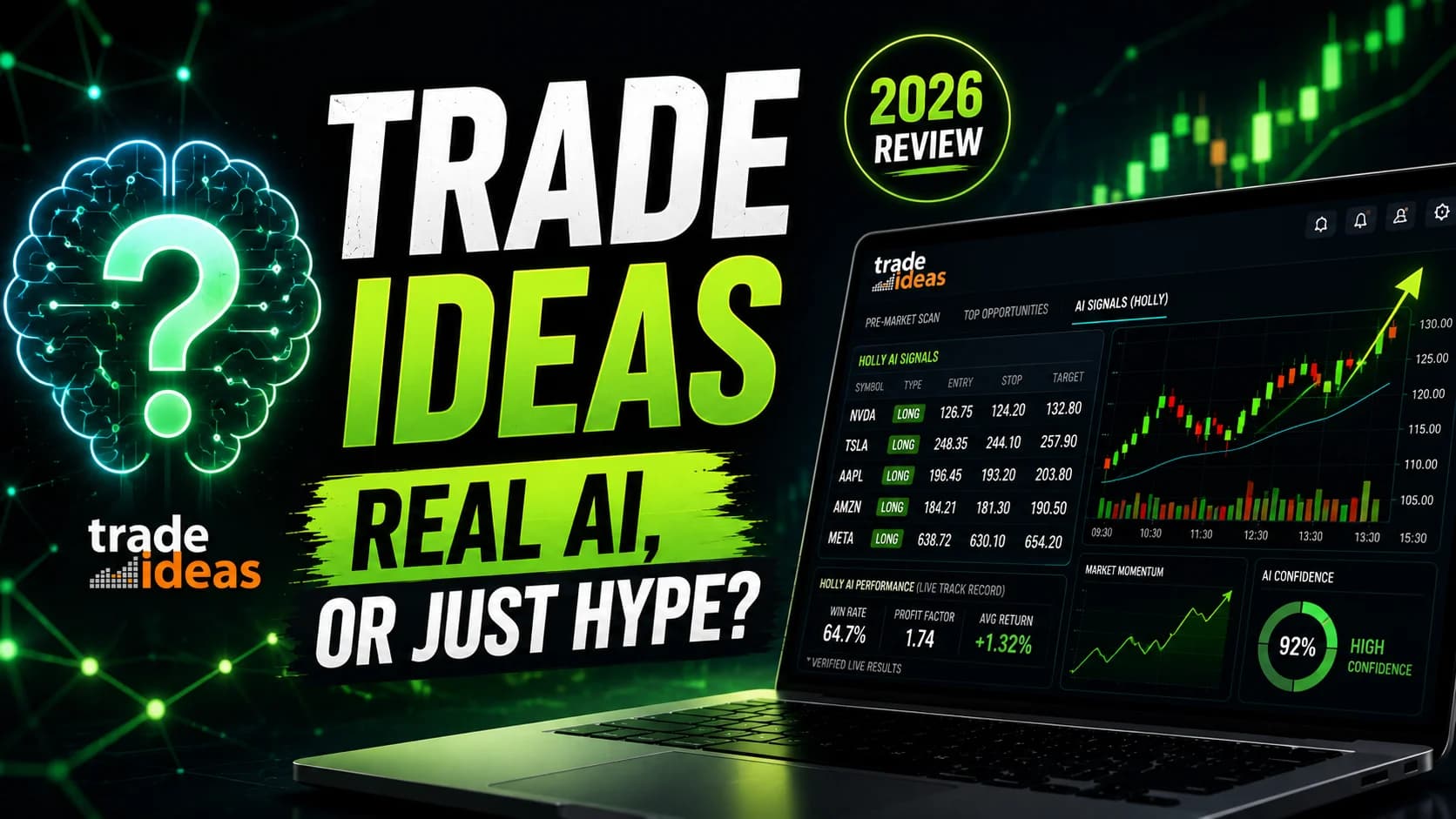
Trade Ideas Review 2026: Real AI, or Just Hype?

In this article13 sections
Almost every trading tool bolted the word "AI" onto its homepage this year. Most of it is a marketing sticker on the same rules-based screener that's existed for a decade — a few if-then filters wearing a robot costume. So the useful questions about Trade Ideas were never "does it have AI." They're the two that actually decide a purchase: is the AI doing real work, and is that work worth up to $2,136 a year to you specifically?
This review answers both — and unlike most Trade Ideas reviews, it doesn't stop at the feature tour. It's built on the official documentation, the platform's published performance record, verified pricing and billing policies, and a full library of deep-dive research this site maintains on every major component. Where Trade Ideas earns its price, this review says so plainly. Where it doesn't — and there are real cases where it doesn't — it says that too, because a recommendation you can't trust on the cons isn't worth anything on the pros.
One more thing worth saying up front: 2026 changed this platform. A July release quietly killed the single most repeated criticism in Trade Ideas' history, and this review treats that development with the weight it deserves.
Trade Ideas Review
A genuinely AI-driven discovery, testing, and execution platform with unmatched real-time scanning — now meaningfully more accessible since the AI Assistant release, though still priced strictly for active traders.
Pros
Strengths- Holly AI surfaces 5–25 intraday trade ideas a day — each with a defined entry, stop, and target — and Trade Ideas publishes her full live trade log, losing trades included
- Real-time, tick-by-tick scanning across the entire U.S. market against 500+ filters, a speed browser-based scanners can't match
- The new AI Assistant (July 2026) builds scans from plain-language descriptions — typed or by voice — collapsing the learning curve that was historically the platform's biggest weakness
- A complete no-code pipeline competitors don't match: scan → OddsMaker backtest → live-data simulator → automated execution
- Direct execution via Brokerage Plus across Interactive Brokers, E*TRADE, TradeStation, and Alpaca
- All U.S. real-time market data bundled for non-professional subscribers — a $40–60/month line item on many rival platforms
- A free, no-credit-card live trading room runs every market day — evaluate the platform in action before paying a cent
Cons
Trade-offs- Priced for active full-time traders — hard to justify if you trade only a few times a month
- Covers U.S. stocks and ETFs only — no futures, forex, options chains, or crypto
- The advanced features live in a Windows-native desktop app; Mac users need virtualization
- All sales are final — Trade Ideas offers store credit or exchanges, never refunds, which makes your evaluation sequence matter
- A learning curve remains for window management and workflow design, even with the Assistant handling scan-building
What Is Trade Ideas?
What is Trade Ideas? Trade Ideas is an AI-powered market intelligence platform for U.S. stock traders. Founded in 2003, it combines real-time scanning across 500+ filters, the Holly AI signal engine, a conversational AI Assistant, charting, no-code backtesting, paper trading, and direct broker execution into one system — built to find, test, and act on intraday setups faster than manual analysis allows.
Here's the mistake most first-time buyers make: they file Trade Ideas under "stock scanner" and compare its price to a $40 screener. That comparison guarantees you'll think it's overpriced, because you're measuring it against one-fifth of what it does.
The scanner is the foundation. What's built on top — two generations of AI signal engines, a conversational interface, the OddsMaker backtester, a live-data simulator, and direct broker execution — is where the value (and the cost) actually lives. The honest way to evaluate the platform is as a workflow: it finds the setup, tests whether the setup has been worth trading, lets you rehearse it without risk, and executes it when you're ready. Whether that full chain is worth the price depends entirely on how you trade, and this review maps exactly who lands on each side of that line. First, the part everyone's actually asking about: the AI.
How the AI Actually Works (Holly and the Money Machine)
This is the section that matters most, because it's where Trade Ideas separates from the pack of tools that just relabeled their screener as "AI."
Holly is the engine that built the platform's reputation. Strip away the marketing and here's the mechanic: every night after the close, Holly runs over 60 proprietary algorithms against recent market data through thousands of simulations, looking for which strategies have lined up with the kind of conditions setting up for the next session. When the market opens, she issues real-time signals — usually 5 to 25 trade ideas across the day — each with a specific entry price, stop-loss, and target. No configuration required. She trades only her own strategies, they're not customizable, and she closes everything before the bell.
The single most important thing to understand about Holly is what she is and isn't. She's a probability engine, not a prediction machine. A signal means a setup resembles ones that have historically behaved a certain way — not that the trade will work. And here's the detail that earns Trade Ideas genuine credibility: it publishes Holly's complete live trade record, including the losers. Most "AI signal" services show you a highlight reel of winners and bury everything else. The fact that you can see Holly's misses is the best reason to take her seriously — and the clearest reminder that your own risk management, not the AI, is what keeps you solvent. For the full mechanics of her three variants (Holly Grail, Holly 2.0, and Holly Neo) and how traders use each, the Holly AI explainer goes deep.
The Money Machine is the second-generation layer, and it's a different beast. Where Holly flags setups for you to act on, the Money Machine is end-to-end: it identifies the strongest momentum names in real time, then handles entry, position sizing, stop-loss, exit timing, and rotation automatically through Brokerage Plus. You pick a direction — upside, downside, or both — and it keeps you positioned in the market's top momentum candidates, swapping a fading name for a fresher one as conditions shift.
It's powerful and it's exactly where caution belongs. Automation amplifies a sound process — and amplifies a flawed one just as fast. Trade Ideas seems to know this: the Money Machine runs in a full simulation mode (on live data) for every Premium subscriber, with live execution rolling out in waves rather than flipping on for everyone at once. The right way to use it is the slow way: weeks in simulation before a single real dollar is involved. The full breakdown is in the Money Machine walkthrough.
And this isn't a niche tool with a handful of users testing the AI — Trade Ideas reports its subscribers traded 55.2 million shares in May alone. That's the signal of an active, heavily-used platform, not a thin signal service coasting on the "AI" label.
The AI Assistant: The Biggest Objection, Answered
For years, the most persistent criticism of Trade Ideas had nothing to do with what the platform could find. It was about what it took to ask. Building a custom scan meant working through a GUI configuration editor, filter by filter — powerful, but slow to learn, and the single most repeated complaint in nearly every Trade Ideas discussion ever published. Reviews were still citing "no plain-language scan entry" as a core weakness weeks before it stopped being true.
In July 2026, Trade Ideas shipped the AI Assistant — a conversational tool, sitting at the top of the New menu, that builds alert windows and top lists from plain-language descriptions. Typed or spoken. "Show me stocks under $20, up at least 4% today, on three times normal volume" becomes a working, streaming scan window in seconds. It also runs in reverse: paste any existing scan configuration and it explains the settings in plain English, which turns the platform's enormous library of shared community scans into study material instead of black boxes.
Two clarity points, because confusion here is guaranteed. First, the Assistant is not Holly — it generates no signals and makes no market judgments. Holly hands you her ideas; the Assistant builds what you describe. Second, it doesn't remove the 500+ filter library — advanced users still hand-tune everything — it removes the requirement to master the library before using it.
The bottom line for a buyer: the "it's too hard to learn" objection, the one that legitimately stopped capable traders from subscribing for years, is now mostly historical. This review's Ease of Use score moved from 6.8 to 7.4 on the strength of this release, and the full breakdown of what the Assistant can and can't do is in the AI Assistant guide.
Real AI vs. AI Hype: Where Trade Ideas Lands
Because "AI" is the most abused word in trading software right now, it's worth being precise about which side of the line Trade Ideas sits on.
A lot of what gets sold as AI trading is a fixed set of rules with a chatbot pasted on the front — the logic never changes, it just sounds futuristic. Trade Ideas is in the smaller group where real machine-driven work is happening: nightly re-evaluation across dozens of strategies, simulation at scale, signal selection that adapts to recent conditions, and now a natural-language interface layer on top. That doesn't make it magic. It makes it a legitimately AI-driven tool rather than a rebranded screener.
If you're weighing it against the broader field, the Best AI Tools for Day Traders roundup separates the real machine learning from the branding across the whole category, and the complete AI day trading guide covers how these tools fit a real workflow. Two honest counterweights worth reading before you spend anything: the 7 AI trading risks every buyer should know, and the blunt case for why AI won't make you a better trader on its own. The AI is a force multiplier — it multiplies whatever edge you bring, including a negative one.
The Scanning Engine: Still the Moat
The AI gets the headlines, but the scanning engine is the moat — the thing no competitor has matched in two decades.
It processes every market tick on institutional-grade servers: when a stock meets your criteria, the alert fires in real time, not on a 15- or 30-second refresh. For momentum trading, that difference is the whole game — the setups that matter most are precisely the ones that don't wait. Over 500 configurable alert types cover essentially any objective condition: gaps, volume spikes, breakouts, VWAP crosses, relative-strength shifts, opening-range breaks. The Channel Bar layers 40+ pre-built professional workspaces on top for traders who don't want to start from a blank screen — and per the platform's own onboarding design, nobody should.
Don't take the depth on faith — inspect it. Our five momentum scan recipes publish exact alert-and-filter stacks built from the official documentation, which doubles as a preview of what you'd actually be working with. And the first week on the platform has a mapped path now: the setup guide takes a new subscriber from download to first custom scan, including the installation gotchas and the Mac options.
Testing and Execution: The Pipeline Nobody Else Has
Here's the platform's least-marketed, most defensible advantage — the part that turns four features into a system.
The OddsMaker is the no-code backtester: right-click any scan, and it tests the strategy against roughly the past three months of market data, returning win rate, profit factor, average winner versus loser, equity curve, and drawdown. It lets you kill a bad idea before it touches real capital — the discipline most traders skip because other tools make it too hard. It has honestly documented limits (1-minute candle resolution, no spread modeling, not built for scalping-speed strategies), and the OddsMaker review covers both the power and the fine print.
Brokerage Plus closes the loop: one-click and drag-and-drop order entry from charts and scanner alerts, position management, and fully automated strategy execution — connected to Interactive Brokers, ETRADE, TradeStation, or Alpaca. It ships with a real-time simulator that runs the identical execution environment against live market data, which is both the best free rehearsal space in retail software and the mandatory middle step before any automation. The broker-specific requirements (IBKR needs a Pro account; ETRADE needs a data plan) and the automation guardrails — strategies must be re-enabled daily, hard-capped at 100 trades — are detailed in the Brokerage Plus review.
Chain it together and you get the retail version of how quantitative firms actually work: scan → backtest → simulate → execute, with no strategy touching capital until the data has voted on it twice. No coding anywhere in the chain. This pipeline is the strongest single argument for the platform — and it barely appears in Trade Ideas' own marketing.
Who Trade Ideas Is Best For
"Is it worth it" depends entirely on who's asking, and the full profile-by-profile math — cost per trading day, per trade, and against your account size — lives in the dedicated worth-it analysis. The short version:
Active day traders (several sessions a week) are the core audience. Real-time scanning is the daily workhorse, Holly's signals and one-click execution are built for exactly this day, and the per-trade overhead math collapses to pocket change at this frequency. Premium is the tier that makes sense here.
Systematic and semi-automated traders may get the most leverage of anyone. If you think in rules and statistical edges, the scan-test-simulate-automate pipeline is the most complete no-code version of it in retail software — this is the profile where the platform functions as a system rather than a subscription.
Swing traders can use it, but the cost-benefit is tighter — you don't need tick-by-tick processing for multi-day holds. If Trade Ideas at all, The Core plus the Weekly Swing Picks add-on is the honest configuration, and a cheaper screener genuinely covers many swing traders.
Newer traders still building a foundation should wait — and this review means that. Trade Ideas amplifies an existing process; it can't substitute for one. Its own support materials say plainly that traders who can't comfortably treat roughly $8 a day as risk capital shouldn't subscribe yet. Start with the free tier and the trading room, build a real strategy, and run the honest checklist of 5 signs you're not ready before spending anything. Not ready isn't a verdict — it's a sequence.
One outdated belief to clear up, because it still shapes buying advice everywhere: you no longer need a $25,000 account to actively day trade. FINRA eliminated the Pattern Day Trader minimum effective June 4, 2026, replacing it with a risk-based framework starting near $2,000 — the full story is in the PDT elimination guide and the intraday margin explainer. The legal barrier dropped; the tool-to-account-size math didn't move an inch.
Trade Ideas Pricing (And the Fine Print That Matters)
Three tiers, and the structure pushes toward annual billing:
- Plan
- Free (Par)
- Monthly
- $0
- Annual
- —
- Effective Monthly (Annual)
- Delayed data; explore the interface only
- Plan
- Basic — "The Core"
- Monthly
- $127/mo
- Annual
- $1,068/yr
- Effective Monthly (Annual)
- $89/mo
- Plan
- Premium — "The Apex"
- Monthly
- $254/mo
- Annual
- $2,136/yr
- Effective Monthly (Annual)
- $178/mo
| Plan | Monthly | Annual | Effective Monthly (Annual) |
|---|---|---|---|
| Free (Par) | $0 | — | Delayed data; explore the interface only |
| Basic — "The Core" | $127/mo | $1,068/yr | $89/mo |
| Premium — "The Apex" | $254/mo | $2,136/yr | $178/mo |
The Core gives you the complete manual workflow: real-time scanning with the full filter library, charting, paper trading, manual Brokerage Plus execution, and the trading room. The Apex adds the machines that decide, test, and act: all three Hollys, the Money Machine, OddsMaker, Smart Risk Levels, and auto-trading. The tier decision reduces to one question — will you actually use the AI signals or the backtester? If yes, The Apex is non-negotiable; if you'll trade your own scans manually, The Core is honestly sufficient. Three optional add-ons (AVWAP and GoNoGo at $49/month, Weekly Swing Picks at $17/month) stack on either tier, and the complete tier-by-tier and add-on breakdown is in the pricing guide.
Is $178 a month cheap? No. But two structural facts change the math. All U.S. real-time market data is bundled for non-professional subscribers — a $40–60/month line item on many rival platforms — and annual billing runs roughly 30% below monthly ($456 saved on The Core, $912 on The Apex).
Now the fine print most reviews skip, and buyers deserve to know before checkout. All sales are final — Trade Ideas' published policy offers store credit or exchanges, never refunds. And discount codes apply to the first installment only, with subscriptions renewing at the standard rate. Neither is a scandal; both should shape your strategy: evaluate before you buy, start monthly before annual, and budget on the renewal price. This review deliberately doesn't reprint promo codes — they rotate, and stale codes waste your checkout. The current working codes, the seasonal sales Trade Ideas runs several times a year, and the deepest available stack live on the deals page, with the full savings methodology in the maximum discount guide. There's almost always a code worth applying — check before you subscribe.
What the Research Likes
A few things genuinely set Trade Ideas apart, named specifically rather than in generalities:
- Holly's record is transparent. The full live trade log, losers included — rare for an AI signal service, and it lets you judge the tool on the whole picture instead of a curated highlight reel.
- The scanning speed is a different category. Server-side, tick-by-tick processing beats any browser screener refreshing on a timer, and for momentum trading those seconds are the whole game.
- The pipeline is real. Discovery, backtesting, simulation, and execution genuinely live in one place — the no-code quant workflow no single competitor replicates.
- The Assistant killed the fair criticism. The learning-curve objection was legitimate for years; as of July 2026 it's mostly historical, and being early to say so plainly is exactly the kind of update this review exists for.
- The company is unusually blunt about fit. A vendor that publishes "if you can't afford the risk capital, don't subscribe" in its own support materials is doing your qualification work for you.
Limitations
No tool is right for everyone, and a review that pretends otherwise isn't worth reading.
- US equities only. No futures, forex, options chains, or crypto — if you trade anything outside U.S. stocks and ETFs, Trade Ideas has zero coverage for it. The single biggest functional limit, and the fastest legitimate "no."
- Windows-native desktop app. The advanced features live there, so Mac users need Parallels or similar — extra cost and setup friction — and the web version, while it carries the full scanning library, lacks Brokerage Plus, Holly, and the OddsMaker.
- No refunds. The all-sales-final policy is published and unambiguous, and it raises the stakes on your evaluation sequence — which is exactly why the free-first decision path below exists.
- A learning curve remains. The AI Assistant collapsed the scan-building portion — the historically brutal part — but window management, layout design, and execution setup still take genuine screen time. Budget a structured first week (the setup guide provides one), not an afternoon.
- The crowding question. When thousands of subscribers get the same Holly signal at once, the initial rush can affect fills — the most legitimate criticism of the platform that remains standing. It's manageable with timing (taking the pullback rather than the first spike), but it's real and worth knowing before you buy.
How to Decide: The Path That Risks Almost Nothing
Given the no-refund policy, the sequence matters. Here's the path this review recommends, in order, with what each step costs:
Step 1 — Watch it work, free. The free live trading room streams every market day, no credit card, with the platform in live use by a professional educator. A few sessions here answers "is this how I want to trade?" at zero cost.
Step 2 — Self-qualify honestly. Run the 5-signs checklist. If it flags you, stop — the platform will still be here in six months, and the subscription money is worth more as trading capital right now.
Step 3 — Test Drive the real thing. When Trade Ideas runs one of its periodic Test Drives, a small one-time fee unlocks full Premium — Holly, OddsMaker, the Assistant, everything — for about two weeks. That's enough time to build your actual scans, backtest them, and judge the platform against your own trading rather than anyone's review, this one included.
Step 4 — Subscribe deliberately. Pick the tier with the one-question test (AI stack or not), grab whatever code is currently live on the deals page — codes stack on top of annual savings, and there's almost always one running — and consider starting monthly, earning your way to the annual discount once the platform has proven it belongs in your process. When you're ready, you can get started with Trade Ideas here.
That sequence costs a few hours and at most a Test Drive fee — and it converts this purchase from a leap of faith into a decision your own trading already validated.
How Trade Ideas Fits a Modern AI Trading Stack
In practice, very few serious traders run Trade Ideas alone. The common pattern is Trade Ideas for discovery, testing, and execution, paired with a dedicated charting platform for deep analysis — the scanner finds it, the chart confirms it, Brokerage Plus executes it. For the head-to-heads, this site maintains direct comparisons with TradingView and the full Trade Ideas alternatives roundup. And if you're assembling an AI-aware toolkit rather than buying a single product, the ChatGPT vs. Gemini vs. Claude for traders comparison covers where general-purpose AI fits alongside a purpose-built platform like this one.
The Complete Platform — If You'll Actually Use It
Frequently Asked Questions
Does Holly AI actually work, or is it just marketing?
Each night Holly re-evaluates over 60 strategies against recent market conditions and issues 5–25 intraday signals the next session, each with an entry, stop, and target. The reason to take it seriously isn't a promise of wins — it's that Trade Ideas publishes Holly's full live trade log, losers included, so you can judge the real hit rate yourself. Like any signal system, results vary with market conditions, and your own risk management still decides whether you come out ahead.
Key Takeaway: Holly is real AI that gives you a researched starting point, not a crystal ball — see the Holly AI explainer for how her three variants differ.
Is Trade Ideas just an expensive stock scanner?
This was a fair criticism years ago. Today, Trade Ideas is a full discovery-to-execution workflow: the scanner finds the setup, OddsMaker tests it, the simulator rehearses it, and Brokerage Plus executes it — with two AI systems layered across the top. The flip side remains true: if you only use the scanner and ignore the rest, you are overpaying, and a cheaper screener deserves your consideration.
Key Takeaway: Judge the price against the full pipeline it replaces, not against a standalone screener — the alternatives roundup maps the cheaper substitutes honestly.
What is the new Trade Ideas AI Assistant?
It's a different system from Holly: the Assistant generates no trade signals and makes no market judgments. Its job is translation — your description becomes a working scan, and any pasted configuration becomes a plain-English explanation. For traders deterred by the platform's configuration editor, it's the most significant accessibility change Trade Ideas has shipped in years, and the reason this review's Ease of Use score rose.
Key Takeaway: The Assistant builds scans; Holly generates signals — the full breakdown is in our Trade Ideas AI Assistant guide.
If everyone gets the same Holly signal, doesn't the edge disappear?
When thousands of subscribers receive an alert simultaneously, the initial rush can move price and affect fills. This is the most legitimate criticism of any widely-used signal service. The practical workaround is to treat the signal as a heads-up rather than a market-order trigger — wait for the pullback, confirm on your own chart, and size accordingly.
Key Takeaway: The crowd effect is manageable with discipline, but it's a genuine reason not to blindly market-buy every alert.
Can you make money with Trade Ideas?
It's a force multiplier: it amplifies whatever edge you bring. With a sound strategy and proper risk control, it helps you act faster and more consistently. Without an edge, it helps you lose money faster with more professional-looking tools. The platform creates efficiency, not profitability — and any review or marketing that promises otherwise is selling you something.
Key Takeaway: Trade Ideas is a professional tool, not a money printer — and AI won't make you a better trader on its own.
How is Trade Ideas' AI different from the newer "AI trading tools"?
The distinction that matters is whether the logic adapts or just sounds futuristic. Trade Ideas re-runs and re-selects strategies against recent conditions rather than executing a static rulebook, and the 2026 Assistant added the conversational layer competitors claimed it lacked. That doesn't make it better for everyone — but it's not marketing veneer.
Key Takeaway: For the full field, the Best AI Tools roundup separates real machine learning from the hype.
Is Trade Ideas legit or a scam?
A platform doesn't survive two-plus decades integrated with brokers like Interactive Brokers, E*TRADE, and TradeStation if it isn't legitimate — those firms run their own due diligence before integration. The free trading room offers daily, public transparency into how the tools perform in real time, the scale is real (subscribers traded 55.2 million shares in May alone), and the company's own materials explicitly warn users that anyone asking to trade on your behalf is a scam.
Key Takeaway: Trade Ideas is expensive and has a learning curve, but it's unquestionably legitimate — verify it yourself in the free trading room.
Does Trade Ideas work for swing trading?
Multi-day holds don't need tick-by-tick processing, which removes the platform's headline advantage from the equation. Daily-timeframe scanning and backtesting retain real value, but many swing traders are genuinely better served by a cheaper screener — the worth-it analysis does that comparison without flinching.
Key Takeaway: Swing traders should start the comparison at cheaper tools and justify upward, not the reverse.
Does Trade Ideas support futures, forex, or crypto?
This is the platform's single biggest functional limitation. Its depth in U.S. stocks is unmatched precisely because that's all it focuses on, but if you trade other markets, you'll need separate tools for them. Don't buy Trade Ideas expecting any coverage outside U.S. equities.
Key Takeaway: US stocks and ETFs only — a strength for equities traders, a dealbreaker for everyone else.
Does Trade Ideas have a mobile app?
There's no full-featured dedicated mobile app. The web-based version handles scanning, charting, and monitoring on the go — it carries the complete alert and filter library — but the AI systems, backtesting, and integrated execution live on the Windows desktop platform. Mac users run it through virtualization, and the setup guide covers every route.
Key Takeaway: Plan to use Trade Ideas primarily on a desktop; the web version is for monitoring, not full trading.
How much does Trade Ideas cost, and are there discounts?
All paid plans include real-time U.S. market data for non-professional subscribers at no extra charge — a $40–60/month value most platforms bill separately — and three optional add-ons run $17–$49/month. One policy detail worth knowing: codes discount the first installment only, and subscriptions renew at the standard rate.
Key Takeaway: The full tier breakdown is in the pricing guide, and the current working codes are always on the deals page.
Can I get a refund if Trade Ideas isn't for me?
This is the single policy that should most shape how you buy: evaluate through the free trading room and a Test Drive before subscribing, start monthly rather than annual until the platform has proven itself in your actual trading, and set a reminder for your renewal date. None of this is difficult — it just rewards the deliberate buyer over the impulsive one.
Key Takeaway: Treat every payment as non-recoverable and follow the decision path above — it exists precisely because of this policy.
Do I need a $25,000 account to use Trade Ideas?
That outdated requirement still appears in a lot of buying advice, so it's worth correcting: you can actively day trade with far less capital now. What hasn't changed is the practical question of whether a premium subscription makes sense for a small account — if the cost is a meaningful slice of your capital, it's too early, no matter what the regulations allow.
Key Takeaway: The $25K barrier is gone — see the PDT elimination guide — but match the tool to your account size and trading frequency.
Disclaimer
Was this helpful?
Be the first to weigh in

Written by
Kazi Mezanur RahmanFounder, independent researcher, and editor of DayTradingToolkit. A one-person publication focused on risk-first trading education and documented tool research. He trades his own capital as a retail trader and combines personal market experience with systematic primary-source research.
Keep Reading
Tools & Tutorials
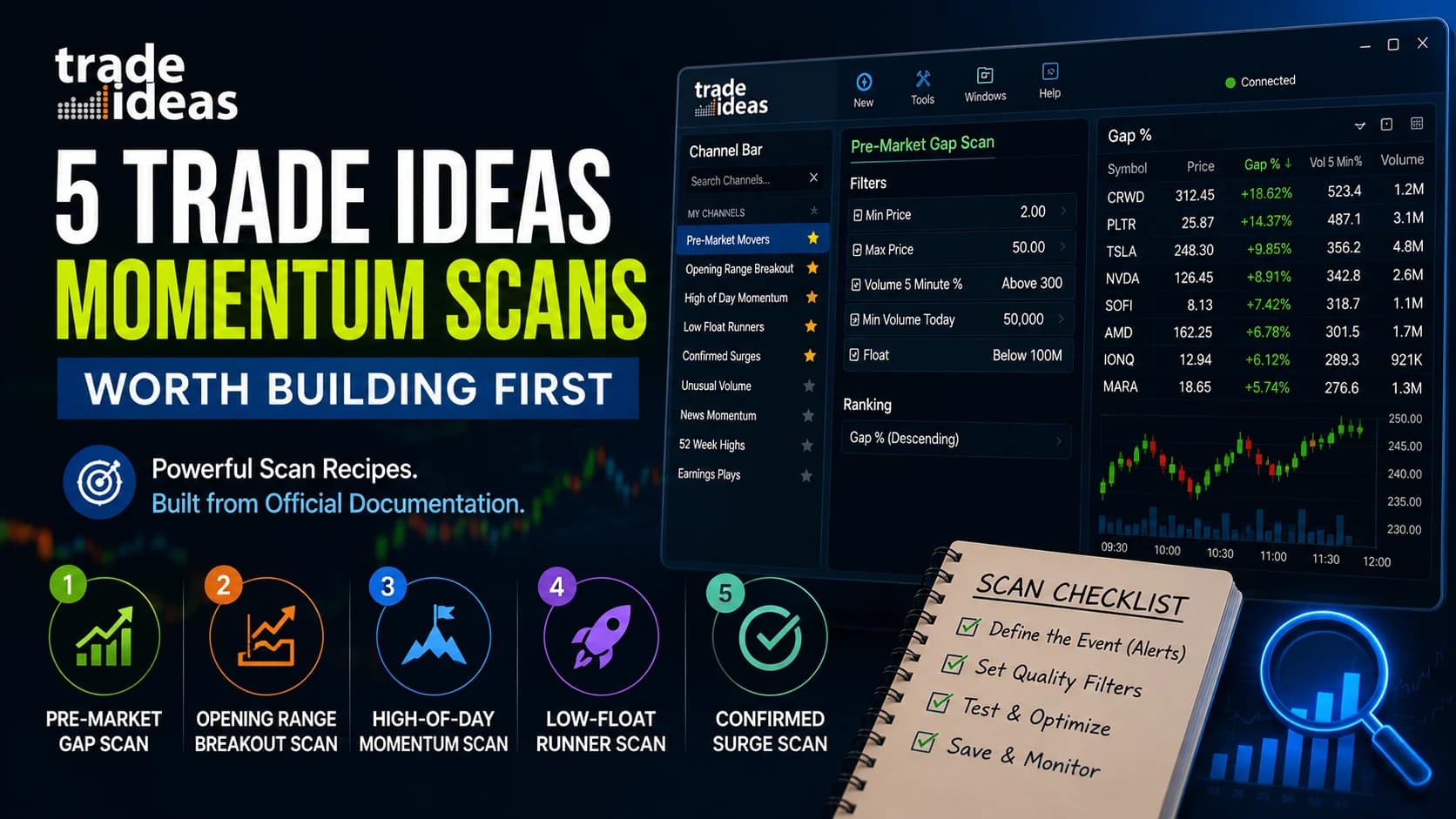
Best Trade Ideas Scans for Momentum Traders: 5 Recipes Worth Building First
Five complete momentum scan recipes for Trade Ideas — exact alerts, filters, and starting values built from the official documentation, plus the OR/AND logic that breaks most beginner scans, the Multi-Strategy consolidation setup, and how to validate any scan before trading it.
Tools & Tutorials
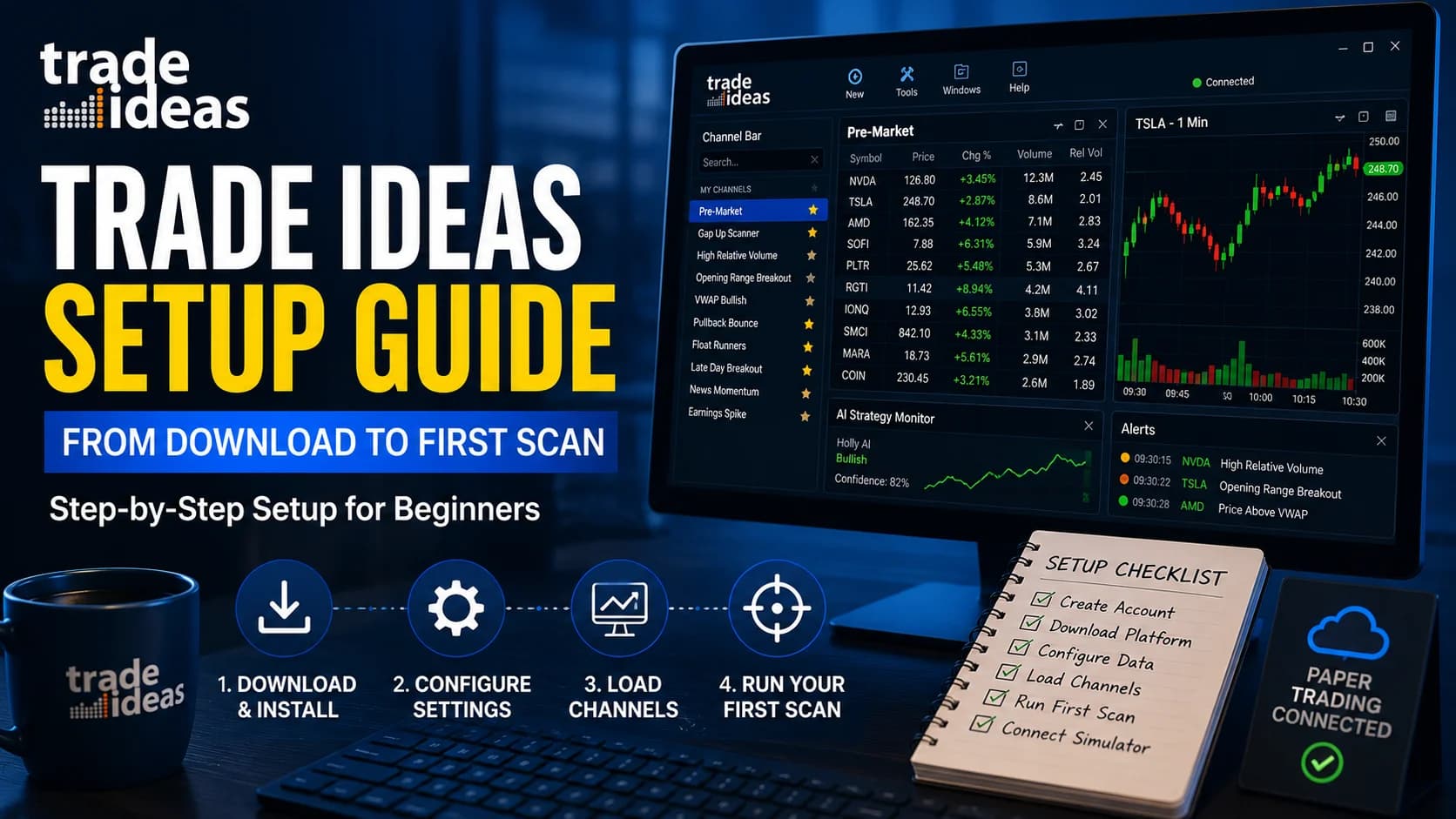
Trade Ideas Setup Guide for Beginners: From Download to Your First Scan
A step-by-step Trade Ideas setup guide built from the official documentation: account decisions, system requirements and Mac options, install gotchas, the Channel Bar quick start, your first custom scan, and the paper-trading connection to make before anything else.
Tools & Tutorials
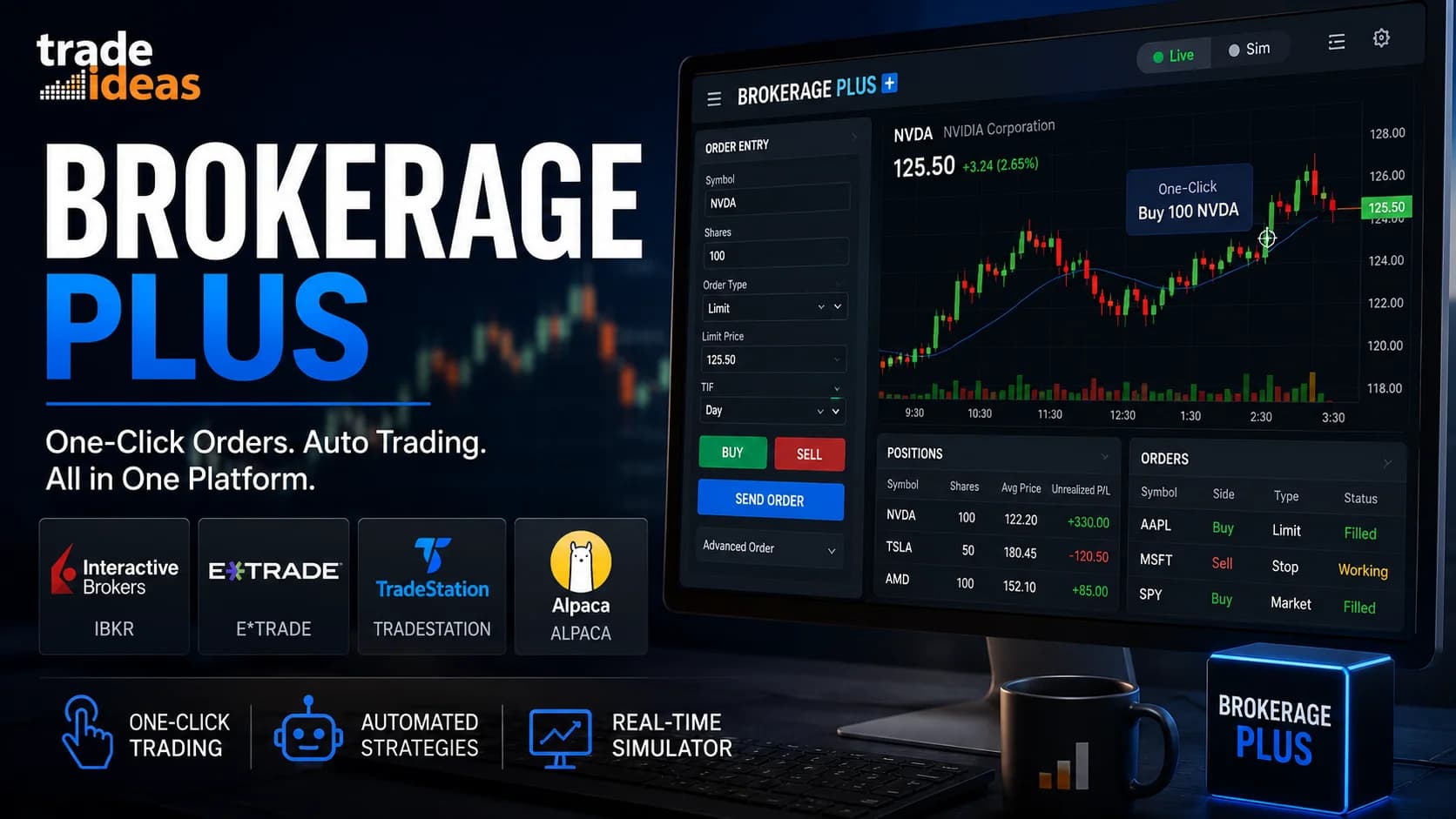
Trade Ideas Brokerage Plus Review: One-Click Orders, Auto-Trading, and the Simulator
A complete review of Trade Ideas Brokerage Plus: how the four broker connections actually work (including the documented quirks), why the built-in simulator is the module's most valuable component, the auto-trading workflow and its safety rails, and who integrated execution genuinely fits.
Tools & Tutorials
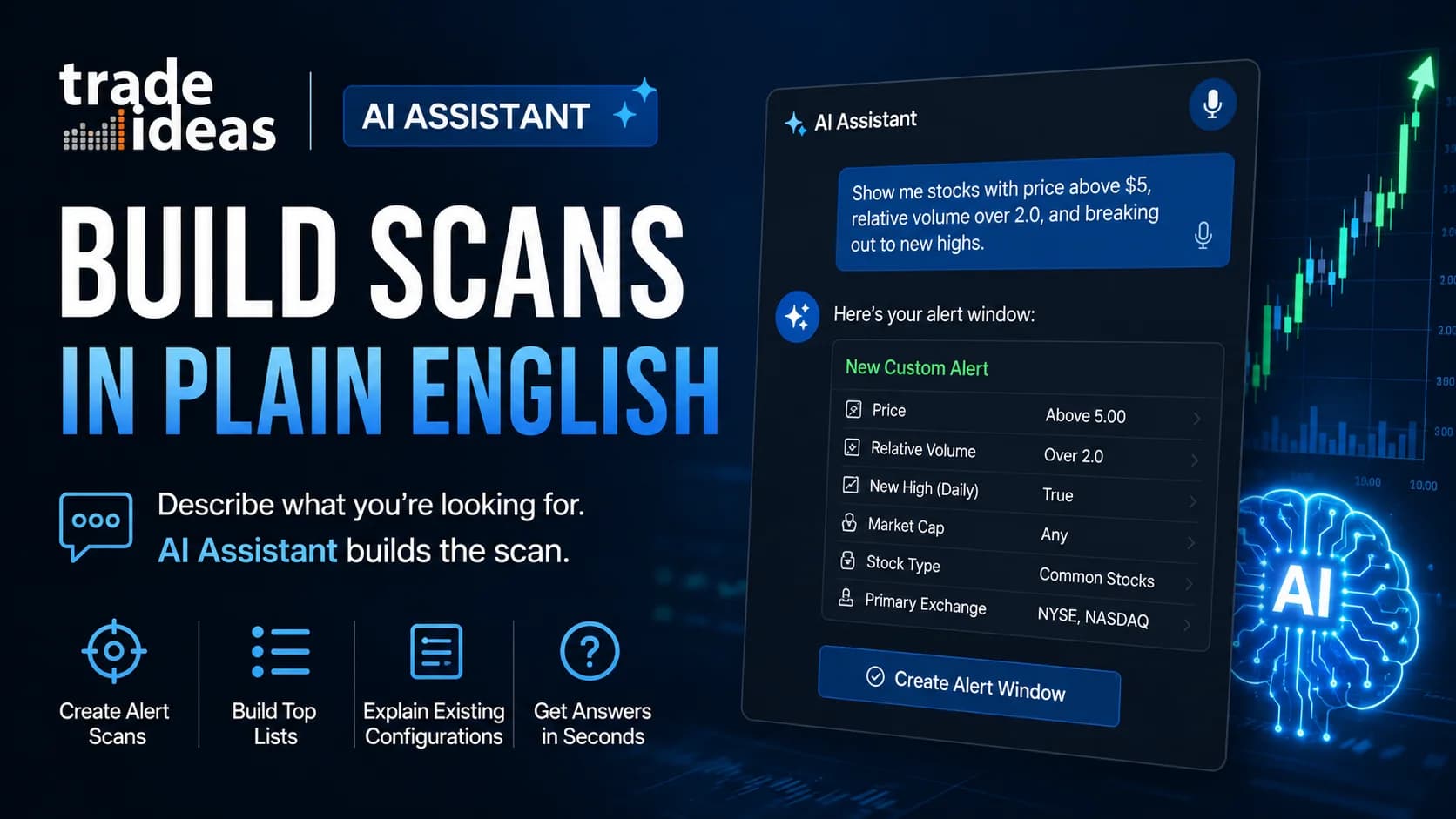
Trade Ideas AI Assistant: Build Scans in Plain English — By Typing or Voice
Trade Ideas just released an AI Assistant that builds alert windows and top lists from plain-language descriptions — typed or by voice. Here's what it does, how it differs from Holly AI, and what it changes about the platform's learning curve.
Comments
No comments yet. Be the first to share your thoughts.