



When I first started trading, I thought success was all about picking winning trades. But the reality hit hard: even with some winners, I was still losing money. That’s when I discovered the importance of the reward-to-risk ratio. It’s a simple concept but mastering it can completely change the way you approach trading.
In this guide, I’ll explain exactly what the reward/risk ratio is, why it matters more than win rate, how to calculate it step-by-step, and how you can use it to build a disciplined trading strategy. I’ll also share a few personal insights from my own trading journey, so this doesn’t feel like another textbook article. And if you want to speed things up, you can use our Reward/Risk Calculator to do the math instantly.
Table of Contents
What Is the Reward/Risk Ratio?
The reward/risk ratio (often written as R:R or risk-reward ratio) measures the potential profit of a trade compared to the potential loss.
Formula:
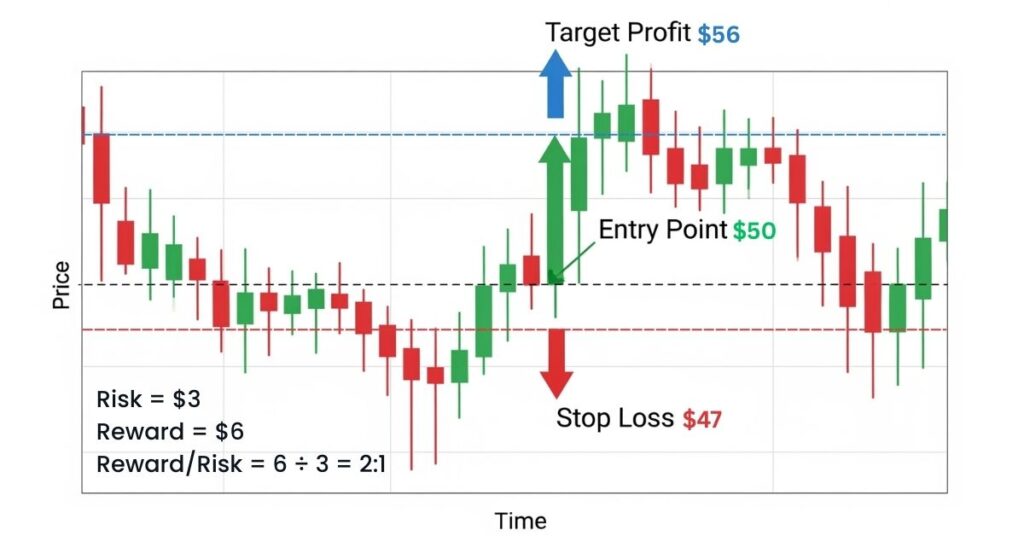
Reward/Risk Ratio = (Target Price – Entry Price) ÷ (Entry Price – Stop-Loss Price)Here’s a simple example:
- Entry price: $50
- Stop-loss: $47 (risk $3 per share)
- Target price: $56 (reward $6 per share)
Reward/Risk = 6 ÷ 2 = 2:1
That means for every $1 you risk, you expect to make $2.
This ratio is universal—you’ll find traders using it in stocks, forex, crypto, and futures. No matter what you trade, the principle stays the same.
Why It Matters More Than Win Rate
Many beginners think a high win rate means profitability. But even if you win 70% of the time, you can still lose money if your risk/reward setup is poor.
Here’s an example I often share with new traders:
- Trader A wins 70% of trades with a 0.5:1 risk/reward ratio (risking $100 to make $50). Over 10 trades, they risk $1,000 but only earn $350. Net: loss.
- Trader B wins only 40% of trades with a 2:1 ratio (risking $100 to make $200). Over 10 trades, they risk $1,000 and earn $800. Net: profit.
The math shows it clearly: a solid reward/risk ratio can make you profitable even with a lower win rate.
Step-by-Step: How to Calculate Reward/Risk Ratio
Here’s how you can calculate the ratio for any trade:
- Decide your entry price – The level where you plan to buy or short.
- Set your stop-loss – This defines how much you’re willing to lose if the trade goes against you.
- Choose your profit target – The price level where you’ll take profit.
- Do the math:
- Risk = Entry – Stop-Loss
- Reward = Target – Entry
- Ratio = Reward ÷ Risk
Example:
- Entry: $200
- Stop-loss: $210
- Target: $180
Risk = $10
Reward = $20
Reward/Risk = 20 ÷ 10 = 2:1
👉 If you don’t want to calculate manually, you can use the Reward/Risk Calculator—just plug in your numbers and it will instantly show you the ratio.
What’s a “Good” Risk-Reward Ratio?
There’s no one-size-fits-all, but here are some common benchmarks:
- 1:2 ratio → Minimum many professional traders accept.
- 1:3 ratio → Gives you a buffer for mistakes or lower win rates.
- 1:4+ ratio → Excellent, but often harder to find consistently.
Different strategies use different ratios:
- Scalpers may settle for 1:1.5 because they trade frequently.
- Swing traders often aim for 1:2 or 1:3.
- Position traders may hold for larger moves, 1:5 or more.
Personally, I don’t take trades below 1:2. It keeps me disciplined and ensures even if I’m wrong more often than right, I can still grow my account.
Common Pitfalls to Avoid
While the ratio is powerful, it’s not foolproof. Some mistakes I’ve made (and seen others repeat):
- Ignoring fees and commissions – Spreads, commissions, and slippage can eat into your “reward.” Always check the net numbers.
- Moving your stop-loss emotionally – If you widen your stop to “give it room,” you just destroyed your risk/reward.
- Unrealistic profit targets – Don’t set a 1:10 ratio if the market never moves that far.
- Not sticking to the plan – A good ratio is meaningless if you close early out of fear.
The key is balance: set targets that the market can realistically hit, while keeping your losses capped.
Why a Calculator Helps
When I was starting out, I used to scribble numbers on paper and make quick mental estimates. The problem? I often miscalculated under pressure. That mistake cost me multiple trades.
Using a calculator takes the guesswork out. With our Reward/Risk Calculator, you just:
- Enter entry, stop, and target prices
- Instantly get the ratio
- Quickly decide if the trade is worth taking
This small step can save you from entering bad trades and help you stay consistent over time.
Real-World Trader Tip
Here’s a personal lesson: early in my trading journey, I focused only on setups I “liked” and ignored the math. I’d take a trade with a bad ratio just because it looked like a sure thing. The result? A string of small losses wiped out the occasional big win.
Now, I never enter a trade without calculating the reward/risk first. If it doesn’t meet my rule (minimum 1:2), I skip it—no matter how good it “looks.” Skipping bad trades is just as important as taking good ones.
Conclusion
The reward/risk ratio is one of the simplest but most powerful tools in a trader’s toolkit. It shifts your focus from chasing wins to building consistent profitability.
To recap:
- Calculate it before every trade (reward ÷ risk).
- Aim for at least 1:2 or better.
- Avoid emotional mistakes that ruin your ratio.
- Use tools like the Reward/Risk Calculator to make the process quick and accurate.
Trading success isn’t about being right every time—it’s about managing risk and stacking the odds in your favor. Master the reward/risk ratio, and you’ll already be ahead of most traders.


