
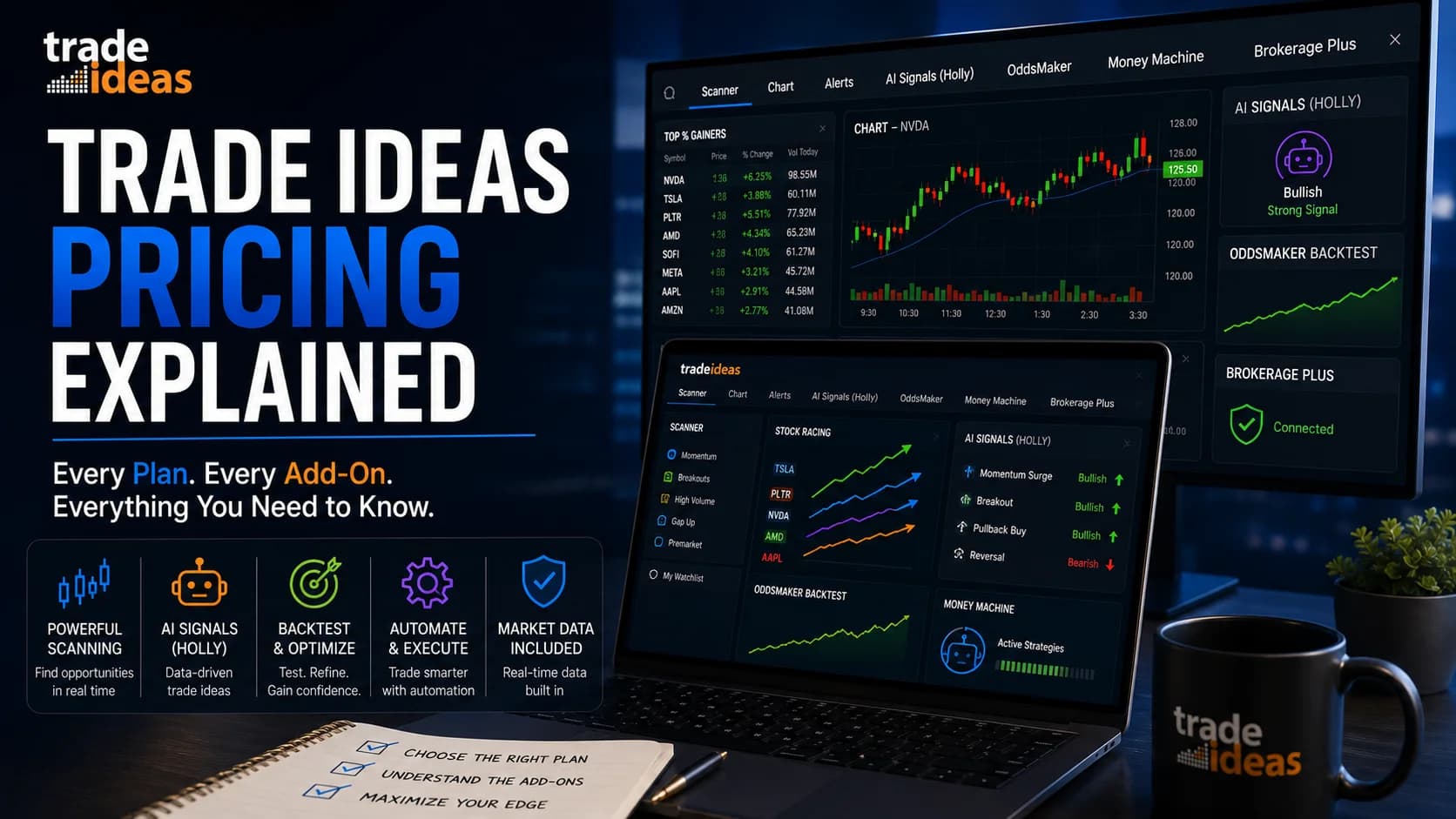
Trade Ideas costs more than most trading software, so the useful question isn't just "how much," it's "how much for what, and on what terms." This Trade Ideas pricing guide answers all three, starting with the numbers.
How much does Trade Ideas cost? Trade Ideas has two paid plans. The Core costs $127 a month, or $1,068 a year ($89/month). The Apex costs $254 a month, or $2,136 a year ($178/month). Annual billing saves about 30%. Only The Apex includes Holly AI signals, BacktestingThe process of running a defined trading strategy against historical price data to evaluate how it would have performed before risking real capital. A well-constructed backtest gives you a statistical baseline — win rate, profit factor, maxRead definition → and auto trading. Real-time U.S. market data is included for non-professional traders, and a free account is available.
Last verified: October 7, 2026, against Trade Ideas' pricing page and billing policy.
Disclosure: DayTradingToolkit is a Trade Ideas affiliate partner. If you subscribe through our links we may earn a commission at no extra cost to you.
Trade Ideas Plans and Prices
- Plan
- Free account
- Monthly billing
- $0
- Annual billing
- $0
- Annual, per month
- $0
- Annual saving
- —
- Plan
- The Core (TI Standard)
- Monthly billing
- $127
- Annual billing
- $1,068
- Annual, per month
- $89
- Annual saving
- $456
- Plan
- The Apex (TI Premium)
- Monthly billing
- $254
- Annual billing
- $2,136
- Annual, per month
- $178
- Annual saving
- $912
| Plan | Monthly billing | Annual billing | Annual, per month | Annual saving |
|---|---|---|---|---|
| Free account | $0 | $0 | $0 | — |
| The Core (TI Standard) | $127 | $1,068 | $89 | $456 |
| The Apex (TI Premium) | $254 | $2,136 | $178 | $912 |
In 30 seconds
- The Core is the real-time manual workflow: scanning, charts, paper trading and in-app trading.
- The Apex adds Holly AI signals, backtesting, Smart Risk Levels and auto trading. Pick it only if you'll use those.
- Annual billing saves $456 (The Core) or $912 (The Apex) versus paying monthly.
- Codes like DTT15 discount your first billing period only; renewals are at full price.
- All sales are final, and promo-code purchases get no credit or exchange either.
Prefer to watch first? This short video runs the five checks to make before you pay: how you trade, what The Apex adds, what each plan costs, whether you'll use it enough, and the discount and billing rules.
What Does Trade Ideas Cost per Day?
Billed annually, The Core works out to about $4.24 per trading day and The Apex to about $8.48. On monthly billing it's about $6.05 and $12.10 per trading day. These figures assume roughly 252 U.S. trading days a year.
- Plan
- The Core
- Annual billing, per trading day
- $4.24
- Monthly billing, per trading day
- $6.05
- Plan
- The Apex
- Annual billing, per trading day
- $8.48
- Monthly billing, per trading day
- $12.10
| Plan | Annual billing, per trading day | Monthly billing, per trading day |
|---|---|---|
| The Core | $4.24 | $6.05 |
| The Apex | $8.48 | $12.10 |
This is the number that actually decides value. If you trade most days, the cost spreads thinly across hundreds of trades a year. If you trade twice a month, you're paying for roughly 250 trading days you don't use. Our is Trade Ideas worth it analysis runs this math against account size and trade frequency.
What's Included in The Core vs. The Apex?
The Core finds what you AskThe ask is the lowest price a seller is currently willing to accept. When you buy with a market order, you pay the ask.Read definition → for; The Apex adds machines that decide, test and act. Every feature below comes from Trade Ideas' own pricing page.
- Feature
- Real-time data
- The Core
- Yes
- The Apex
- Yes
- Feature
- 10 charts on screen
- The Core
- Yes
- The Apex
- Yes
- Feature
- Customizable layouts, scans and screeners
- The Core
- Yes
- The Apex
- Yes
- Feature
- 500+ data points (alerts and filters)
- The Core
- Yes
- The Apex
- Yes
- Feature
- Real-time paper trading
- The Core
- Yes
- The Apex
- Yes
- Feature
- In-app trading (Brokerage Plus)
- The Core
- Yes
- The Apex
- Yes
- Feature
- TI Wave
- The Core
- Yes
- The Apex
- Yes
- Feature
- Price alerts
- The Core
- Yes
- The Apex
- Yes
- Feature
- AI signals (Holly)
- The Core
- No
- The Apex
- Yes
- Feature
- Backtesting
- The Core
- No
- The Apex
- Yes
- Feature
- Smart Risk Levels
- The Core
- No
- The Apex
- Yes
- Feature
- Auto trading
- The Core
- No
- The Apex
- Yes
- Feature
- RBI/GBI and compare-count windows
- The Core
- No
- The Apex
- Yes
- Feature
- Customizable multi-strategy windows and Stock Races
- The Core
- No
- The Apex
- Yes
- Feature
- Unlimited personal watchlists
- The Core
- No
- The Apex
- Yes
| Feature | The Core | The Apex |
|---|---|---|
| Real-time data | Yes | Yes |
| 10 charts on screen | Yes | Yes |
| Customizable layouts, scans and screeners | Yes | Yes |
| 500+ data points (alerts and filters) | Yes | Yes |
| Real-time paper trading | Yes | Yes |
| In-app trading (Brokerage Plus) | Yes | Yes |
| TI Wave | Yes | Yes |
| Price alerts | Yes | Yes |
| AI signals (Holly) | No | Yes |
| Backtesting | No | Yes |
| Smart Risk Levels | No | Yes |
| Auto trading | No | Yes |
| RBI/GBI and compare-count windows | No | Yes |
| Customizable multi-strategy windows and Stock Races | No | Yes |
| Unlimited personal watchlists | No | Yes |
Which Trade Ideas Plan Should You Choose?
Choose The Apex only if you'll use Holly's AI signals or backtesting; otherwise The Core is enough. There's no middle tier, so that one question does nearly all the work.
- The Core fits discretionary traders who build and run their own scans, want real-time alerts and integrated execution, and don't want AI signals. Our momentum scan recipes all run on The Core.
- The Apex fits traders who want Holly's ready-made signals with entries and stops, want to backtest scans before trading them, or plan to automate. It also includes the Money Machine beta, which runs in paper mode for Premium users.
- Neither fits yet if you're still learning setups or trade a few times a month. Start with the free tools below.
Upgrading later is allowed, so starting on The Core and moving up when you actually need the AI stack is a sensible path. A downgrade doesn't refund the difference for the current billing period.
Is There a Free Version of Trade Ideas?
Yes. Trade Ideas offers a free account plus several free tools, but no standing free trial of the paid plans. Trade Ideas describes the free account as "essential market scanning tools and comprehensive data visualization."
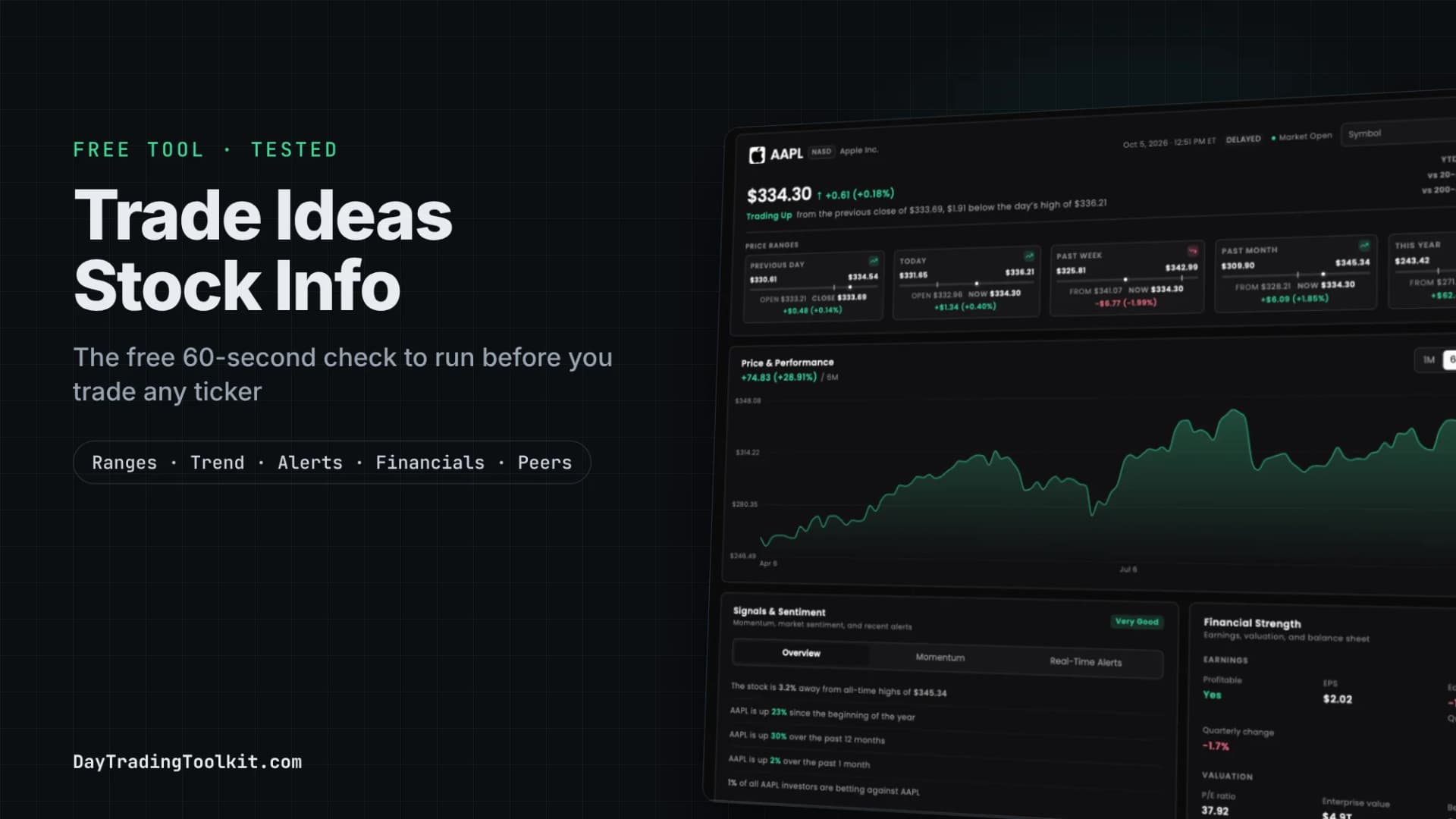
- Stock Info: free research pages for any U.S. stock. Three lookups a day without an account, more with the free account. See our Stock Info guide or try Stock Info free.
- Free live trading room: streams every market day, no card needed. Our trading room guide explains what to expect.
- Free market dashboard with real-time stock races and market breadth.
- Test Drive events: when Trade Ideas runs one, a small one-time fee unlocks the full Premium platform for a limited period. The fee is final, and a Test Drive never turns into a subscription by itself. See our Test Drive guide.
How to Get a Trade Ideas Discount
The biggest discounts come from Trade Ideas' seasonal sales; outside a sale, code DTT15 takes 15% off. Discounts stack with the annual-billing saving, but they apply to your first billing period only.
What that looks like on the first year of an annual plan:
- List price
- The Core, annual
- With DTT15 (15% off)
- $1,068
- With a 28% seasonal code
- $907.80
- List price
- The Apex, annual
- With DTT15 (15% off)
- $2,136
- With a 28% seasonal code
- $1,815.60
| List price | With DTT15 (15% off) | With a 28% seasonal code |
|---|---|---|
| The Core, annual | $1,068 | $907.80 |
| The Apex, annual | $2,136 | $1,815.60 |
Seasonal code sizes vary by sale; 28% is the size of Trade Ideas' October 2026 Premium Annual sale. Check our Trade Ideas deals page for whatever is live before you buy, and see the maximum discount guide for how the savings stack. When you're ready, you can see Trade Ideas plans here.
The Billing Fine Print
All sales are final, discounts apply to your first billing period only, and promo-code purchases get no credit or exchange. Here's what Trade Ideas' billing policy says, in plain English:
- No refunds. No refund is payable on a paid invoice. Trade Ideas may offer credit or a plan exchange in individual cases, at its discretion.
- Promo purchases are excluded from that discretion. Anything bought with a promo code or promotional price gets no refund, credit or exchange.
- Codes cover the first invoice only: the first month of a monthly plan, or the first year of an annual plan. Renewal is at the standard price, which is shown at checkout.
- Automatic renewal. Subscriptions renew until cancelled. Reminders go to your account email.
- Cancel any time in Account Management or the Billing Portal. Access continues until the end of the period you paid for; nothing is prorated.
- Annual plans aren't prorated or refunded for unused months.
- Price changes come with advance notice and apply from your next renewal, so you can cancel first if you don't accept them.
- Billing errors (a duplicate charge, a charge after cancellation, or a wrong amount) are corrected if reported within 60 days.
- Market data fees: Trade Ideas pays exchange fees for non-professional users. Professional traders pay the extra exchange fees for their status.
The practical takeaway: try the free tools first, consider starting monthly before committing to annual, set a reminder before your renewal date, and budget on the full renewal price.
Does Trade Ideas Have Add-Ons?
Yes, but they're no longer listed on the main pricing page, so confirm current add-ons and prices at checkout. Trade Ideas' billing policy confirms that add-ons are billed on their own cycle, and cancelling a subscription doesn't cancel an add-on (or the reverse).
When we last saw them listed (July 2026), the add-ons were AVWAP ($49/month, anchored VWAPVWAP (Volume Weighted Average Price) is the average price a security has traded at throughout the session, weighted by volume — it's the most important intraday indicator for day traders, serving as a real-time measure of fair value and theRead definition → analysis), GoNoGo ($49/month, TrendA trend is a sustained directional movement in price over time — an uptrend is characterized by a sequence of higher highs and higher lows, a downtrend by lower highs and lower lows — and correctly identifying the current trend direction isRead definition →-clarity indicators that overlap with TI Wave) and Weekly Swing Picks ($17/month, five swing ideas a week). The rule for all of them: add one only when your trading already needs it.
Frequently Asked Questions
How much does Trade Ideas cost per month?
Annual billing saves $456 a year on The Core and $912 on The Apex. Both paid plans include real-time U.S. market data for non-professional traders at no extra charge.
Is Trade Ideas Premium worth it over Standard?
Upgrading later is allowed, so starting on The Core and moving to The Apex when you actually need the AI tools is usually the cheaper path. A downgrade doesn't refund the difference for the current billing period.
What is the Trade Ideas promo code?
Trade Ideas discount codes apply to the first billing period only, and purchases made with a promo code are final, with no refund, credit or exchange.
Does Trade Ideas have a free plan?
Stock Info allows three lookups a day without an account and more with the free account. Our Stock Info guide shows what it covers.
Does Trade Ideas offer a free trial?
Test Drive fees are non-refundable, but a Test Drive never turns into a subscription automatically. Our Test Drive guide explains how the events work.
Can you get a refund on Trade Ideas?
Billing errors, such as a duplicate charge or a charge after a confirmed cancellation, are corrected if reported within 60 days of the invoice date.
Do Trade Ideas discount codes work on renewals?
For example, The Apex annual plan with a 28% code costs $1,537.92 for the first year and renews at $2,136.
Is real-time market data included in Trade Ideas' price?
Traders classified as professionals pay the additional exchange fees for their status. When comparing Trade Ideas with platforms that bill data separately, add their data fees to their headline price.
How do I cancel a Trade Ideas subscription?
No part of a paid period is refunded, and add-ons are billed separately, so cancel those on their own if you have any.
For the full platform verdict, see our Trade Ideas review.
What We Updated
- October 7, 2026: Rebuilt the guide around direct answers. Re-verified prices and plan features on Trade Ideas' pricing page, added cost per trading day and first-year discount examples, updated the billing rules (promo purchases excluded from credit or exchange, Test Drive terms, price-change notice, billing-error window), replaced the old free-plan description with the current free account and free tools, and flagged that add-ons are no longer listed on the pricing page.
Article Sources
- Trade Ideas pricing - plan prices and features, verified October 7, 2026trade-ideas.com
- Trade Ideas billing and cancellation policy - refunds, renewals, promo purchases, Test Drives, exchange feestrade-ideas.com
- Trade Ideas free account signup - free account descriptiontrade-ideas.com
- Trade Ideas Stock Info - free research pages and lookup limitstrade-ideas.com