
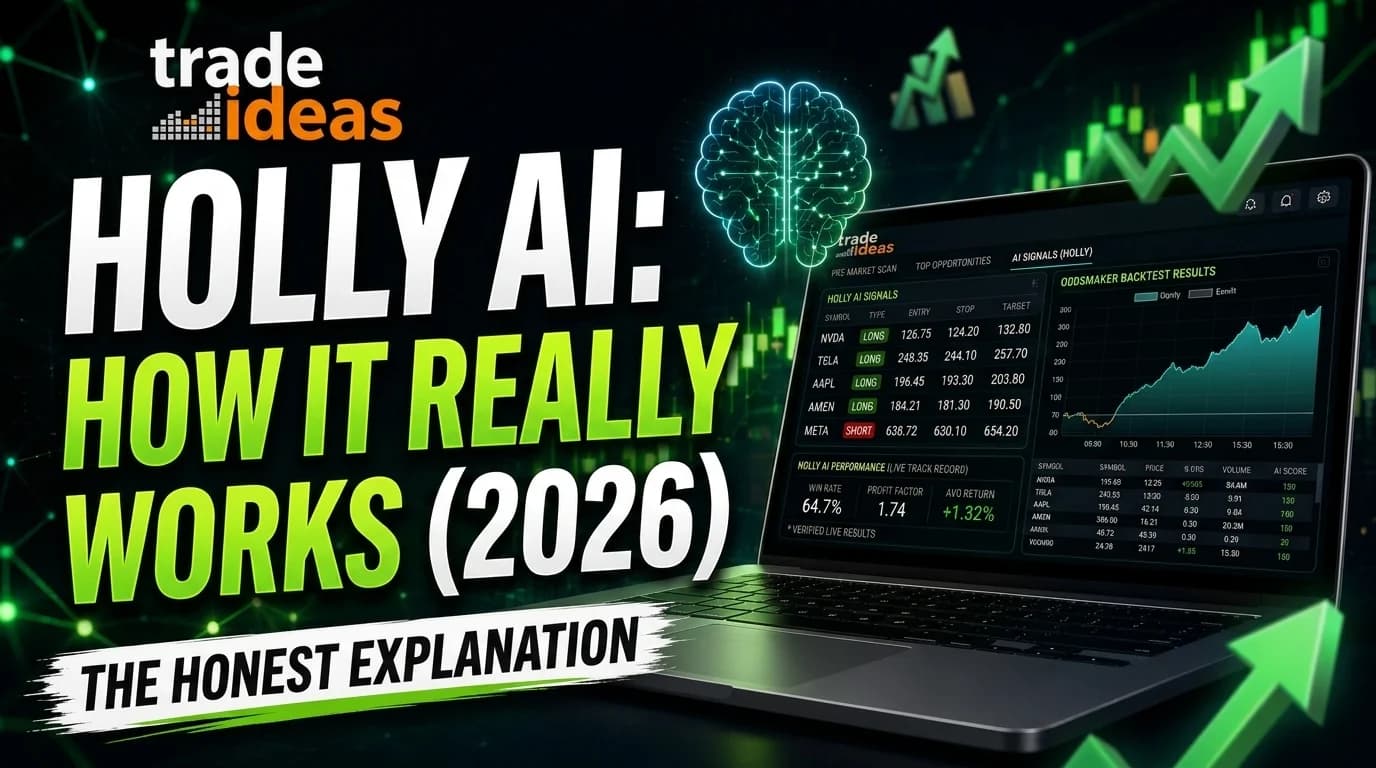
Most "AI trading tool" articles fall into one of two camps: breathless hype or vague hand-waving. They'll call Holly AI "revolutionary," flash a screenshot of a 300% winner, and quietly skip the losers, the learning curve, and the $2,136 annual price tag.
This guide doesn't do that. It explains how Holly actually works — the documented mechanics, the genuine strengths, and the real limitations — drawing on Trade Ideas' own documentation and independent review. By the end you'll understand exactly what Holly can realistically do for your trading, and just as importantly, what she can't.
What is Holly AI? Holly AI is Trade Ideas' machine-learning signal engine. Each night it runs simulations across dozens of strategies and the full U.S. stock universe, then issues real-time intraday trade signals the next session — each with an entry, a stop, and a target. Holly comes pre-trained, needs no setup, trades only her own strategies, and is available on the Premium ("The Apex") plan.
Quick Answer
Holly AI is genuine machine learning, not a rules-based scanner wearing an "AI" badge. Overnight, she re-simulates her strategy library against recent market data and keeps only the strategies holding up in current conditions; during the session she fires 5–25 intraday trade ideas, each with a defined entry, stop, and target. She comes pre-trained (no model-building required), trades U.S. equities only, closes everything before the bell, and can't be customized. Holly lives on the Premium tier — and like any signal system, she identifies probabilities, not certainties.
What Is Holly AI? (And Why It's Not Just Another "AI" Label)
Holly is Trade Ideas' proprietary AI signal engine. She's not a chatbot and not a generative tool like ChatGPT — she's a machine-learning system that re-optimizes overnight and then issues real-time stock signals through the trading day.
The distinction that matters in 2026, when nearly every tool slaps "AI" on its homepage: most of those products are a fixed set of if-then rules with a futuristic label. The logic never changes. Holly's does. Her strategies adapt nightly based on fresh market data — parameters shift, filters tighten or loosen, strategies that stop working get benched, and ones that are clicking get promoted. That self-adjusting loop is the difference between genuine machine learning and marketing veneer.
There's a second distinction worth understanding, because it's Holly's real selling point against the new wave of AI tools. Some platforms hand you a lab and make you train your own model. Holly is the opposite: she comes pre-trained. Trade Ideas has already run the AI across millions of market scenarios, so there's no model to build, no data science to learn, and no configuration to tune — you turn her on and she's working. For a trader who wants AI without becoming an AI engineer, that "zero training" approach is the whole appeal. (The trade-off, covered below, is that you also can't tweak how she thinks.)
How Holly's Nightly Cycle Works
Most articles compress this into one line — "Holly runs millions of backtests" — and move on. The cycle is the reason her signals carry more weight than a random alert, so it's worth understanding.
After the close each day, Holly ingests the full session's market data. Overnight, she runs her library of strategies against the broad universe of U.S.-listed stocks through large numbers of simulations, evaluating how each strategy would have performed in the current market environment. Crucially, Trade Ideas describes this as a forward simulation on recent data — Holly leans on the last few months of market behavior rather than testing against decades of stale history, on the logic that what worked in markets long ago may say little about what's working now.
From there, she keeps only the strategies that held up. Trade Ideas has historically pointed to strong win rates and favorable reward-to-risk as the bar a strategy must clear to be deployed — so the strategies that go live the next morning are the ones that performed best in recent simulation, while the rest sit on the bench. When the market opens, Holly scans in real time and fires a signal when a stock matches one of her active strategies.
This repeats every night. Monday's Holly may deploy a different mix than Friday's, because the data shifted. As StockBrokers.com noted in its 2026 review, these AI modules refresh daily using machine learning and updated BacktestingThe process of running a defined trading strategy against historical price data to evaluate how it would have performed before risking real capital. A well-constructed backtest gives you a statistical baseline — win rate, profit factor, maxRead definition → to adapt to changing market trends — a self-optimizing approach the reviewer called novel for a retail trading product. Adaptive, though, is not the same as infallible. More on that below.
The Three Hollys: One Engine, Three Personalities
New users are often surprised there isn't just one Holly. Trade Ideas runs three variants, each with a different style. Picking the wrong one for your temperament is a common source of frustration.
- Holly Variant
- Holly (Holly Grail)
- Style
- The balanced workhorse — a full mix of long and short intraday setups across conservative-to-aggressive strategies
- Best suited to
- Most traders; the right starting point
- Holly Variant
- Holly 2.0
- Style
- The same engine with the risk dial turned up — wider targets, messier charts, bigger potential moves and more heat
- Best suited to
- Experienced traders comfortable with volatility
- Holly Variant
- Holly Neo
- Style
- The pattern hunter — leans more on real-time chart patterns forming during the session rather than purely overnight optimization
- Best suited to
- Traders wanting a more reactive, intraday-pattern read
| Holly Variant | Style | Best suited to |
|---|---|---|
| Holly (Holly Grail) | The balanced workhorse — a full mix of long and short intraday setups across conservative-to-aggressive strategies | Most traders; the right starting point |
| Holly 2.0 | The same engine with the risk dial turned up — wider targets, messier charts, bigger potential moves and more heat | Experienced traders comfortable with volatility |
| Holly Neo | The pattern hunter — leans more on real-time chart patterns forming during the session rather than purely overnight optimization | Traders wanting a more reactive, intraday-pattern read |
The practical approach most traders settle on: use the original Holly as the primary signal source, and treat 2.0 and Neo as additional sets of eyes. You don't have to trade every signal from all three — in fact, you shouldn't.
Inside a Holly Signal: What You Actually See
When Holly fires, the alert lands in the AI Strategy Trades Window and on your charts. Each signal names the ticker, the strategy that triggered it, the direction, a suggested entry, a stop-loss, a target, and the expected hold time. On the chart, an arrow marks the entry, with colored lines for the entry, stop, and target so you can judge the setup against the broader price action at a glance.
- Signal Element
- Ticker
- What You See
- ABCD
- Signal Element
- Strategy
- What You See
- Breakout Long
- Signal Element
- Direction
- What You See
- Buy
- Signal Element
- Entry
- What You See
- $14.52
- Signal Element
- Stop Loss
- What You See
- $14.10
- Signal Element
- Target
- What You See
- $15.35
- Signal Element
- Hold Time
- What You See
- ~45 minutes
| Signal Element | What You See |
|---|---|
| Ticker | ABCD |
| Strategy | Breakout Long |
| Direction | Buy |
| Entry | $14.52 |
| Stop Loss | $14.10 |
| Target | $15.35 |
| Hold Time | ~45 minutes |
Holly also shows her work: you can see which strategy triggered, review that strategy's recent performance, and watch her trades resolve in real time along with her success rate. That transparency is rare among AI signal tools — but read the next section before you trust any highlight reel.
Here's the reality check competitors skip: not every signal wins. A Win RateWin rate is the percentage of your trades that result in a profit — calculated as (number of winning trades ÷ total trades) × 100 — and while commonly cited as a measure of trading success, it means very little without also knowing the averRead definition → below 100% means some signals are designed to lose — that's probability, not a defect. The system aims for winners larger than losers across a meaningful sample. The traders who struggle with Holly are usually the ones who cherry-pick signals, bail early on winners, or override stops on losers — which destroys the exact statistical edge the system is built to provide.
TI Wave, Stock Races, and the Wider AI Toolkit
Holly doesn't operate alone. Two related tools are worth knowing because they shape how her signals are used.
TI Wave is Trade Ideas' adaptive pattern-recognition layer. It reads market movement and surfaces timing cues through simple visual signals — the color flipping from one state to another as momentum shifts — so you can gauge whether conditions favor a move before acting. Stock Races is the momentum-detection visualization: a live "race" that ranks movers in real time so emerging strength or weakness is obvious at a glance, rather than buried in a list.
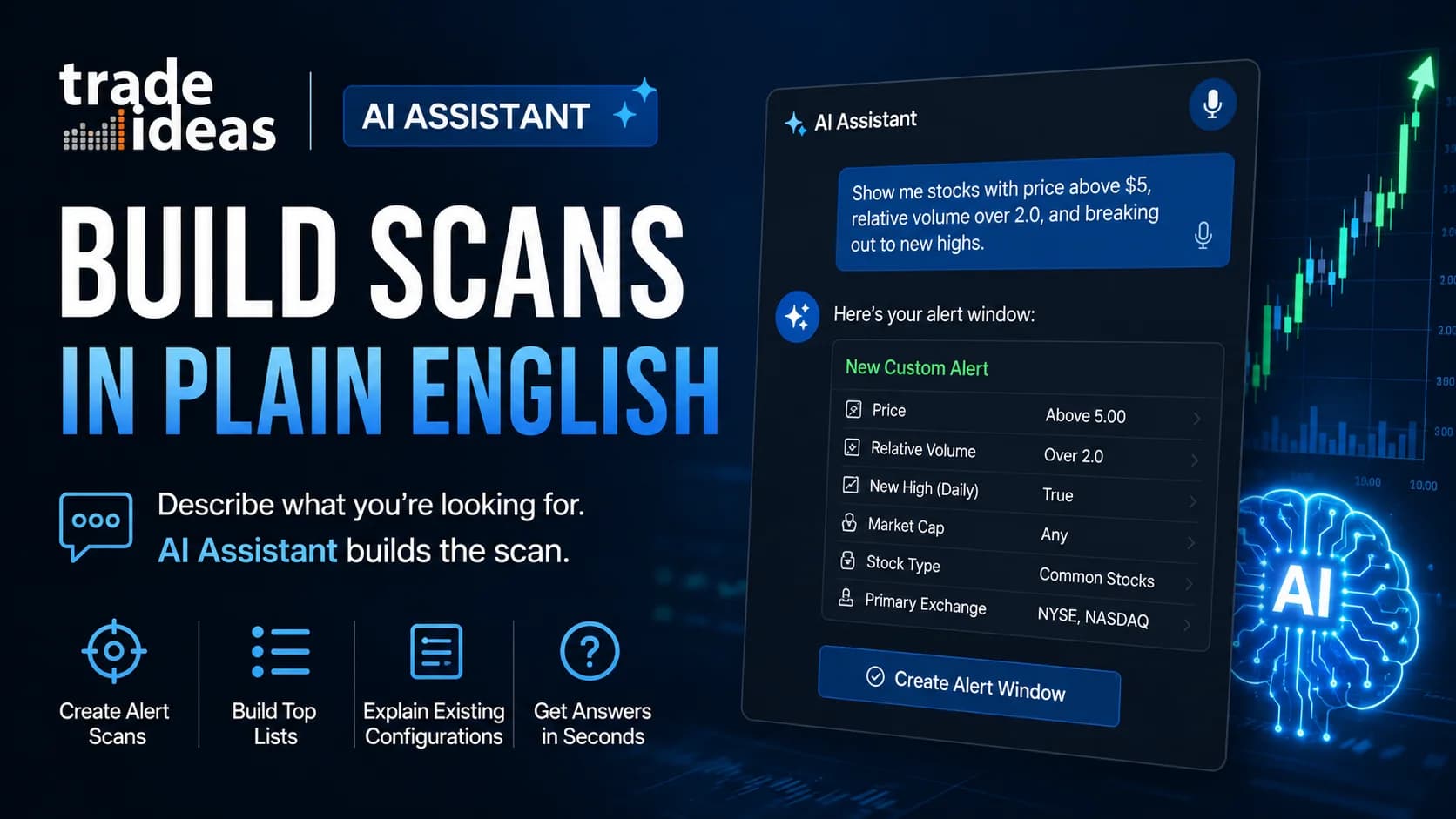
In July 2026, Trade Ideas added a fourth piece that's easy to confuse with Holly because of the shared AI branding: the new AI Assistant, a conversational tool that builds alert and top-list windows from plain-language descriptions — typed or by voice — and explains existing scan configurations in plain English. The critical distinction: the Assistant generates no signals and makes no market judgments. Holly decides what might be worth trading; the Assistant builds the scans you describe. Our full Trade Ideas AI Assistant guide covers what it does and doesn't do.
Together, these form Trade Ideas' AI stack: TI Wave for timing context, Stock Races for momentum visibility, the AI Assistant for plain-language scan building, and Holly for the actual entry-stop-target signal. It's a genuinely AI-driven workflow rather than a single feature — which is why Trade Ideas consistently ranks among the strongest tools in our best AI tools for day traders roundup.
Four Ways to Trade With Holly
You're not locked into one execution style. Trade Ideas offers four, from fully manual to fully automated.
- Manual (Holly Hands-On). Watch the signals, evaluate the setup yourself, and place the order in your own brokerage. Holly tells you what; you decide whether. The External Linking feature can auto-populate the ticker in your broker to save a few seconds. This keeps your own judgment as a filter on top of the AI — the combination of human and machine, as Trade Ideas puts it, beats either alone.
- One-click. If you've connected a broker through the Brokerage Plus module — currently Interactive Brokers, E*TRADE, TradeStation, and Alpaca — you can execute a signal in a single click, with size, stop, and target pre-set to your risk parameters. Fast, but you still approve each trade.
- Simulated. Holly's signals can execute automatically in the built-in paper-trading simulator on live data, no money at risk. This should be step one for every new user — spend two to four weeks here before going live.
- Automated (Brokerage Plus). The system can execute Holly's signals in a live account, hands-off. Powerful and risky in equal measure: it removes emotional interference, but SlippageSlippage is the difference between the price you expected to receive when placing a trade and the actual fill price you got — it occurs because the market moved between when you placed the order and when it was executed, or because you usedRead definition →, fast markets, and unusual conditions can produce outcomes that look nothing like a backtest. Our semi-automated trading guide covers how to keep the right balance of human oversight and machine speed.
Start with manual or simulated. Graduate to faster execution only after you've watched how Holly behaves in live conditions.
Holly vs. the Money Machine
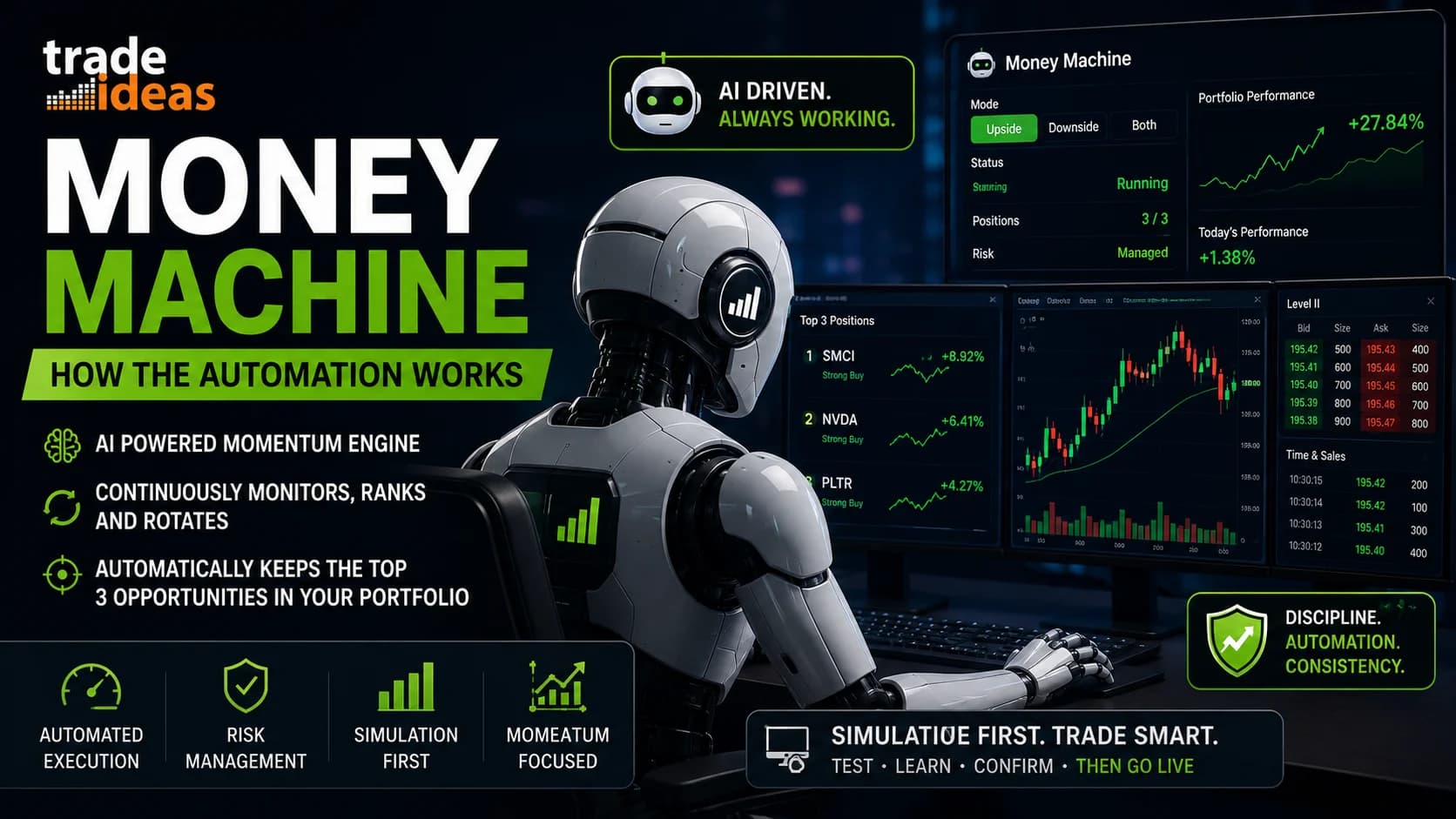
Holly is the flagship, but it isn't Trade Ideas' only AI system. The Money Machine is the second-generation engine, and it's a different animal. Where Holly generates individual signals you choose to act on, the Money Machine is end-to-end: you pick a direction, and it identifies the market's strongest momentum names and handles entry, position sizing, stops, exits, and rotation automatically, swapping a fading name for a fresher one.
As of early 2026 the Money Machine is in a phased live rollout, with full simulation available to every Premium subscriber. The simple way to hold the two in your head: Holly is AI signals with human execution; the Money Machine is autonomous momentum management. The full breakdown is in the Money Machine guide.
Real AI vs. AI Hype: How to Judge Holly Honestly
Since "AI" is the most abused word in trading software right now, here's how to evaluate Holly without getting sold.
On the "real AI" side: the nightly re-optimization, forward simulation on recent data, and adaptive strategy selection are genuine machine learning, not a static rulebook. That puts Holly in the smaller group of legitimately AI-driven tools. The broader category — and how to tell real machine learning from branding — is exactly what our AI trading bots: truth vs. hype guide and the complete AI day trading guide are for.
On the "be skeptical" side: judge Holly by her live record inside the platform, not by Trade Ideas' marketing. The public performance pages lean heavily on cherry-picked winners — triple-digit gains presented without the losing trades beside them — and independent reviewers have flagged exactly that. The honest signal is the success rate you can watch resolve in real time during a Test Drive or in the trading room, not a highlight reel. And no matter how the AI is framed, it doesn't predict the future; Trade Ideas itself says Holly pattern-matches early behavior that often precedes moves, which is a probability claim, not a guarantee. Two worthwhile counterweights before you spend anything: the 7 AI trading risks every buyer should know, and the blunt case that AI won't make you a better trader on its own.
The Honest Truth: What Holly Can't Do
Holly is impressive technology with real limitations that will affect your trading if you're not ready for them.
- She doesn't guarantee profits. The optimization targets positive ExpectancyExpectancy is the average amount your strategy makes or loses per dollar risked — it's the single best number for evaluating whether your trading approach has a real mathematical edge.Read definition → over a large sample — but on any day, or a bad week, you can lose money, and losing streaks are normal math. If a four-trade losing streak would shake your account or your nerves, fix your position sizing before touching Holly or any system.
- Everyone sees the same signals. Every Premium subscriber gets Holly's alerts at once. On a thin small-cap, that crowding can move the price before you're filled and crowd the exits too — StockBrokers flagged this in its 2026 review. The fix is selectivity: trade only signals with enough VolumeVolume is the total number of shares (or contracts) traded during a given time period — it's the primary confirmation tool for all price action, because a price move accompanied by high volume indicates genuine market participation, while tRead definition → and liquidity to absorb the crowd, and treat the alert as a heads-up rather than a market-buy trigger.
- The learning curve is steep. The advanced features live in a complex Windows desktop platform. Expect real time learning the AI windows, channels, and execution setup. It's professional software, not a "buy now" button. The new AI Assistant meaningfully softens the scan-building portion of that curve, though the platform's execution and window-management learning remains.
- She's a black box. Holly shows which strategy triggered and the entry/stop/target, but not precisely why the model chose those parameters that night — the classic explainability gap FINRA highlights as a risk for AI tools in the securities industry.
- Backtested ≠ live. Signals are optimized on historical data; live markets add slippage, execution lag, liquidity gaps, news, and the crowding effect. Our hidden costs of automated trading covers why the gap matters.
- U.S. equities only. Holly scans U.S.-listed stocks and ETFs — nothing for forex, futures, crypto, or international markets.
None of this makes Holly a bad tool. It makes her a specific tool that works best paired with realistic expectations, proper risk management, and your own judgment.
Who Should (and Shouldn't) Use Holly AI
Holly makes sense if you're an active day trader in U.S. stocks who already reads structure, volume, and risk; you trade often enough that the Premium cost is justifiable against your results; and you want an AI idea-generation engine as one input in your process — not your whole strategy.
Holly probably isn't for you if you're still building fundamentals (she amplifies what you already have — including bad habits), you expect the AI to think for you, or the subscription would eat a meaningful slice of a small account. On that last point, one correction to outdated advice: you no longer need a $25,000 balance to actively day trade — FINRA eliminated the old Pattern Day Trader minimum effective June 4, 2026, replacing it with a risk-based framework starting near $2,000 (see the PDT elimination guide). The capital barrier dropped, but the cost-versus-account-size math hasn't: if Premium would consume a big share of your capital, it's too early. Our honest checklist of 5 signs you're not ready for Trade Ideas goes deeper.
The in-between option: curious but not ready to commit? The free plan (delayed data) lets you learn the interface, the free live trading room lets you watch Holly's signals discussed in real time at no cost, and a periodic Test Drive opens full Premium access cheaply so you can judge Holly's live success rate yourself. For the full platform verdict, see the Trade Ideas review; for pricing and the current code, the discount guide and the deals page.
Frequently Asked Questions
Is Holly AI a trading bot?
Holly's core job is producing trade ideas with defined entry, stop, and target levels. You can act on them manually, with one-click execution, or fully automatically through Brokerage Plus — but out of the box she's an idea engine, not a bot. Trade Ideas' Money Machine is the system that comes closer to true end-to-end autonomy.
Key Takeaway: Holly generates signals; you decide how and whether to execute them — see the trading bot types guide for the wider landscape.
How does Holly AI actually work?
It's a self-optimizing loop: ingest the day's data, simulate strategies forward on recent history, keep the ones that performed, and scan live for matching setups the next morning. Because it re-runs nightly, the active strategy mix shifts with the market rather than staying static — genuine machine learning rather than a fixed rulebook.
Key Takeaway: Holly adapts nightly to current conditions, which is what separates her from rules-based scanners labeled "AI."
Does Holly AI actually work?
The nightly optimization is legitimate machine learning, and over a meaningful sample the math is built for positive expectancy. Individual results vary with your execution quality and which signals you trade, and no AI guarantees profits. Note too that Trade Ideas showcases winners more prominently than losers in its marketing, so judge Holly by her live success rate, not the highlight reel.
Key Takeaway: Holly offers a genuine signal-generation edge; your skill and discipline decide whether it becomes profit.
Is Holly AI the same as the new Trade Ideas AI Assistant?
The two share AI branding but do opposite jobs. Holly makes market judgments within her nightly-tested strategy library and streams entry, stop, and target signals during the session. The Assistant makes no market judgments — it translates your typed or spoken description into alert windows and top lists, and explains existing configurations in plain English. One produces ideas; the other builds infrastructure.
Key Takeaway: Holly hands you her ideas; the Assistant builds what you describe — see the full AI Assistant guide for the breakdown.
How is Holly different from newer AI trading tools?
Some platforms hand you a lab to engineer and train custom machine-learning models — powerful, but it demands time and know-how. Trade Ideas already trained Holly across millions of scenarios, so there's nothing to build or configure. The trade-off is control: you can't customize how Holly thinks, only which signals you act on.
Key Takeaway: Holly trades convenience for control — pre-trained and instant, but not customizable.
How much does Holly AI cost?
Holly isn't on the free or Basic ("The Core") tiers. Premium unlocks all three Holly variants, the Money Machine, OddsMaker backtesting, and Brokerage Plus execution. The Basic plan at $127/month gives real-time scanning and charting but no AI signals.
Key Takeaway: Budget at least $178/month (annual) for Holly — see the discount guide and deals page to reduce it.
What brokers work with Holly AI?
These connections enable one-click and automated trading straight from the platform. If your broker isn't on the list, you can still trade Holly's signals manually — the External Linking feature streamlines placing the order in your own broker — and the built-in simulator works regardless.
Key Takeaway: IBKR, E*TRADE, TradeStation, and Alpaca connect directly; any other broker can be traded manually.
How many trades does Holly make per day?
Volatile, trending days produce more signals because more stocks meet her criteria; quiet days produce fewer. Holly is strictly intraday and holds nothing overnight. You're not meant to trade every signal — most experienced users filter to the setups that fit their style and liquidity needs.
Key Takeaway: Expect 5–25 intraday signals daily, and trade them selectively.
Can I customize Holly's strategies?
Letting users edit the strategies would defeat the nightly machine-learning optimization. You can, however, choose which Holly variant to follow, filter signals by price or volume, and apply your own judgment. To build and test your own strategies, use the OddsMaker backtester — our backtesting guide covers the basics.
Key Takeaway: You can't edit Holly's algorithms, but you control which signals you take and how you manage them.
What's the difference between Holly and the Money Machine?
Holly tells you what to buy or short with defined risk levels, and you decide how to act. The Money Machine selects, enters, manages, and exits the strongest momentum names automatically, rotating as momentum shifts. They can be used together or separately.
Key Takeaway: Holly = AI signals with human execution; Money Machine = autonomous momentum management — full details in the Money Machine guide.
Does Holly work in both bull and bear markets?
Because the overnight simulation evaluates bullish and bearish strategies alike, Holly shifts toward short-biased signals in selloffs and long-biased ones in rallies — she doesn't cling to strategies that aren't working in the current regime. That adaptability is one of her genuine strengths.
Key Takeaway: Holly's nightly optimization adjusts to bull and bear conditions automatically.
Is Holly AI worth it?
The value lands when you trade frequently enough to justify the Premium cost and already have a strategy Holly can accelerate. It won't fix an undefined edge or trade for you. The lowest-risk way to decide is to evaluate Holly's live signals during a Test Drive before committing.
Key Takeaway: Worth it for the active, disciplined trader — see the full Trade Ideas review and the 5 signs you're not ready before deciding.
Article Sources
- Trade Ideas — official Holly AI User Guide - primary documentation on Holly's strategies, nightly simulation, signal mechanics, and execution methods.trade-ideas.com
- StockBrokers.com — Trade Ideas Review 2026 - independent review of Holly's machine-learning approach, pricing, and limitations, including the cherry-picked-results caveat.stockbrokers.com
- FINRA — Artificial Intelligence in the Securities Industry - regulatory context on AI applications, explainability, and risk.finra.org
- Investopedia — Backtesting - neutral reference on backtesting and simulation methodology.investopedia.com