
Every platform, scanner, and bot now claims to be "AI-powered." The marketing is relentless. Revolutionary. Game-changing. Institutional-grade intelligence, finally in your hands.
Here's the uncomfortable part that most of that marketing hopes you won't notice: a large share of what gets sold as "AI" isn't artificial intelligence at all. It's the same rules-based logic traders have used for decades, wrapped in a new label.
But the flip side matters just as much. Genuine AI tools have arrived that can legitimately help a retail day trader. Large language models can compress hours of research into minutes. Machine-learning scanners like Trade Ideas' Holly surface candidates a human would never find by eye. Sentiment systems read thousands of headlines before you finish your coffee. And in 2026, a newer category crossed a line that didn't exist a year ago: AI that doesn't just analyze, but acts — placing trades on your behalf.
So the real question was never "can AI help my trading?" It can. The question is which tools are real, how to use them without handing over judgment you shouldn't, and where even the best of them quietly fall apart.
That's what this guide is for. It gives you a framework for testing any "AI" claim in seconds, lays out exactly what's usable today, and is honest about the limits no model has solved. No hype, no promises of easy money — just a clear-eyed map of a field that's moving fast.
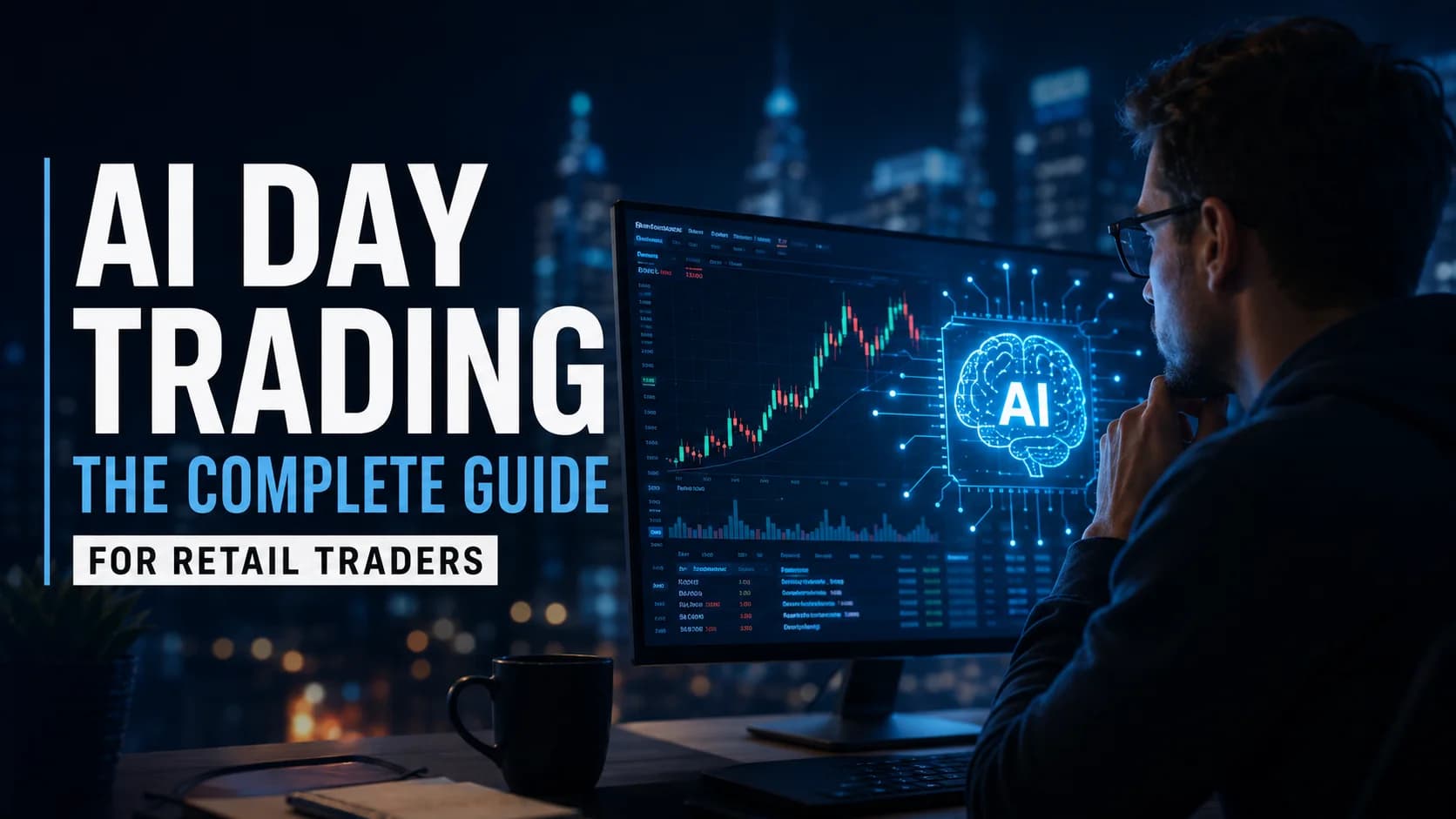
What is AI day trading? AI day trading is the use of artificial-intelligence tools to assist with parts of the intraday trading process — research, scanning, analysis, idea generation, and in newer systems, execution. It does not mean a machine runs your account. In practice, the AI handles data-heavy work while the trader keeps judgment and final decisions.
What "AI Trading" Actually Means (Cutting Through the Hype)
Start with a definition that holds up: AI day trading is using artificial-intelligence technology to assist with any part of the day trading process. The two words doing the work there are "assist" and "any." You don't need a robot running your whole operation to be "using AI." Pointing a language model at an EarningsAn earnings report is the quarterly financial disclosure a public company files with the SEC, revealing revenue, earnings per share (EPS), profit margins, and forward guidance — it's the most significant regular catalyst for individual stocRead definition → report counts. So does running a machine-learning scanner before the open.
The confusion is by design. "AI" sells, so every product reaches for the label. A scanner with an RSI filter becomes "AI-powered." A backtester with a parameter slider claims "machine-learning optimization." The term has been stretched so thin it tells you almost nothing about what a tool actually does.
One distinction clears most of the fog: AI trading is not the same as algorithmic trading.
Algorithmic trading follows predefined rules. If price crosses above the 20 EMA, buy. If it drops 2%, sell. The rules can be elaborate, but they're still rules — a computer executing instructions a human wrote. AI might help discover those rules by finding patterns in historical data, but a machine running if-then logic isn't intelligence. It's code doing what code has always done.
True AI learns. It adapts. It makes predictions from patterns nobody explicitly programmed. That's a far higher bar than most "AI trading tools" clear — and knowing the difference is the first defense against paying premium prices for ordinary software. For the traditional automated side of this, see this guide's complete guide to algorithmic trading for retail traders.
A Framework for Evaluating Any "AI" Claim
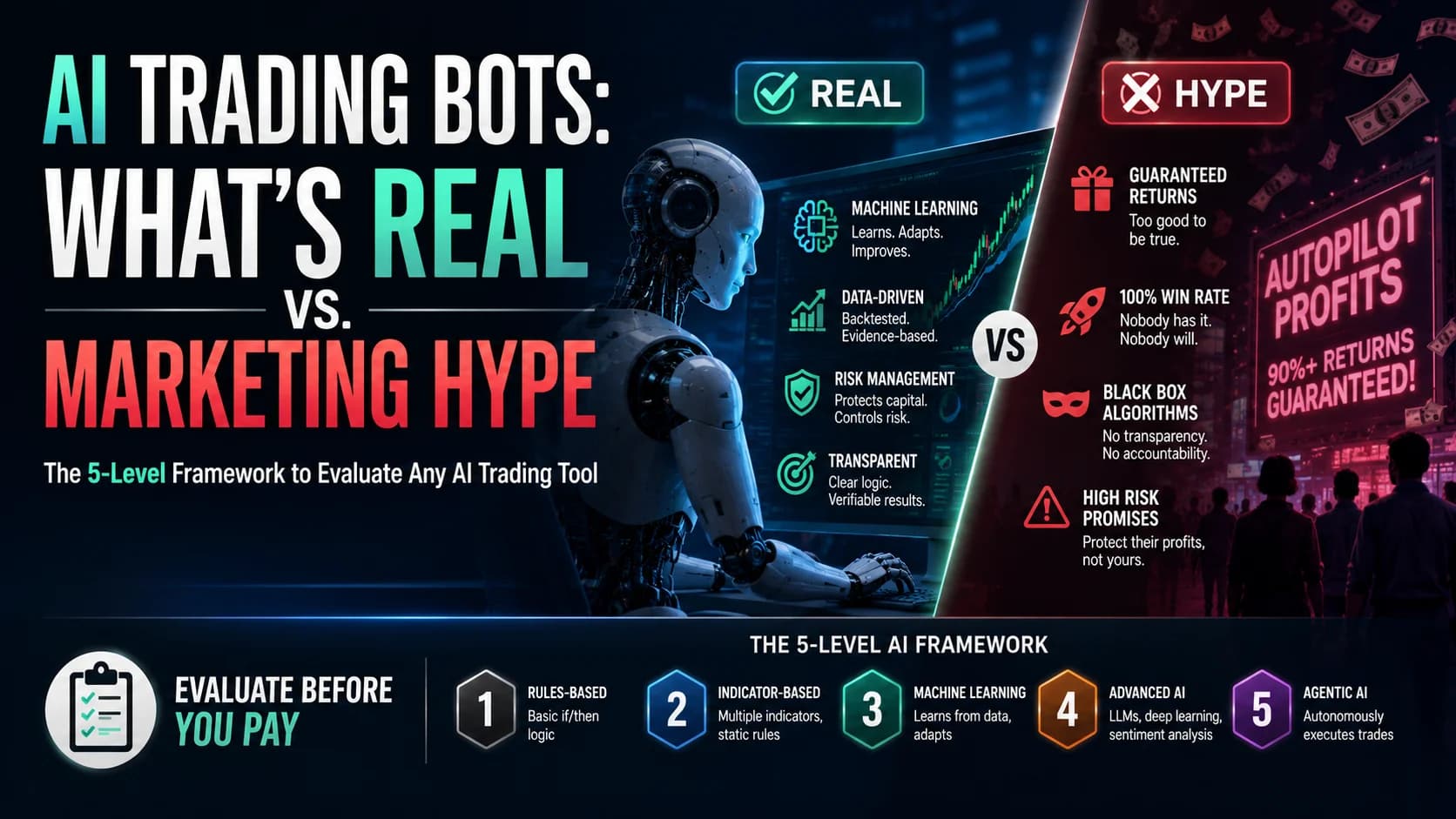
After reviewing how dozens of "AI-powered" products actually describe themselves, a simple pattern emerges — most fall into one of five tiers. This framework is the fastest way to place any tool and price-check its marketing against reality.
Level 1 — Rules-based systems. Pre-programmed if/then logic. If RSI drops below 30, alert. If price breaks ResistanceResistance is a price level where selling pressure has historically overcome buying pressure, causing price to stall, reverse, or consolidate — it's the ceiling where supply enters the market and where breakout traders watch for either a coRead definition →, signal. Static rules that never change until a human edits them. This is where most "AI trading bots" actually live. Useful? Often. Intelligent? No. The tell: any product promising "set and forget" profits or insisting you don't need to understand what it's doing is almost always Level 1 in an AI costume.
Level 2 — Adaptive indicator logic. Smarter rules that combine indicators or adjust thresholds to recent conditions — say, shifting RSI OverboughtA technical condition where an asset has risen so far, so fast that momentum indicators suggest the move may be extended and due for a pullback or consolidation. Most commonly defined as RSI above 70.Read definition → levels as volatility changes. More sophisticated than Level 1, but the "intelligence" is still pre-written optimization, not learning. Marketing language to watch for: "dynamic parameter adjustment," "adaptive indicators."
Level 3 — Machine learning. Systems that genuinely learn from historical data, find patterns, and make predictions no one hard-coded. Trade Ideas' Holly is the retail benchmark here: it runs large batches of strategy backtests nightly and surfaces setups that fit current conditions. TrendSpider's pattern-recognition engine is another. Genuine machine learning is rare in retail because it needs serious computing power, clean data, and real engineering. When you find it, it usually comes from a well-funded company willing to explain its methodology.
Level 4 — Advanced AI: LLMs and deep learning. Neural networks, natural-language processing, and large language models like ChatGPT, Claude, and Gemini. These read unstructured data — news, filings, social posts — understand context, and generate analysis on demand. The newest generation is also multimodal: you can hand a model a screenshot of a chart and AskThe ask is the lowest price a seller is currently willing to accept. When you buy with a market order, you pay the ask.Read definition → it to read the structure. Powerful, accessible, and full of traps covered later in this guide.
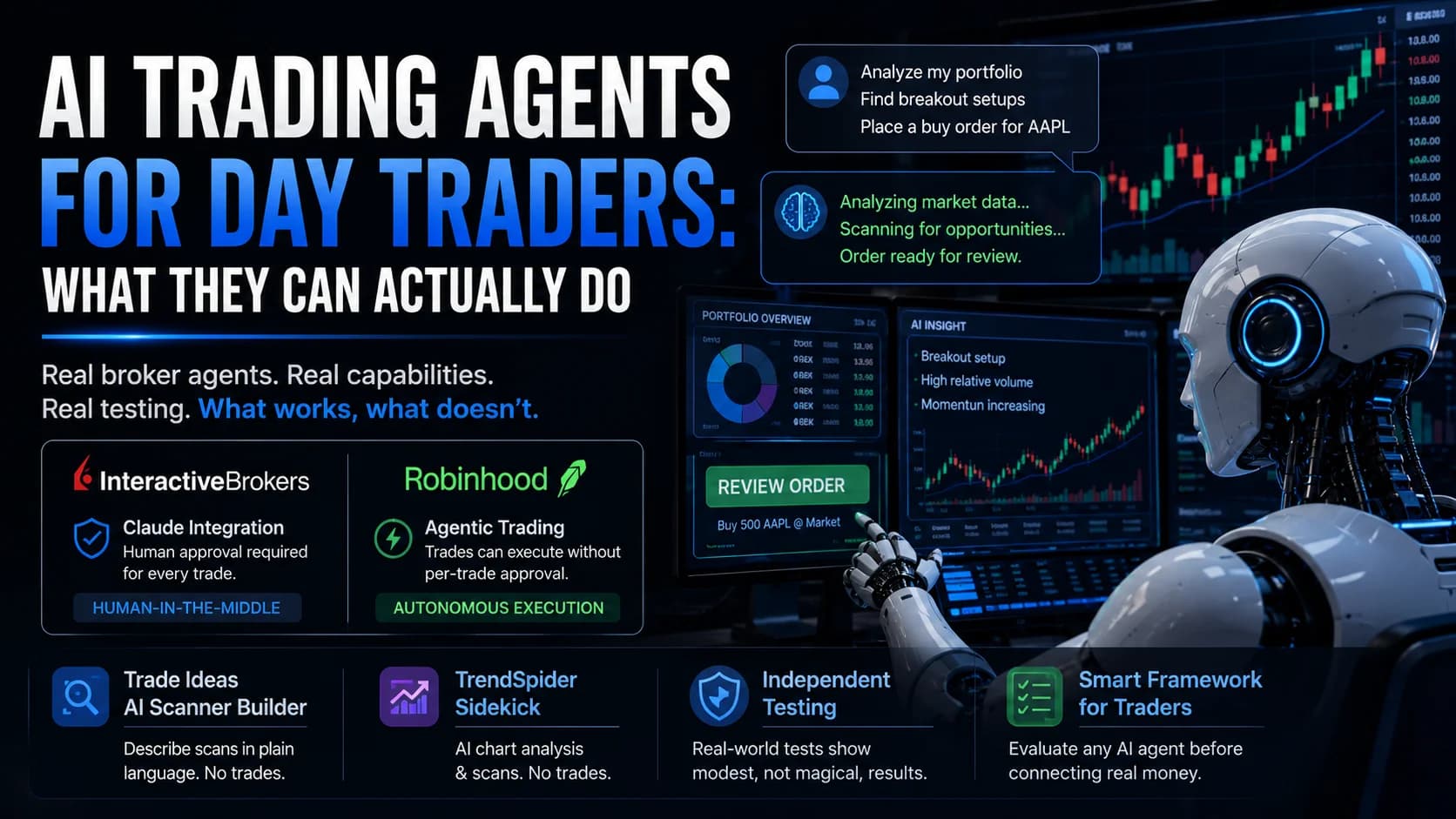
Level 5 — Agentic AI (the new frontier). Systems that don't just advise — they take actions. As of 2026, this moved from lab demo to live product, with mainstream platforms letting AI agents place trades inside guarded accounts. This is the most consequential and the most dangerous shift in the space, and it gets its own section below.
How to use the framework: when any tool claims AI, ask whether the company explains how it works or just chants buzzwords; whether it learns or merely follows rules; what data it trains on; what limits it admits to; and whether any performance data is verifiable and risk-disclosed. A tool that dodges those questions is selling marketing, not machine learning.
How Retail Day Traders Can Actually Use AI Today
Enough theory. Here's what's genuinely usable right now.
Large language models (ChatGPT, Claude, Gemini). The most accessible AI for retail traders, and one of the most useful. These models won't execute trades, but they compress research and learning dramatically. They're strong at brainstorming setups to test, generating Pine Script or Python for indicators and alerts without coding knowledge, explaining complex concepts faster than a textbook, finding patterns across a pasted trading journal, summarizing long financial documents, and producing quick company or SectorA broad grouping of companies that operate in the same segment of the economy — such as Technology, Healthcare, Energy, or Financials. Stocks within a sector tend to move together in response to shared economic, regulatory, and sentiment faRead definition → context.
There's also a capability that barely existed when most guides on this topic were written: modern models are multimodal. You can paste a chart screenshot and ask the model to describe the structure — trend, consolidation, candidate support and resistance, the pattern forming. It's a useful second opinion. It is not a trade signal: the model can't see live price, sometimes misreads complex structure, and should be one input among several, never the decision itself. Some models can now browse the web too, which helps with current context — but a browsing model still isn't a live market data feed.
A University of Florida study by Lopez-Lira and Tang found GPT-4 reached roughly a 90% hit rate at predicting the initial direction of market reactions to news headlines. Impressive in isolation, misleading without context: accuracy on any single headline was about 51% — a coin flip. The edge came from aggregating across many headlines and many days, not from being right on one call. That single statistic is the whole truth about LLMs and prediction in miniature. This guide goes deeper in the ChatGPT day trading guide, with specific prompts.
AI-powered scanners. For retail day traders, Trade Ideas is the clearest example of genuine machine learning in a scanning workflow — and it's a comprehensive trading platform, not just a scanner. Beyond real-time scanning across 500+ filters, it includes Holly AI signals (generated from nightly backtesting across historical data, with results that vary by market condition), built-in charting, paper trading, OddsMaker backtesting, a live trading room, and Brokerage Plus for one-click live execution through connected brokers. Rather than only filtering by static indicators, Holly surfaces setups that match patterns and conditions it has tested. It won't tell you which trades will work — no system can — but it scans far more of the market than any human can watch. Traders who want to try it can start here: Trade Ideas. For current pricing and discounts, check the deals page, and for a full breakdown of features and fit, see this guide's Trade Ideas review.
Trade Ideas added a second, distinct AI layer in July 2026: an AI Assistant that builds scan and alert windows from a plain-language description — typed or spoken — instead of manual filter configuration. It's a different tool from Holly, not a replacement for it: the Assistant builds the scans you describe, while Holly is the one generating trade ideas on its own. The full breakdown lives in this guide's AI Assistant guide.
TrendSpider is another genuine machine-learning option, strongest on automated technical analysis — trendline detection, pattern recognition, and rules-based backtesting. For where it fits versus a scanner-first workflow, this guide's tool reviews lay out the trade-offs.
Free and research-focused AI tools. Not every useful tool costs money. A growing set of free platforms now layer AI analysis and natural-language research over market data — useful for idea generation and context before you commit to a paid stack. DayTradingToolkit's independent look at one of them is the StockAlpha.ai review, and the free AI tools guide maps the wider field.
Sentiment analysis. AI reads news, social media, and commentary faster than any human, and some tools score real-time sentiment across thousands of sources around a ticker or sector. Genuinely helpful for news-driven trading — but sentiment is probabilistic, not predictive. A bullish score is not a buy signal. This guide covers the nuance in AI sentiment analysis for day trading.
What's New in 2026: Agentic AI and the Shift From Advice to Action
For years the honest answer to "can AI trade for me?" was: not really, and you wouldn't want it to. In 2026 that answer changed — and every retail trader should understand what changed and why caution matters more, not less.
Agentic AI means software that takes actions on your behalf without you clicking each button. Mainstream platforms have started offering exactly that: in May 2026, a major retail brokerage launched a product letting AI agents buy and sell stocks inside an isolated account funded separately from your main portfolio, with spending limits and a one-tap kill switch. Around the same time, a multi-asset platform launched a tool that lets users execute real trades from directly inside ChatGPT and Claude across hundreds of markets. The wall between "AI that advises" and "AI that acts" came down.
This is genuinely new capability. It is also where the risk profile changes completely. A few things every trader should sit with before going near it:
- You own the outcome, not the AI. The platforms offering this say so plainly: agents can make errors, and monitoring the account is your responsibility. The convenience is real; so is the accountability.
- Leverage plus autonomy is a fast way to lose money. With the pattern day trader rule eliminated in June 2026 (this guide's PDT elimination guide covers the details), smaller accounts now have more freedom to trade frequently. Handing that freedom to an autonomous agent multiplies both the upside and the damage.
- An agent can't explain its conviction. It can act faster than you can react. That's the appeal and the danger in one sentence.
This guide's position is straightforward: agentic trading is worth understanding because it's the direction the industry is moving, but it is not a shortcut to skill. If you can't trade a setup well yourself, automating it only loses money faster. Treat any agent as an experiment with strictly limited capital, full monitoring, and a kill switch you actually use — not as a replacement for learning to trade.
AI's Real Strengths for Day Trading
Set the hype aside and a few genuine advantages remain. These are documented capabilities, not hypotheticals.
Speed of information processing. AI reads a 50-page earnings report in seconds and scans thousands of headlines while you're still on the first paragraph. For information-heavy work, the speed edge is real. The IMF's October 2024 Global Financial Stability Report noted that since large language models became widespread, equity moves in the seconds after Federal Reserve releases line up more consistently with the eventual direction — a sign machines are already digesting complex documents faster than people.
Pattern recognition at scale. Machine-learning models scan thousands of charts across years of data and multiple timeframes at once. Holly, for instance, evaluates an enormous volume of scenarios nightly. You couldn't review that much data working around the clock.
Analysis without emotion. AI doesn't panic in volatility, doesn't feel FOMO, doesn't revenge trade. It evaluates the same data the same way every time. The catch — and it's a big one — is that the analysis is emotionless. The execution is still you, and that's exactly where your emotions show up.
A faster learning curve. For newer traders, language models collapse research time. Concepts that took weeks to piece together from scattered sources now take days. Used well, that's a genuine accelerant — used lazily, it's a way to feel informed without being informed.
Continuous monitoring. AI tools watch markets, news, and alert conditions around the clock. If you can't sit in front of screens all day, that monitoring is real value — provided you've set the conditions thoughtfully.
AI's Real Limitations: The Uncomfortable Truth
Here's where honesty earns its keep. Every limitation below is one that marketing tends to skip, and several can drain an account if you don't respect them.
LLMs have no live market data. ChatGPT, Claude, and Gemini cannot tell you what a stock is trading at right now. Even with web browsing, a model is reading text, not a live tape. Traders still make decisions based on a model's "analysis" of current conditions it literally cannot see. For real-time data, you need an actual platform.
Confident, fluent, and wrong. LLMs hallucinate — they invent statistics, misattribute quotes, fabricate events — while sounding completely certain. The IMF's note on generative AI in finance flagged exactly this: AI-generated assessments built on market sentiment "could be wrong," with real consequences for risk-taking. Verify anything that would move money. Never trade on a confident-sounding paragraph you haven't checked against a primary source.
Backtests that lie. Predictive models can post spectacular historical results by memorizing patterns that never repeat. This is overfitting, and it's one of the most expensive traps in quantitative trading — 80% backtest "accuracy" that collapses the moment real money is on the line because the model learned noise, not signal. This guide breaks it down in the hidden costs of automated trading.
No feel for context. AI processes data; it doesn't understand the day. It can't sense that price action is behaving strangely, or that a textbook setup "isn't right" given the broader tape. Reading market character, adjusting to the unusual, knowing when to sit on your hands — those remain human.
Garbage data, garbage output. A model is only as good as what it learned from. Train on poor data, or data that doesn't reflect current conditions, and the output fails confidently. Legitimate tools are transparent about their data and methods. Ones that won't explain their data are hiding something.
The herding risk. Regulators have flagged what happens when many traders lean on similar models. The SEC has warned that AI could heighten fragility by promoting herding — many actors making the same move because they're reading the same signal from the same base model. If thousands of accounts get "sell" at once, the cascade hurts everyone in it. Worth knowing even as an individual.
The Human–AI Partnership: Co-Pilot, Not Pilot
One principle organizes everything above: AI is an assistant, not a replacement for skill. It amplifies what's already there — good habits get sharper, bad habits get faster and more expensive.
The practical split is clean. Delegate to AI the data-heavy, repeatable work: research, document summarization, code generation, monitoring and alerts, scanning at scale, first-pass idea generation. Keep for yourself everything that requires judgment: final trade decisions, risk management, position sizing, reading the day's character, and — most important — knowing when to overrule the tool.
That last one matters because markets routinely do things no model trained for. Geopolitical shocks, surprise macro prints, regime changes — conditions where historical patterns break. When something feels off, human judgment beats pattern recognition, because the AI doesn't know what it doesn't know.
A workable AI-assisted routine looks like this: let scanners and models surface candidates, filter them against your own criteria and the current tape, use AI to dig deeper on the survivors, make the call yourself, then review outcomes — again with AI help — in your journal. AI at the edges, judgment in the center. This guide's walk-through of using AI to analyze your trading journal shows the review step in practice. And the deeper point — that AI can't supply the foundation you skipped — is the whole argument of why AI won't make you a better trader until you do the work first.
Regulation and Financial-Stability Considerations
You should know roughly where regulators stand, because it shapes what tools exist and how they behave.
Is AI trading legal? Yes. Using AI tools to trade is legal in the United States and most major markets. No rule bars a retail trader from using a language model, an AI scanner, or an automated system. What stays illegal is the behavior, not the tool: market manipulation, front-running, and fraud are illegal whether a human or an algorithm does them. FINRA applies "technology-neutral" rules — existing obligations cover AI the same way they cover anything else. The SEC has acted against firms for "AI washing" (overstating AI capabilities), but that's false-advertising enforcement, not a restriction on using AI.
The stability angle. The IMF's October 2024 report devoted a chapter to AI in capital markets. Its cautions: AI could increase speed and volatility under stress if models react alike; herding during shocks could become self-reinforcing; activity may grow more opaque as it shifts toward less-regulated intermediaries; and concentration risk rises when many firms depend on a few AI providers. It also noted real benefits — better risk management, deeper liquidity, sharper monitoring. The takeaway isn't that AI is bad; it's that the risks are specific and worth understanding.
Getting Started: A Realistic Roadmap
If you want to fold AI into your workflow without lighting money on fire, here's a progression that doesn't require a big upfront spend.
Phase 1 — Free tools first. Start with the free tiers of the major models to learn what they can and can't do. ChatGPT is a strong generalist for research and code; Claude often handles long documents and nuanced reasoning well; Gemini's search integration helps with current context. Use them for research, brainstorming, and learning — not live decisions, since they don't see live prices.
Phase 2 — Skills before software. This is the part most people skip, and it's the part that matters. AI amplifies what you already have. If you can't read a chart, a pattern scanner won't save you. If you can't manage risk, no model will. Build the foundation first: understand your style and edge, get position sizing and risk management right, write and test a basic plan, and put in screen time. If you're early, this guide's full beginner's guide is the place to start before any AI tool.
Phase 3 — Upgrade when it's justified. Pay for AI tools when you have a defined approach worth scaling, the free versions are genuinely limiting you, you've tested a tool and seen real value, and the cost is a small slice of your trading capital. Don't buy software hoping it makes you profitable — buy software that makes an already-working process more efficient.
Phase 4 — Build the integrated stack. For serious, active traders, the strongest setup combines a language model for research, a machine-learning scanner for idea generation, AI-assisted charting, and an AI-supported journal for review. It's a real investment — make sure your results justify it before committing, and route any purchase decisions through this guide's reviews and current deals.
The AI Day Trading Library
One guide won't make you fluent in AI trading. To build a real edge — and dodge the junk flooding the market — go deeper with the rest of this cluster, grouped by what you're trying to do.
Master generative AI the smart way:
Find scanners and tools that actually work:
- The Best AI Tools for Day Traders
- Free AI Tools for Day Trading
- AI Stock Scanners vs. Traditional Scanners
- Trade Ideas Holly AI: How It Actually Works — for current Trade Ideas pricing and discounts, see the deals page.
Sharpen strategy and analytics:
Protect your capital from the scams:
Frequently Asked Questions
What is AI trading and how does it work?
Can AI really predict stock prices?
Is ChatGPT useful for day trading?
What's the difference between AI trading and algorithmic trading?
Are AI trading bots legitimate or scams?
What is agentic AI trading, and should I use it?
Is AI trading legal?
Can AI replace human traders?
How do I start using AI for day trading?
How much does AI trading software cost?
Free model tiers deliver real research value. Charting and scanning platforms range widely by tier and features. Whether any of it is "worth it" depends entirely on whether it improves your results, not on the price tag. For current numbers and discounts, route to the deals page rather than trusting a figure that changes often. Key Takeaway: Start with free tools and only pay once a tool clearly earns its cost in your workflow.
Disclaimer
Article Sources
- IMF Global Financial Stability Report, October 2024 (Chapter on AI in Capital Markets) - AI's impact on market speed, herding, and document-processing effects.imf.org
- Lopez-Lira, A. & Tang, Y. — "Can ChatGPT Forecast Stock Price Movements?" (SSRN) - the 90% directional / 51% single-headline accuracy findings on LLM prediction.papers.ssrn.com
- FINRA — Artificial Intelligence (AI) in the Securities Industry - technology-neutral rule application and AI oversight guidance.finra.org
- Financial Stability Board — The Financial Stability Implications of Artificial Intelligence (Nov 2024) - herding, model risk, and data-governance concerns.fsb.org
- U.S. Securities and Exchange Commission - enforcement posture on "AI washing" and statements on AI and financial fragility.sec.gov
- Trade Ideas — official platform and features - reference for Holly AI, scanning, OddsMaker, and Brokerage Plus capabilities described above.daytradingtoolkit.com