

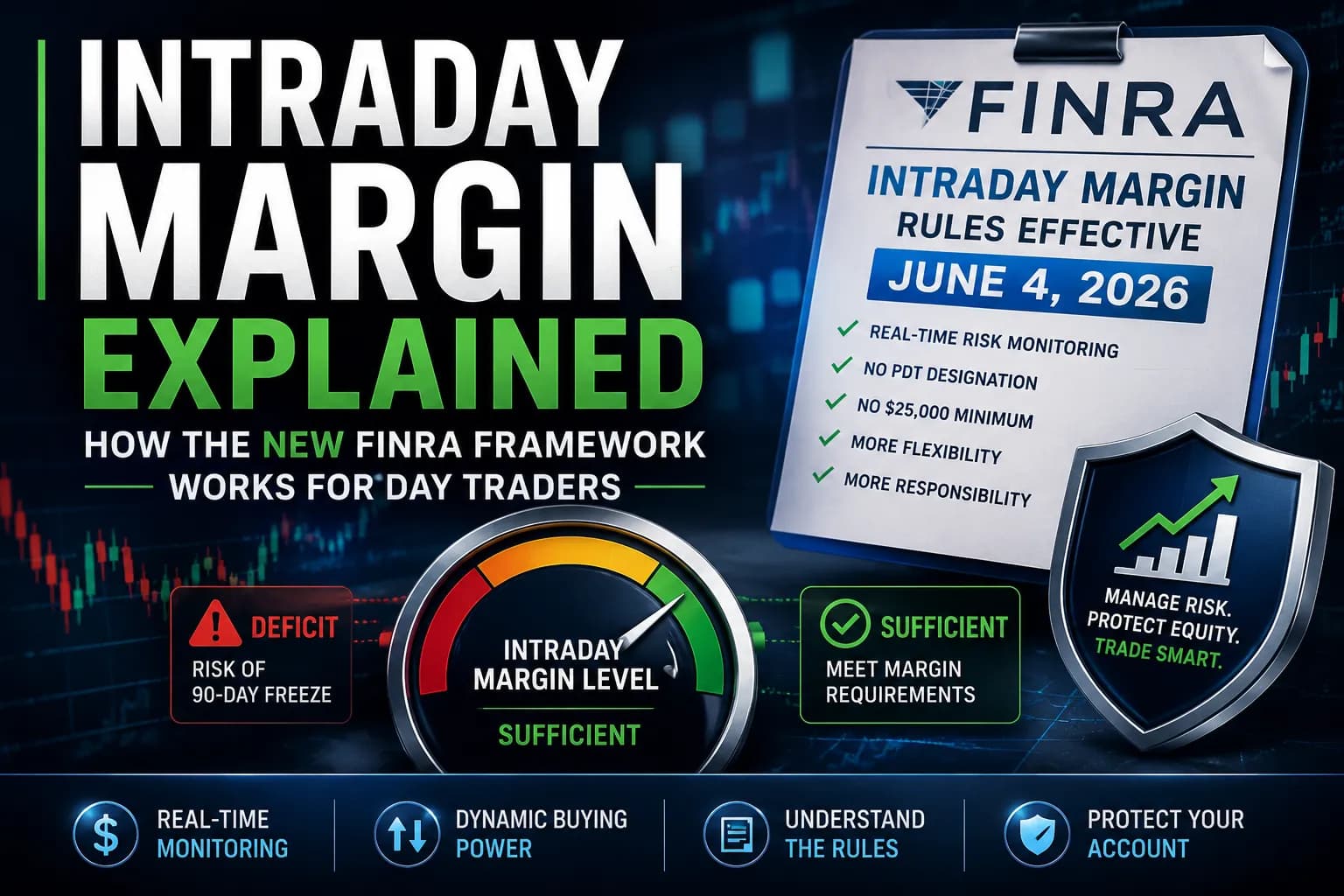
The $25,000 rule is gone. What replaced it is more flexible — but also more technical than most traders realize.
On June 4, 2026, FINRA's new intraday MarginMargin is borrowed capital from your broker that lets you control a larger position than your cash balance would otherwise allow — a $25,000 account with 4:1 intraday margin can control up to $100,000 in positions, amplifying both profits aRead definition → rules officially took effect, replacing the Pattern Day Trader framework that governed day trading accounts for 25 years. Most of the coverage has focused on what's going away: the $25,000 minimum equity requirement, the four-day-trade count, the "PDT" designation itself. What's received far less attention is what's arriving in its place — and for traders who don't understand the new mechanics, the surprises will not be pleasant.
The new system is called intraday margin. It does not restrict how many times you trade. It does not label you a pattern day trader. But it monitors your account equity in real time (or at end of day, depending on your broker), and if your positions consume more margin capacity than your account can SupportSupport is a price level where buying pressure has historically overcome selling pressure, causing price to stop declining and reverse — it's the floor where demand enters the market, and when it holds, it's a potential long entry; when it Read definition →, you will have an intraday margin deficit. Handle that deficit poorly, repeatedly, and you face a 90-day trading restriction — the same consequence as the old PDT freeze, arrived at through a completely different path.
This guide explains how the new framework actually works. Not the press release version — the mechanics version. What an intraday margin level is. What triggers a deficit. How your broker monitors it. What the $2,000 minimum means in practice. And the scenarios where traders who assume the new rules are more forgiving than the old ones will be in for a rude awakening.
What is intraday margin?
Intraday margin is FINRA's new framework for managing risk in customer margin accounts during the trading day. Effective June 4, 2026, it replaces the old Pattern Day Trader rules under FINRA Rule 4210. Instead of restricting trading based on trade count and a fixed $25,000 equity minimum, the new system requires your account equity to remain sufficient to cover a defined margin requirement at all times throughout the trading day — not just at the end of it. If it falls short at any point after a qualifying transaction, you have an intraday margin deficit.
From the Old System to the New: The Key Shift
It helps to understand what changed at the structural level before going into the mechanics.
Under the old PDT rules, the system worked like a counter and a threshold. FINRA counted how many times you day traded in a five-business-day rolling window. Hit four or more, and you were designated a Pattern Day Trader. That designation triggered a $25,000 minimum equity requirement. Fall below $25,000, and your broker froze your day-trading privileges for 90 days.
The system was blunt by design. It did not care how much risk you were actually taking — only how frequently you traded. A trader with $24,000 in a blue-chip stock, never using leverage, was treated identically to a trader with $24,000 in leveraged, volatile penny stocks. Same count, same freeze.
The new intraday margin framework does the opposite. It does not count trades. It does not care how many times you buy and sell in a day. What it cares about is whether your account equity is sufficient to cover the maintenance margin on your positions throughout the trading day. The risk monitoring is continuous and position-based, not activity-based.
That is a meaningful improvement in logic. But it also means you can no longer predict your buying power by looking at yesterday's closing balance and multiplying by four. Your available capacity changes dynamically as you open positions, as prices move, and as your margin requirements shift.
For a detailed breakdown of what the PDT rule actually was, what drove its elimination, and the broker-by-broker implementation timeline, see our complete PDT rule elimination guide. If you are still deciding whether a margin account is right for you at all, our margin vs. cash accounts guide covers the foundational tradeoffs.
Understanding the Intraday Margin Level (IML)
The entire new system is built around a single concept: the Intraday Margin Level, or IML.
Here is the FINRA definition, translated out of regulatory language: the IML is the amount of money you could withdraw from your margin account right now while still meeting the maintenance margin requirement on all your current open positions.
Think of it as a buffer. When you have no open positions and your account is fully in cash, your IML is essentially the full value of your account — you could withdraw most of it without violating any margin requirements. The moment you open a leveraged position, maintenance margin requirements kick in, reducing your IML. Open a bigger position, or a more volatile one with a higher margin requirement, and your IML shrinks further.
The critical point: the IML is not a fixed number. It changes continuously throughout the trading day as your positions change in value. If a stock you bought rises, your account equity rises and your IML improves. If it drops, your IML drops with it.
Under the old PDT system, margin monitoring happened at end of day. You could carry intraday positions, see your account equity drop significantly during the session, and as long as it recovered before close — or you deposited funds before the deadline — the mechanics were forgiving about intraday swings. The new system removes that buffer. Maintenance margin must be met throughout the trading day, not just at the close.
What Is an IML-Reducing Transaction?
The IML-reducing transaction is the specific trigger point the new rules care about.
An IML-reducing transaction is, broadly, any trade that decreases your IML — any trade that reduces the amount you could withdraw from your account while still meeting maintenance margin requirements.
In practice, this covers:
- Buying a stock on margin. Purchasing a security using borrowed funds increases your margin exposure, which reduces your IML.
- Executing a short sale. Short SellingShort selling is borrowing shares from a broker and selling them at the current price with the intention of buying them back later at a lower price — profiting from the price decline, but with theoretically unlimited loss potential if the sRead definition → creates a liability in your account, which reduces your IML.
- Any transaction that increases your maintenance margin requirement without a corresponding increase in your account equity.
What does not count as IML-reducing:
- Buying to cover an existing short position (this typically reduces margin exposure, improving IML)
- Closing a long position you already hold
- Depositing cash into your account
The reason the definition matters: FINRA only requires your broker to calculate an intraday margin deficit on days when you execute an IML-reducing transaction. If you are purely closing positions and not opening new ones, you are not triggering the intraday deficit calculation process for that day.
How an Intraday Margin Deficit Forms
Now we get to the core concept.
An intraday margin deficit is the highest deficiency between the maintenance margin required and the account equity in your account at any point following an IML-reducing transaction on a given trading day.
Break that down:
- Your account has some amount of equity.
- Your open positions require a certain amount of maintenance margin (25% of the market value of your long margin-eligible equity positions, as a general baseline).
- If, at any point during the day after you've executed an IML-reducing transaction, your equity falls short of that maintenance margin requirement, the GapA gap is a price discontinuity on a chart where a stock opens significantly higher or lower than the previous session's close, leaving a visible empty space — gap-ups are driven by overnight buying pressure or positive news; gap-downs by seRead definition → between what you need and what you have is your intraday margin deficit.
- The deficit is measured as the highest such gap during the day — the worst point.
A concrete example: Suppose you have $8,000 in a margin account. You buy $30,000 worth of stock on margin (using $22,000 in borrowed funds). The maintenance margin requirement on that $30,000 position is 25%, or $7,500. Your account equity covers that comfortably — you have $8,000, you need $7,500, so you have $500 of cushion.
Now the stock drops 5%, bringing the position value to $28,500. Your account equity drops with it — it is now approximately $6,500 (your original $8,000 minus the $1,500 paper loss). The maintenance margin requirement on a $28,500 position is 25%, or $7,125. You now need $7,125 but only have $6,500. The gap — $625 — is your intraday margin deficit.
If the stock recovers before close, the deficit resolves itself. If it does not, you have an outstanding deficit that must be satisfied.
The important nuance here: the size of the deficit that matters is the highest it reached during the day, not where it ends up at close.
The $2,000 Minimum — What It Actually Means in Practice
Here is where a lot of the simplified coverage gets misleading. You have probably seen headlines saying something like "the $25,000 PDT minimum is gone — now you only need $2,000 to day trade." That is technically true but practically incomplete.
The $2,000 figure is the minimum equity required to use leverage in a margin account at all. Below $2,000, you can maintain a margin account, but you can only trade with the actual cash you have — no borrowed funds, no leverage.
Above $2,000, you can use leverage. But the amount of leverage available to you is not a fixed multiplier — it is determined dynamically by your account equity, your positions, and the maintenance margin requirements on those positions.
The practical implication: a trader with $3,000 in a margin account who buys $10,000 worth of a stock requiring 25% maintenance margin needs $2,500 in equity to avoid a deficit. That leaves only $500 of cushion. A 5% drop in that stock wipes out the cushion entirely and creates a deficit. A 10% drop creates a significant deficit.
What this means for smaller accounts: the new rules are more permissive in terms of activity — you can trade as many times as you want — but they are not more permissive in terms of risk capacity. A $5,000 account has $5,000 worth of maintenance margin capacity. It cannot comfortably support $20,000 in leveraged stock exposure. The math does not change just because the PDT label is gone.
The traders most at risk of surprises here are those who assume that removing the trade count restriction also removes the leverage constraint. It does not. In fact, for small accounts using leverage aggressively, the new system's real-time monitoring is in some ways less forgiving than the old end-of-day methodology.
How Your Broker Monitors Your Account: Real-Time vs. End-of-Day
FINRA gave brokers two implementation options, and which one your broker chooses will meaningfully affect your day-to-day trading experience.
Option 1: Real-Time Monitoring with Pre-Trade Blocking
Under this approach, your broker monitors your account equity against your open positions continuously throughout the trading day. If an order you are about to place would create an intraday margin deficit — or worsen an existing one — the broker blocks the trade before it executes.
This is the more sophisticated implementation and requires significantly more technology infrastructure. Firms like Interactive Brokers, which already operated real-time position-level risk engines before the change, were among the early adopters of this approach. Schwab also confirmed it uses real-time monitoring, blocking trades that would create or worsen a deficit before they execute.
What this feels like as a trader: Your buying power display updates dynamically throughout the day. You will see your available margin capacity shrink as your positions move against you, and expand as they move in your favor. If you try to place an order that would breach your margin capacity, it simply will not go through — similar to how a cash account blocks you if you try to spend more than your balance.
Option 2: End-of-Day Calculation with Margin Calls
Under this approach, the broker performs a single calculation at the end of the trading day. If your account had an intraday margin deficit at any point during the day (specifically, the highest deficit reached), the broker issues a margin call for that amount.
This gives traders more intraday flexibility — you can go into deficit territory during the session as long as you resolve it before close. But it also means you can accumulate a deficit without realizing it, and receive a margin call after the session ends.
What this feels like as a trader: Your buying power display may be less dynamic. You may be able to execute trades during the day that would otherwise be blocked under real-time monitoring. But at the end of the day, if the math shows a deficit, you owe that amount — and you must pay it promptly.
The practical advice: Confirm which approach your specific broker uses, since it changes how trading actually feels day to day. As of this update, both Schwab and ETRADE have confirmed their rollout is complete: Schwab chose real-time monitoring and finished its transition on June 8, 2026, and ETRADE completed its rollout on June 9, 2026. For the full broker-by-broker status across every major platform, see this site's complete PDT rule elimination guide. Most other major brokers have also confirmed implementation; don't assume your broker's approach matches another broker's without checking directly.
What Happens When You Have a Deficit — and the 90-Day Freeze
This is the most important section for traders to understand, because it is where the consequences of the new system become real.
When you have an intraday margin deficit, you must satisfy it "as promptly as possible."
FINRA does not define "promptly" with a precise clock, but the rule text sets two distinct deadlines that are easy to conflate. First, an accounting cutoff: a deficit can be satisfied through net deposits or other IML increases any time between the day it occurs and the close of business on the 15th business day after that date. Once that window closes, the deficit is no longer treated as outstanding for satisfaction purposes, regardless of what happens to your account afterward. That's a separate deadline from the one that actually triggers the 90-day freeze, which runs on a much shorter, five-business-day clock, covered next.
The 90-day freeze — how it happens:
If you develop a pattern of failing to satisfy intraday margin deficits promptly, and if you specifically fail to satisfy a deficit by the close of business on the fifth business day after the deficit date, your broker is required to restrict your account for up to 90 days.
During a 90-day freeze, you cannot receive extensions of credit — meaning you cannot use margin for trading. You can still trade with cash you actually hold in the account.
Note the subtle but important difference from the old PDT freeze: the old freeze was triggered by trading activity (4+ day trades while below $25,000). The new freeze is triggered by deficit behavior — specifically by establishing a pattern of not meeting your obligations. It is possible under the new system to execute hundreds of day trades a month and never face a freeze, if your account is appropriately funded and managed. It is also possible to execute very few trades and trigger a freeze if you repeatedly run deficits and fail to resolve them quickly.
Exceptions to the freeze:
FINRA built in two exceptions — situations where a deficit will not trigger the 90-day restriction even if not satisfied within five business days:
- The deficit does not exceed the lesser of 5% of account equity or $1,000 (a de minimis threshold).
- The deficit occurred under "extraordinary circumstances" — a term FINRA will interpret case by case, but which generally refers to events outside the trader's control, such as a significant market event or a broker system failure.
Practical Scenarios: What This Looks Like in Real Trading
Abstract rules only become useful when you see them applied. Here are four realistic scenarios illustrating how the new intraday margin framework plays out.
Scenario 1: The Textbook Clean Trade
Account equity: $15,000. No open positions.
You buy 200 shares of a stock at $50 ($10,000 position). Maintenance margin required: 25% of $10,000 = $2,500. Your equity is $15,000 — far more than the $2,500 requirement. Your IML is healthy. The stock runs to $55. You sell for a $1,000 profit. No deficit was triggered at any point.
This is the most common outcome. A reasonably sized position relative to account equity, managed with a stop-loss, will almost never create an intraday margin deficit.
Scenario 2: The Overleveraged Position
Account equity: $6,000. Margin account at a broker using end-of-day monitoring.
You buy $20,000 worth of a volatile biotech stock on margin (using $14,000 in borrowed funds). Maintenance margin: 25% of $20,000 = $5,000. Your $6,000 equity covers it — barely, with $1,000 of cushion.
The stock drops 7% on a news release to $18,600. Your equity drops to approximately $4,600 (the $1,400 loss falls on you, not the broker). Maintenance margin required is now 25% of $18,600 = $4,650. You need $4,650 but have $4,600. You have a $50 deficit.
At end of day, your broker issues a margin call for $50. You deposit $50 that evening. Deficit satisfied. No freeze.
But if the stock had dropped 15% instead of 7%, your deficit would have been much larger — potentially requiring a same-day deposit you might not have available. This is the scenario where aggressive leverage on volatile stocks becomes dangerous under the new system.
Scenario 3: The Trigger for the 90-Day Freeze
Account equity: $4,500. Trader repeatedly operates near capacity.
Over three consecutive weeks, the trader runs small intraday deficits due to taking positions that push against their margin capacity. The broker issues margin calls after each session. The trader does not deposit funds — instead, the positions recover or close, and the deficits technically resolve when positions are closed. But the broker's system logs this as a pattern of failing to satisfy deficits promptly.
On the fifth occurrence, the broker enforces the 90-day restriction. The trader can no longer access margin for the next 90 days.
The lesson here: deficits that resolve because a position happened to recover are not the same as deficits that are satisfied. FINRA's language requires active steps to meet the obligation — not passive resolution by market movement.
Scenario 4: The Small Account Navigating Correctly
Account equity: $4,000.
A trader with $4,000 wants to day trade actively under the new rules. They focus on smaller position sizes — $2,000 to $3,000 per trade — staying well within a margin cushion that even a 10% adverse move would not breach. They use a pre-trade checklist: before every trade, they verify that the Position SizePosition size is the number of shares, contracts, or dollar value you deploy in a single trade — determined by the relationship between your account risk percentage, your dollar risk per share (distance to stop), and your account size ratheRead definition →, at 25% maintenance margin, still leaves their equity with at least 30% buffer above what's required.
This trader day trades 10-15 times per week without triggering a single deficit. The new rules created no practical obstacle for them — because they sized correctly relative to their actual account equity.
The moral is simple: position sizing discipline is the mechanism that keeps you out of trouble under the new system. Our position sizing guide and our advanced risk management framework both cover the mathematical frameworks for this in detail.
One More Thing: Portfolio Margin Accounts
For traders with larger accounts, it is worth noting that the new rule also applies a parallel intraday risk control framework to portfolio margin accounts with less than $5 million in equity.
Portfolio margining — a separate, more sophisticated margining system available to qualified accounts — applies risk-based rather than fixed-percentage margin requirements. The new rules bring these smaller portfolio margin accounts into the intraday monitoring framework alongside standard margin accounts.
If you are operating a portfolio margin account under $5 million, you should review the specific intraday controls your broker is implementing for that account type. The specifics vary by firm and are more complex than what is covered here — consult directly with your broker's margin desk.
Frequently Asked Questions
Do I still need $25,000 to day trade after June 4, 2026?
The $2,000 figure is the general minimum equity requirement for any margin account — it has existed for years and is not a new PDT replacement rule. Above $2,000, you can trade as many times per day as you want. However, your practical buying power is still limited by your account equity and the maintenance margin requirements on your positions. A $3,000 account can day trade freely but cannot support the same position sizes as a $30,000 account.
Key Takeaway: $25,000 is no longer required, but adequate funding relative to your position sizes remains essential — the new rules do not change the math of leverage and margin requirements.
What is an intraday margin deficit in plain English?
Think of it as your account temporarily going "in the red" on margin. If you open a position and the market moves against you enough that your equity falls below 25% of your position's current value, that shortfall is your intraday margin deficit. You are required to fix it — by depositing funds, closing positions, or both — as quickly as possible.
Key Takeaway: A deficit is not automatically catastrophic — a small, quickly resolved deficit will not permanently damage your account. The problem comes from repeated deficits that are not promptly satisfied.
What triggers an intraday margin deficit — can it happen on any trade?
Once you have executed an IML-reducing transaction during a session, your broker calculates the highest deficit that occurred at any point in that session. If you only bought to cover a short, or only closed out long positions, no deficit calculation is required for that day.
Key Takeaway: Days where you are purely exiting positions carry no deficit calculation risk. Days where you are opening new leveraged positions are the ones where monitoring matters.
What is the difference between maintenance margin and intraday margin?
Under the old system, maintenance margin was checked at end of day. The new intraday margin rules extend that check to any point during the session when you execute a qualifying trade. The maintenance margin percentage itself (typically 25% for stocks) did not change — only when and how often compliance is checked changed.
Key Takeaway: If you were already managing your margin account conservatively and respecting maintenance margin requirements, the new system creates minimal practical change. It is primarily a shift in the monitoring methodology, not the underlying equity requirements.
What happens if I get a margin call under the new rules?
Satisfying a margin call means either depositing cash or securities to bring your equity above the required maintenance margin level, or closing enough positions to reduce your margin exposure. Waiting for a position to recover is not considered "promptly satisfying" the deficit — it must be actively resolved.
Key Takeaway: Treat margin calls under the new system the same way you would treat them under the old system — address them immediately. The 90-day freeze mechanism is still there; only the trigger mechanism changed.
Can I still be frozen out of day trading under the new rules?
The freeze is no longer triggered by trading too many times. But it can still be triggered by repeatedly running deficits and not addressing them. The practical effect on your account during a freeze is similar to the old PDT freeze: you can trade with cash only, no leverage.
Key Takeaway: The 90-day freeze did not disappear with the PDT rule. It remains in the framework, just attached to a different trigger mechanism — deficit behavior rather than trade count.
Does it matter whether my broker uses real-time or end-of-day monitoring?
If your broker uses real-time monitoring, you will experience more active trade blocking — your order simply will not go through if your margin capacity cannot support it. This is more conservative but means fewer surprise margin calls. If your broker uses end-of-day monitoring, you have more intraday flexibility but must track your own margin exposure carefully throughout the session to avoid end-of-day surprises.
Key Takeaway: Ask your broker directly which approach they are implementing. This is one of the most practically important implementation details of the new rule for active traders.
How do I know if my trading style is compatible with the new intraday margin rules?
The simplest pre-trade check: take your planned position size, multiply by 25%, and confirm that your account equity exceeds that number by a comfortable buffer — ideally at least 30-40% above the minimum. If your standard position sizes push your account close to the maintenance margin line, you will be vulnerable to deficits during normal intraday price fluctuations. Use our reward/risk calculator to stress-test position sizes before going live under the new framework.
Key Takeaway: The new rules reward disciplined position sizing and punish over-leverage just as the old rules did — they just do it through real-time margin monitoring rather than trade counting. The math of risk management remains unchanged.
Disclaimer
Article Sources
- https://www.finra.org/rules-guidance/notices/26-10 - FINRA Regulatory Notice 26-10 — Official notice announcing the effective date of June 4, 2026, and summary of new intraday margin standards.finra.org
- https://www.finra.org/investors/insights/intraday-margin-requirements - FINRA Investor Insights — "Understanding the New Intraday Margin Requirements" — FINRA's official investor-facing explainer on the new framework.finra.org
- https://www.federalregister.gov/documents/2026/04/17/2026-07485/ - SEC / Federal Register — Order Granting Accelerated Approval of proposed rule change to amend FINRA Rule 4210 (April 17, 2026).federalregister.gov
- https://us.etrade.com/knowledge/library/margin/pattern-day-trading-rule-change - E*TRADE — "FINRA's Pattern Day Trading Rule Change" — Broker implementation guidance covering the new intraday buying power mechanics.us.etrade.com
- https://www.kslaw.com/news-and-insights/finra-adopts-sweeping-changes-to-margin-requirements-for-day-trading - King & Spalding LLP — "FINRA Adopts Sweeping Changes to Margin Requirements for Day Trading" — Legal analysis of the Rule 4210 amendments.kslaw.com
- https://www.wilmerhale.com/en/insights/client-alerts/20260423-sec-approves-amendments-to-finra-rule-4210-replacing-day-trading-margin-requirements-with-a-modernized-intraday-margin-standard - WilmerHale — "SEC Approves Amendments to FINRA Rule 4210 Replacing Day Trading Margin Requirements with a Modernized Intraday Margin Standard" (April 23, 2026).wilmerhale.com
- https://www.schwab.com/learn/story/schwab-changes-rules-around-day-trading - Charles Schwab — "Schwab Updates Day Trading and Margin Rules" — Schwab's official confirmation of its June 8, 2026 rollout and real-time monitoring approach.schwab.com