
Somewhere right now, a trader is staring at an ad promising a "revolutionary AI trading bot" capable of generating "consistent 90%+ returns on autopilot." The pitch is irresistible. Just plug in your account, let the AI work, and watch the money roll in.
Here's what years of independent research and tool evaluation reveal: that ad is almost certainly lying — not about everything, but about the part that matters most.
The technology is real. Machine learning can genuinely improve certain aspects of trading. But the vast majority of products marketed as "AI-powered" to retail traders are about as intelligent as a kitchen timer with a premium label. The U.S. Commodity Futures Trading Commission put it plainly in its official customer advisory: "AI technology can't predict the future or sudden market changes."
That's not an opinion. That's the federal regulator responsible for overseeing commodity and futures markets telling you, in plain English, that the marketing doesn't match reality.
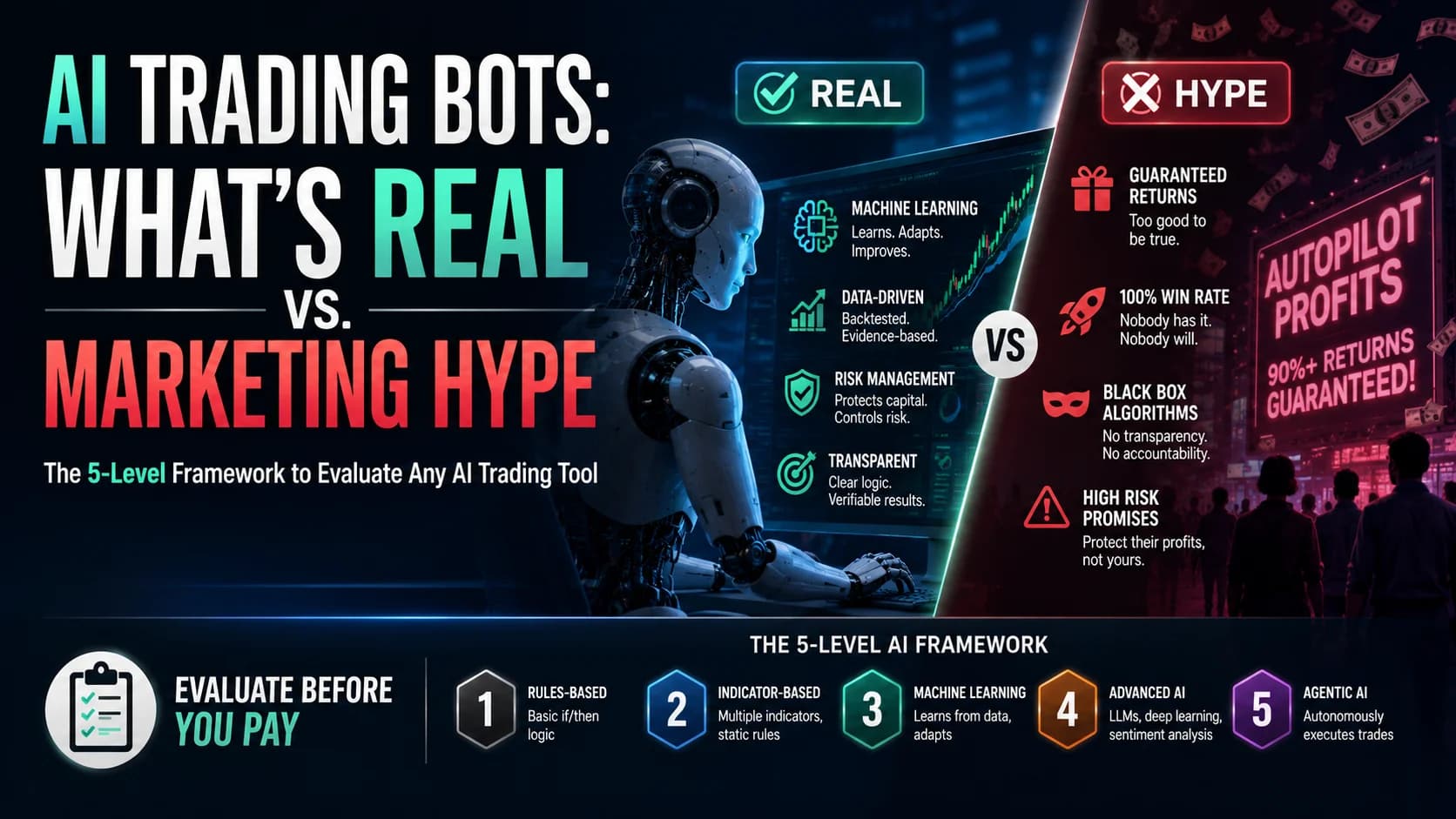
So how do you separate genuine AI trading tools from hype machines and outright scams? That's exactly what this article covers. DayTradingToolkit's documented research produced the 5-Level AI Framework — a classification system that cuts through any "AI" product claim, tells you what you're actually getting, and gives you a practical checklist before you hand over money.
No hype. No sales pitch. Just the truth.
What is an AI trading bot? An AI trading bot is software that automates some or all of a trading workflow — scanning, signaling, or executing trades — using rules, algorithms, or machine learning. The term covers everything from simple if/then alert systems (often mislabeled "AI") to genuine machine-learning platforms that adapt nightly to current market conditions.
The Great AI Trading Bot Marketing Machine
The word "AI" has become the most overused term in trading software marketing — and it's not hard to see why. Slap "AI-powered" on any product and it immediately sounds cutting-edge and trustworthy. The problem: there is no regulatory standard defining what qualifies as "AI" in a trading product. Any company can call a basic if/then alert system "artificial intelligence" and face zero consequences — unless, as covered below, regulators catch them making specific false claims.
The marketing playbook is predictable. Terms like "machine learning," "neural networks," "deep learning," and "proprietary algorithm" appear in product descriptions with the same casual abandon as "artisanal" on a $12 loaf of bread. They sound impressive. They create an aura of sophistication. And most retail traders don't have the technical background to question whether those terms are being used accurately.
The result: a market flooded with products that are, at best, basic rules-based systems dressed up in AI marketing — and at worst, outright scams designed to take your money.
The CFTC's customer advisory is remarkably direct. The agency warns that scammers are "exploiting public interest in artificial intelligence to tout automated trading algorithms, trade signal strategies, and crypto-asset trading schemes that promise unreasonably high or guaranteed returns." Products claiming "100 percent win rates" or returns of "tens of thousands of percent" are specifically called out.
Quick reality check: if anyone had a system capable of 100% win rates, they wouldn't be selling it to you for $49.99 a month.
Understanding what algorithmic trading actually involves — the infrastructure, data requirements, ongoing maintenance — is the first step to seeing through the fog. But to evaluate any specific product, you need a structured framework.
The 5-Level AI Framework for Evaluating Any "AI" Trading Bot
DayTradingToolkit's framework for classifying AI trading tools cuts through the noise for any product — stocks, crypto, forex, futures — that claims to use artificial intelligence. Think of it as the car analogy: someone tries to sell you a "self-driving car." Level 1 is cruise control. Level 2 adds lane assist. Level 3 is genuine autopilot requiring human oversight. Level 4 is a fully autonomous vehicle. Level 5 is an agent that can drive to destinations you haven't specified and make real-time decisions along the way. Each level is a real technology. Marketing them all as "self-driving" would be wildly misleading.
The same thing is happening in trading.
- Level
- 1
- Classification
- Rules-Based
- What It Actually Does
- Executes pre-programmed if/then logic. "If RSI drops below 30, buy." No learning, no adaptation.
- Retail Examples
- Most marketed "AI bots"
- Level
- 2
- Classification
- Indicator-Based
- What It Actually Does
- Combines multiple technical triggers with conditional logic. More complex rules, but still static.
- Retail Examples
- "Smart" scanner alerts, basic signal services
- Level
- 3
- Classification
- Machine Learning
- What It Actually Does
- Learns from historical data, optimizes parameters, adapts strategies based on performance.
- Retail Examples
- Trade Ideas Holly AI, TrendSpider AI Strategy Lab
- Level
- 4
- Classification
- Advanced AI (LLMs / Deep Learning)
- What It Actually Does
- Neural networks, natural-language processing, sentiment analysis, multimodal reasoning.
- Retail Examples
- ChatGPT, Claude, Gemini — emerging in retail
- Level
- 5
- Classification
- Agentic AI
- What It Actually Does
- Takes actions autonomously — not just advises, but executes trades on your behalf.
- Retail Examples
- Launched in retail in 2026; see section below
| Level | Classification | What It Actually Does | Retail Examples |
|---|---|---|---|
| 1 | Rules-Based | Executes pre-programmed if/then logic. "If RSI drops below 30, buy." No learning, no adaptation. | Most marketed "AI bots" |
| 2 | Indicator-Based | Combines multiple technical triggers with conditional logic. More complex rules, but still static. | "Smart" scanner alerts, basic signal services |
| 3 | Machine Learning | Learns from historical data, optimizes parameters, adapts strategies based on performance. | Trade Ideas Holly AI, TrendSpider AI Strategy Lab |
| 4 | Advanced AI (LLMs / Deep Learning) | Neural networks, natural-language processing, sentiment analysis, multimodal reasoning. | ChatGPT, Claude, Gemini — emerging in retail |
| 5 | Agentic AI | Takes actions autonomously — not just advises, but executes trades on your behalf. | Launched in retail in 2026; see section below |
The overwhelming majority of retail "AI trading bots" are Level 1 or Level 2. They are rules engines with a marketing department. The "AI" label is cosmetic.
The critical difference between Level 1–2 and Level 3–5 is whether the system learns and adapts. A Level 1 bot executes the same rules forever, regardless of whether market conditions have changed. A Level 3 system — like Trade Ideas' Holly — reruns its entire strategy library through BacktestingThe process of running a defined trading strategy against historical price data to evaluate how it would have performed before risking real capital. A well-constructed backtest gives you a statistical baseline — win rate, profit factor, maxRead definition → every single night and adjusts which strategies it deploys based on current conditions. That is a fundamentally different technology.
Does that mean Level 1–2 tools are useless? Not necessarily. A well-designed rules-based scanner can help you find candidates faster. But you should know what you're buying. If a company is charging $200 a month for a Level 1 product while marketing it as "cutting-edge AI," you're overpaying for the technology and being misled about what it does.
The full picture of the framework — including how to apply it to your own workflow — lives in this site's complete AI day trading guide. The best AI tools roundup maps the best-in-class option at each level for different trading jobs.
What Genuine AI Trading Actually Looks Like
Most "AI" bots aren't really AI. But genuine AI trading tools do exist for retail traders. Understanding what they look like — and what they can realistically do — is how you calibrate expectations correctly.
Trade Ideas Holly AI is the clearest example of genuine machine learning available to retail day traders. Every night after the market closes, Holly runs dozens of trading strategies through a backtesting engine, evaluates each against recent market data, and deploys only the strategies meeting strict performance criteria for the next session. Holly operates across multiple systems, each targeting different risk profiles and trade types. For the full mechanical breakdown of how Holly works — including its three systems, signal logic, and honest limitations — this site's Holly AI deep dive covers it in full.
This is legitimately impressive technology. It's adaptive; the strategy selection changes based on current market conditions. It's data-driven; decisions come from quantitative backtesting, not gut feel. And the track record goes back years.
But it is not magic. Independent testing has noted that some displayed results can reflect favorable backtesting windows. A meaningful percentage of Holly's signals lose money. Tools don't guarantee profits, and nothing about Holly changes that. For a comprehensive breakdown of the full Trade Ideas platform — scanning, charting, paper trading, Brokerage Plus execution, pricing, and who it's actually built for — the Trade Ideas review is the place to start. Current pricing and available discounts are on the deals page.
Trade Ideas also added a second, distinct AI layer in July 2026: an AI Assistant that builds scan and alert windows from a plain-language description instead of manual filter configuration. It's a different tool from Holly, not a replacement — the Assistant builds the scans you describe, Holly is the one generating trade ideas on its own. This site's AI Assistant guide covers exactly what it does and doesn't do.
TrendSpider is another legitimate application of machine learning in retail trading. Its AI Strategy Lab uses pattern recognition and machine learning to identify chart patterns and optimize strategy parameters automatically. The TrendSpider review covers its AI features in detail, including the Strategy Lab, Sidekick, and automated trendlines.
What the academic research says. A 2024 study in the Journal of Financial Economics by Cao, Jiang, Wang, and Yang found that AI outperformed human analysts in raw prediction accuracy for stock analysis. But the real takeaway was the hybrid result: the "Man + Machine" approach — human analysts using AI as a tool — outperformed both humans alone and AI alone. That finding aligns with this guide's core position: AI is a co-pilot, not the pilot. Building the human half of that equation is its own skill, and it doesn't come from watching Holly's signal feed alone — it comes from screen time and, for a lot of traders, structured mentorship. Communities like Investors Underground exist for exactly that half of the pairing: the pattern recognition and risk judgment a backtesting engine can't teach.
Where AI actually adds value (the unsexy truth). Professional quant traders don't primarily use AI to predict price direction. They use it for operational advantages: dynamic position sizing based on volatility regimes, execution optimization to reduce SlippageSlippage is the difference between the price you expected to receive when placing a trade and the actual fill price you got — it occurs because the market moved between when you placed the order and when it was executed, or because you usedRead definition →, regime detection to know when to turn strategies on or off, and portfolio heat distribution across sectors. These applications compound small advantages over thousands of trades. Not glamorous. But that's what actually works.
The GAO confirmed this in their May 2025 report on AI in financial services (GAO-25-107197), noting that financial institutions use AI across automated trading, risk management, credit decisions, and customer service — while flagging significant risks around bias, hallucinations, data quality, and conflicts of interest. The technology is powerful. It's also imperfect.
Agentic AI in 2026: A New Category That's Not a Scam — But Carries New Risks
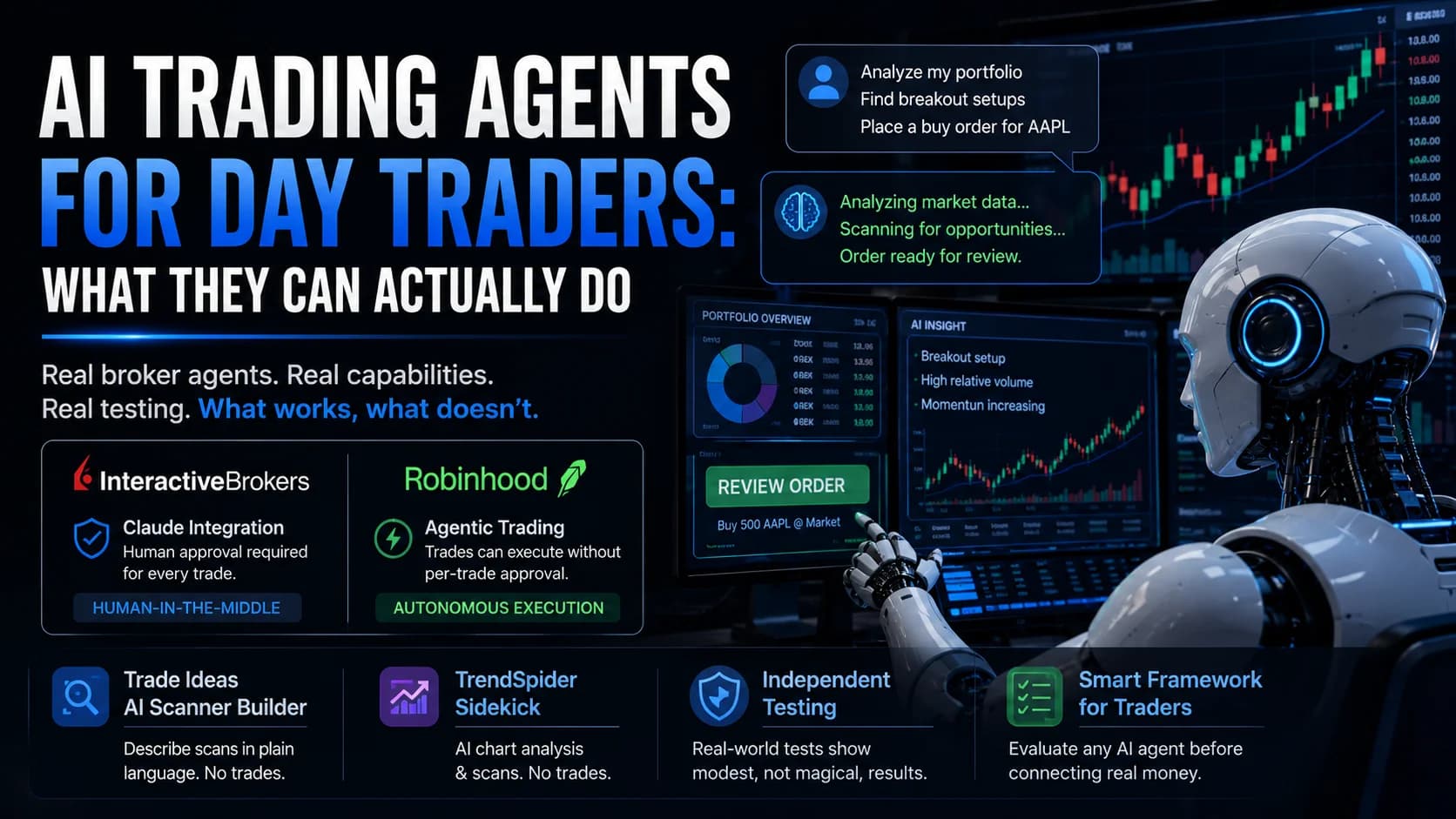
Level 5 crossed from concept to live retail product in 2026. Mainstream platforms now offer tools that let AI agents place trades inside isolated, separately funded accounts with spending limits and a one-tap kill switch. This is genuinely different from the "set and forget" passive-income bots covered in the red flags below.
The distinction matters: a scam bot promises autonomous profits and requires no attention. A legitimate agentic tool is explicit that it can make errors, that monitoring is the user's responsibility, and that the account is guarded with hard spending limits. One is a fraud. The other is a real product with a specific, well-defined risk profile.
But even legitimate agentic AI demands more caution than research-only tools, not less. Autonomy plus leverage can lose money faster than a human can react. The relevant question isn't "is this a scam?" — it's "do I understand what this agent will do without my input, and have I stress-tested it with capital I can afford to lose?" If the answer to either part is no, the account funding level should be zero until it's yes.
The SEC Is Cracking Down: Real AI Washing Enforcement Cases
If you needed proof that "AI washing" is a serious problem, look at the SEC's enforcement record. The regulator has made it clear that companies making false claims about their AI capabilities will face consequences.
March 18, 2024: The First-Ever AI Washing Cases
The SEC announced settled charges against two investment advisers in the first enforcement actions specifically targeting AI-related misrepresentations.
Delphia (USA) Inc. was a Toronto-based robo-adviser that told clients — in SEC filings, press releases, and on its website — that it used a "predictive algorithmic model" powered by client data, claiming it "puts collective data to work to make our artificial intelligence smarter so it can predict which companies and trends are about to make it big." During a 2021 examination, Delphia admitted it had never actually built the algorithm. It never used client data in any AI model. The whole thing was marketing fiction. Even after admitting this to regulators, Delphia continued making similar false claims for nearly two more years. Penalty: $225,000.
Global Predictions Inc., a San Francisco-based firm, falsely claimed to be the "first regulated AI financial advisor" and marketed "expert AI-driven forecasts" on its website and social media. None of it was true. Penalty: $175,000.
SEC Chair Gary Gensler's response was unambiguous: "Investment advisers should not mislead the public by saying they are using an AI model when they are not. Such AI washing hurts investors."
SEC Enforcement Director Gurbir Grewal identified five distinct AI risk categories: AI washing, using AI to facilitate fraud or market manipulation, conflicts of interest from AI prioritizing firm interests over clients, hallucinations in AI-generated materials, and systemic risk from too many firms using identical AI models.
The message is backed by action. In February 2025, the SEC created the Cybersecurity and Emerging Technologies Unit (CETU), with AI washing designated an "immediate priority." In January 2024, the SEC, FINRA, and NASAA issued a joint investor alert specifically about AI and investment fraud — three separate regulatory bodies warning simultaneously. That coordinated response should tell you everything about how seriously this problem is taken.
For retail traders, the lesson is direct: if a company's AI claims sound too good to be true, there is now regulatory precedent showing that fraudulent AI claims carry real penalties.
7 Red Flags That Expose Fake "AI" Trading Bots
Certain patterns emerge with remarkable consistency among the fraudulent or misleading tools documented in independent research. Here are the warning signs.
1. "Guaranteed Passive Income" Language — With No Monitoring Required
Legitimate agentic AI tools exist in 2026, but they are explicit that the user must monitor the account and that errors can occur. What distinguishes those from scam-level bots is the absence of passive-income promises. If a product says "activate and walk away while money rolls in" — no monitoring, no judgment required, guaranteed results — it is lying. Real AI trading, even at Level 5, requires active oversight. The GAO's 2025 report specifically flagged the risk of "AI agents acting autonomously without human validation and approval." Any product that presents autonomous trading as consequence-free is making a claim no legitimate technology can SupportSupport is a price level where buying pressure has historically overcome selling pressure, causing price to stop declining and reverse — it's the floor where demand enters the market, and when it holds, it's a potential long entry; when it Read definition →.
2. Guaranteed Returns or Impossibly High Win Rates
The CFTC warns specifically about products claiming "100 percent win rates" or returns of "tens of thousands of percent." No legitimate trading system — AI or otherwise — can guarantee returns. Markets are inherently unpredictable. Consistent 10%+ monthly returns with no risk is a scam, not a product.
3. "Secret Algorithm" With Zero Methodology Explanation
Legitimate AI companies can explain — at least at a high level — how their technology works. Trade Ideas publishes information about Holly's nightly backtesting process. TrendSpider explains its pattern recognition methodology. If a company hides behind "proprietary secret algorithms" and refuses to explain even the basic approach, that is a Level 1 bot wearing a Level 4 costume.
4. Deepfake Celebrity Endorsements
This is the 2024–2026 evolution of trading scams. Fraudsters now use AI-generated deepfake videos of public figures — tech executives, investment legends — to endorse fake platforms. The joint SEC/FINRA/NASAA investor alert specifically warns about AI-generated videos used to "spread false or misleading information." If a trading bot's marketing features a celebrity endorsement shared via social media, verify it independently before engaging with the product at all.
5. Anonymous or Unverifiable Team
Who built this bot? Can you find them on LinkedIn? Is the company registered with any regulatory body? Legitimate companies have real people with verifiable track records. Trade Ideas was founded in 2003. Its team is publicly identified. If you cannot find a single real human behind an "AI trading bot," that is your answer.
6. High-Pressure Tactics and Artificial Urgency
"Only 50 spots left!" "Price doubles at midnight!" "Join now or miss out forever!" These are the hallmarks of scams, not legitimate technology companies. Understanding how cognitive biases affect trading decisions is one of the best defenses against this kind of manipulation — FOMOFOMO — Fear of Missing Out — is the emotional pressure that drives traders to chase moves they've already missed, entering at suboptimal prices because watching a stock run without them feels worse than taking a bad trade.Read definition → and urgency bias make these tactics devastatingly effective.
7. You Can Deposit but Can't Withdraw
This is the ultimate red flag, and by the time you encounter it, it's usually too late. Fraudulent platforms make deposits seamless but create endless obstacles — "verification requirements," "tax fees," "processing delays" — when you try to withdraw. If you encounter withdrawal problems with any trading platform, contact the CFTC, SEC, or your state securities regulator immediately.
The hidden costs of automated trading are real even with legitimate tools — subscription fees, data costs, slippage, and execution gaps all eat into performance. With fraudulent bots, the cost isn't just fees. It's your entire deposit.
The 5-Question Due Diligence Framework for Any AI Trading Bot
Red flags tell you when to walk away. But what about products that seem reasonable — professional website, fair price, nothing outrageous in the marketing? Here are five questions to dig deeper. No computer science degree required.
Question 1: "What level of AI is this, really?"
Apply the 5-Level Framework. Read the product documentation carefully. Does it describe actual machine learning — data training, model optimization, adaptive parameters? Or does it describe rules and indicators dressed up in AI language? If the documentation says "our AI monitors RSI and MACDMACD (Moving Average Convergence Divergence) is a momentum and trend-following indicator that measures the relationship between two exponential moving averages — typically the 12 and 26 EMA — and plots the difference (MACD line) alongside aRead definition → crossovers," that is a Level 2 indicator-based system. Useful, potentially — but not AI in any meaningful sense.
Question 2: "Can they explain HOW the AI makes decisions?"
Ask directly. Email support. Read the FAQ. A legitimate AI company will explain — even in simplified terms — what data the model uses, how it is trained, and what criteria drive its signals. "Proprietary" is acceptable; "we can't tell you anything" is a problem. FINRA's 2026 Regulatory Oversight Report specifically flags "auditability and transparency" as a key AI risk, noting that "complicated, multi-step agent reasoning tasks can make outcomes difficult to trace or explain."
Question 3: "Is there independent, verifiable performance data?"
Company-published results can be cherry-picked. Look for independent reviews, third-party backtesting, or verified track records on platforms like Collective2 or Myfxbook. Any legitimate tool should encourage you to backtest its strategies yourself using historical data before risking real capital.
Question 4: "Is this company registered and regulated?"
Non-negotiable. Use FINRA BrokerCheck (brokercheck.finra.org) and the SEC's EDGAR database (sec.gov/edgar) to verify registration. Check Investor.gov's free search tool. If a company claiming to manage or advise on investments is not registered with appropriate regulatory bodies, that is a major red flag. The joint SEC/FINRA/NASAA alert explicitly recommends this step.
Question 5: "What happens when the AI is wrong?"
Every system loses. What matters is how the system — and the company — handles losses. Does the bot have built-in risk management? Maximum drawdown limits? Position sizing controls? Can you set your own stop-losses? If the product does not address what happens when trades go wrong, it is either poorly designed or intentionally hiding its downside.
And regardless of how compelling any AI tool looks on paper, paper trade it first. Practice accounts exist for exactly this reason. If you want to build your own automated systems rather than buy one, the trading bot blueprint walks through the full process, and the guide to trading bot types covers the mechanical differences between each approach.
Frequently Asked Questions
Do AI trading bots actually work?
Are AI trading bots a scam?
The SEC's AI washing enforcement actions prove that fraud exists in this space — Delphia and Global Predictions were literally charged with fabricating their AI capabilities. But platforms like Trade Ideas and TrendSpider are legitimate, well-established, and built on real technology. The challenge is that scams and legitimate tools can look remarkably similar from the outside, which is exactly why the 5-Question Due Diligence Framework above exists. Key Takeaway: Not all AI bots are scams, but many are overhyped — always verify claims before paying for anything.
What is the best AI trading bot in 2026?
Can AI trading bots make you money?
A high-end set of knives helps a skilled chef cook better. They do not turn someone who has never cooked into a professional. AI trading tools work the same way — they amplify what you already have. If risk management is poor and your strategy is untested, AI will help you lose money faster and more efficiently. Key Takeaway: AI bots contribute to profitability only when paired with solid fundamentals and realistic expectations.
What is "AI washing" in trading?
What does the SEC say about AI trading bots?
How do you know if an AI trading bot is legitimate?
Is Trade Ideas Holly a real AI?
Why do most AI trading bots fail?
Can AI predict the stock market?
Disclaimer
Article Sources
- SEC Press Release 2024-36: SEC Charges Two Investment Advisers with Making False and Misleading Statements About Their Use of Artificial Intelligence - Primary source for the Delphia and Global Predictions AI washing enforcement cases, penalties, and Chair Gensler's statement.sec.gov
- CFTC Customer Advisory: AI Won't Turn Trading Bots into Money Machines - The CFTC's official warning on AI trading scams and the limits of AI in predicting markets.cftc.gov
- SEC, FINRA, and NASAA Joint Investor Alert: Artificial Intelligence and Investment Fraud - Joint alert from three regulatory bodies on AI-fueled investment fraud, deepfake technology, and investor verification steps.investor.gov
- GAO Report GAO-25-107197: Artificial Intelligence — Use and Oversight in Financial Services (May 2025) - The Government Accountability Office's comprehensive analysis of AI use, risks, and regulatory oversight gaps across financial services.gao.gov
- FINRA 2026 Annual Regulatory Oversight Report: GenAI Continuing and Emerging Trends - FINRA's most recent regulatory guidance on AI risks including agent autonomy, auditability, and data sensitivity.finra.org
- Cao, Jiang, Wang and Yang (2024): "From Man vs. Machine to Man + Machine: The Art and AI of Stock Analyses" — Journal of Financial Economics — Peer-reviewed research finding that AI outperforms human analysts in accuracy but the hybrid Man + Machine approach outperforms both.