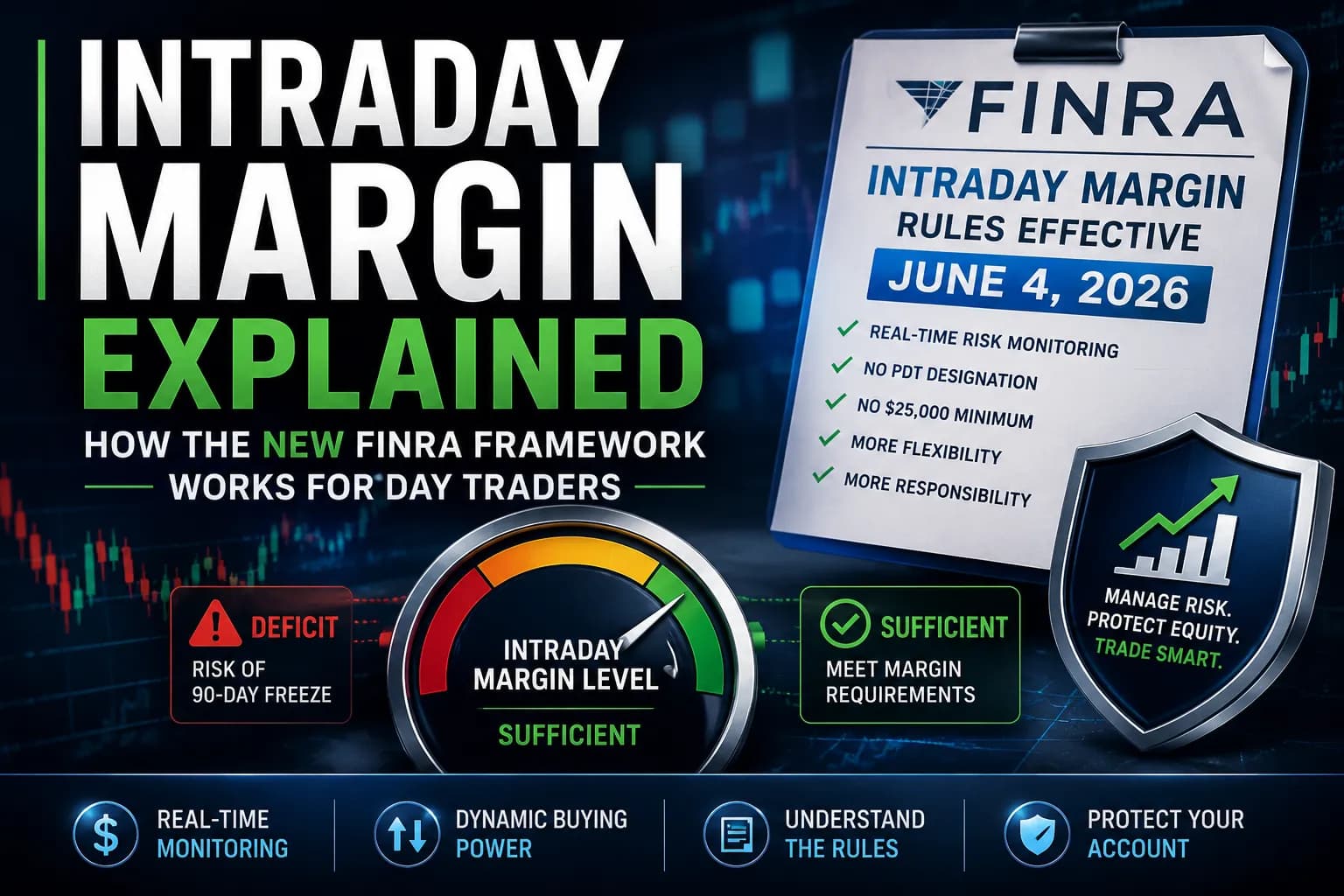


After 25 years, the single most frustrating regulation in retail trading is officially gone.
On April 14, 2026, the SEC granted accelerated approval of FINRA's proposal to eliminate the Pattern Day Trader rule — the regulation that required anyone making four or more day trades per week in a MarginMargin is money borrowed from your broker, secured by the cash and securities in your account, that lets you hold a larger position than your own cash would allow. For example, with the standard 50% initial margin, $10,000 of equity can buyRead definition → account to maintain a minimum of $25,000 in equity. The $25,000 threshold. The day trade counting. The PDT flag. The 90-day account freezes. All of it — eliminated, and replaced.
FINRA published Regulatory Notice 26-10 confirming the effective date: June 4, 2026. Brokers that need additional time have until October 20, 2027 to fully implement the new framework.
What replaces it is a modern, risk-based intraday margin system where your buying power is calculated dynamically based on the actual risk of your positions — not an arbitrary dollar floor that hasn't been updated since the dot-com crash.
This article is the complete guide, and it's been updated to reflect what actually happened — not just what was planned. It's now been more than three months since the effective date, every major broker has confirmed its rollout, and one detail from earlier coverage (including an earlier version of this guide) needs a direct correction: the 90-day freeze didn't fully disappear. It changed shape. That correction, the confirmed broker-by-broker status, and every practical detail traders need are below.
What the SEC Approved on April 14, 2026
The SEC's accelerated approval order — Release No. 34-105226 — approved FINRA's proposal to amend Rule 4210 (Margin Requirements) by replacing its day trading margin provisions with intraday margin standards. The order was published in the Federal Register on April 17, 2026.
This wasn't a tweak. FINRA eliminated the entire day trading margin framework and replaced it with something fundamentally different. Here's what the approval specifically covers:
Eliminated entirely:
- The "pattern day trader" designation — brokers will no longer count your day trades or flag your account
- The $25,000 minimum equity requirement for pattern day traders
- The day-trading buying power formula (the old 4:1 intraday leverage calculation tied to PDT status)
- The old day-trading margin call and its 90-day freeze specifically tied to the $25,000 threshold and the four-trades-in-five-days counter (a separate, deficit-based 90-day freeze mechanism exists under the new framework — the correction and details are below)
- The requirement for separate PDT account approvals and disclosures
Established in its place:
- New intraday margin standards under Rule 4210 paragraphs (a)(17) through (a)(19) and (d)(2)
- Real-time or end-of-day intraday margin monitoring by broker-dealers
- Buying power calculated based on "margin excess" at the time of each opening transaction
- Updated portfolio margin provisions under new paragraphs (g)(1)(J) and (g)(1)(K)
- Cash swept to bank sweep products or money-market mutual funds can now be included in buying power calculations
That last point is easy to miss but significant — if your broker sweeps idle cash to a money-market fund (which many do automatically), that cash now counts toward your available buying power for intraday trades. Under the old system, it didn't.
One more detail that's easy to miss if you're not trading a large account: the amendments also touch portfolio margin. Accounts using portfolio margin with less than $5 million in equity must maintain intraday margin substantially similar to what's required at the close of business, preserving the existing $5 million threshold that already applied under FINRA's portfolio margin rules. Most retail accounts covered in this guide fall well under that threshold and aren't affected, but it's worth knowing if you're trading size.
The SEC found "good cause" to approve the proposal on an accelerated basis, meaning it skipped the standard 30-day waiting period after filing Amendment No. 1. The Commission noted that FINRA's amendment addressed commenter concerns about implementation timing without altering any substantive provisions — and that the proposal had overwhelming public SupportSupport is a price level where buying pressure has historically overcome selling pressure, causing price to stop declining and reverse — it's the floor where demand enters the market, and when it holds, it's a potential long entry; when it Read definition → during the comment period.
The Complete Timeline: From Dot-Com Rule to 2026 Elimination
Understanding the full arc of how we got here matters — both for context and because some of these dates determine when the change actually reaches your account.
2001: Following the dot-com crash, FINRA (then NASD) implements the Pattern Day Trader rules under Rule 4210, requiring $25,000 minimum equity for anyone making four or more day trades in five business days. The rule is approved by the SEC on February 27, 2001.
2001–2024: The PDT rule remains essentially unchanged for 23 years. Multiple calls for reform go nowhere. Retail traders develop an entire ecosystem of workarounds — cash accounts, futures trading, offshore brokers, multiple brokerage accounts — to circumvent the restriction.
October 2024: FINRA issues Regulatory Notice 24-13, launching a formal retrospective review of its day trading requirements. This is the first official signal that FINRA is seriously reconsidering the PDT framework. FINRA solicits public comment on the effectiveness and efficiency of the rules.
January 2025: FINRA receives approximately 65 comments in response to the retrospective review. The overwhelming majority favor eliminating or significantly reducing the PDT threshold.
September 2025: FINRA's Board of Governors votes to approve a proposed overhaul — not a tweak, but a complete replacement of the day trading margin provisions with modern intraday margin standards.
December 29, 2025: FINRA officially files the proposed rule change with the SEC as SR-FINRA-2025-017.
January 9, 2026: The SEC issues Release No. 34-104572, formally acknowledging receipt of the filing.
January 14, 2026: The SEC publishes the proposal in the Federal Register (91 FR 1580), opening a public comment period.
January 28, 2026: The SEC designates a longer review period, extending its deadline for action to April 14, 2026 (Release No. 34-104732).
February 4, 2026: Public comment period closes. The SEC receives over 100 comment letters — all but one supporting the proposal. Major commenters include Charles Schwab, Robinhood, E*TRADE, SIFMA, and the Securities Traders Association.
March 18, 2026: FINRA submits its formal response letter to the public comments received by the SEC.
April 2, 2026: FINRA files Amendment No. 1, clarifying that the effective date will be 45 days after FINRA publishes its Regulatory Notice, and that brokers needing more time can phase in implementation over 18 months.
April 14, 2026: The SEC grants accelerated approval (Release No. 34-105226). The Pattern Day Trader framework is officially eliminated.
April 15, 2026: Webull announces immediate support for the new rules upon the effective date. BULL stock surges 11.2%.
April 17, 2026: The SEC's accelerated approval order is published in the Federal Register (91 FR 20731).
April 20, 2026: FINRA publishes Regulatory Notice 26-10, confirming the effective date and providing implementation GuidanceGuidance is forward-looking financial projections that a company's management provides for upcoming periods — typically covering expected revenue, earnings, or margins — and the market's reaction is often driven more by guidance than by theRead definition →.
June 4, 2026: Official effective date. The PDT designation ceases to exist under FINRA rules. Webull, Lightspeed, Cobra Trading, tastytrade, Robinhood, and Fidelity all confirm day-one implementation.
June 8, 2026: Charles Schwab completes its implementation, as previously planned.
June 9, 2026: E*TRADE completes its implementation.
October 20, 2027: Final deadline. All FINRA member firms must have fully implemented the new intraday margin requirements by this date.
What Exactly Was Eliminated — And What Replaced It
The simplest way to understand the change is to compare the old system to the new one side by side.
The Old System (2001–2026): Fixed Threshold, Trade Counting
Under the old framework, FINRA used a blunt instrument: count the trades, check the balance.
If you made four or more day trades within five consecutive business days in a margin account — and those trades represented more than 6% of your total activity — your broker flagged you as a "pattern day trader." Once flagged, you had to maintain $25,000 in equity at all times. Drop below, and you were restricted to closing-only transactions until you deposited enough to get back above $25,000 or waited out a 90-day freeze.
Flagged accounts with $25,000+ got 4:1 intraday buying power — meaning $25,000 in equity could control $100,000 worth of stock during the day. Accounts below $25,000 that weren't flagged got standard 2:1 margin.
The system was simple, universal, and — by FINRA's own admission — increasingly disconnected from how modern markets and risk management actually work.
The New System (2026+): Risk-Based, Real-Time
The new framework eliminates trade counting entirely. There's no "four trades in five days" trigger. There's no PDT designation. There's no $25,000 threshold.
Instead, your broker calculates your intraday buying power based on your account's margin excess at the time you open each trade. "Margin excess" is the amount of equity in your account above what's required to maintain your existing positions. If you have $10,000 in equity and $3,000 is required as maintenance margin on your current holdings, your margin excess is $7,000 — and that excess determines how much additional buying power you have for new intraday positions.
The minimum account balance to day trade on margin drops to approximately $2,000 — the standard Regulation T minimum for opening any margin account. Individual brokers may set their own higher internal floors.
Brokers are now required to monitor intraday margin levels in real time (or at minimum, by end of day) and can restrict trading or require position closures if your account falls below required margin levels during the session. This is a shift from account-level restrictions (PDT flag) to position-level risk management (dynamic margin monitoring).
For traders, the practical impact is significant: a trader with $5,000 in a margin account can now day trade without restriction — no trade counting, no three-trade limit, no $25,000 barrier. Their buying power will be determined by standard maintenance margin requirements, which typically means 25% of position value for most equity positions. A $5,000 account with no existing positions would have roughly $20,000 in intraday buying power under standard 4:1 maintenance margin math.
How the New Intraday Margin System Actually Works
This is the section most articles skip, and it's the one that matters most for your actual trading experience. Let's translate the regulatory language into plain English.
Your buying power is now dynamic, not static.
Under the old system, your day-trading buying power was calculated once per day based on the previous close: equity minus maintenance requirement, multiplied by four. Simple formula, same number all day.
Under the new system, your buying power changes throughout the day as you open and close positions. Every trade you enter reduces your available margin excess. Every trade you close releases margin back into your available buying power.
Think of it like a checking account balance that updates with every purchase and every deposit — not a credit card with a fixed limit.
Concentrated positions get treated differently.
The new framework pays attention to position concentration. If a significant portion of your account is tied up in a single stock — especially a volatile one — your effective buying power for additional positions may be lower than the simple 4:1 math suggests. Brokers calculate margin based on the actual risk profile of what you're holding, not just the total dollar amount.
This is a meaningful change from the old system, where a PDT account got the same 4:1 buying power regardless of whether they were trading blue-chip stocks or penny stocks. Under the new rules, volatile and concentrated positions will require more margin, effectively giving you less leverage on higher-risk trades.
Cash swept to money-market or bank sweep programs now counts.
Under the old rules, if your broker automatically swept idle cash into a money-market fund or bank sweep product, that money was technically outside your brokerage account and didn't count toward your day-trading buying power. E*TRADE's official guidance on the new rules specifically notes that this cash can now be included in buying power calculations — a practical improvement for traders who didn't realize their available capital was being reduced by their broker's sweep settings.
Margin calls work differently — and a version of the 90-day freeze actually survived. Here's the correction.
The old PDT system had a specific type of margin call — the "day trade margin call" — triggered when you exceeded your day-trading buying power, with unique penalties including reduced buying power going forward. That specific mechanism, tied to the old $25,000 threshold, is gone.
In its place, E*TRADE's official guidance introduces a defined term worth knowing: an Intraday Margin Deficit (IMD) occurs when your trading activity exceeds your available intraday margin level — your equity above the FINRA minimum requirement. If your positions create an IMD, your broker can require additional funds, reduce your positions, or, in some cases, liquidate positions on your behalf. Some brokers, like Schwab, chose real-time monitoring that can block a trade before it would create a deficit rather than allowing the trade and issuing a call afterward; others use an end-of-day check instead. This is broker-specific — confirm which model your platform uses. For a deeper walkthrough of how a deficit actually forms, including worked examples, see this site's dedicated guide to how the new intraday margin system works.
Now the correction: an earlier version of this guide, along with a lot of other coverage published before the effective date, described the 90-day freeze as eliminated entirely. That's not accurate. tastytrade's own official announcement marking the June 4 rollout confirms directly that the 90-day freeze still applies under the new intraday margin standards — it's simply no longer tied to the old $25,000 threshold or the four-trades-in-five-days counter. Under the new framework, the trigger is repeatedly failing to resolve an intraday margin deficit within five business days. Industry analysis of FINRA's notice describes a de minimis exemption for small deficits — under roughly 5% of account equity or $1,000, whichever is less — that don't count toward triggering the freeze. Confirm the exact mechanics with your own broker, since implementation details can vary firm to firm.
When It Takes Effect: The Implementation Timeline
There are three dates every trader needs to know.
June 4, 2026 — The Effective Date
This is the date confirmed by FINRA Regulatory Notice 26-10. On this date, the PDT designation officially ceased to exist under FINRA rules, and brokers that were ready began operating under the new intraday margin standards immediately.
As it turned out, most were ready. Webull, Lightspeed, Cobra Trading, tastytrade, Robinhood, and Fidelity all confirmed day-one implementation on June 4. Schwab followed on June 8, and E*TRADE on June 9 — both exactly as each had planned weeks earlier.
Now: More Than Three Months Past the Effective Date
Every major retail broker covered in this guide has now published official confirmation of its rollout. If you haven't checked with your specific broker yet, this is worth doing today — not because the rule isn't in effect (it is), but because implementation details, including exactly how your broker monitors intraday margin deficits and applies the new freeze mechanism, vary firm to firm.
October 20, 2027 — The Final Implementation Deadline
FINRA gave member firms up to 18 months from the Regulatory Notice publication date to fully implement the new intraday margin systems. In practice, every major retail broker moved far faster than that deadline required — but smaller or regional firms with older technology infrastructure may still be transitioning. If you trade at a smaller or less prominent brokerage, check directly rather than assuming.
Broker-by-Broker: What Actually Happened
Every major broker below has now confirmed its rollout, which is itself worth noting — as of this update, this list is complete rather than partial. Last updated: September 25, 2026, more than three months after the effective date. This update adds TradeStation and Firstrade, both of which confirmed June 4 implementation in their own published materials.
Webull — Confirmed day-one implementation on April 15, 2026, one day after SEC approval — the earliest public commitment of any broker. Webull Group President Anthony Denier called the reform "long overdue." BULL stock surged 11.2% on the announcement. The new rules apply to stocks, ETFs, and options on Webull's platform. Confirmed: implemented June 4, 2026.
Lightspeed Trading — One of the first direct-access brokers to commit to a specific date, and it held. Lightspeed confirmed its internal minimum account equity at $2,000 — the Regulation T floor — with no higher internal PDT-replacement threshold, making it one of the more attractive options for active traders with smaller accounts. Confirmed: implemented June 4, 2026. Confirmed minimum: $2,000.
Charles Schwab — Schwab's own materials now confirm the rollout was completed as planned: as of June 8, Schwab stopped counting day trades in margin accounts, stopped opening new PDT-designated accounts, and removed PDT status from existing flagged accounts below $25,000 — those accounts can now day trade using their available buying power. Schwab chose real-time intraday margin monitoring, meaning its systems can block a trade before it creates a deficit rather than issuing a call after the fact. Buying power is viewable on Schwab.com under Accounts → Balances, or on the Monitor tab in thinkorswim. Confirmed: implemented June 8, 2026, as planned.
ETRADE — ETRADE has confirmed a firm date rather than the earlier "shortly after June 4": implementation completed June 9, 2026. E*TRADE's official guidance is also the source of the Intraday Margin Deficit (IMD) terminology used throughout this guide, and confirms idle cash swept to bank sweep programs is now included in buying power calculations. Confirmed: implemented June 9, 2026.
Fidelity — Fidelity has published official guidance confirming its rollout: the new rules went into effect June 4, 2026, and Fidelity aligned its systems accordingly — no $25,000 minimum for intraday margin trading, and existing PDT-flagged accounts had those restrictions and calls dropped. The standard $2,000 margin account minimum remains. Confirmed: implemented June 4, 2026.
Interactive Brokers — IBKR has published official documentation (its "Pattern Day Trader Reset" support materials) confirming the $25,000 PDT minimum is removed, with the standard Reg T $2,000 minimum remaining for margin and short-sale trading. Given IBKR's existing real-time, position-level risk engine, this aligns with the broader expectation that firms with mature margin infrastructure would move fastest. Confirmed: documentation published; PDT minimum removed.
Robinhood — Robinhood confirmed full implementation of the new framework on June 4, 2026 — a day-one rollout consistent with the fast implementation the firm signaled throughout the SEC review period, during which it argued in its comment letter that the old rules "disenfranchise retail traders." Confirmed: implemented June 4, 2026.
Cobra Trading — Cobra confirmed its internal minimum at $2,000 and delivered on its stated day-one implementation target, consistent with its public commitment ahead of the effective date. Confirmed: implemented June 4, 2026. Confirmed minimum: $2,000.
tastytrade — tastytrade confirmed day-one implementation on June 4, 2026, and marked the date with an official announcement carrying genuinely useful data: a survey of 1,057 active retail traders, conducted with Dr. Michele Madansky between May 20–25, 2026, found that 53% expect the $25,000 minimum's removal to have a major or extremely significant impact on their trading, and 76% expect to change their trading behavior as a result. Of those planning to change behavior, 78% expected to do so within the first month, and 34% planned to add capital to their accounts. Notably, only 25% described themselves as "very confident" trading in the new environment — a genuinely useful data point on how much guidance traders feel they still need. tastytrade's announcement is also the primary source confirming that the 90-day freeze mechanism persists under the new framework, just decoupled from the old $25,000 threshold. Confirmed: implemented June 4, 2026.
TradeStation — TradeStation's own day trading requirements page confirms it has moved off the Pattern Day Trader framework: the PDT designation, the $25,000 minimum, and the four-trades-in-five-days test are gone as of June 4, 2026. Its replacement is an Intraday Margin Buying Power system with a $2,000 margin equity threshold. Accounts at or above $2,000 get up to 4x their margin excess for same-day trading; accounts that drop below $2,000 are limited to 1x margin excess. TradeStation also flags a detail worth knowing: positions held overnight at full intraday leverage can trigger a margin call, because overnight positions use a separate buying power calculation. Confirmed: implemented June 4, 2026. Confirmed minimum: $2,000.
Firstrade — Firstrade's help center confirms June 4, 2026 implementation with the standard $2,000 margin minimum, real-time intraday margin tracking in place of end-of-day calculations, and automatic removal of existing PDT flags and restrictions. Firstrade issues Intraday Margin (IM) Calls when an account lacks sufficient margin excess, and unmet calls lead to a 90-day liquidation-only restriction, a concrete example of the deficit-based freeze described earlier in this guide. Confirmed: implemented June 4, 2026. Confirmed minimum: $2,000.
If your broker isn't listed above, including Merrill Edge, Vanguard, SoFi, moomoo, and Public, contact them directly to confirm their specific implementation details. As of September 25, 2026, this guide could not find a firm-specific implementation date published by those brokers, which doesn't mean they haven't switched; it means you should confirm before assuming — every FINRA member firm must fully implement the new framework no later than October 20, 2027, but as this update shows, nearly every major retail broker moved well ahead of that deadline.*
What This Means for You: Trader Action Items by Account Type
The practical impact depends entirely on your current situation. Here's what to do based on where you are right now.
If you have a margin account with $25,000+ in equity:
Honestly? Not much changes for you operationally. You were already trading freely under the old rules. The main differences: the PDT flag on your account has been removed, the specific day-trade margin call mechanism is gone, and your buying power calculation now uses the new dynamic margin system. You might notice small changes in how your buying power updates throughout the day.
If you have a margin account with less than $25,000:
This is the big one. Now that your broker has implemented the new rules, the three-day-trade limit that used to restrict your account no longer applies. You can day trade without counting trades or worrying about the PDT flag. Your buying power is determined by your margin excess — roughly 4:1 on your equity for standard positions.
Action items: Confirm your broker has completed its transition (all major brokers covered above have). If you've been using a cash account specifically to avoid PDT restrictions, evaluate whether a margin account now makes more sense for your strategy. If you were previously flagged as a PDT and your account was frozen, you should be unrestricted now — contact your broker's compliance team if that hasn't happened. And understand the new deficit-based 90-day freeze mechanism described above, since it's the thing most likely to catch traders off guard who assumed the old freeze concept vanished entirely.
For a full playbook on sizing positions, choosing strategies, and managing risk on a $2,000 to $25,000 account under the new rules specifically, see Day Trading a Small Account: The Complete Playbook for the Post-PDT Era.
If you're using a cash account to avoid PDT restrictions:
Cash accounts remain completely unaffected by this change. They were never subject to the PDT rule in the first place, and nothing about cash account settlement rules, Good Faith Violations, or T+1 settlement has changed.
However, this is a good time to reconsider whether a margin account might serve you better — especially if you've been dealing with settlement timing frustrations. With the PDT barrier eliminated, a margin account offers instant capital recycling, potential leverage, and the ability to short sell. The tradeoff is margin call risk — including the new deficit-based freeze mechanism — and the DisciplineTrading discipline is the consistent application of your predefined rules — entries, stops, targets, position sizing, maximum daily loss — regardless of what you're feeling in the moment.Read definition → required to manage leverage responsibly.
If you've been trading futures or forex specifically to avoid PDT:
Many traders chose futures or forex not because those markets fit their strategy best, but because the PDT rule locked them out of equities. If that's you, the door to stock day trading is now open. But don't rush the transition — futures and forex have their own advantages (extended hours, tax treatment under Section 1256, leverage flexibility) that don't disappear just because the PDT rule is gone. Evaluate honestly whether equities actually fit your strategy better, or whether you've found a genuine edge in your current market.
If you're brand new and thinking about starting:
The elimination of the PDT rule makes it easier to start day trading. It does not make it easier to succeed at day trading. The same brutal statistics apply: over 80% of day traders lose money, and only 1–4% achieve consistent profitability. More access means more opportunity — and more ways to lose money if you skip education, risk management, and practice. tastytrade's own survey data on trader confidence is worth sitting with: even among active traders who've been through this transition, only a quarter feel genuinely confident navigating the new rules.
Our honest recommendation: start with paper trading, study the fundamentals through our Beginner's Guide series, and build your skills before risking real capital. When you're ready for tools, a quality scanner like Trade Ideas helps you find high-probability setups efficiently — especially valuable when you're no longer limited to three day trades per week. We break down the full tool stack in our Day Trading Toolkit.
What Hasn't Changed: The Reality Check Every Trader Needs
The PDT rule was a barrier to access. Its removal does not change the difficulty of day trading itself. This section matters as much as everything above — maybe more.
The failure rate hasn't changed. Academic research consistently shows that 80–97% of day traders lose money. FINRA's own 2020 data found 72% of day traders ended the year with losses. The PDT rule didn't cause those losses. Lack of skill, poor risk management, emotional decision-making, and inadequate capital caused them. All of those factors remain fully intact.
Risk management still determines survival. The 1% rule, stop-loss discipline, daily max loss limits, and proper position sizing are just as critical as they were before June 4. In fact, they may be more critical now — because the PDT rule, for all its frustrations, functioned as a forced speed limit for underfunded traders. That guardrail is gone (mostly — see the deficit-based freeze above). If you don't bring your own discipline, there's nothing stopping you from OvertradingOvertrading is taking too many trades — whether from boredom, greed, frustration, or an inability to sit on your hands — leading to degraded selectivity, inflated commission costs, and decision fatigue that compounds losses well beyond whatRead definition → a $3,000 account into the ground.
Cash account rules haven't changed. T+1 settlement, Good Faith Violations, and freeriding rules remain exactly as they were. The PDT elimination only affects margin accounts. If you're in a cash account, nothing about your experience changes.
Futures and forex are unaffected. These markets were never subject to the PDT rule. Their margin requirements, leverage rules, and capital structures remain the same.
Your broker's internal policies still apply. Even though FINRA eliminated the $25,000 regulatory minimum, individual brokers can set their own higher floors. Some may require $5,000 or $10,000 for unrestricted day trading. Some may impose additional requirements for volatile stocks or concentrated positions. Check with your specific broker.
Taxes haven't changed. Day trading profits are still taxed as short-term capital gains at your ordinary income rate. The PDT elimination doesn't create any tax advantages. For the full tax picture, see our Day Trading and Taxes guide.
The bottom line: the door is wider open than it's been since 2001. But the market on the other side of that door is exactly as difficult, competitive, and unforgiving as it was before the door widened. Prepare accordingly. Our Introduction to Risk Management and How Much Money You Really Need to Start Day Trading are the right starting points.
Frequently Asked Questions
When exactly did the PDT rule end?
The SEC approved the elimination on April 14, 2026, and the rule became legally inoperative 45 days after FINRA published its Regulatory Notice — June 4, 2026. Webull, Lightspeed, Cobra Trading, tastytrade, Robinhood, and Fidelity all confirmed day-one implementation; Schwab followed on June 8 and E*TRADE on June 9. If you trade at a smaller or regional broker not covered in this guide, confirm their status directly.
Key Takeaway: June 4, 2026 was the regulatory effective date, and as of this update, every major broker has confirmed its rollout is complete.
Is the 90-day freeze completely gone?
tastytrade's own official announcement marking the June 4 rollout confirms this directly: the 90-day freeze still applies under the new intraday margin standards. The trigger has changed — it's no longer about the old $25,000 line or counting four trades in five days. Instead, it's tied to repeatedly failing to resolve an Intraday Margin Deficit (IMD) within five business days. Industry analysis of FINRA's notice describes a de minimis exemption for small deficits — roughly under 5% of account equity or $1,000, whichever is less. Confirm the exact mechanics with your specific broker.
Key Takeaway: The freeze mechanism survived in a modified form — don't assume the old "no consequences" framing applies to the new system.
Do I still need $25,000 to day trade?
However, individual brokers may set their own internal minimums above $2,000. Also, $2,000 is a regulatory minimum — not a recommendation. DayTradingToolkit strongly advises having significantly more than the minimum for responsible risk management. A $2,000 account with 1% risk per trade means risking just $20 per trade, which severely limits your options.
Key Takeaway: The regulatory barrier is gone, but capital is still the biggest factor in your survival. Read our starting capital guide for realistic numbers.
Can I day trade unlimited times now?
Your only constraint is your available intraday buying power, which is calculated based on your margin excess, and the new deficit-based freeze mechanism if you repeatedly exceed it. As long as you have sufficient margin to support a new position, you can open it — whether it's your first trade of the day or your fiftieth.
Key Takeaway: Unlimited trades doesn't mean unlimited risk. Having the freedom to overtrade is one of the biggest dangers for undisciplined traders.
What happens to my existing PDT flag?
E*TRADE's official guidance specifically noted that "current PDT accounts that have less than $25,000 in equity and are restricted to 'liquidating transactions only' would no longer be restricted," and Schwab, Fidelity, and the others have confirmed the same outcome for their platforms. If your restrictions haven't been lifted, contact your broker's compliance team directly — every major broker has now completed this transition.
Key Takeaway: Existing PDT flags and restrictions have been cleared at every major broker as of this update.
How does the new margin system calculate my buying power?
Under the old system, day-trading buying power was calculated once per day using a fixed 4:1 formula. Under the new system, it updates dynamically throughout the day. Every trade you open consumes margin; every trade you close releases it. For standard equity positions, the maintenance margin is typically 25% of position value, which gives you effective buying power of roughly 4:1 on unencumbered equity. Volatile or concentrated positions may require more margin, reducing your effective leverage. If you exceed your available margin, you create what E*TRADE calls an Intraday Margin Deficit (IMD).
Key Takeaway: Your buying power is no longer a static number — it flexes with your positions. Monitor it throughout the trading session.
Does this affect cash accounts?
If you've been using a cash account specifically to avoid PDT restrictions, this is a good time to evaluate whether switching to a margin account makes sense for your strategy — but there's no pressure to change. Cash accounts still offer the advantage of zero leverage risk and no margin calls.
Key Takeaway: Cash accounts are unchanged. The margin vs. cash decision should be based on your strategy and risk tolerance, not PDT avoidance. See our Margin vs. Cash Accounts guide.
Which brokers have implemented the new rules?
Broker readiness tracked closely with existing technology infrastructure, as predicted — firms with mature real-time margin systems moved fastest. As of this update, there are no major retail brokers still operating exclusively under the old PDT framework.
Key Takeaway: If your broker isn't listed here, contact them directly — but every major retail broker has completed its transition well ahead of the October 2027 deadline.
Does the PDT elimination affect options trading?
However, options margin requirements are complex and vary significantly by strategy type (covered calls vs. naked puts vs. spreads). Brokers may apply different margin treatment to options positions under the new intraday framework. Check your broker's specific options margin policies.
Key Takeaway: Options day traders benefit from the PDT elimination, but options margin is more complex than stock margin. Make sure you understand your broker's specific policies.
Will more people lose money now that the PDT rule is gone?
The PDT rule, for all its frustrations, functioned as a forced speed limit for small accounts. Its removal means more people with less capital have unrestricted access to day trading — and without the skills, risk management, and discipline required to survive, many will lose money faster than they would have under the old restrictions. FINRA's own analysis showed 1.3 million accounts were designated as pattern day traders, representing about 2.4% of margin account holders. With the barrier removed, that number is expected to rise significantly.
Key Takeaway: The elimination creates opportunity for prepared traders and danger for unprepared ones — and post-implementation survey data suggests most traders know it.
How does this compare to futures and forex, which never had PDT rules?
Traders who moved to futures or forex specifically to avoid PDT should evaluate their options. If your strategy works better in equities, the door is now open. If you've found a genuine edge in futures or forex, there's no reason to switch back just because you can.
Key Takeaway: The playing field is more level now across markets. Choose your market based on strategy fit, not regulatory workarounds.
What should I do right now to prepare?
If you're currently paper trading, keep paper trading. If you're a developing trader, use this period to tighten your risk management rules — the old guardrail is mostly gone, replaced by a narrower deficit-based one, and you'll need your own discipline to fill the gap. If you're consistently profitable and were previously limited by PDT restrictions, your account should already be operating under the new rules at every major broker.
Key Takeaway: Preparation beats reaction. Confirm the specifics with your own broker rather than assuming the old or new rules apply uniformly everywhere.
Article Sources
- SEC Order Granting Accelerated Approval — Release No. 34-105226 (April 14, 2026) - The SEC's official order approving FINRA's elimination of the Pattern Day Trader framework and adoption of risk-based intraday margin standards.sec.gov
- FINRA Regulatory Notice 26-10 — New Intraday Margin Standards (April 20, 2026) - FINRA's official notice confirming the June 4, 2026 effective date and October 20, 2027 full implementation deadline, with an overview of the new intraday margin framework.finra.org
- Federal Register: Notice of Accelerated Approval — 91 FR 20731 (April 17, 2026) - Official Federal Register publication of the SEC's accelerated approval order with complete regulatory text and implementation details.federalregister.gov
- ETRADE — What FINRA's Proposal Could Mean for Margin Accounts - ETRADE's official guidance, including the Intraday Margin Deficit (IMD) terminology, the June 9, 2026 implementation date, and confirmation that swept cash is included in buying power.us.etrade.com
- Charles Schwab — Schwab Updates Day Trading and Margin Rules - Schwab's official confirmation of its June 8, 2026 rollout, real-time monitoring approach, and buying-power monitoring tools.schwab.com
- Fidelity — Intraday Trading Guidance - Fidelity's official confirmation of June 4, 2026 implementation and removal of existing PDT restrictions.fidelity.com
- Interactive Brokers — Pattern Day Trader Reset - IBKR's official documentation confirming removal of the $25,000 PDT minimum and the retained $2,000 Reg T floor.ibkrguides.com
- tastytrade / Business Wire — As the PDT Rule Ends June 4, tastytrade Welcomes a New Class of Active Traders (June 4, 2026) - tastytrade's official June 4 announcement, including confirmation that the 90-day freeze persists under the new framework and the cited trader-sentiment survey data.businesswire.com
- Federal Register: Original Notice of Filing — 91 FR 1580 (January 14, 2026) - The SEC's original publication of FINRA's proposed rule change, including PDT account data (1.3 million accounts, 2.4% of margin holders) and FINRA's economic impact analysis.federalregister.gov
- Webull Press Release — Webull Unlocks Active Trading for All (April 15, 2026) - Webull's official announcement of immediate support for the new PDT-free framework upon the effective date, including confirmation that the changes apply to stocks, ETFs, and options.stocktitan.net
- FINRA Regulatory Notice 26-11: Updated Interpretations of the Margin Rule (May 2026) - FINRA's follow-up notice publishing updated interpretations of Rule 4210 and new investor education resources for the intraday margin standards.finra.org
- FINRA Investor Insights: Understanding the New Intraday Margin Requirements - FINRA's own plain-language investor guidance on the new framework, published alongside Regulatory Notice 26-11.finra.org
- TradeStation: Day Trading Requirements - TradeStation's official confirmation of its June 4, 2026 move to Intraday Margin Buying Power and the $2,000 threshold.tradestation.com
- Firstrade: Important Changes to the Pattern Day Trader Rule - Firstrade's official implementation details, including real-time margin tracking and the 90-day restriction for unmet intraday margin calls.help.firstrade.info