
At 8:30 a.m. Eastern Time, one economic report can send a heavily traded stock sharply higher or lower. Stock traders with premarket access can react immediately. Traders holding options on that same company have generally had to watch the move unfold and wait for the options market to open at 9:30.
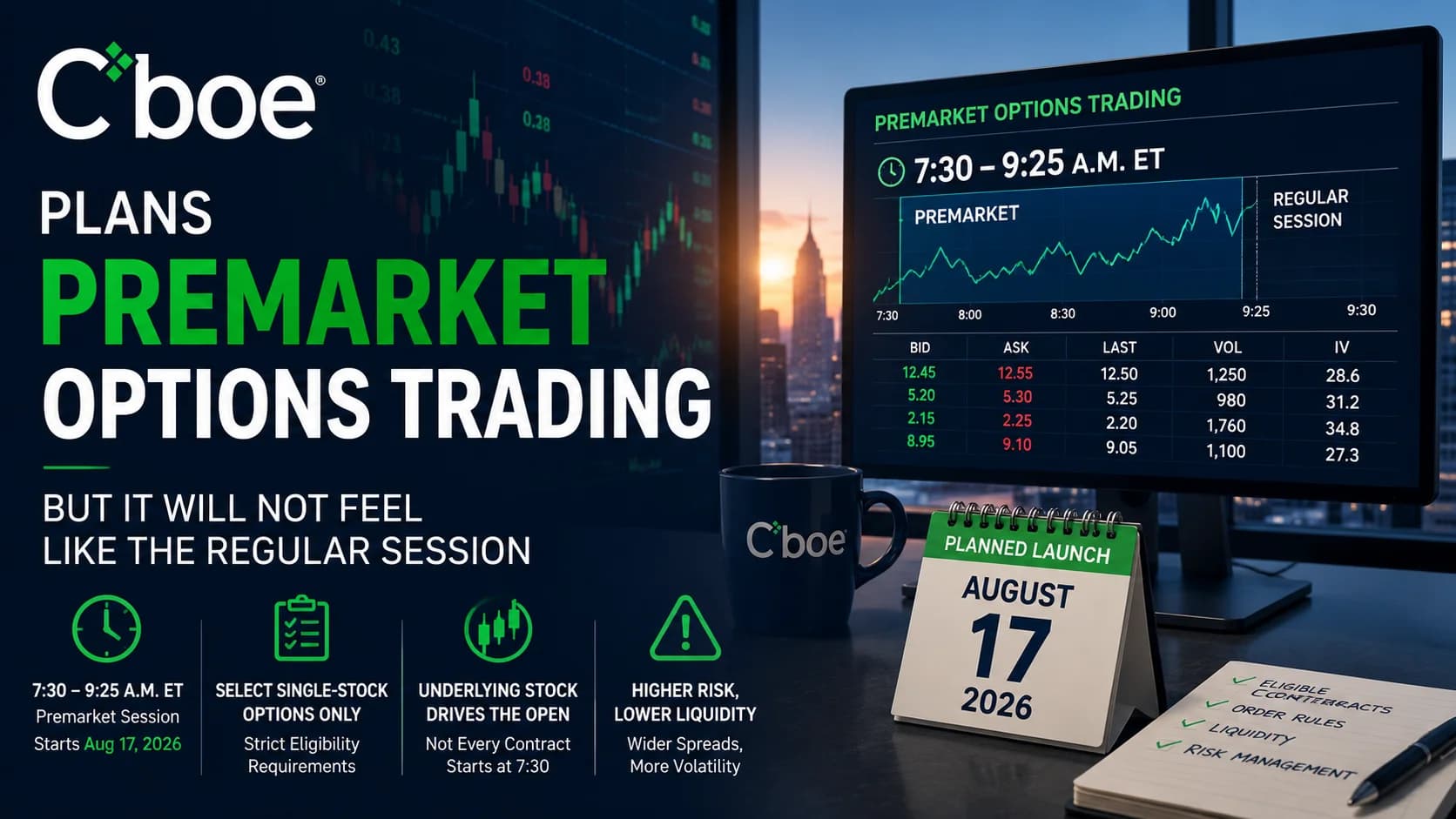
Cboe's C1 exchange spent the summer preparing a premarket session for select single-stock options, running 7:30 to 9:25 a.m. ET, plus a short afternoon session from 4:00 to 4:15 p.m. It was supposed to go live August 17, 2026.
It did not. Cboe pulled the August 17 start date on August 10 and replaced it with "a date to be announced in a subsequent notice," the second delay after the original July 13 target slipped earlier in the summer. No new launch date has been set as of this writing. The mechanics below describe the session Cboe has designed and is still planning to launch, not one that is live today, and the first version of this market will be much narrower than the phrase "premarket options trading" suggests.
What is premarket options trading? Premarket options trading allows eligible option contracts to change hands before the regular 9:30 a.m. ET opening. Under Cboe's current plan, designated single-stock options will have a separate morning session from 7:30 to 9:25, giving traders earlier access while the underlying shares are already trading.
Cboe Delayed the Launch (Updated August 20, 2026)
This article originally covered Cboe's plan to launch on August 17, 2026. That date came and went without a launch.
On August 10, Cboe quietly updated its own C1 schedule notice, striking the August 17 effective date and replacing it with "a date to be announced in a subsequent notice." The exchange also pulled two planned customer weekend tests from the calendar and said a further notice would precede the eventual launch. Finance Magnates confirmed the change publicly on August 17, the day the session was originally supposed to go live, reporting that Cboe gave no reason for the postponement. This is the second delay: the project first slipped from its original July 13 target to August 17, and has now slipped again to an unannounced date.
Nothing about the underlying plan appears to have changed. The session structure, the eligibility rules, and the anticipated symbol list below are all still what Cboe has published. What changed is the timeline. Until Cboe issues a new notice with a firm date, treat everything below as the design of a session that is coming, not one you can trade yet. Check Cboe's own notices page or your broker's platform announcements before assuming this session is live.
First, the Launch Date Has Changed
The SEC approved Cboe's main proposal for extended trading in designated equity options on May 28, 2026. Cboe initially said the new sessions would begin July 13, then pushed the production launch to August 17 because a related rule filing was still pending approval.
OPRA, the system that consolidates quotes and trade reports from U.S. options exchanges, revised its extended-hours SupportSupport is a price level where buying pressure has historically overcome selling pressure, causing price to stop declining and reverse — it's the floor where demand enters the market, and when it holds, it's a potential long entry; when it Read definition → date to match that August 17 target at the time. Then Cboe delayed a second time, as the update above explains, and August 17 came and went with no session live.
The lesson for traders following this rollout: treat any specific launch date, including whichever one Cboe eventually announces next, as provisional until the session is actually live and your broker confirms support for it. Cboe itself has said the timetable is subject to change based on regulatory review and operational readiness.
Here is the trading day Cboe has designed, in Eastern Time. This is the plan as published, not a confirmed live schedule:
- Session
- Order queuing
- Time
- From 7:15 a.m.
- Practical Meaning
- Eligible orders can enter the queue, but the options are not yet trading.
- Session
- Global Trading Hours
- Time
- 7:30-9:25 a.m.
- Practical Meaning
- The new premarket session for designated equity options.
- Session
- Regular Trading Hours
- Time
- 9:30 a.m.-4:00 p.m.
- Practical Meaning
- The familiar single-stock options session.
- Session
- Curb
- Time
- 4:00-4:15 p.m.
- Practical Meaning
- A separate post-close session for designated contracts.
| Session | Time | Practical Meaning |
|---|---|---|
| Order queuing | From 7:15 a.m. | Eligible orders can enter the queue, but the options are not yet trading. |
| Global Trading Hours | 7:30-9:25 a.m. | The new premarket session for designated equity options. |
| Regular Trading Hours | 9:30 a.m.-4:00 p.m. | The familiar single-stock options session. |
| Curb | 4:00-4:15 p.m. | A separate post-close session for designated contracts. |
The five-minute break between 9:25 and 9:30 is easy to overlook. The underlying stock can continue moving during that interval while the option is between sessions.
Only a Small Group of Single-Stock Options Will Qualify
This is not an industry-wide opening of every options chain. Cboe's rule allows it to designate as many as 100 option classes, but each one must clear three demanding thresholds. The option class needs average daily VolumeVolume is the total number of shares (or contracts) traded during a given time period — it's the primary confirmation tool for all price action, because a price move accompanied by high volume indicates genuine market participation, while tRead definition → of at least 150,000 contracts; the company must have a market value of at least $50 billion; and the underlying stock must average at least 10 million shares a day.
That screening is meant to start the new session in names where both the stock and its options already attract substantial trading. Cboe's current implementation notice anticipates 21 symbols:
AAPL, AMD, AMZN, AVGO, BABA, BAC, GOOG, GOOGL, HOOD, INTC, META, MSFT, MU, NFLX, NOK, NVDA, ORCL, PFE, PLTR, TSLA, and TSM.
"Anticipated" is the important word. Cboe will publish the production eligibility status in its reference data, and it can change the selected list. If an underlying is approved, all listed series in that option class can participate, including permitted Monday and Wednesday expirations.
This plan also should not be confused with the longer hours already available in certain index options. SPX, VIXThe CBOE Volatility Index — a real-time measure of the market's expectation for 30-day volatility in the S&P 500, derived from the prices of S&P 500 options. Widely called the "fear gauge," a rising VIX indicates increasing uncertainty and Read definition →, XSP, and RUT have different Global Trading Hours, settlement features, and broker-access rules. The August change is about selected options on individual companies.
A 7:30 Session Does Not Mean Every Contract Opens at 7:30
The clock starts the session. The underlying stock starts the option.
Before Cboe begins the opening rotation for an eligible option class, it must see a round-lot trade in the underlying stock after 7:30 and a two-sided stock quote from an exchange. The option market must then satisfy Cboe's opening-price controls.
If the stock has not printed, its quote is incomplete, or the options market is not ready, the class can open later. That is likely to matter on quiet mornings and in less active strikes. A symbol appearing on the eligible list does not promise a usable market in every expiration and strike from the first second of the session.
This is where the underlying stock remains the better starting point. Our premarket trading playbook explains how thin volume and uneven price discovery affect shares before the bell. An option adds another layer because its premium also responds to strike, time to expiration, and Implied VolatilityImplied volatility (IV) is the market's forward-looking estimate of how much a stock will move, derived from current option prices — high IV means options are expensive because the market expects big moves, low IV means options are cheap beRead definition →.
The Early Option Quote May Be Tradable Without Being Attractive
The new session creates the opportunity to trade earlier. It cannot manufacture regular-hours LiquidityLiquidity in trading refers to how easily you can enter and exit a position at a fair price — a liquid stock has high volume and a tight bid-ask spread, allowing large orders to be filled quickly without moving the price, while an illiquid Read definition →.
FINRA's extended-hours risk disclosure warns that trading outside the main session can bring lower liquidity, wider spreads, greater volatility, and prices that do not carry into the regular open. An options chain divides the available activity further across calls, puts, strikes, and expiration dates.
Imagine a hypothetical call option showing a $2.10 bid and a $2.90 ask after an earnings announcement. The screen has a quote, but the $0.80 spread leaves plenty of room for a bad fill. The midpoint is not automatically fair value, either. The stock may still be jumping between premarket trades while market makers are adjusting implied volatility.
That is why Cboe will accept only limit orders in the new morning and Curb sessions. Market orders, stop orders, and stop-limit orders will be rejected when submitted with an extended-hours designation. The restriction prevents an order from filling at any available price, but it does not protect a trader who chooses an aggressive limit.
The first weeks should reveal how much real depth develops. A useful test is to compare the same contract before 9:25, at the regular opening, and again after the first few minutes of regular trading. Watch the spread, the size displayed at each price, and the underlying stock's volume. Those observations will tell you more about execution quality than the mere existence of an early quote.
Your Broker Still Decides Whether You Can Participate
Cboe can open the exchange session without making it appear in every retail account. A broker must support the market data, route the order to the correct session, handle the relevant account permissions, and explain how its order ticket labels session eligibility.
That final point matters because an order can be marked for all sessions, regular hours only, or regular hours plus Curb. An order marked for all sessions can remain active across the morning and regular sessions. A regular-hours-only order will wait for the normal open.
There is a less obvious trap. Cboe says that if a firm sends an extended-session designation for an ineligible symbol, the exchange may accept the order as regular-hours-only instead of rejecting it. A trader who assumes the order failed could discover it resting at the 9:30 open.
Do not guess from familiar labels such as "Day" or "GTC." Check how your broker defines the session, when an unfilled order expires, and whether it carries into 9:30. Our day-trading broker checklist covers the wider execution questions worth asking before choosing a platform.
The 15 Minutes After the Close Have Their Own Risk
Cboe's afternoon Curb runs from 4:00 to 4:15 p.m. It is a separate session, not an extension that automatically keeps every regular-hours order active. That gives firms and customers a choice about whether their orders should participate after the closing bell.
The window may be useful when a company releases news just after 4:00 or when a trader needs to manage an eligible position. But 15 minutes is not the same as the much longer after-hours stock market, and the option can still be pricing a fast-moving underlying with limited depth.
Expiration day adds a detail that deserves attention. Eligible expiring single-stock options may trade during Curb until 4:15, but OCC still uses the underlying stock's 4:00 closing price to determine whether the option is in or out of the money. The later trade does not move the official expiration reference to 4:15.
Cboe will report morning and Curb trades through OPRA with an extended-hours condition. Those trades will not count as the contract's official last sale, daily high, or daily low. Depending on how a broker displays the data, a conventional quote field may not tell the whole story of the extended session.
Earlier Access Changes the Decision, Not the Risk
The clearest use case is event timing. The morning session includes the 8:30 window when many U.S. economic reports arrive, as well as some company announcements released before the bell. The Curb covers the first 15 minutes after the stock market closes.
Previously, a trader could watch the underlying shares react while the corresponding single-stock option remained closed. Cboe's plan allows selected option markets to begin processing that information sooner.
That flexibility should not become pressure to trade. On a thin morning, waiting for the regular session may still produce a narrower spread and a more stable underlying price. Earlier access can also be used for observation: an opening option quote offers information even when it does not offer a sensible fill.
For anyone considering the new session, three decisions should be made before the order is sent: the maximum acceptable price, whether the order may remain active at 9:30, and how much account risk the position can carry if the stock moves again. Our risk management cheat sheet can help with the last question, although stop orders themselves will not be available in Cboe's extended sessions.
The regular opening will still matter. Broader participation and heavier stock volume can change the option price quickly after 9:30. The market-open playbook explains why the first minutes often require patience even when the premarket direction looks clear.
This Is a Step Toward Longer Markets, Not 24-Hour Stock Options
U.S. stocks are moving toward longer weekday trading, and the options market is beginning to follow. Still, the plan Cboe has designed is measured: selected companies, one morning window, one 15-minute afternoon window, and exchange-specific order rules.
It is not overnight access to AAPL or NVDA options. It does not guarantee that another options exchange will show a competing quote. And it does not guarantee that a retail broker will support the session on day one.
Our guide to 23-hour stock-market trading covers the broader market-structure shift. The practical conclusion here is narrower. Cboe is bringing some single-stock options closer to the hours when their underlying shares already trade. Whether that becomes genuinely useful will depend on the liquidity that appears—not simply the extra time on the clock.
Frequently Asked Questions
Did Cboe launch premarket options trading on August 17 as planned?
The exchange gave no public reason for either postponement. Cboe's own C1 schedule notice now lists the effective date as "to be announced in a subsequent notice," and two planned customer weekend tests were removed from the calendar along with it. Nothing about the session design appears to have changed, only the timing.
Key Takeaway: Check Cboe's current notices page before assuming any specific launch date is live.
How will I know which options are eligible that morning?
Cboe plans to mark qualifying underlyings for GTH and Curb eligibility in its production reference file. The exchange can update the list, and the current 21 anticipated symbols are not a permanent guarantee. Once an underlying qualifies, all listed series in that option class can be available.
Key Takeaway: Treat the exchange's live eligibility data as the final authority.
Will every retail broker offer the new session?
Each broker must support the data, routing, session labels, and account permissions needed for the market. Some may enable it at launch, some later, and others may not support it. Check the broker's official notice and order-ticket documentation before August 17.
Key Takeaway: Confirm broker support before assuming an eligible option can be traded from your account.
What happens if an option has not opened at 7:30?
Cboe needs a round-lot trade and two-sided quote in the underlying stock after 7:30, followed by an acceptable options opening market. A quiet stock or difficult option quote can delay the opening. Some strikes may therefore remain inactive even while other contracts in the class are trading.
Key Takeaway: Watch the underlying stock and the actual option market, not just the clock.
Can I use a market or stop order during GTH or Curb?
Market, stop, and stop-limit orders with an extended-session designation will be rejected. A limit order sets the worst price you are willing to accept, but it can still fill at an unattractive level if the spread is wide. It may also remain unfilled while the stock moves.
Key Takeaway: A limit controls price, not liquidity or execution quality.
Will an unfilled premarket order carry into the 9:30 session?
Cboe orders marked for all sessions can carry across the morning and regular sessions. Other designations may keep an order out of GTH or Curb. Broker labels vary, so the trader must understand the exact time-in-force and session setting before submitting the order.
Key Takeaway: Decide before entry whether you want the order exposed at the regular open.
Does the 4:15 Curb close change option expiration calculations?
That difference can matter when the stock moves after the closing bell. Broker exercise cutoffs and assignment procedures may create additional constraints, especially for positions near the strike price. Review those rules before expiration day rather than during the Curb session.
Key Takeaway: Trading can continue until 4:15 without moving the official 4:00 expiration reference.
Disclaimer
This article is for educational and informational purposes only and does not provide investment, trading, legal, tax, or financial advice. Cboe's planned premarket options session has already been delayed twice, from July 13 to August 17, 2026, and then to an unannounced date, so the eligible option classes, session rules, and eventual launch date described here may still change. Options involve substantial risk and are not suitable for all investors. Extended-hours markets may have lower liquidity, wider spreads, greater volatility, partial fills, or no fills. Review current exchange and broker rules and the Options Clearing Corporation's options disclosure document before trading.
Article Sources
- Cboe: Schedule Update, C1 Options to Offer Expanded Trading Hours for Select Equity Options - the current live notice, showing the effective date changed from August 17, 2026 to "a date to be announced in a subsequent notice."cboe.com
- Finance Magnates: Cboe Delays Early Trading for Nvidia and Tesla Options Again - confirms the August 17 postponement, notes it is the second delay after the original July 13 target, and that Cboe gave no reason.financemagnates.com
- Cboe: Equity Options Extended Trading Hours FAQ - eligibility, session handling, OPRA reporting, expiration treatment, and order restrictions as designed.cboe.com
- U.S. Securities and Exchange Commission: SR-CBOE-2025-079 - rulemaking record and May 28, 2026 approval order.sec.gov
- OPRA: Extension of OPRA Trading Hours Update - the original August 17 data-support timeline, since superseded by Cboe's own delay.cdn.opraplan.com
- FINRA Rule 2265: Extended Hours Trading Risk Disclosure - lower-liquidity, higher-volatility, pricing, news, and spread risks.finra.org
- Options Clearing Corporation: Characteristics and Risks of Standardized Options - official standardized-options risk disclosure.theocc.com