Warsh Wants Fewer Fed Meetings: What Changes for Traders

In this article8 sections
Fed Chair Kevin Warsh spent his first FOMC meeting under real pressure. On July 29, 2026, he presided over a 9 to 3 vote to hold rates steady, three regional presidents publicly wanted a hike instead, and his press conference left investors so unconvinced that JPMorgan moved its own rate-hike forecast up by more than a year within hours. Two days later, the New York Times reported that Warsh's response to that credibility problem is to hold fewer press conferences in the first place, by cutting the number of scheduled FOMC meetings.
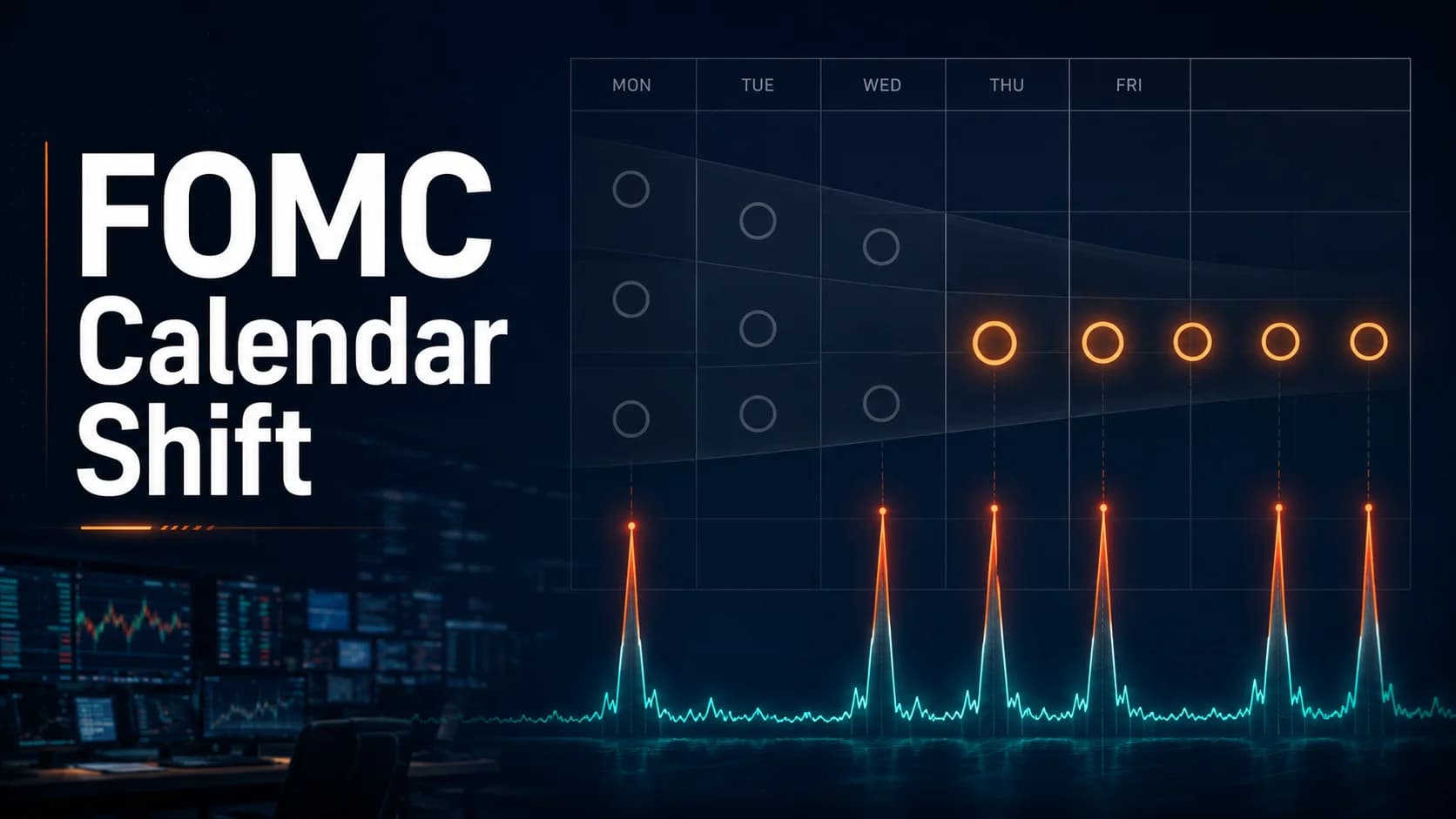
If that happens, it would be the biggest change to how the Fed talks to markets since Paul Volcker standardized the eight-meeting calendar in 1981. It would also change something very specific about your trading calendar: the predictable rhythm of Fed-day volatility that shows up roughly every six weeks would stretch out, and each remaining date would likely carry more weight, not less.
What is the FOMC meeting calendar? The Federal Open Market Committee, the Fed's rate-setting body, currently holds eight scheduled two-day meetings a year to set interest rates and communicate policy guidance. Four of those meetings (March, June, September, and December) also include the Summary of Economic Projections, the "dot plot" of individual rate forecasts that tends to move markets the most.
What Warsh Is Actually Proposing
Here's what's confirmed so far, and it's less than a formal plan. According to the New York Times report that broke the story on July 31, Warsh raised the idea of cutting FOMC meeting frequency during the July 29 to 30 meeting itself, as a discussion topic, and asked other committee members to submit their views in writing. A Fed spokesperson declined to comment when reporters asked about it. That's the entire official record right now: an idea floated internally, not a proposal on the table for a vote.
Warsh hasn't put a specific number on it publicly, but he's given enough of a hint to work with. During his April 2026 Senate confirmation hearing, he said the statute requires a minimum of four meetings a year, and added that "four is not enough." Read together with the current eight, that leaves a fairly narrow band in between, and most people tracking the story have landed on five or six meetings a year as the likely target if this actually happens.
The timeline matters as much as the number. Because Warsh asked for written committee views following the July meeting, a decision could plausibly come together before the next FOMC gathering on September 15 to 16, 2026. But deciding to change the calendar and actually changing it aren't the same thing. Even if the committee agrees on fewer meetings, the earliest realistic start for a new schedule is 2027. Nothing about the rest of this year's calendar, including September, October, and December, is affected by this proposal.
Why This Is Coming Up Now
Warsh's stated reasoning, as reported, is that financial markets have grown too dependent on Fed signals instead of doing their own work with economic data. Fewer meetings, in his framing, would force traders and investors to react to the actual numbers rather than parsing every word of a press conference for a hint about the next move.
There's a more immediate backdrop, too. The July 29 meeting that preceded this idea was rough for Warsh specifically. Dallas Fed President Lorie Logan, Cleveland Fed President Beth Hammack, and Minneapolis Fed President Neel Kashkari all dissented in favor of raising rates, while Vice Chair Philip Jefferson called the current policy "well positioned" and New York Fed President John Williams argued inflation had already peaked. That's a committee that doesn't agree with itself in public, which is uncomfortable for any new chair.
What made it worse was the market's reaction to Warsh personally. JPMorgan's Michael Feroli said Warsh "failed to specify how he intended to achieve his stridently asserted inflation resolve," and the firm responded by pulling its own forecast for the next hike forward from mid-2027 to December 2026. Economist Stephanie Roth put it more bluntly: "His communications style appears to be backfiring and the market is calling his bluff." Stocks sold off and long-dated Treasury yields pushed toward two-decade highs in the days that followed. A chair who just had his live Q&A picked apart in real time has an obvious reason to want fewer live Q&As.
The Historical Precedent Nobody's Mentioning
Here's the part of this story that mainstream coverage keeps skipping: an eight-meeting Fed calendar isn't some permanent law of nature. It's a 45-year-old convention, not a rule from the Constitution.
Before Volcker standardized the schedule in 1981, the FOMC met far more often, and far less predictably. Through the 1950s and 1960s, the committee gathered anywhere from 10 to 19 times a year. At the peak of the 1978 inflation crisis, the Fed held 12 full meetings plus additional emergency sessions on top of that. The eight-meeting, pre-scheduled calendar traders take for granted today is actually the anomaly in the Fed's own history, a deliberate simplification built for a specific era.
That cuts both ways for how you should think about Warsh's idea. On one hand, cutting to five or six meetings would be a reversion toward how the Fed used to operate for decades, not some radical experiment with no precedent. On the other hand, the pre-1981 Fed also met far more often during genuine stress, not less, which is close to the opposite instinct behind what Warsh is reportedly considering now.
What Wall Street Thinks This Does to Volatility
The read from professional Fed watchers is surprisingly consistent, and it cuts against the idea that fewer meetings means a calmer market.
David Kelly, chief global strategist at JPMorgan Asset Management, doesn't think there's a communications problem worth solving this way. "If you give markets no information, they're going to do wild things," he said, adding that "there are lots of problems in Washington, D.C. The Fed's communications isn't one of them." Goldman Sachs chief economist Jan Hatzius made a related point: less frequent Fed input forces markets to make decisions "with less evidence and a greater chance of getting it wrong."
Occidental College economist Andrew Jalil zeroed in on the volatility mechanism directly. Fewer meetings, he argued, means each remaining decision carries disproportionate weight, and "if they're more likely to be surprised by something, it could paradoxically move" markets harder than the current setup does. He also pointed out that markets already fill information gaps with their own guesswork, noting that traders had recently priced in a quarter-point hike for the year with no clear signal from the Fed to justify it. Cut the number of scheduled updates and that kind of speculative pricing has more room to run between checkpoints, not less.
There's also a tail-risk wrinkle nobody's fully worked through yet. If the Fed does move to a five or six-meeting calendar and then has to call an unscheduled, emergency meeting, that meeting instantly becomes a much bigger signal than it would be today. Under the current eight-meeting system, an off-cycle Fed action is already rare and notable. Under a leaner calendar, it would be a louder alarm bell by definition, since the whole point of the new system is that the Fed doesn't convene outside the plan unless something's genuinely wrong.
The Trader Math: What Actually Changes on Your Calendar
This is the part worth sitting with, because it's concrete and nobody covering the political angle of this story has bothered to run the numbers.
The eight FOMC meetings scheduled for 2026 land roughly six to seven weeks apart: January 27 to 28, March 17 to 18, April 28 to 29, June 16 to 17, July 28 to 29, September 15 to 16, October 27 to 28, and December 8 to 9. That's the rhythm every active trader has effectively built into their calendar, whether they think about it explicitly or not. It's why volume and volatility tend to compress in the days before an FOMC decision and expand sharply once it drops.
Cut that to six meetings a year and the average gap stretches to roughly eight and a half weeks. Cut it to five, the low end of what Warsh's own words imply, and you're looking at closer to ten and a half weeks between scheduled Fed catalysts. That's not a small shift. It's the difference between a Fed-day setup showing up every month and a half and one showing up roughly once a quarter, with everything else you trade in between happening in a wider information vacuum.
Two things fill that vacuum under the current system, and both would matter even more under a leaner one. The first is scheduled economic data. CPI, PPI, and the jobs report already move markets on their own, but they'd effectively become the primary signal traders lean on between the Fed's now-rarer check-ins, since there's less frequent Fed commentary to contextualize them. The second is Fed speeches outside the formal meeting calendar, and this is where it gets specific: Warsh has already said he'll discuss the broader shakeup with internal task forces before his Jackson Hole address on August 27 to 29, which means that speech, covered in more detail in Jackson Hole 2026: What Day Traders Should Watch, could double as the first real public signal on where this proposal is headed. If a decision does come together before the September 15 to 16 meeting as this article's timeline section discussed, that meeting stops being just another scheduled dot plot and becomes the day the market finds out whether its own calendar just changed.

How to Adjust Your Playbook
Nothing about this changes what you trade tomorrow. The 2026 calendar is locked, and even a committee decision to cut meetings wouldn't take effect before 2027 at the earliest. But a story like this is worth building into your framework now, for two reasons: it might genuinely happen, and even the process of the Fed deciding whether to do it is itself a source of headline risk between now and September.
Start with position sizing on FOMC days themselves. If the meeting count does eventually shrink, expect the average move on each remaining decision day to run larger than what you've gotten used to on a "normal" Fed day, closer to what shows up on the four meetings that already include the dot plot. The Trader's Playbook: How to Day Trade in a High VIX Market is the framework worth having ready before that adjustment becomes necessary, not after the first outsized move catches you off guard.
Then plan for the other side of the equation: longer stretches with no scheduled Fed catalyst at all. Between-meeting drift already frustrates momentum traders looking for a reliable volatility trigger, and a wider gap makes that worse before it gets better. The Pro Trader's Playbook for Low-Volume, Low-Volatility Markets covers how to adjust size, timeframe, and expectations when the calendar simply isn't giving you a catalyst on a given week.
Watch CPI, PPI, and jobs report days more closely than you might already. If Fed commentary genuinely gets scarcer, these releases pick up more of the job of setting rate expectations between meetings, and the market's reaction to a single data point could get sharper as a result. A scanner built to flag unusual pre-market volume and options activity around known data releases, something like Trade Ideas' real-time scanning, is more useful for catching that kind of setup early than checking a handful of tickers by hand.
Finally, don't treat this as settled. It's a floated idea with a spokesperson's "no comment" attached to it, not a rule change. Build the awareness into your calendar, follow the actual developments around Jackson Hole and the September meeting, and adjust the playbook above only once there's an actual committee decision to react to.
Where This Stands Right Now
To be direct about what's fact and what's still speculation: it's confirmed that Warsh raised the idea internally at the July 29 to 30 meeting and asked for written committee feedback. It's confirmed the Fed hasn't commented publicly beyond a "no comment." It's not confirmed how many meetings the new calendar would have, whether the full committee will actually agree to it, or exactly when a public announcement might come. The five-to-six range circulating in coverage is an inference from Warsh's own past statements, not an official target.
What is fixed is the rest of 2026. Meetings are scheduled for September 15 to 16, October 27 to 28, and December 8 to 9, and none of them move regardless of what the committee decides about future years. If you trade around Fed days, that's still the calendar to plan against for now. The next real checkpoints on the meeting-frequency story itself are Warsh's Jackson Hole address in late August and whatever comes out of the September meeting, and this article will get updated once either one produces an actual answer instead of a floated idea.
Frequently Asked Questions
Is the Fed actually going to hold fewer FOMC meetings?
This is closer to an internal discussion topic than a policy in motion. Reports describing five or six meetings a year as the likely outcome are drawing on Warsh's own April 2026 Senate testimony, where he said the legal minimum of four meetings "is not enough," rather than any officially disclosed target.
Key Takeaway: Treat this as a real possibility worth tracking, not a done deal. Watch for developments around Warsh's Jackson Hole address and the September 15 to 16 meeting.
How many FOMC meetings does the Fed hold each year right now?
Four of those eight meetings (March, June, September, and December) include the Summary of Economic Projections, the dot plot of individual rate forecasts that tends to be the most market-moving part of the calendar. The other four are rate decisions without the added economic projections.
Key Takeaway: The full 2026 schedule (January, March, April, June, July, September, October, and December) is unaffected by this proposal no matter how it's ultimately resolved.
Why does Warsh want to cut the number of Fed meetings?
There's also a more immediate factor. Warsh's first meeting as chair on July 29, 2026 produced a contentious 9 to 3 vote, three dissents from regional Fed presidents wanting a rate hike, and a press conference that investors and analysts, including JPMorgan's Michael Feroli, criticized as unclear. The proposal to reduce meeting frequency surfaced two days after that rocky debut.
Key Takeaway: Both explanations point the same direction: fewer live opportunities for the market to pick apart what the chair says in real time.
Would fewer Fed meetings mean less market volatility?
JPMorgan Asset Management's David Kelly warned that reduced Fed communication would cause "even more confusion and volatility," and Goldman Sachs chief economist Jan Hatzius said markets would be forced to act "with less evidence and a greater chance of getting it wrong." Occidental College economist Andrew Jalil made the volatility mechanism explicit: fewer meetings raise the odds that any single decision surprises the market, which tends to produce a bigger move, not a smaller one.
Key Takeaway: Plan for wider swings on the FOMC days that remain, not calmer ones, if this proposal ever takes effect.
Has anything like this happened before in Fed history?
Through the 1950s and 1960s, the committee gathered 10 to 19 times a year. During the 1978 inflation crisis, it held 12 full meetings plus additional emergency sessions. Volcker's 1981 standardization to eight scheduled meetings a year was itself a major change from how the Fed had operated for decades before it.
Key Takeaway: A move to five or six meetings would be a partial reversion to an older Fed pattern, not an unprecedented experiment, though the pre-1981 Fed met more often during stress, which cuts against the current proposal's own logic.
When would a change to the FOMC calendar actually take effect?
A decision could plausibly come together before the September 15 to 16, 2026 meeting, since Warsh requested written committee views following the July meeting. But agreeing on a new calendar and implementing it aren't the same step, and every report on this story so far places actual implementation in 2027 at the earliest.
Key Takeaway: Nothing about how you trade the rest of 2026's FOMC dates changes because of this proposal, whatever happens to it.
What should day traders actually watch for next on this story?
Warsh has indicated he'll discuss the broader Fed communications shakeup with internal task forces before Jackson Hole, which makes that speech a plausible venue for the first real public detail on the meeting-frequency idea. If committee views converge before September, that meeting could double as both a scheduled dot-plot decision and the moment this proposal gets a real answer.
Key Takeaway: See Jackson Hole 2026: What Day Traders Should Watch for the full setup on that speech.
How does this affect the value of Fed Chair press conferences and economic data releases?
That's the practical trading implication that matters most day to day: a Fed that talks less often makes every remaining data release and every remaining Fed appearance carry more information content than it does today, since traders have fewer scheduled opportunities to get a direct read from the source.
Key Takeaway: Start paying closer attention to how CPI, PPI, and jobs data move the market now, since that reaction is likely to get sharper, not calmer, if Fed communication genuinely gets less frequent.
Disclaimer
Article Sources
- Bloomberg: Warsh Raises Rethink on Fed's Policy Meeting Frequency, Timing - confirms the internal nature of the discussion and timing context
- Fortune: Warsh Considering Reducing Number of Fed Meetings, NYT Reports - the original NYT-sourced report, the July 29 meeting backdrop, and the Fed's non-comment
- Axios: Wall Street: Less Fed Information Will Mean More Volatile Markets - David Kelly and Jan Hatzius commentary on volatility implications
- Marketplace: How Would the Markets React to Fewer Fed Meetings? - Andrew Jalil and Gary Richardson analysis on market speculation and historical transparency trends
- TechTimes: Warsh Eyes FOMC Calendar Cuts, Fewest Scheduled Meetings Since Volcker - the Volcker-era standardization history and pre-1981 meeting frequency
- 24/7 Wall St: Is the Fed Becoming an Even Bigger Black Box? - transparency and oversight concerns around reduced meeting frequency
- Yahoo Finance: Fed's Warsh Rebuked by Investors Craving a Real Inflation Fight - the July 29 vote details, dissenting officials, and market reaction to Warsh's press conference
- The Federal Reserve: Meeting Calendars and Information - the official 2026 FOMC meeting schedule
Was this helpful?
Be the first to weigh in

Written by
Kazi Mezanur RahmanFounder, independent researcher, and editor of DayTradingToolkit. A one-person publication focused on risk-first trading education and documented tool research. He trades his own capital as a retail trader and combines personal market experience with systematic primary-source research.
Keep Reading
Market Analysis & Insights
How Midterm Elections Move the Stock Market: A Day Trader's Guide
The 2026 midterms land November 3 in the middle of a Fed hiking cycle. What history really shows about midterms and stocks, why the pattern exists, and how day traders can handle the overnight results gap.
Market Analysis & Insights
Jackson Hole Aftermath: What Warsh Changed for Traders
Warsh did not promise a September rate hike at Jackson Hole. He made inflation the Fed's dominant concern, and the bond market repriced the next meeting immediately.

Market Analysis & Insights
Cboe Premarket Options Trading Is Delayed: What Changed and What to Watch For
Cboe's C1 exchange postponed its planned 7:30-9:25 a.m. ET premarket options session past its August 17, 2026 target, with the new date still TBD. Here's what changed, why it matters, and what the eventual launch will look like.
Market Analysis & Insights
September's Trading Calendar: FOMC, Quad Witching, and the Rebalance All Land in One Week
Three major structural events land in the same five trading days this September: the FOMC's dot-plot meeting, quadruple witching, and the Nasdaq-100/S&P 500 quarterly rebalance. Here's how they interact and how to prepare.
Comments
No comments yet. Be the first to share your thoughts.