Jackson Hole Aftermath: What Warsh Changed for Traders

In this article9 sections
Kevin Warsh never said the Federal Reserve would raise rates in September. The bond market heard enough to price that possibility anyway.
Within hours of Warsh's first Jackson Hole speech as Fed chair on Friday, August 28, the two-year Treasury yield had jumped 11.8 basis points to 4.348%. Rate futures moved the probability of a September hike from roughly 35% before the speech to around 58%. Stocks initially rose, then faded. Gold dropped 3.2%, and the dollar strengthened.
That is the Jackson Hole aftermath traders are dealing with now: no promise, no explicit reaction function, but a much clearer statement that inflation remains the Fed's dominant concern. The distinction matters because the next decision still depends on data that had not arrived when Warsh spoke.
What changed after Jackson Hole? Warsh did not commit to a rate hike. He made clear that the Fed sees inflation, rather than employment, as the more urgent risk, rejected routine forward guidance, and set a demanding standard for declaring inflation beaten. Markets responded by pushing short-term yields and September hike odds sharply higher.
The speech changed the odds, not the decision
Warsh's closing line supplied the headline. Unless underlying inflation is moving toward the Fed's 2% objective clearly and fast enough, he said, the central bank has "work to do."
That phrase carried weight because of everything before it.
Warsh described an economy that remains resilient, with rising business investment, strong corporate profits, healthy consumer spending, easy credit conditions, and a labor market he still considers consistent with full employment. He then drew a much less comfortable picture of inflation. Twelve-month PCE inflation stood at 3.7%, six-month PCE inflation ran at 4.1%, and 54% of the components in the PCE basket had risen more than 3% over the previous year.
Put those pieces together and the market's interpretation becomes easier to understand. Warsh sees limited evidence that current interest rates are seriously restricting activity, while inflation remains broad and well above target. That combination leaves room to tighten policy if the next round of data holds up.
It still does not guarantee a hike.
Warsh finished by saying he was committed to "a discipline, not to a decision." That was more than a rhetorical flourish. The Federal Open Market Committee votes on rates, and incoming employment and inflation data can still alter the balance before September 16.
Warsh put inflation ahead of the weak payroll headline
The most consequential part of the speech may have been Warsh's treatment of the labor market.
July nonfarm payrolls fell by 23,000, and the prior two months were revised down by a combined 103,000. Read without context, that looks like a clear warning that employment is deteriorating. Warsh interpreted it differently. He argued that slow labor-force growth naturally reduces the number of monthly jobs needed to keep unemployment stable. With unemployment at 4.1% and weekly claims still low, he described employment as broadly healthy.
That interpretation changes how traders should read Friday's August jobs report.
Before Jackson Hole, another modest payroll number might have reinforced the idea that the Fed could remain patient. After the speech, a merely average report may be enough to keep a September hike alive because Warsh has already explained why low job growth does not automatically mean labor-market weakness.
The hurdle for a dovish repricing is therefore higher. A soft headline alone may not do it. Traders will need to check unemployment, average hourly earnings, labor-force participation, and revisions to previous months before deciding whether the report genuinely challenges Warsh's full-employment view.
For the broader mechanics of these releases, DTT's guide to CPI, NFP, and FOMC market reactions explains why the surprise relative to consensus usually matters more than the headline in isolation.

A quieter Fed creates a different trading problem
Warsh devoted a large part of the speech to ending the Fed's reliance on routine forward guidance. Forward guidance means telling markets how policymakers expect rates to evolve before they have formally made the decision.
His objection is straightforward. If markets lean too heavily on the Fed's projections, and the Fed then uses those market prices as evidence about the economy, both sides can end up looking at reflections of each other instead of new information. Warsh called this a hall-of-mirrors problem.
He also rejected the idea of publishing a mechanical reaction function that would tell traders exactly how the Fed will respond to a hot or cold data release. Economic relationships change, forecasts miss, and one monthly number rarely carries enough information on its own.
That approach gives traders less certainty between meetings.
Under a guidance-heavy Fed, the market can anchor to a projected rate path and adjust around it. Under Warsh, each major data release has more freedom to move that path. CPI, payrolls, PCE, and even secondary evidence such as ISM surveys or jobless claims can create larger repricing because the chair has deliberately left fewer promises in place.
This is consistent with his broader push toward fewer FOMC meetings and wider gaps between decisions. If both changes happen, traders may face longer stretches with less official guidance and more sensitivity to incoming data.
Why the two-year Treasury yield moved first
The two-year Treasury yield is particularly sensitive to expectations for the Fed's near-term policy rate. When traders raise the probability of a hike, they tend to sell short-dated Treasuries. Bond prices fall and yields rise.
That is exactly what happened on Friday. The two-year yield rose 11.8 basis points to 4.348%, its largest one-day increase on a Jackson Hole speech day since Alan Greenspan spoke there in 1996, according to Dow Jones Market Data. The 10-year yield rose about 5 basis points to 4.72%, while the 30-year moved much less.
The shape of that move tells a story. Short-term rates repriced because Warsh changed expectations for the next few Fed meetings. Long-term yields did not rise by the same amount because the speech also reinforced the Fed's commitment to containing inflation over time.
Equities reacted more slowly. The S&P 500 initially rose, then closed about 0.2% lower. The Nasdaq lost roughly 0.5%. The dollar index climbed about 0.6%, while gold fell sharply as higher real-rate expectations and a stronger dollar hit at the same time.
None of those relationships is automatic on every Fed day. Oil, geopolitical news, positioning, and company-specific catalysts can interfere. This week's jobs report, Iran risk, and earnings calendar is a good example: several independent forces can move the same instruments in opposite directions.
The AI discussion was not a near-term policy pivot
Warsh spent meaningful time on artificial intelligence, but the market did not treat that section as dovish. That was the correct reading.
He described AI as a possible new factor of production that could raise productivity and economic growth. He also noted that more than half of this year's capital-expenditure growth may be connected to AI infrastructure. Those are substantial claims, but Warsh explicitly said the Fed's task-force work on AI, productivity, and jobs will inform future challenges, not the current policy decision.
For September, the AI section matters in a narrower way. Strong capital spending, expanding profits, and easy credit support Warsh's view that financial conditions are not broadly restrictive. At the same time, he acknowledged that the long-term effects on workers, pricing, and returns on capital remain unsettled.
So the speech did not resolve the AI debate. It separated the long-run research question from the immediate inflation problem.
That separation matters this week because Broadcom reports on Wednesday. A strong AI-capex signal from the company could support the economic-resilience side of Warsh's argument, but one earnings report cannot determine Fed policy. It can only add another piece to a much larger picture.
Friday's jobs report is the first serious test
The Bureau of Labor Statistics will release the August Employment Situation report on Friday, September 4, at 8:30 a.m. ET. Economists surveyed by Reuters expect payrolls to rebound by about 58,000 after July's 23,000 decline, with unemployment holding at 4.1%.
Three broad outcomes matter.
A firm report supports Warsh's reading. Payroll growth near or above consensus, stable unemployment, and firm wages would make it harder to argue that the labor side of the Fed's mandate requires patience. Watch the two-year yield, the dollar, small caps, homebuilders, and high-multiple technology stocks for confirmation.
A genuinely weak report challenges it. Another negative payroll print, a meaningful rise in unemployment, weaker wages, or broad downward revisions would force the market to reconsider whether employment is as stable as Warsh believes. A fall in the two-year yield and a drop in September hike odds would confirm that interpretation.
A mixed report creates the most difficult tape. A weak headline with strong wages, or a strong headline with poor revisions and falling participation, can trigger a fast first move followed by a reversal. The first number across the wire is not the whole report.
This is why guessing the release is usually a poor trade. DTT's Fed-chair speech playbook applies here too: let rates and the dollar show how the market is interpreting the information before treating the equity move as settled.
What traders should watch before the September meeting
The next FOMC meeting runs September 15 and 16. It includes a new Summary of Economic Projections and dot plot, which makes the meeting more consequential than an ordinary rate decision.
Between now and then, the cleanest read comes from several markets moving together:
- Two-year Treasury yield: A sustained move above Friday's post-speech level would show that near-term hike expectations are strengthening. A quick reversal below the pre-speech range would suggest the repricing did not hold.
- Fed funds futures: Probabilities are market prices, not promises. Still, they offer the most direct view of whether each data release is changing the expected decision.
- U.S. dollar: A stronger dollar tends to confirm a more hawkish rate path, particularly when short-term U.S. yields are rising at the same time.
- Gold: Gold's Friday decline reflected higher yields and a stronger dollar. If gold rises despite those pressures, another force, such as geopolitical demand, may be dominating the rate story.
- Rate-sensitive equities: IWM, homebuilders, regional banks, and high-valuation technology stocks can reveal whether the equity market accepts the bond market's interpretation.
The September meeting also collides with options expiration and major index rebalancing. DTT's September trading calendar maps those separate volatility windows so they do not get mistaken for a single Fed-driven move.
What the original preview got right and wrong
The original version of this article expected a two-stage reaction: an initial move in yields and the dollar, followed by a slower equity interpretation. That is close to what happened. Short-term yields and the dollar moved first. Stocks initially rose, then gave back the move as the inflation message took control.
The preview underestimated how directly Warsh would rank the risks. It allowed for a philosophical speech that left markets without a strong near-term conclusion. Warsh did avoid a formal rate signal, but his assessment was not neutral. He described employment as consistent with full employment and said the Fed's predominant focus should be prices.
That was enough.
The speech also sharpened the communication style discussed when Warsh first became Fed chair. He is willing to state principles clearly while refusing to map those principles onto a promised rate path. Traders get a firm framework and less certainty about the next decision.
The practical response is simple: stop waiting for Warsh to tell the market what September will bring. He has said he does not want to do that. Watch how the data changes the short end of the Treasury curve, then check whether equities, the dollar, and gold agree.
Frequently asked questions
What did Kevin Warsh say at Jackson Hole?
He also described the labor market as consistent with full employment, argued that broad financial conditions are not restrictive, and rejected routine forward guidance. That combination led markets to conclude that a September rate hike had become more plausible, even though Warsh did not promise one.
Key Takeaway: The speech was hawkish in its priorities, but it did not lock in a September decision.
Did Warsh announce a September interest-rate hike?
The FOMC makes the decision collectively on September 16. Warsh said he was committed to a policy discipline rather than a specific decision, leaving payrolls, inflation data, and other evidence to influence the vote.
Key Takeaway: Market-implied odds rose sharply, but probability is not policy.
Why did the two-year Treasury yield jump after the speech?
When traders raised the probability of a September hike, they sold short-dated Treasury securities. Their prices fell and yields rose. The two-year yield gained 11.8 basis points on Friday, far more than the move at the long end of the curve.
Key Takeaway: The short end showed that markets heard a higher near-term rate path.
What does a quieter Fed mean for traders?
Warsh believes routine forward guidance can distort both market expectations and the Fed's own reading of those expectations. If he follows through, traders will need to rely more heavily on economic data, Treasury yields, and cross-market confirmation instead of waiting for a promised policy path.
Key Takeaway: Less guidance increases the value of preparation and confirmation.
Why is the August jobs report so important after Jackson Hole?
A firm report would support the case for focusing on inflation. A broadly weak report could revive concern about the employment side of the Fed's mandate and reduce September hike expectations.
Key Takeaway: Payrolls matter most when the full report confirms or contradicts Warsh's labor-market assessment.
Which part of the jobs report should traders watch?
One strong or weak headline can mislead. Wages affect the inflation interpretation, unemployment and participation show labor-market breadth, and revisions can change the trend that the Fed says it cares about.
Key Takeaway: The report's internal consistency matters more than one number.
Which markets provide the clearest confirmation of a hawkish Fed reaction?
Equities can take longer because higher rates affect sectors differently. Gold, small caps, homebuilders, regional banks, and high-valuation technology stocks add useful confirmation, but company news and geopolitical events can complicate those relationships.
Key Takeaway: Start with short-term yields and the dollar, then check whether equities and commodities agree.
When is the next FOMC meeting?
The meeting includes a new Summary of Economic Projections and dot plot. That gives traders both the immediate rate decision and the committee's updated view of the path ahead.
Key Takeaway: Jackson Hole changed the setup, but the September meeting settles the decision.
Disclaimer
Article Sources
- Federal Reserve: Kevin Warsh's Jackson Hole keynote - Full prepared remarks, including his inflation assessment, communication principles, and economic outlook.
- Reuters: Rate-hike expectations rise after Warsh's speech - Immediate moves in Treasury yields, the dollar, stocks, and rate futures.
- Barron's: Two-year yield posts its largest Jackson Hole reaction since 1996 - Dow Jones Market Data comparison and the closing two-year yield.
- Bureau of Labor Statistics: July Employment Situation - July payrolls, unemployment, wage data, revisions, and the September 4 release schedule.
- Federal Reserve: FOMC meeting calendar - September meeting dates and confirmation that the meeting includes updated projections.
- Reuters: Markets enter the week with yields elevated - Follow-through in rate expectations, Treasury yields, oil, gold, and equity futures.
Was this helpful?
Be the first to weigh in

Written by
Kazi Mezanur RahmanFounder, independent researcher, and editor of DayTradingToolkit. A one-person publication focused on risk-first trading education and documented tool research. He trades his own capital as a retail trader and combines personal market experience with systematic primary-source research.
Keep Reading
Market Analysis & Insights
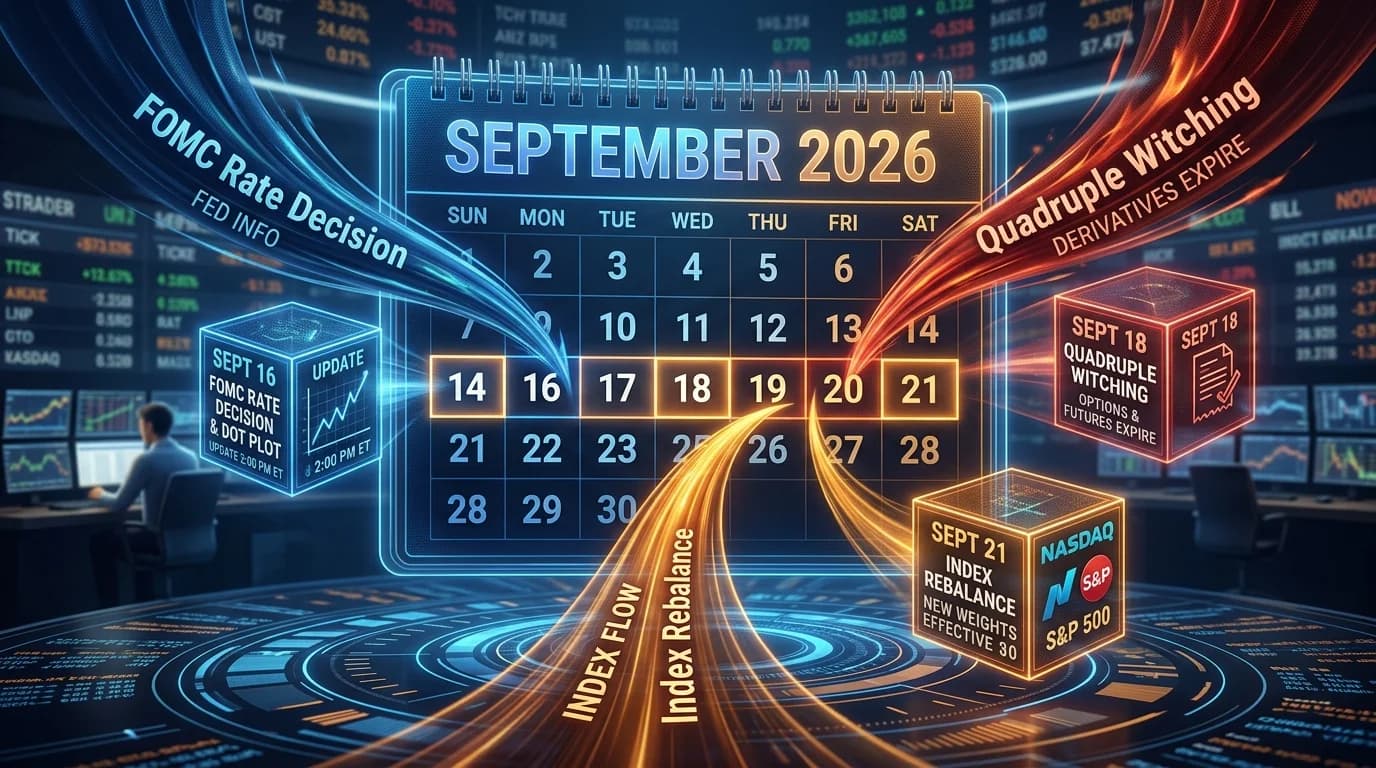
September's Trading Calendar: FOMC, Quad Witching, and the Rebalance All Land in One Week
Three major structural events land in the same five trading days this September: the FOMC's dot-plot meeting, quadruple witching, and the Nasdaq-100/S&P 500 quarterly rebalance. Here's how they interact and how to prepare.
Market Analysis & Insights
Can Friday's Jobs Report Undo What Warsh Just Did to Rate Bets? Weekly Market Insights, August 31-September 4
Warsh's hawkish Jackson Hole speech pushed September rate-hike odds above 50%. Then Iran struck back at the calendar entirely: a fresh U.S. strike on the Strait of Hormuz, a Broadcom earnings test, and Friday's jobs report all collide in the same five days.
Market Analysis & Insights
Warsh Wants Fewer Fed Meetings: What Changes for Traders
Fed Chair Kevin Warsh is exploring cutting FOMC meetings from eight a year to as few as five or six. Here's what's actually been proposed, the history behind the eight-meeting standard, and what wider gaps between Fed decisions would mean for your trading calendar.
Market Analysis & Insights
New Fed Chair Kevin Warsh: What Day Traders Need to Know
Kevin Warsh takes over as Fed Chair this week. Here's what the leadership change means for volatility, interest rates, and how to trade the June 2026 FOMC meeting.
Comments
No comments yet. Be the first to share your thoughts.