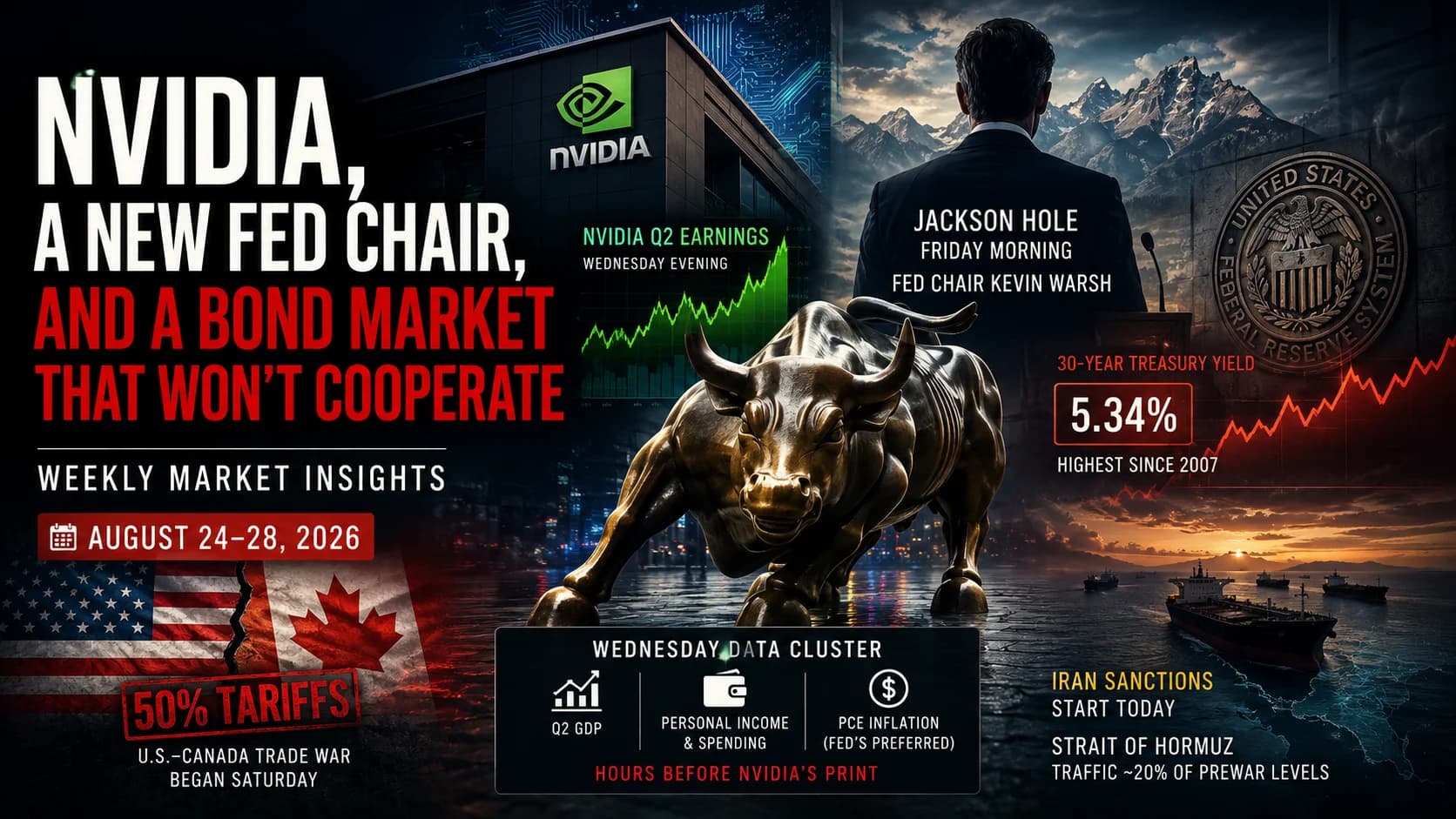


Kevin Warsh spent his first Jackson Hole speech refusing to give the market what it wanted. No forward GuidanceGuidance is forward-looking financial projections that a company's management provides for upcoming periods — typically covering expected revenue, earnings, or margins — and the market's reaction is often driven more by guidance than by theRead definition →, no reaction function, just a warning that summer's inflation data, while better than feared, "do not tell me that underlying trends have meaningfully improved." Traders didn't need a clearer signal than that. September rate-hike odds, sitting near one-in-three a week earlier, jumped to roughly 50 to 57 percent within hours.
Then, Sunday night, before this week's first trading session even opened, the U.S. struck Iranian rocket launchers on the Strait of Hormuz. It was the first American military action in a month, aimed at Revolutionary Guard forces reportedly preparing to fire sea mines into the strait. Iran has vowed to retaliate. Oil jumped roughly 2 percent within hours.
This guide is current through Sunday night, August 30. What follows is a preparation map for a five-day week that has to reconcile a HawkishHawkish describes a monetary policy stance favoring higher interest rates, reduced money supply, or tighter financial conditions to control inflation — the opposite of dovish.Read definition → Fed chair, a labor market that just posted its first negative print in years, a live and escalating conflict in the Middle East, and the single largest AI-EarningsAn earnings report is the quarterly financial disclosure a public company files with the SEC, revealing revenue, earnings per share (EPS), profit margins, and forward guidance — it's the most significant regular catalyst for individual stocRead definition → event still left on the calendar. None of it resolves cleanly. That's exactly why it's worth mapping out before Monday's open.
Week at a Glance
- Day
- Mon
- Date
- Aug 31
- Time ET
- All day
- Event
- Iran retaliation risk; month-end positioning
- Expected Relevance
- High
- Why It Matters
- First session since Sunday's Hormuz strike; month-end flows can amplify moves
- Day
- Tue
- Date
- Sep 1
- Time ET
- 10:00 AM
- Event
- ISM Manufacturing PMI (Aug)
- Expected Relevance
- High
- Why It Matters
- July hit 55.6%, the strongest reading since May 2022; this tests whether it holds
- Day
- Tue
- Date
- Sep 1
- Time ET
- 10:00 AM
- Event
- JOLTS Job Openings (Jul)
- Expected Relevance
- Medium
- Why It Matters
- Labor-demand gauge two sessions before ADP and three before the jobs report
- Day
- Tue
- Date
- Sep 1
- Time ET
- After close
- Event
- Palo Alto Networks, Dell earnings
- Expected Relevance
- High
- Why It Matters
- First cybersecurity read since CrowdStrike's report last week; Dell tests AI-PC and enterprise demand
- Day
- Wed
- Date
- Sep 2
- Time ET
- 8:15 AM
- Event
- ADP Employment Report (Aug)
- Expected Relevance
- High
- Why It Matters
- Private-payrolls preview, two days ahead of the government's jobs report
- Day
- Wed
- Date
- Sep 2
- Time ET
- 10:00 AM
- Event
- Factory Orders (Jul)
- Expected Relevance
- Low-Medium
- Why It Matters
- Secondary manufacturing-demand check
- Day
- Wed
- Date
- Sep 2
- Time ET
- 2:00 PM
- Event
- Fed Beige Book
- Expected Relevance
- Medium
- Why It Matters
- Anecdotal read on conditions, released two weeks ahead of the September 15-16 FOMC decision
- Day
- Wed
- Date
- Sep 2
- Time ET
- After close
- Event
- Broadcom, HPE, Snowflake earnings
- Expected Relevance
- Highest
- Why It Matters
- Broadcom is this week's single largest catalyst; direct continuation of the Nvidia AI-capex test
- Day
- Thu
- Date
- Sep 3
- Time ET
- 8:30 AM
- Event
- Initial jobless claims
- Expected Relevance
- Medium
- Why It Matters
- Weekly labor-market pulse, day before the main event
- Day
- Thu
- Date
- Sep 3
- Time ET
- 10:00 AM
- Event
- ISM Services PMI (Aug)
- Expected Relevance
- High
- Why It Matters
- Services make up most of the economy; a soft reading would reinforce a slowdown thesis
- Day
- Thu
- Date
- Sep 3
- Time ET
- Evening
- Event
- Tesla Cybercab launch event (Austin, livestreamed)
- Expected Relevance
- Medium
- Why It Matters
- Third Tesla product catalyst this week, alongside the Optimus production ramp and the September 24 Semi event
- Day
- Thu
- Date
- Sep 3
- Time ET
- After close
- Event
- lululemon, Zscaler, Docusign earnings
- Expected Relevance
- Medium
- Why It Matters
- Third consumer-health test of the month, a higher-income counterpoint to Walmart and Kohl's
- Day
- Fri
- Date
- Sep 4
- Time ET
- 8:30 AM
- Event
- August jobs report (NFP)
- Expected Relevance
- Highest
- Why It Matters
- The week's defining release; July's shock -23,000 print is the reason hike odds had fallen before Friday's speech pushed them back up
| Day | Date | Time ET | Event | Expected Relevance | Why It Matters |
|---|---|---|---|---|---|
| Mon | Aug 31 | All day | Iran retaliation risk; month-end positioning | High | First session since Sunday's Hormuz strike; month-end flows can amplify moves |
| Tue | Sep 1 | 10:00 AM | ISM Manufacturing PMI (Aug) | High | July hit 55.6%, the strongest reading since May 2022; this tests whether it holds |
| Tue | Sep 1 | 10:00 AM | JOLTS Job Openings (Jul) | Medium | Labor-demand gauge two sessions before ADP and three before the jobs report |
| Tue | Sep 1 | After close | Palo Alto Networks, Dell earnings | High | First cybersecurity read since CrowdStrike's report last week; Dell tests AI-PC and enterprise demand |
| Wed | Sep 2 | 8:15 AM | ADP Employment Report (Aug) | High | Private-payrolls preview, two days ahead of the government's jobs report |
| Wed | Sep 2 | 10:00 AM | Factory Orders (Jul) | Low-Medium | Secondary manufacturing-demand check |
| Wed | Sep 2 | 2:00 PM | Fed Beige Book | Medium | Anecdotal read on conditions, released two weeks ahead of the September 15-16 FOMC decision |
| Wed | Sep 2 | After close | Broadcom, HPE, Snowflake earnings | Highest | Broadcom is this week's single largest catalyst; direct continuation of the Nvidia AI-capex test |
| Thu | Sep 3 | 8:30 AM | Initial jobless claims | Medium | Weekly labor-market pulse, day before the main event |
| Thu | Sep 3 | 10:00 AM | ISM Services PMI (Aug) | High | Services make up most of the economy; a soft reading would reinforce a slowdown thesis |
| Thu | Sep 3 | Evening | Tesla Cybercab launch event (Austin, livestreamed) | Medium | Third Tesla product catalyst this week, alongside the Optimus production ramp and the September 24 Semi event |
| Thu | Sep 3 | After close | lululemon, Zscaler, Docusign earnings | Medium | Third consumer-health test of the month, a higher-income counterpoint to Walmart and Kohl's |
| Fri | Sep 4 | 8:30 AM | August jobs report (NFP) | Highest | The week's defining release; July's shock -23,000 print is the reason hike odds had fallen before Friday's speech pushed them back up |
What Changed Last Week
The headline indexes still closed higher. The S&P 500 finished Friday at 7,711.76, up 0.5% on the week. The Dow added 0.5% to 53,559.99, its first winning week in three. The Nasdaq Composite gained 0.9% to 26,402.42. Look underneath those numbers and the week tells a rougher story: the S&P fell 0.25% on Friday alone, the Nasdaq dropped 0.52%, and the Russell 2000 shed 1.39%, the worst single-day move of the four major indexes. The VIXThe CBOE Volatility Index — a real-time measure of the market's expectation for 30-day volatility in the S&P 500, derived from the prices of S&P 500 options. Widely called the "fear gauge," a rising VIX indicates increasing uncertainty and Read definition → stayed calm at 14.43, which by itself should tell you it isn't the instrument currently pricing this market's real tension.
That tension showed up first in Nvidia's earnings. The company reported fiscal second-quarter revenue of $96.2 billion, more than double a year earlier, and EPS of $2.22. The stock jumped 8.7% Thursday, its best single day since April 2025. Then Thursday evening, Marvell Technology beat estimates and raised guidance too, and fell 10.3% Friday anyway. That's the same "blowout or bust" pattern this guide flagged heading into Nvidia's print last week: positioning in AI-adjacent names has gotten crowded enough that a beat-and-raise quarter isn't a guaranteed pass anymore. Broadcom inherits that exact setup Wednesday.
Wednesday's data cluster added its own complication. The Bureau of Economic Analysis's second estimate confirmed Q2 GDP growth at 1.5% annualized, down from 2.1% in the first quarter. The same morning, July's core PCE index, the Fed's preferred inflation gauge, held at 3.3% year over year, unchanged from June and still nearly double the Fed's 2% target. Slower growth and sticky inflation in the same report is not a combination that makes any Fed chair's job easier, and it's the exact backdrop Warsh walked into two days later.
Friday brought two more data points worth holding onto. First, the BLS released its preliminary annual benchmark revision to Nonfarm PayrollsNonfarm Payrolls (NFP) is the monthly US employment report released the first Friday of every month by the Bureau of Labor Statistics, showing how many jobs the economy added or lost outside of farming — it's one of the most market-moving eRead definition →: total employment for the year through March 2026 was revised down by 79,000, with private payrolls down 178,000. That's a real downward revision, but it's a fraction of the size of last February's shock, when the same annual process cut payrolls by 862,000. Read in context, Friday's revision is closer to reassuring than alarming: whatever the labor market's real problems are, they don't appear to include a monthly survey that's dramatically overstating the picture the way it was a year ago.
Second, and the one that actually moved markets: Warsh's keynote. Delivered at 10:00 AM ET, it avoided both forward guidance and a stated reaction function, which is exactly what Warsh promised he'd do in his July press conference. What he did say was pointed. "We must be confident that underlying inflation is moving to our objective, clearly and at sufficient speed," he told the room. "Otherwise, we have work to do." Markets read "work to do" as code for a possible hike, and priced it in immediately: the 2-year Treasury yield jumped roughly 8 basis points to around 4.31%, the 10-year rose to 4.72%, and the dollar posted its biggest one-day gain in about a month. Gold, which had spent most of August climbing on dollar weakness and debt concerns, fell 2.9% to $4,529.90, the mechanical result of a stronger dollar and higher real yields showing up all at once.
Fresh Since Friday: A Strike Nobody Scheduled
Sunday brought the development that wasn't on anyone's calendar. According to U.S. Central Command, Revolutionary Guard forces were observed preparing rocket launchers on Larak Island, in the Strait of Hormuz, to fire mines into the strait's shipping lanes. The U.S. struck those launchers Sunday, its first acknowledged military action against Iran in roughly a month, after weeks in which the administration had explicitly pivoted toward economic pressure over force. Iran's Revolutionary Guard acknowledged the strike, reported casualties, and vowed to respond "in a seismic manner."
The timing matters because of what was already in motion. On August 24, the Treasury announced a new sanctions push against Iran under the banner "Operation Economic Outcast," targeting roughly 60 entities across five sectors it called Iran's core lifelines: digital assets, technology, gold, aviation, and shipping. That campaign was explicitly framed as an alternative to further military action. Sunday's strike suggests the administration is now running both tracks at once, sanctions and force, on a conflict that has already cut daily Strait of Hormuz traffic to a small fraction of prewar levels.
Oil reacted immediately. WTI, which closed Friday at $83.40, traded up roughly 2% in Sunday-evening trading toward $85, with Brent crude following a similar path toward $89.90. None of that tells you whether Iran's retaliation escalates further or fizzles the way several prior exchanges have this year. It does tell you that energy, defense, and airline names are trading with a live, unscheduled catalyst sitting over them all week, on top of everything already on the calendar.
Update, Wednesday Morning: The Escalation Didn't Fizzle
Sunday's strike turned out to be the opening move, not the end of it. A vessel transiting the strait was hit by an unknown projectile late Monday, and by Wednesday morning commercial traffic through Hormuz was running at a small fraction of even last week's reduced pace. Oil moved with it: WTI surged more than 5% to top $90 a barrel, and Brent pushed toward $95, both well past the Sunday-night levels cited above. The 10-year Treasury yield climbed further, to roughly 4.79%, the dollar extended its gain, and gold, already down from Friday's Warsh-driven selloff, fell again toward $4,300. Market-implied odds for a hike at the September 15-16 meeting have moved with the oil price: some trackers now put them near 70%, up from the 50-57% range cited above over the weekend. None of this changes the calendar below, but it raises the stakes on today's Beige Book and Broadcom print, and on Friday's jobs report — a Fed already inclined toward a hawkish read on inflation is now watching a live energy shock develop in real time.
The Question Connecting This Week
Two weeks ago, the market's framework for this Fed cycle was straightforward: a weak July jobs report had eased hike fears, and traders were mostly asking when the next cut might come. Warsh's speech didn't just complicate that framework. It flipped the more immediate question entirely, from "when does the Fed cut" to "does the Fed actually hike in three weeks."
That's the tension this week's calendar is built to test. If July's -23,000 payroll print was the start of a genuine labor-market slowdown, a hike aimed at fighting inflation risks making a cooling jobs market worse at exactly the wrong moment. If July was closer to noise, an anomaly inside a benchmark-revision process that's already run its correction, then Warsh's hawkish framing has real data behind it and the market's repricing toward a hike is justified. Friday's August jobs report is the single most direct piece of evidence either side gets before the September 15-16 FOMC decision.
It isn't the only evidence, though. Tuesday's ISM Manufacturing reading, Wednesday's ADP print, and Thursday's ISM Services number all feed into the same picture before Friday's headline number even lands, and none of them need to agree with each other for the week to matter. A soft ADP followed by a strong headline NFP, or the reverse, would itself be a signal that the labor market's underlying picture is genuinely mixed rather than settled. That's a normal outcome worth planning for, not a reason to wait for a cleaner story that may not arrive.
This is a lens for reading the week, not a filter. Broadcom's earnings, Sunday's Iran strike, and Canada's approaching tariff deadline don't need to fit this frame to matter, and none of them are waiting for Friday's jobs number to move.
Broadcom, Palo Alto, and the AI-Capex Test Continues
Broadcom reports fiscal third-quarter results Wednesday after the close, and it's the single largest scheduled catalyst on this week's calendar. Consensus sits near $3.24 in EPS, up roughly 91.5% year over year, on revenue of about $29.4 billion, up 84.1%. The semiconductor solutions segment, the part of the business most directly tied to AI infrastructure spending, is expected to more than double from $9.2 billion a year ago to roughly $18.5 billion. Analysts are also watching for fourth-quarter guidance near $3.88 in EPS and $35 billion in revenue. Options are pricing a post-earnings move of about 7.6% in either direction.
The number to watch isn't just whether Broadcom clears those bars. It's whether clearing them is enough. Marvell just proved that beating and raising doesn't guarantee a positive reaction when a stock has already run hard into the print. If Broadcom beats and still sells off, that's a second data point suggesting the AI-infrastructure trade has entered a phase where good news gets sold rather than bought, at least in already-crowded names. If it beats and holds the gain, that's evidence the market is still discriminating between company-specific execution and sector-wide positioning fatigue.
Palo Alto Networks reports Tuesday evening, one session after CrowdStrike's own print last week reinforced the idea that cybersecurity demand keeps growing regardless of the macro backdrop. Whether that holds for a second name in the same week, alongside CrowdStrike's own Fal.Con customer conference running Tuesday and Wednesday, is worth tracking as its own confirmation pair: two companies selling into the same enterprise-security budget, reporting days apart.
Stocks to Watch
Every name below earns its place by answering "why this stock, this week," not because the chart looks interesting.
Broadcom (AVGO). Wednesday's earnings are already the single largest catalyst on this week's calendar, for the reasons laid out above. The number worth watching in real time is the first hour of after-hours trading against that roughly $18.5 billion semiconductor solutions bar. A beat that still sells off would be the clearest possible confirmation that Marvell's Friday reaction wasn't a one-off.
Palo Alto Networks (PANW). Same logic as Broadcom, one day earlier and one sector over. Billings growth and platformization trends are the specific numbers to watch, alongside any commentary tied to the Fal.Con conference running the same week. A strong quarter that still gets read through a "the sector already priced this in" lens would say more about positioning than about Palo Alto's actual business.
Chevron (CVX) and United Airlines (UAL). These two sit on opposite sides of Sunday's Hormuz strike, and running them as a pair says more than either alone would. Chevron is about as clean a large-cap proxy for higher crude as the market offers. United carries the mirror image through jet fuel costs. If both move in genuinely opposite directions on the same oil headline this week, that's the market pricing the actual mechanism rather than reacting to noise. Company-specific news at either name, or a sudden de-escalation signal, could muddy that read fast.
Newmont (NEM) versus spot gold. Gold had been one of August's cleanest trends, up more than 15% at one point on dollar weakness and mounting debt concerns, before Friday's hawkish reaction to Warsh knocked it down 2.9% in a single session. Newmont and the other miners are the fastest way to see whether that reversal has legs. If the miners hold up better than gold itself this week, that's a sign the market still sees the underlying trend as intact rather than broken. A soft jobs report Friday could just as easily send the whole trade back the other way before the week is out.
D.R. Horton (DHI) versus the 10-year yield. No single event puts D.R. Horton on this list. The 10-year sitting near 4.72% does. Homebuilders are among the most directly rate-sensitive equities on the board, and this week stacks enough data, ADP, both ISM prints, the jobs report, to move that yield more than once. Watching whether D.R. Horton moves inversely to the 10-year on each release is a quick check that the usual transmission mechanism is still working the way it should. A stray piece of company guidance or regional housing data could easily complicate a purely rate-driven read.
iShares Russell 2000 ETF (IWM). The Russell 2000 fell 1.39% Friday alone, nearly three times the S&P's decline, and that gap isn't an accident. Small-cap balance sheets carry more variable-rate debt and less pricing power than the mega-caps that dominate the S&P, which makes IWM the most amplified read on whatever Friday's jobs report does to rate expectations. Watch its reaction relative to the S&P in the minutes right after 8:30 AM. A number that's directionally clear but small in magnitude is the one scenario likely to get read more than one way.
lululemon (LULU). lululemon reports Thursday after the close, and it's this month's third consumer-spending test after Walmart's and Kohl's signals of real softness at the value end of the market. lululemon skews toward a higher-income, more discretionary shopper, so a soft print here would suggest the pressure has spread further up the income ladder than the past two weeks indicated. Comparable sales and any specific U.S.-versus-international commentary are the numbers that matter. Apparel retailers also carry their own idiosyncratic risks, inventory, promotions, weather, that can swamp a purely macro reading of the results.
PayPal (PYPL). PayPal has no earnings this week, but it doesn't need one. The stock fell 16% in Friday's premarket session after Advent International and Stripe both walked away from their reported pursuit of the company, the kind of overnight repricing that tends to keep generating headlines for several sessions afterward. Whether the stock stabilizes this week or keeps drifting on the loss of a takeout premium is the thing to watch. Any fresh reporting on why the deal talks collapsed could move it independently of everything else on this list.
Tesla (TSLA). No earnings on the calendar this week, but Tesla has had two of its own catalysts land back to back. Its Optimus humanoid robot entered production at the Fremont factory in late August, and Thursday evening brings the company's invite-only Cybercab launch event in Austin, livestreamed for everyone else, unveiling the purpose-built, steering-wheel-free robotaxi Tesla has been building toward for two years. A newly announced Semi-truck investor event for September 24 adds a third product story to the calendar. Watch whether Thursday's Cybercab reveal moves the stock meaningfully, or whether, as some coverage has already argued, the news is largely priced in given how modest Tesla's existing robotaxi fleet still is.
Also on the radar: the broader semiconductor complex (SMH) as a sympathy check on Broadcom; Dell and HPE for an AI-PC and enterprise-hardware demand read; Snowflake and Five Below among Wednesday's smaller reports; and Anthropic's IPO timeline, which this guide covered in detail last week, since a public S-1 filing could land in any given week from here.
Scenario Map
These are conditional paths built from this week's actual research, not predictions, and no single one is more likely than the others based on the evidence available as of this cutoff.
Hawks get their data. Friday's jobs report meets or beats the roughly 55,000 consensus, and ADP and the ISM readings come in firm. Confirmation: the 2-year yield pushes toward 4.4%, the dollar extends Friday's gain, small caps and gold both stay weak into the weekend.
Labor cools for real. Friday's NFP disappoints again, unemployment ticks up toward 4.2% or higher, and ADP or claims data show genuine softening earlier in the week. Confirmation: yields ease across the curve, the dollar gives back Friday's gain, homebuilders and small caps rally, and September hike pricing fades back toward 30%.
AI capex holds, cyber holds too. Broadcom and Palo Alto both beat and guide well, and the stocks hold their gains regardless of what the week's macro data show. Confirmation: SMH and software-sector proxies move higher on the earnings days specifically, independent of the jobs-report reaction.
The Marvell pattern repeats. Broadcom beats and raises guidance and still sells off, echoing Marvell's Friday move. Confirmation: a clear "sell the news" reaction on strong numbers, reinforcing that positioning risk currently outweighs fundamentals in the most crowded AI-adjacent names.
Iran overrides the calendar. Tehran's promised retaliation for Sunday's strike materializes in a way that further disrupts Hormuz shipping or damages a vessel with casualties, or the conflict escalates on a new front. Confirmation: oil and gold rise together, an unusual combination that signals genuine risk-off positioning, and equities sell off broadly regardless of what the jobs data or earnings showed that same day.
Trader Preparation
This week's trap is straightforward: five separate threads (a hawkish Fed, an escalating conflict, a jobs report, an AI-capex earnings test, and a cybersecurity earnings test) are all live at once, and none of them defers to the others. Trying to hold a single narrative through Friday is likely to leave you fighting the tape more than reading it.
- Confirm the exact order of Tuesday through Thursday's data releases each morning. ISM prints, ADP, and jobless claims sometimes shift by minutes in ways that matter for the first few minutes of algorithmic reaction.
- Check the options-implied move on Broadcom and Palo Alto before sizing anything around either report. An implied move that looks small next to the stock's recent realized volatility is itself worth noting.
- Treat any fresh Iran or Hormuz headline as a standalone catalyst for energy, defense, and airline names all week, even without a fixed release time. This conflict has produced fast-moving headlines all year, and Sunday's strike raises the odds of more this week specifically.
- Widen stops or reduce size heading into Friday's 8:30 AM jobs report specifically. A number that lands anywhere outside the consensus range has to get repriced against both the hike odds Warsh just moved and July's shock miss, which raises the odds of a sharp, possibly two-sided reaction.
- Watch the Chevron-versus-United and Newmont-versus-gold relationships as quick, real-time checks on whether a given headline is being priced as genuine risk-off or just noise.
- Look past this week too. September's trading calendar stacks the FOMC decision, quadruple witching, and the Nasdaq-100/S&P 500 quarterly rebalance into a single five-day stretch two weeks from now, and however this week resolves becomes the setup walking into that one. Scanning for unusual volume around Wednesday's and Friday's releases is exactly the kind of setup a tool like Trade Ideas is built to flag in real time rather than after the fact.
FAQs
Why did rate-hike odds jump so much from a speech that deliberately avoided forward guidance?
Central bank communication doesn't have to name a number to move a market. Warsh's choice of words, especially "we have work to do," read as a deliberate departure from the more reassuring framing markets had been using to price a possible September cut just weeks earlier. Combined with a Fed that already voted 9-3 in July, with three dissents favoring a hike rather than a cut, the speech confirmed that a hike is a live option rather than a remote one.
Key Takeaway: Watch whether Friday's jobs report and this week's other data either reinforce or push back against that hawkish framing, since the speech itself didn't settle the question.
If July's jobs report was already weak, why would one more month of data change anything?
July's -23,000 print was a genuine outlier against a year that had mostly shown modest but positive job growth. One weak month, even a negative one, doesn't necessarily indicate a trend on its own, especially with revisions still working through the data. A second weak or negative print in August would be much harder to write off as a one-time distortion, and would directly weaken the case for a hike that Warsh's speech just strengthened.
Key Takeaway: Friday's report matters less for its headline number in isolation than for whether it confirms or contradicts the direction July already set.
Does Friday's benchmark revision change how traders should read July's weak jobs number?
That distinction matters because it removes one possible excuse for dismissing July's print. If the survey methodology were badly broken right now, a trader could reasonably discount any single month's number while waiting for a correction. Friday's smaller, more ordinary-sized revision suggests July's -23,000 reading is more likely to reflect real labor-market softening than a temporary measurement problem.
Key Takeaway: A modest benchmark revision means Friday's August jobs number carries more, not less, weight as a genuine read on the labor market.
Marvell beat estimates and raised guidance and still fell 10%. Does that mean Broadcom is set up to fail no matter what it reports Wednesday?
Marvell and Broadcom sell into overlapping but distinct parts of the AI infrastructure buildout, custom silicon and optical interconnects for Marvell, a broader semiconductor and software portfolio for Broadcom, so one company's post-earnings reaction doesn't mechanically determine the other's. What Marvell's move does confirm is that positioning risk is real right now: money has already flowed into these names ahead of their prints, which lowers the bar for a "sell the news" outcome even on genuinely good numbers.
Key Takeaway: Judge Broadcom's Wednesday reaction against the specific bar set by consensus and guidance, not against whether the print itself was objectively strong.
How seriously should traders take Sunday's Hormuz strike if Iran hasn't visibly retaliated yet?
The absence of a retaliation as of this writing doesn't mean one isn't coming. Iran's Revolutionary Guard acknowledged the strike and casualties and used language, "in a seismic manner," that suggests a response is being planned rather than abandoned. The uncertainty here is in timing and scale, not in whether the underlying risk is real.
Key Takeaway: Treat any fresh Iran-related headline this week as a standalone catalyst worth reacting to in real time, not a story that's already been priced in.
Why does gold falling on a hawkish Fed matter for anything besides gold traders?
Gold had spent most of August rising on a combination of dollar weakness and concerns about the growing size of the national debt, a trend sometimes called the debasement trade. Friday's reversal happened because Warsh's hawkish tone did the opposite of both of those things at once: it strengthened the dollar and pushed real yields higher. Watching whether gold keeps falling or snaps back this week is a fast way to gauge whether the market still believes the hawkish read Friday delivered.
Key Takeaway: Use gold's direction this week as a quick cross-asset check on whether Friday's hawkish repricing is holding or already fading.
Does it matter that Labor Day isn't until September 7 instead of falling inside this trading week?
A full five-day week means liquidity should be more normal than in years when a Friday jobs report is immediately followed by a market holiday, which can sometimes thin out the following session's reaction and let a move carry over. This year, whatever Friday's jobs report does will have to work itself out in a completely ordinary Friday close and into a normal Tuesday session the following week, since Monday the 7th is the holiday, not this Monday.
Key Takeaway: Don't assume this Friday behaves like a pre-holiday session. It's a standard full trading day in every respect except the news on the calendar.
Why watch the Russell 2000 specifically around Friday's jobs report instead of the S&P 500?
The S&P 500's largest constituents include companies with enormous cash balances and minimal near-term refinancing needs, which insulates them somewhat from short-term rate moves. Small caps don't have that same cushion. When a single data point meaningfully shifts hike-or-cut odds, as Warsh's speech and this week's jobs report both have the potential to do, the Russell 2000 tends to move first and furthest.
Key Takeaway: Use the Russell 2000's reaction to Friday's jobs report as an amplified, faster-moving read on the same rate story the S&P 500 is pricing more slowly.
Does Canada's September 8 tariff retaliation matter for anything this week, or is it purely a next-week story?
Canada's retaliatory tariffs, ranging from 15% to 50% on more than 700 U.S. products including steel, aluminum, dairy, and agricultural equipment, take effect at 12:01 AM on September 8, one trading day after this week ends. Industrials and materials names with real Canadian revenue exposure could see analyst commentary or hedging activity build through this week even before the tariffs are technically in force.
Key Takeaway: Treat September 8 as the hard deadline, but don't be surprised if Canada-exposed industrials start moving on the headline before the date actually arrives.
What would actually tell a trader the AI-capex trade is rolling over, rather than just digesting recent gains?
Marvell's 10% drop on a beat-and-raise quarter is a data point, not proof of a trend by itself. It's within a single week's noise if Broadcom, Palo Alto, and the broader semiconductor complex hold their levels. A genuine rollover would look different: several unrelated names selling off together, memory and equipment stocks giving back recent gains alongside the software names, and that pattern persisting across more than one earnings cycle.
Key Takeaway: Judge this week's AI-capex reports as one data point each, and look for agreement across multiple unrelated names before concluding the broader trade has actually turned.
Disclaimer
Article Sources
- Federal Reserve Board, Chairman Warsh's Jackson Hole keynote remarks, August 28, 2026 - confirms the speech's language on inflation and the Fed's approach to forward guidance.federalreserve.gov
- Federal Reserve Board, September 2026 calendar - confirms the Beige Book release date, the FOMC meeting dates, and the Labor Day holiday closure.federalreserve.gov
- U.S. Bureau of Labor Statistics, Employment Situation, July 2026 - confirms the July payroll decline, prior-month revisions, and the scheduled August 2026 jobs report date.bls.gov
- U.S. Bureau of Economic Analysis, Personal Consumption Expenditures Price Index - confirms the July core and headline PCE readings and the Q2 GDP second estimate.bea.gov
- Institute for Supply Management, PMI Report release calendar - confirms the September 1 Manufacturing PMI release date and July's 55.6% reading.ismworld.org
- Government of Canada, Department of Finance, counter-tariff notice - confirms the September 8 effective date and affected product categories.canada.ca
- Associated Press, U.S. strikes Iranian rocket launchers on the Strait of Hormuz, August 30, 2026 - confirms the strike details and Iran's response.nbcnews.com
- CNBC, stock market close coverage, August 28, 2026 - confirms Friday's index closes and the market's rate-hike repricing.cnbc.com