
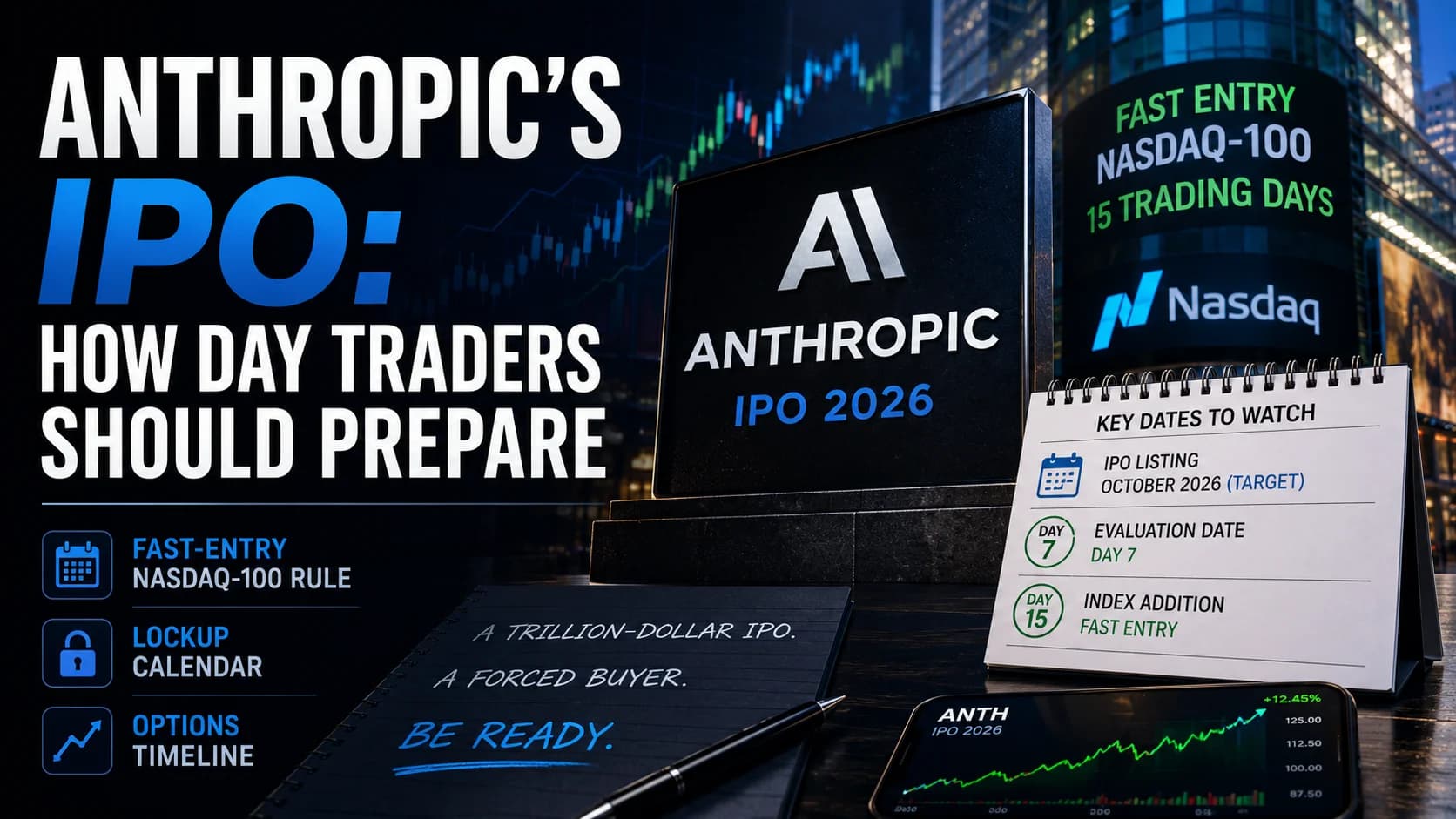
Anthropic confidentially filed for an IPO on June 1, 2026, days after closing a $65 billion funding round that valued the company at $965 billion. If it lists this fall as planned, it will start trading closer to a trillion dollar valuation than any company in history has on its first day. That is not a reason to chase the stock. It is a reason to understand the mechanics before the opening bell rings, because this listing comes wired with a forced buyer that most first-day traders have never had to think about.
What is the Anthropic IPO fast entry effect? It refers to a 2026 Nasdaq-100 rule that lets a newly listed company skip the index's usual three-month waiting period entirely. If Anthropic's market capitalization lands in the top 40 of current Nasdaq-100 constituents, roughly $100 billion or higher, it gets added to the index just 15 trading days after listing, forcing every fund that tracks the Nasdaq-100 to buy shares on a fixed schedule regardless of price.
What We Actually Know About the Timeline
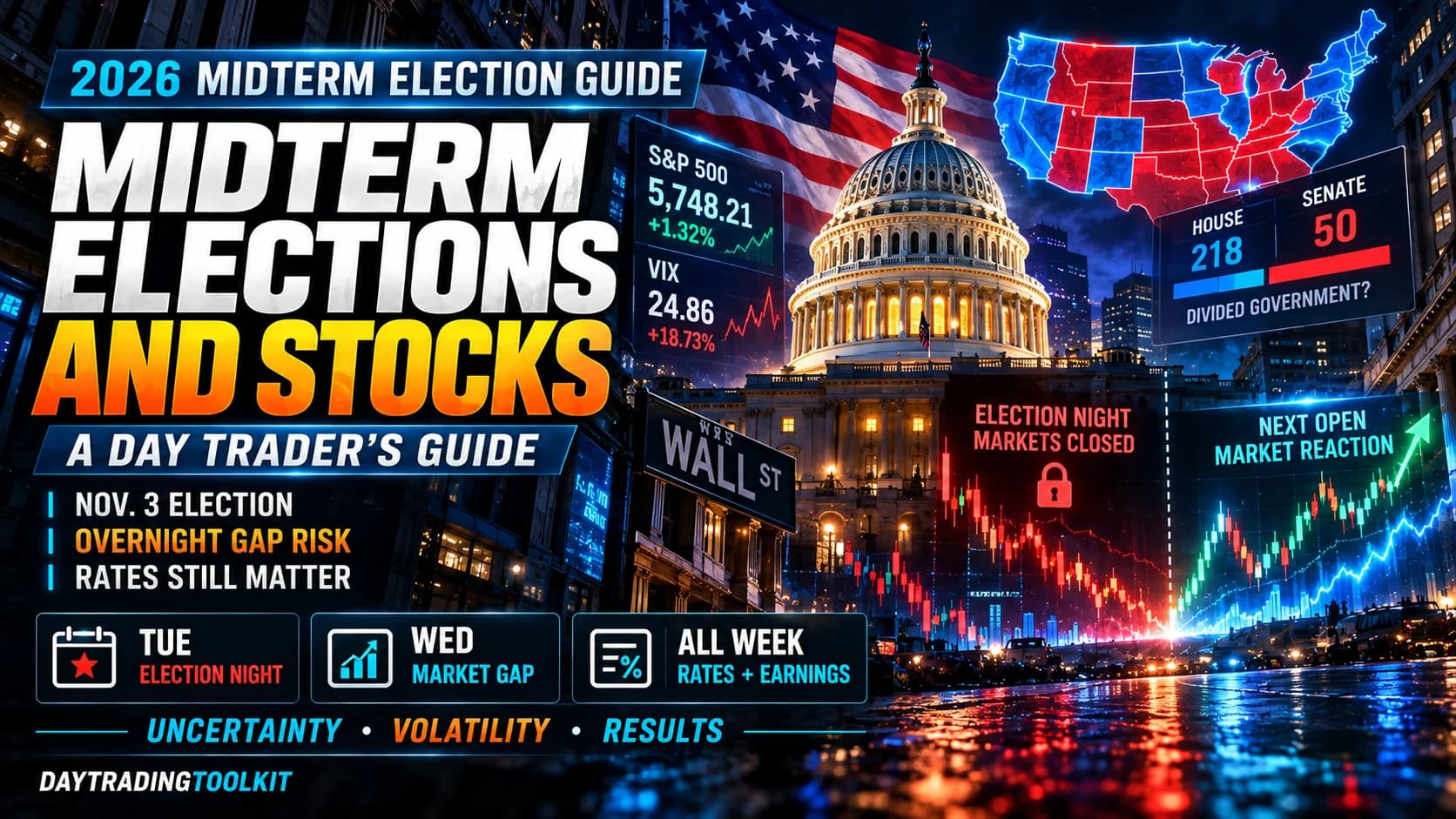
Update, September 25, 2026: The public S-1 still has not appeared on EDGAR, and the target date has moved again. On September 18, The Wall Street Journal reported that Anthropic pushed its planned IPO from October to November so it can put third-quarter financial results in front of investors. Reporting from the Journal and the Financial Times now puts investor expectations around a $2 trillion valuation and a raise of up to $100 billion, which would make it larger than SpaceX's record June listing. Anthropic has not confirmed any of these figures or dates. A November listing could land on either side of the November 3 midterm elections, a timing overlap covered in our guide to how midterm elections move the stock market. The public S-1 remains the trigger to watch: the share count, price RangeA range (or trading range) is a price zone where a stock oscillates between a defined support floor and resistance ceiling without making meaningful new highs or lows — price is consolidating rather than trending, and the dominant trade is Read definition →, FloatFloat is the number of shares of a company that are actually available for public trading — it excludes shares held by insiders, major institutions with lock-ups, and the company itself.Read definition →, and lockup terms in this guide stay unconfirmed until it posts.
Update, September 5, 2026: Reuters reported that Anthropic's timeline has slipped further. The public S-1 prospectus, previously expected imminently, is now not expected until late September, and the institutional roadshow is unlikely to begin before mid-October, with a listing targeted for just days before the November midterm elections. As part of the process, Anthropic is finalizing a $15 billion revolving credit facility led by Morgan Stanley, with Goldman Sachs, JPMorgan, and Citigroup also involved, before the analyst and investor meetings that precede a roadshow typically begin. Some reporting now floats a valuation as high as $2 trillion, well above the $965 billion private mark cited below. None of this is locked in. Treat every date in this section as a moving target until the public S-1 actually drops.
Start with the confirmed facts, because the coverage of this deal has been thick with speculation. Anthropic's own June 1 announcement said only that it had confidentially submitted a draft S-1 to the SEC, giving it "the option to go public after the SEC completes its review," and that the offering "will depend on market conditions and other factors." No share count. No price range. No locked-in date.
Here's what's actually documented: the $65 billion Series H round closed just days before the filing, pushing the private valuation to $965 billion. Reported annualized revenue was around $47 billion as of May 2026, up from roughly $10 billion the year before, a growth curve that explains why bankers are willing to underwrite a deal this size. Goldman Sachs, JPMorgan, and Morgan Stanley are reported to be leading the offering. OpenAI filed its own confidential paperwork about a week later, on June 8, setting up a competitive race to the public markets that CEO statements on both sides have only partly clarified.
Media reports had originally converged on an October 2026 target for the Nasdaq listing, with some accounts suggesting the public S-1 could surface as early as late summer. Those estimates are now stale: as of early September, people familiar with the process say the prospectus has moved to late September and the roadshow to mid-October at the earliest, and The Wall Street Journal's September 18 report points to a November listing instead. Treat all of it as a target, not a commitment. A confidential filing buys a company the option to go public within a review window, not an obligation to hit any specific date, and pricing depends on market appetite that can shift in either direction between now and listing day. If you're tracking this for a trade, watch for the actual public S-1 filing as your next confirmed CatalystA catalyst is the specific event or news item that triggers unusual price movement in a stock — earnings reports, FDA decisions, analyst upgrades, acquisition announcements, product launches, and short squeeze setups are all catalysts. WithRead definition →, not any specific date currently being floated.
The Rule That Changes How This IPO Trades
This is the part most coverage of the Anthropic story skips entirely, and it's the reason this listing deserves a different playbook than a typical mega-IPO.
Since May 1, 2026, Nasdaq has run a "fast entry" pathway into the Nasdaq-100 index. Under the old rules, a newly public company waited for the annual reconstitution in December, sometimes sitting outside the index for the better part of a year even if its market cap dwarfed half the existing members. Under fast entry, a company is evaluated at the close of its seventh trading day. If its full market capitalization ranks in the top 40 of current Nasdaq-100 constituents (a bar sitting around $100 billion based on year end figures), Nasdaq announces it as a fast entry addition with five trading days' notice, then adds it to the index on trading day 15. The company skips the usual three-month seasoning period and the LiquidityLiquidity in trading refers to how easily you can enter and exit a position at a fair price — a liquid stock has high volume and a tight bid-ask spread, allowing large orders to be filled quickly without moving the price, while an illiquid Read definition → screens entirely, and its inclusion doesn't require removing another member. The index simply expands past 100 constituents until the next scheduled reconstitution.
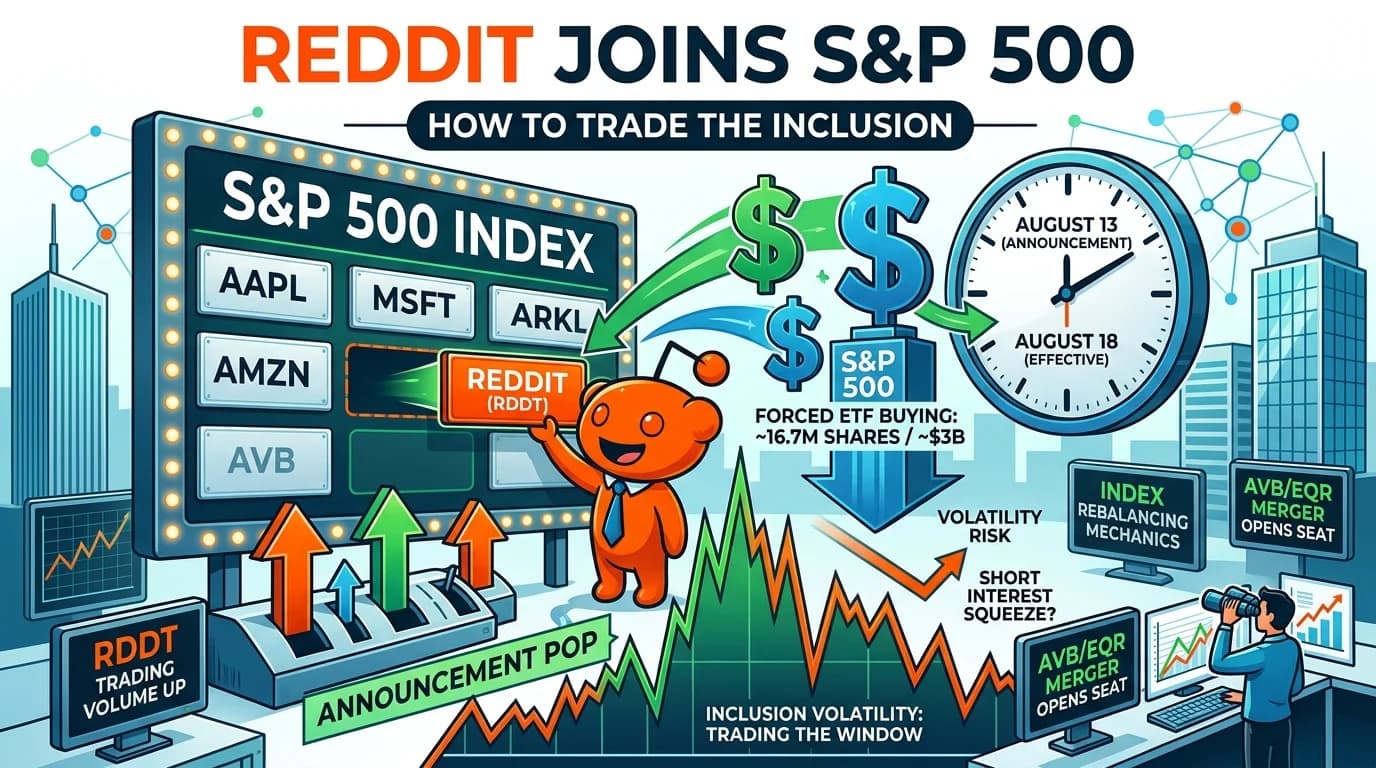
Nasdaq built this rule specifically with companies like Anthropic in mind. Regulatory filings describing the mechanism have named Anthropic, OpenAI, and SpaceX by name as the kind of listings it was designed to accommodate. It's the same forced-buying mechanic, on a compressed timeline, that pushed Reddit into the S&P 500 in August 2026: index funds have to own the stock the moment the rules say so, regardless of what any individual manager thinks the price should be.
For a company sized anywhere close to Anthropic's private valuation, top-40 by market cap on day one isn't a stretch goal. It's close to a formality. That means the real event to watch isn't necessarily the IPO pop itself. It's the trading day roughly three weeks later, when every fund benchmarked to the Nasdaq-100 has to own the stock whether its managers like the price or not.
The Math Behind the Forced Buying
Index funds don't get a choice about fast entry additions. If a benchmark says own it, they own it, and that mechanical demand is worth sizing up before it happens rather than reacting to it in real time.
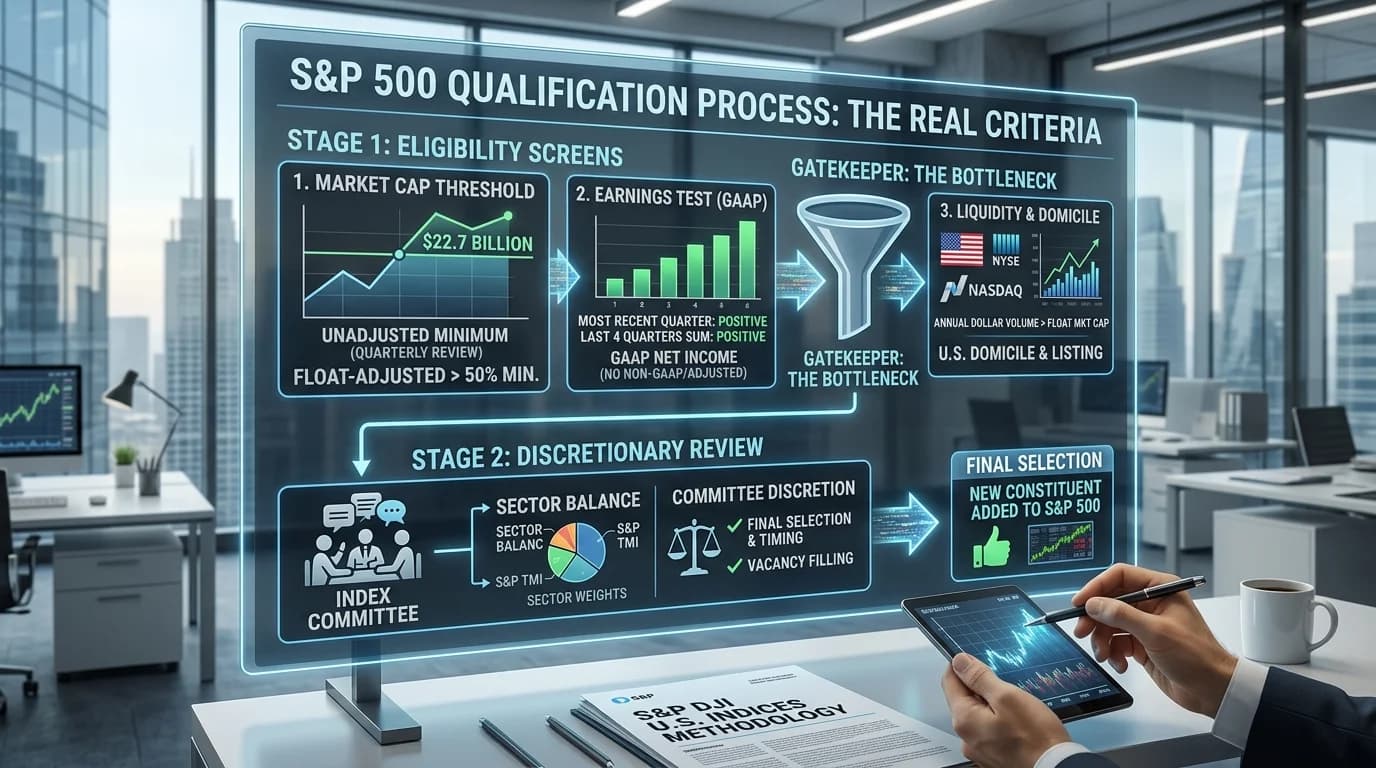
The Nasdaq-100 is tracked by more than 200 investment products holding upward of $600 billion in combined assets, with the Invesco QQQ Trust alone running well over $400 billion. When a stock enters the index at a weight of even 1%, index funds of that size collectively need to buy billions of dollars worth of shares over a short window, and the buying is price-insensitive: it happens whether the stock is up 40% from its IPO price or down 15%. A financial industry consultancy modeling this exact scenario in mid-2026 estimated that a company representing roughly 1% of total Nasdaq-100 index weight could force something in the neighborhood of $6 billion in passive buying, a figure equal to a meaningful share of that stock's available public float in the first few weeks of trading. The eligibility math for index inclusion works differently for the S&P 500 than for Nasdaq-100 fast entry, and it's worth understanding both before assuming Anthropic follows either path exactly.
That's the setup. It's also the trap. Hedge funds and other fast-money buyers can purchase shares on day one specifically to sell into that forced-buying window fifteen days later, a strategy critics of the fast entry rule have flagged explicitly since the rule was proposed. If you're planning to trade around the fast entry date itself rather than the IPO day, understand that you are one of many traders who have already identified the same mechanical catalyst, and the stock's price by day 15 may already reflect a lot of anticipatory buying that front-runs the actual index flows.
The Lockup Calendar Worth Marking Now
IPO day almost never represents the full available float. Most large tech listings carry staggered lockup provisions, commonly releasing tranches at 90, 180, and 366 days after listing, specifically to prevent every early investor and employee from selling at once and overwhelming the new stock's liquidity.
DayTradingToolkit covered exactly this mechanic in detail when SpaceX's own lockup began releasing in August, including what the actual multi-day price reaction looked like once billions in previously restricted shares became sellable. The full breakdown of that lockup event is here, and the same structural questions apply to Anthropic once its own S-1 becomes public: how the lockup is tranched, which early investors and employees are covered, and whether any lockup provisions get waived early the way they sometimes do for strategic investors. None of that detail exists yet in Anthropic's confidential filing. It will exist the moment the public S-1 drops, and that document is worth reading in full rather than relying on secondhand summaries once it's available.
When Options Actually Start Trading
There's a GapA gap is a price discontinuity on a chart where a stock opens significantly higher or lower than the previous session's close, leaving a visible empty space — gap-ups are driven by overnight buying pressure or positive news; gap-downs by seRead definition → that catches newer traders off guard on every mega-IPO: the stock lists and trades from day one, but listed options do not.
Exchanges typically wait somewhere between two and five trading days after an IPO before listing options, and even then, only after the underlying stock clears minimum price and trading volume thresholds the exchange sets for new listings. For a name expected to draw retail and institutional volume at Anthropic's scale, options almost certainly get listed close to the earliest end of that window once eligibility criteria are met, but "day one" options access on a brand new IPO is not something to plan a trade around. If your strategy for this listing runs through calls, puts, or spreads rather than the underlying shares, build the timeline assumption into your plan now instead of discovering the gap on listing morning.
What History Actually Says About the First Days
The honest answer is that recent mega-IPO precedent argues against assuming a predictable pattern, in either direction.
Reddit's addition to the S&P 500 in August 2026 showed how a forced-buying event can produce a real but short-lived price reaction that fades within days once the mechanical demand is satisfied. SpaceX's own path through Nasdaq listing and its subsequent lockup expiration demonstrated the opposite risk: a widely anticipated structural event that produced a much more mixed, less directional outcome than the pre-event narrative suggested. Multiple academic studies of historic IPO first-day pops have found that the size of an opening pop is frequently a sign of underpricing for the benefit of institutional allocation, not a signal that the rally continues, and post-IPO price action for the largest, most hyped tech listings over the past decade has been genuinely mixed rather than uniformly bullish.
None of that means Anthropic's debut will behave like any specific prior example. It means the base rate for "biggest IPO ever equals guaranteed upside" is weaker than the hype cycle around any single mega-listing usually suggests.
Where This Setup Goes Wrong
The single biggest risk with any pre-IPO mechanism trade is timing risk on a date that isn't actually fixed. Confidential S-1 filings carry no obligation to list by any particular quarter, and "market conditions and other factors" is corporate language for exactly the kind of macro shock, in either direction, that can push a listing from October into next year without warning. Building a trading plan around an assumed date before the public S-1 confirms a pricing window is planning around a rumor, not a fact.
The second risk is valuation risk that has nothing to do with the trading mechanics described above. A $965 billion private valuation set in May 2026 reflects what growth investors were willing to pay at that moment, not a guaranteed IPO price, and public markets have repeatedly re-rated hyped private valuations sharply lower once quarterly earnings scrutiny actually begins. Nothing about the Nasdaq-100 fast entry mechanism changes the fundamental question of whether the business is worth what the IPO prices it at.
The third risk is crowding. A mechanism this well publicized, forced index buying roughly 15 trading days after listing, is not a secret edge. Every quantitative desk and index arbitrage fund with access to the Nasdaq-100 methodology has run this exact math already, and a catalyst that's fully priced in by the time retail traders act on it behaves very differently than one nobody else has noticed yet.
How to Actually Prepare Your Watchlist
The useful work happens before the public S-1 filing, not after.
Confirm the eligibility math yourself once real numbers exist: current Nasdaq-100 constituent rankings and the approximate top-40 market cap cutoff change over time, so the $100 billion-ish threshold cited here is a snapshot, not a fixed number. Build a rough model of Anthropic's likely float and share count once the public S-1 discloses them, since the forced-buying math above depends heavily on how much of the company is actually available to trade versus locked up with insiders. And set alerts rather than trying to watch manually for the filing itself: a scanner that can flag unusual volume or news-driven volatility the moment a public S-1 or pricing announcement hits is genuinely useful here, since the stock most likely to move fastest on that news is Anthropic itself in the pre-market session immediately following any filing. Trade Ideas built its alert and scanning infrastructure specifically for this kind of event-driven setup, catching abnormal volume and price action across thousands of tickers in real time rather than requiring you to refresh a filings page manually.
Whatever the actual listing date turns out to be, the mechanism described in this guide, the fast entry rule, the lockup structure, and the options listing lag, will still apply. That's worth having mapped out now, while there's no pressure to act on it yet. Check our market insights coverage for updates as the public S-1 and roadshow news actually break.
Frequently Asked Questions
Has Anthropic's IPO date been confirmed?
Early reports pointed to an October 2026 Nasdaq listing with a public S-1 possibly landing by late summer. As of September 5, 2026, people familiar with the process told Reuters the public prospectus is now expected in late September and the roadshow no earlier than mid-October, with a listing targeted for just before the November midterm elections. Then on September 18, The Wall Street Journal reported the target had moved again, to November, so the company can include third-quarter results in its offering materials. Anthropic's own June 1 statement explicitly said the offering "will depend on market conditions and other factors," language that has already proven accurate once and leaves real room for the timeline to shift again.
Key Takeaway: Treat any date currently being reported as a planning assumption, not a locked date, and watch for the actual public S-1 filing as the next real confirmation point.
What is the Nasdaq-100 fast entry rule?
Before this rule, new listings typically waited for the annual December reconstitution to join the index, regardless of size, sometimes sitting outside it for the better part of a year. Fast entry evaluates a company at the close of its seventh trading day and, if it qualifies, adds it to the index on day 15 with only five trading days' advance notice. The company is exempt from the usual three-month seasoning period and liquidity screens, and no existing member has to be removed to make room.
Key Takeaway: A company sized like Anthropic would very likely clear the top-40 threshold immediately, making the fast entry window a real, mechanical event rather than a hypothetical one.
Will Anthropic definitely qualify for fast entry into the Nasdaq-100?
The top-40 cutoff moves over time along with the value of existing Nasdaq-100 constituents, and it sat in the neighborhood of $100 billion based on recent year-end figures. Anthropic's last private valuation of $965 billion sits comfortably above that bar, but IPO pricing can land meaningfully above or below a company's most recent private round, and the final eligibility call depends on where the stock is actually trading a week into its public life.
Key Takeaway: Don't assume the exact eligibility threshold without checking current Nasdaq-100 constituent data close to Anthropic's actual listing date.
How does fast entry inclusion affect the stock price?
Index funds representing hundreds of billions of dollars in combined assets have to buy shares to match their benchmark regardless of valuation, and that demand is concentrated into a short window around the fifteenth trading day. But sophisticated traders anticipate this exact mechanism and often buy ahead of it, meaning much of the expected demand can already be reflected in the price before the actual index-fund buying occurs.
Key Takeaway: Forced buying is a real, documented flow, not a guaranteed trading edge, especially once a mechanism is this widely known.
When will options be available to trade on Anthropic stock?
For a stock expected to draw heavy volume immediately, options are likely to arrive close to the earlier end of that range once the underlying clears exchange listing standards, but there's no guarantee of an exact date until the stock is actually trading and those thresholds are tested in real time.
Key Takeaway: Traders planning an options-based strategy around this listing should build in a multi-day gap after the IPO before contracts are live.
What happens to Anthropic's lockup provisions after the IPO?
Large tech IPOs commonly stagger lockup expirations across multiple dates, often near the 90, 180, and 366-day marks after listing, specifically to avoid flooding the market with sellable shares all at once. Some early or strategic investors occasionally receive earlier releases through separate negotiated terms.
Key Takeaway: SpaceX's own lockup structure is the closest available precedent until Anthropic's own terms become public.
Is Anthropic's IPO likely to see a big first-day pop?
A large first-day pop is sometimes read as a bullish signal, but it can just as easily reflect deliberate underpricing that benefited early institutional allocation at the expense of public buyers, a pattern documented across multiple academic studies of historic IPOs. Recent examples of comparable mega-cap tech listings have produced meaningfully different first-week outcomes from one another, which argues against treating any single precedent as a reliable template.
Key Takeaway: A large opening pop is not, by itself, evidence that the rally is likely to continue.
Does the size of this IPO guarantee it will move the broader market?
Nasdaq-100 index weight changes gradually as new constituents phase in, and a single stock, even one added through fast entry, represents a modest percentage of total index value even at a near-trillion dollar valuation. The more concentrated effect shows up in AI sector sentiment and in the specific funds and ETFs that have to rebalance around the inclusion date.
Key Takeaway: Watch AI-sector correlation and Nasdaq-100 fund flows around the fast entry date rather than expecting a broad market move.
What should traders actually track between now and the IPO?
Beyond the filing itself, watch for roadshow scheduling news, which typically begins four to eight weeks before pricing, and for any updates to Nasdaq-100 constituent rankings closer to the actual listing date, since the top-40 fast entry cutoff shifts as the index's existing members change in value.
Key Takeaway: Set an alert for the public S-1 filing specifically. Everything else in this guide becomes concrete the moment that document exists.
Disclaimer
Article Sources
- Anthropic: Confidentially submits draft S-1 to the SEC - the company's own primary announcement of its June 1, 2026 filinganthropic.com
- CNBC: Anthropic confidentially files IPO prospectus with SEC - reporting on the filing, valuation, and revenue figurescnbc.com
- SEC.gov: Bank of Montreal Form 424B2 filing - primary regulatory documentation describing the Nasdaq-100 Fast Entry methodology in fullsec.gov
- Charles Schwab: Some Indexes Accelerate Entry for Massive IPOs - explainer on how the fast entry rule works across index providersschwab.com
- Yahoo Finance: New rule could fast-track SpaceX IPO for Nasdaq index inclusion - context on why the rule was adopted and which companies it targetsfinance.yahoo.com
- CNBC: Anthropic IPO launch shifts toward mid-October, Reuters reports - September 5, 2026 reporting on the delayed prospectus, roadshow timing, and credit facilitycnbc.com
- Yahoo Finance: Anthropic delays IPO staging to November, WSJ says - September 18, 2026 reporting on the move to a November target and the reasons behind ituk.finance.yahoo.com