
The S&P 500 is not, despite how it's usually described, a list of the 500 largest publicly traded companies in the United States. It's a curated index. A company can be worth $20 billion, growing fast, and trading on the New York Stock Exchange, and still not be in it, because one specific number on its income statement is negative.
That number is the actual gatekeeper for most companies that get shut out, and it rarely gets mentioned in coverage of who's getting added or removed. This site's breakdown of Reddit's August 2026 addition and its guide to the mechanics of index rebalancing both cover what happens once a stock gets in. This one covers the part that happens before that: the actual rules a company has to clear, in order, before S&P Dow Jones Indices' Index Committee will even consider it.
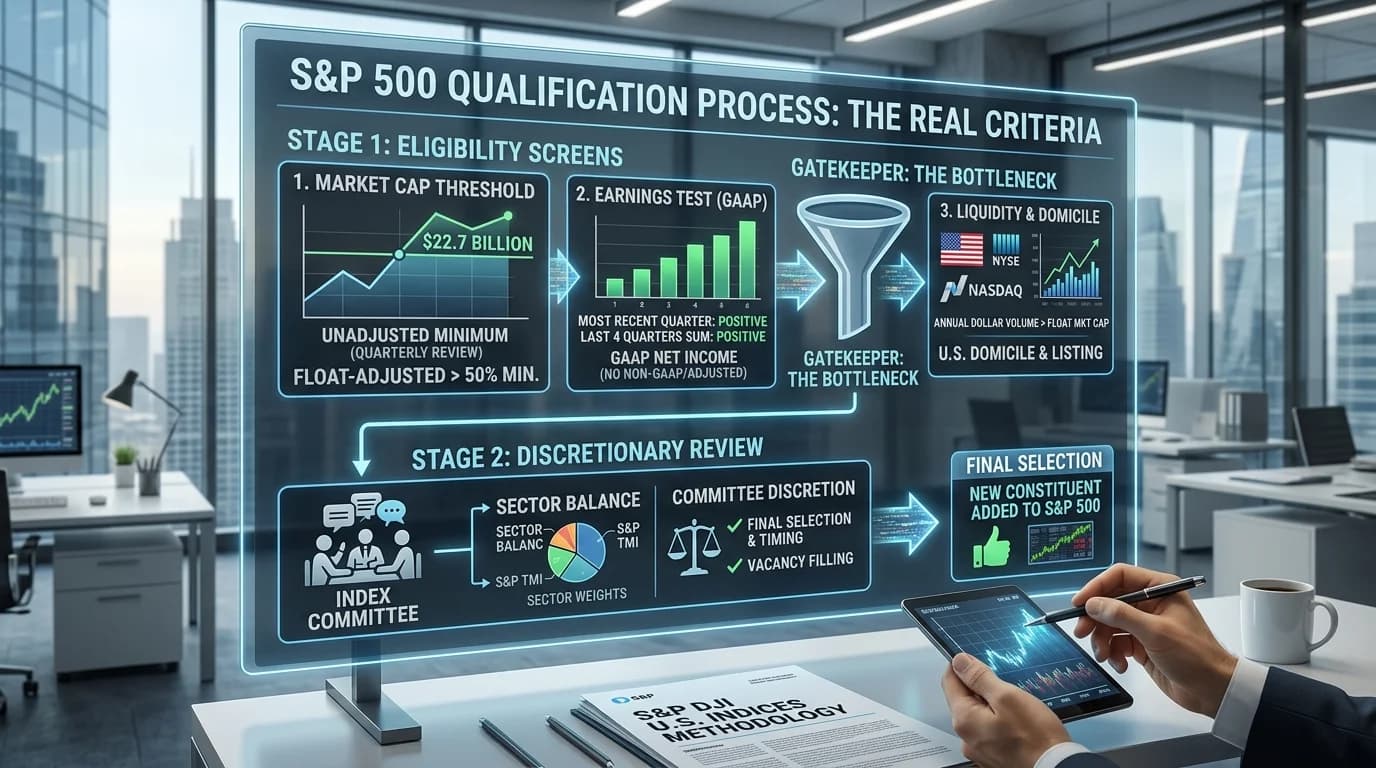
What are the S&P 500 inclusion criteria? The S&P 500 inclusion criteria are a set of quantitative screens, a minimum market cap, positive GAAP EarningsAn earnings report is the quarterly financial disclosure a public company files with the SEC, revealing revenue, earnings per share (EPS), profit margins, and forward guidance — it's the most significant regular catalyst for individual stocRead definition →, and sufficient LiquidityLiquidity in trading refers to how easily you can enter and exit a position at a fair price — a liquid stock has high volume and a tight bid-ask spread, allowing large orders to be filled quickly without moving the price, while an illiquid Read definition →, that a company must pass before S&P Dow Jones Indices' Index Committee will consider adding it. Passing every screen doesn't guarantee inclusion; the Committee still exercises discretion over final selection and timing.
The Market Cap Threshold Isn't a Round Number
Unlike a lot of financial thresholds that get quoted as clean, memorable figures, the S&P 500's market-cap bar is neither round nor fixed. As of S&P Dow Jones Indices' most recent published update, a company needs an unadjusted market capitalization of at least $22.7 billion to be eligible for S&P 500 consideration.
That number moves. S&P DJI reviews it at the start of every calendar quarter and adjusts it to keep the S&P 500 tracking roughly the 85th percentile of the S&P Total Market Index universe by size. The threshold has climbed steadily for years, from $11.8 billion in 2021 to $14.5 billion in 2024 to $20.5 billion and then $22.7 billion through 2025, simply because the overall market has grown. A company that would have cleared the bar comfortably five years ago might not clear it today, without doing anything differently.
There's a second, less-discussed layer to the market-cap test. Meeting the unadjusted threshold isn't enough on its own; a candidate's FloatFloat is the number of shares of a company that are actually available for public trading — it excludes shares held by insiders, major institutions with lock-ups, and the company itself.Read definition →-adjusted market capitalization, the value of shares actually available to trade, excluding insider and strategic holdings, must also equal at least 50% of that same threshold. A company with a large headline market cap but a small public float, common with recent IPOs where founders and early investors retain large stakes, can clear the first test and fail the second.
The Earnings Test Is the Real Bottleneck
AskThe ask is the lowest price a seller is currently willing to accept. When you buy with a market order, you pay the ask.Read definition → anyone who tracks index additions closely and they'll tell you the market-cap threshold gets all the attention while the profitability requirement does most of the actual filtering.
The rule has two parts, and a company must clear both. GAAP net income from continuing operations has to be positive in the company's most recent fiscal quarter. And separately, the sum of GAAP net income from continuing operations across the four most recent consecutive quarters also has to be positive. A company can't back into eligibility with one enormous quarter propping up three losing ones, and it can't count a one-time gain from selling a division or a favorable legal settlement to paper over an unprofitable core business, since S&P DJI screens specifically for continuing operations.
This is the test that keeps plenty of large, well-known companies out of the index entirely. A company can clear $30 billion in market cap and still fail to qualify because its GAAP earnings, under standard accounting rules rather than the adjusted or non-GAAP figures a company might headline in its own earnings release, come in negative. For a growth company burning cash to fund expansion, earnings trajectory matters more than valuation for figuring out when, or whether, index inclusion becomes realistic.
Liquidity, Domicile, and the Rules That Get Skipped Over
Beyond size and profitability, a handful of quieter requirements round out the quantitative screen.
A candidate's annual dollar trading VolumeVolume is the total number of shares (or contracts) traded during a given time period — it's the primary confirmation tool for all price action, because a price move accompanied by high volume indicates genuine market participation, while tRead definition → needs to meet or exceed its float-adjusted market cap, a liquidity test meant to ensure the index isn't adding names that index funds would struggle to actually buy and sell in size without moving the price. The company needs to be organized in the United States, with its primary listing on an eligible U.S. exchange, generally the NYSE or Nasdaq, and the plurality of its assets and revenue based domestically. Recently public companies face a seasoning requirement as well: roughly 12 months of trading history on an eligible exchange before they can even be considered, a rule that exists specifically to keep newly listed, still-volatile stocks out of the index until they've built a real trading record.
Real estate investment trusts are explicitly eligible, a detail some traders assume isn't the case given how differently REITs are taxed and structured compared to typical operating companies.
Sector Balance and the Discretionary Layer
Passing every quantitative screen above gets a company onto the list of eligible candidates. It does not guarantee a seat.
S&P Dow Jones Indices' Index Committee retains real discretion over which eligible candidates actually get selected and when, considering factors beyond the pure numbers. Sector balance is an explicit part of that judgment: the Committee compares each GICS sector's weight in the S&P 500 against that sector's weight in the broader S&P Total Market Index, and factors that comparison into which eligible companies get picked from a given size range. Reddit's own August 2026 addition illustrates this layer directly. It had reportedly cleared the market-cap and profitability bars months before actually getting selected, having been passed over twice earlier in 2026 in favor of other eligible candidates, and only got its seat once a merger between two existing constituents created an opening the Committee needed to fill.
S&P DJI revisited this exact question in a formal public consultation on whether MegaCap companies should get special treatment or exceptions to the standard criteria. In June 2026, the Committee announced it would make no changes: no carve-outs to the financial viability screen, the seasoning period, or the minimum float requirement based on market capitalization alone, no matter how large a candidate's headline valuation. The message was explicit: a company doesn't get to skip the earnings test or the seasoning period just because it's big enough to move the index meaningfully once added.
How This Compares to the Nasdaq-100's Rules-Based System
The contrast with the Nasdaq-100 is worth understanding, because the two indexes handle selection in fundamentally different ways, and conflating them leads to bad assumptions about how either one actually works.
The Nasdaq-100 runs largely on a mechanical, rank-based system: eligible companies are ranked by market capitalization, and membership follows from where a stock lands in that ranking, reviewed quarterly under the index's current methodology. Nasdaq's fast-track rule, covered in detail elsewhere on this site, lets a newly public company ranked in the top 40 by market cap join after just 15 trading days, bypassing the seasoning period entirely. SpaceX qualified for the Nasdaq-100 this way in July 2026, purely on the numbers, with no committee discretion involved in whether it got a seat once it hit the ranking threshold.
The S&P 500 doesn't work that way. There's no ranking that automatically seats the next-largest eligible company. A company can be eligible on every quantitative measure and simply not get selected because the Committee hasn't found the right vacancy or sector fit for it yet, exactly what happened to Reddit for most of 2026. That distinction, mechanical ranking versus discretionary committee selection, is the single biggest structural difference between how these two widely tracked indexes actually decide membership, and it's worth knowing before assuming a company's market cap alone tells you when it's getting added to either one.
Why This Actually Matters for a Day Trader
None of this is a reason to trade a stock differently on an ordinary day. It matters at two specific moments.
Before an addition, understanding the actual criteria lets you evaluate whether a company being discussed as a "future index candidate" has genuinely cleared the bar or is still years away, since a large valuation alone means nothing without the earnings track record and seasoning period behind it. After an addition, understanding that the Index Committee exercises real discretion, and that eligibility and selection are separate steps, helps explain why some qualifying companies wait months or years for a seat while others get added the moment a vacancy opens, a timing question that has nothing to do with the stock's own fundamentals changing.
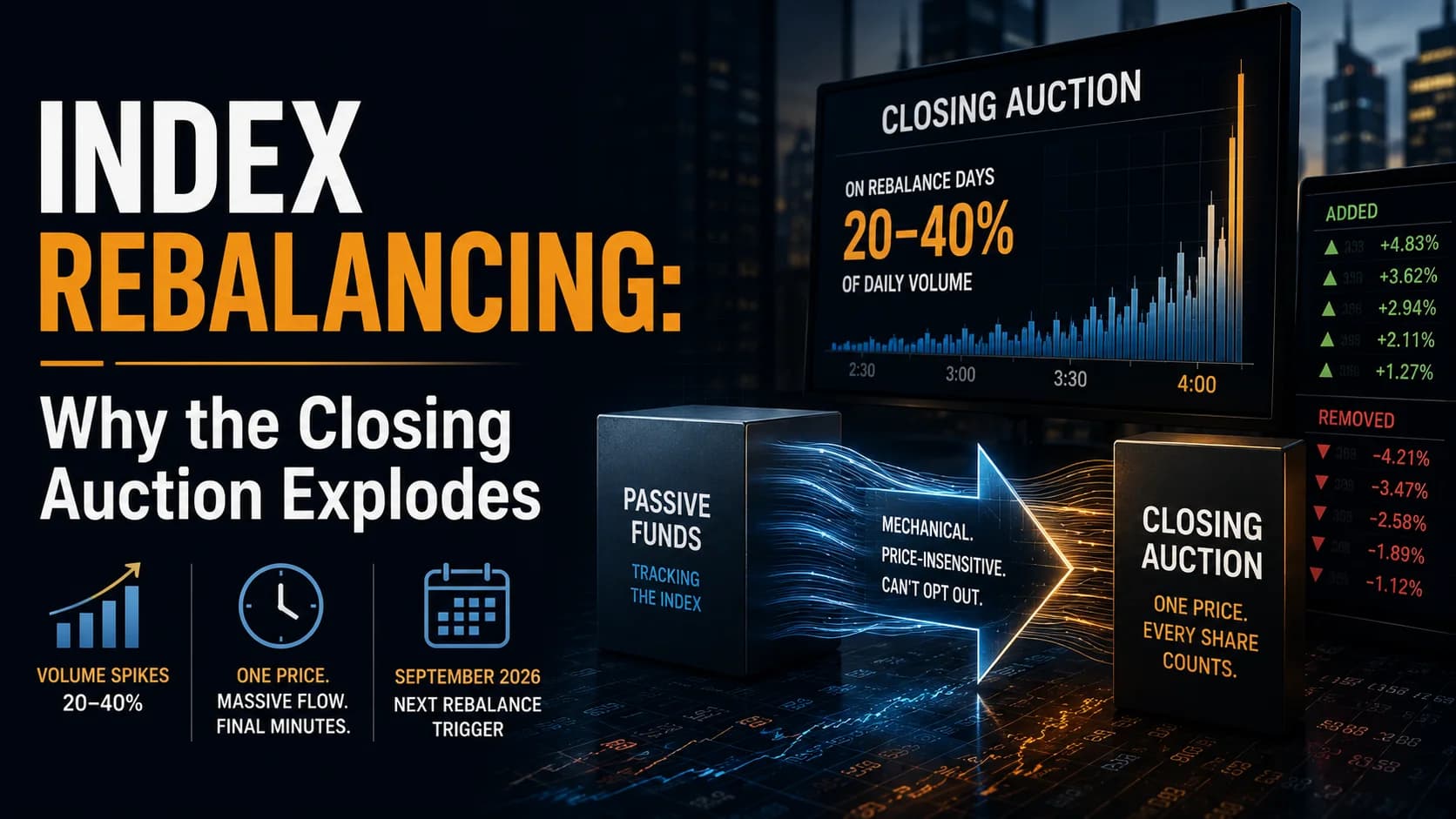
The forced-buying mechanics that actually move a stock's price around an addition, and what the historical data says about whether that buying produces a reliable pop, are covered in full in this site's guides to index rebalancing mechanics and Reddit's own inclusion event. This article is the eligibility layer underneath both of those: the rules a company clears long before any trader notices the news.
Frequently Asked Questions
What is the current minimum market cap to qualify for the S&P 500?
The threshold is designed to track roughly the 85th percentile of company size across the S&P Total Market Index universe, which is why it has risen steadily over the years as the overall market has grown, from $11.8 billion in 2021 to $22.7 billion more recently.
Key Takeaway: Treat any specific dollar figure as current as of its publication date. This threshold moves quarterly and should be verified against S&P DJI's own methodology documents before relying on it.
Why do some large companies never make it into the S&P 500?
A company can clear the market-cap threshold by a wide margin and still be ineligible if its earnings, under standard GAAP accounting, come in negative. This filters out plenty of large, fast-growing, cash-burning companies regardless of how their stock is performing.
Key Takeaway: Market cap gets the headlines, but the earnings test is usually the actual bottleneck for large, unprofitable companies.
Does meeting every S&P 500 requirement guarantee a company gets added?
Reddit is a documented example. It reportedly cleared the market-cap and profitability bars months before its actual August 2026 addition, having been passed over for two earlier vacancies in favor of other eligible candidates.
Key Takeaway: Eligibility and selection are two separate steps. Passing the numbers gets a company on the list of candidates, not a guaranteed seat.
How is the S&P 500's selection process different from the Nasdaq-100's?
Nasdaq's fast-track rule lets a qualifying newly public company join the Nasdaq-100 after just 15 trading days based purely on its size ranking, with no committee judgment call involved. The S&P 500 has no equivalent automatic path; there's no ranking that seats the next-largest eligible company without an actual Committee decision.
Key Takeaway: See this site's guide to Nasdaq's fast-track rule for how that mechanically different process actually works.
How long does a newly public company have to wait before it can join the S&P 500?
This rule exists specifically to keep newly listed, often still-volatile stocks out of the index until they've built an actual trading record, separate from and in addition to the market-cap and profitability screens.
Key Takeaway: A mega-IPO clearing every financial threshold on day one still has to wait out the seasoning period before S&P 500 consideration, even if it might already qualify for a faster-moving index like the Nasdaq-100.
Did S&P Dow Jones Indices ever consider relaxing these rules for very large companies?
The Committee specifically stated that exceptions to the financial viability, seasoning, and liquidity requirements should not be granted based on market capitalization alone, meaning even an extremely large company still has to clear the same profitability and seasoning bar as any other candidate.
Key Takeaway: Size alone has never been a shortcut into the S&P 500, and a 2026 review reaffirmed that it still isn't.
Are REITs eligible for S&P 500 inclusion?
This surprises some traders given how differently REITs are taxed and structured compared to typical operating companies, but S&P DJI's methodology treats them as eligible common equity, not a separate or excluded category.
Key Takeaway: A REIT clearing the standard thresholds is evaluated the same way as any other eligible candidate.
What's the difference between a company's market cap and its float-adjusted market cap for S&P 500 purposes?
This distinction matters most for recent IPOs, where founders and early investors often retain large stakes that aren't part of the tradable float, meaning a company can clear the headline market-cap number while still failing the float test underneath it.
Key Takeaway: A large headline valuation doesn't automatically mean a company clears the float-adjusted portion of the market-cap test.
Disclaimer
Article Sources
- S&P Dow Jones Indices: U.S. Indices Methodology - the official eligibility criteria, including the GAAP earnings test, liquidity requirement, and domicile rules.spglobal.com
- S&P Dow Jones Indices: Announces Update to S&P Composite 1500 Market Cap Guidelines, July 2025 - the most recently published market-cap thresholds and the quarterly review process.press.spglobal.com
- S&P Dow Jones Indices: Consultation on Treatment of MegaCap Companies, Results - the June 2026 decision not to grant MegaCap exceptions to the standard eligibility criteria.press.spglobal.com
- Nasdaq-100 Index Methodology - Nasdaq, Inc.'s rank-based selection rules, used here for comparison against the S&P 500's discretionary process.indexes.nasdaq.com
- LegalClarity: What Are the S&P 500 Inclusion Criteria? - plain-language summary of the two-part GAAP earnings test and its practical effect on candidate eligibility.legalclarity.org