

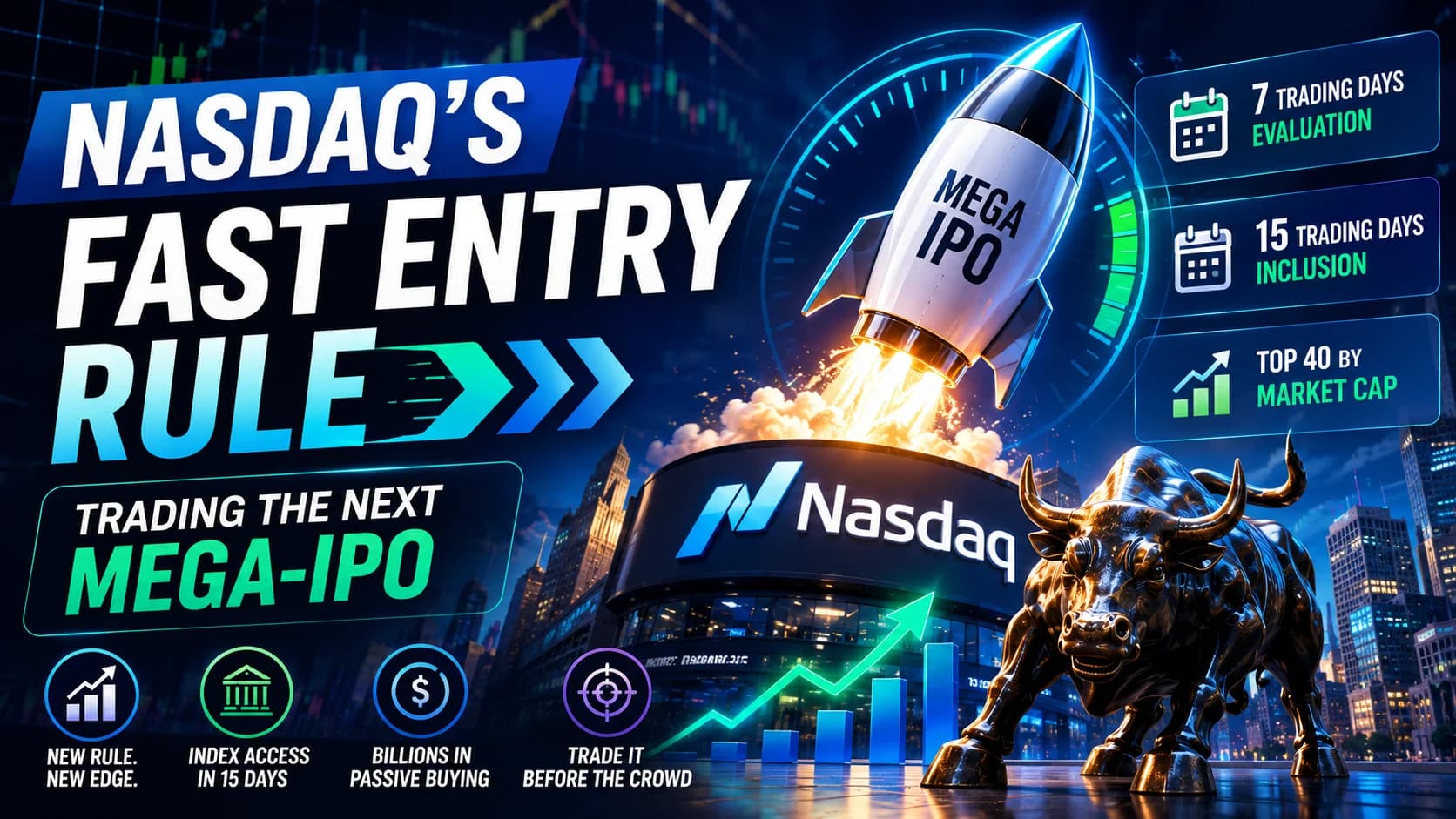
A newly public company used to wait months — often close to a year — before it could join a major benchmark index like the Nasdaq-100. That rule is gone. Since May 1, 2026, a company can be evaluated for inclusion on its seventh trading day and added on its fifteenth, provided it's large enough. Nasdaq calls it "Fast Entry," and it's a permanent change to the rulebook, not a one-time exception written for a single company.
SpaceX became the rule's first real test case when it went public in June 2026. But the rule itself doesn't care about SpaceX. It applies to any newly listed company that ranks among the top 40 Nasdaq-100 constituents by market capitalization — and with OpenAI and Anthropic both reportedly weighing 2026 listings of their own, SpaceX is very unlikely to be the last mega-IPO this rule touches.
What is Nasdaq's Fast Entry rule? Fast Entry is a Nasdaq-100 Index methodology provision, effective May 1, 2026, that lets a newly listed company skip the index's usual three-month seasoning requirement if it ranks among the top 40 current constituents by market capitalization. Eligible companies are evaluated on their seventh trading day and added to the index on their fifteenth. ---
This guide covers the mechanism itself — what changed, why Nasdaq made the change, and how to recognize the next company this will happen to before the headlines catch up.
What Nasdaq Actually Changed on May 1, 2026
Before this year, a company joining the Nasdaq-100 outside the normal path had exactly one door in: the annual reconstitution every December, and only after clearing a three-month "seasoning" period plus a minimum three-month average daily traded value of $5 million. A company could be enormous, heavily traded, and obviously index-worthy, and it would still sit outside the benchmark for the better part of a year.
Nasdaq's own reasoning, laid out by Emily Spurling, the exchange's Global Head of Index, in a newsroom Q&A following the update: public companies are staying private longer, listing at a larger scale when they finally do go public, and arriving with more complex share structures than the seasoning rule was originally built to handle. The old rule assumed IPOs needed time to "season" — to trade long enough for the market to settle on a fair price — because most newly public companies were small and thinly followed. That assumption stopped holding for the handful of IPOs large enough to enter a major index on day one.
The fix, adopted after a formal public consultation process, is Fast Entry. A newly listed company is evaluated on its seventh trading day. If its market capitalization ranks within the top 40 of current Nasdaq-100 constituents — a bar that sat at roughly $100 billion based on year-end 2025 figures — Nasdaq announces the company as a Fast Entry addition, with five trading days' notice before it's added on day fifteen. All other standard eligibility criteria still apply; only the seasoning period is waived.
One structural detail matters more than it sounds like it should: a Fast Entry addition doesn't force an existing constituent out. Nasdaq can temporarily carry more than 100 names in the "Nasdaq-100" until the next scheduled reconstitution reconciles the count. That single design choice removes the political friction that used to make index committees hesitant to add a major newcomer mid-cycle — nobody has to lose their spot for someone else to gain one.
The Weighting Fix Nobody's Talking About
The seasoning period wasn't the only thing that changed, and the second change matters just as much for how hard the eventual buying hits the stock.
The Nasdaq-100 used to carry a minimum public FloatFloat is the number of shares of a company that are actually available for public trading — it excludes shares held by insiders, major institutions with lock-ups, and the company itself.Read definition → requirement — a floor on how much of a company's shares actually had to be tradable before it could join. Nasdaq eliminated that requirement outright and replaced it with a different mechanism: every constituent's index weight is now based on "modified market capitalization," defined as the lesser of the company's full listed market cap or three times the value of its free-floating shares.
In plain terms: a company with a small float relative to its total market cap doesn't get excluded anymore — it just gets a smaller initial weight, capped at three times its actual tradable float value. As more shares become tradable over time (lockups expiring, secondary offerings), its weight grows toward its true market-cap-based level. This is why a company can debut at a multi-trillion-dollar valuation and still enter the index at well under 1% weight: the float cap, not the sticker-price market cap, is doing the math.
For a trader, the practical takeaway is this: the size of the forced-buying event a Fast Entry company generates isn't simply "market cap times index weight." It's constrained by how much of the company's stock is actually tradable at the time it joins — which means the loudest headline valuation numbers routinely overstate the real mechanical impact.
Why Nasdaq Made This Change Now
The rule didn't appear out of nowhere. Nasdaq opened a formal consultation, took feedback from asset managers and institutional investors, and adjusted the proposal based on that input — the float weighting cap, for instance, was originally proposed at five times float and tightened to three times float after stakeholders pushed back on how much distortion a looser cap would create.
The broader TrendA trend is a sustained directional movement in price over time — an uptrend is characterized by a sequence of higher highs and higher lows, a downtrend by lower highs and lower lows — and correctly identifying the current trend direction isRead definition → behind the rule change is straightforward: companies are staying private for longer and going public at a scale that used to be rare. A wave of well-known, deep-pocketed private companies — reportedly including OpenAI and Anthropic alongside SpaceX — has been weighing 2026 IPOs large enough to matter to a major index on day one. Nasdaq built Fast Entry because the old rulebook was written for a market where that almost never happened, and it stopped being rare.
Not every index followed. S&P Dow Jones Indices opened its own consultation around a similar idea — shortening the S&P 500's seasoning window for megacap IPOs — and rejected the proposal. The S&P 500 still requires a full year of trading history plus four consecutive quarters of GAAP profitability, with no fast-track exception. That split is worth remembering: Fast Entry is a Nasdaq-100-specific mechanism. A company can qualify for one index and remain locked out of the other for a year or more, exactly as SpaceX did.
SpaceX Was Just the First Test Case
SpaceX priced its IPO on June 12, 2026, and qualified for Fast Entry inclusion on July 7 — fifteen trading days later, right on schedule. It's the first company large enough to actually trigger the rule since it took effect, which makes it a useful worked example, but the mechanics that mattered were about the rule, not the rocket company.
This guide's dedicated breakdown of the SpaceX Nasdaq-100 event covers the trading specifics — the estimated dollar flows, the historical precedent for how similar additions have traded, and the three-window approach to the event itself. Worth reading if you want the applied version of everything below.
Who's Next? How to Spot a Fast Entry Candidate Before It Happens
This is the part that actually pays off: recognizing a Fast Entry candidate before it's a headline, not after.
Watch the private mega-cap pipeline. A company doesn't need to have filed anything public yet to be worth tracking — reporting on confidential S-1 filings, roadshow chatter, and reported target valuations routinely surfaces months before an actual listing date. As of this writing, OpenAI and Anthropic have both been reported as weighing 2026 listings large enough to plausibly clear the top-40 threshold on debut. Neither has confirmed a date, and that can change without notice — but a trader who's already read the rulebook has a head start over one who's hearing about Fast Entry for the first time on the actual event day.
Check the threshold, not the hype. The qualifying bar is relative, not fixed — "top 40 Nasdaq-100 constituents by market capitalization," which shifts as the index's own constituents rise and fall in value. A company priced well above $100 billion at IPO is a reasonable candidate; anything meaningfully below that line likely isn't, regardless of how much media attention the listing gets.
Start the countdown at the IPO price, not the announcement. Once a company actually prices its IPO and begins trading, day seven is the evaluation date and day fifteen is the addition date — with Nasdaq's own notice landing around day ten, five trading days ahead of inclusion. That gives a trader a real, dated window instead of a vague "sometime after the IPO" expectation.
Estimate the float, not just the valuation. Because weighting is capped at three times free-floating share value, a company's headline market cap tells you less than its actual public float does. A mega-IPO with a large retail allocation and a big float behaves differently, mechanically, than one where most shares stay locked up with insiders.
The Repeatable Trading Framework
The trading mechanics here generalize, and they're worth understanding independent of any single company.
Once a company is confirmed for Fast Entry, every fund benchmarked to the Nasdaq-100 has to acquire it in proportion to its assigned weight, regardless of price — that's not a prediction about the stock, it's a structural requirement built into how index funds operate. The buying is heaviest right around the close before the addition takes effect, concentrated into a narrow window because there's a hard, published deadline.
What that forced buying does to the stock's price is a separate question, and the evidence is more sobering than the "guaranteed pop" framing suggests. The Nasdaq-100's own reconstitution history — including a batch of high-profile additions in December 2024 — shows a repeated pattern: stocks run up into their addition date on anticipation, the forced buying executes exactly as required, and the stock declines in the days that follow anyway, because the traders who bought ahead of the news are the ones selling into it. A repeatable framework treats the announcement-to-inclusion window as the period to watch for anticipatory positioning, the inclusion date itself as the mechanical event, and the days after as the window where that anticipatory positioning often unwinds — rather than assuming the forced buying itself guarantees a sustained move higher.
Relative VolumeRelative volume (RVOL) compares a stock's current trading volume to its average volume for the same time of day, expressed as a multiple — a stock with 5x RVOL is trading five times more actively than normal, signaling unusual interest and Read definition → is the practical tool for spotting where a candidate actually sits in that cycle. A move on unusually high relative volume with no fresh company-specific news is a reasonable signal of index-driven anticipatory flow rather than a fundamental CatalystA catalyst is the specific event or news item that triggers unusual price movement in a stock — earnings reports, FDA decisions, analyst upgrades, acquisition announcements, product launches, and short squeeze setups are all catalysts. WithRead definition →. If you're tracking several pre-IPO or recently-IPO'd names against this framework at once, a real-time scanner that flags unusual VolumeVolume is the total number of shares (or contracts) traded during a given time period — it's the primary confirmation tool for all price action, because a price move accompanied by high volume indicates genuine market participation, while tRead definition → the moment it appears is more practical than checking each ticker by hand — Trade Ideas is this guide's top pick for that kind of ongoing monitoring, and its full review covers the rest of what the platform does.
If you've traded a short squeeze before, the underlying shape here will feel familiar: a category of buyer that has to transact regardless of price, on a deadline. The catalyst is completely different — this is a rules-based mechanical flow, not short covering — but "price-insensitive buyer, hard deadline" is the common thread worth recognizing across both setups.
Where This Approach Breaks Down
Fast Entry is genuinely new, and that cuts against treating any of this as a settled playbook.
The sample size is small. SpaceX is the first real Fast Entry case since the rule took effect. One data point, however well-documented, isn't a track record. The historical Nasdaq-100 addition pattern this guide references comes from the index's ordinary reconstitution history, which follows different timing than a Fast Entry event — it's a reasonable analog, not a guarantee that Fast Entry additions will behave identically.
This is a Nasdaq-100 mechanism specifically. S&P Dow Jones Indices considered and rejected a similar fast-track rule for the S&P 500. A company qualifying for Fast Entry tells you nothing about its S&P 500 timeline, which still runs on the old seasoning-plus-profitability clock. Don't extrapolate this framework to other benchmarks without checking whether they've actually adopted anything comparable.
Float estimates are exactly that — estimates. The three-times-float weighting cap depends on knowing how many shares are genuinely free-floating, and that figure isn't always precise or fully disclosed at the time a company qualifies. Position sizing around an estimated forced-buying number should account for the real possibility that the actual flow is smaller, or arrives on a different timeline, than early estimates suggest.
Concentration risk doesn't disappear because a flow is mechanical. A newly public, low-float stock is volatile with or without an index event attached to it. Trading around Fast Entry doesn't reduce the underlying risk of holding a name with a short trading history — it adds a second variable on top of it.
FAQs
When did Nasdaq's Fast Entry rule take effect?
Nasdaq first proposed the change around March 30, 2026, and finalized it after gathering feedback from asset managers, institutional investors, and other market participants. The float-weighting cap, for example, was tightened from an initially proposed five-times multiplier to three times based on that feedback before the rule was finalized.
Key Takeaway: This is a permanent methodology change dated to May 1, 2026 — not a temporary or one-off exception.
What size does a company need to be to qualify for Fast Entry?
That threshold moves with the index itself — it's defined relative to the current 40th-largest Nasdaq-100 constituent, not as a fixed dollar figure, so the exact bar shifts gradually over time as constituent valuations change. Very few IPOs clear it; the rule was built for genuinely mega-cap listings, not typical newly public companies.
Key Takeaway: Check the current 40th-ranked constituent's market cap for the live threshold rather than relying on a static number.
How is Fast Entry different from the normal way stocks join the Nasdaq-100?
Both paths still require the company to meet other standard eligibility criteria, including minimum trading value. The difference is purely about timing — Fast Entry exists specifically so a company large enough to matter to the index doesn't have to wait most of a year to actually join it.
Key Takeaway: Fast Entry is a timing exception, not a different set of standards — it's the same bar, reached faster.
Does a Fast Entry addition remove another company from the index?
The count reconciles at the next scheduled reconstitution. This design choice was a deliberate part of the rule change — removing the need to displace an existing constituent takes away a major point of friction that previously made adding a large newcomer mid-cycle politically and mechanically awkward.
Key Takeaway: A Fast Entry addition is purely additive in the short term; no other stock gets forced out to offset it.
Will Nasdaq's Fast Entry rule affect S&P 500 inclusion too?
That means a company can qualify for Nasdaq-100 Fast Entry while remaining locked out of the S&P 500 for a year or more, exactly as happened with SpaceX. Don't assume qualifying for one index says anything about the other.
Key Takeaway: Fast Entry and S&P 500 inclusion run on completely separate rulebooks — check each index independently.
How does the float-based weighting cap actually work?
This replaced the old minimum public float requirement. In practice, it means a company with a small tradable float enters the index at a smaller initial weight than its headline valuation would suggest, and that weight grows over time as more of its shares become tradable.
Key Takeaway: A company's headline valuation overstates its actual mechanical impact on the index if its public float is small.
Which companies might qualify for Fast Entry next?
Neither company has confirmed a listing date, and reported plans for private companies change frequently without notice. This guide makes no prediction about whether or when either company will actually go public — the point is that the rule itself, not any single company, is the durable thing to understand and watch for.
Key Takeaway: Track the rule and the private mega-cap pipeline generally, rather than betting on any one specific company's timeline.
Does Fast Entry inclusion guarantee a stock's price will rise?
The forced buying itself is a documented mechanical fact. Whether a stock's price rises, falls, or does both in sequence around the event is a separate question that this rule doesn't answer on its own.
Key Takeaway: Treat "the company qualifies for Fast Entry" and "the stock will go up" as two separate claims, not one.
Disclaimer
Article Sources
- Nasdaq — Nasdaq-100 Index Methodology Update: Why Now, and What It Means - Nasdaq's own explanation of the Fast Entry rule and the rationale behind it.nasdaq.com
- Invesco — Nasdaq-100 Index Methodology Updates - detailed breakdown of the modified market capitalization weighting mechanism.invesco.com
- Lexology / Ashurst — Nasdaq Adopts New "Fast Entry" Rule for the Nasdaq-100 Index - legal analysis of the rule's eligibility criteria and timeline.lexology.com
- Yahoo Finance — New Rule Could Fast-Track SpaceX IPO for Nasdaq Index Inclusion - coverage of the rule's announcement and the reported 2026 mega-IPO pipeline, including OpenAI and Anthropic.finance.yahoo.com
- CNBC — SpaceX to Join the Nasdaq-100 in a Fast-Tracked Process - the rule's first real-world application.cnbc.com