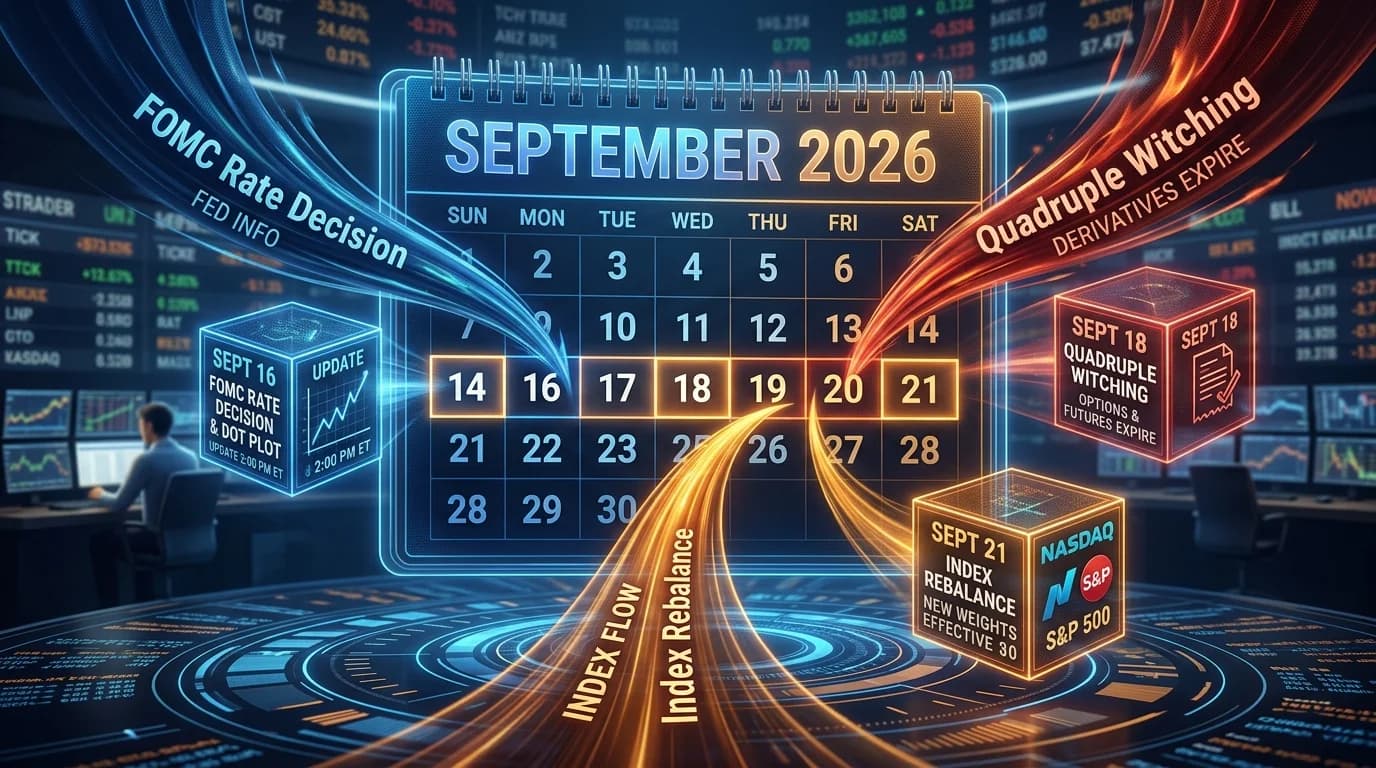

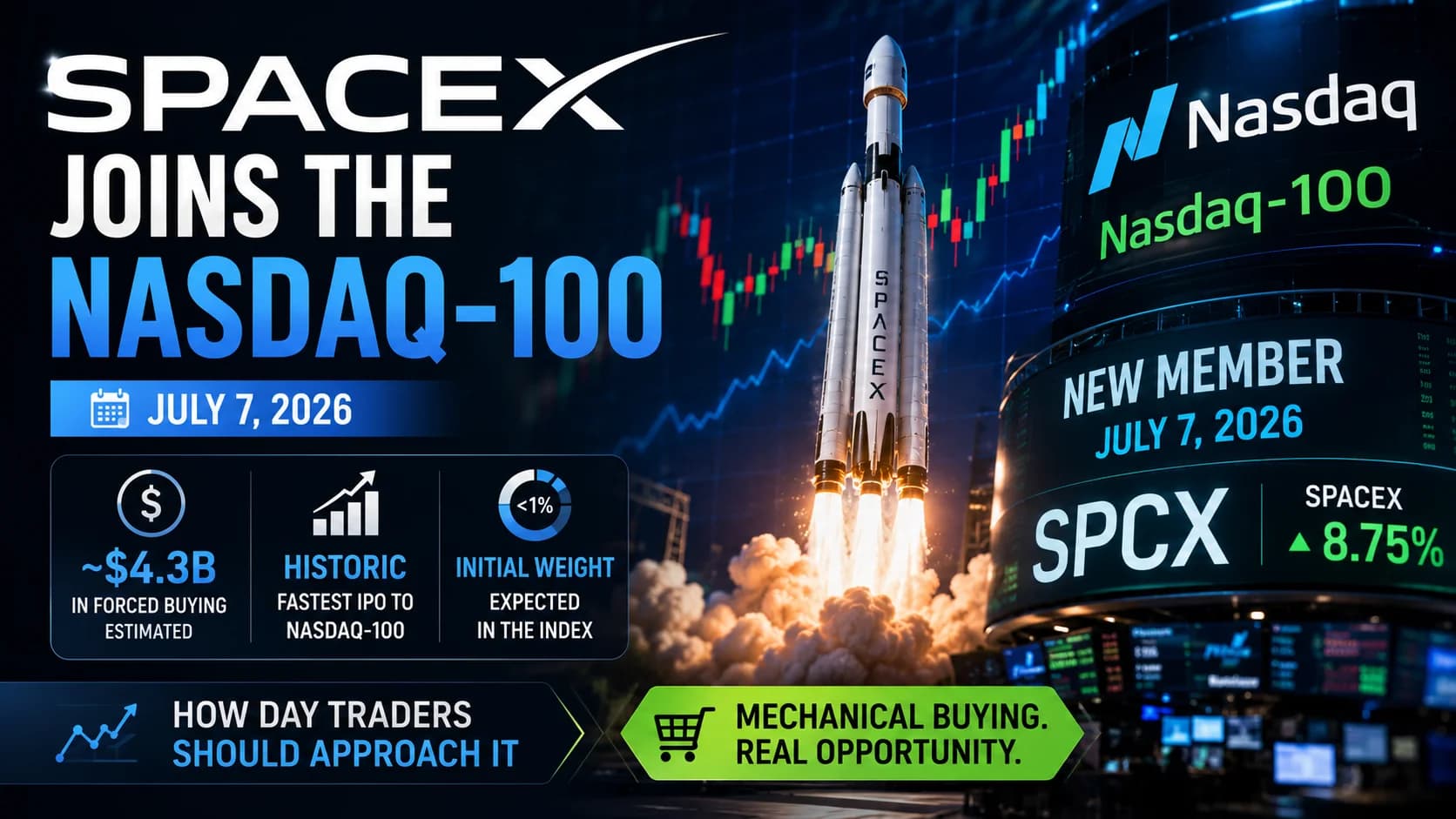
Before the opening bell on Tuesday, July 7, SpaceX becomes a Nasdaq-100 stock. That single sentence is going to move billions of dollars in the next few trading sessions — not because of anything SpaceX did, but because every fund that tracks the Nasdaq-100 is now contractually required to own it, whether the manager running that fund thinks the price is fair or not.
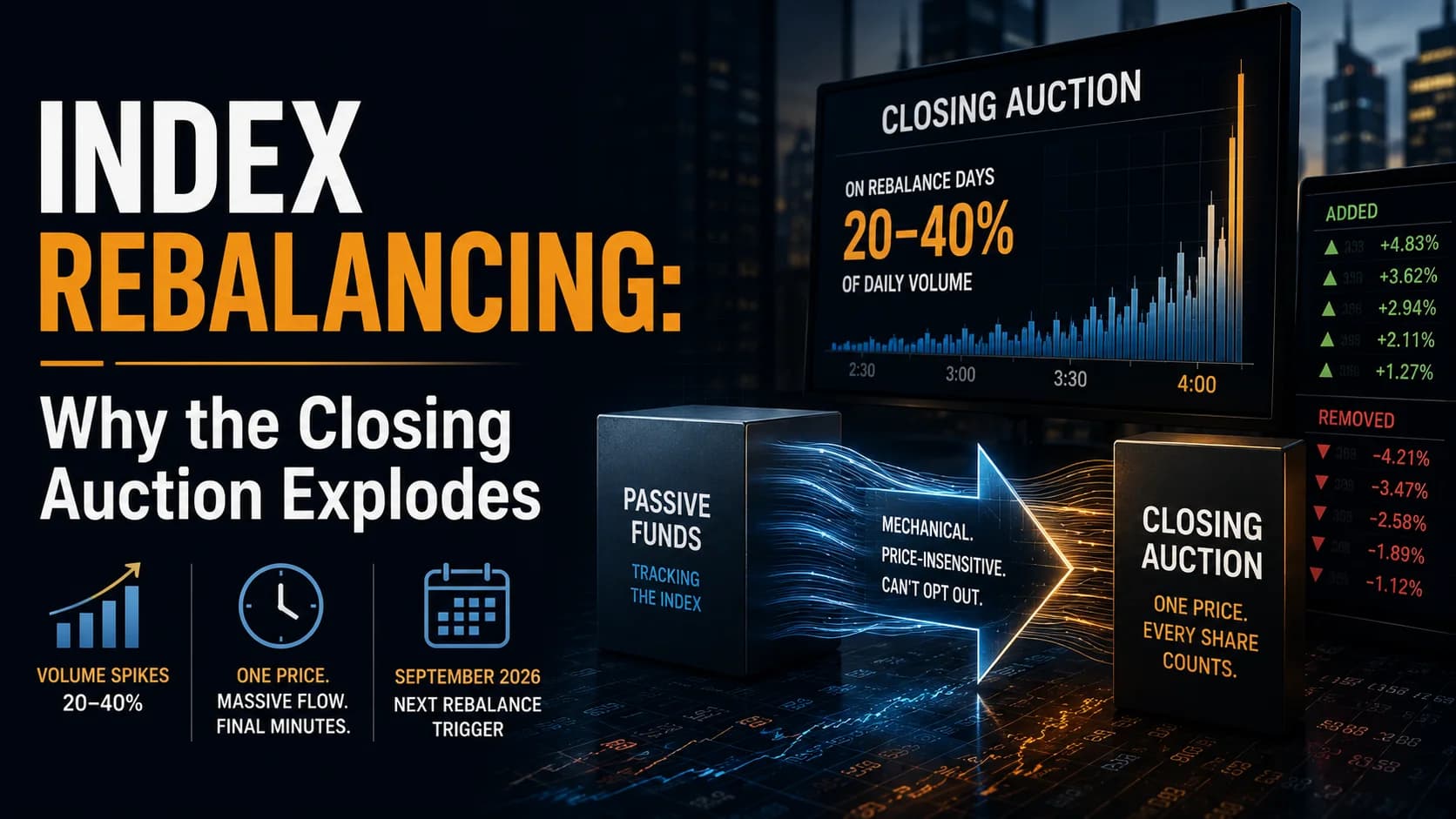
J.P. Morgan estimates roughly $4.3 billion in mechanical, price-insensitive buying tied to this single event, most of it landing after the close on Monday, July 6. That's not a forecast about where SpaceX is headed. It's math — index funds don't get to skip a name they don't like.
This is the fastest a company has ever gone from IPO to Nasdaq-100 membership. SpaceX priced its IPO on June 12. Fifteen trading days later, it qualifies for the index under a rule Nasdaq only adopted this spring. Nothing like this rule existed a year ago, and there's genuinely no long track record to lean on for exactly this scenario — a mega-cap, low-FloatFloat is the number of shares of a company that are actually available for public trading — it excludes shares held by insiders, major institutions with lock-ups, and the company itself.Read definition →, weeks-old public company being forced into a $1.4 trillion benchmark before it's even reported a full quarter as a public company.
What is index inclusion (forced-buying) trading? Index inclusion trading is the practice of anticipating or reacting to the price impact that occurs when a stock is added to a major benchmark index. Because funds tracking that index are required to hold every constituent in proportion to the index's rules, an addition creates mechanical, non-discretionary buying — separate from whether the stock is genuinely undervalued or overvalued.
Here's what's actually driving this, what the last few comparable events tell us about what tends to happen next, and where a trader chasing this setup is most likely to get hurt.
What's Actually Happening on July 6 and 7
Nasdaq confirmed the addition after the close on Friday, June 26. SpaceX (SPCX) will officially become a Nasdaq-100 constituent before trading opens on July 7. Index funds, ETFs, and other products benchmarked to the Nasdaq-100 — a group that collectively manages more than $1.4 trillion, including the roughly $490 billion Invesco QQQ Trust — are expected to execute the bulk of their required buying after the close on July 6, the last session before the change takes effect.
Under the index's old methodology, a newly public company had to season for months — in most cases a year or more — before it could even be considered for inclusion. That requirement is why a company as large as SpaceX would normally have waited well into 2027 to join. Nasdaq rewrote that rule this spring: any newly listed company that ranks among the top 40 Nasdaq-listed names by market capitalization can now qualify after just 15 trading days.
SpaceX is the first company large enough to actually trigger it. It priced its IPO — the largest in history, raising roughly $85.7 billion after underwriters exercised their overallotment option — on June 12 at $135 a share. Fifteen trading sessions later, it's in.
Worth noting: this isn't happening at the S&P 500. S&P Dow Jones Indices considered a similar fast-track carve-out earlier this year and declined to adopt one. The S&P 500 still requires at least a year of trading history and, separately, demonstrated GAAP profitability across four consecutive quarters — a bar SpaceX doesn't clear given a 2025 net loss of roughly $4.9 billion. So while SpaceX is entering one major benchmark this week, it remains locked out of the other for at least another year, and the earliest realistic window for S&P inclusion is sometime in 2027, contingent on the company actually turning a GAAP profit.
That split matters for how you think about this trade. The Nasdaq-100 move is real and it's happening in days. The S&P 500 story is a much longer, more uncertain runway — worth knowing about, not worth positioning around yet.
The Forced-Buying Math: Why the Price Doesn't Matter to the Buyer
This is the part that actually creates the trading opportunity, so it's worth sitting with the mechanics for a second.
An index fund doesn't evaluate whether SpaceX is a good investment at $2.1 trillion. It holds whatever the index says to hold, in the weight the index assigns, on the schedule the index dictates. When the Nasdaq-100 adds a new constituent, every single fund benchmarked to it has to buy — not because a portfolio manager likes the setup, but because the rulebook says so. That's a fundamentally different kind of buyer than the one driving day-to-day price discovery, and it behaves differently: it doesn't wait for a PullbackA pullback is a temporary counter-trend price movement within an established trend — in an uptrend, a pullback is a short-term decline that offers a lower-risk entry point before the trend resumes, as opposed to a reversal which signals theRead definition →, it doesn't care about valuation, and it has a hard deadline.
Despite SpaceX's headline $2.1 trillion market cap, it won't enter as one of the index's largest members. The Nasdaq-100 doesn't weight purely by market cap — it applies a modified methodology, and low-float names get an adjusted multiplier rather than a straight cap-weighted slot. Estimates put SpaceX's initial weighting somewhere under 1% of the index. J.P. Morgan's $4.3 billion figure is the most widely cited estimate of what that translates to in actual dollar buying; a few other analyses using different assumptions about the float multiplier have put the number meaningfully higher. The exact figure will only be known in hindsight, but every credible estimate lands in the billions, concentrated into a window of roughly one trading session.
And because this is a fast-track addition — not part of the index's regular quarterly reconstitution — no existing member is being dropped to make room. The index temporarily holds more than 100 names. That's a small technical detail with a real consequence: the buying pressure lands entirely on SpaceX without an offsetting, equally mechanical sell order in some other stock to net it out.
If you've traded around a short squeeze before, the forced-buying dynamic here will feel familiar in one specific way: a class of buyer that has to transact regardless of price, compressed into a narrow window. The CatalystA catalyst is the specific event or news item that triggers unusual price movement in a stock — earnings reports, FDA decisions, analyst upgrades, acquisition announcements, product launches, and short squeeze setups are all catalysts. WithRead definition → is completely different — this is a rules-based mechanical flow, not short covering — but the "price-insensitive buyer with a deadline" structure rhymes.
What History Actually Says About Nasdaq-100 Add Days
Here's where it gets less exciting than the headline number suggests, and this is the part most coverage of this event is skipping.
The Nasdaq-100 added three high-profile names in its December 2024 reconstitution: Palantir Technologies, Strategy (formerly MicroStrategy), and Axon Enterprise. All three had run up hard into their addition dates on anticipation of exactly this kind of forced buying. All three then declined over the ten trading days that followed the actual addition. The forced buying happened — the funds bought what they were required to buy — and the stocks went down anyway, because the people who'd bought ahead of the news were the ones selling into it.
A more recent example is even closer to home. Astera Labs joined the Nasdaq-100 in this year's June reconstitution — barely two weeks before SpaceX's fast-track addition — and it hasn't produced a meaningful post-inclusion pop either.
None of that means SpaceX will follow the same script. A 15-day fast-track addition with almost no seasoning period, on a stock that's still finding its trading RangeA range (or trading range) is a price zone where a stock oscillates between a defined support floor and resistance ceiling without making meaningful new highs or lows — price is consolidating rather than trending, and the dominant trade is Read definition →, isn't identical to a routine quarterly reconstitution add. But the pattern across multiple recent Nasdaq-100 additions is consistent enough that "the stock pops because index funds have to buy" deserves real skepticism as a trading thesis on its own. The forced buying is a documented fact. A guaranteed price reaction is not — anyone telling you otherwise is selling something.
SPCX's Own Setup: Thin Float, No Trading History, Wide Range
Set the index event aside for a second and look at what you'd actually be trading.
SpaceX has roughly 13 billion shares outstanding, and only an estimated 5% of that is currently in the public float — the rest sits with Musk, pre-IPO investors, and other insiders, most of it under lockup agreements that don't start releasing until later this year and into 2027. A 5% float on a $2 trillion-plus company is an unusually thin amount of tradable stock relative to the size of the business, and thin float is exactly the condition that makes forced buying (or forced selling) hit the tape harder than the dollar amount alone would suggest.
The stock's short trading history backs that up. Since its June 12 debut, SPCX has traded as high as $225.64 and as low as $147.11 — a range of more than 50% in under a month, with no full quarter of EarningsAn earnings report is the quarterly financial disclosure a public company files with the SEC, revealing revenue, earnings per share (EPS), profit margins, and forward guidance — it's the most significant regular catalyst for individual stocRead definition →, no full year of price history, and no established technical levels that have actually been tested more than once or twice. Support and resistance on a stock with three weeks of data is a much shakier concept than it is on a name with years of established trading behavior.
That combination — thin float, wide range, forced institutional flow arriving on a fixed date — is precisely the setup that tends to produce outsized relative volume and volatility around the event itself, independent of which direction it ultimately resolves.
How to Actually Approach This as a Day Trader
Split this into three windows, because each one behaves differently.
Before the July 6 close. This is where any front-running flow shows up — traders and funds trying to buy ahead of the forced-buying wave in hopes of selling into it. If you're watching for this, the tell is volume and price action diverging from the broader market and from SpaceX-specific news. A move higher on heavier-than-normal volume with no accompanying catalyst is the signature of anticipatory positioning, not fundamental news.
The event window itself — after the July 6 close into the July 7 open. This is when the bulk of the mechanical buying is expected to actually execute. Overnight and pre-market price action on July 7 will reflect how much of that flow got absorbed versus how much anticipatory buying already happened in the days before. A muted open despite the confirmed billions in required buying would itself be informative — it would suggest the move was already priced in.
The days after. Based on the pattern from the December 2024 additions and the more recent Astera Labs example, this is the window where a lot of the pre-event buying tends to unwind. Traders who bought the anticipation, not the fundamentals, generally aren't the ones planning to hold.
None of this is a signal to load up on SPCX calls and hope. Position size needs to reflect the volatility this stock has already shown — a 50%+ range in three weeks is not a stock where you size like it's a mature large-cap, regardless of the market cap on the ticker. If you're actively scanning for the volume anomalies that mark each of these windows — a sudden RVOL spike before the close, an unusual pre-market surge — a real-time scanner built for exactly that kind of alert is more useful here than manually refreshing a quote. Trade Ideas is this guide's top pick for that kind of live monitoring: its scanning engine covers thousands of stocks simultaneously and can flag unusual volume the moment it appears, which matters when the window you're watching for is measured in hours. This guide's full Trade Ideas review breaks down the rest of the platform's feature set, including its Holly AI signal engine and Brokerage Plus execution.
Where This Setup Can Go Wrong
Every risk here traces back to the same root cause: this is a genuinely new kind of event, and there isn't a clean precedent for how it resolves.
The valuation debate is real and unresolved. At a $2.1 trillion valuation on roughly $18.7 billion in 2025 revenue, SpaceX trades at a price-to-sales ratio north of 100x. Morningstar's equity analysts have pegged a fair value estimate closer to $780 billion — less than half the IPO valuation — and characterized the current price as stretched. KeyBanc turned more cautious on the stock in late June, and shares dropped double digits in the sessions that followed. None of this means the skeptics are right. It means there's a live, credible bear case running in parallel with the forced-buying tailwind, and the index event doesn't resolve that debate one way or the other.
The thin float cuts both ways. It's exactly what makes forced buying hit the price hard — and exactly what makes forced selling, or even ordinary profit-taking by early IPO allocation holders once their restrictions lift, hit just as hard in the other direction.
There's no reliable technical map yet. With three weeks of trading history, any support or resistance level you draw on a SPCX chart has been tested once, maybe twice. That's not enough data to trade the stock the way you'd trade an established name with years of price memory behind key levels.
And single-stock concentration risk applies regardless of the catalyst. A stock that's already moved more than 50% in less than a month can keep doing that in either direction, index event or not.
FAQs
When exactly does SpaceX join the Nasdaq-100?
Nasdaq confirmed the addition after the close on Friday, June 26, giving the market roughly a week and a half of notice before the change takes effect. That lead time is itself part of the story — it's long enough for anticipatory positioning to build ahead of the actual event, which is exactly what the historical precedent in this guide addresses.
Key Takeaway: The mechanical buying window is narrow — Monday's close into Tuesday's open — even though the announcement came days earlier.
Why is SpaceX joining the Nasdaq-100 so quickly after its IPO?
SpaceX priced its IPO on June 12 and is the first company large enough to actually trigger this fast-track provision. Under the old rules, a company this size would typically have waited close to a year before even being considered. The rule change was adopted in anticipation of exactly this kind of mega-cap IPO, and SpaceX is its first real test case.
Key Takeaway: This is a brand-new mechanism with no long track record — SpaceX isn't following a well-worn path, it's establishing one.
How much forced buying is expected from this index inclusion?
The estimate reflects what funds benchmarked to the Nasdaq-100 — collectively more than $1.4 trillion in assets, including the roughly $490 billion Invesco QQQ Trust — need to buy to bring their holdings in line with SpaceX's new index weighting. Because this is a fast-track addition rather than a routine reconstitution, no other stock is being removed to offset the flow, so the buying pressure isn't diluted by an equal and opposite sell order elsewhere in the index.
Key Takeaway: The dollar figure is an estimate, not a guarantee, but every credible calculation lands in the billions concentrated into roughly one session.
Will SpaceX also join the S&P 500?
SpaceX posted a net loss of roughly $4.9 billion in 2025, which means it doesn't currently clear the S&P 500's profitability bar even setting the seasoning requirement aside. Analysts generally see 2027 as the earliest realistic window for S&P 500 inclusion, contingent on the company turning a sustained GAAP profit. That's a materially different, much longer timeline than the Nasdaq-100 event happening this week.
Key Takeaway: Don't confuse this week's Nasdaq-100 event with S&P 500 inclusion — they run on completely different rules and timelines.
Does Nasdaq-100 inclusion guarantee SPCX stock will go up?
The mechanism works exactly as described: funds tracking the index are required to buy. What history shows is that a lot of that expected demand often gets front-run by traders positioning ahead of the actual addition date, and once the news event actually happens, those same traders frequently sell into the confirmed buying rather than holding through it. The forced buying and the stock's price direction are two separate things.
Key Takeaway: Treat "index inclusion" and "the stock goes up" as two different claims — the data doesn't support assuming the second follows automatically from the first.
Why does SpaceX's small public float matter for this trade?
Most of SpaceX's shares remain held by Musk, pre-IPO investors, and other insiders under lockup agreements that begin releasing later in 2026 and into 2027. A thin float is exactly the condition that amplifies the price impact of forced index buying — and it will just as easily amplify the impact of forced or voluntary selling once lockup restrictions start lifting.
Key Takeaway: The same float that makes this event volatile on the way up will make future lockup expirations worth watching on the way down.
How is trading this event different from just buying SPCX stock?
A day trader positioning around this event is reading volume, relative volume, and price action for signs of anticipatory buying or post-event unwinding, using tight risk management appropriate for a stock with three weeks of trading history. That's a fundamentally different exercise from an investor deciding whether SpaceX is worth $2.1 trillion over a five-year horizon — a question this guide takes no position on.
Key Takeaway: This guide covers the event mechanics for active traders, not a long-term valuation call on the company.
Could SpaceX ever be removed from the Nasdaq-100?
Because SpaceX entered through a fast-track provision rather than the standard quarterly reconstitution process, its ongoing membership will still be evaluated under the index's regular rules going forward. Nothing in the current announcement suggests removal is a near-term concern, but it's a reminder that index membership reflects a rules-based snapshot, not a permanent designation.
Key Takeaway: Index inclusion is a rules-based status that gets re-evaluated over time, not a one-time, irreversible event.
Does this fast-track rule change matter beyond SpaceX?
This is a permanent change to how Nasdaq-100 inclusion works, not a one-time exception carved out for SpaceX. Traders who understand the mechanics of this event — the forced-buying math, the historical tendency for pre-event anticipation to outrun the actual reaction, the risks tied to thin float and short trading history — will be equipped to recognize the same setup the next time a mega-cap IPO qualifies.
Key Takeaway: This week's event is also a template — the mechanics here will likely repeat with the next large IPO that clears the top-40 threshold.
Article Sources
- CNBC — SpaceX to join the Nasdaq-100 in a fast-tracked process - confirms the inclusion date, the 15-trading-day fast-track rule, and Nasdaq's rationale.cnbc.com
- The Motley Fool — SpaceX Joins the Nasdaq-100 on July 7. What It Means for Index Fund Investors - the J.P. Morgan forced-buying estimate and index weighting mechanics.finance.yahoo.com
- The Motley Fool — Will SpaceX Soar After It Joins the Nasdaq-100? History Offers a Compellingly Clear Answer - the December 2024 Palantir, Strategy, and Axon Enterprise precedent and the Astera Labs comparison.fool.com
- U.S. Securities and Exchange Commission — Space Exploration Technologies Corp. S-1 Registration Statement - primary-source financial data, share structure, and lockup terms.sec.gov
- Forbes — SpaceX IPO: 8 Things to Know Before It Goes Public - IPO pricing, valuation, and offering structure background.forbes.com