
SpaceX Lockup Expiration: The $123B Unlock Explained

In this article7 sections
SpaceX reported its first-ever earnings as a public company after the close on August 4, 2026. Two trading days later, on August 6, insiders became free to sell up to 20% of their restricted holdings, roughly 911.5 million shares worth close to $123 billion at recent prices. That's not the whole lockup. It's the opening tranche of a staggered release schedule that keeps adding supply into SPCX stock through December.
This is the mirror image of what happened on July 7, when SpaceX's Nasdaq-100 inclusion forced roughly $4.3 billion of price-insensitive buying into the stock. The lockup does the opposite: it removes the one thing that's kept SPCX's float artificially small since its record-breaking June 12 IPO, and it did it right as the stock was trading near, and briefly below, its $135 IPO price.
What is a lockup expiration? A lockup expiration is the date (or, as with SpaceX, a series of dates) when an IPO's contractual restriction on insiders selling their shares ends. Founders, employees, and early investors who couldn't sell during the lockup period suddenly can, and when a large percentage of a company's total share count becomes sellable at once, the added supply can pressure the stock regardless of how the business is actually performing.
What Actually Happened When SpaceX's Lockup Opened (Updated August 11, 2026)
The setup described below was written before any of this happened. Here's what actually happened, and it's messier and more interesting than either the bull case or the bear case predicted.
SpaceX's August 4 earnings beat on the numbers that mattered most: $7.8 billion in revenue, up 92% from a year ago, and a $541 million net loss that was far narrower than the roughly $1.9 billion Wall Street had modeled. Shares had already climbed nearly 10% into the print, closing that Tuesday session at $125.33. Then the after-hours tape turned, falling as much as 8% once investors reached the capex line: $18.4 billion in a single quarter, about 42% above what analysts expected, with management guiding to similar spending in each of the next two quarters. That pace implies something in the neighborhood of $65 billion for the full year, more than triple what SpaceX spent in all of 2025.
By the time the lockup actually opened on August 6, SPCX had already slid to a fresh all-time low near $105 at the open. That's the headline moment this article was written to prepare you for: 911.5 million shares, worth close to the $123 billion figure discussed throughout this piece, suddenly eligible to sell, landing on a stock already reeling from the capex scare. It's the setup where the bear case (Uber, Twitter) looked more likely than the bull case (Facebook).
It didn't play out that way. The stock closed that same session higher, not lower. And it kept climbing: SPCX rallied more than 26% off the August lockup-week low over the following days, briefly touching and then closing at its $135 IPO price on Monday, August 10, the first time it had traded back at that level since mid-July. Mizuho flagged a likely reason: most of the newly eligible shares probably weren't going to trade regardless of the headline unlock number. Several analysts leaned into the move rather than away from it. Citi raised its 2026 and 2027 estimates on the earnings beat while holding a $200 price target, and Morgan Stanley's Adam Jonas called the sell-off "an opportunity" rather than a red flag.
None of this means the supply story is over. The next scheduled release, one of the smaller time-based tranches this article outlines below, lands around day 70 after the IPO, roughly August 21. That's the real test of whether this was a one-time liquidity absorption or the first round of a longer drip. What already happened, though, is a clean real-world answer to a question this article asks further down: a lockup expiration is a ceiling on selling, not a forecast of it. SPCX just proved that by nearly doubling its tradable float and shrugging it off inside a week.
Why SpaceX's Lockup Isn't a Normal Lockup
Most IPOs use a single 180-day cliff: nothing sellable, then everything sellable, all at once, on one date. SpaceX's underwriters built something more complicated, and it matters for how you should think about the supply overhang, both the part that already landed and the part still ahead.
Instead of one release, SpaceX's lockup unwinds in five separate triggers:
The first and largest came from Q2 earnings. Two trading days after SpaceX reported on August 4, insiders could sell up to 20% of their restricted shares: the roughly 911.5 million-share, roughly $123 billion tranche that drove most of the market anxiety heading into August 6.
There's also a price-based trigger built into the agreement: if SPCX trades at least 30% above the $135 IPO price (above roughly $175.50) on 5 of any 10 trading days, another 10% of eligible shares can release early. As of August 11, 2026, SPCX has rallied back to roughly its $135 IPO price after the earnings beat and the lockup opening, but that's still well short of the $175.50 level, so this trigger remains a long-shot scenario rather than a near-term concern.
Then come five smaller time-based tranches, roughly 7% of restricted shares each, releasing at day 70, 90, 105, 120, and 135 after the June 12 IPO. Doing the math, that's a steady drip from late August through late October, not a single cliff.
A second major wave, around 28% of restricted shares, follows Q3 earnings.
And the backstop: the full 180-day lockup expires December 8, 2026, releasing anything still restricted.
The logic behind spreading it out is straightforward. Underwriters have watched enough single-day lockup cliffs turn into disorderly selloffs that they'd rather meter the supply. Whether that succeeds over the full schedule, not just the August 6 opening tranche, is the question the rest of this article, and its next update, is built to answer.
The Mechanics: Why This Is Price-Insensitive Supply
The reason lockup expirations move stocks isn't complicated, but it's worth being precise about it, because "insiders can now sell" gets thrown around loosely.
Pre-IPO investors, venture funds, early employees, founders, hold shares that were priced years before the IPO, often at a tiny fraction of the $135 offer price. For many of them, any sale above their cost basis is a win regardless of where SPCX trades on a given Tuesday. That's what makes this supply structurally different from ordinary trading volume: it isn't driven by an opinion about SpaceX's Starlink growth or Starship cadence. It's driven by contractual timing and, for funds with limited partners waiting on distributions, by an obligation to actually realize gains and return capital.
That's also why the selling pressure isn't confined to the unlock date itself. Institutional holders who know a wave of supply is coming tend to trim ahead of it, which is part of why lockup-adjacent stocks often drift lower in the days before the date, not just on it. The market is trying to price in supply it can see coming.
None of this says anything about whether SpaceX is a good long-term holding. It's a statement about flow, not fundamentals. Separating those two things is the entire skill in trading an event like this, and the August 6 to 10 stretch is a real-world example: the flow story (a doubled float) and the fundamentals story (an earnings beat with a capex scare) pointed in different directions at first, and the fundamentals won.
What History Actually Says
The honest answer is: it's mixed, and the mix matters more than any single headline number.
Facebook's biggest lockup expiration in November 2012 is the case bulls point to. The stock closed 12.5% higher that day on 3.1x normal volume, defying the standard playbook entirely. But that same IPO also had two earlier, smaller lockup releases in August and October 2012 that pulled the stock down roughly 5% and 3% respectively. Same company, same lockup structure, three different releases, three different outcomes.
The bear case has its own anchor: Uber's November 2019 lockup. The stock fell 17% in the days approaching the expiration and continued sliding afterward, compounding losses that were already building from a rocky post-IPO stretch. Twitter's May 2014 unlock is the outlier on the downside: a 17.7% single-day drop, driven partly by the fact that co-founders and early employees held an unusually large share of the float relative to other tech IPOs.
Most lockup expirations land somewhere in the unremarkable middle. Snap's lockup expiration produced about a 1.1% decline. Lyft's was roughly 1.6%. Uber's actual expiration-day print (as opposed to the run-up decline) was closer to 3.9%. These are the base rate, and the base rate is quiet.
What separates the Facebook outcome from the Uber and Twitter outcomes appears to come down to two things: how much of the float insiders actually chose to sell (a lockup expiring doesn't mean everyone sells at once, plenty hold), and what the stock's setup looked like heading into the date. Facebook's November 2012 release came after the stock had already been beaten down for months and sentiment had turned; there was less "fresh" bad news left to discover. Uber and Twitter's declines came while sentiment was still actively souring.
SPCX's own result, a fresh low on the open followed by a sharp multi-day rally, doesn't fit neatly into either bucket. It's closer to a fourth pattern: a stock where a separate catalyst (the earnings beat) mattered more than the mechanical supply event, at least in the first week.
SpaceX's Own Setup Going In
SPCX walked into this lockup from a position of weakness, not strength, and that's the part that made the actual outcome worth paying attention to.
The stock priced at $135, opened at $150 on June 12, and traded as high as $225.64 within its first week: a debut that briefly rivaled Facebook's 2012 trading volume, with more than 500 million shares changing hands on day one. From that high, SPCX fell more than 30% heading into August. It sank below its $135 IPO price for the first time in mid-July, recovered briefly, then broke back below it again, and on July 28, Bloomberg reported the stock briefly traded 20% under its IPO price, erasing roughly $1.2 trillion of the valuation investors had assigned it on debut day.
The reasons behind that slide were fundamentals, not just sentiment fatigue: SpaceX posted a $4.9 billion net loss in 2025 and lost another $4.28 billion in the first quarter of 2026. Analysts pointed to a combination of post-IPO hype cooling off, profit-taking from early allocation holders, and a market that had grown less patient with unprofitable, capital-intensive growth stories generally, the same dynamic that pressured AI infrastructure names through July.
That was the backdrop the lockup landed on: a stock already down more than 30% from its high, already trading near or below its offer price, about to see a wave of insiders (many sitting on gains from a cost basis set years before the IPO) gain the legal ability to sell into whatever bounce showed up. On paper, that looked closer to the Uber setup than the Facebook one. What actually happened looked more like Facebook's outcome anyway: shares set a fresh 52-week low near $105 on the morning of August 6, then spent the next several sessions erasing that damage and more, closing back near $135 by August 10. History said the setup mattered. It did, just not in the direction the setup alone predicted.
How Traders Approached the Event, and What Still Applies Going Forward
Before the unlock. Watch for the pre-positioning that tends to show up ahead of known supply events: elevated relative volume without a clear news catalyst, and unusually persistent selling into strength. Ahead of August 6, SPCX did exactly that, sliding into the unlock rather than holding steady, which was the market pricing in supply it could see coming. A scanner that flags relative volume (RVOL) and unusual options activity on a specific ticker, something like Trade Ideas' real-time scanning, is more useful here than watching the ticker manually, because pre-positioning tends to show up in options flow before it shows up in the share price.
The event window. SpaceX's August 4 earnings and the August 6 unlock sat three trading days apart, which meant the opening week wasn't a single-session event. It was a stretch where a fundamental catalyst (the actual Q2 numbers) and a structural catalyst (the unlock) compounded each other. That's exactly what happened: the earnings beat gave buyers a reason to step in that had nothing to do with the lockup, and it's a large part of why the unlock didn't produce the feared crash.
After the window. This still isn't a one-and-done event. The 7% time-based tranches keep landing through late October, the next one around August 21, and the Q3 earnings-linked 28% tranche is still ahead after that. A trader who only planned for August 6 and treats the story as finished is missing most of the actual supply schedule. The same three-part framework, watch the pre-positioning, read the fundamental catalyst first, then track the next scheduled date, applies again for every tranche still to come.
Where This Setup Goes Wrong
The single most common mistake with lockup trades is treating "insiders can sell" as "insiders will sell everything, immediately." They won't. Plenty of long-term holders, employees who believe in the company, funds without near-term distribution pressure, simply don't sell when their lockup lifts. SPCX's first week is a live example: the unlock was a ceiling on what could hit the market, not a forecast of what would, and the ceiling turned out to matter less than the earnings print.
The second mistake is ignoring the earnings dependency. SpaceX's first tranche was gated behind its first-ever public earnings report, and the August 4 to 10 stretch shows why that mattered more than the unlock itself. A trade plan built purely around the calendar date and blind to what the earnings actually say is trading half the setup, every time this schedule produces another date.
The third mistake, and the one that burns the most accounts on stories like this: assuming the base rate (a quiet, sub-4% move) is the only possible outcome because it's the median historical outcome. Twitter's 17.7% single-day drop, Uber's 17% run-up decline, and SPCX's own 26%-plus reversal off the August 6 low all happened to real traders holding real positions sized for what they assumed would be a "normal" lockup day. Size for the tail, not just the median.
And a risk specific to SPCX going forward: this is still a young, thinly-tested public company with no long earnings history as a public reporter, a 52-week range that now runs from roughly $105 to $225.64, and a lockup structure with four more triggers still ahead. Complexity itself is a risk. Five different unlock triggers means five different dates where the setup can change on you, and August 6 is proof that each one can resolve in a way the setup alone wouldn't have predicted.
When exactly did SpaceX's lockup start releasing shares, and what happened next?
That first tranche allowed insiders to sell up to 20% of restricted shares, roughly 911.5 million shares at recent prices worth close to $123 billion. It was the largest single release in the schedule, but not the only one. Smaller tranches continue through October, the next around August 21, a second large tranche follows Q3 earnings, and the full lockup backstop expires December 8, 2026. See the updated section above for exactly what happened on and after August 6.
Key Takeaway: August 6 was the first date to watch, not the last. The next tranche lands around August 21.
Did SpaceX's lockup expiration crash the stock?
That outcome fits the wider historical pattern better than the doom-and-gloom framing many traders expected going in. Facebook's largest lockup expiration in November 2012 closed 12.5% higher. Uber's 2019 expiration coincided with a 17% decline in the run-up to the date. Snap and Lyft's expirations produced modest single-digit declines. The direction depends heavily on how much of the eligible float actual sellers choose to sell, and on the stock's fundamental setup heading into the date, not on the mechanical fact that a lockup exists.
Key Takeaway: Treat an unlock as a source of added volatility and supply risk, not a directional prediction. SpaceX just demonstrated that directly.
Why is SpaceX's lockup schedule so complicated compared to other IPOs?
Instead of one 180-day cliff, the schedule spreads releases across an earnings-triggered tranche, a price-based trigger, five smaller time-based tranches, a second earnings-triggered tranche, and a final backstop expiration. This design choice reflects lessons learned from prior mega-IPOs where a single cliff created outsized one-day moves.
Key Takeaway: Expect a longer stretch of elevated supply risk in SPCX rather than one clean catalyst date, with the next test around August 21.
What is the price-based early-release trigger, and is it close to happening?
SPCX spent most of July trading at or below its $135 IPO price, briefly touching 20% under that level in late July, before the sharp rally that followed the August 6 lockup opening pushed shares back toward, and briefly above, the IPO price by August 10. Getting from there to a sustained 30% premium is a meaningfully bigger move than the one that already happened.
Key Takeaway: This trigger only matters if SPCX rallies much further from here. It's not part of the near-term setup even after the post-lockup bounce.
How does the lockup expiration relate to SpaceX's Nasdaq-100 inclusion in July?
Both are mechanism stories rather than fundamentals stories. The flows exist because of index rules and lockup contracts, not because of a view on SpaceX's business. Understanding one makes the other easier to reason about, since they're the same category of event pointed in different directions.
Key Takeaway: For the full mechanics of the inclusion side of this story, see SpaceX Joins the Nasdaq-100: How to Trade July 7.
Why did SPCX fall below its IPO price before the lockup even started, and has it recovered?
The stock's slide from its $225.64 high wasn't primarily about the lockup. It started weeks before the first unlock date. Analysts pointed to a broader market reassessment of high-growth, capital-intensive, unprofitable companies, a pattern that showed up elsewhere in the AI infrastructure trade through July as well. The August 4 earnings report added a new wrinkle: revenue and the bottom line both beat expectations, but capital expenditure of $18.4 billion for the quarter, about 42% above estimates, briefly overshadowed the beat before buyers stepped back in.
Key Takeaway: Know the difference between what's driving the trend (fundamentals and sentiment) and what's adding to it (mechanical supply). They call for different read-throughs, and both can reverse faster than expected.
Should beginner or small-account traders touch this event?
SPCX combines a wide 52-week range, an unusually complex multi-trigger unlock schedule, and a stock with a short public earnings track record that's already produced one sharp reversal. For newer traders working with the smaller account sizes that became viable after the PDT rule's elimination, position sizing discipline matters more here than in a calmer setup, not less.
Key Takeaway: If you're still building your risk process, see Day Trading a Small Account: The Complete Playbook for the Post-PDT Era before sizing into an event like this one.
How should I actually manage risk if I trade around the remaining unlock dates?
Given the range of historical outcomes (from plus 12.5% to minus 17.7% on comparable lockup days, and SPCX's own plus 26% swing off its August 6 low), a stop based on support and resistance or ATR will hold up better than a round-number stop that ignores the stock's actual volatility. This is a case where the specific risk approach matters more than the general one.
Key Takeaway: See How to Place a Stop Loss Correctly and Strategy-Specific Risk Management for frameworks that adjust to a stock's actual volatility rather than a fixed percentage.
Disclaimer
Article Sources
- Bloomberg: SpaceX Falls 20% Below IPO Price, Erasing $1.2 Trillion Value - confirms the July 28 price action and valuation context
- CNBC: SpaceX Stock Sinks Below Its IPO Price for the First Time - mid-July price action and analyst commentary on the decline
- Yahoo Finance: SpaceX Q2 2026 Earnings: Revenue Beats, Stock Falls After Hours - confirms the August 4 revenue, net loss, and after-hours reaction
- IndMoney: SpaceX Q2 Earnings, Why SPCX Stock Fell Despite Earnings Beat - detailed capex figures and the August 5 price action ahead of the lockup
- TradingKey: SpaceX's First Lockup Passed Without a Crash - the August 6 outcome, float data, and Mizuho and Morgan Stanley commentary
- TradingKey: SpaceX Shares Surge 26% After First Lock-Up Expiration - the rally through August 10 and updated analyst price targets
- Yahoo Finance: SpaceX Stock Rebounds to $135 IPO Price After Post-Debut Slump - confirms the August 10 close back at the IPO price and Citi's estimate increase
- Investing.com: SpaceX IPO Lockup Expiry, $123B in Shares Set to Unlock in Early August 2026 - the staggered tranche schedule and dollar-value estimate
- CNBC: SpaceX IPO Takeaways, SPCX Closes at $161, Jumping 19% After Record Debut - IPO-day pricing and volume data
- Aswath Damodaran: Much Ado About Liquidity? Lockup Expirations and Stock Prices - historical lockup expiration outcomes across Facebook, Uber, Twitter, Snap, and Lyft
Was this helpful?
Be the first to weigh in

Written by
Kazi Mezanur RahmanFounder, independent researcher, and editor of DayTradingToolkit. A one-person publication focused on risk-first trading education and documented tool research. He trades his own capital as a retail trader and combines personal market experience with systematic primary-source research.
Keep Reading
Market Analysis & Insights
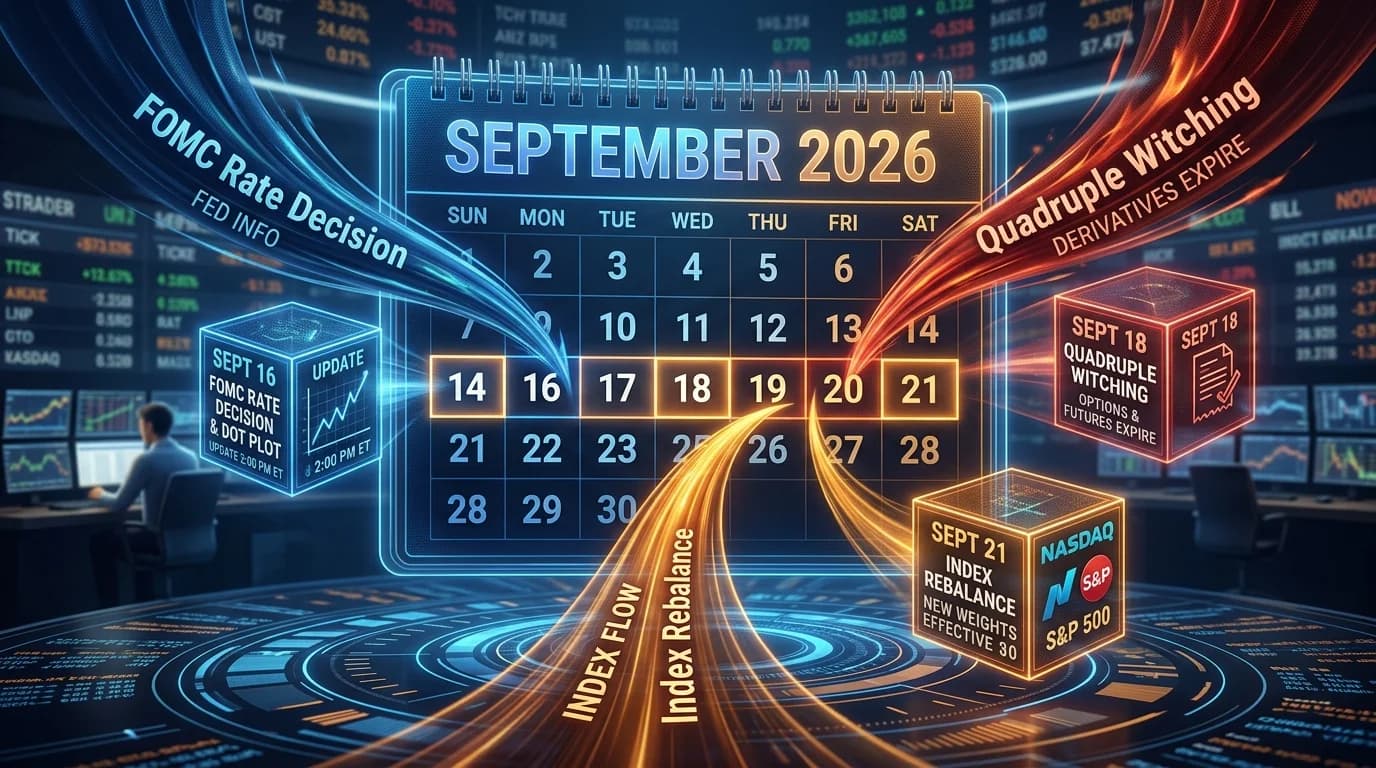
September's Trading Calendar: FOMC, Quad Witching, and the Rebalance All Land in One Week
Three major structural events land in the same five trading days this September: the FOMC's dot-plot meeting, quadruple witching, and the Nasdaq-100/S&P 500 quarterly rebalance. Here's how they interact and how to prepare.

Market Analysis & Insights
Why Index Rebalancing Days Break Volume Records—and Why Chasing the Addition Still Fails
Index rebalancing forces price-insensitive buying and selling into the closing auction, sometimes 40%+ of a stock's daily volume. The mechanics, the September 2026 dates, and why forced buying doesn't guarantee a price pop.
Market Analysis & Insights
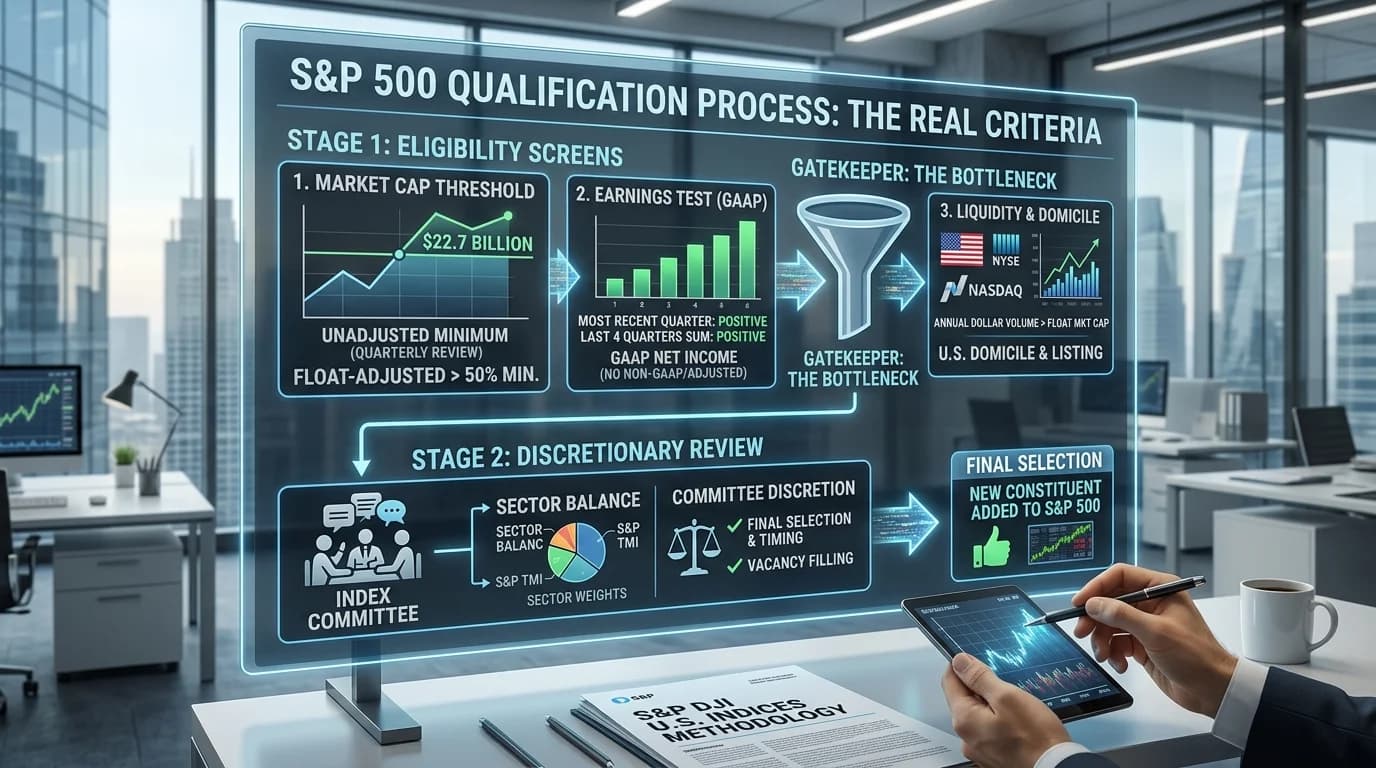
How Stocks Actually Qualify for the S&P 500
The S&P 500 isn't a list of the 500 biggest US companies. It's a curated index with a two-part GAAP earnings test, a moving market-cap threshold, and a discretionary committee. Here's the real eligibility bar, using Reddit's own numbers as the case study.

Market Analysis & Insights
Reddit Joins the S&P 500: How to Trade the Inclusion
Reddit joined the S&P 500 on August 18, 2026, after AvalonBay's merger opened a seat. Here's the forced-buying math, what actually happened to RDDT across four sessions, and what history says about chasing an index addition.
Comments
No comments yet. Be the first to share your thoughts.