
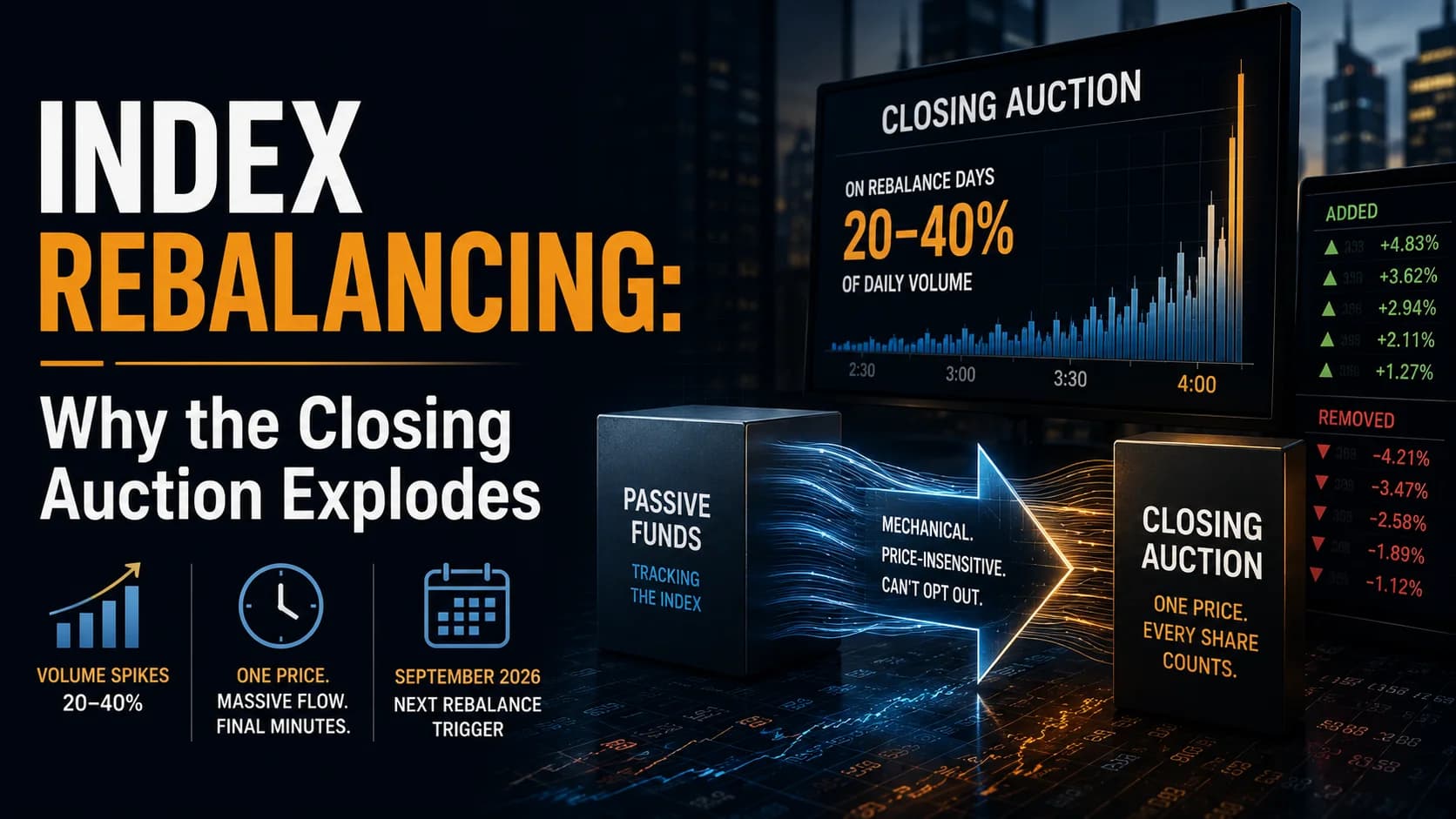
The single largest LiquidityLiquidity in trading refers to how easily you can enter and exit a position at a fair price — a liquid stock has high volume and a tight bid-ask spread, allowing large orders to be filled quickly without moving the price, while an illiquid Read definition → event of any U.S. trading day isn't the opening bell. It's the last few minutes before the close, when exchanges match roughly $50 billion in notional VolumeVolume is the total number of shares (or contracts) traded during a given time period — it's the primary confirmation tool for all price action, because a price move accompanied by high volume indicates genuine market participation, while tRead definition → through the closing auction on a typical session. On an index rebalance day, that figure can climb to 20% of total daily volume—and for the individual stocks being added or removed, closing auction volume can run as high as 40% of everything that trades in that name all day.
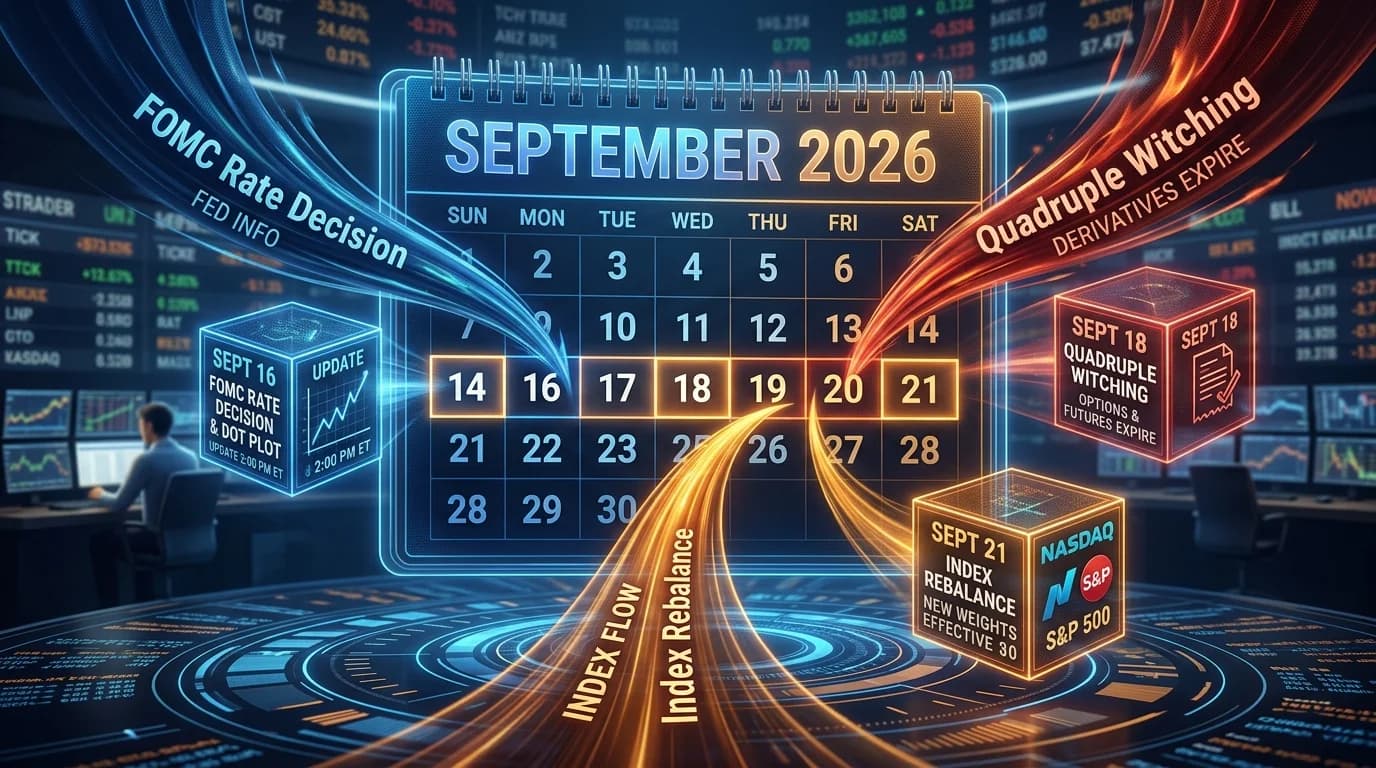
The next scheduled trigger for that spike lands in September. Nasdaq-100 uses the last trading day of August—Monday, August 31, 2026—as its reconstitution reference date, with any resulting changes taking effect at the market open on Monday, September 21, 2026, the first trading day after the third Friday of September. The S&P 500 runs on the identical third-Friday effective schedule. Both are the next entries in a mechanism that's been unusually visible all year, following the SpaceX Nasdaq-100 fast-track addition in July and a run of passive-flow-driven volatility through June.
What is index rebalancing? Index rebalancing is the periodic process where an index provider updates which stocks belong in a benchmark and how much weight each one carries. Because trillions of dollars in funds and ETFs are contractually required to track these benchmarks, every rebalance forces mechanical, price-insensitive buying and selling—most of it concentrated into the closing auction on the effective date.
Why the Money Piles Into One Specific Moment
Index funds don't get to have an opinion. A fund tracking the Nasdaq-100 has to hold every constituent in the index, at the index's assigned weight, on the index's schedule—not because the manager likes the setup, but because the fund's entire mandate is to minimize tracking error against the benchmark. When Nasdaq or S&P Dow Jones Indices announces a change, every single one of those funds has an identical, non-negotiable instruction: adjust the position to match, by the effective date.
The closing auction is where nearly all of that adjustment lands, for a simple reason: funds are measured against the closing price. A portfolio manager who buys a new constituent at 2 p.m. and the stock drifts before 4 p.m. has introduced tracking error relative to a benchmark that reconstitutes at the close. Buying exactly at the close—via a market-on-close or limit-on-close order—eliminates that risk. That's why NYSE research on 2026 auction data found a scatter-plot relationship between closing auction executed volume and the unfilled residual volume sitting alongside it, and why that relationship is measurably stronger on rebalance days than on ordinary ones: bigger auctions attract more participants trying to trade at that single price, and more of them end up unmatched.
The scale involved explains why this isn't a niche curiosity. On a typical day in 2024, exchanges matched roughly $50 billion in the closing auction, about 9% of total daily trading volume. On index rebalance or options-expiration days, that share doubles to roughly 20%. At last year's Russell Reconstitution alone, more than $217 billion in U.S. stocks traded in the closing moments of that single session. For the individual stocks actually being added to or removed from an index, academic research tracking auction behavior around S&P 500 changes found that closing auction volume permanently increases by about 20% relative to the rest of the trading day after an addition—and permanently decreases by about 15% after a deletion. That's not a one-day spike. It's a lasting shift in how the stock trades going forward.
Exchanges also give traders a preview of how lopsided a given close is likely to be before it happens. NYSE publishes running imbalance data—closing "D-Orders" and similar messages—in the minutes leading into 4 p.m., and that feed has itself become more informative over time: more than a quarter of closing D-Orders are now entered before 3:50 p.m., an order-entry pattern that used to be reserved for rebalance and month-end sessions and now shows up more broadly. On an actual rebalance day, that same imbalance feed is the closest thing to a real-time read on which side of a stock's order book is genuinely overwhelmed—useful information whether you're trying to understand the mechanics or just trying to stay out of the way.
Announcement Date vs. Effective Date—The Distinction That Actually Matters
Every rebalance has two dates, and confusing them is the single most common mistake in how this event gets discussed.
The announcement date is when the index provider publishes which stocks are being added or removed. That's the news event—the headline, the press release, the thing that shows up in a market recap. The effective date is when funds actually have to own the new weights, which for both the Nasdaq-100 and the S&P 500 falls at the market open on the first trading day after the third Friday of the rebalance month. There's typically a GapA gap is a price discontinuity on a chart where a stock opens significantly higher or lower than the previous session's close, leaving a visible empty space — gap-ups are driven by overnight buying pressure or positive news; gap-downs by seRead definition → of one to three weeks between the two. That gap is where anticipatory positioning happens: traders and even some funds buy ahead of the confirmed mechanical demand, hoping to sell into the forced buying when it actually arrives.
That gap also explains why chasing the news on announcement day is usually late. By the time a change is public, professional index-arbitrage desks and quantitative funds have already modeled the expected order flow and started positioning. The retail trader reacting to the headline is trading several steps behind money that's had the same information for days or weeks.
Nasdaq's own methodology adds a wrinkle worth knowing: since a May 2026 update, the index runs a rank-based quarterly review every March, June, and September, in addition to the December annual reconstitution—a change from the prior framework, where December was effectively the only point new constituents entered outside of special fast-track cases. The first rebalance under the new rules landed June 22, 2026, folding several ad hoc adjustment mechanisms into the regular schedule. September 2026 will be the second cycle to run under this newer, more frequent framework, which means more scheduled opportunities for membership changes than the index has had in years past—and, correspondingly, more scheduled closing-auction events to track.
What History Actually Says About "Buying the Addition"
This is the part that gets skipped in most coverage of index events, and it's the one that should shape how you actually trade around one.
The Nasdaq-100's December 2025 reconstitution added six new constituents representing nearly $300 billion in combined weight—a reminder of how much capital moves on a single reconstitution date. But being added didn't protect the index's own members from continuing to fall: The Trade Desk and Lululemon, both still in the index through that reconstitution, ranked among the Nasdaq-100's weakest performers for the year, down 68% and 46% respectively. Meanwhile Biogen, at a $26 billion market cap, was removed for falling below the index's size threshold—removal because a company shrank, not because anything mechanically bad happened to it that day.
Academic research on the S&P 500 specifically found something equally inconvenient for the "guaranteed pop" narrative: even on S&P 500 rebalancing days, there's little evidence of abnormal price deviation at the closing auction relative to the volume that trades through it. The auction price differs from the pre-close quote midpoint by an average of about 8 basis points—only slightly more than the ordinary half Bid-Ask SpreadThe bid-ask spread is the difference between the highest price buyers will pay and the lowest price sellers will accept — it's an immediate, invisible transaction cost on every trade you make.Read definition →. In other words, the auction absorbs enormous, concentrated volume without systematically mispricing the stock in the process. The forced buying is real. A predictable, tradable price pop from that forced buying is a much weaker claim, and the data doesn't SupportSupport is a price level where buying pressure has historically overcome selling pressure, causing price to stop declining and reverse — it's the floor where demand enters the market, and when it holds, it's a potential long entry; when it Read definition → it as a default assumption.
This site's own coverage of SpaceX's Nasdaq-100 fast-track addition in July documented the same pattern on a recent, closely watched case: several prior additions to the index had already run up hard on anticipation and given back those gains in the sessions following the actual addition. That's not a coincidence specific to one stock. It's the mechanical consequence of anticipatory buyers needing to exit into whatever liquidity the event provides—and the event itself providing exactly that liquidity, in the closing auction, on the effective date.
None of this means the forced-buying flow isn't real or doesn't matter. NYSE's own research shows that unmatched closing-auction volume—shares eligible to trade at the closing price but left without a counterparty—reaches nearly $1 billion on major rebalance days for MSCI, Russell, and S&P events combined, roughly double the ordinary daily average. That's real, measurable friction. It just doesn't resolve in one predictable direction.
What Kind of Stocks Actually Move Through This Machine
Additions and removals aren't random. Index committees are mechanically applying rules—market capitalization thresholds, sector classification, minimum liquidity requirements, sometimes profitability screens—and the stocks that pass through tend to share characteristics.
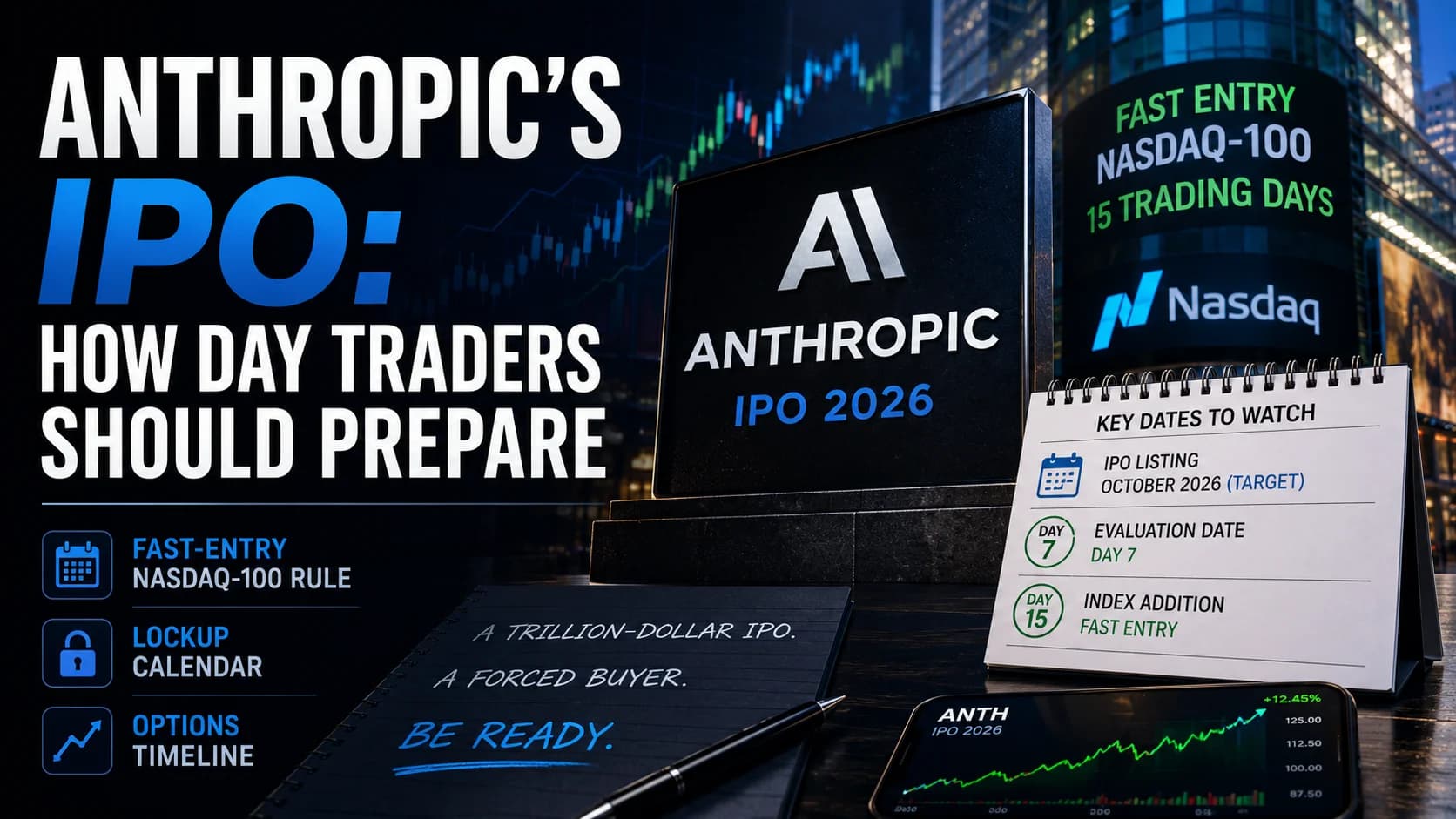
Additions typically skew toward names that have grown fast enough to clear a size threshold they didn't previously meet: recent IPOs finishing a seasoning period, or existing public companies whose market cap climbed enough to qualify. The June 2026 S&P 500 quarterly rebalance is a clean example—Marvell Technology and Flex were added, replacing Pool Corp and The Campbell's Company, tilting the index further toward technology and away from consumer names that had simply grown more slowly by comparison. Nasdaq's new fast-track provision, covered in more detail in this site's dedicated guide to the rule, creates an additional, faster path: a newly public company ranked in the Nasdaq's top 40 by market cap can qualify after just 15 trading days instead of waiting for a full seasoning period.
Removals skew the opposite way—companies that have shrunk, been acquired, or simply grown more slowly than the rest of the index's universe. Neither category is inherently a "buy" or a "sell" signal on the fundamentals; it's a statement about relative size and eligibility, decided by a rules engine, not an analyst.
The float and trading history of the specific stock matters enormously here. A recent IPO with a thin public float—the kind of situation this site examined in detail with SpaceX's own addition—amplifies the price impact of the same dollar amount of forced buying, because there's simply less tradable stock available to absorb it. A large, well-established name with a broad float and years of relative volume history barely registers the same event on a percentage basis, even though the actual dollar flow might be larger.
How to Actually Watch a Rebalance Day Unfold
Split the event into three windows, because each behaves differently and rewards different things.
The run-up, between announcement and effective date. This is where anticipatory positioning builds. Watch for volume and price action in the affected names diverging from the sector and the broader market with no accompanying company-specific news—that divergence is the signature of positioning ahead of the mechanical flow, not a reaction to anything the company actually did.
The close on the last session before the effective date. This is when the bulk of the actual mechanical buying and selling executes, concentrated in the final minutes before 4 p.m. ET. Volume in the affected names on this specific session will dwarf a normal day by a wide margin, and the imbalance data exchanges publish in the run-up to the close (NYSE's D-Quotes and equivalent imbalance feeds on other venues) gives a real-time read on how lopsided the order flow actually is before the auction prints.
The days that follow. Based on the pattern across recent Nasdaq-100 and S&P 500 events, this is frequently where anticipatory positions unwind. Traders who bought ahead of the confirmed flow are often the ones selling into whatever liquidity shows up once the news is no longer new.
None of this requires predicting direction in advance. It requires watching for the volume and imbalance signatures specific to each window, and sizing any position around the fact that these are some of the most volatile, thin-liquidity-relative-to-flow sessions of the calendar. A scanner built to flag unusual relative volume the moment it appears—something like Trade Ideas—is a more reliable way to catch the run-up phase across dozens of potentially affected names than manually watching a handful of charts.
Where This Setup Goes Wrong
The most common mistake is treating "index funds have to buy" as equivalent to "the stock will go up." The mechanism is documented and real. The price direction is not guaranteed, and the historical record—both the specific Nasdaq-100 cases this site has tracked and the broader academic data on S&P 500 auction pricing—leans toward skepticism of a reliable, tradable pop rather than confirmation of one.
A second mistake is ignoring float and liquidity when sizing a position around one of these events. The same dollar amount of forced flow produces wildly different percentage price impact depending on how much stock is actually available to trade. Treating a thin-float recent IPO and a broad-float mega-cap as the same kind of setup, just because both are going through an index change, ignores the variable that actually determines how violent the move will be.
A third mistake is confusing the fast-track mechanism with the standard quarterly or annual process. A 15-trading-day fast-track addition, covered in depth elsewhere on this site, behaves differently from a routine quarterly rebalance where the affected stocks have years of trading history and broad existing ownership. Applying lessons from one to the other without adjusting for the different starting conditions is a good way to misjudge how a specific event will actually trade.
Frequently Asked Questions
What's the difference between an index rebalance and an index reconstitution?
Under Nasdaq's updated methodology, both can now happen at the same quarterly checkpoints in March, June, and September, alongside the more comprehensive annual reconstitution in December. The S&P 500 doesn't run on a fixed reconstitution calendar in the same way—changes are announced whenever a qualifying event occurs, but implementation still lands on the same quarterly third-Friday effective schedule.
Key Takeaway: "Rebalance" and "reconstitution" aren't interchangeable, even though both can trigger the same kind of closing-auction volume spike.
When is the next major index rebalancing date?
That date follows the same third-Friday-of-the-month structure used for the March, June, September, and December cycles. Announcements of any specific additions or removals typically land in the days immediately before the effective date, not months in advance.
Key Takeaway: Mark September 21, 2026 as the date mechanical flow executes—but watch for the announcement in the preceding one to three weeks for the specific names involved.
Why does closing auction volume spike so much on rebalance days?
On a typical day, the closing auction handles about 9% of total trading volume across U.S. exchanges. On rebalance or options-expiration days, that share roughly doubles to around 20%, and for the specific stocks being added or removed, it can run substantially higher than that.
Key Takeaway: The spike is a structural consequence of how index funds are required to trade, not a sign of unusual news or sentiment.
Does getting added to an index guarantee a stock goes up?
The forced buying itself is well documented and mechanically certain. What isn't certain is the stock's price direction, because a meaningful share of the expected demand is often already priced in by anticipatory buyers who sell into the confirmed event rather than holding through it.
Key Takeaway: Treat "the fund has to buy" and "the price will rise" as two separate claims—the data supports the first far more reliably than the second.
What is "buy the rumor, sell the inclusion" and does it actually happen?
The Nasdaq-100's own December 2024 reconstitution is a documented example: several high-profile additions ran up into their inclusion date and gave back those gains in the ten trading days that followed. The mechanism works because anticipatory buyers need somewhere to sell, and the event itself supplies exactly that liquidity.
Key Takeaway: The phrase describes a real, recurring pattern—not a guarantee, but a documented tendency worth weighing against any "buy the news" instinct.
How much of a stock's daily volume can the closing auction represent on a rebalance day?
For stocks that remain in the index without changing weight category, that figure runs lower—typically in the 25% range—still far above the roughly 9% closing auction share on an ordinary trading day.
Key Takeaway: The concentration of volume into a few minutes is the defining feature of these sessions, more than any single day's price direction.
How is the Nasdaq-100's fast-track rule different from a normal rebalance?
SpaceX's July 2026 addition was the rule's first real test case, covered in full elsewhere on this site, including the forced-buying estimate and the specific mechanics of that event. A standard quarterly or annual rebalance, by contrast, involves companies with years of established trading history and broader existing ownership.
Key Takeaway: Fast-track additions and routine reconstitution additions are mechanically related but behave differently—don't assume lessons from one transfer cleanly to the other.
Can a stock be removed from an index without anything going wrong at the company?
The Nasdaq-100's December 2025 reconstitution removed a constituent for falling below the index's market-cap threshold relative to other qualifying names, even though the company itself hadn't necessarily deteriorated—it had simply been outgrown by faster-moving peers being considered for inclusion.
Key Takeaway: Index removal is a relative-ranking outcome, not automatically a verdict on the underlying business.
Is the Russell Reconstitution the same kind of event as a Nasdaq-100 or S&P 500 rebalance?
Because it happens only once a year and touches a much broader universe of stocks (Russell 1000 and Russell 2000 combined cover most of the investable U.S. equity market), the Russell Reconstitution tends to produce the single largest closing-auction volume day of the year—larger than any individual Nasdaq-100 or S&P 500 quarterly event.
Key Takeaway: Same forced-flow mechanism as every other index event on this page, just concentrated into one enormous annual session instead of four smaller quarterly ones.
Disclaimer
Article Sources
- Nasdaq-100 Index Methodology - Nasdaq, Inc. Official reconstitution and rebalance reference-date and effective-date rules.indexes.nasdaq.com
- NYSE Research — Behind the Record Volumes: A Hidden Opportunity - NYSE, 2026. Unmatched closing-auction liquidity data and the executed-versus-residual volume relationship on rebalance days.nyse.com
- Into the Close: Unpacking U.S. Closing Auction Dynamics - Traders Magazine, 2025. Closing auction share of daily volume on ordinary versus rebalance days.tradersmagazine.com
- Who Trades at the Close? Implications for Price Discovery and Liquidity - ScienceDirect. Academic research on closing auction volume and price-deviation effects following S&P 500 additions and deletions.sciencedirect.com
- Nasdaq-100 Index Methodology Update: Why Now, and What It Means - Nasdaq, Inc., May 2026. Details on the rank-based quarterly review process introduced across March, June, and September.nasdaq.com
- 2025 Nasdaq-100 Reconstitution and Performance Highlights - Nasdaq, Inc. December 2025 addition and removal data.indexes.nasdaqomx.com