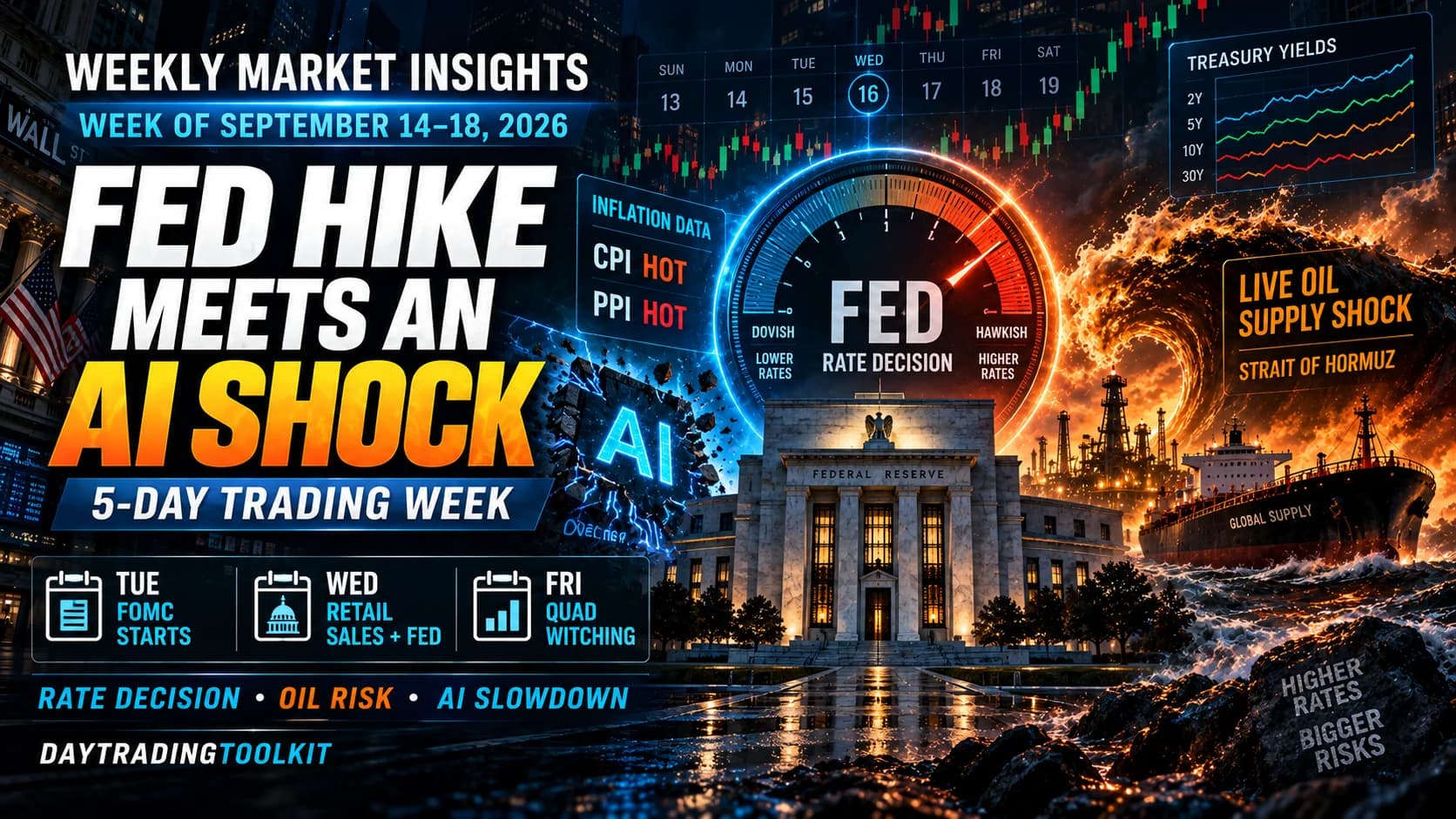

Most months hand traders one major structural date to plan around. September 2026 hands you three, and they land inside a single five-trading-day stretch.
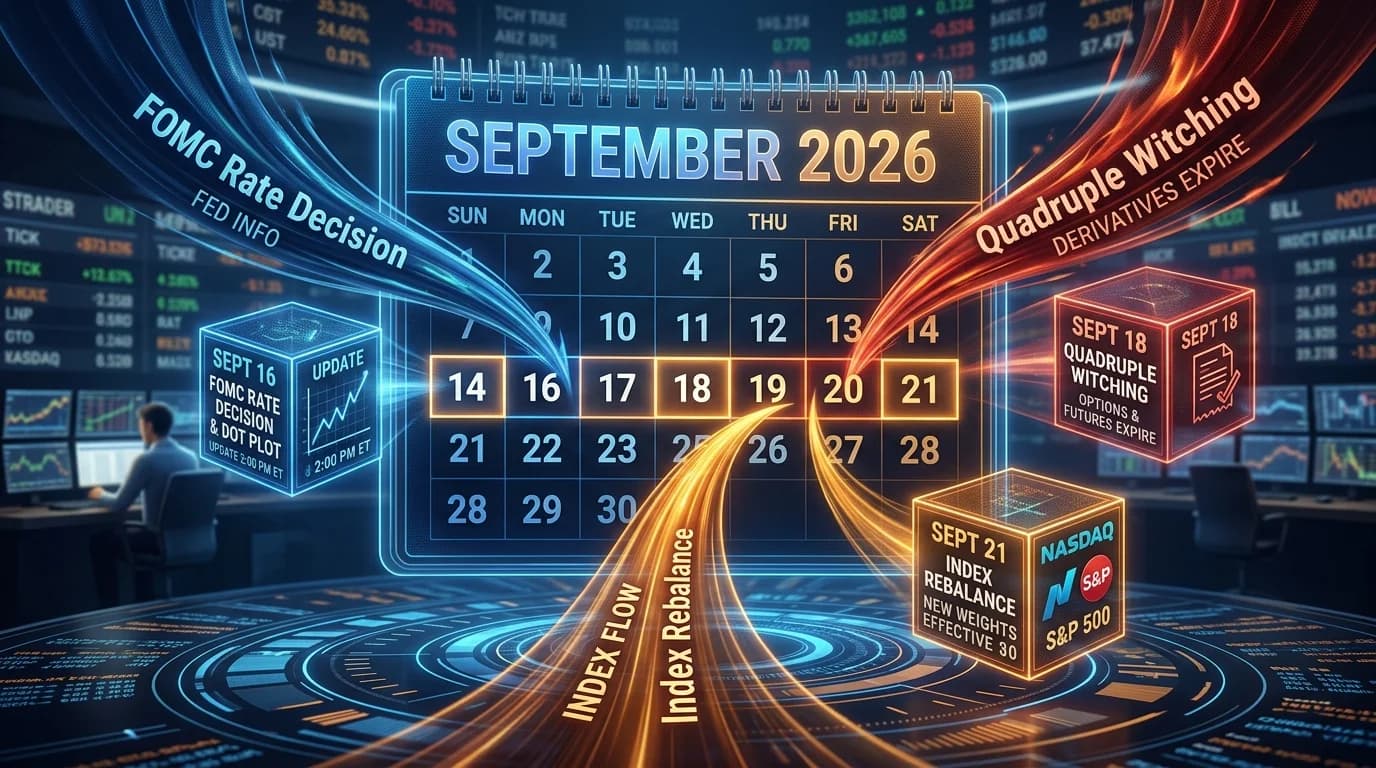
The Federal Reserve announces its rate decision Wednesday, September 16. Quadruple witching, the simultaneous expiration of stock index futures, stock index options, stock options, and single-stock futures, hits two trading days later on Friday, September 18. The Nasdaq-100 and S&P 500's quarterly rebalance becomes effective the following Monday, September 21. Layer on September's own reputation as the market's weakest calendar month, and you get a stretch of five trading days that concentrates more mechanical, scheduled volatility than the rest of the month combined.
None of these events are new individually. What's worth mapping out is how close together they land this particular September, and what that compression actually means for position sizing, expected VolumeVolume is the total number of shares (or contracts) traded during a given time period — it's the primary confirmation tool for all price action, because a price move accompanied by high volume indicates genuine market participation, while tRead definition →, and which day of the week deserves your full attention.
What makes September 2026 different? September is a quarterly month for both Fed dot-plot meetings and index rebalancing, and every third Friday brings quadruple witching regardless of the month. In September 2026, the FOMCThe Federal Open Market Committee (FOMC) is the Federal Reserve committee that sets U.S. monetary policy — most importantly, the target federal funds rate — at eight scheduled meetings per year.Read definition → decision (Sept 16), quad witching (Sept 18), and the Nasdaq-100/S&P 500 rebalance effective date (Sept 21) all fall within the same five trading days, a compression that doesn't happen in March, June, or December the same way.
The Full September 2026 Trading Calendar
Here's the month at a glance, in order.
- Date
- September 15-16
- Day
- Tue-Wed
- Event
- FOMC meeting, rate decision, SEP dot plot
- Why It Matters
- One of four meetings a year with updated economic projections; decision at 2:00 p.m. ET, press conference 2:30 p.m. ET
- Date
- September 18
- Day
- Friday
- Event
- Quadruple witching
- Why It Matters
- Stock index futures, stock index options, stock options, and single-stock futures all expire simultaneously
- Date
- September 21
- Day
- Monday
- Event
- Nasdaq-100 and S&P 500 quarterly rebalance, effective date
- Why It Matters
- Index funds must own the new weights by the close of trading; most of the mechanical flow executes in the closing auction the prior Friday
| Date | Day | Event | Why It Matters |
|---|---|---|---|
| September 15-16 | Tue-Wed | FOMC meeting, rate decision, SEP dot plot | One of four meetings a year with updated economic projections; decision at 2:00 p.m. ET, press conference 2:30 p.m. ET |
| September 18 | Friday | Quadruple witching | Stock index futures, stock index options, stock options, and single-stock futures all expire simultaneously |
| September 21 | Monday | Nasdaq-100 and S&P 500 quarterly rebalance, effective date | Index funds must own the new weights by the close of trading; most of the mechanical flow executes in the closing auction the prior Friday |
Two things about this table are easy to miss on a first read. First, the rebalance's heaviest trading day is actually September 18, the same day as quad witching, since funds print most of their required buying and selling in that Friday's closing auction ahead of the Monday effective date. That means September 18 carries both the witching expiration and the bulk of the rebalancing flow at once. Second, the FOMC decision on September 16 sets the volatility backdrop that both of those Friday events then trade into, not the other way around.
September 15-16: A Divided Fed Meets Its Dot Plot
The September meeting is one of the four FOMC meetings each year that includes an updated Summary of Economic Projections, the dot plot showing where each committee member expects rates to land. That makes it structurally more market-moving than an ordinary hold-steady meeting, regardless of what the headline decision turns out to be.
Context matters here. The target RangeA range (or trading range) is a price zone where a stock oscillates between a defined support floor and resistance ceiling without making meaningful new highs or lows — price is consolidating rather than trending, and the dominant trade is Read definition → has sat at 3.50% to 3.75% since December 2025, and the committee has grown more openly split on the path from here. The June meeting produced a unanimous hold. Six weeks later, the July decision came down as a 9-3 vote, the most divided FOMC vote since 2016, with dissents pointing in different directions on how much further easing the data actually supports. A committee that's split on direction going into a dot-plot meeting tends to produce more disagreement in the projections themselves, and more disagreement in the projections tends to produce a sharper market reaction to whatever the median dot actually shows.
For day traders, the mechanical part of this is familiar: the statement drops at 2:00 p.m. ET, the press conference starts at 2:30 p.m. ET, and the real move often isn't the first knee-jerk reaction to the rate decision itself but the second one that develops once the Fed chair starts taking questions. This site's FOMC trading playbook covers the mechanics of trading that two-part reaction in detail. What's specific to September 2026 is that whatever volatility regime this meeting sets, both quad witching and the rebalance close inherit it two and five days later.
September 18: Quadruple Witching Arrives Two Days Later
Quadruple witching happens on the third Friday of March, June, September, and December every year without exception, so September 18, 2026 was locked in long before anyone knew what the Fed would decide two days earlier. What's specific to this particular witching day is the timing: most quarters don't have a dot-plot FOMC meeting landing 48 hours before the expiration.
The mechanics of witching itself, why volume spikes, how Open InterestOpen interest is the total number of outstanding (open) options contracts that have not been exercised, expired, or closed — it measures how much market participation exists at a specific strike price and expiration, and unusually high openRead definition → unwinds, and what tends to happen into the final hour of trading, are covered in full in this site's quadruple witching playbook. The version worth flagging here is narrower: a witching session that follows a fresh, possibly contentious Fed decision by two trading days tends to carry positioning that's still adjusting to that decision, on top of the ordinary options and futures unwind. That's a different setup than a witching Friday in a quiet macro week, and it's worth treating the volume and price action on September 18 as a blend of two separate forces rather than assuming it's a normal witching day that happens to fall in September.
September 21: The Rebalance Becomes Effective
The Nasdaq-100 and S&P 500 both run their quarterly reviews on the same third-Friday cycle, with any resulting membership or weight changes becoming effective at the market open on the first trading day after that Friday, which in September 2026 is Monday the 21st. This site's deep-dive on index rebalancing mechanics covers why that forced, price-insensitive buying and selling concentrates into the closing auction, how much of a stock's daily volume it can represent, and why a documented pattern of funds buying the announcement and selling the actual inclusion means getting added to an index is not a reliable directional signal on its own. That article is the mechanism reference; this one is about the calendar collision.
The collision specifically: because most of the rebalance's mechanical flow executes in the closing auction on the last trading day before the effective date, and because September 18 is also quad witching, the two events physically overlap in the same closing print. A trader watching Relative VolumeRelative volume (RVOL) compares a stock's current trading volume to its average volume for the same time of day, expressed as a multiple — a stock with 5x RVOL is trading five times more actively than normal, signaling unusual interest and Read definition → and imbalance data on the afternoon of September 18 is watching both quad witching's options and futures unwind and the bulk of the rebalance's forced buying and selling resolve in the same few minutes. Untangling which flow is driving which stock's move that afternoon is harder than in a quarter where the two events don't share a session.
What the "September Effect" Actually Says
September's reputation as the market's weakest month predates all three of the events above, and it's worth being precise about what the data actually shows rather than repeating the headline.
Going back to 1928, the S&P 500 has averaged roughly a 1% loss in September, the only calendar month with a negative long-run average return, and the index has finished September lower in a bit more than half of those years (Yardeni Research; S&P Global data cited via CME Group). That's a real, well-documented pattern, not a myth. It's also a much weaker edge than the "worst month" framing implies in practice. September 2025 posted one of its strongest results in over a decade, up nearly 4%, and roughly 45% of Septembers on record have finished positive. An average built from nearly a century of data absorbs some genuinely disastrous individual Septembers, the 1931 crash month and 2008's financial crisis stretch among them, without those years representing what happens in a typical one.
The honest takeaway for a day trader isn't "avoid September." It's that September carries a mild statistical headwind on top of three separate scheduled catalysts that can each independently move the tape, and treating the seasonal pattern as a forecast rather than a background condition is where this kind of statistic gets misused most often.
How the Three Events Actually Interact
Trading each event as an isolated line item misses the part that's actually useful about mapping the calendar this way: the order they land in changes what each one means.
The Fed goes first. Whatever volatility regime the September 16 decision and dot plot establish, that's the backdrop both Friday events trade into. A hawkish surprise that pushes yields higher two days before witching changes the options positioning that unwinds on the 18th. A dovish surprise does the opposite. Neither witching nor the rebalance happens in a vacuum from what the Fed just did.
The Friday collision compounds rather than cancels. Quad witching and the bulk of the rebalance's forced flow both concentrate into the same closing auction on September 18. That's not two moderate events happening to share a date; it's two separate sources of price-insensitive, mechanically required trading volume landing in the same few minutes, on top of whatever positioning the Fed decision two days earlier already created.
The following Monday is where the read-through happens. September 21 is when the rebalance's new weights actually take effect and when the market gets its first full session to process everything that happened over the prior week without a fresh scheduled catalyst competing for attention. Historically, this is often when anticipatory positioning from the rebalance starts to unwind, the pattern covered in more depth in this site's rebalancing mechanics guide.
How to Prepare for the Week
Treat September 14 through 21 as one connected stretch rather than three separate calendar reminders.
Before September 16, check where fed funds futures are pricing the decision and note whether the committee has looked unified or divided in its recent public commentary; a split committee going into a dot-plot meeting tends to produce a noisier reaction than a unified one. Going into September 18, expect relative volume in index-affected names to run well above normal from the open, and expect that volume to include both witching-related options and futures activity and rebalance-related mechanical flow that can be difficult to separate in real time. Going into September 21, watch specifically for reversal patterns in whichever names were added to or removed from the indexes the prior week; that Monday session is historically where some of the run-up gets given back.
A scanner that flags unusual relative volume across dozens of names at once, something like Trade Ideas, is more useful for this specific week than manually watching a handful of charts, precisely because the volume signal on September 18 is coming from at least three different sources layered on top of each other. Sizing matters more than usual here too: this site's guide to strategy-specific risk management is worth reviewing before trading into a week that stacks this many scheduled catalysts back to back.
Frequently Asked Questions
Why do the FOMC meeting, quad witching, and the index rebalance all fall in the same week in September 2026?
Each of the three calendars is set independently by a different body, the Federal Reserve, the options and futures exchanges, and the index providers, and they don't coordinate with each other. Most quarters, the FOMC meeting doesn't happen to fall two trading days before the witching Friday. September 2026 is one of the quarters where it does.
Key Takeaway: The compression is unusual for this specific September, not a permanent feature of the September calendar.
Is September 18, 2026 both quadruple witching and the index rebalance day?
That means the two events physically overlap in the same closing print even though they're technically dated a trading day apart. Volume and price action late in the September 18 session reflects both forces at once.
Key Takeaway: Watch September 18's close specifically. It's carrying two separate mechanical flows, not one.
Does the FOMC decision affect how quad witching or the rebalance plays out?
A surprise hawkish or dovish outcome changes implied volatility levels heading into the 18th, which affects how aggressively market makers hedge into the expiration. The rebalance's flow is less directly affected since it's driven by index weights rather than rates, but the overall volume and volatility environment it executes into is shaped by whatever the Fed just did.
Key Takeaway: Treat the week as sequential, not three unrelated events. What happens September 16 colors what happens September 18 and 21.
Is the "September effect" a reliable trading signal?
The pattern is real in the aggregate data, driven partly by a handful of historically disastrous individual Septembers, but it's a weak basis for a single-month directional bet. Treat it as a mild statistical backdrop, not a forecast.
Key Takeaway: September's seasonal reputation is real but weak. Three scheduled, mechanical catalysts in one week matter more for actual positioning than the seasonal average does.
What time does the Fed announce its September 2026 rate decision?
September is one of the four meetings each year, alongside March, June, and December, that includes the Summary of Economic Projections and dot plot, which historically produces a larger market reaction than a meeting without updated projections.
Key Takeaway: The press conference, not just the statement, is often where the bigger move develops. Plan to watch both.
What actually expires during quadruple witching?
That simultaneity is what drives the elevated volume, since positions across all four contract types need to be closed, rolled, or exercised in the same session rather than staggered over separate weeks.
Key Takeaway: For the full mechanics of how each expiration type behaves and how to trade around them, see this site's quadruple witching playbook.
Will the specific stocks being added to or removed from the Nasdaq-100 and S&P 500 be known before September 18?
Index providers announce specific additions and removals shortly before the effective date, which gives the market a window to position ahead of the confirmed mechanical flow. That announcement-to-effective gap is exactly where the anticipatory buying and selling documented in index rebalancing research tends to happen.
Key Takeaway: Watch for the specific addition and removal announcements in the days leading into September 18, not just the fixed calendar date itself.
Should beginner traders sit out this particular week?
The core risk isn't any single event; it's that volume and volatility from three separate sources can make it genuinely difficult to tell which catalyst is driving a given stock's move at any given moment during the September 18 session specifically.
Key Takeaway: If you're newer to trading around scheduled catalysts, this site's risk management cheat sheet is worth reviewing before September 15.
Disclaimer
Article Sources
- Federal Reserve: Meeting calendars and information - official 2026 FOMC meeting dates and confirmation that September is a Summary of Economic Projections meeting.federalreserve.gov
- Yardeni Research: S&P 500 monthly seasonal returns - long-run average monthly return data back to 1928, including September's average and frequency of negative years.yardeni.com
- Nasdaq-100 Index Methodology - Nasdaq, Inc. official reconstitution and rebalance reference-date and effective-date rules.indexes.nasdaq.com
- CME Group: Quadruple witching explainer - mechanics of simultaneous futures and options expiration on the third Friday of March, June, September, and December.cmegroup.com
- S&P Dow Jones Indices: U.S. Indices Methodology - official S&P 500 quarterly rebalance schedule and effective-date rules.spglobal.com