An AI Slowdown Call, a Live Fed Hike, and $108 Oil Collide in One Week: Weekly Market Insights, September 14-18

In this article13 sections
Most weeks give you one thing to plan around. This week gives you four.
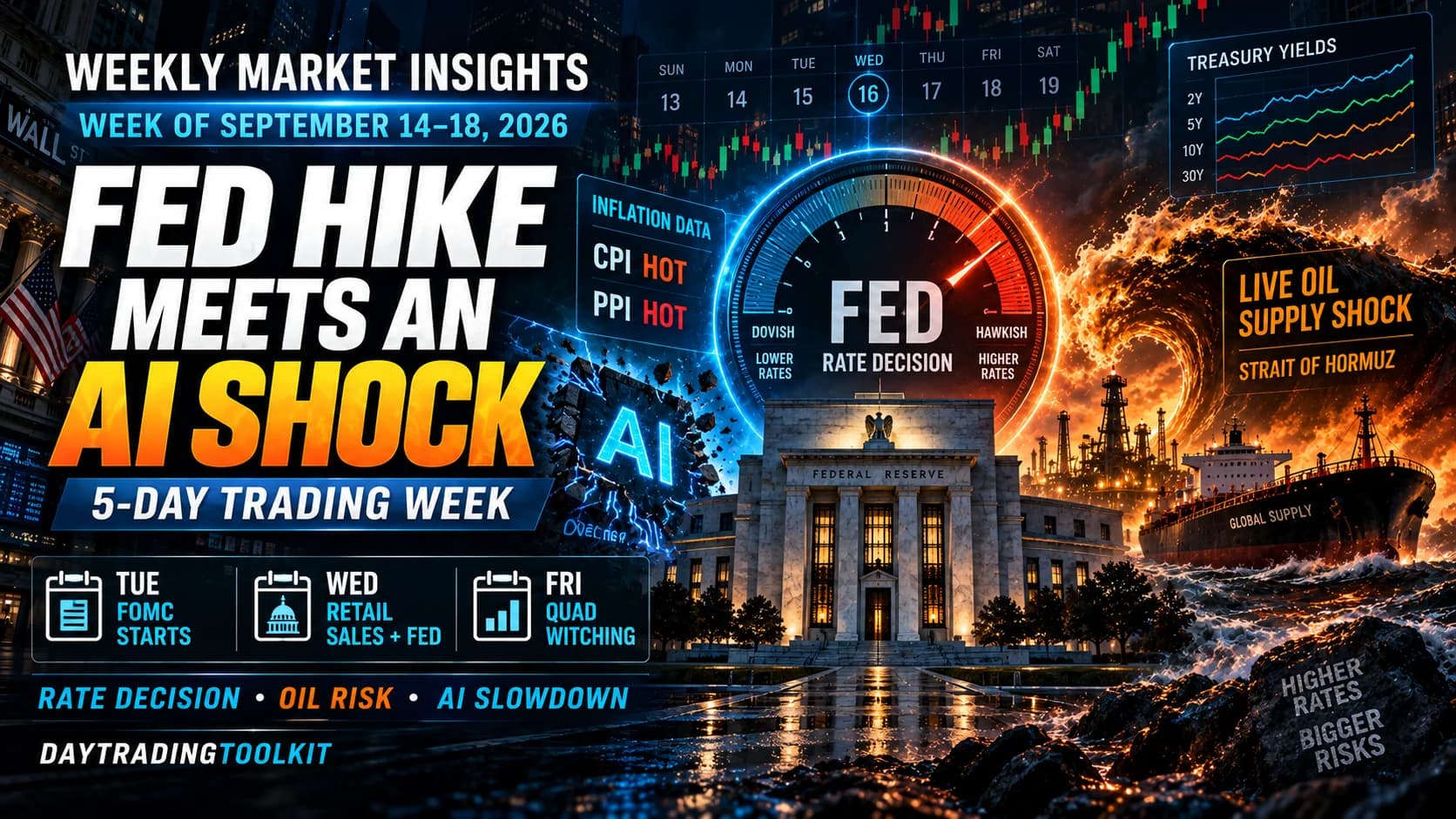
The Federal Reserve delivers a live interest rate decision on Wednesday, with the odds of a hike running from under 40 percent to the high 80s in about two weeks. Over the weekend, Anthropic CEO Dario Amodei published an essay calling on the AI industry to slow down, and OpenAI's Sam Altman and xAI's Elon Musk both backed him within hours, which hit chip stocks hard before Monday's open. Oil is spiking again after Saudi Arabia shut a pipeline that moves 7 million barrels a day. And Friday is quadruple witching, three days before Bloom Energy, Dell, and SanDisk officially become S&P index buys.
This guide's research cutoff is Monday, September 14, before the US cash open. A few fast-moving pieces, especially Monday's actual close in chip stocks and Friday's oil price, are worth a quick check before you trade on anything below.
What to Know This Week
The Fed's Wednesday decision is genuinely live. CME FedWatch had a 25 basis point hike at under 40 percent odds two weeks ago. After Friday's inflation data, it's sitting in the mid-to-high 80s, and some trackers pushed it close to 90 percent in the hours right after the report. A hike would be the first since 2023 and would move the federal funds target range from 3.50 to 3.75 percent up to 3.75 to 4.00 percent.
A weekend essay just became this week's biggest wild card. Anthropic CEO Dario Amodei published a piece calling on AI labs to slow the pace of capability development. OpenAI's Sam Altman and xAI's Elon Musk both said they agreed within hours, and Altman added that OpenAI won't pursue an IPO this year. Chip stocks sold off hard in Asia and US futures dropped before Monday's open. It's the first real test of whether the AI trade can absorb a shock like this one.
Oil is spiking on a fresh Middle East escalation. Brent is pushing toward $108 a barrel and WTI above $102 after Saudi Arabia shut its East-West pipeline, a 7 million barrel a day artery, following drone attacks. A planned diplomatic meeting between Iran and Gulf states over the Strait of Hormuz was supposed to happen Monday and got postponed because of it.
Friday is quadruple witching, and Monday's rebalance is the real payoff. Options and futures contracts across four categories expire Friday. The bigger mechanical story lands the following Monday, September 21, when $BE, $DELL, and $SNDK officially join their respective S&P indices and forced index-fund buying kicks in.
It's also a global central bank week. The Bank of England meets Thursday, and the Bank of Japan's decision, concluding Thursday night into Friday morning in Tokyo, looks close to a lock for a hike that would push Japan's policy rate above 1 percent.
Two earnings reports land in the middle of all of this. $LEN reports Wednesday after the close into a market already nervous about mortgage rates near a 14-month high. $CCL reports Thursday before the open into a market nervous about fuel costs.
AI financing is suddenly a headline in its own right. Larry Ellison disclosed, then a day later canceled, a plan to sell $7.5 billion of $ORCL stock. SoftBank ($SFTBY) has a Monday deadline on the remaining balance of a loan tied to its OpenAI stake. Both put a spotlight on how the AI buildout is actually being paid for.
Week at a Glance
Monday, September 14
- Time (ET)
- Overnight
- Event
- AI slowdown fallout in Asia and US futures
- Why It Matters
- First live session pricing Amodei's weekend essay
- Time (ET)
- Overnight
- Event
- Oil spikes past $102 (WTI) and $107 (Brent)
- Why It Matters
- Saudi pipeline shutdown, postponed Hormuz talks
- Time (ET)
- After close
- Event
- $PLAY (Dave and Buster's) earnings
- Why It Matters
- Minor, consumer discretionary read
| Time (ET) | Event | Why It Matters |
|---|---|---|
| Overnight | AI slowdown fallout in Asia and US futures | First live session pricing Amodei's weekend essay |
| Overnight | Oil spikes past $102 (WTI) and $107 (Brent) | Saudi pipeline shutdown, postponed Hormuz talks |
| After close | $PLAY (Dave and Buster's) earnings | Minor, consumer discretionary read |
Tuesday, September 15
- Time (ET)
- 8:30 AM
- Event
- Empire State Manufacturing Index (September)
- Why It Matters
- First regional manufacturing read of the week
- Time (ET)
- All day
- Event
- FOMC meeting begins
- Why It Matters
- Two day meeting, decision Wednesday
- Time (ET)
- After close
- Event
- $TCOM (Trip.com) earnings
- Why It Matters
- Minor, travel sector read
| Time (ET) | Event | Why It Matters |
|---|---|---|
| 8:30 AM | Empire State Manufacturing Index (September) | First regional manufacturing read of the week |
| All day | FOMC meeting begins | Two day meeting, decision Wednesday |
| After close | $TCOM (Trip.com) earnings | Minor, travel sector read |
Wednesday, September 16
- Time (ET)
- 8:30 AM
- Event
- Retail Sales (August)
- Why It Matters
- Last major data point ahead of the Fed
- Time (ET)
- 8:30 AM
- Event
- Import prices (August)
- Why It Matters
- Inflation pass-through context
- Time (ET)
- 10:00 AM
- Event
- NAHB Housing Market Index (September)
- Why It Matters
- Builder sentiment amid high mortgage rates
- Time (ET)
- 2:00 PM
- Event
- FOMC policy statement and dot plot
- Why It Matters
- The main event
- Time (ET)
- 2:30 PM
- Event
- Chair Warsh press conference
- Why It Matters
- Tone matters more than the decision itself
- Time (ET)
- After close
- Event
- $LEN earnings
- Why It Matters
- Homebuilder read on a 7 percent mortgage market
| Time (ET) | Event | Why It Matters |
|---|---|---|
| 8:30 AM | Retail Sales (August) | Last major data point ahead of the Fed |
| 8:30 AM | Import prices (August) | Inflation pass-through context |
| 10:00 AM | NAHB Housing Market Index (September) | Builder sentiment amid high mortgage rates |
| 2:00 PM | FOMC policy statement and dot plot | The main event |
| 2:30 PM | Chair Warsh press conference | Tone matters more than the decision itself |
| After close | $LEN earnings | Homebuilder read on a 7 percent mortgage market |
Thursday, September 17
- Time (ET)
- 8:30 AM
- Event
- Weekly jobless claims
- Why It Matters
- First labor read since the Fed decision
- Time (ET)
- 8:30 AM
- Event
- Philadelphia Fed Manufacturing Index (September)
- Why It Matters
- Second regional manufacturing read
- Time (ET)
- 8:30 AM
- Event
- Housing starts and building permits (August)
- Why It Matters
- More housing data into a high-rate environment
- Time (ET)
- Before open
- Event
- $CCL earnings
- Why It Matters
- Fuel-cost exposure into an active oil spike
- Time (ET)
- Morning, UK time
- Event
- Bank of England decision
- Why It Matters
- Global central bank week
- Time (ET)
- Overnight into Friday
- Event
- Bank of Japan decision
- Why It Matters
- Hike to above 1 percent looks close to priced in
| Time (ET) | Event | Why It Matters |
|---|---|---|
| 8:30 AM | Weekly jobless claims | First labor read since the Fed decision |
| 8:30 AM | Philadelphia Fed Manufacturing Index (September) | Second regional manufacturing read |
| 8:30 AM | Housing starts and building permits (August) | More housing data into a high-rate environment |
| Before open | $CCL earnings | Fuel-cost exposure into an active oil spike |
| Morning, UK time | Bank of England decision | Global central bank week |
| Overnight into Friday | Bank of Japan decision | Hike to above 1 percent looks close to priced in |
Friday, September 18
- Time (ET)
- 9:15 AM
- Event
- Industrial production and capacity utilization (August)
- Why It Matters
- Closes out the week's data
- Time (ET)
- 9:30 AM
- Event
- Fed Governor Bowman speaks
- Why It Matters
- First Fed commentary after Wednesday's decision
- Time (ET)
- 10:00 AM
- Event
- Conference Board Leading Index (August)
- Why It Matters
- Backward-looking, low market impact
- Time (ET)
- All day
- Event
- Quadruple witching
- Why It Matters
- Options and futures expiration across four categories
| Time (ET) | Event | Why It Matters |
|---|---|---|
| 9:15 AM | Industrial production and capacity utilization (August) | Closes out the week's data |
| 9:30 AM | Fed Governor Bowman speaks | First Fed commentary after Wednesday's decision |
| 10:00 AM | Conference Board Leading Index (August) | Backward-looking, low market impact |
| All day | Quadruple witching | Options and futures expiration across four categories |
All Week, Unscheduled
The Strait of Hormuz situation, the US-Canada tariff dispute, and the AI slowdown fallout are all live stories with no fixed release time. Any of the three could produce a headline on any given day.
Priority Stocks at a Glance
- Stock
- $NVDA
- Catalyst and Timing
- AI slowdown fallout, ongoing
- Why It's Here
- Direct exposure to the weekend's biggest story
- Stock
- $AMD
- Catalyst and Timing
- Same story, plus a multi-week trend resistance test
- Why It's Here
- High-beta read on the AI narrative
- Stock
- $MU
- Catalyst and Timing
- Same story, pure memory demand exposure
- Why It's Here
- Closed $975.26 Friday
- Stock
- $SNDK
- Catalyst and Timing
- Same story, plus S&P 100 inclusion September 21
- Why It's Here
- Sits at the intersection of two live threads
- Stock
- $META
- Catalyst and Timing
- Testing trendline resistance after its Muse AI launch
- Why It's Here
- Well-defined technical level with real analyst targets behind it
- Stock
- $ORCL
- Catalyst and Timing
- Ellison's canceled stock sale
- Why It's Here
- Direct read on AI-financing sentiment
- Stock
- $BE
- Catalyst and Timing
- S&P 500 inclusion effective September 21
- Why It's Here
- Forced index-fund buying flow, real earnings behind the move
- Stock
- $SPCX
- Catalyst and Timing
- AI regulation and xAI headlines
- Why It's Here
- Consolidating, sensitive to Musk-adjacent news
- Stock
- $FRO
- Catalyst and Timing
- Tanker rates at fresh record highs
- Why It's Here
- Direct read on the Hormuz and pipeline disruption
- Stock
- $SFTBY
- Catalyst and Timing
- $25.9 billion OpenAI loan payment due Monday
- Why It's Here
- Dated, specific event tying AI financing risk to a real deadline
| Stock | Catalyst and Timing | Why It's Here |
|---|---|---|
| $NVDA | AI slowdown fallout, ongoing | Direct exposure to the weekend's biggest story |
| $AMD | Same story, plus a multi-week trend resistance test | High-beta read on the AI narrative |
| $MU | Same story, pure memory demand exposure | Closed $975.26 Friday |
| $SNDK | Same story, plus S&P 100 inclusion September 21 | Sits at the intersection of two live threads |
| $META | Testing trendline resistance after its Muse AI launch | Well-defined technical level with real analyst targets behind it |
| $ORCL | Ellison's canceled stock sale | Direct read on AI-financing sentiment |
| $BE | S&P 500 inclusion effective September 21 | Forced index-fund buying flow, real earnings behind the move |
| $SPCX | AI regulation and xAI headlines | Consolidating, sensitive to Musk-adjacent news |
| $FRO | Tanker rates at fresh record highs | Direct read on the Hormuz and pipeline disruption |
| $SFTBY | $25.9 billion OpenAI loan payment due Monday | Dated, specific event tying AI financing risk to a real deadline |
This is a preparation shortlist, not a buy list or a ranked forecast.
Market Setup Entering the Week
Friday's session snapped a four-day losing streak. The S&P 500 climbed 0.86 percent to close at 7,656.98, the Dow gained 0.98 percent to 52,573.29, and the Nasdaq Composite rose 0.96 percent to 26,333.04. The Russell 2000 added 0.45 percent to 2,903.94. For the week, though, all three major averages still finished lower: the S&P 500 down 0.8 percent, the Dow down 1.6 percent, and the Nasdaq down 0.7 percent.
The VIX dropped 11.2 percent Friday to 15.84, which tells you the relief rally was real even if the week's headline numbers weren't pretty. Nine of eleven S&P sectors closed green Friday, led by technology, industrials, and communications. Healthcare and utilities lagged.
Bonds tell a rougher story. The 10-year Treasury yield closed at 4.96 percent Friday, its highest level in years, and the 2-year sits at 4.63 percent. Both moved up sharply as traders priced in a higher chance of a hike this week.
Friday's August CPI report came in at 0.4 percent month over month and 3.4 percent year over year on the headline number, both in line with expectations. Core CPI, though, ran hot: up 0.3 percent on the month against a 0.2 percent forecast, even as the annual core rate slowed slightly to 2.4 percent. Thursday's producer price report had already come in hotter than expected and hit stocks that day before Friday's relief rally.
Economy, the Fed, and Global Policy
Wednesday's Federal Open Market Committee decision is the single biggest event of the week, and it's a genuinely open question, not a formality. The Fed has held its target range at 3.50 to 3.75 percent all year. Three committee members dissented in July, arguing for higher rates on persistent inflation, and Fed officials have pointed to a core inflation measure running in the 3.3 to 3.7 percent range, well above the 2 percent target.
This is also a Summary of Economic Projections meeting, meaning an updated dot plot lands alongside whatever the Fed decides on rates. That matters more than the headline decision itself. A hike that's already priced in tends to be a smaller market mover than a dot plot that signals two more hikes are coming instead of one, or a press conference tone from Chair Kevin Warsh that reads more or less hawkish than expected.
There's a political layer worth understanding here too, purely as market context. President Trump and Vice President Vance have both publicly pushed for the Fed to cut rates, while Warsh has leaned hawkish on persistent inflation. That tension doesn't change what the data says, but it does mean the press conference itself, not just the rate decision, is worth watching for how Warsh frames the disagreement.
Wednesday's Retail Sales report for August lands at 8:30 AM, four and a half hours before the Fed announcement, and gives the committee its last real data point. Thursday brings weekly jobless claims, the Philadelphia Fed manufacturing survey, and housing starts and permits, all landing in the first real week of data after the decision.
This is also a rare week where three major central banks meet within days of each other. The Bank of England decides Thursday. The Bank of Japan's meeting concludes Thursday night into Friday morning Tokyo time, and futures markets have priced a hike to above 1 percent as close to certain, following months of signaling from Governor Kazuo Ueda about upside inflation risk. None of this moves US markets the way the Fed does, but a BOJ hike tends to strengthen the yen and can ripple into carry-trade unwinds that show up in US equity volatility, so it's worth knowing it's happening even if it never becomes the headline.
For the deeper mechanics behind why quadruple witching and the index rebalance land so close together this month, DayTradingToolkit's trading calendar guide covers that in full. This week is the live version of the setup that guide described back in August.
Stocks to Watch
$NVDA: the center of the AI slowdown story
Anthropic CEO Dario Amodei published an essay Saturday calling on AI labs to slow the pace at which they push their most capable models, proposing independent safety evaluators, coordination among labs, and greater international cooperation. He was explicit that this isn't a call to halt AI development, just to slow its pace. OpenAI's Sam Altman and xAI's Elon Musk both backed the idea within hours.
$NVDA closed Friday at $218.26, before any of this hit the tape. Asian chip stocks sold off sharply in Monday trading, and Nasdaq 100 futures dropped more than 1 percent overnight. At least one report by Monday's later hours suggested the initial reaction was already fading, so this is genuinely fluid. Nvidia also has its own threads running in parallel: a formalized $12.9 billion Hugging Face acquisition, reported talks to invest as much as $10 billion in Anthropic's upcoming IPO, and a Department of Justice inquiry into its licensing deal with Groq.
Where this gets interesting for a trader is the disconnect between the size of the story and the size of Monday's actual move. If the selloff holds through the week, that's a real repricing of AI infrastructure spending expectations. If it fades by Tuesday, that tells you the market has decided a voluntary slowdown pledge doesn't change near-term hyperscaler capex, which is the actual thing driving chip demand.
$AMD: pushing back toward resistance after a long consolidation
$AMD closed Friday at $516.13, up 2.49 percent on the day, and is caught in the same weekend story as Nvidia. Chart watchers have flagged AMD as basing after a lengthy consolidation and pushing back toward a trend resistance level that's held for weeks. A clean break above it would be notable given the stock's high-beta relationship to AI sentiment generally.
The setup here is straightforward: AMD tends to move harder than Nvidia in both directions when AI narratives shift, since a larger share of its story is still being priced on future orders rather than delivered revenue. That cuts both ways this week.
$MU and $SNDK: memory sits at the crossroads of two stories
$MU closed Friday at $975.26, down a modest 0.22 percent, while $SNDK was also among the names flagged in the weekend's chip-stock reaction. Memory names are exposed to the AI slowdown story for a direct reason: high-bandwidth memory demand is one of the more concrete, near-term inputs to AI infrastructure buildouts, so any narrative that suggests slower capability development could mean less memory ordered translates quickly into these stocks.
SanDisk has a second thread going. S&P Dow Jones Indices confirmed on September 4 that SanDisk will join the S&P 100 effective before the open on Monday, September 21, alongside Dell, Palo Alto Networks, and Arista Networks. That's mechanical, forced buying from funds that track the index, arriving the trading day after this week closes. Micron and SanDisk holding their broader uptrend through a normal pullback would leave both positioned for another leg if the AI story stabilizes. A trend break would suggest the opposite.
$META: a real trendline test tied to a real product launch
$META launched Muse, a personal AI agent that can shop online, book flights, and manage a calendar, on September 8. The stock jumped more than 6 percent the next session to close near $653.69 and broke through both its 200-day moving average and a key retracement level in the process.
That put Meta into a well-documented technical spot. Multiple chart services have flagged resistance clustering around $665, a level the stock has tested and failed to clear twice since the Muse launch. A confirmed break above it opens the door toward $685 and $690, with JPMorgan's $820 price target, Morgan Stanley's $775, and TD Cowen's $750 sitting further out as the bull case. Support sits around $623 to $625, the same zone that used to be resistance, with a deeper floor near $520 to $524 from March's low.
None of those numbers are a prediction. They're the specific levels multiple analysts and chart services are actually watching, which makes this one of the cleaner technical setups on the board this week regardless of which direction it resolves.
$ORCL: a canceled stock sale puts AI financing under the microscope
$ORCL disclosed Friday that Executive Chairman Larry Ellison had adopted a trading plan in June to sell up to 50 million shares, worth about $7.5 billion. A day later, on Saturday, Oracle announced Ellison had canceled the plan entirely. No shares were sold, and the company said he has no other plans to sell.
The context matters here. Oracle stock closed Friday at $150.28, down 22 percent for the year and down more than 50 percent over the past twelve months, largely on investor anxiety over its AI buildout. Oracle's fiscal 2026 capital spending hit $55.7 billion, and free cash flow ran negative at $23.7 billion, with the company planning roughly $40 billion in new debt and equity financing for fiscal 2027. A person close to Ellison reportedly described the stock as undervalued at current levels, which is one read on why he walked away from selling into weakness.
This is worth pairing mentally with SoftBank's story below. Both are examples of the same underlying question the market is now asking out loud: how sustainable is the financing behind the AI infrastructure buildout, separate from whether the technology itself works.
$BE: the S&P 500's newest member, three trading days early
$BE will officially join the S&P 500 before the open on Monday, September 21, replacing Molson Coors, alongside Illumina and Everpure joining the same day. S&P Dow Jones Indices confirmed the change on September 4. The stock has already run hard on the news, from around $206 on August 31 to $252.87 just days later, a move of roughly 23 percent, and UBS has raised its price target to $325.
The fundamentals behind the move are real, not just index-flow speculation. Bloom posted its strongest quarter in company history in the second quarter, with revenue growth above 166 percent year over year, and raised full-year guidance to a range implying 100 percent growth at the midpoint. The company has an agreement with Oracle to supply up to 2.8 gigawatts of fuel cell capacity for data centers, tying Bloom directly into the AI power theme.
The trading question for this week is whether the stock can hold its gains into the actual inclusion date. Index additions often see a pre-event runup followed by a sell-the-news pullback once the forced buying is complete, and Bloom has already had its runup.
$SPCX: consolidating while the AI regulation story plays out around it
$SPCX, which merged with xAI earlier this year and now carries Grok, the X platform, and its satellite data center ambitions inside one public company, closed Friday at $151.21. It's a direct, if unusual, way to get exposure to the same AI narrative driving this week's chip-stock reaction, since its AI segment revenue grew 247 percent year over year last quarter.
There's a genuine tension worth watching here. Elon Musk co-signed Amodei's call to slow AI development over the weekend, but he separately called for lighter AI regulation at a G20 summit earlier this month. Headlines touching xAI, Grok, or any government response to the broader AI safety conversation are the most likely near-term catalysts for a stock that's otherwise been consolidating.
$FRO: tanker rates just hit fresh record highs
$FRO operates one of the largest fleets of very large crude carriers in the world, and this week's Middle East disruption is a direct tailwind for its business model. Bloomberg reported this week that supertanker shipping costs surged to fresh record highs following the biggest wave of attacks on Middle East shipping since the current conflict began, as tankers get rerouted around a tightening Strait of Hormuz and a damaged Saudi pipeline.
The company already posted a record quarterly profit of $659.2 million in its most recent quarter, with average daily rates for its VLCC fleet at $152,700, and has booked roughly 86 percent of its third-quarter VLCC days at $156,900. Management itself has said tanker traffic through Hormuz should normalize quickly if the US and Iran reach a credible deal, which is the honest way to think about this trade: the same disruption driving the upside is the thing that ends it once it resolves.
$SFTBY: a $25.9 billion deadline lands Monday
$SFTBY owes the remaining balance, $25.9 billion, of a $40 billion bridge loan used to finance its stake in OpenAI, due September 15. The loan wasn't originally due until March 2027. SoftBank is refinancing with longer-term debt, reportedly weighing a junk bond sale of $10 billion to $20 billion and having already secured a $10 billion margin loan backed by its OpenAI position.
This is one of the more concrete, dated data points behind the broader AI-financing anxiety showing up across this week's stories. A stake in a private company doing double duty as both a core investment and loan collateral is a structure worth understanding if you're trading anything adjacent to the AI infrastructure theme, since it's a real example of leverage sitting underneath a story that's mostly been discussed in terms of capital expenditure headlines.
Earnings and Company Events
$LEN reports its fiscal third-quarter results Wednesday after the close, timed to land the same day as the Fed decision. Analysts expect earnings per share of $1.30, down 35 percent year over year, on revenue of $8.4 billion, down 4.5 percent. The backdrop is a genuinely difficult one for homebuilders: the 30-year mortgage rate recently touched a 14-month high above 7 percent, July new home sales fell 10.5 percent from June, and existing home sales slipped another 2 percent from July into August. UBS analyst John Lovallo expects a roughly in-line print but flagged the possibility of softer orders, and holds a neutral rating on the stock.
$CCL reports Thursday before the open, with analysts looking for earnings per share of $1.29. The timing puts a fuel-intensive business squarely into a week when oil is spiking on Middle East supply risk, which makes this one of the more direct reads on how rising fuel costs are working through a real company's cost structure right now, separate from the macro headlines about oil.
Two smaller reports round out the week. $PLAY (Dave and Buster's) reports Monday after the close with a $0.18 per share estimate, and $TCOM (Trip.com) reports Tuesday after the close at $5.94 per share. Both are lower-priority for this audience but worth knowing about if either name is already on your screen.
How Different Assets Could Move on Wednesday
Wednesday's decision is the kind of event that ripples across asset classes in fairly predictable directions, even though nobody can tell you in advance which way it breaks. This is a framework for thinking through the scenarios, not a set of trades.
Bonds. $TLT tracks long-dated Treasuries, and a hike paired with a genuinely hawkish tone from Chair Warsh, one that pulls longer-term inflation expectations lower by signaling the Fed is serious about fighting inflation, could produce a short-term bounce in long bonds even though rates just went up. That's viewed as a short-term relief trade rather than evidence of a real bottom in a bond market that's been under pressure most of the year.
Precious metals. $GLD and $SLV are both sitting in a genuinely two-sided setup into Wednesday. A hawkish hike that convinces the market inflation is actually being brought under control could pressure both. A Fed that hikes but signals it's done for a while, effectively tolerating inflation running hot, could reignite the inflation-hedge trade in both metals fairly quickly.
Oil. $USO remains driven far more by the Middle East disruption than by anything the Fed does this week. Absent a real de-escalation, either a credible ceasefire signal or the Saudi pipeline coming back online, the path of least resistance stays higher. The Fed decision is a secondary factor here at best.
Crypto and crypto-proxies. $MSTR, $IBIT, and $PURR are all built to move hard on Wednesday's outcome. Higher rates generally pressure assets that don't pay a yield, so a hawkish hike is the bearish scenario for this group, while a dovish surprise, meaning no hike or a hike paired with clearly dovish forward guidance, is the scenario that tends to send inflation-sensitive assets like these sharply higher. $PURR specifically holds HYPE, the native token of the Hyperliquid blockchain, as a treasury asset, making it a more concentrated, single-asset bet than $MSTR's Bitcoin exposure or $IBIT's direct spot exposure.
Sectors, Commodities, and Ongoing Developments
The Strait of Hormuz situation remains the dominant commodity story of the week. Saudi Arabia's East-West pipeline, which normally carries 7 million barrels a day to Red Sea export terminals, has been shut since Friday following drone attacks, with no timeline given for repairs. A separate attack on a commercial vessel near Qeshm Island over the weekend killed one person and injured four, and a planned Iran-Gulf States meeting in Oman meant to discuss safe passage through the strait was postponed because of the pipeline attack. DayTradingToolkit's geopolitical oil shock framework covers the underlying trading mechanics of this kind of disruption in more depth.
An unusual way to get pure exposure to the shipping side of this story, separate from the tanker companies themselves, is $BWET, an exchange-traded fund that holds crude oil tanker freight futures rather than tanker stocks or oil itself. It's genuinely a niche product: because it tracks a small, illiquid futures market rather than a broad index, it can extend far beyond what normal mean reversion would suggest before eventually snapping back. The honest way to trade something like this is to wait for an actual catalyst, a real ceasefire signal or the pipeline reopening, and let price action confirm it rather than trying to call the top on a chart that's already up several hundred percent this year.
The broader AI hardware and data center theme is still running in the background of this week's chip-stock story. Microsoft disclosed on September 11 that it plans to more than triple its global data center capacity to over 38 gigawatts by 2032, part of a hyperscaler capital spending cycle that's put Super Micro Computer, Dell, and Hewlett Packard Enterprise all in direct competition for server and infrastructure contracts. None of the three has a single, dated catalyst landing inside this specific week, which is why they sit here as a theme to watch rather than a full stock entry, but it's the same underlying spending story touching Nvidia, Oracle, and Bloom Energy above.
The US-Canada trade dispute remains an active, unresolved background risk. Canada's retaliatory tariffs of 15, 25, and 50 percent on roughly $27.6 billion of US goods took effect September 8, matching a 50 percent US tariff on a similar amount of Canadian goods imposed in late August, and the US separately added import bans and procurement restrictions the same day. There's no new dated catalyst inside this specific week, but steel, auto, and agricultural names with meaningful cross-border exposure remain conditionally sensitive to any fresh escalation or de-escalation headline.
Market Structure: Quad Witching and the Rebalance That Follows It
Friday, September 18 is quadruple witching, the quarterly expiration of stock index futures, stock index options, stock options, and single-stock futures all on the same day. For a full breakdown of why this tends to concentrate volume and volatility into the final hour of trading, DayTradingToolkit's trading calendar guide covers the mechanics.
The part that's easy to miss is that the actual S&P index rebalance doesn't take effect until the following Monday, September 21, not Friday itself. S&P Dow Jones Indices confirmed on September 4 that $BE, Illumina, and Everpure will join the S&P 500, replacing Molson Coors, Trade Desk, and Builders FirstSource. Separately, $DELL, Palo Alto Networks, Arista Networks, and $SNDK will join the S&P 100. That means this Friday's witching volume and Monday's forced index-fund buying are two related but distinct events, three trading days apart, and treating them as the same thing is a good way to misjudge the timing of any flow-driven move.
DayTradingToolkit's look at whether September really is the market's worst month is also worth a read heading into a week this structurally loaded, since the seasonal pattern and this week's actual, verified catalysts are two different things worth keeping separate in your head.
Broader Weekly Radar
A handful of additional threads are real but didn't clear the bar for a full priority entry this week. The Empire State and Philadelphia Fed manufacturing surveys, releasing Tuesday and Thursday respectively, are worth a glance for anyone trading industrial names, though neither tends to move the broad market on its own. The Bank of England's Thursday decision is unlikely to move US markets directly but is part of the same global rate-repricing story running through the Fed and Bank of Japan this week. A Trade Ideas scan for unusual volume in chip and AI-adjacent names is a reasonable way to keep tabs on which of this week's stories is actually driving flow on any given day, rather than relying on headlines alone.
If you're catching up after being away, last week's issue covers the CPI print, the earlier stage of the oil spike, and the trade fight that set up everything happening this week.
What Could Change the Week
The single biggest swing factor is straightforward: what the Fed actually does Wednesday, and how Chair Warsh frames it. A hike paired with a dot plot showing more hikes ahead is the most hawkish realistic outcome and would likely pressure the crypto and precious metals names discussed above while giving Treasury yields room to keep climbing. A hike paired with signals that the Fed is done for a while is a more mixed outcome, potentially good for stocks broadly while still being a real hike. No hike at all, now the less likely outcome but not impossible, would be a genuine surprise given where market pricing sits heading into the week.
The second variable is whether the AI slowdown story has real staying power or fades once traders get a full week to think it through. Watch whether $NVDA, $AMD, and the memory names hold Monday's losses or recover them by Wednesday.
The third is oil. A credible de-escalation signal, either a ceasefire framework or the Saudi pipeline coming back online, would take real pressure off the inflation narrative feeding into Wednesday's decision. Continued escalation does the opposite, and would make an already-hawkish Fed meeting harder to argue against.
None of this is a reason to widen a stop or resize a position ahead of time. It's a reason to know which headlines matter before they hit your feed, so you're reacting to the news rather than being surprised by it.
Frequently Asked Questions
Why are AI and chip stocks reacting to a blog post instead of a Fed decision or an earnings report?
Dario Amodei's essay wasn't a regulatory action or a company's own earnings miss. It was a voluntary call from Anthropic, quickly joined by OpenAI's Sam Altman and xAI's Elon Musk, three leaders whose companies together shape a huge share of how investors think about AI infrastructure demand. A coordinated signal like that can move markets harder than a single data point precisely because it reframes expectations about pace, not just about one company's results.
Key Takeaway: Whether this holds through the week or fades by Wednesday is the real question, and it's worth tracking $NVDA and $AMD specifically for the answer.
Does a Fed hike on Wednesday automatically mean stocks fall?
A widely expected hike is often already priced into stocks before it happens, which is a big part of why CME FedWatch odds matter as much as the actual decision. The bigger swing factor tends to be the dot plot showing the Fed's projected path for future meetings, and the tone Chair Warsh takes in his press conference about how much further rates might need to go.
Key Takeaway: Watch the 2:30 PM press conference at least as closely as the 2:00 PM statement itself.
Larry Ellison canceled his own stock sale. Does that mean Oracle is a buy?
Ellison disclosed a plan to sell up to $7.5 billion of $ORCL stock on Friday, then canceled it entirely on Saturday with nothing sold. $ORCL is down 22 percent for the year on real concerns about how it's financing its AI buildout, including negative free cash flow and roughly $40 billion in planned new financing for next fiscal year. Canceling a sale into a beaten-down stock is a reasonable signal of confidence, but it doesn't resolve the underlying financing question the market has been asking.
Key Takeaway: Treat this as context for Oracle's setup this week, not as a standalone reason to act.
Why does an obscure tanker ETF matter more than the tanker stocks themselves?
Because $BWET holds freight futures on a small, illiquid market rather than tracking a broad index or even a basket of tanker stocks, its moves can be dramatically larger than what a company like $FRO experiences from the same underlying news. That also means it can keep extending well past what normal mean reversion logic would suggest, since there's no earnings report or balance sheet anchoring its price the way there is for an actual company.
Key Takeaway: This is a product built for a specific, catalyst-driven trade, not a buy-and-hold position, and it deserves real caution given how far it's already moved this year.
Bloom Energy is joining the S&P 500. Does that mean the stock is still worth buying at these levels?
$BE ran from around $206 to nearly $253 in the days after its inclusion was announced, a move that priced in a lot of the coming forced buying before it actually happens. Index additions often see exactly this kind of pattern: a runup into the announcement, followed by a sell-the-news pullback once the mechanical buying is complete on the actual effective date.
Key Takeaway: Whether $BE holds its gains through the September 21 effective date is the thing worth watching, separate from the company's genuinely strong underlying earnings.
If the Bank of Japan hikes rates Thursday night, does that actually affect US day traders?
A Bank of Japan hike tends to strengthen the yen, which can pressure trades built around borrowing cheaply in yen to buy higher-yielding assets elsewhere, sometimes called the yen carry trade. When those trades unwind quickly, it has occasionally shown up as a volatility spike in US equities, even though the direct link is loose.
Key Takeaway: This isn't a headline event for most US day traders, but it's part of the same global rate-repricing backdrop as Wednesday's Fed decision, worth knowing about even if it doesn't move your screen directly.
SoftBank has a loan payment due this week tied to OpenAI. Why does that matter for stocks I actually trade?
$SFTBY owes $25.9 billion Monday on a loan used to fund its OpenAI stake, and is refinancing partly with a margin loan backed by that same OpenAI position. That means a private company's valuation is doing double duty as both an investment and loan collateral, which is exactly the kind of structural detail that turns an abstract "is AI overspending" debate into something with a real date attached.
Key Takeaway: Pair this mentally with $ORCL's financing story above. Both are the same underlying question showing up in two different companies this week.
Quad witching is Friday. Is that the same thing as the index rebalance everyone keeps mentioning?
Quadruple witching on Friday is the expiration of options and futures contracts. The actual S&P 500 and S&P 100 rebalance, including $BE, $DELL, and $SNDK officially joining their respective indices, doesn't take effect until the following Monday, September 21.
Key Takeaway: Don't expect Friday's witching volume to be the same event as Monday's forced index-fund buying. They're connected by timing, not by mechanism.
Memory chip stocks like Micron and SanDisk keep getting mentioned together. Why?
$MU and $SNDK both react quickly to any narrative shift around AI capability development, because memory orders tend to move in step with how fast hyperscalers expect to need more computing capacity. $SNDK has the added wrinkle of its own S&P 100 inclusion landing the Monday after this week closes, giving it a second, unrelated source of buying pressure layered on top of the memory story.
Key Takeaway: Watch whether these two hold their broader uptrend through this week's news or actually break it, since that tells you more about real demand than the initial headline reaction does.
Disclaimer
Article Sources
- Federal Reserve - FOMC meeting schedule and policy statements
- CME Group FedWatch Tool - market-implied rate hike probabilities
- Bureau of Labor Statistics - August CPI and PPI data
- S&P Dow Jones Indices - September quarterly rebalance additions and removals
- Kiplinger - weekly economic and earnings calendar
- Oracle Investor Relations - Larry Ellison trading plan disclosure and cancellation
Was this helpful?
Be the first to weigh in

Written by
Kazi Mezanur RahmanFounder, independent researcher, and editor of DayTradingToolkit. A one-person publication focused on risk-first trading education and documented tool research. He trades his own capital as a retail trader and combines personal market experience with systematic primary-source research.
Keep Reading
Market Analysis & Insights
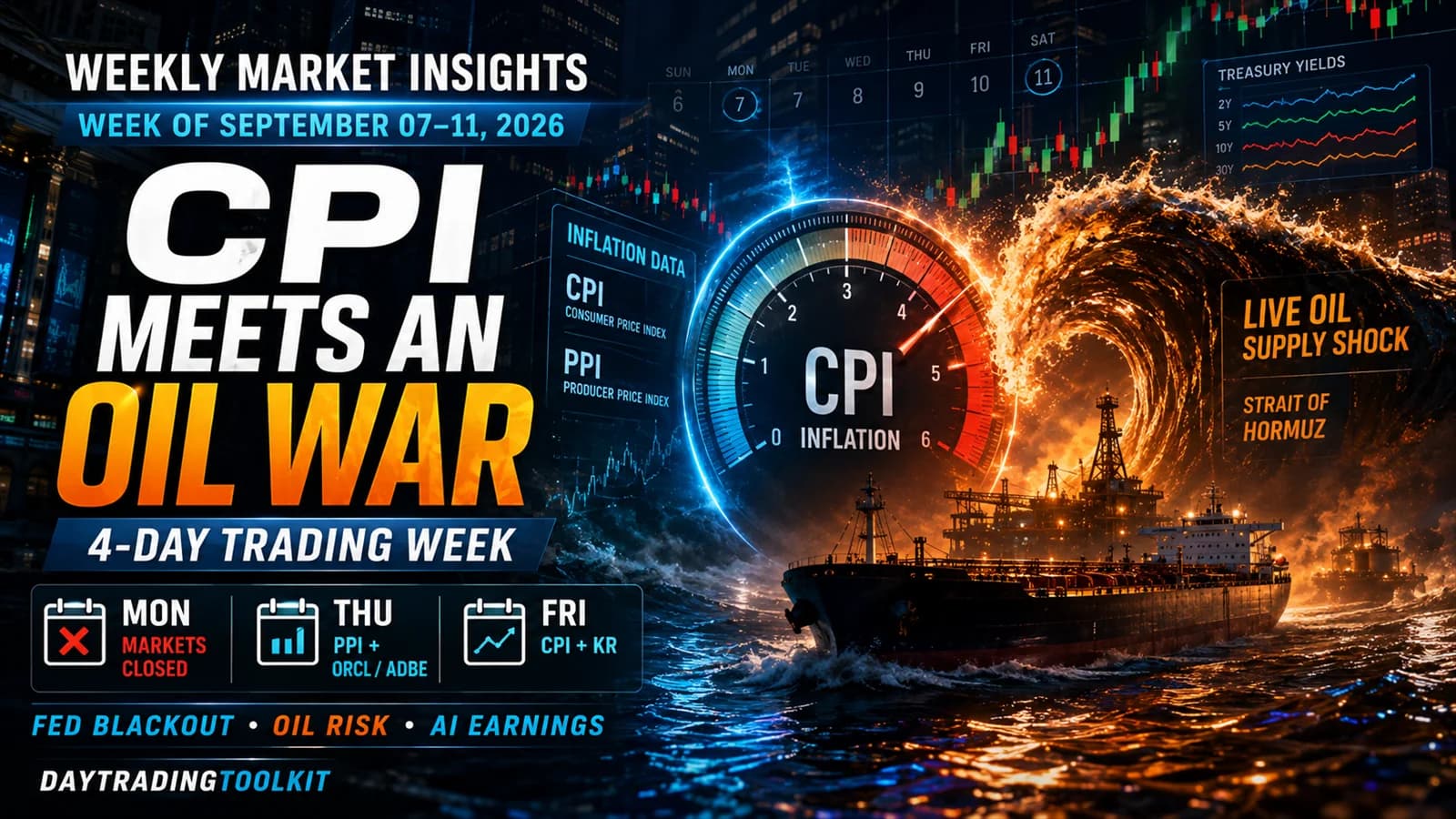
Two Wars, a Trade Fight, and CPI Still Has to Land Clean: Weekly Market Insights, September 7-11
A blowout jobs report already pushed rate-hike odds above 58%. Now a widening Middle East war and a new US-Canada trade fight collide with the last inflation data before the Fed's September 15-16 decision, while Nokia, Compass Pathways, Qualcomm, and Amgen all move on stories the calendar never saw coming.
Market Analysis & Insights
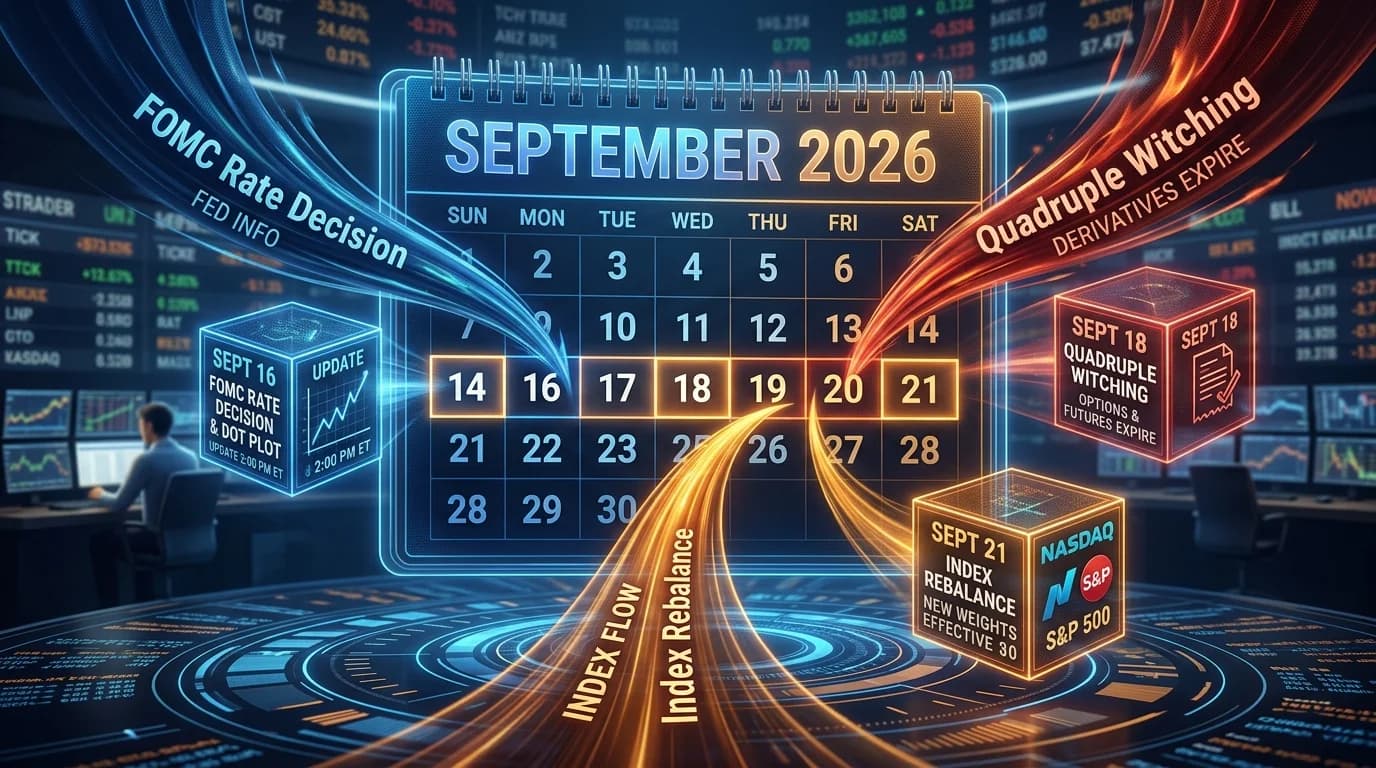
September's Trading Calendar: FOMC, Quad Witching, and the Rebalance All Land in One Week
Three major structural events land in the same five trading days this September: the FOMC's dot-plot meeting, quadruple witching, and the Nasdaq-100/S&P 500 quarterly rebalance. Here's how they interact and how to prepare.
Market Analysis & Insights
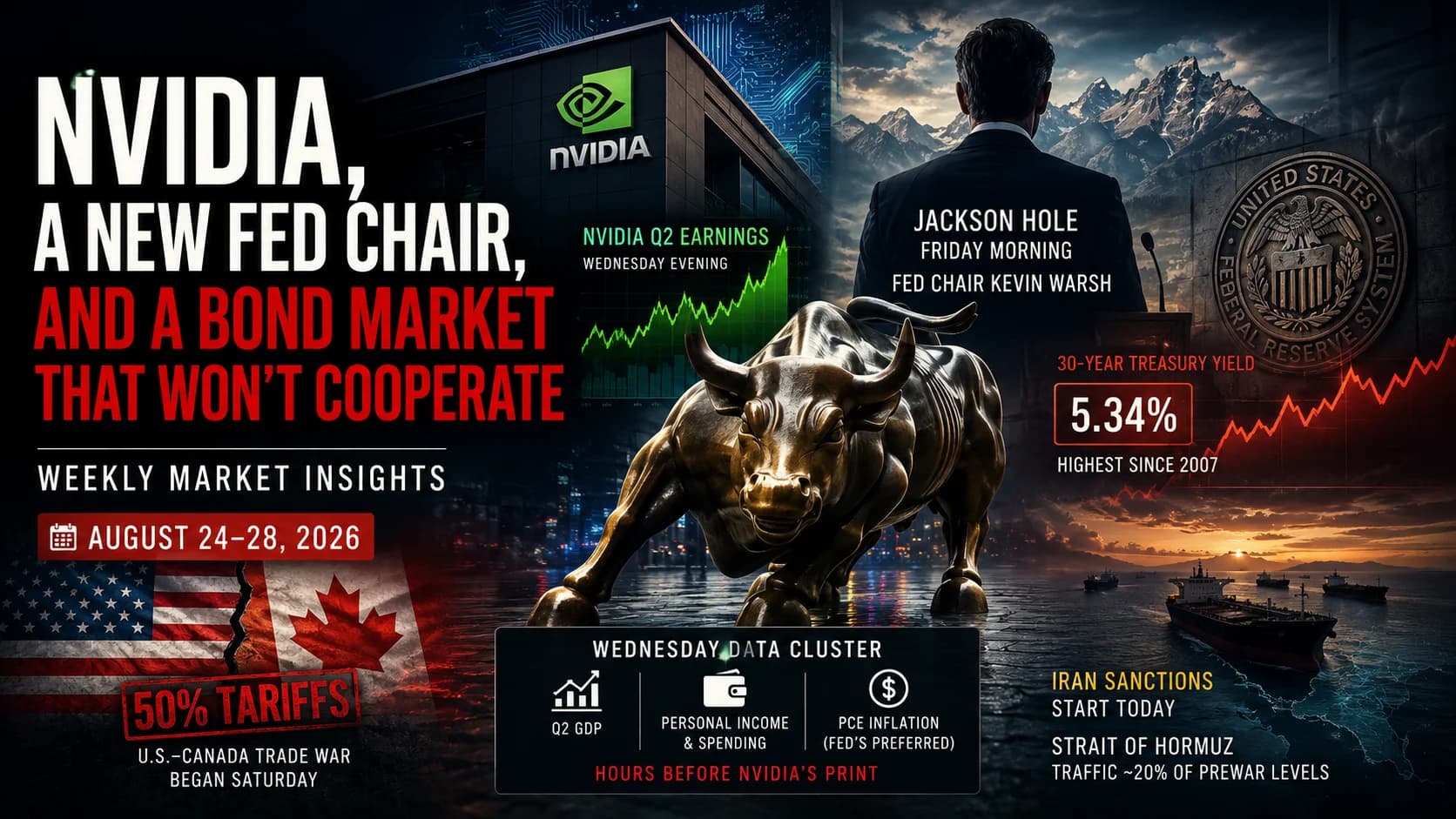
Nvidia, a New Fed Chair, and a Bond Market That Won't Cooperate: Weekly Market Insights, August 24-28
Warsh's first Jackson Hole speech, Nvidia's earnings, and fresh Iran and Canada shocks collide this week. The full Aug 24-28 catalyst map, stock watchlist, and scenario tree for traders.
Market Analysis & Insights
Can Friday's Jobs Report Undo What Warsh Just Did to Rate Bets? Weekly Market Insights, August 31-September 4
Warsh's hawkish Jackson Hole speech pushed September rate-hike odds above 50%. Then Iran struck back at the calendar entirely: a fresh U.S. strike on the Strait of Hormuz, a Broadcom earnings test, and Friday's jobs report all collide in the same five days.
Comments
No comments yet. Be the first to share your thoughts.