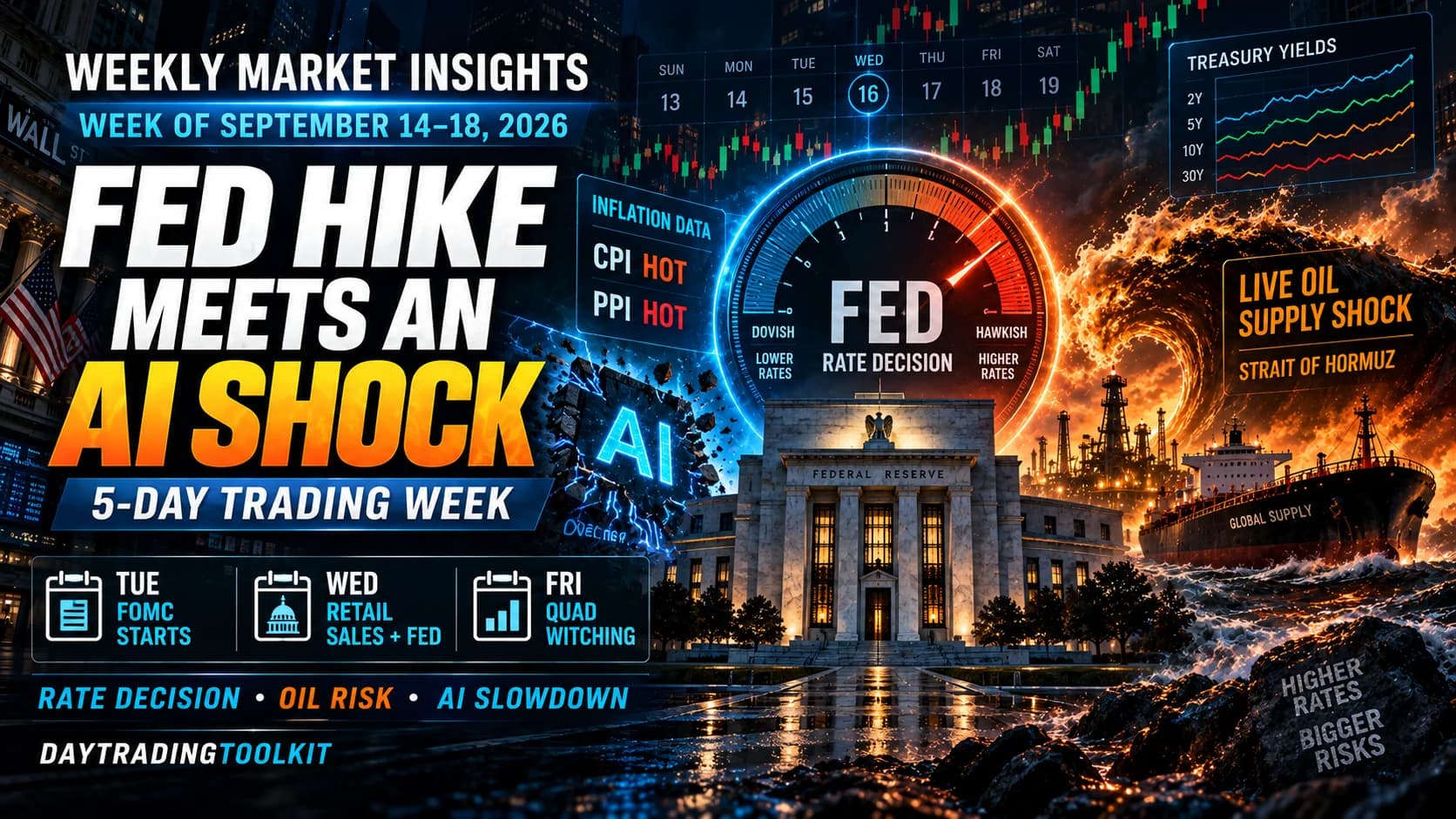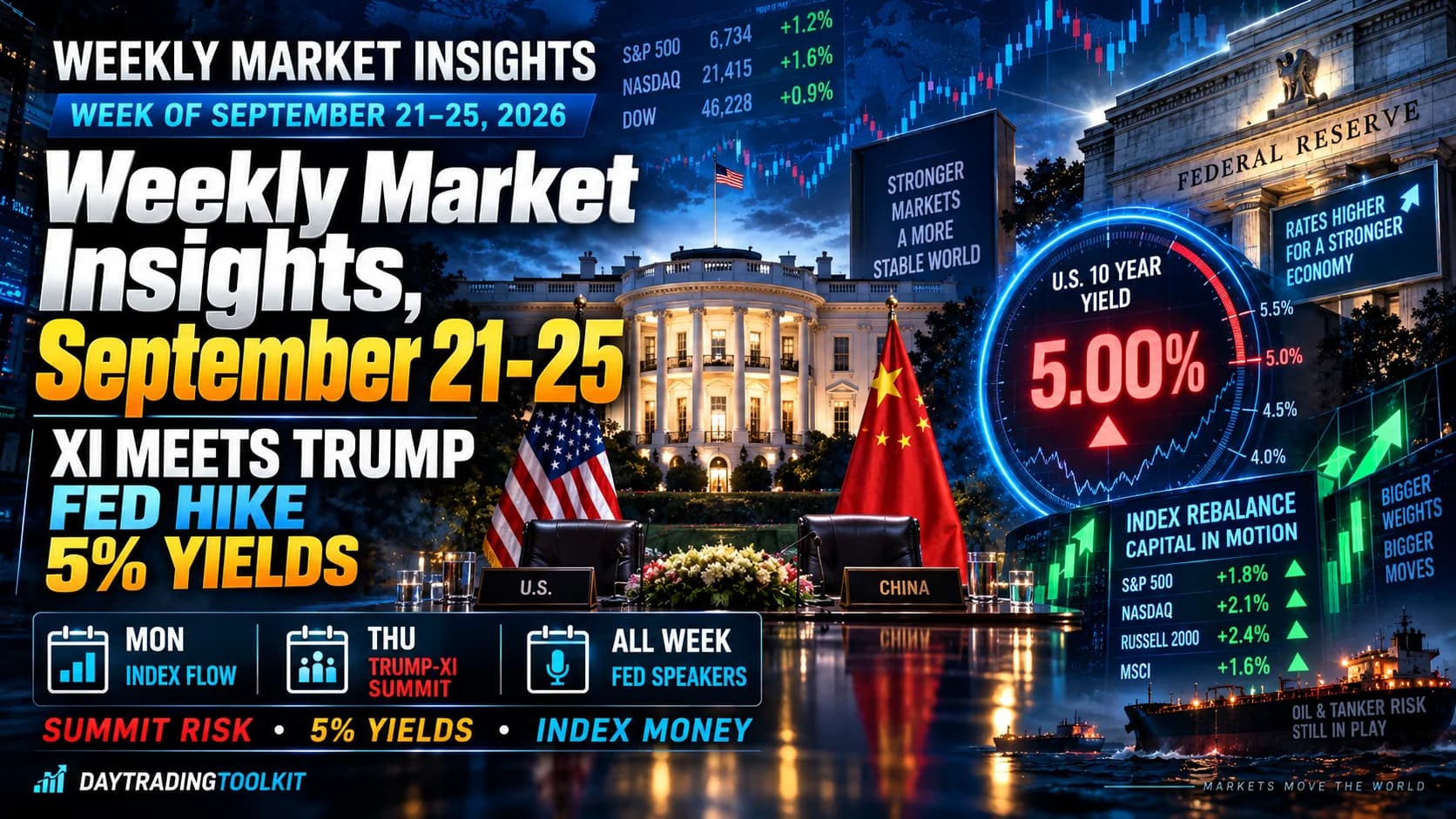

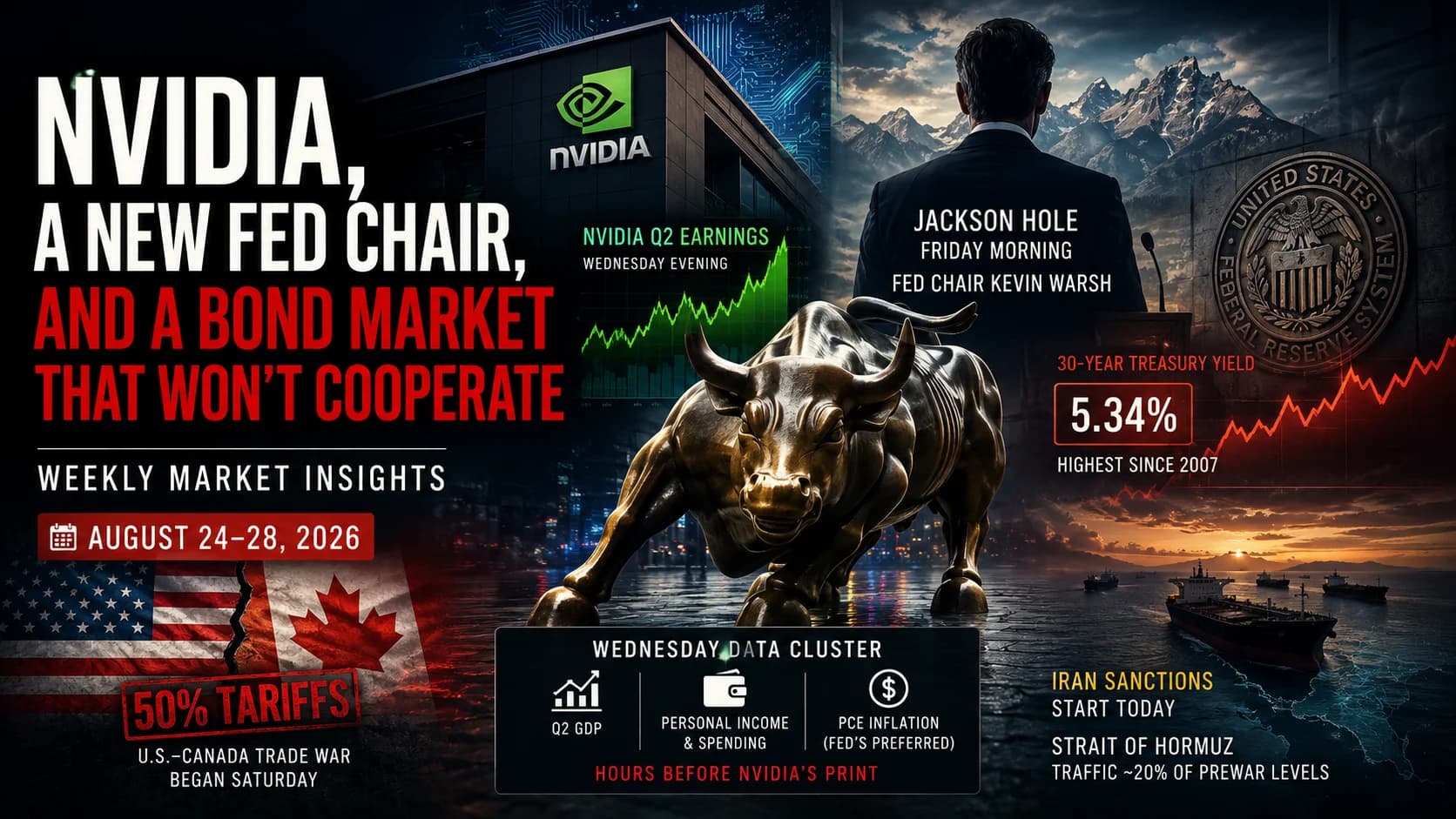
The 30-year Treasury yield touched its highest level since 2007 last week. The Treasury Department tried to talk it back down with a surprise buyback announcement, and by Friday the bond market had shrugged that off too. That is the backdrop Kevin Warsh walks into Friday morning at Jackson Hole, delivering his first speech as Fed chair to a market that is no longer waiting for his committee to move. It is already pricing its own verdict on Washington's fiscal path.
Layer on top of that a trade war with Canada that erupted Friday night, a fresh round of Iran sanctions due today, and a data cluster on Wednesday dense enough to move every asset class before the trading day is half over. Then there is Nvidia, reporting the same Wednesday evening as a stacked slate of software and retail EarningsAn earnings report is the quarterly financial disclosure a public company files with the SEC, revealing revenue, earnings per share (EPS), profit margins, and forward guidance — it's the most significant regular catalyst for individual stocRead definition →, in what may be the single most consequential print left in this AI cycle.
None of these threads are new. All of them accelerated at once over the past ten days. This is a preparation guide for a five-day stretch, not a set of trade calls or price predictions.
Key Takeaways
- The 30-year Treasury yield hit 5.34% intraweek, the highest since 2007, and a surprise Treasury buyback announcement only bought a few hours of relief before yields round-tripped most of the way back.
- Fed Chair Kevin Warsh delivers his first Jackson Hole keynote Friday morning against a committee that split 9-3 in July, with three regional presidents dissenting in favor of a hike, not a cut.
- Nvidia reports Wednesday evening in the same hour as CrowdStrike, Salesforce, and five other names, with options pricing a swing of more than $300 billion in market value either way.
- The U.S. and Canada entered a fresh trade war Saturday: 50% tariffs on roughly $20 billion of Canadian goods took effect at midnight, with Canada's dollar-for-dollar retaliation set for September 8.
- Trump's promised "economic warfare" campaign against Iran gets its first concrete details today, layered onto a Strait of Hormuz that is already running at roughly a fifth of its prewar traffic.
- Wednesday's data cluster (Q2 GDP, July personal income and spending, and the Fed's preferred PCE inflation gauge) lands hours before Nvidia's print, meaning the macro and single-stock stories collide on the same calendar day.
Last Week's Setup: Calm Index, Turbulent Everything Else
The S&P 500 closed Friday at 7,674.37, the Dow at 53,277.01, the Nasdaq Composite at 26,180.46, and the Russell 2000 at 3,017.87, all posting gains on the day but a second straight weekly loss for the broad index, roughly 1% lower on the week. The VIXThe CBOE Volatility Index — a real-time measure of the market's expectation for 30-day volatility in the S&P 500, derived from the prices of S&P 500 options. Widely called the "fear gauge," a rising VIX indicates increasing uncertainty and Read definition → finished at 15.13, down more than 5% on the day and still historically calm. That calm is the tell that something else is doing the work: the index level looks fine while the bond market looks anything but.
The 30-year Treasury yield surged to 5.34% on Tuesday, the highest since 2007, before the Treasury Department's surprise Wednesday announcement that it would more than double its long-bond buyback size, from a $2 billion cap to at least $4 billion per operation. The move briefly pushed the 30-year down to 5.19%. By Friday it had climbed back to roughly 5.26%, erasing nearly all of that relief. The 10-year finished the week at 4.74%, testing 20-month highs, while the 2-year held near 4.17%, comparatively anchored. The same week the buyback was announced, the national debt formally crossed $40 trillion.
That combination, a steepening curve with the long end refusing to cooperate even after direct intervention, is the story most of this week's calendar connects back to. Evercore ISI's Krishna Guha described the buyback as "a weak form of Operation Twist," a nod to the Fed's 2011 strategy of buying long bonds. This time it was Treasury acting alone, and the market's response suggests it wants more than a LiquidityLiquidity in trading refers to how easily you can enter and exit a position at a fair price — a liquid stock has high volume and a tight bid-ask spread, allowing large orders to be filled quickly without moving the price, while an illiquid Read definition → gesture.
Friday brought one piece of unambiguously good news: the S&P Global flash composite PMI jumped to 56.0 in August, the fastest pace of U.S. business activity since April 2022, with services strength offsetting a manufacturing slowdown. The survey now points to third-quarter GDP growth approaching 3% annualized, up from 1.5% in the second quarter, alongside easing input costs. It is the rare recent data point that doesn't complicate the picture. Nearly everything else did.
Retail earnings delivered the complicating half. Walmart beat estimates and raised full-year GuidanceGuidance is forward-looking financial projections that a company's management provides for upcoming periods — typically covering expected revenue, earnings, or margins — and the market's reaction is often driven more by guidance than by theRead definition → (adjusted EPS now $2.80 to $2.87, up from $2.75 to $2.85) and the stock still fell 9% Thursday, its worst day since May 2022, after U.S. comparable sales growth slowed to just 2.6%, the softest pace in years. Home Depot missed on the top line and cut its outlook. Target and Lowe's also reported into the same week. None of this is brand new context. Last week's issue flagged the "is the consumer slowing or trading down" question before any of these five reports landed. What's new is that Walmart's answer leaned toward genuine softness at the lower-income end, and this week brings a second, different-demographic test.
The Question Connecting This Week: Who's Actually Setting Financial Conditions?
For most of this year, the market has organized itself around a simple question: what will the Fed do next. That framework is straining. The Fed held rates at 3.50% to 3.75% on July 29 by a 9-3 vote, the most divided committee decision since 2016, but the three dissents (Cleveland's Beth Hammack, Minneapolis's Neel Kashkari, and Dallas's Lorie Logan) all wanted to hike, not cut. Warsh himself has said a Rate HikeA rate hike is when the Federal Reserve raises its benchmark federal funds rate target, increasing borrowing costs across the economy to slow inflation — it's generally considered bearish for stocks in the near term because it reduces liquiRead definition → isn't his preferred tool for fighting inflation. Markets spent last week pricing meaningful odds of a September increase anyway, an odd position for a cycle most traders still associate with cuts.
Then the bond market did something more direct than debate the Fed's next move: it started ignoring it. A 30-year yield at a 19-year high, a Treasury buyback that worked for about a day, and a national debt above $40 trillion together suggest the long end is being priced on fiscal and term-premium grounds that have little to do with whatever Warsh says about the path of short-term rates. Treasury Secretary Scott Bessent, a longtime Warsh ally, has pushed for a more coordinated Treasury-Fed approach to managing the balance sheet and long-end yields specifically, an arrangement Warsh has previously said he's open to. Whether Friday's speech addresses that tension directly, or pointedly avoids it, will itself be read as a statement about where Fed independence stands.
That's one half of the question this week is built to answer. The other half arrives Wednesday evening in the form of Nvidia's earnings, alongside a stacked evening of software and security prints. If the bond market has effectively taken over setting financial conditions from the Fed, can single-stock earnings still move the tape on their own terms, or does everything now trade through a rates lens first? A weak Nvidia print in a week when yields are already elevated could compound quickly. A strong one might have to work harder than usual to matter.
This is a lens for reading the week, not a filter. The items below don't need to fit this frame to earn a place on the calendar, and several don't.
Fresh Since Friday: Iran and Canada, Both at Once
Two developments broke over the weekend, neither of them scheduled, and both carry real teeth.
Iran. Trump halted talks with Tehran last week and pivoted to what he's calling "economic warfare," posting that the campaign would be "an ECONOMIC D-DAY" targeting any country or entity that keeps Iran connected to global trade and financial networks. Treasury is expected to detail the specific new sanctions today. The backdrop makes the timing matter: the Strait of Hormuz, which once carried roughly a fifth of the world's oil, was running at just 73 tanker transits in the week ended August 16, down from 91 the week before and a small fraction of prewar norms, according to Lloyd's List Intelligence data. Pentagon figures put U.S. military casualties tied to the broader conflict at more than 770. Gas prices reflect the strain: the national average hit $4.11 a gallon Friday, up 97 cents from a year earlier. Crude has moved accordingly, with WTI near $87 and Brent in the low $90s.
The mechanism here is straightforward and one this guide has tracked since the Hormuz standoff first escalated this year: tighter oil supply raises energy costs, energy costs feed inflation expectations, and inflation expectations complicate whatever case Warsh wants to make Friday about the path ahead. Today's sanction details are the piece that isn't on any calendar and could move faster than everything else on this list combined.
Canada. Trade talks between Washington and Ottawa collapsed just before a midnight deadline Friday, and 50% U.S. tariffs on roughly $20 billion of Canadian goods, covering categories like building materials, spirits, and apparel, took effect at the stroke of midnight Saturday. Prime Minister Mark Carney called the outcome "a miscalculation" and confirmed Canada will retaliate dollar for dollar starting September 8, with duties concentrated in steel, dairy, appliances, agricultural equipment, pulp and paper, and electronics. Carney, asked why it felt like his country was "going to war," answered: "Because we were attacked."
This is genuinely new, with no DTT coverage yet, and it's a real complication for any name with Canadian exposure in the targeted categories. Deere, which told investors just last week that "2026 will mark the bottom of the current ag equipment cycle," now faces a fresh tariff on exactly the equipment category it was hoping had bottomed. That's a coincidence worth watching rather than a certainty, and it's covered in the watchlist below.
A Fed Chair's First Big Test, and a Committee That's Still Arguing
Warsh took office May 22 after the narrowest Senate confirmation in the position's history, 54-45. His July 29 press conference produced two lines worth holding onto heading into Friday: he called his upcoming Jackson Hole address "a blank piece of paper right now," and he said the Fed is "not constrained by market prices," a pointed way of saying the three-dissent push for a hike doesn't automatically bind him. The symposium itself runs Thursday through Saturday under the theme "Financial Innovation: Implications for Payments and Policy," but virtually every trading desk covering the event is treating the theme as background noise next to the keynote itself.
September rate-hike odds have moved substantially over the past six weeks, from as high as 82% in mid-July down to roughly one in three by last week, as a weak July jobs report (payrolls fell 23,000, with May and June revised down a combined 103,000) and a benign July CPI print (headline +0.1% month over month, core +0.2%) took the edge off the hawkish case. That's still a live hike probability heading into a chair's first major speech, an unusual setup for a cycle most of the public conversation still frames around cuts. This guide's Jackson Hole preview covers the historical pattern of first speeches moving markets in ways the printed agenda never predicted; nothing about that pattern has changed, and Warsh inherits a bond market that's already primed to react to whatever tone he strikes.
Wednesday's core PCE reading, the Fed's actual preferred gauge, adds another layer directly ahead of the speech. July's producer price data showed core services costs jumped 0.4% month over month, four times June's pace, driven by a spike in portfolio management fees. That single data point flows straight into Wednesday's PCE print. A hot reading two days before Warsh speaks would sharpen every question reporters ask him Friday; a soft one would ease the pressure on his framing considerably. This guide's playbook for FOMC and Fed announcement days covers the first-move, second-move dynamic that tends to show up around major Fed communication, and Friday's speech is exactly the kind of event where that pattern matters.
Wednesday's Data Wall, Before the Earnings Even Start
Wednesday, August 26 is the single busiest day on this calendar, and it starts before the market opens. At 8:30 AM ET, the Bureau of Economic Analysis releases the second estimate of Q2 GDP alongside July personal income, personal spending, durable goods orders, and the core PCE price index, all at once. Tuesday's Conference Board Consumer Confidence reading (July fell to 90.8) sets the table the day before; a further decline would reinforce the same consumer-fatigue thread Walmart's earnings opened last Thursday. The Treasury auctions a 2-year note Tuesday and a 5-year note Wednesday, both real-time tests of investor appetite after last week's soft 10-year and 30-year sales; the 30-year auction priced at 5.216%, the highest yield for that maturity since 2001.
Then, after the close, Nvidia reports.
Stocks to Watch
Every name below earns its place by answering "why this stock, this week," not because the chart looks interesting.
Also on the radar: the rest of Wednesday evening's software cluster (Okta, Synopsys, HP, Salesforce, Rubrik) for a read on enterprise software spending broadly; homebuilders like Lennar and D.R. Horton as a straightforward 10-year yield confirmation pair; gold miners such as Newmont against gold's push toward $4,650 to $4,680; and SpaceX, whose staggered lockup expiration is still working through the market even as retail investors keep buying the dip.
Week at a Glance
- Day
- Mon
- Time (ET)
- All day
- Event
- Iran sanction details expected
- Stocks/Sectors
- Energy, airlines, gold
- Why It Matters
- First concrete look at the "economic warfare" campaign Trump announced last week.
- Day
- Tue
- Time (ET)
- 10:00 AM
- Event
- Conference Board Consumer Confidence (Aug)
- Stocks/Sectors
- Broad market, retail
- Why It Matters
- July fell to 90.8; another decline reinforces the consumer-fatigue thread from Walmart's earnings.
- Day
- Tue
- Time (ET)
- All day
- Event
- 2-year Treasury note auction
- Stocks/Sectors
- Rate-sensitive sectors
- Why It Matters
- First bond-demand test of the week after last week's weak 10-year and 30-year sales.
- Day
- Wed
- Time (ET)
- 7:00 AM
- Event
- Kohl's, Abercrombie, Bath & Body Works, Williams-Sonoma earnings
- Stocks/Sectors
- KSS, ANF, BBWI, WSM
- Why It Matters
- Second consumer-health test of the month, different demographic than last week's retailers.
- Day
- Wed
- Time (ET)
- 8:30 AM
- Event
- Q2 GDP (2nd estimate), July PCE, personal income/spending, durable goods
- Stocks/Sectors
- Entire market
- Why It Matters
- The densest data cluster of the month, hours before Nvidia reports.
- Day
- Wed
- Time (ET)
- All day
- Event
- 5-year Treasury note auction
- Stocks/Sectors
- Rate-sensitive sectors
- Why It Matters
- Second bond-demand check of the week.
- Day
- Wed
- Time (ET)
- ~5:00 PM
- Event
- Nvidia, CrowdStrike, Salesforce, HP, Okta, Synopsys, Veeva earnings
- Stocks/Sectors
- NVDA, CRWD, CRM, HPQ, OKTA, SNPS, VEEV
- Why It Matters
- The single largest concentration of earnings risk on this calendar.
- Day
- Thu
- Time (ET)
- 8:30 AM
- Event
- Jobless claims, continuing claims, advance goods trade balance
- Stocks/Sectors
- Broad market
- Why It Matters
- Tests the labor-softness thesis directly ahead of Warsh's speech.
- Day
- Thu
- Time (ET)
- All day
- Event
- Jackson Hole Symposium opens; 7-year Treasury note auction
- Stocks/Sectors
- Rate-sensitive sectors
- Why It Matters
- Symposium begins; third bond-demand test of the week.
- Day
- Thu
- Time (ET)
- After close
- Event
- Marvell, Intuit, Autodesk earnings
- Stocks/Sectors
- MRVL, INTU, ADSK
- Why It Matters
- AI-infrastructure and enterprise software confirmation the morning after Nvidia.
- Day
- Fri
- Time (ET)
- Morning
- Event
- Kevin Warsh's first Jackson Hole keynote
- Stocks/Sectors
- Entire market
- Why It Matters
- The most consequential scheduled Fed communication before the September 16 decision.
- Day
- Fri
- Time (ET)
- TBD
- Event
- Preliminary annual benchmark revision to nonfarm payrolls
- Stocks/Sectors
- Broad market
- Why It Matters
- Could reframe the entire year's labor-market narrative depending on the size of the revision.
| Day | Time (ET) | Event | Stocks/Sectors | Why It Matters |
|---|---|---|---|---|
| Mon | All day | Iran sanction details expected | Energy, airlines, gold | First concrete look at the "economic warfare" campaign Trump announced last week. |
| Tue | 10:00 AM | Conference Board Consumer Confidence (Aug) | Broad market, retail | July fell to 90.8; another decline reinforces the consumer-fatigue thread from Walmart's earnings. |
| Tue | All day | 2-year Treasury note auction | Rate-sensitive sectors | First bond-demand test of the week after last week's weak 10-year and 30-year sales. |
| Wed | 7:00 AM | Kohl's, Abercrombie, Bath & Body Works, Williams-Sonoma earnings | KSS, ANF, BBWI, WSM | Second consumer-health test of the month, different demographic than last week's retailers. |
| Wed | 8:30 AM | Q2 GDP (2nd estimate), July PCE, personal income/spending, durable goods | Entire market | The densest data cluster of the month, hours before Nvidia reports. |
| Wed | All day | 5-year Treasury note auction | Rate-sensitive sectors | Second bond-demand check of the week. |
| Wed | ~5:00 PM | Nvidia, CrowdStrike, Salesforce, HP, Okta, Synopsys, Veeva earnings | NVDA, CRWD, CRM, HPQ, OKTA, SNPS, VEEV | The single largest concentration of earnings risk on this calendar. |
| Thu | 8:30 AM | Jobless claims, continuing claims, advance goods trade balance | Broad market | Tests the labor-softness thesis directly ahead of Warsh's speech. |
| Thu | All day | Jackson Hole Symposium opens; 7-year Treasury note auction | Rate-sensitive sectors | Symposium begins; third bond-demand test of the week. |
| Thu | After close | Marvell, Intuit, Autodesk earnings | MRVL, INTU, ADSK | AI-infrastructure and enterprise software confirmation the morning after Nvidia. |
| Fri | Morning | Kevin Warsh's first Jackson Hole keynote | Entire market | The most consequential scheduled Fed communication before the September 16 decision. |
| Fri | TBD | Preliminary annual benchmark revision to nonfarm payrolls | Broad market | Could reframe the entire year's labor-market narrative depending on the size of the revision. |
Scenario Map
These are conditional paths built from this week's actual research, not predictions, and no single one is more likely than the others based on the evidence available as of this cutoff.
Growth without a hike. Wednesday's data holds up, Nvidia and Marvell both guide well, and Warsh delivers language the bond market reads as credible without validating the dissenters' case for a hike. Confirmation: the 30-year yield eases back from its recent highs, the S&P pushes back toward its record near 7,817, and memory and semiconductor names extend their run.
The bond vigilantes win regardless. The data comes in fine and Warsh says something reasonable, but term-premium and fiscal concerns, a $40 trillion debt load and heavy auction supply, keep the 30-year pinned near its highs anyway. Confirmation: gold and rate-sensitive names like homebuilders stay weak even if the S&P itself is flat to higher, a sign the long end has stopped listening to the Fed chair entirely.
AI capex doubt. Nvidia and Marvell merely meet already-elevated expectations rather than beat decisively, and CrowdStrike's print, complicated by the CTO departure, comes in soft. Confirmation: a broad de-rating across AI and software names independent of what the macro data showed the same morning, with memory names giving back recent gains.
Escalation shock. Today's Iran sanctions provoke retaliation, whether a fresh tanker incident or a diplomatic breakdown, or the Canada dispute widens before the September 8 retaliation date arrives. Confirmation: oil and gas prices spike, gold and Treasurys both catch a safe-haven bid at the same time, an unusual combination, and equities sell off broadly regardless of what Nvidia or Warsh said earlier in the week.
Trader Preparation
The behavioral trap this calendar sets is straightforward: Wednesday alone stacks a data dump, two Treasury auctions, and the week's largest earnings event into a single trading day. Trying to react to all of it in real time usually means arriving late to each individual move.
- Confirm Nvidia's exact call time and the precise release order of Wednesday's data (GDP, PCE, personal income, durable goods) the morning of, since components sometimes stagger by minutes in ways that matter for algorithmic reactions.
- Check the options-implied move on any earnings name before sizing a position around its report. An implied move that looks smaller than the stock's recent realized volatility is itself a signal worth noting.
- Treat Wednesday's retail cluster (Kohl's, Abercrombie, Bath & Body Works) as a group read first. One soft print among three is noise; three in the same direction confirms a trend that started with Walmart last Thursday.
- Widen stops or reduce size heading into Friday morning specifically. A first Jackson Hole speech from a new chair has historically produced outsized, sometimes reversing, initial reactions before the market settles on what was actually said.
- Treat any fresh Iran sanctions headline as a standalone catalyst for energy, defense, and airline names even though the exact timing isn't fixed. This conflict has produced fast-moving, unscheduled headlines all year.
- Watch the Exxon-versus-Delta and gold-versus-Treasury relationships as quick, real-time checks on whether a given headline is being priced as a genuine risk-off signal or just noise.
- Look ahead past this week too. September's trading calendar stacks the FOMC decision, quadruple witching, and the Nasdaq-100/S&P 500 quarterly rebalance into the same five-day stretch, so however this week resolves becomes the setup walking into that one.
FAQs
Why does it matter that the Fed's July dissents wanted to hike rates rather than cut them?
A unanimous hold and a 9-3 hold carry very different amounts of information even though the headline rate is identical. The three dissenters, Cleveland's Beth Hammack, Minneapolis's Neel Kashkari, and Dallas's Lorie Logan, all argued inflation hadn't cooled enough to justify standing pat, a live disagreement rather than a settled one.
Key Takeaway: Watch whether Warsh's Friday speech engages with that hawkish minority directly or sidesteps the question entirely; either choice will be read as a signal.
If the Treasury's bond buyback didn't hold, why would anything Warsh says on Friday work any better?
If the 30-year yield is being driven mainly by fiscal and term-premium concerns (worries about how much debt the government needs to sell, not what the Fed will do with short-term rates) then no amount of reassuring language from Warsh addresses the actual cause. That's the scenario several of this week's paths above are built around.
Key Takeaway: Watch the 30-year yield's reaction in the minutes after Friday's speech specifically, since a muted reaction there would be a meaningful signal on its own.
With Nvidia and CrowdStrike reporting the same evening, how would a trader tell which stock's reaction is actually driving the tape?
Nvidia and CrowdStrike sell fundamentally different things (AI hardware and cybersecurity software) and a strong Nvidia print doesn't necessarily say anything about CrowdStrike's net-new ARR, or the reverse. The two can diverge sharply even while trading in the same after-hours session.
Key Takeaway: A same-direction move in both names is more likely a macro reaction to something else (like Wednesday's PCE data landing hours earlier) than confirmation that both companies' fundamentals actually improved.
What would actually distinguish this week's Kohl's, Abercrombie, and Bath & Body Works reports from noise?
Walmart's report showed real softness concentrated in a lower-income, value-focused customer base. Kohl's serves a similar middle-income shopper, while Abercrombie and Bath and Body Works skew toward more discretionary mall-based spending. If all three show comparable softness, the pressure has likely spread past necessity retail into discretionary categories. If Kohl's alone is weak while the other two hold up, the story is probably still contained to value-focused shoppers specifically.
Key Takeaway: Read Wednesday's retail cluster as one combined signal before drawing any conclusion about the broader consumer.
How seriously should traders take the Iran sanctions announcement if the exact details aren't known yet?
The Strait of Hormuz has been running at a small fraction of its prewar shipping volume for months, and a fresh sanctions package aimed at isolating Iran economically has real potential to affect global oil-trading relationships even before any physical supply disruption occurs. The uncertainty is in the specifics and timing, not in whether the headline matters.
Key Takeaway: Treat today's sanctions rollout as a live risk for energy and airline names all day, not a single scheduled event with a fixed reaction window.
Does the new U.S.-Canada trade dispute actually matter for a stock like Deere, or is it mostly noise?
The actual dollar impact depends on how much of Deere's revenue comes specifically from the Canadian market, which is a fraction of its total business. That makes an outsized stock reaction to headlines alone worth treating skeptically, even though the underlying tariff is genuine and newly confirmed.
Key Takeaway: Watch for any direct company statement on Canadian exposure before assuming the tariff materially changes Deere's recovery story.
Is the current calm in the VIX consistent with everything else happening this week, or is it mispricing the risk?
A calm VIX alongside a volatile bond market has shown up before this year and isn't automatically a warning sign on its own. It becomes more notable if a Friday surprise from Warsh, a sharp escalation in Iran, or a disappointing Nvidia print actually forces the S&P 500 to move sharply, since implied volatility priced this low would then adjust quickly.
Key Takeaway: A rising VIX later this week would itself be a signal that one of this week's other threads has started moving equities directly, not just bonds or commodities.
With so many catalysts landing on Wednesday alone, is there a safer day to sit out entirely?
Wednesday stacks a retail earnings cluster before the open, the month's densest economic data release at 8:30 AM, a Treasury auction, and the week's largest single-stock catalyst after the close, all in one session. Trying to react to each with full size and normal stops is a common way traders end up whipsawed by moves that reverse within minutes.
Key Takeaway: Pick one or two setups with a genuine thesis for Wednesday specifically, and treat the rest of the day's news as information to read rather than positions to take.
Disclaimer
Article Sources
- Federal Reserve Board, FOMC Statement, July 29, 2026 - confirms the 9-3 vote, the three named dissenters, and the held rate range.federalreserve.gov
- U.S. Bureau of Labor Statistics, Employment Situation, July 2026 - confirms the July payroll decline and prior-month revisions.bls.gov
- U.S. Bureau of Labor Statistics, Consumer Price Index, July 2026 - confirms headline and core CPI figures.bls.gov
- U.S. Department of the Treasury, Tentative Auction Schedule - confirms this week's 2-year, 5-year, and 7-year note auction dates.home.treasury.gov
- S&P Global, PMI data and releases - confirms the composite and manufacturing flash PMI readings for August.pmi.spglobal.com
- Bureau of Economic Analysis, Personal Consumption Expenditures Price Index - confirms the PCE release cadence and the Fed's inflation target framing.bea.gov
- Bloomberg, US Bond Selloff Drives 30-Year Yields to Highest Since 2007 - confirms 30-year yield levels and the auction context.bloomberg.com
- CNBC, Bessent Treasury Buybacks Yields Warsh Fed - confirms the buyback announcement size and the Fed-Treasury coordination context.cnbc.com
- NBC News, U.S.-Canada tariff and retaliation coverage - confirms the tariff rate, affected goods categories, and the September 8 retaliation date.nbcnews.com
- Benzinga, Nvidia earnings week implied-move coverage - confirms the August 26 earnings date and options-implied move context.benzinga.com