
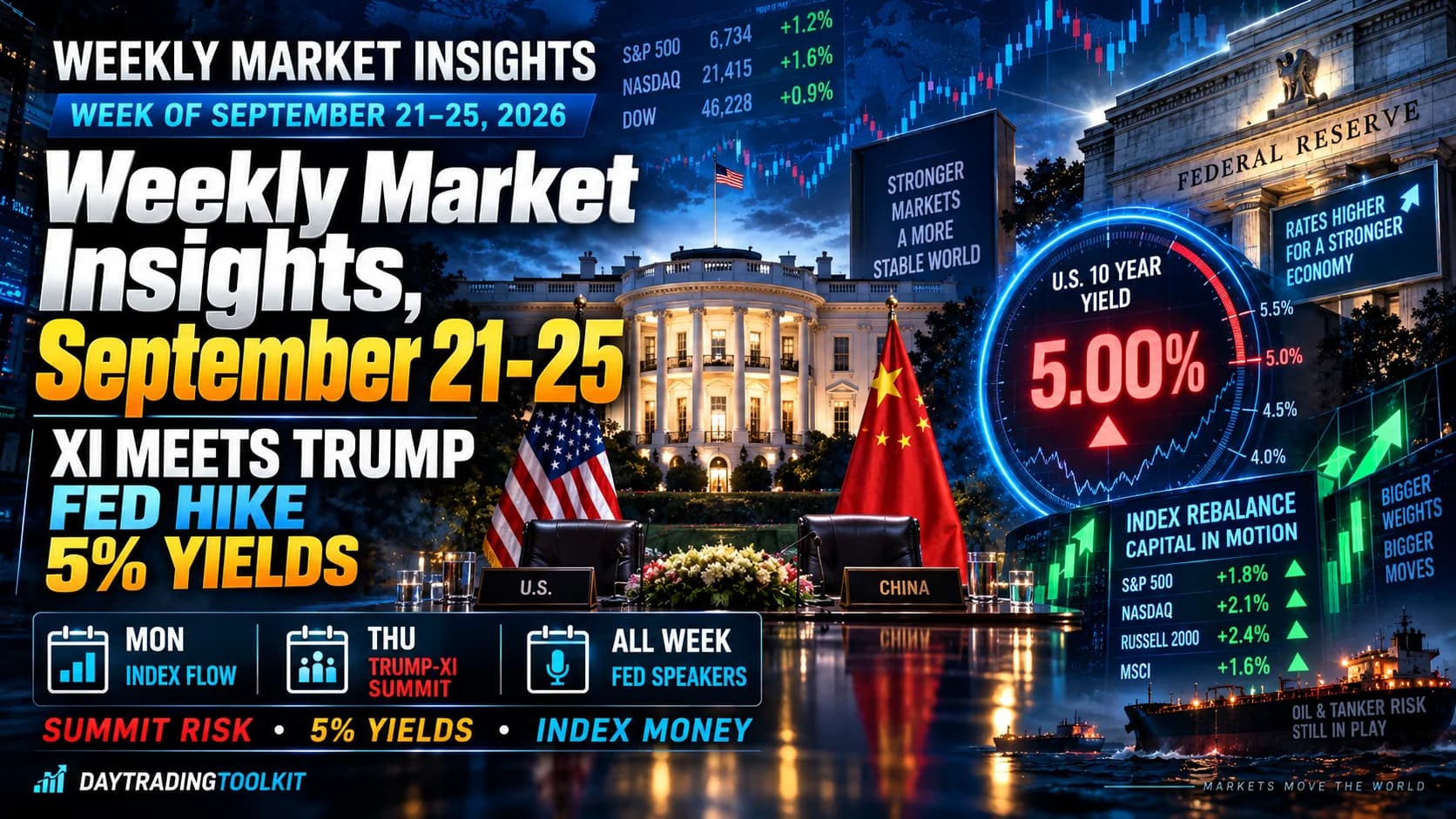
Xi Comes to Washington, the Fed's First Hike Lands, and Index Money Moves Before Monday's Open: Weekly Market Insights, September 21-25

In this article14 sections
Last week the Fed did the thing it had not done in three years. This week you find out what the rest of the world thinks about it.
There is almost no economic data on the calendar. What there is instead: Xi Jinping at the White House on Thursday, eleven separate Fed speaking appearances, a 10-year Treasury yield sitting on 5 percent, tanker rates at all-time highs, and a quarterly index reshuffle that takes effect before Monday's opening bell. A light data week is not the same as a quiet week, and this one is a good illustration of the difference.
This guide's research cutoff is Sunday, September 20, at 8:00 PM ET. Everything below reflects Friday, September 18's closing prices. Oil, bitcoin, and anything tied to the summit can move meaningfully before Monday's open, so re-check live quotes before you act on any level mentioned here.
What to Know This Week
Xi Jinping arrives at the White House on Thursday. It is his first White House visit in a decade and the first Chinese state visit to the United States since 2015. Tariffs, semiconductor export rules, rare earths, agricultural access, Taiwan, and Iran are all reportedly on the table. The current tariff truce expires November 10, and Bloomberg reported on September 17 that Washington is holding back a planned set of excess-capacity tariffs until after the meeting. This is the single largest scheduled headline risk of the week.
The Fed hiked, and nobody dissented. On Wednesday, September 16, the FOMC raised the federal funds target range by 25 basis points to 3.75 to 4.00 percent, its first increase in three years, on a unanimous 12-0 vote. The statement said inflation "remains elevated" and framed the move as supporting "a timelier return to the Committee's 2 percent goal." The updated projections put year-end 2026 rates at 4.1 to 4.4 percent, which implies the Committee is not finished.
With no inflation data this week, Fed speakers are the only new information. August PCE does not arrive until September 30. That leaves eleven scheduled Fed appearances between Monday and Friday, including Williams three separate times, to do all the work of telling markets how fast the next hike is coming. Speaker headlines will move the rates market more than usual precisely because nothing else is competing with them.
The 10-year Treasury yield is sitting on 5 percent. It closed Friday at 5.00 percent, up 5.3 basis points. The 2-year finished at 4.756 percent, a 52-week high, and the 30-year at 5.328 percent. Any company whose story depends on cheap financing is trading against that backdrop every single day right now.
Index changes take effect before Monday's open, not last Friday. S and P Dow Jones Indices confirmed on September 4 that Bloom Energy ($BE), Illumina ($ILMN), and Everpure ($P) join the S and P 500, replacing Molson Coors ($TAP), The Trade Desk ($TTD), and Builders FirstSource ($BLDR). Dell ($DELL), Palo Alto Networks ($PANW), Arista Networks ($ANET), and SanDisk ($SNDK) join the S and P 100. The effective time is "prior to the open of trading on Monday, September 21." Friday's quadruple witching and Monday's index flow are two different events.
Crypto rallied through a legislative defeat. The Senate failed to invoke cloture on the Digital Asset Market Clarity Act on September 15, falling 49-50 on a motion that needed 60 votes, which shelves comprehensive crypto market-structure legislation for 2026. Bitcoin fell to roughly $75,000 mid-week, then rebounded to close Friday above $80,800. It absorbed a failed bill and a rate hike in the same week and still finished higher.
Tanker rates are at record levels and oil is near $100. VLCC day rates on the Oman-to-China route hit $870,947 as of September 18, with the West Africa-to-China route at an all-time-high $509,000, roughly 20 times break-even. WTI settled near $101 and Brent near $103, both easing for a third straight session. Anything that changes the Strait of Hormuz picture, including Thursday's summit, hits this complex first.
Costco is the only megacap report, and Micron is not this week. $COST reports fiscal Q4 after Thursday's close. Micron ($MU) reports its fiscal Q4 on September 30, the week after this one. If you have memory names on your list because of an earnings catalyst, check that date before you build a plan around it.
Week at a Glance
Monday, September 21
- Time (ET)
- Before open
- Event
- S and P index changes take effect
- Why It Matters
- $BE, $ILMN, $P into the S and P 500; $DELL, $PANW, $ANET, $SNDK into the S and P 100
- Time (ET)
- 6:30 AM
- Event
- Chicago Fed President Goolsbee speaks
- Why It Matters
- First Fed voice after the hike
| Time (ET) | Event | Why It Matters |
|---|---|---|
| Before open | S and P index changes take effect | $BE, $ILMN, $P into the S and P 500; $DELL, $PANW, $ANET, $SNDK into the S and P 100 |
| 6:30 AM | Chicago Fed President Goolsbee speaks | First Fed voice after the hike |
Tuesday, September 22
- Time (ET)
- Before open
- Event
- $AZO, $THO, $MLKN earnings
- Why It Matters
- Consumer and housing-adjacent reads
- Time (ET)
- 10:05 AM
- Event
- New York Fed President Williams speaks
- Why It Matters
- Williams is the most closely parsed non-Chair voice
- Time (ET)
- 10:20 AM
- Event
- Fed Vice Chair Jefferson speaks
- Why It Matters
- Leadership signal on the hiking path
- Time (ET)
- 1:00 PM
- Event
- Richmond Fed President Barkin speaks
- Why It Matters
- Third Fed speaker of the day
- Time (ET)
- After close
- Event
- $KBH, $WOR earnings
- Why It Matters
- Homebuilder read with mortgage rates elevated
| Time (ET) | Event | Why It Matters |
|---|---|---|
| Before open | $AZO, $THO, $MLKN earnings | Consumer and housing-adjacent reads |
| 10:05 AM | New York Fed President Williams speaks | Williams is the most closely parsed non-Chair voice |
| 10:20 AM | Fed Vice Chair Jefferson speaks | Leadership signal on the hiking path |
| 1:00 PM | Richmond Fed President Barkin speaks | Third Fed speaker of the day |
| After close | $KBH, $WOR earnings | Homebuilder read with mortgage rates elevated |
Wednesday, September 23
- Time (ET)
- Before open
- Event
- $CTAS, $PAYX, $GIS, $CBRL earnings
- Why It Matters
- Paychex and Cintas are live reads on small-business hiring
- Time (ET)
- 9:45 AM
- Event
- S and P Global Flash Manufacturing PMI (September)
- Why It Matters
- First hard September data anywhere
- Time (ET)
- 9:45 AM
- Event
- S and P Global Flash Services PMI (September)
- Why It Matters
- Services prices paid is the inflation line to check
- Time (ET)
- 10:05 AM
- Event
- Fed Governor Barr speaks
- Why It Matters
- Governor-level commentary
- Time (ET)
- After close
- Event
- $FUL, $SFIX earnings
- Why It Matters
- Minor
| Time (ET) | Event | Why It Matters |
|---|---|---|
| Before open | $CTAS, $PAYX, $GIS, $CBRL earnings | Paychex and Cintas are live reads on small-business hiring |
| 9:45 AM | S and P Global Flash Manufacturing PMI (September) | First hard September data anywhere |
| 9:45 AM | S and P Global Flash Services PMI (September) | Services prices paid is the inflation line to check |
| 10:05 AM | Fed Governor Barr speaks | Governor-level commentary |
| After close | $FUL, $SFIX earnings | Minor |
Thursday, September 24
- Time (ET)
- All day
- Event
- Trump-Xi summit at the White House
- Why It Matters
- The week's dominant scheduled event
- Time (ET)
- 4:10 AM
- Event
- Williams speaks
- Why It Matters
- Overseas audience, still moves futures
- Time (ET)
- 8:30 AM
- Event
- Weekly jobless claims (week ending September 19)
- Why It Matters
- Only labor data of the week
- Time (ET)
- 8:30 AM
- Event
- US International Transactions, Q2
- Why It Matters
- Low market impact
- Time (ET)
- 8:50 AM
- Event
- Cleveland Fed President Hammack speaks
- Why It Matters
- Among the more hawkish voices
- Time (ET)
- 10:00 AM
- Event
- New home sales (August)
- Why It Matters
- Housing under 5 percent yields
- Time (ET)
- 10:10 AM
- Event
- Philadelphia Fed President Paulson speaks
- Why It Matters
- Fourth speaker of the day
- Time (ET)
- Before open
- Event
- $DRI, $SNX earnings
- Why It Matters
- Restaurant and IT distribution reads
- Time (ET)
- After close
- Event
- $COST, $BB, $FDXF earnings
- Why It Matters
- Costco is the week's largest report
| Time (ET) | Event | Why It Matters |
|---|---|---|
| All day | Trump-Xi summit at the White House | The week's dominant scheduled event |
| 4:10 AM | Williams speaks | Overseas audience, still moves futures |
| 8:30 AM | Weekly jobless claims (week ending September 19) | Only labor data of the week |
| 8:30 AM | US International Transactions, Q2 | Low market impact |
| 8:50 AM | Cleveland Fed President Hammack speaks | Among the more hawkish voices |
| 10:00 AM | New home sales (August) | Housing under 5 percent yields |
| 10:10 AM | Philadelphia Fed President Paulson speaks | Fourth speaker of the day |
| Before open | $DRI, $SNX earnings | Restaurant and IT distribution reads |
| After close | $COST, $BB, $FDXF earnings | Costco is the week's largest report |
Friday, September 25
- Time (ET)
- 5:15 AM
- Event
- Williams speaks
- Why It Matters
- Third Williams appearance of the week
- Time (ET)
- 8:30 AM
- Event
- Durable goods orders (August)
- Why It Matters
- Capital spending read, watch core capex
- Time (ET)
- 10:00 AM
- Event
- University of Michigan sentiment, final (September)
- Why It Matters
- Inflation expectations are the line that matters
- Time (ET)
- 2:00 PM
- Event
- Hammack speaks
- Why It Matters
- Closes the week's Fed commentary
| Time (ET) | Event | Why It Matters |
|---|---|---|
| 5:15 AM | Williams speaks | Third Williams appearance of the week |
| 8:30 AM | Durable goods orders (August) | Capital spending read, watch core capex |
| 10:00 AM | University of Michigan sentiment, final (September) | Inflation expectations are the line that matters |
| 2:00 PM | Hammack speaks | Closes the week's Fed commentary |
All Week, Unscheduled
Summit headlines can land at any hour Thursday and can leak before then. The Strait of Hormuz situation, Houthi activity in the Red Sea, and tanker freight pricing are live daily. Post-hike repricing in the Treasury market runs continuously. None of these has a scheduled release time, and any of them can set the tone for a session before the opening bell.
Priority Stocks at a Glance
- Stock
- $BE
- Catalyst and Timing
- Joins the S and P 500 before Monday's open
- Why It's Here
- Dated, mechanical flow event into a stock already up about 150 percent
- Stock
- $SNDK
- Catalyst and Timing
- Joins the S and P 100 before Monday's open
- Why It's Here
- Index flow stacked on top of a live memory shortage
- Stock
- $MU
- Catalyst and Timing
- Memory shortage, earnings September 30
- Why It's Here
- Closed $977.50 September 17; the catalyst is next week, not this one
- Stock
- $MSTR
- Catalyst and Timing
- Rose 16.4 percent Friday, no scheduled event
- Why It's Here
- Bitcoin crossed back above its average cost basis
- Stock
- $NVDA
- Catalyst and Timing
- Trump-Xi summit Thursday
- Why It's Here
- Most direct listed read on any change to China chip access
- Stock
- $BABA
- Catalyst and Timing
- Trump-Xi summit Thursday
- Why It's Here
- Named H200 buyer, direct exposure to both sides of the outcome
- Stock
- $FRO
- Catalyst and Timing
- Tanker rates at all-time highs, ongoing
- Why It's Here
- De-escalation risk cuts both ways at these levels
- Stock
- $CRML
- Catalyst and Timing
- September 16 Tanbreez results, no new event scheduled
- Why It's Here
- $1.85 billion capex plan meeting a 5 percent 10-year
- Stock
- $COST
- Catalyst and Timing
- Fiscal Q4 earnings Thursday after the close
- Why It's Here
- Only megacap report of the week
| Stock | Catalyst and Timing | Why It's Here |
|---|---|---|
| $BE | Joins the S and P 500 before Monday's open | Dated, mechanical flow event into a stock already up about 150 percent |
| $SNDK | Joins the S and P 100 before Monday's open | Index flow stacked on top of a live memory shortage |
| $MU | Memory shortage, earnings September 30 | Closed $977.50 September 17; the catalyst is next week, not this one |
| $MSTR | Rose 16.4 percent Friday, no scheduled event | Bitcoin crossed back above its average cost basis |
| $NVDA | Trump-Xi summit Thursday | Most direct listed read on any change to China chip access |
| $BABA | Trump-Xi summit Thursday | Named H200 buyer, direct exposure to both sides of the outcome |
| $FRO | Tanker rates at all-time highs, ongoing | De-escalation risk cuts both ways at these levels |
| $CRML | September 16 Tanbreez results, no new event scheduled | $1.85 billion capex plan meeting a 5 percent 10-year |
| $COST | Fiscal Q4 earnings Thursday after the close | Only megacap report of the week |
This is a preparation shortlist, not a buy list or a ranked forecast.
Market Setup Entering the Week
Friday, September 18 was quadruple witching, and the closes reflect it. The S and P 500 finished at 7,650.50, up 0.16 percent on the day and down about 0.1 percent for the week. The Nasdaq Composite closed at 26,522.55, up 0.39 percent Friday and up roughly 0.7 percent on the week. The Dow ended at 51,682.64, down 0.19 percent Friday and down about 1.7 percent across the five sessions. The Russell 2000 closed at 2,860.40, down 0.50 percent.
Read those four numbers together and you get the week's real shape. Large-cap technology absorbed a rate hike and finished up. Everything else did not.
The VIX closed at 14.81, down 4.08 percent. That is the part worth sitting with. The Fed delivered its first hike in three years, the long bond went to 5.3 percent, and the volatility index went down. Options markets are not pricing this as a crisis. They are pricing it as a policy shift that equities have already decided they can live with.
Rates tell a harsher story. The 10-year at 5.00 percent, the 2-year at a 52-week high of 4.756 percent, and the 30-year at 5.328 percent mean the entire curve repriced higher on a hike that was widely expected. That combination, expected hike plus higher yields anyway, usually means the market moved its view of how many more hikes are coming, not just this one.
Sector leadership last week was narrow and specific. Cybersecurity names including $CRWD, $PANW, $OKTA, and $SAIL posted weekly gains in the 8 to 14 percent range on AI safety concerns. Crypto-linked equities led Friday: $MSTR up 16.4 percent, $COIN up 6.6 percent, $HOOD up 5.9 percent. Memory ran hard mid-week.
The laggards were rate-sensitive and cyclical. $NUE fell 5.3 percent Friday, $GM 5.2 percent, and $NFLX dropped roughly 4 percent premarket after a Wells Fargo downgrade to Underweight.
Gold closed at $4,424.90 and bitcoin at $80,472, both firm into a hiking Fed. That is not the textbook reaction, and it is worth noticing rather than explaining away.
The Fed After the Hike: Eleven Speakers and No Data
Here is the setup in one sentence. The Fed just raised rates, told you it expects to raise them again, and then scheduled eleven public appearances in a week with no inflation report to check them against.
The projections are the specific thing to anchor on. Year-end 2026 in the 4.1 to 4.4 percent range, against a current 3.75 to 4.00 percent, means the median Committee member expects at least one more hike and possibly two before the year is out. The next meeting is October 27-28. The longer-run neutral rate projection sits at 3.0 percent, which tells you the Committee currently views policy as restrictive and intends to keep it that way.
Think of the speaker slate like a jury filing out one at a time to explain a verdict you have already heard. The verdict does not change. How confidently each of them describes the next one absolutely does, and rate futures will move on it.
Three names carry the most weight. Williams speaks Tuesday, Thursday, and Friday, and as New York Fed President he is the closest thing to a read on the center of the Committee. Jefferson, as Vice Chair, speaks Tuesday. Hammack speaks twice, Thursday and Friday, and sits toward the hawkish end.
The only genuinely new data is Wednesday's flash PMIs at 9:45 AM ET. Flash PMIs are early-month survey estimates of business activity, released before the full monthly figures, with anything above 50 indicating expansion. The line to read is not the headline but services prices paid, which is the closest thing you get this week to a live inflation reading. Thursday's jobless claims and Friday's durable goods and final University of Michigan sentiment fill out a thin week. On the Michigan report, the inflation expectations component matters more than the sentiment number, because the Fed watches it directly.
Thursday at the White House: What the Summit Actually Puts in Play
Xi Jinping's state visit on Thursday, September 24 is the first by a Chinese leader since 2015 and his first White House visit in ten years. For a day trader, the useful question is not what it means geopolitically. It is which tickers reprice on a headline, and in which direction.
Four threads have real market plumbing behind them.
Semiconductor export rules. As of now, Nvidia's ($NVDA) H200 is cleared for sale to China under conditions that are unusually specific: units must be made by TSMC, shipped to the United States for inspection, then re-exported, with a 25 percent duty collected at the US checkpoint and case-by-case government review of each sale. Blackwell and the upcoming Rubin architecture remain restricted with no approved pathway. Beijing has been pressing Washington to delay a rule that would cut thousands of Chinese firms off from advanced US technology. Any movement in either direction is a direct read on $NVDA, $AMD, and the Chinese buyers named in that program.
Tariffs. Reporting points to a possible reciprocal reduction package covering roughly $30 billion of non-strategic goods, with energy tariffs potentially included. Bloomberg reported September 17 that a separate set of excess-capacity tariffs is being held back until after the summit. The existing truce expires November 10, so a renewal or a failure to renew has a date attached to it.
Energy and agriculture. If energy tariffs come down, resumed Chinese LNG purchases have been sized at $7.5 billion to $12 billion a year. Agricultural access and non-tariff barriers are also on the agenda. Those are the concrete, checkable items most likely to produce a same-day move in a specific name.
Aircraft. A large pending Boeing ($BA) order, reported as up to 500 737 MAX jets plus wide-body aircraft, is the kind of announcement that summits exist to produce.
One caution worth holding onto. Analysts covering this summit have been explicit that few major announcements should be expected and that the meeting is better judged on implementation than on the number of agreements signed. Markets often trade the headline first and the substance second, which means the first move and the durable move can point in opposite directions. You do not have to guess which way the news breaks to prepare for it. You do have to know which names are wired to it before Thursday morning.
Stocks to Watch
$BE: index inclusion arrives at the worst possible moment to be expensive
Bloom Energy joins the S and P 500 before Monday's open, confirmed by S and P Dow Jones Indices on September 4. The company makes fuel cells, and the reason it has run roughly 150 percent is AI data center power demand, including 800-volt data center wins.
The mechanics are worth being precise about. Index funds that track the S and P 500 must own $BE once it is a member, which creates a block of price-insensitive buying concentrated around the effective date. That buying is mandatory. It is also finite.
The pattern index additions frequently show is a run into the announcement, then a fade once the mechanical buying is done. $BE moved from roughly $206 to nearly $253 in the days after the September 4 announcement, which means a meaningful share of the flow was priced in more than two weeks before it arrived.
What would strengthen the case for continued attention: holding the post-inclusion price through Monday and Tuesday on normal volume, which would suggest real buyers rather than just index mechanics. What would weaken it: a sharp reversal Monday on heavy volume, the classic signature of the flow being absorbed and then sold. What invalidates it entirely: a broad move higher in yields, since a capital-intensive power company is one of the more rate-sensitive ways to own the AI theme.
$SNDK: two live stories landing on the same stock
SanDisk joins the S and P 100 before Monday's open. Unlike $BE, it has a second, unrelated story running underneath.
Memory is in a genuine shortage. Samsung and SK hynix finished-goods DRAM inventories fell below 10 days on September 17, the lowest since 2021. DRAM module contract prices are trending toward $2,100. Morgan Stanley has characterized the situation as structural rather than cyclical, and the mechanism is specific: HBM4 production lines, the high-bandwidth memory used in AI accelerators, are consuming capacity that would otherwise make conventional DRAM.
You can see the shortage outside the stock market too. Apple raised iPhone 18 Pro pricing by $100, and memory costs were cited as a driver. When a component shortage shows up in a consumer handset price, it has stopped being a forecast.
$SNDK closed at $1,614.39 on September 18 after gaining 4.93 percent, inside a 52-week range of $93.54 to $2,354.39. Sit with that range for a second: the low and the high differ by a factor of 25 within one year. This is a violently volatile stock, and index inclusion does not change that.
Its next earnings report is November 5, so there is no company-specific catalyst this week beyond the index flow. What would strengthen the case: DRAM or NAND pricing headlines confirming the shortage is still tightening. What would weaken it: any sign that the S and P 100 flow has fully cleared and the stock cannot hold its level without it.
$MU: the right story, the wrong week for the catalyst
Micron closed at $977.50 on September 17, up 5.50 percent that session alongside $SNDK at 6.21 percent and SK hynix ADRs at 4.64 percent. It is the purest large-cap listed expression of the memory shortage described above.
The part to get right is timing. Micron confirmed on August 26 that fiscal Q4 results arrive on September 30, which is next week. If you have $MU on a list because of an earnings catalyst, that catalyst is not in these five sessions.
What that leaves for this week is a stock in an established uptrend with no scheduled event, trading on memory pricing headlines and general semiconductor sentiment, into a summit that could change China access rules. Pre-earnings drift and positioning ahead of September 30 are real, but they are a different thing from an event you can date to a session.
A note on expressing this. GraniteShares runs a 2x leveraged daily $MU product under the ticker $MULL. Leveraged daily products reset their exposure every session, which causes returns to diverge from twice the underlying's move over any period longer than a day, especially in choppy conditions. It is excluded from this guide's stock universe for that reason, and it is not a substitute for the common stock in a multi-day thesis.
$MSTR: the stack just crossed back above cost
Strategy rose 16.39 percent on Friday to close at $153.92, on 54.7 million shares, with a market capitalization of $59.14 billion and a 52-week range of $81.81 to $365.21. The beta is 3.60, which is the number that explains most of what this stock does on any given day.
The specific development worth understanding is arithmetic. Strategy holds 847,363 bitcoin at an average cost of $75,651. Bitcoin closed Friday above $80,800. During last week's rebound, the position moved from underwater to modestly in the money for the first time in a while, and that is a meaningful shift in how the company's financing options look.
The pressure on the other side is real and dated. The board approved a Digital Credit Capital Framework on June 29 authorizing a $1.25 billion bitcoin monetization program, which permits selective sales of up to roughly 20,800 coins, about 2.5 percent of the holdings. The company also raised its STRC preferred dividend from 11.5 percent to 12 percent and built a $3.8 billion liquidity buffer to cover preferred dividends and interest without needing bitcoin to recover.
Here is the structural change that matters most. The premium to net asset value, often called mNAV, has compressed from the 2x to 3x range it held historically to roughly 1x. At Friday's close, the market capitalization sits below a rough mark of the bitcoin itself, though that comparison ignores debt and preferred obligations and should not be treated as a precise discount. When the premium is gone, issuing stock to buy more bitcoin stops being accretive, which is exactly why a sales authorization exists.
Treat $MSTR as leveraged bitcoin exposure with a balance sheet attached, not as a bitcoin proxy. There is no scheduled event this week. It will trade on bitcoin and on the post-CLARITY regulatory tone.
$NVDA: the most direct listed read on Thursday
Nvidia is the clearest single-stock expression of the summit's semiconductor thread. The current position is narrow and specific: H200 approved for China under TSMC manufacturing, US inspection, a 25 percent duty, and case-by-case review, with Alibaba ($BABA), ByteDance, and Tencent among the named buyers. Blackwell and Rubin remain restricted.
Two things could change on Thursday. Washington could loosen or tighten the approved list. Beijing could respond with import limits tied to domestic procurement requirements, which regulators have reportedly discussed, effectively forcing Chinese buyers to purchase Huawei Ascend chips alongside any US ones.
There is also a supply wrinkle that cuts against the simple bullish read. H200 manufacturing has been deprioritized in favor of US and allied orders, so even approved Chinese demand faces a bottleneck. An announcement that sounds like a win may be worth less in near-term revenue than the headline implies.
This is a conditional watch, not a directional call. The honest framing is that the range of Thursday outcomes is wide and $NVDA is wired to most of them.
$BABA: exposed to both sides of the same headline
Alibaba is named among the approved H200 buyers, which places it directly inside the summit's technology thread. It has separately been rebounding from its 2026 lows on its own AI story, including new Qwen model releases positioned around lower inference costs and an approval to power Apple devices in China with Qwen.
That gives it two independent drivers and a real problem for anyone trying to read it cleanly. A summit outcome that loosens chip access is good for Alibaba's cloud buildout. A Beijing response that mandates domestic procurement is bad for its access to Nvidia ($NVDA) silicon but arguably good for Chinese chipmakers it partners with. Tariff relief on goods is a third, separate channel.
What would make this a cleaner watch: a specific, named announcement Thursday rather than a general statement of goodwill. What would weaken it: a summit that ends with warm language and no implementation detail, which is what most analysts covering it expect.
$FRO: record rates are a setup in both directions
Frontline is a crude tanker operator, and the numbers underneath it right now are extraordinary. As of September 18, VLCC day rates were $870,947 on the Oman-to-China route and $509,000 on West Africa-to-China, the latter an all-time high at roughly 2.7 times where it sat in early September and about 20 times break-even. Suez-to-West-Africa-to-Europe hit an all-time high of $238,000 on September 11.
The cause is documented. The US-Iran memorandum of understanding signed June 17 collapsed within 60 days. Iran is enforcing a naval blockade, the US Navy is running patrols, two mariners were killed in Iranian attacks in mid-August, and the Houthis have seized Perim Island and closed the East-West Saudi pipeline, pushing more Saudi crude through the Strait of Hormuz. Transits through the Strait hit a three-week high of 97 in the week of September 7-13, against 67 during the July 27 to August 16 stretch.
Now the part that makes this a two-sided watch rather than a momentum story. Rates this far above break-even embed a large risk premium. Iran is on Thursday's summit agenda, specifically Chinese support for Tehran and sanctions enforcement. A credible de-escalation signal would take pressure off that premium quickly, and things that went up 2.7 times in three weeks can come down on a similar schedule.
What would extend the current move: further Houthi activity, more diverted Saudi volume, or the pipeline staying shut. What would break it: any concrete Iran-related outcome from Thursday.
A related instrument deserves a clear label. $BWET is the Breakwave Tanker Shipping ETF, and it holds crude tanker freight futures rather than shipping company shares. It is up roughly 2,900 percent this year. Because it tracks a small, illiquid futures market with no earnings or balance sheet anchoring it, its moves are far larger in both directions than $FRO's from the same news. It is an exchange-traded product, not a stock, and this guide treats it as context rather than as a stock candidate.
$CRML: a good drill result meeting a bad interest rate
Critical Metals operates the Tanbreez rare earth project in Greenland. On September 16 the company announced greater than 99 percent dissolution of eudialyte concentrate into 19 ultra-high-purity rare earth products, alongside economics for a proposed joint venture refinery in Romania: roughly $1.85 billion of capital expenditure for projected annual revenue of $1.8 billion to $2.2 billion.
Despite that, the stock eased 2.18 percent on Friday to about $6.72. The explanation given is the obvious one. A pre-revenue company announcing a $1.85 billion capital requirement in the same week the 10-year yield touches 5 percent is announcing a financing problem as much as a technical achievement.
One correction on timing, since it affects how you plan around this. The company's own news page shows no release dated Friday, September 18. The most recent items are September 16 (Tanbreez results) and September 15 (court orders convening scheme meetings for the European Lithium acquisition, with the Scheme Booklet registered with ASIC). If you had this down as a Friday after-hours catalyst, the verified catalyst is Wednesday's, and the stock has already had two sessions to react to it.
The dated forward event is the European Lithium shareholder meeting on October 22. There is also a live, separate thread of speculation about US interest in Greenland that has moved this stock before and is not on anyone's calendar.
This is a small, headline-driven name that gaps. If you trade it, the relevant DayTradingToolkit reading is the gap and go strategy for continuation and the gap fill and gap fade strategy for the more common outcome, which is that gaps reverse.
$COST: the week's only megacap report
Costco reports fiscal Q4 after Thursday's close, with the stock holding around $888. It is the single largest earnings event of the week and lands the same day as the summit, which means Thursday's after-hours session has two unrelated stories running at once.
The things worth watching are membership fee income, renewal rates, and margins, since those are what separate Costco's results from a general read on consumer spending. Its DoorDash partnership launched too late to affect the quarter being reported, so treat any commentary about it as forward-looking color rather than results.
One structural note for day traders. $COST has a documented tendency not to move much on earnings relative to the implied volatility priced into its options beforehand. That does not mean it cannot move. It means the base rate for a large post-earnings gap here is lower than for a typical megacap, which is worth knowing before you build a plan around one.
Earnings and Company Events
Outside $COST, this is a light and unusually old-economy week, which itself tells you something: no technology earnings report lands here to compete with the summit or the Fed.
Tuesday before the open brings $AZO, $THO, and $MLKN. AutoZone is a reliable read on whether consumers are repairing older vehicles instead of buying new ones, which matters more than usual with General Motors having fallen 5.2 percent Friday. Thor Industries, in recreational vehicles, is a discretionary big-ticket read against high financing costs. $KBH and $WOR report Tuesday after the close, with KB Home giving you a homebuilder's view of demand with the 10-year at 5 percent.
Wednesday before the open is the most informative cluster. $PAYX and $CTAS both report, and both are indirect labor market reads.
Paychex processes payroll for small and mid-sized businesses, and Cintas rents uniforms to them, so both see hiring and headcount trends before those show up in government data. In a week with only one labor release, that is genuinely useful.
$GIS and $CBRL fill out the consumer staples and restaurant picture. $FUL and $SFIX follow after the close.
Thursday before the open brings $DRI and $SNX. Darden covers casual dining traffic, and TD Synnex, as an IT distributor, gives you a channel-level view of enterprise technology demand. After the close, alongside $COST, $BB and $FDXF report.
Sectors, Commodities, and Ongoing Developments
Memory and AI infrastructure. The memory shortage is the most fundamentally supported story on this list, and it is not primarily a sentiment trade. Sub-10-day DRAM inventories, contract prices moving toward $2,100 per module, HBM4 lines cannibalizing conventional DRAM capacity, and a consumer handset price increase attributed to component costs are four independent pieces of evidence pointing the same direction. DayTradingToolkit's guide to how AI capex disclosures actually move chip and memory stocks covers the mechanism behind why supplier stocks and hyperscaler stocks often move in opposite directions on the same headline.
Oil and shipping. WTI settled near $101 and Brent near $103 on Friday, both down for a third consecutive session as Saudi supply concerns eased. That is lower than the $107 to $108 range seen the prior week, so the direction of travel has changed even though the absolute level is still high. Freight is where the disruption is showing up most violently, as covered in the $FRO entry above. For the general mechanism, DayTradingToolkit's framework for geopolitical oil shocks explains why oil and equities react on different clocks.
Crypto and crypto-linked equities. The CLARITY Act's failure on a 49-50 cloture vote on September 15 shelves comprehensive market-structure legislation for 2026. What it does not do is stop regulation: SEC Chairman Paul Atkins has said the agency will continue developing crypto rules under existing authority, and the CFTC is on the same path. That means rulemaking headlines rather than legislative headlines are now the thing to watch, and they arrive without a vote calendar to warn you.
Bitcoin's path through the week was $80,000-plus, down to roughly $75,000, back to above $80,800 by Friday's close, all while the Fed hiked and the bill failed. $IBIT is the largest spot bitcoin ETF and the cleanest listed vehicle for the underlying move, but note that it is an exchange-traded product, not a stock, and it has no independent catalyst of its own.
Among the equities, $CRCL is the most regulation-sensitive of the group, since Circle issues USDC and a Fed proposal on payment stablecoin issuers goes to the core of how it manages reserves and bank relationships. $PURR, Hyperliquid Strategies, is a digital asset treasury company structured on the same general model as $MSTR but around a different asset and with far less liquidity and history behind it. Treasury-company structures concentrate the underlying asset's volatility and add financing risk on top of it, so the risk is not equivalent to holding the asset.
Power and industrials. The AI power theme running through $BE is broader than one stock, and it is the part of the AI trade most directly damaged by 5 percent yields, since building generation capacity is capital intensive by definition.
Market Structure and Special Situations
The index change taking effect before Monday's open is the week's one purely mechanical event, and it is worth having the full list.
Joining the S and P 500: Bloom Energy ($BE), Illumina ($ILMN), and Everpure ($P). Leaving it: Molson Coors ($TAP), The Trade Desk ($TTD), and Builders FirstSource ($BLDR), all three moving down to the S and P SmallCap 600.
Joining the S and P 100: Dell ($DELL), Palo Alto Networks ($PANW), Arista Networks ($ANET), and SanDisk ($SNDK). Leaving: Honeywell Aerospace ($HONA), Nike ($NKE), Simon Property Group ($SPG), and Colgate-Palmolive ($CL).
The deletions matter as much as the additions and get less attention. A stock moving from the S and P 500 to the SmallCap 600 faces forced selling from large-cap index funds. $TTD is the most notable of the three, given it was a widely held growth name.
Two timing points that are easy to get wrong.
First, most of the flow associated with a rebalance executes in the closing auction of the last session before the effective date, which was Friday, September 18, the same session as quadruple witching. That is a large part of why Friday's volume looked the way it did. DayTradingToolkit's breakdown of index rebalancing and closing auction volatility covers why that concentration happens and why forced buying does not reliably produce a price pop.
Second, the effective date being Monday does not mean Monday is when the buying happens. Monday is when membership changes. Expecting a fresh wave of index buying at Monday's open is a common and expensive misreading.
DayTradingToolkit's September trading calendar guide covers the quad witching and rebalance mechanics in more detail, and last week's issue has the setup that led into all of this.
Broader Weekly Radar
These are real, verified threads that did not clear the bar for a full entry. Each needs its own verification before you act on it, and appearing here is not an endorsement of any of them as a liquid trading candidate.
Index deletions. $TTD, $TAP, and $BLDR all move to the SmallCap 600 before Monday's open. Forced selling from large-cap funds is the mechanism.
AI infrastructure names with technical setups but no dated catalyst this week. $ORCL, $AMD, $META, $SMCI, $HPE, $AVGO, and $ARM are all inside the same theme. Oracle specifically carries a financing overhang worth knowing about, with roughly $88 billion in net debt and a heavy revenue concentration in OpenAI, and it fell 25 percent in the first half of 2026. None of these has a scheduled event in these five sessions, which means they trade on summit headlines and rates.
$SPCX. SpaceX listed in 2026 at $135 and reclaimed that level in August. It is a large, liquid, genuinely new listing with no scheduled event this week.
Weekly percentage gainers. A screen of the top US weekly gainers through September 18 returned almost entirely sub-$200 million market cap names, with the top twenty ranging from roughly $1 million to $186 million. None met a reasonable liquidity bar, which is the ordinary outcome of that screen and the reason it is run alongside others rather than on its own.
A correction worth flagging. EchoStar changed its Nasdaq ticker from SATS to ECHO effective June 24, 2026. Several current watchlists still circulate the old symbol. If you see SATS on a list this week, it is stale.
Fed speaker cluster. Eleven appearances across five days, detailed in the calendar above. Tuesday and Thursday are the crowded days.
What Could Change the Week
Thursday's summit is the largest single variable. A concrete announcement on chip export rules moves $NVDA, $AMD, and $BABA the same session. Tariff relief, especially on energy, moves LNG names and the broader China trade. A Boeing order moves $BA. A meeting that produces warm language and no detail, which is what most analysts covering it expect, may produce a sharp initial move that fades. The range of outcomes here is genuinely wide, and no one currently knows which one arrives.
Fed speakers can reprice the October meeting on their own. With no inflation data to anchor against, a hawkish Hammack or a cautious Williams has more room to move rate futures than either would in a normal week. Watch the 2-year yield for the cleanest read on whether October odds are shifting.
Iran is the swing factor for oil and shipping. It is on Thursday's agenda. Given VLCC rates at roughly 20 times break-even, the asymmetry at these levels is worth respecting: a de-escalation headline has more room to cut rates than an escalation headline has to raise them further.
Yields are the quiet variable running under everything. The 10-year at exactly 5.00 percent is a level that gets watched for its own sake. A decisive move above it pressures every capital-intensive story in this guide at once, including $BE, $CRML, and the AI buildout names. A move back below it does the reverse.
The memory shortage is the one thread that is mostly independent. It runs on inventory and pricing data rather than on Washington, which makes it the least correlated story on this list.
Trader Preparation
A few genuine overlaps are worth mapping before Monday.
Thursday is doing three jobs at once: the summit all day, four Fed speakers, and Costco earnings after the close. If you trade earnings reactions, be aware that Thursday's after-hours tape may be reacting to something other than the earnings you are watching.
Monday's index change is not Monday's trade. The flow largely happened at Friday's close.
With eleven Fed appearances, a summit that can produce headlines at any hour, and no data to anchor the tape, a real-time scanner earns its place this week more than usual. Running an unusual-volume scan in Trade Ideas across the chip, shipping, and crypto-linked names below tells you which of these stories is actually driving flow on a given session, rather than which one is loudest in your feed.
Several names on this list are wired to the same underlying event. $NVDA, $AMD, and $BABA all move on the chip thread. $FRO and $BWET both move on the Iran thread. If you have more than one of them open at the same time, you have a larger single-event exposure than the number of positions suggests.
Two dated events sit just outside this week and are easy to misplace: Micron's earnings on September 30, and August PCE plus the third estimate of Q2 GDP, both also on September 30. Next week is considerably heavier than this one.
Finally, the market-wide point. The VIX closed at 14.81 into a hiking Fed and a 5 percent 10-year. Low implied volatility ahead of a scheduled event with a wide range of outcomes is not the same thing as safety. It usually means options are cheap relative to the actual risk, which is a statement about pricing, not about what is going to happen.
None of the above is a reason to change a stop, a size, or a direction in advance. It is a reason to know which headlines matter before they hit your feed.
Frequently Asked Questions
The Fed just hiked. Why did the VIX go down and gold and bitcoin go up?
A widely anticipated move is largely in the price before it happens, which is why the VIX closed at 14.81, down 4.08 percent on the week. The real information was in the projections showing year-end 2026 at 4.1 to 4.4 percent, and that showed up in yields rather than in equity volatility, with the 2-year hitting a 52-week high. Gold at $4,424.90 and bitcoin above $80,800 into a hiking cycle is less conventional, and it is worth treating as an observation rather than something to explain away with a tidy story.
Key Takeaway: Check the 2-year yield this week rather than the VIX if you want to know whether the market is changing its mind about October.
With no CPI or PCE this week, does the economic calendar actually matter?
Flash PMIs are early-month survey estimates of business activity released ahead of the full monthly figures, and the services prices paid component is the closest thing to a live inflation reading you get before September 30. Beyond that, eleven Fed appearances in five days with nothing to check them against gives speaker commentary more influence over rate futures than it would normally have.
Key Takeaway: A light data week concentrates market-moving power into fewer events rather than removing it.
Bloom Energy joins the S and P 500 Monday. Is Monday morning the trade?
That session was Friday, September 18, which also happened to be quadruple witching. The Monday effective date is when index membership formally changes, not when the bulk of the buying happens. $BE also ran from roughly $206 to nearly $253 in the days after the September 4 announcement, so a large share of the anticipated flow was priced in well before it arrived.
Key Takeaway: Watch whether $BE holds its level on Monday and Tuesday rather than expecting a fresh wave of buying at the open.
Should I be positioning ahead of the Trump-Xi summit on Thursday?
Analysts covering the meeting have been explicit that few concrete announcements are expected and that it should be judged on implementation rather than on agreements signed. At the same time, chip export rules, a $30 billion tariff package, energy and agricultural access, and a large pending Boeing order are all genuinely in play. That combination, low expectations plus high potential specificity, is exactly the setup where an initial headline move and the durable move can point in opposite directions.
Key Takeaway: Know which tickers are wired to which thread before Thursday, and recognize that anyone claiming to know the direction in advance does not.
Why is a leveraged Micron ETF like MULL excluded from the watchlist when $MU is on it?
$MULL is GraniteShares 2x Long MU Daily ETF. The daily reset means that in choppy conditions, the fund can lose value even when the underlying finishes flat over a week, a mathematical effect of compounding rather than a fee problem. This guide's universe covers US-listed common stocks and ADRs and excludes leveraged and inverse products, and a multi-day thesis on memory is not well expressed through one.
Key Takeaway: If the thesis is measured in days, a daily-reset product is the wrong instrument for it regardless of how the underlying performs.
Micron is in the memory story. Why is its earnings date not this week's catalyst?
Several watchlists circulating this weekend reference Micron earnings as though they land in these five sessions. They do not. What is live this week is memory pricing and inventory news, which moves $MU and $SNDK together, plus any summit outcome affecting China semiconductor access.
Key Takeaway: Verify an earnings date against the company's own investor relations page before building a plan around it. This one was off by a week on multiple lists.
Tanker rates are at all-time highs. Does that make shipping stocks a momentum trade?
VLCC rates went from their early-September level to $509,000 a day on the West Africa-to-China route in about three weeks, a 2.7 times move. The reason is a specific and reversible set of events: the collapse of the June 17 US-Iran memorandum, an Iranian naval blockade, Houthi seizure of Perim Island, and the closure of the East-West Saudi pipeline. Iran is on Thursday's summit agenda, which means a de-escalation headline is a live possibility inside this week.
Key Takeaway: At these levels the risk is not only that rates stop rising. It is that the premium unwinds on a single headline.
What is the difference between $FRO and $BWET if they respond to the same news?
Because $BWET tracks a small, illiquid futures market directly, its moves from the same news are far larger in both directions than a tanker operator's, and it is up roughly 2,900 percent this year. Nothing anchors it the way earnings and asset values anchor a company, which cuts both ways: it can extend much further than seems reasonable, and it can retrace just as violently. This guide treats it as market context rather than as a stock candidate, because it is not a stock.
Key Takeaway: Know which one you are looking at before you size anything, because the two are not interchangeable expressions of the same view.
The CLARITY Act failed and bitcoin went up. Does regulation not matter for crypto anymore?
The September 15 cloture vote failed 49-50 against a 60-vote threshold, which shelves comprehensive market-structure legislation for 2026. SEC Chairman Paul Atkins has said the agency will keep developing crypto rules under existing authority. That means the regulatory risk did not disappear, it became less predictable in timing. For a name like $CRCL, whose reserve management and bank relationships sit at the center of proposed Fed stablecoin rules, that is a meaningful change in how the risk arrives.
Key Takeaway: Fewer scheduled votes to watch does not mean fewer regulatory headlines, just less warning before each one.
Disclaimer
Article Sources
- Federal Reserve - September 16 FOMC statement, target range, and vote
- S and P Dow Jones Indices - September 4 quarterly rebalance announcement and effective date
- Bureau of Economic Analysis - release schedule confirming August PCE and Q2 GDP on September 30
- Micron Investor Relations - fiscal Q4 earnings date
- Critical Metals Corp - September 15 and September 16 announcements
- USNI News - VLCC day rates, Strait of Hormuz transit counts, and security situation
Was this helpful?
Be the first to weigh in

Written by
Kazi Mezanur RahmanFounder, independent researcher, and editor of DayTradingToolkit. A one-person publication focused on risk-first trading education and documented tool research. He trades his own capital as a retail trader and combines personal market experience with systematic primary-source research.
Keep Reading
Market Analysis & Insights
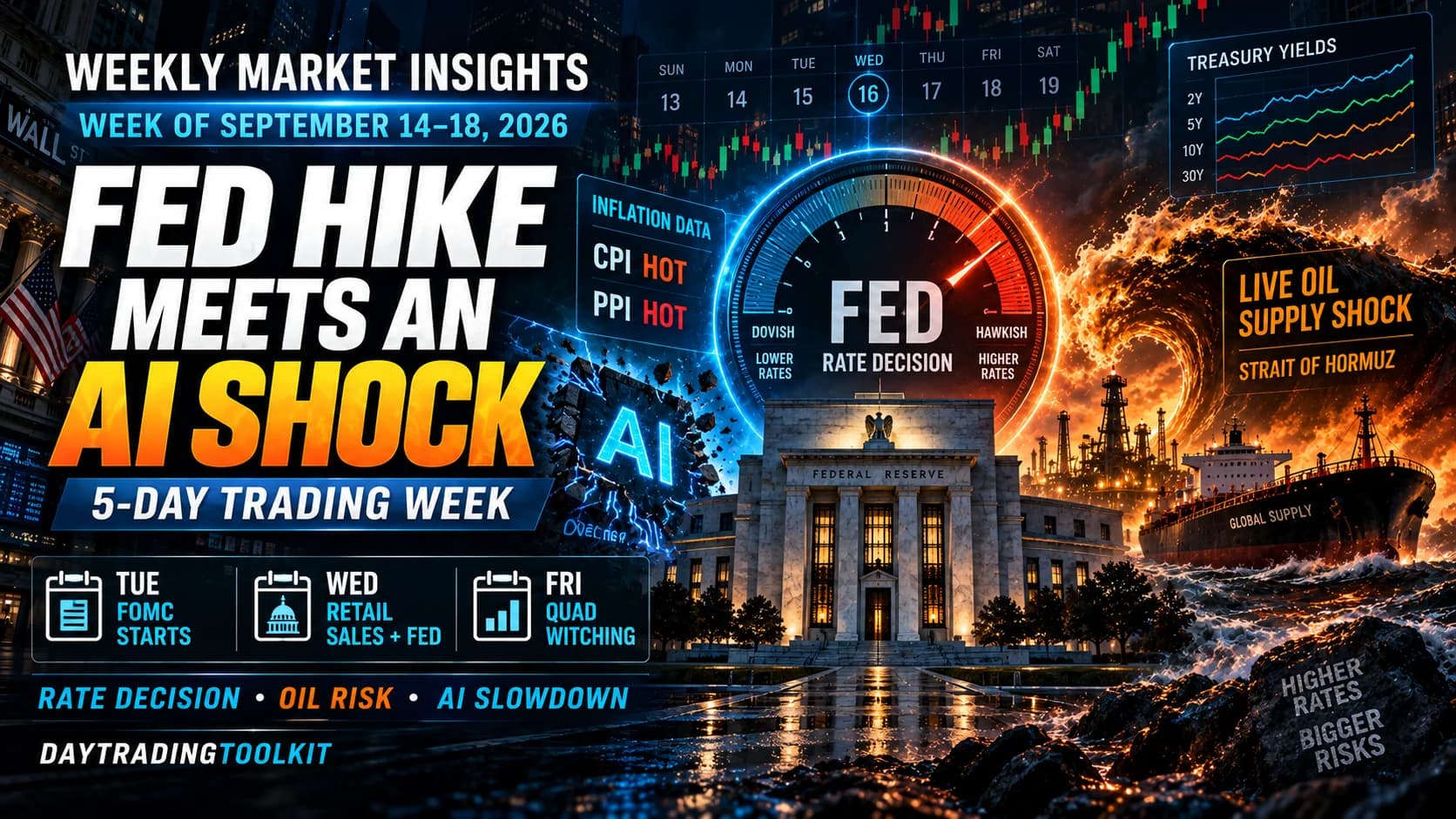
An AI Slowdown Call, a Live Fed Hike, and $108 Oil Collide in One Week: Weekly Market Insights, September 14-18
CME FedWatch has Wednesday's hike odds near 90 percent after a weekend AI slowdown call from Anthropic's CEO hit chip stocks, oil spiked past $107 on a Saudi pipeline shutdown, and Friday's quad witching sets up next Monday's S&P rebalance.
Market Analysis & Insights
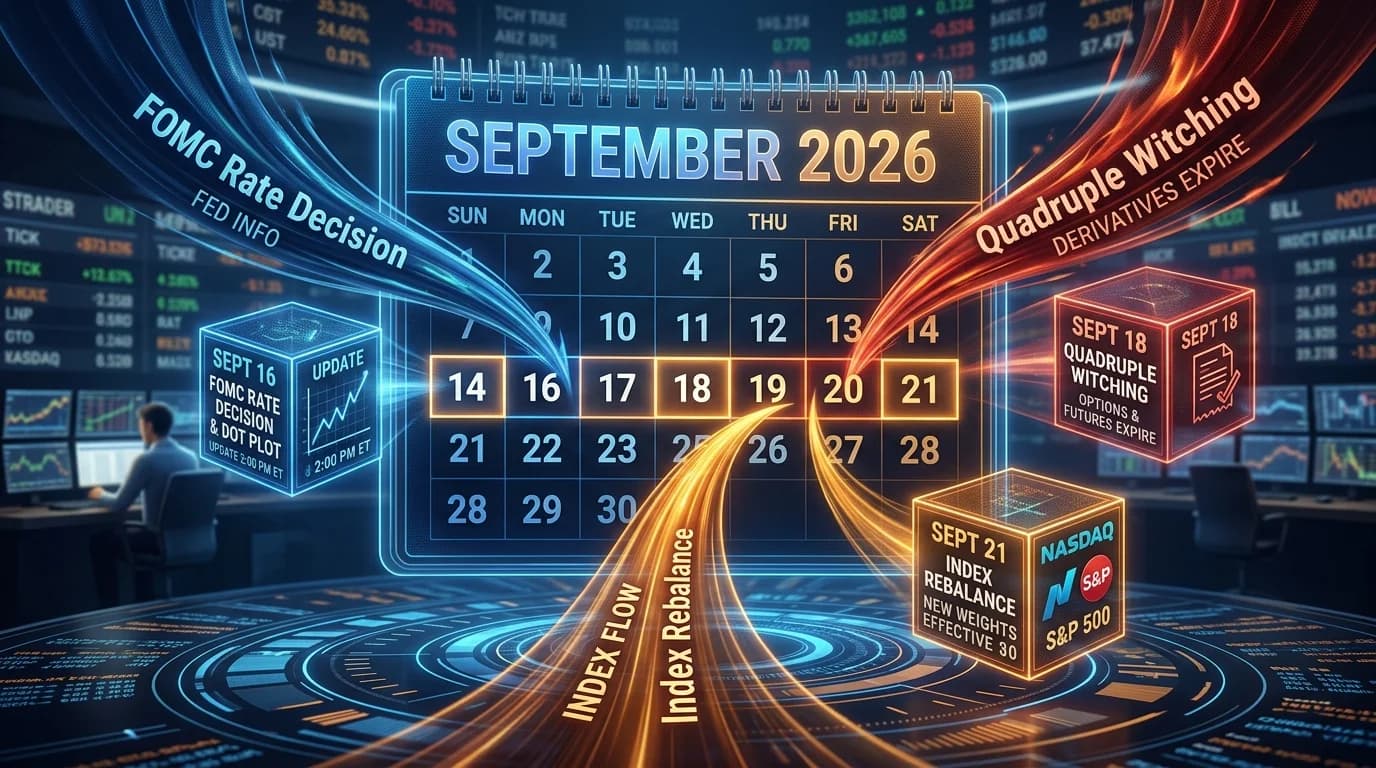
September's Trading Calendar: FOMC, Quad Witching, and the Rebalance All Land in One Week
Three major structural events land in the same five trading days this September: the FOMC's dot-plot meeting, quadruple witching, and the Nasdaq-100/S&P 500 quarterly rebalance. Here's how they interact and how to prepare.
Market Analysis & Insights
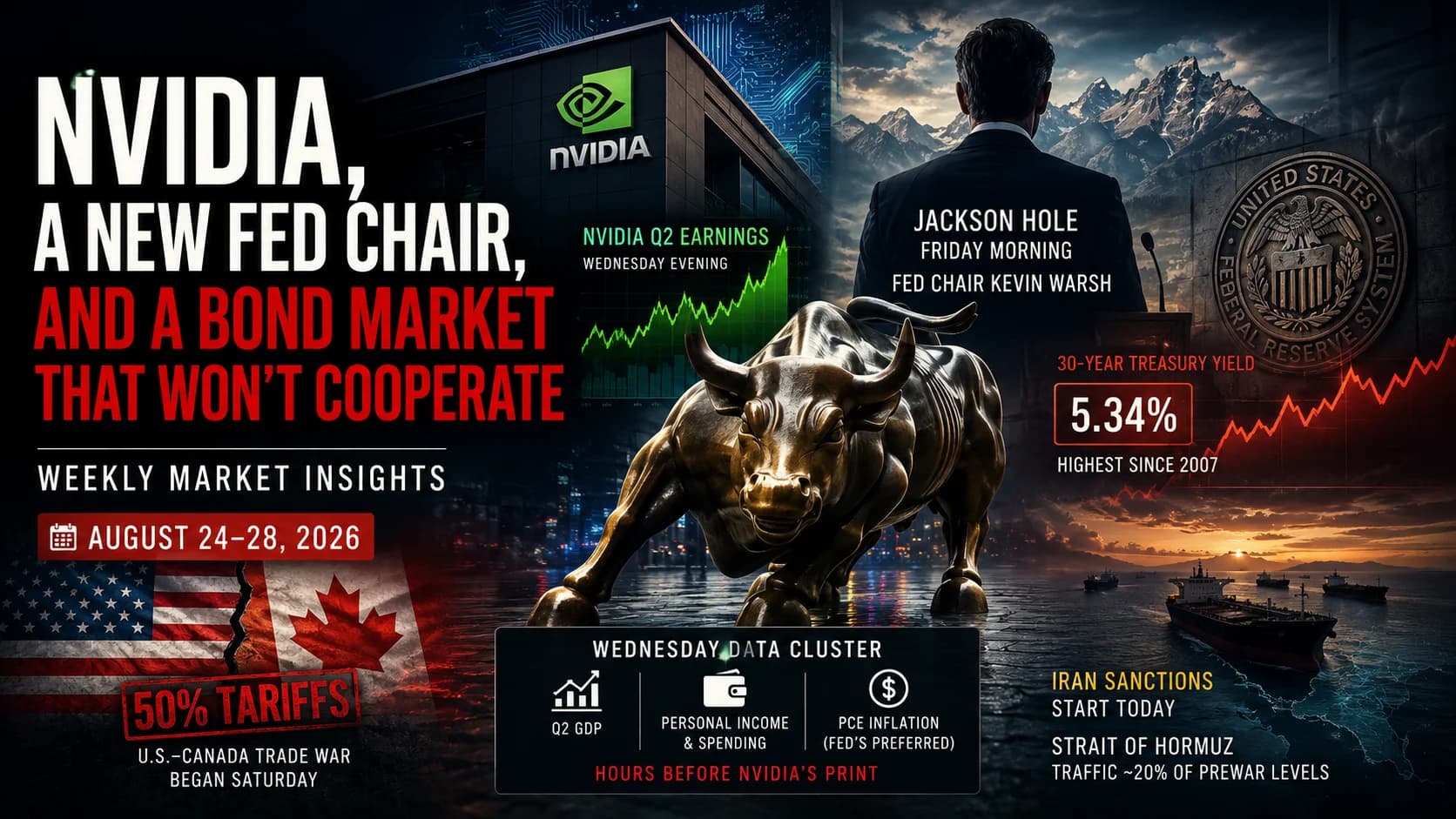
Nvidia, a New Fed Chair, and a Bond Market That Won't Cooperate: Weekly Market Insights, August 24-28
Warsh's first Jackson Hole speech, Nvidia's earnings, and fresh Iran and Canada shocks collide this week. The full Aug 24-28 catalyst map, stock watchlist, and scenario tree for traders.
Market Analysis & Insights
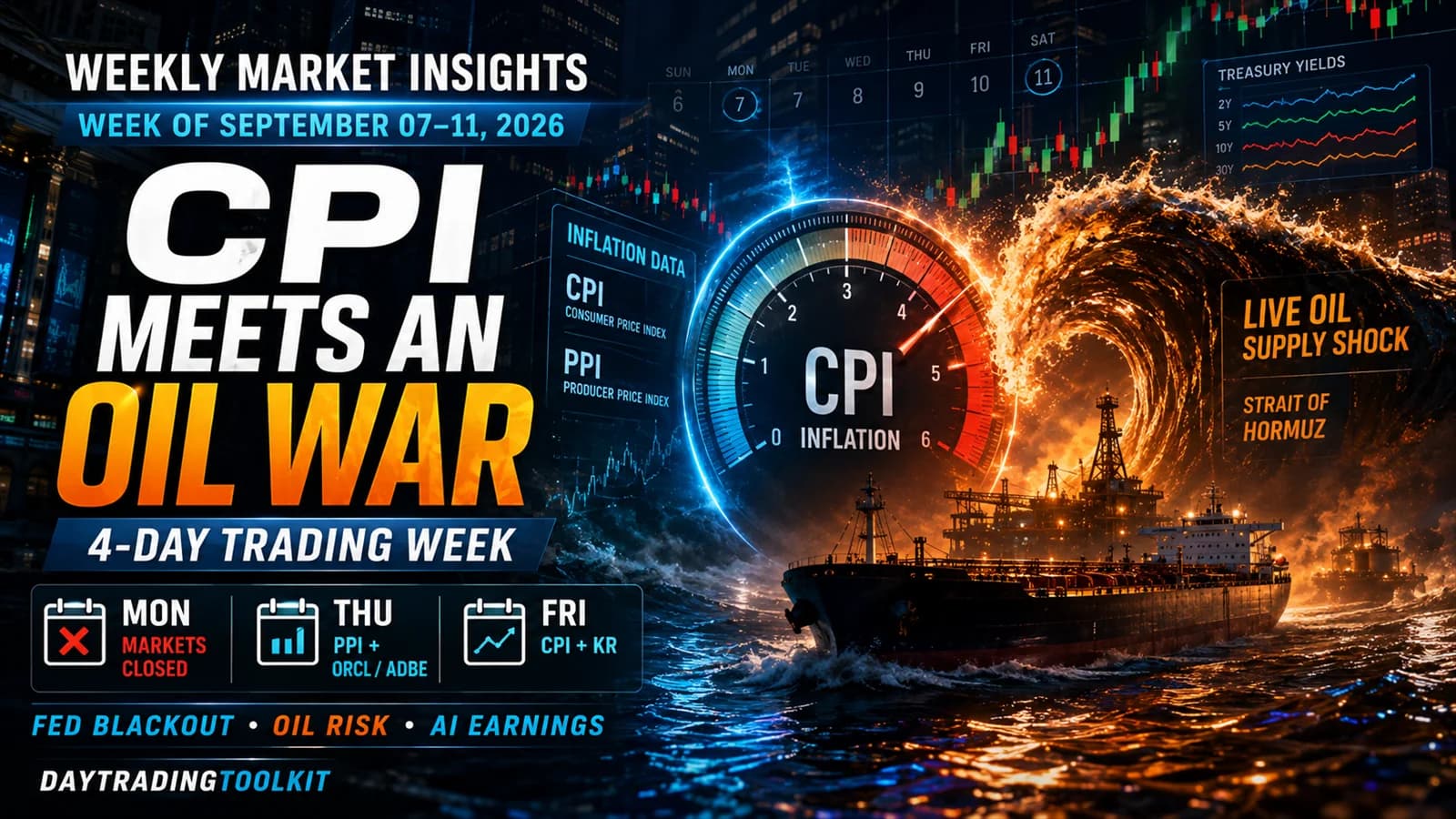
Two Wars, a Trade Fight, and CPI Still Has to Land Clean: Weekly Market Insights, September 7-11
A blowout jobs report already pushed rate-hike odds above 58%. Now a widening Middle East war and a new US-Canada trade fight collide with the last inflation data before the Fed's September 15-16 decision, while Nokia, Compass Pathways, Qualcomm, and Amgen all move on stories the calendar never saw coming.
Comments
No comments yet. Be the first to share your thoughts.