
A stock gaps up 30% on a viral social media post, with barely any real Pre-MarketPre-market trading is the session that occurs between 4:00 AM and 9:30 AM Eastern, before the regular market opens — it allows traders to react to overnight news and earnings reports, establishes where stocks will likely open (the gap), andRead definition → VolumeVolume is the total number of shares (or contracts) traded during a given time period — it's the primary confirmation tool for all price action, because a price move accompanied by high volume indicates genuine market participation, while tRead definition → behind it. That's not a stock preparing to run — it's close to the textbook description of what a decade of academic research has repeatedly found reverses hard once regular trading begins. GapA gap is a price discontinuity on a chart where a stock opens significantly higher or lower than the previous session's close, leaving a visible empty space — gap-ups are driven by overnight buying pressure or positive news; gap-downs by seRead definition → fade is the mirror image of chasing a gapper higher: betting that a specific, identifiable kind of gap gives back its overnight move rather than extending it.
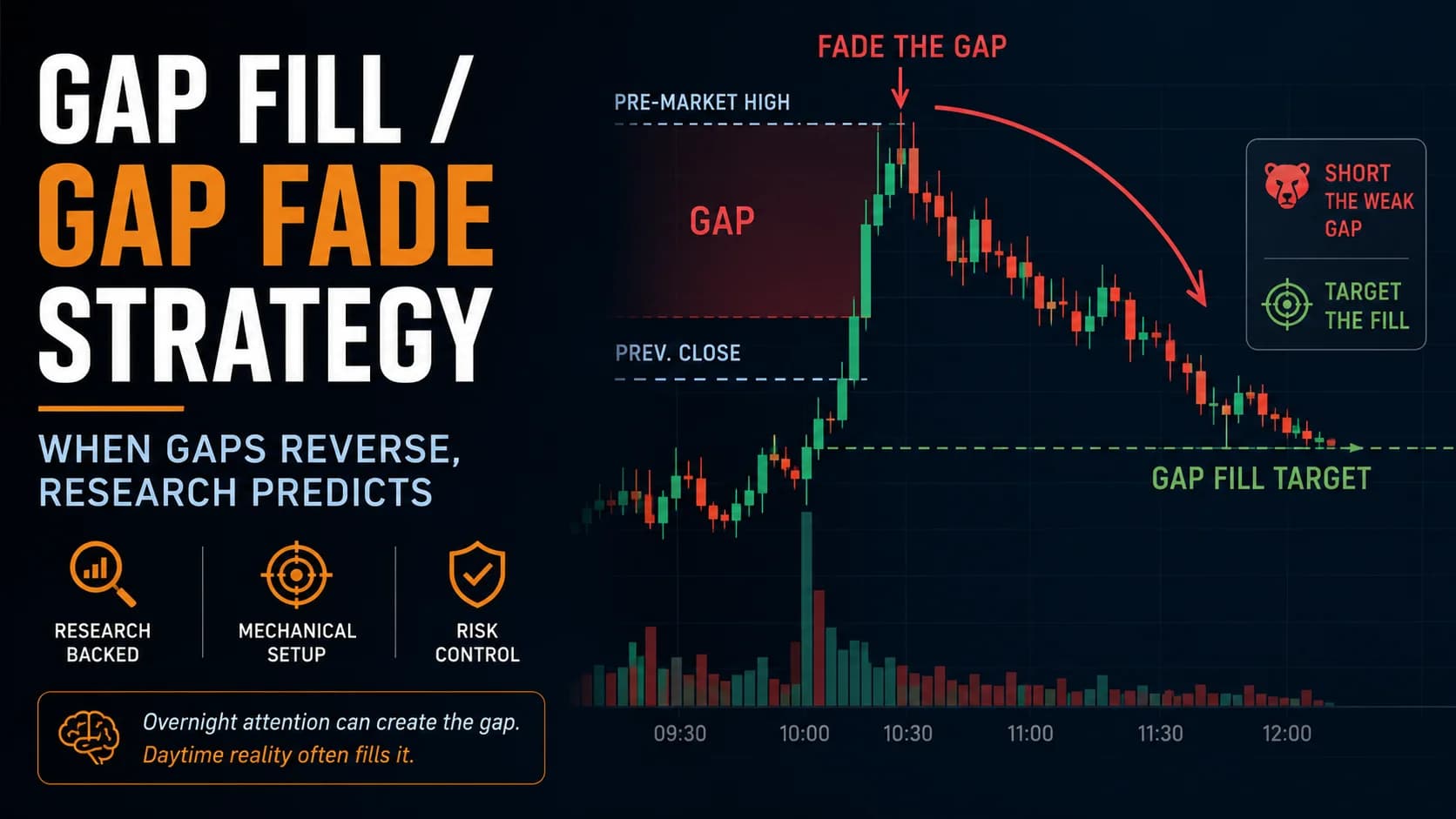
What is the Gap FillA gap fill occurs when price retraces to close the open space left by a gap — returning to the level where the gap originated — and is one of the most reliable statistical tendencies in markets, with studies consistently showing that the maRead definition → / gap fade strategy? Gap fade involves shorting a stock (or buying a gap-down) shortly after the open when the overnight gap shows signs of being driven by attention rather than a durable CatalystA catalyst is the specific event or news item that triggers unusual price movement in a stock — earnings reports, FDA decisions, analyst upgrades, acquisition announcements, product launches, and short squeeze setups are all catalysts. WithRead definition →, betting that price reverses back toward its prior close rather than continuing in the gap's direction. The target is a partial or full "fill" of the gap. Readers who need the basics on why stocks gap in the first place should start there before this deeper treatment.
Why This Is the Mirror Image of Gap and Go
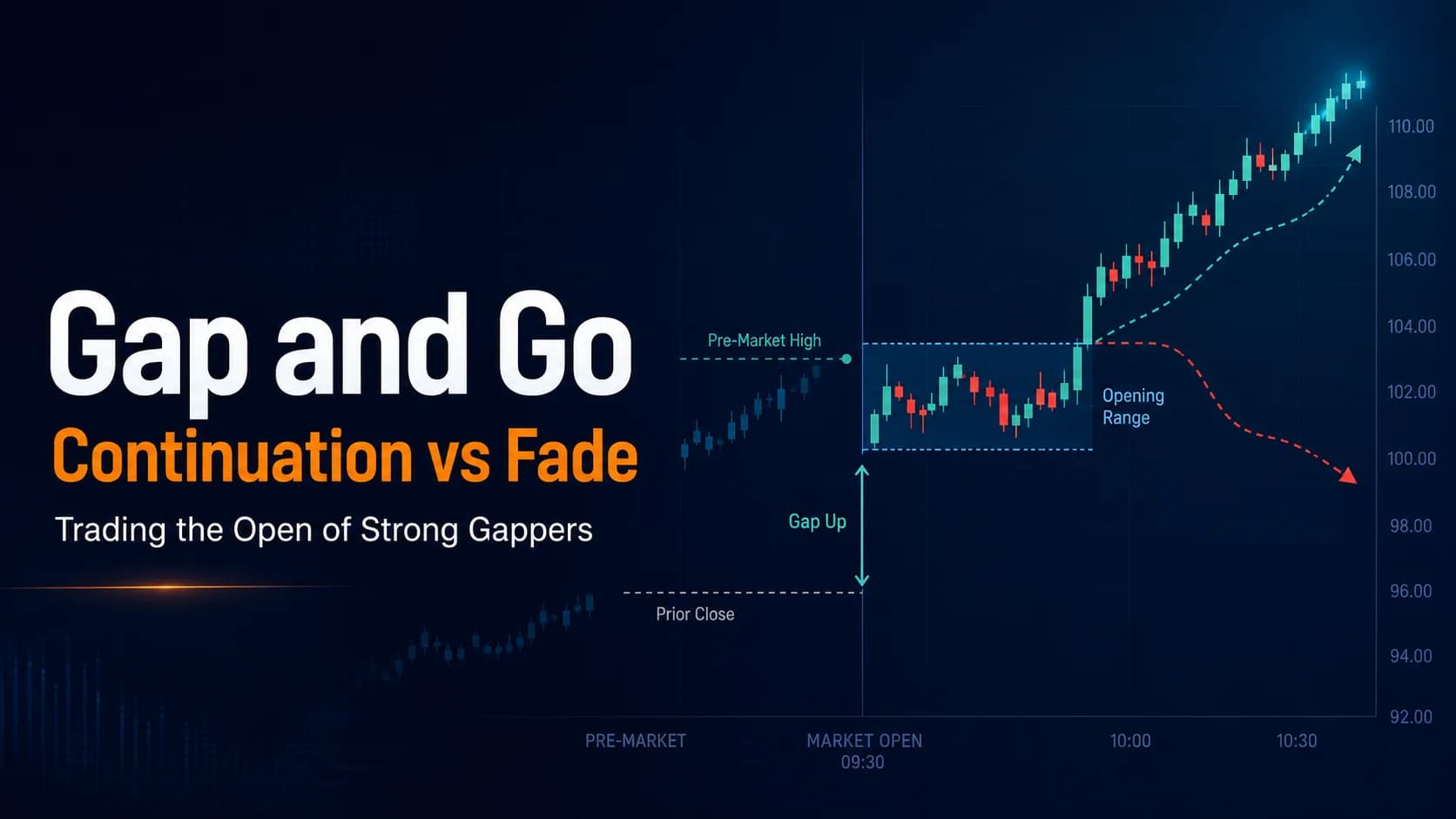
This hub's Gap and Go strategy and this guide are two answers to the exact same question, argued from opposite sides. Both start with the identical piece of evidence — a stock gapped significantly overnight — and both watch the same opening-range mechanics to decide which way to lean. Gap and Go bets the move continues; gap fade bets it doesn't. A gap that fails the entry criteria for one strategy is very often, in the same moment, setting up as a candidate for the other.
That symmetry isn't a coincidence. The research covered below documents that gaps reverse more often than casual assumption suggests, which means the fade side of this trade has a real, repeatedly-confirmed evidentiary basis behind it — arguably a stronger one than the continuation side, at least for the specific population of gaps driven mainly by retail attention rather than a fresh, durable catalyst.
The Research Behind Fading a Gap
This is one of the more thoroughly re-tested findings in market microstructure research, which is worth laying out directly rather than citing a single study in isolation. Berkman, Koch, Tuttle, and Zhang's original 2012 study documented that positive overnight returns are frequently followed by reversals during the trading day, driven by an opening price pushed up by retail demand and concentrated in stocks that had recently attracted heavy attention.
That finding held up under further scrutiny rather than fading with time. Aboody, Even-Tov, Lehavy, and Trueman's 2018 study, published in the same journal, confirmed the pattern using an expanded methodology and found that stocks with unusually high overnight returns tend to underperform over the following weeks — consistent with the overnight move reflecting temporary, sentiment-driven mispricing rather than durable information. A 2022 study by Akbas, Boehmer, Jiang, and Koch pushed the finding further still, framing the pattern as a daily "tug of war" between overnight noise traders and daytime arbitrageurs, and found that stocks experiencing more frequent and intense overnight-to-daytime reversals showed distinct return patterns in the cross-section — evidence that the reversal dynamic is a real, persistent market feature rather than an artifact of one dataset or one decade.
That "tug of war" framing is a genuinely useful mental model for what this strategy is actually trading. Overnight, retail order flow (placed after hours, executed at the open) pushes price up on attention and enthusiasm; during the day, arbitrageurs and other daytime participants trade against that pressure once they have a full session to react, pulling price back toward where the fundamentals actually support it. Fading a gap is a bet on being on the arbitrageur side of that daily tug of war rather than the overnight-sentiment side.
Three separate research teams, publishing a decade apart using different samples and methods, converging on the same basic dynamic is about as strong a foundation as this kind of pattern gets in finance research. That's the case for treating gap fade as a legitimate strategy rather than a fringe contrarian bet.
What Makes a Gap a Genuine Fade Candidate
Not every gap is a fade candidate, any more than every gap is a Gap and Go candidate — and the criteria are close to inverses of each other. A strong fade candidate shows thin or unremarkable pre-market volume relative to the size of the percentage move, a catalyst that's vague, unverified, or purely attention-driven (a social media mention, a chat-room rumor, old news being recirculated) rather than a fresh earnings beat or verified announcement, and often a stock already known for heavy retail attention and light institutional ownership — precisely the profile the research above finds shows the strongest reversal tendency.
The clearest early warning sign shows up right at the open: a gapper that can't hold its pre-market high, showing weakness in the first few minutes rather than continued strength, is behaving exactly like the research's description of overnight sentiment losing its grip once daytime participants (arbitrageurs, in the research's framing) start trading against it.
The Setup Specification: Eight Rules for Fading the Gap
Every component below is a hard rule for identifying and trading a genuine fade candidate.
- Component
- Market Conditions Required
- Rule
- A significant overnight gap lacking a fresh, verifiable, durable catalyst — driven mainly by attention, an unverified rumor, or recirculated old news.
- Component
- Time of Day
- Rule
- Specifically the opening bell through the first 15 to 30 minutes, mirroring the time window this hub's Gap and Go strategy uses for the opposite bet.
- Component
- Stock Selection Criteria
- Rule
- Thin or unremarkable pre-market volume relative to the size of the gap; a history of heavy retail attention and light institutional ownership adds further confirmation.
- Component
- Entry Trigger
- Rule
- Short (for a gap-up fade) once price fails to hold the pre-market high and breaks below the opening range low, confirming the gap isn't extending.
- Component
- Stop Loss
- Rule
- Above the opening range high, or above the pre-market high if that level hasn't yet been tested.
- Component
- Initial Profit Target + Scaling
- Rule
- A partial gap fill — roughly the midpoint between the prior close and the gap high — as a first scale-out, with the full gap fill back to the prior close as an extended target.
- Component
- Trade Management
- Rule
- Cover into continued weakness; trail the stop down behind new lower highs as the fade develops.
- Component
- Invalidation Criteria
- Rule
- A reclaim and hold above the opening range high or pre-market high invalidates the fade — that reclaim is the entry signal for Gap and Go instead.
| Component | Rule |
|---|---|
| Market Conditions Required | A significant overnight gap lacking a fresh, verifiable, durable catalyst — driven mainly by attention, an unverified rumor, or recirculated old news. |
| Time of Day | Specifically the opening bell through the first 15 to 30 minutes, mirroring the time window this hub's Gap and Go strategy uses for the opposite bet. |
| Stock Selection Criteria | Thin or unremarkable pre-market volume relative to the size of the gap; a history of heavy retail attention and light institutional ownership adds further confirmation. |
| Entry Trigger | Short (for a gap-up fade) once price fails to hold the pre-market high and breaks below the opening range low, confirming the gap isn't extending. |
| Stop Loss | Above the opening range high, or above the pre-market high if that level hasn't yet been tested. |
| Initial Profit Target + Scaling | A partial gap fill — roughly the midpoint between the prior close and the gap high — as a first scale-out, with the full gap fill back to the prior close as an extended target. |
| Trade Management | Cover into continued weakness; trail the stop down behind new lower highs as the fade develops. |
| Invalidation Criteria | A reclaim and hold above the opening range high or pre-market high invalidates the fade — that reclaim is the entry signal for Gap and Go instead. |
The invalidation rule is the cleanest illustration of how tightly these two strategies mirror each other: the exact price action that ends a fade trade is the exact price action that begins a Gap and Go trade. Rather than treating that as a coincidence to shrug off, it's worth treating the open of any significant gap as a genuine fork — the same few minutes of price action will point toward one strategy or the other, and the discipline is in recognizing which one is actually happening rather than committing to a read before the bell.
Profit targets are set conservatively for a reason. A partial fill is often reached quickly if the fade is genuine, and locking in a portion of the position there protects the trade before finding out whether the stock continues all the way back to a full fill or stabilizes partway through.
A Minute-by-Minute Walk-Through: Fading a Gap in a Hypothetical Stock
Consider a hypothetical small-cap stock, ticker VWX, gapping up on a viral social media post with no verified company news behind it. None of the prices or events below are real; they're constructed to show the mechanics in action.
VWX closed the prior session at $5.00. Pre-market, it's indicated as high as $6.50 — a 30% gap — but the actual pre-market volume behind that move is thin, only a few hundred thousand shares changing hands despite the large percentage move, a red flag given the size of the gap.
At the open, VWX opens at $6.40 and shows immediate weakness rather than extending. The first five minutes establish an opening range between $5.80 and $6.40, with the candle closing at $5.85 — already well off the pre-market high. A short entry triggers on the next candle breaking below $5.80, around $5.75, with a stop placed above the opening range high at $6.40 (with a small buffer).
VWX continues fading through the next 20 minutes, reaching the partial-fill target near $5.70 quickly, where a portion of the position covers. The stock keeps drifting down through the rest of the morning, eventually testing the full-fill level at $5.00 — the prior session's close — where the remainder of the position covers. Along the way, VWX briefly attempts a bounce back to $6.00 before failing again, a reminder that a fade rarely moves in a straight line even when the overall thesis is correct.
Notice that the trade never required a specific news catalyst to explain the reversal — the setup was built entirely from the mismatch between the size of the pre-market move and the thinness of the volume supporting it, exactly the profile the research above associates with a sentiment-driven, reversal-prone gap.
Managing the Trade as the Fade Develops
Cover into continued weakness rather than waiting for the full fill to feel certain — if the fade is genuine, the stock keeps giving back the overnight gain, and there's no requirement to hold the entire position for one all-or-nothing target.
Trail the stop down behind new lower highs as the fade develops, the same discipline this hub applies to every momentum-adjacent setup, just applied to a position moving in the opposite direction. The one rule that overrides the others: a reclaim and hold above the opening range high ends the fade thesis immediately, regardless of how compelling the reversal looked minutes earlier.
Where This Strategy Fails: When the Gap Actually Has Real Legs
The dominant failure mode is fading a gap that turns out to have genuine fundamental backing. This hub's Gap and Go guide covers research on post-earnings-announcement drift showing that gaps built on real earnings surprises can continue drifting in that direction for an extended period — exactly the population of gaps this fade strategy should be screening out, not targeting. A fade entered on a stock with a real, verified, material catalyst is betting against a documented tendency toward continuation rather than with a documented tendency toward reversal.
A second failure mode is a delayed continuation: a gap that shows initial weakness, tempting a fade entry, before finding renewed buying and reclaiming the opening range high later in the morning. This is precisely why the invalidation rule exists as a hard, mechanical level rather than a feeling that the fade "should" still work — a reclaim of that level is treated as the setup failing, full stop, not a temporary annoyance to hold through.
Adapting the Setup Across Gap Directions and Targets
Everything above applies in mirror image to a gap-down: buying a stock that gapped down on thin volume and an unverified or already-priced-in negative catalyst, entering once it fails to hold its pre-market low and reclaims the opening range low, targeting a partial and then full fill back toward the prior close.
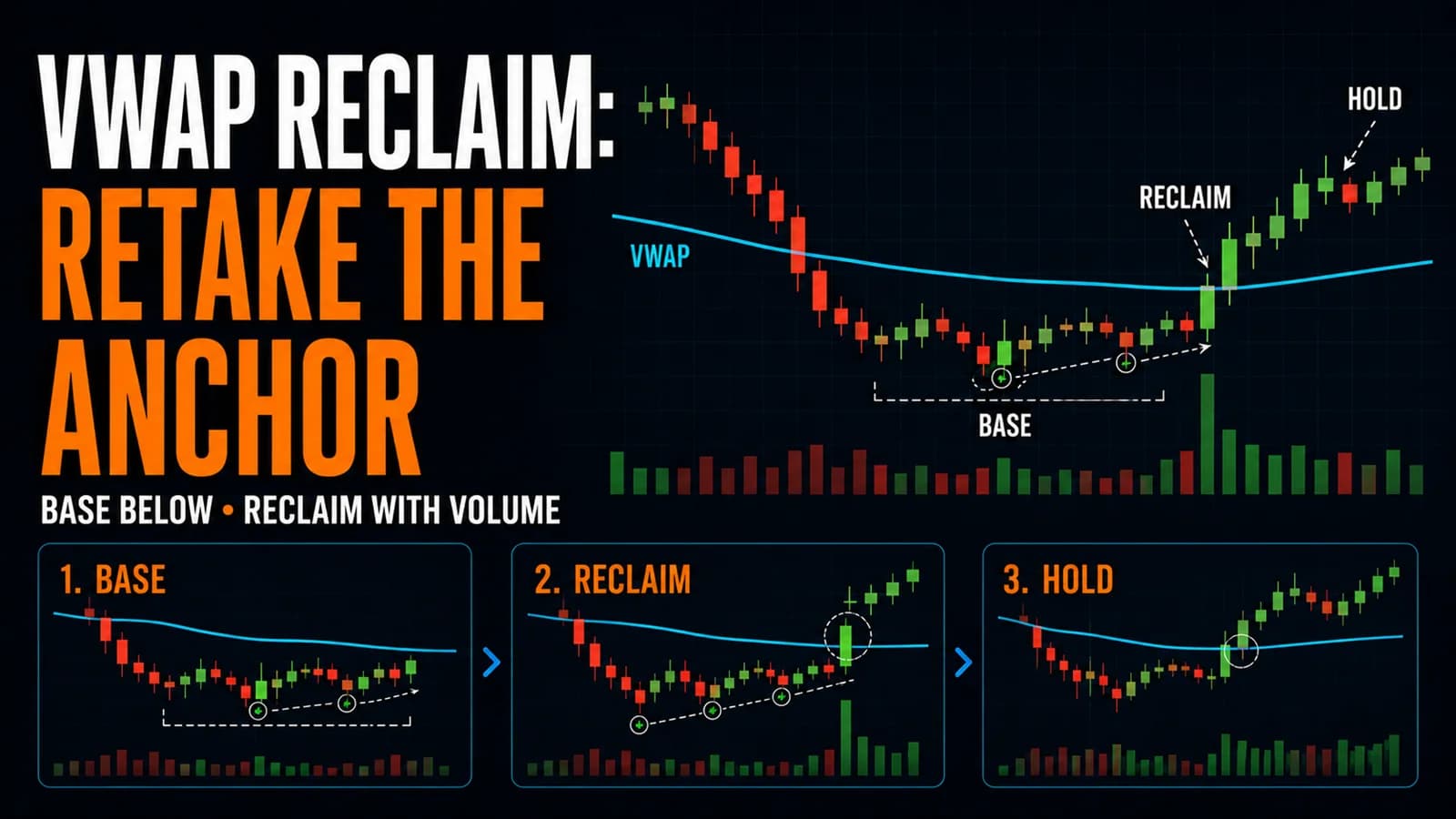
VWAP often serves as a useful intermediate reference alongside the partial and full gap-fill levels, since it reflects the average price paid during the session and frequently sits between the extremes of the gap and the prior close. Some traders use a VWAP reclaim or rejection as a secondary confirmation layer on top of the opening-range mechanics described in the setup specification.
Scanning for Fade Candidates Before the Open
Manually checking pre-market volume against gap size across a broad watchlist isn't practical without a scanning tool built for the comparison. A useful pre-market scan flags stocks with a large percentage gap but comparatively thin pre-market volume, and where available, surfaces whether the apparent catalyst is a verified company announcement or unconfirmed chatter.
Trade Ideas is built to run this kind of pre-market scan as a comprehensive scanning and research platform, surfacing gap size alongside pre-market volume and built-in charting to review each candidate's opening range as the session develops. The scan narrows the field to genuine candidates; confirming the actual failure to hold the pre-market high still governs the entry.
Sizing the Gap Fade Trade Inside a Broader Plan
This strategy shares its sizing discipline with the rest of this hub's momentum-adjacent setups: risk defined in R-multiples against the actual stop level — the opening range high or pre-market high — rather than a fixed share count carried over out of habit.
The psychological challenge here runs in the opposite direction from Gap and Go's FOMO trap: shorting a stock that just gapped up 30% requires tolerating the discomfort of betting against a move that still looks exciting to everyone watching it, particularly in the first few minutes before the fade has fully confirmed. This hub's guide to managing fear and greed covers the discipline required to act on a contrarian read when the crowd is still enthusiastic. This strategy belongs on the Strategies Hub as the evidence-backed mirror to Gap and Go — useful precisely because the research behind fading a hype-driven gap is, if anything, better established than the case for chasing one.
Common Questions About Trading Gap Fill and Gap Fade
How is this different from Gap and Go?
A gap that fails Gap and Go's entry criteria (thin volume, weak catalyst, failure to hold the pre-market high) is very often, in that same moment, meeting this strategy's entry criteria instead. The two strategies are best understood as a single framework for reading a gap's open, pointing toward one trade or the other depending on what actually happens.
Key Takeaway: Approach every significant gap as a fork between these two strategies rather than committing to one read before the session opens.
Is the research behind fading a gap actually solid, or is this contrarian folklore?
That doesn't make every gap a guaranteed fade; it means the underlying tendency this strategy exploits has held up under repeated, independent scrutiny across a full decade rather than appearing in one dataset and disappearing under later testing.
Key Takeaway: This is one of the more thoroughly replicated findings underlying any setup on this hub, which is a reason for confidence in the general pattern, not a guarantee for any single trade.
What's the clearest early warning sign a gap is a fade candidate?
A large gap on genuinely light volume suggests the move reflects a small number of aggressive buyers rather than broad, informed participation — exactly the profile the research above associates with sentiment-driven mispricing rather than durable news being priced in.
Key Takeaway: Compare volume to gap size before anything else — a big percentage move on thin volume is a warning sign, not a reason for excitement.
Why does the invalidation rule matter so much for this specific setup?
Holding a fade position through a reclaim of the opening range high means fighting against the same evidence that would justify a completely different trade in the opposite direction. The rule exists specifically to prevent that.
Key Takeaway: A reclaim of the opening range high isn't noise to trade around — it's the market telling you which of the two mirror-image strategies is actually happening.
Does this strategy work on gap-downs too?
The same red flags apply in mirror image: thin volume relative to the size of the gap, a vague or unconfirmed catalyst, and a stock with a track record of heavy retail attention are all the same warning signs, just pointing toward a bounce instead of a fade.
Key Takeaway: The framework is direction-agnostic — only the direction of the trade and the specific levels change.
What's a reasonable first target when fading a gap?
VWAP often sits usefully between these levels and can serve as an additional reference point, since it reflects the average price paid during the session rather than just the two endpoints of the gap.
Key Takeaway: Scale out in stages rather than holding the entire position for a single full-fill target that may or may not be reached.
Can a genuine catalyst still produce a gap worth fading?
That's exactly why verifying the catalyst matters as much as checking the volume. A gap with a confirmed, material earnings beat behind it is a weaker fade candidate and a stronger candidate for the continuation strategy covered elsewhere on this hub.
Key Takeaway: Treat a verified, material catalyst as a reason to lower confidence in a fade, not a detail to overlook.
How does VWAP fit into this strategy?
A stock that loses its VWAP after failing to hold the pre-market high adds a second, independent piece of evidence pointing toward a genuine fade, beyond the opening-range structure alone.
Key Takeaway: Use VWAP as a supporting reference point, not a replacement for the opening-range entry and invalidation rules.
Why is thin pre-market volume such an important red flag?
Genuine, durable moves tend to attract real volume well before the open; a gap that's mostly a thin, illiquid quote moving on a few trades is a structurally weaker foundation regardless of how dramatic the percentage change looks.
Key Takeaway: A gap's percentage size means little without checking whether real volume actually supports it.
Does shorting a hype-driven gapper come with the same borrow concerns as other short strategies on this hub?
Checking share availability and the borrow fee before sizing a fade trade is part of running this setup correctly, not an afterthought — a great mechanical setup on paper is worth little if the shares aren't actually available to short at a reasonable cost.
Key Takeaway: Confirm locate availability and borrow cost before assuming the mechanical entry rules alone make the trade viable.
Disclaimer
Article Sources
- Berkman, Koch, Tuttle & Zhang (2012), "Paying Attention: Overnight Returns and the Hidden Cost of Buying at the Open", Journal of Financial and Quantitative Analysis - the original documentation of overnight gains reversing during the trading day, concentrated in high-attention stocksideas.repec.org
- Aboody, Even-Tov, Lehavy & Trueman (2018), "Overnight Returns and Firm-Specific Investor Sentiment", Journal of Financial and Quantitative Analysis - confirms the pattern and finds high overnight-return stocks underperform over the following weekscambridge.org
- Akbas, Boehmer, Jiang & Koch (2022), "Overnight Returns, Daytime Reversals, and Future Stock Returns", Journal of Financial Economics - the most recent confirmation, framing the pattern as a daily "tug of war" between overnight and daytime traderssciencedirect.com