
A stock gaps up 20% before the open on real news, and the instinct is to assume it keeps climbing once the bell rings. Academic research on overnight price gaps says the opposite is more often true: a large GapA gap is a price discontinuity on a chart where a stock opens significantly higher or lower than the previous session's close, leaving a visible empty space — gap-ups are driven by overnight buying pressure or positive news; gap-downs by seRead definition → up frequently reverses during the trading day rather than continuing. Gap and GoA momentum strategy where a trader enters a stock that gapped up (or down) at the open and continues moving in the direction of the gap — rather than filling it. The trader bets that the catalyst driving the gap is strong enough to sustain Read definition → isn't a bet that every gap "goes" — it's a bet on identifying the specific minority of gaps that do, and having a mechanical reason to be in one before it happens rather than after.
What is the Gap and Go strategy? Gap and Go involves buying a stock at or shortly after the open when it has gapped up significantly overnight on real VolumeVolume is the total number of shares (or contracts) traded during a given time period — it's the primary confirmation tool for all price action, because a price move accompanied by high volume indicates genuine market participation, while tRead definition → and a real CatalystA catalyst is the specific event or news item that triggers unusual price movement in a stock — earnings reports, FDA decisions, analyst upgrades, acquisition announcements, product launches, and short squeeze setups are all catalysts. WithRead definition →, betting that the move continues through the early session rather than fading. It's a momentum strategy specifically anchored to the opening bell, rather than a setup that can develop at any point in the session. Readers who need a refresher on why stocks gap and what causes it should start there before this deeper treatment.
Why Most Gaps Don't "Go": The Research on Overnight Reversals
This is worth confronting directly rather than glossing over. Berkman, Koch, Tuttle, and Zhang's 2012 study documented a strong pattern of positive overnight returns followed by reversals during the trading day — driven by an opening price pushed high by retail investor demand, concentrated in stocks that had recently attracted heavy attention. The reversal was more pronounced specifically in stocks that are harder to value and more costly to arbitrage — a description that fits a large share of the small-cap, low-FloatFloat is the number of shares of a company that are actually available for public trading — it excludes shares held by insiders, major institutions with lock-ups, and the company itself.Read definition → names this setup typically targets.
That finding doesn't mean gap trading is a bad idea; it means treating every gap as an automatic "go" is a mistake the research specifically warns against. A gap driven mostly by retail attention and hype, with no fresh fundamental substance behind it, is closer to the pattern Berkman and his co-authors documented reversing. The setup below exists to filter for the gaps that have a genuine, defensible reason to continue rather than trading every green pre-market screen.
What Separates a Real Continuation From a Retail-Driven Fade
The clearest evidence of a defensible reason to continue is a real earnings or fundamental catalyst, not just news volume or social media attention. Bernard and Thomas's classic 1989 study on post-earnings-announcement drift found that stocks with strong positive earnings surprises continued drifting upward for an extended period afterward — sometimes weeks — because the market doesn't fully incorporate the news immediately. A gap driven by a genuine earnings beat, a major contract win, or clinical trial results has that underreaction dynamic working in its favor, at least for the session or two immediately following the news.
A gap driven purely by a viral social media mention or an unverified rumor has no such foundation — it's closer to the pure attention-driven pattern the reversal research documents. Neither type of gap is guaranteed to behave a specific way, but weighting a fundamentally-grounded gap more heavily than a purely hype-driven one is a reasonable, evidence-informed way to filter candidates before the open. Checking whether a gap's catalyst is verifiable through a primary source — an actual earnings release, an official company announcement, a regulatory filing — versus a screenshot or a chat-room claim with no clear origin is a fast, practical version of this same filter applied in real time.
Genuine intraday momentum research adds one more piece: Gao, Han, Li, and Zhou's 2018 study, covered in more depth in this hub's general momentum guide, found that the return during a session's first half hour carries real predictive information about the rest of the session — a pattern stronger on higher-volume, higher-volatility days. That's directly relevant here: a gapper that holds and extends through the first 30 minutes on continued volume is showing exactly the signature that research associates with genuine continuation, which is a meaningfully different situation than a gap that immediately starts fading in the first few minutes.
The Setup Specification: Eight Rules for Trading the Open
Every component below is a hard rule for this specific, time-anchored version of momentum trading.
- Component
- Market Conditions Required
- Rule
- A significant overnight gap — commonly 10% or more for smaller-cap names, less for large caps — on genuine pre-market volume, not just a headline with no real trading behind it.
- Component
- Time of Day
- Rule
- Specifically the opening bell through the first 15 to 30 minutes; this is a time-anchored setup, unlike momentum trades that can develop at any point in the session.
- Component
- Stock Selection Criteria
- Rule
- A real, identifiable catalyst, weighted more heavily toward earnings or fundamental news than pure social-media attention; float size shapes how sharp the move can get.
- Component
- Entry Trigger
- Rule
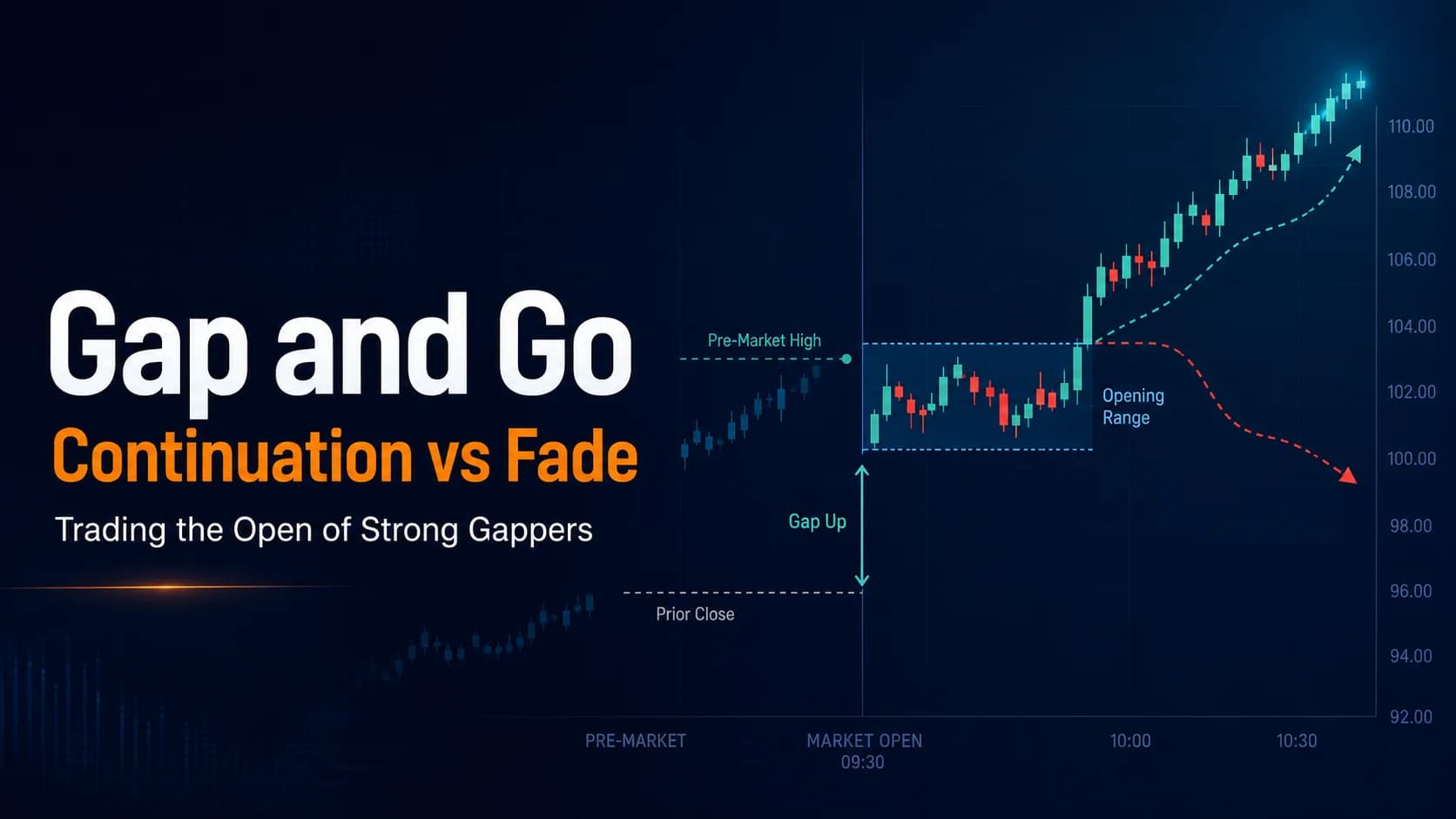
- Conservative version: wait for the opening range (the first one to five minutes) to establish, then enter on a break above that range's high with continued volume. Aggressive version: enter at the open if price holds above the pre-market high immediately.
- Component
- Stop Loss
- Rule
- Below the opening range low, or below the pre-market high if that level is reclaimed as support after an initial break above it.
- Component
- Initial Profit Target + Scaling
- Rule
- Scale into continued strength rather than fixing one static target, consistent with this hub's broader momentum framework; the goal is riding genuine continuation, not hitting one predetermined number.
- Component
- Trade Management
- Rule
- Trail the stop behind new higher lows as the move develops through the morning; add to a working position on continued confirmation.
- Component
- Invalidation Criteria
- Rule
- A reclaim of the pre-market high from above (failure to hold the gap), or a break of the opening range low — either signals the "go" isn't happening and the gap may instead be setting up to fade.
| Component | Rule |
|---|---|
| Market Conditions Required | A significant overnight gap — commonly 10% or more for smaller-cap names, less for large caps — on genuine pre-market volume, not just a headline with no real trading behind it. |
| Time of Day | Specifically the opening bell through the first 15 to 30 minutes; this is a time-anchored setup, unlike momentum trades that can develop at any point in the session. |
| Stock Selection Criteria | A real, identifiable catalyst, weighted more heavily toward earnings or fundamental news than pure social-media attention; float size shapes how sharp the move can get. |
| Entry Trigger | Conservative version: wait for the opening range (the first one to five minutes) to establish, then enter on a break above that range's high with continued volume. Aggressive version: enter at the open if price holds above the pre-market high immediately. |
| Stop Loss | Below the opening range low, or below the pre-market high if that level is reclaimed as support after an initial break above it. |
| Initial Profit Target + Scaling | Scale into continued strength rather than fixing one static target, consistent with this hub's broader momentum framework; the goal is riding genuine continuation, not hitting one predetermined number. |
| Trade Management | Trail the stop behind new higher lows as the move develops through the morning; add to a working position on continued confirmation. |
| Invalidation Criteria | A reclaim of the pre-market high from above (failure to hold the gap), or a break of the opening range low — either signals the "go" isn't happening and the gap may instead be setting up to fade. |
The entry rule's two versions reflect a real tradeoff. The conservative, opening-range version gives up some of the earliest move in exchange for confirmation that buyers are actually in control once regular trading begins — the first few minutes after the open are often the most chaotic and least informative part of the session. The aggressive version captures more of the move but accepts more risk of getting caught in exactly the kind of immediate reversal the research above warns is common.
The invalidation rule deserves particular attention because it directly mirrors the mirror-image strategy this hub covers elsewhere in this module: a gap that fails to hold and instead reverses back toward its prior close is the setup for fading the gap rather than riding it. Recognizing that failure quickly — rather than hoping the "go" still arrives — is what keeps a wrong read from turning into a bigger loss.
A Minute-by-Minute Walk-Through: Trading a Gap in a Hypothetical Stock
Consider a hypothetical small-cap stock, ticker STU, following a strong earnings beat released before the market open. None of the prices or events below are real; they're constructed to show the mechanics in action.
STU closed the prior session at $8.20 and trades up sharply in pre-market on the earnings news, with real volume already building well before 9:30 AM — not just a quote moving on a handful of shares. By the open, STU is indicated around $10.50, roughly a 28% gap, with the pre-market high sitting at $10.80.
In the conservative approach, the first five minutes are allowed to establish an opening range: STU opens at $10.55, dips to $10.20, and climbs back to close that opening 5-minute candle at $10.75 — a range of $10.20 to $10.75. The entry triggers on the next candle breaking above $10.75 with continued volume, around $10.80 to $10.85, with a stop placed below the opening range low at $10.20.
STU continues higher through the next 20 minutes, reaching $11.60 before pulling back to a higher low near $11.20. The stop trails up behind that higher low. A portion of the position is scaled out into strength near $12.00, with the remainder trailing as long as the pattern of higher lows and elevated volume continues.
By 10:30, volume noticeably slows and STU prints a lower high near $12.30 before breaking its most recent higher low. That structural break closes the remaining position, regardless of what STU does through the rest of the session.
Managing the Trade Through the Morning
The same discipline this hub applies to momentum trades generally applies here: trail the stop behind confirmed structure, scale out in stages rather than all at once, and let a working position keep working instead of exiting the moment the trade starts feeling uncomfortable to still be holding.
The one rule that overrides the others: if the stock reclaims the pre-market high from above, or breaks the opening range low, treat that as the setup failing rather than a dip to hold through. That specific failure is the signal the gap may be setting up to fade back toward its prior close instead of continuing.
Where This Strategy Fails: The Immediate Fade and the Halt Risk
The dominant failure mode is exactly what the research covered above documents: a gap driven mostly by retail attention and hype fades within the first few minutes of trading, as the buying pressure that pushed the pre-market price higher runs out and initial sellers take profits into the open. This is precisely why the entry rules require confirmation — an opening range break, continued volume — rather than buying the pre-market quote directly.
A second, more mechanical risk is specific to this setup: volatility halts. Exchanges can halt trading in a stock that moves too far too fast, and a halted stock can reopen at a dramatically different price than where it was halted — in either direction. A position held into a halt carries real uncertainty that a position in a continuously-trading stock doesn't, and traders working this setup on genuinely volatile, low-float names need to understand that risk exists before it happens, not while staring at a frozen quote. Checking a stock's halt history and typical volatility before sizing a position is a reasonable habit specifically for this setup, since the most explosive Gap and Go candidates are often the same names most prone to triggering a halt.
The mirror-image read is worth naming directly: a gap that fails to hold isn't just a loss to absorb and move on from — it's the setup this hub covers elsewhere in this module for fading a gap back toward its prior close, built on the same reversal research discussed above. The two strategies are opposite bets on the same underlying phenomenon, and recognizing which one a given morning is actually producing matters more than committing to one read before the open.
Adapting the Setup Across Catalysts and Float Sizes
Earnings-driven gaps carry the PEAD-style underreaction logic in their favor most directly, since that research specifically studied earnings surprises. News-driven gaps — a contract win, a regulatory approval, a major partnership — carry a similar underreaction logic to varying degrees depending on how material and how quickly-digestible the news actually is. Pure sentiment or social-media-driven gaps carry the least fundamental backing and deserve the most skepticism and the tightest confirmation requirements before entry.
Float size shapes the character of the move without changing the core mechanics. A low-float name can gap-and-go with extreme velocity, covering a large percentage move in minutes; a larger-float name generally produces a steadier, less explosive version of the same pattern, requiring more genuine volume to move the same percentage distance.
This setup can also apply to gap-downs on the short side, using the identical logic in reverse: a stock gapping down hard on negative news, holding below its pre-market low through an opening range, and continuing to break down on volume.
Scanning for Gap Candidates Before the Open
Manually reviewing pre-market movers across the whole market every morning isn't practical without a dedicated scanning tool. A useful pre-market scan filters for percentage gap size, pre-market volume, and where available, a news or catalyst flag, to separate genuine candidates from stocks whose quote moved on a handful of pre-market shares with no real volume behind it.
Trade Ideas is built to run this kind of pre-market scan as a comprehensive scanning and research platform, surfacing gappers by percentage move and pre-market volume before the bell, with built-in charting to review each candidate's opening range as the session develops. The scan narrows the field to genuine candidates; confirming the actual opening-range break still governs the entry.
Sizing the Gap and Go Trade Inside a Broader Plan
This is a specific, time-anchored application of the general momentum framework covered elsewhere on this hub, and it inherits the same sizing discipline: risk defined in R-multiples against the actual stop level — the opening range low or the pre-market high — rather than a fixed share count applied out of habit.
The specific psychological trap here is acting on the pre-market quote itself rather than waiting for the open to actually confirm anything. A stock indicated up 30% in thin pre-market trading feels like an opportunity slipping away with every passing minute, and that urgency is exactly what pushes traders to skip the confirmation the setup requires. This hub's guide to FOMO in trading covers this exact trap in more depth, and the broader discipline of staying patient and objective applies directly to waiting for the opening range to actually confirm before acting. This strategy belongs on the Strategies Hub as a specific application of momentum trading anchored to the open — useful precisely because it insists on the "go" actually happening before committing capital, not because every gap deserves the same confidence.
Common Questions About Trading Gap and Go
Do most gaps actually continue, or is that a misconception?
That doesn't make gap trading unworkable; it means the setup's value comes from filtering for the specific gaps with a genuine, defensible reason to continue — real earnings or fundamental news, confirmed volume, a held opening range — rather than treating every green pre-market screen the same way.
Key Takeaway: Approach every gap with the base-rate assumption that reversal is at least as likely as continuation, and let confirmation change that assumption on a case-by-case basis.
How is this different from the general momentum strategy covered elsewhere on this hub?
Every Gap and Go setup is a momentum trade, but not every momentum trade is a Gap and Go — a stock that starts moving hard at 1 PM on breaking news uses the same underlying momentum logic without any gap or opening-bell component at all.
Key Takeaway: Gap and Go is the opening-bell-specific application of the broader momentum framework, not a separate strategy built from different principles.
What's the difference between the aggressive and conservative entry?
Neither is strictly correct — it's a tradeoff between capturing more of a genuine continuation and reducing exposure to the immediate reversals the research above documents as common in the first few minutes of trading.
Key Takeaway: More aggressive entries trade confirmation for speed; more conservative entries trade speed for confirmation.
What size gap and pre-market volume actually qualify as a real candidate?
Volume matters as much as the percentage gap itself. A large percentage gap on almost no pre-market volume is a thin, unreliable quote rather than a real signal that genuine participants are already trading the stock ahead of the open.
Key Takeaway: Treat pre-market volume as a filter every bit as important as the size of the gap itself.
Does the catalyst type actually matter for whether a gap continues?
That's a reasonable basis for weighting an earnings or fundamental-news gap more heavily than a purely sentiment-driven one, without treating either category as a guarantee of what the stock does next.
Key Takeaway: A real fundamental catalyst earns more confidence than hype alone, though neither eliminates the need for confirmation.
What's the biggest risk specific to trading gaps at the open?
This is why the entry rules require confirmation rather than acting on the pre-market quote directly. A stock that fades hard in the first few minutes is showing the failure mode directly, and the invalidation rule exists specifically to exit that situation quickly rather than hoping the "go" still arrives later.
Key Takeaway: Confirmation exists specifically to filter out the immediate-fade population of gaps before capital is committed.
Why are trading halts a specific concern for this setup?
This risk concentrates in exactly the volatile, low-float names that produce the sharpest Gap and Go setups, which means the same characteristics that make a stock an exciting candidate also make halt risk a real, specific consideration.
Key Takeaway: A held position through a halt carries genuine uncertainty — understand that risk exists in volatile names before it happens, not while watching a frozen quote.
What about fading a gap instead of riding it?
Both strategies are legitimate responses to the same underlying phenomenon; the entry rules and invalidation criteria in this guide are specifically designed to help distinguish which behavior a given gap is actually showing before committing to either read.
Key Takeaway: A failed Gap and Go setup and a working gap-fade setup are often the same trade viewed from opposite sides.
How long should a Gap and Go trade typically be held?
There's no fixed holding period — the position stays open as long as the trailing structure holds and exits the moment that structure breaks, which in practice means most Gap and Go trades resolve, one way or the other, well before midday.
Key Takeaway: Let the trailing stop and structure — not a clock — determine how long the position stays open.
Does this setup only work on small-cap stocks, or can large-caps gap and go too?
A large-cap stock rarely gaps 20% or 30% the way a small-cap can, but a large-cap gapping 3% to 5% on a major earnings surprise or guidance change can still produce a legitimate, tradable version of the same setup — the percentage thresholds simply need to scale down to match what's actually significant for that size of stock.
Key Takeaway: Scale the expected gap size and volatility to the stock's typical behavior rather than applying one fixed percentage threshold across every market cap.
Disclaimer
Article Sources
- Berkman, Koch, Tuttle & Zhang (2012), "Paying Attention: Overnight Returns and the Hidden Cost of Buying at the Open", Journal of Financial and Quantitative Analysis - documents that overnight price gaps frequently reverse during the trading day, especially in hard-to-value, high-attention stockscambridge.org
- Bernard & Thomas (1989), "Post-Earnings-Announcement Drift: Delayed Price Response or Risk Premium?", Journal of Accounting Research - finds that stocks with genuine earnings surprises continue drifting in that direction for an extended period afterwardjstor.org
- Gao, Han, Li & Zhou (2018), "Market Intraday Momentum", Journal of Financial Economics - documents that early-session returns carry genuine predictive information about the rest of the session, particularly on high-volume dayssciencedirect.com