
A stock already up 15% by 10 AM, on VolumeVolume is the total number of shares (or contracts) traded during a given time period — it's the primary confirmation tool for all price action, because a price move accompanied by high volume indicates genuine market participation, while tRead definition → five times its average, isn't asking anyone's permission to keep moving. Momentum TradingMomentum trading is an approach that identifies stocks moving strongly in one direction — usually driven by a catalyst, high relative volume, and expanding price range — and enters in that direction, riding the move for as long as momentum Read definition → doesn't try to predict when that starts — it tries to join a move that's already proven itself, ride it while the evidence keeps confirming, and get out cleanly once that evidence stops showing up.
What is momentum day trading? Momentum day trading involves entering a stock that's already showing strong, sustained directional movement on elevated volume, with the goal of riding the continuation rather than anticipating a reversal or a BreakoutA breakout is when price moves decisively beyond a defined level — a resistance zone, a consolidation boundary, a chart pattern boundary, or a prior high — suggesting that the previous supply at that level has been overcome.Read definition → that hasn't happened yet. The entry comes after the move has proven itself, not before. Readers new to the concept should start with this hub's introduction to momentum trading basics before this deeper treatment.
Momentum Trading vs. the Academic Momentum Literature
The word "momentum" carries a lot of academic baggage worth untangling before going further. Since Jegadeesh and Titman's foundational 1993 study, financial economists have documented that stocks which outperformed over the past three to twelve months tend to keep outperforming over the following several months — a real, heavily replicated finding, but one that operates on a timescale measured in months, not minutes. A day trader watching a stock rip higher this morning is not exploiting the same phenomenon Jegadeesh and Titman documented, even though both get called "momentum."
The more directly relevant research is newer and narrower. A 2018 study by Gao, Han, Li, and Zhou examined high-frequency data on the S&P 500 ETF and found a genuine intraday momentum pattern: the return during the first half hour of a session predicts the return during the last half hour, with the effect stronger on more volatile, higher-volume, and major-news days. That's a much closer match to what day traders are actually trying to exploit — but it's worth being precise about scope. The study measured broad market and ETF behavior in half-hour windows, not individual small-cap stocks reacting to a specific CatalystA catalyst is the specific event or news item that triggers unusual price movement in a stock — earnings reports, FDA decisions, analyst upgrades, acquisition announcements, product launches, and short squeeze setups are all catalysts. WithRead definition → on a one-minute chart. The underlying principle — that a strong early move carries real, measurable predictive information about the rest of the session, especially under high volume and volatility — transfers reasonably well to individual stocks; the exact numbers don't.
Why a Move Continues: The Underreaction Mechanism
Understanding why momentum persists at all, even briefly, helps explain which setups deserve more confidence than others. Chan, Jegadeesh, and Lakonishok's 1996 study traced return predictability specifically to the market's underreaction to news — particularly EarningsAn earnings report is the quarterly financial disclosure a public company files with the SEC, revealing revenue, earnings per share (EPS), profit margins, and forward guidance — it's the most significant regular catalyst for individual stocRead definition → surprises — finding that both past price momentum and past earnings surprises independently predicted further drift, with security analysts' own forecasts adjusting only sluggishly to new information.
That underreaction story matters for day trading momentum in a practical way: a move built on a real catalyst that the market hasn't fully priced in yet has a more defensible reason to continue than a move built on pure technical follow-through with no fresh information behind it. Neither is guaranteed, but distinguishing "the market is still digesting real news" from "traders are chasing a chart" is worth doing before sizing a position.
Why This Is Different From Trend Following and Scalping
This hub's trend following guide covers riding a stock's established, often multi-day or multi-week directional trend using moving averages and higher-timeframe structure — a more patient, structural read. Momentum day trading operates on a much shorter clock: it's about a stock that's moving right now, today, often for a specific reason (news, a volume spike, a broken level), with the position typically closed within the same session regardless of what the daily chart eventually does.
It's also a different animal from the scalping this hub introduces elsewhere in this module. A scalp lasts seconds to a couple of minutes with a penny-sized target; a momentum trade can run for a meaningful chunk of the session, targeting a much larger move, and doesn't require the same tick-by-tick order flow reading a scalp does. Both can appear in the same stock on the same day — a momentum mover often produces plenty of scalping opportunities along the way — but they're different trades with different holding periods and different tools.
This hub also covers several sharper, more specific applications of the same underlying principle elsewhere in this module: trading the open of a strong overnight gapper, small-cap low-float runners specifically, breaks of the day's high, and momentum built specifically around earnings or news catalysts. This guide covers the general framework those more specific setups all build on.
What Makes a Stock a Genuine Momentum Candidate
Not every stock that's green today is a momentum candidate. A real candidate shows relative volume meaningfully above normal — commonly 2x or higher — alongside a real, identifiable reason for the move: a news catalyst, an earnings surprise, a sector-wide move, or a clean technical break that's drawing fresh attention. Price action itself should show conviction: making new highs (or lows, for a short) relative to its recent range, not just drifting.
The broader market and sector matter more here than for a pure reversal setup. A stock trying to build momentum against a broader market or sector moving hard in the opposite direction is fighting a headwind; the same setup with the broader tape cooperating has a real tailwind behind it. Checking an index or sector ETF alongside the individual stock takes only a moment and meaningfully changes the odds of a move actually continuing versus stalling out against broader resistance.
Float matters too, though less rigidly than it does for the low-float runner variant covered elsewhere in this module. A smaller float amplifies how far a given amount of buying or selling pressure moves the price, producing sharper, faster momentum; a larger float requires more genuine participation to produce the same percentage move, which in practice tends to mean a somewhat steadier, less explosive version of the same setup.
The Setup Specification: Eight Rules for Riding the Move
Every component below is a hard rule for entering and managing a momentum trade, not a vague sense that "it looks strong."
- Component
- Market Conditions Required
- Rule
- A clear, sustained directional move already in progress intraday, not a choppy or directionless session; broader market or sector ideally cooperating rather than fighting the direction.
- Component
- Time of Day
- Rule
- Most common and reliable in the first one to two hours after the open, though a fresh catalyst can trigger genuine momentum at any point in the session.
- Component
- Stock Selection Criteria
- Rule
- Relative volume of 2x or higher; a real, identifiable catalyst or clean technical trigger; price making new highs or lows relative to its recent intraday range.
- Component
- Entry Trigger
- Rule
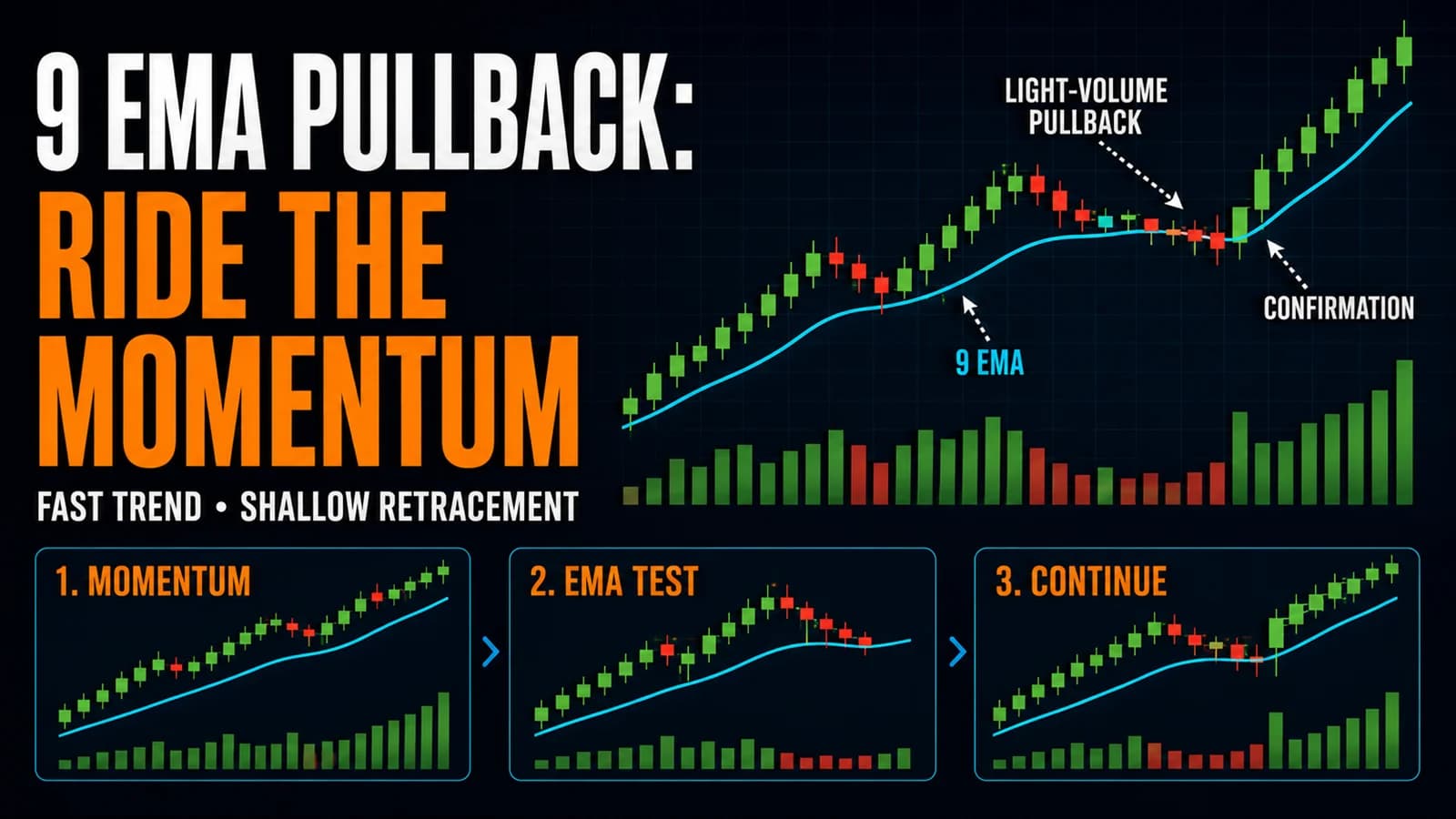
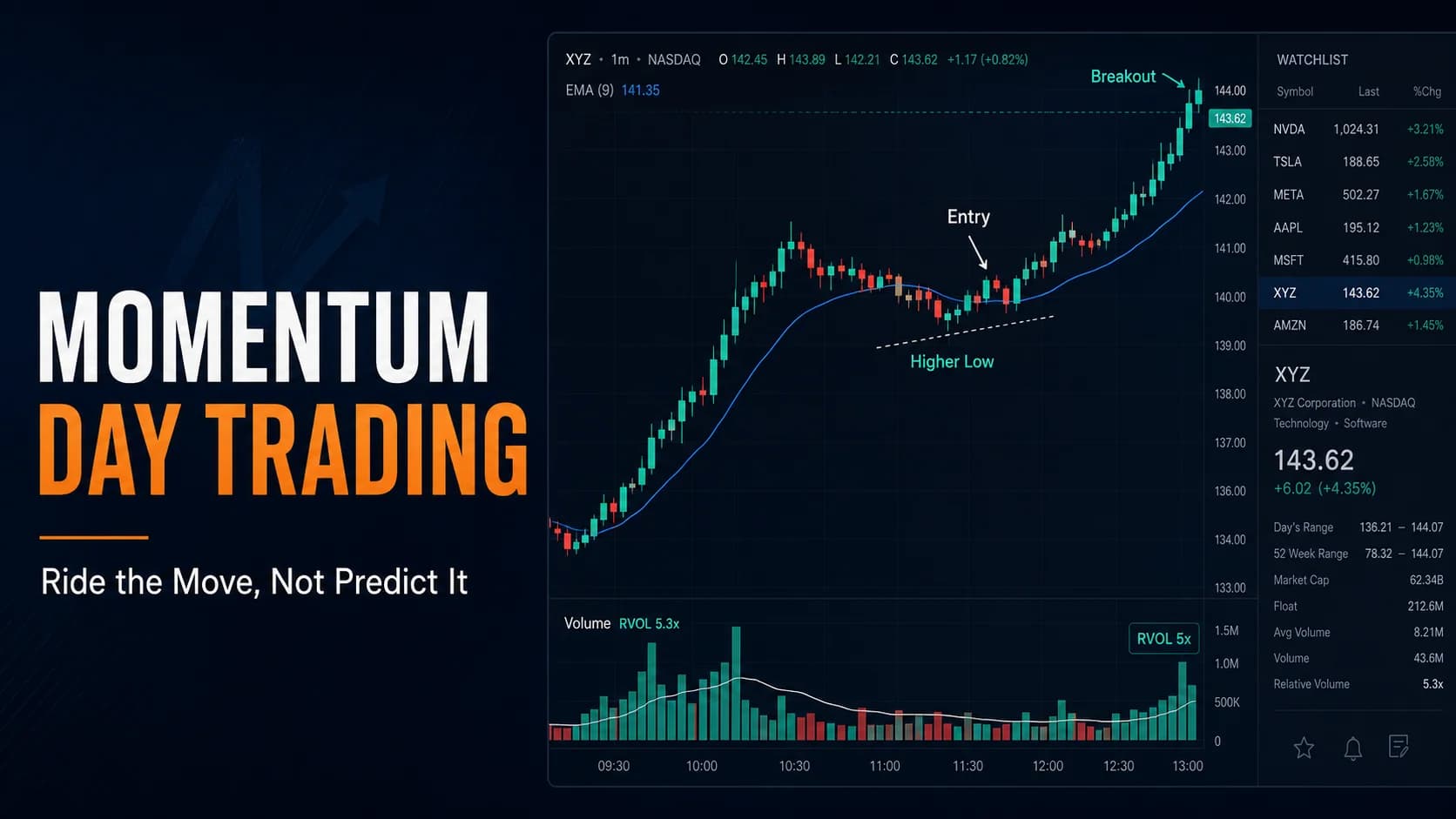
- Enter on a shallow pullback to a fast-moving reference (commonly the 9 EMA) that holds, or on a break of a clear intraday level with volume confirmation — joining confirmed strength, not anticipating it.
- Component
- Stop Loss
- Rule
- Below the most recent higher low for a long, or above the most recent lower high for a short.
- Component
- Initial Profit Target + Scaling
- Rule
- Scale out into continued strength rather than fixing one static target; the goal is riding the move as far as the evidence supports, not locking in a predetermined number.
- Component
- Trade Management
- Rule
- Trail the stop behind each new higher low (long) or lower high (short); adding to a working position on continued confirmation is appropriate here, unlike this hub's reversal setups.
- Component
- Invalidation Criteria
- Rule
- A break of the trailing structure — a new lower high in an uptrend, or higher low in a downtrend — or a visible drop-off in the volume that's been supporting the move.
| Component | Rule |
|---|---|
| Market Conditions Required | A clear, sustained directional move already in progress intraday, not a choppy or directionless session; broader market or sector ideally cooperating rather than fighting the direction. |
| Time of Day | Most common and reliable in the first one to two hours after the open, though a fresh catalyst can trigger genuine momentum at any point in the session. |
| Stock Selection Criteria | Relative volume of 2x or higher; a real, identifiable catalyst or clean technical trigger; price making new highs or lows relative to its recent intraday range. |
| Entry Trigger | Enter on a shallow pullback to a fast-moving reference (commonly the 9 EMA) that holds, or on a break of a clear intraday level with volume confirmation — joining confirmed strength, not anticipating it. |
| Stop Loss | Below the most recent higher low for a long, or above the most recent lower high for a short. |
| Initial Profit Target + Scaling | Scale out into continued strength rather than fixing one static target; the goal is riding the move as far as the evidence supports, not locking in a predetermined number. |
| Trade Management | Trail the stop behind each new higher low (long) or lower high (short); adding to a working position on continued confirmation is appropriate here, unlike this hub's reversal setups. |
| Invalidation Criteria | A break of the trailing structure — a new lower high in an uptrend, or higher low in a downtrend — or a visible drop-off in the volume that's been supporting the move. |
The entry rule is worth dwelling on. Momentum trading, done well, joins a move that has already demonstrated itself rather than trying to guess where one is about to start. That's a meaningfully different posture from a breakout trade betting on a level breaking, or a reversal trade betting on exhaustion — here, the evidence (volume, price structure, a real catalyst) already exists before the position goes on. The tradeoff is giving up the very beginning of the move in exchange for confirmation that it's real.
The permission to add to a working position deserves its own note, since it's the opposite of the discipline this hub emphasizes for reversal setups. A momentum trade that's confirming with fresh higher lows and continued volume is showing the thesis working, which is a different situation than averaging into an unconfirmed reversal hoping to be right.
A Walk-Through: Riding a Momentum Move in a Hypothetical Stock
Consider a hypothetical mid-cap stock, ticker PQR, following a strong pre-market earnings beat. None of the prices or events below are real; they're constructed to show the mechanics in action.
PQR opens at $32.50, up from a $28.00 prior close, and immediately pushes higher on heavy volume — relative volume running near 6x by 10:00 AM. By 10:15, PQR has climbed to $35.20, pulls back to $34.10 on the 9 EMA, and holds there rather than breaking down, printing a higher low. A long entry is taken around $34.30 as that pullback confirms, with a stop placed just below the $34.10 higher low.
PQR continues higher through the next hour, reaching $37.80 by 11:15, pulling back again to a new higher low near $36.50 before continuing. The stop trails up behind each new higher low rather than staying fixed at the original level. A portion of the position is scaled out into the strength near $38.50, with the remainder continuing to trail as long as the pattern of higher lows holds and volume stays elevated.
By early afternoon, volume noticeably thins and PQR prints its first lower high near $39.20, followed by a break below the most recent higher low. That structural break is the invalidation signal — the remaining position exits there, regardless of what the stock does afterward.
Managing the Trade While the Move Is Working
The core discipline here is letting a working position keep working rather than exiting the moment it feels uncomfortable to still be in a trade that's already profitable. Scaling out in stages, rather than all at once, captures gains along the way while still giving the position room to keep running if the move has more left.
Trailing the stop behind confirmed structure — not behind every small pullback, but behind genuine higher lows or lower highs — is what separates disciplined trend-riding from getting shaken out by ordinary noise. The moment that structure actually breaks, the position exits without negotiation, even if the broader story still sounds compelling.
Where This Strategy Fails: Chasing, Fading Volume, and the Momentum Crash
The most common failure mode is entering too late, after a move has already extended well beyond where a fresh pullback and higher low can reasonably form — buying strength that's really just buying the top of the move because it feels exciting rather than because the entry rules are actually met. The discomfort of watching a stock run without being in it is precisely what drives this mistake, and it's worth recognizing that discomfort for what it is rather than acting on it.
A second, quieter failure mode is not noticing when the volume that justified the trade in the first place has dried up. A stock can keep drifting in the same direction on thinning volume for a while, but that drift is fragile and prone to reversing sharply the moment fresh selling (or buying, for a short) shows up — exactly the kind of setup this hub's reversal strategies are built to catch on the other side.
The third, and most severe, is the genuine momentum crash described in the research above: a sudden, sharp reversal rather than a gradual fade, often after the move has already run further than usual and market-wide volatility is elevated. This is exactly why the invalidation rule in the setup specification is a hard break of trailing structure, not a discretionary judgment call made in the moment — a rule decided in advance is far more likely to be followed than one decided while a position is actively moving against expectations.
Adapting the Framework Across Catalysts and Timeframes
The core framework applies whether the catalyst is a gap at the open, a breaking news headline mid-session, or a purely technical trigger with no fresh information behind it — though a real catalyst generally deserves more confidence than a technical-only setup, consistent with the underreaction research covered above.
Timeframe choice changes the granularity of the entries and stops but not the underlying logic: a 1-minute or 5-minute chart works for faster-moving, more volatile names, while a 15-minute chart smooths out noise for less explosive movers. The higher-timeframe version of this same idea — riding a stock's established multi-day trend rather than an intraday move — is covered in more depth in this hub's dedicated trend-following content.
Momentum can also be traded on the short side using the identical logic in reverse: a stock breaking down hard on heavy volume, with lower highs forming on each bounce, follows the same entry, stop, and trailing rules just mirrored.
Scanning for Genuine Momentum Candidates
Manually watching for stocks with the right combination of relative volume, a real catalyst, and clean directional price action isn't practical across a broad market by eye. A useful scan combines a relative volume filter with a percentage-gainer or -loser condition and, where available, a news or catalyst flag, to separate genuine momentum candidates from stocks simply drifting.
Trade Ideas is built to run this kind of scan continuously through the session as a comprehensive scanning and research platform, surfacing high-RVOL movers in real time alongside built-in charting to check price structure on each candidate without switching tools. The scan narrows the field; confirming an actual pullback-and-hold or clean level break still governs the entry.
Sizing the Momentum Trade Inside a Broader Plan
Because momentum trades can run longer and target larger moves than this hub's tighter, more mechanical setups, position sizing should still anchor to a defined risk in R-multiples against the actual stop level — the most recent higher low or lower high — rather than a fixed share count carried over from a different kind of trade.
The psychological pull here is specific: watching a stock run without being in it is uncomfortable, and that discomfort is exactly what pushes traders into chasing an extended move rather than waiting for a genuine pullback-and-hold entry. This hub's guide to trading discipline covers the broader version of resisting that pull. This strategy belongs on the Strategies Hub as the general framework underlying several of this module's more specific setups — useful precisely because it insists on confirmation before entry, not because every green stock qualifies.
Common Questions About Momentum Day Trading
Is this the same "momentum" academic research talks about?
Newer research specifically on intraday momentum exists and is a closer match, but even that work has generally studied broad market and ETF behavior in half-hour windows rather than individual small-cap stocks reacting to a same-day catalyst. The underlying principle — that a strong early move carries real predictive information, especially under high volume — transfers reasonably well; the precise numbers from either body of research don't transfer directly to an individual stock's one-minute chart.
Key Takeaway: Treat the academic term "momentum" as a related but distinct concept from day trading momentum, operating on a completely different timescale.
How is this different from trend following?
A stock can be in a clean long-term downtrend on the daily chart while producing a sharp, tradable intraday momentum move higher on a same-day catalyst — the two frameworks are asking different questions over different time horizons.
Key Takeaway: Trend following is a structural, multi-session read; momentum day trading is a same-session read that doesn't require agreement with the longer-term trend.
How is this different from scalping?
A single momentum mover often produces plenty of scalping opportunities along the way, but the two are different trades with different holding periods, different tools, and different risk management — a momentum position doesn't need the tick-by-tick order-flow reading a scalp depends on.
Key Takeaway: Momentum trading and scalping can coexist in the same stock on the same day without being the same strategy.
Why does entering on a pullback matter instead of just buying strength directly?
Buying strength with no pullback means there's no nearby structural level to place a stop against, which usually results in either an uncomfortably wide stop or a tight one that gets shaken out by ordinary continuation noise.
Key Takeaway: The pullback isn't a delay tactic — it's what generates a real, defensible stop-loss level.
What relative volume level actually signals a genuine momentum candidate?
A stock can show high relative volume while chopping sideways all day; that's not a momentum candidate regardless of the volume number. Volume is a necessary condition here, not a sufficient one.
Key Takeaway: Use relative volume to build a watchlist, then confirm real catalyst and directional conviction before treating a name as tradable.
Can momentum trades be added to as they develop?
That's a meaningful difference in philosophy from averaging into a losing reversal trade. Here, size is added into strength that's actively confirming, not into weakness that hasn't yet proven anything.
Key Takeaway: Adding to a momentum trade should track confirmation, not conviction alone.
What's the biggest sign a momentum move is about to fail?
Momentum moves run on continued participation; when that participation visibly fades, the move is running on inertia rather than genuine buying or selling pressure, and inertia alone is a fragile foundation for a continuing trend.
Key Takeaway: Watch volume as closely as price — a fading volume profile is an early warning the setup's invalidation rule will likely trigger soon.
Does this strategy work the same way on the short side?
The same catalyst-versus-technical-only distinction applies too: a breakdown tied to real negative news carries more of the same underreaction logic than a purely technical breakdown with no fresh information behind it.
Key Takeaway: The framework is direction-agnostic — only the specific levels and direction change between a long and short application.
Does momentum trading require news, or can it be purely technical?
Both can work, and both appear regularly in an active session. The underreaction research covered above specifically found that price momentum and earnings-surprise momentum each independently predicted further drift, which is a reason to weight a catalyst-driven mover somewhat more heavily than a purely chart-based one, not a reason to dismiss technical setups entirely.
Key Takeaway: A catalyst adds a layer of confidence; its absence doesn't disqualify a setup that otherwise meets the mechanical criteria.
What's a reasonable risk/reward expectation for this style of trade?
This differs from setups with a fixed, mechanical target level. Here, a well-managed winner can run for a multiple of the initial risk if the move genuinely continues, while a well-managed loser stays capped at the distance to the most recent higher low or lower high — the actual ratio realized depends on how far a given move actually runs.
Key Takeaway: Judge this strategy on process discipline (confirmed entries, honored stops) rather than expecting a single fixed risk/reward ratio every time.
Disclaimer
Article Sources
- Jegadeesh & Titman (1993), "Returns to Buying Winners and Selling Losers: Implications for Stock Market Efficiency", The Journal of Finance - the foundational momentum study, documenting the effect over three-to-twelve-month horizonsonlinelibrary.wiley.com
- Gao, Han, Li & Zhou (2018), "Market Intraday Momentum", Journal of Financial Economics - documents a genuine intraday momentum effect, with the first half-hour return predicting the last half-hour returnsciencedirect.com
- Chan, Jegadeesh & Lakonishok (1996), "Momentum Strategies", The Journal of Finance - traces momentum to the market's underreaction to news, particularly earnings surprisesonlinelibrary.wiley.com
- Daniel & Moskowitz (2016), "Momentum Crashes", Journal of Financial Economics - documents that momentum strategies can suffer sudden, sharp reversals rather than a gradual fade, particularly during volatile, panic-driven conditionskentdaniel.net