You know the setup. You’ve done the research, marked your levels, set your alerts. The pattern is textbook. Your rules are clear: wait for confirmation, enter at support, set the stop two percent below. Simple.
Then the market opens. The stock pops. Your heart rate ticks up. “What if it runs without me?” You enter early—no confirmation. Price hesitates, dips, triggers your stop. You watch it reverse and rip higher without you. Again.
Here’s the brutal truth: most traders fail not because they lack knowledge, but because they can’t execute what they know. That gap between understanding and doing? That’s trading discipline. And it’s the single most important skill you’ll ever develop—more critical than chart reading, more valuable than any indicator, and far more predictive of your success than your strategy itself.
Our team has watched thousands of traders over the years, and the pattern is undeniable. The ones who survive and thrive aren’t the ones with the most sophisticated algorithms or the fanciest setups. They’re the ones who can follow their own rules when it’s hardest to do so. Let’s talk about why—and more importantly, how you can join them.

What is Trading Discipline? (And Why Most Traders Get It Wrong)
Trading discipline is the consistent ability to follow your predetermined trading plan regardless of market noise, emotional impulses, or temporary setbacks. It’s not about being robotic or emotionless. It’s about having a system and trusting it enough to execute it repeatedly, especially when your emotions are screaming at you to do something else.
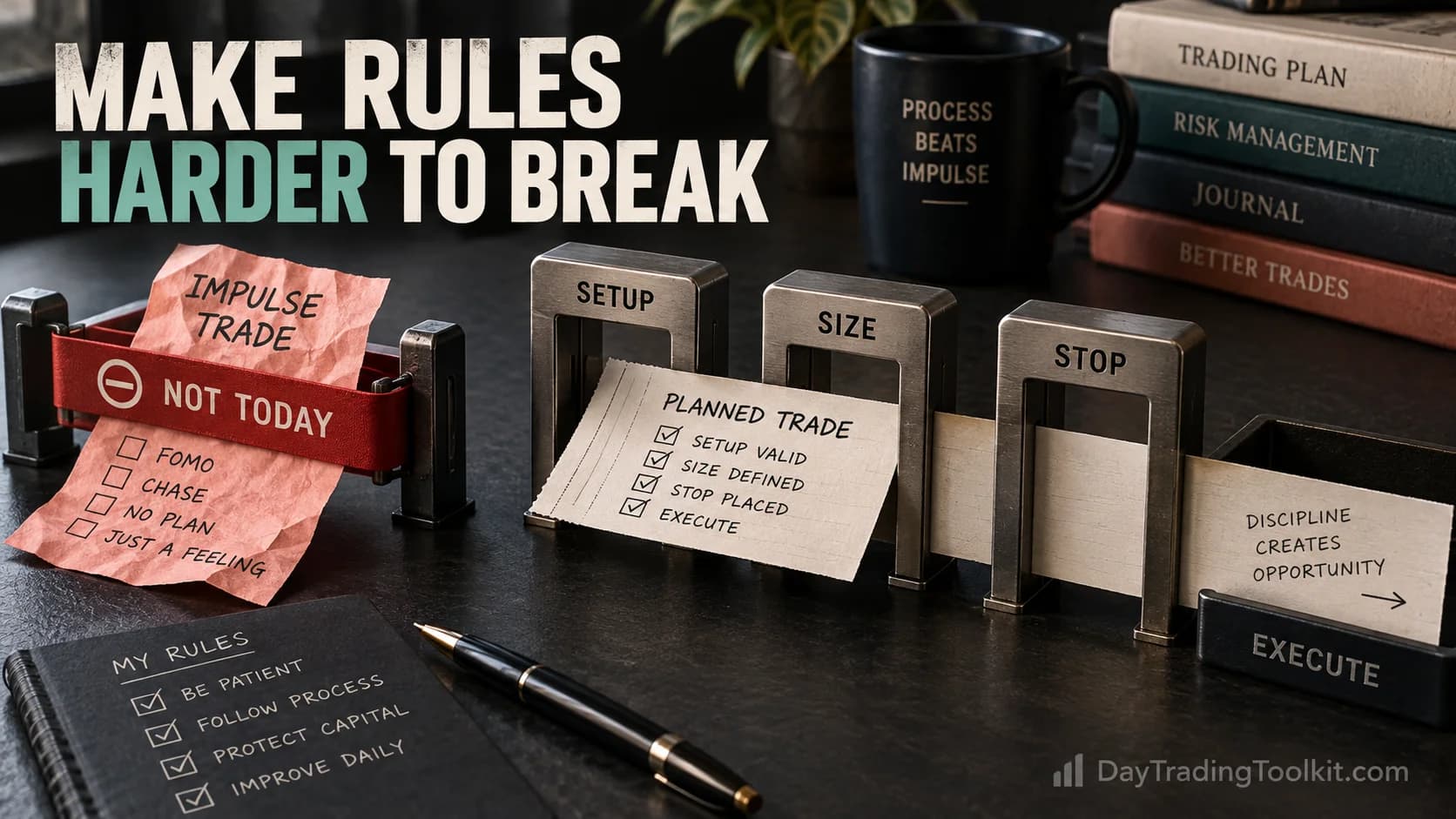
Most traders misunderstand this completely. They think discipline means “trying harder” or “being tougher on themselves.” But discipline isn’t willpower. It’s a framework. It’s having rules so clear that execution becomes automatic, and accountability systems so robust that deviations get caught immediately.
Think of discipline as the bridge between your trading plan and your actual results. You can have the world’s most profitable strategy written down—and if you only follow it 60% of the time, you don’t have that strategy. You have chaos wrapped in the illusion of a plan.
The real challenge? Your brain is wired for survival, not for trading. Every time you stare at a red position, your amygdala fires up like you’re facing a physical threat. Greed feels like opportunity. Fear feels like wisdom. FOMO feels like urgency. And your discipline—that thin layer of rational process—has to override millions of years of evolution telling you to panic or grab.
That’s why this is hard. And that’s exactly why the minority who master it dominate.
The Brutal Statistics: Why Discipline Separates Winners from Losers
Let’s get uncomfortable for a moment. According to data from the U.S. Commodity Futures Trading Commission and mandatory disclosures from CFD brokers across 28 major platforms, approximately 70-80% of retail traders lose money. Not “have a bad month.” Lose money overall. Consistently.
When Babypips analyzed broker disclosure data, they found the average loss rate was 76%. Some brokers reported figures as high as 83%. For day traders specifically? Research shows failure rates between 80-95%, with only 1-7% achieving sustained profitability.
Here’s what makes these numbers devastating: it’s not because 76% of traders are stupid or lazy. Most of them have done the work. They’ve studied the patterns, learned the indicators, paper-traded successfully. They understand the concepts.
The difference—and research from behavioral finance confirms this again and again—is execution discipline. The profitable minority isn’t necessarily smarter. They’re more disciplined.
Consider these performance metrics from actual trading data:
Disciplined Traders:
- Win rate: 55-65%
- Risk per trade: 1-2% of account
- Maximum drawdown: 10-15%
- Monthly return volatility: 3-5%
Undisciplined Traders:
- Win rate: 35-45%
- Risk per trade: 5-10% of account
- Maximum drawdown: 25-40%
- Monthly return volatility: 10-15%
Notice something? The disciplined trader’s win rate isn’t dramatically higher. But their risk management—their discipline around position sizing and stop-loss adherence—creates completely different outcomes.
Mark Douglas, who literally co-founded the field of trading psychology, put it this way: successful trading is 80% psychology and 20% methodology. The traders who fail aren’t missing some secret indicator. They’re missing the mental framework to execute consistently.
The Three Pillars of Trading Discipline
If discipline is the bridge between knowledge and results, it’s built on three foundational pillars. Remove any one of these, and the entire structure collapses. Let’s break them down.

Pillar 1: Your Trading Plan (The Non-Negotiable Rulebook)
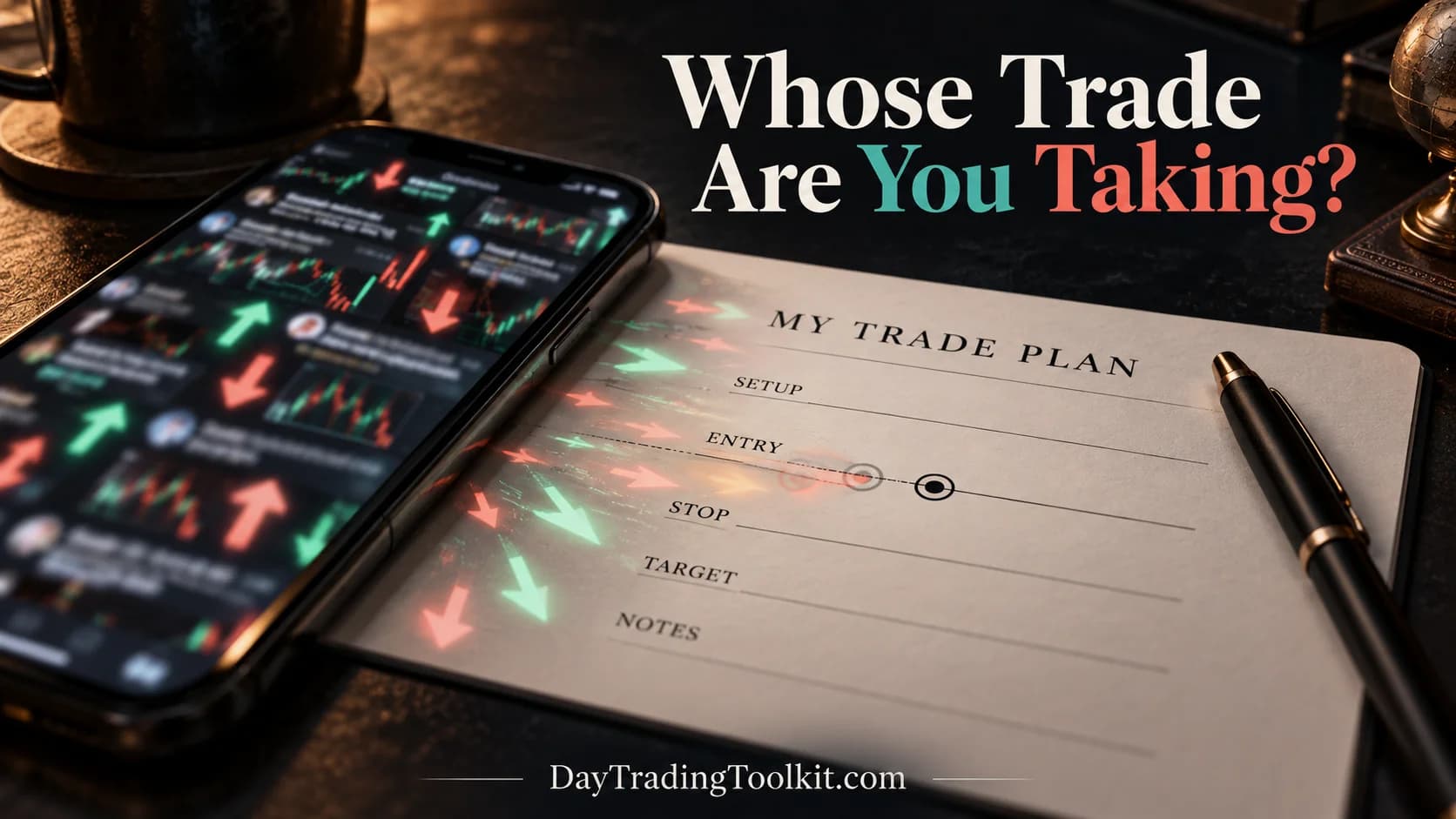
Your trading plan isn’t a suggestion. It’s not guidelines. It’s your professional contract with yourself, and it must be written down with zero ambiguity.
Here’s what a real, disciplined trading plan includes:
- Market selection – Which instruments will you trade? Stocks? Futures? Crypto? Pick your battlefield.
- Strategy criteria – What exact conditions trigger an entry? If you can’t program it into code, it’s not specific enough.
- Entry rules – Price level, confirmation signals, timeframe alignment, volume requirements.
- Exit rules – Profit targets (predetermined), stop-loss placement (predetermined), time-based exits if applicable.
- Position sizing formula – Calculated before every trade based on your account size and the distance to your stop.
- Risk parameters – Maximum risk per trade (1-2% is standard), maximum daily loss limit, maximum correlated positions.
- Trading hours – When will you be active? Market open only? Specific session times?
- Performance review schedule – Weekly minimum. What gets measured gets managed.
The power of this plan isn’t just in having it. It’s in removing decision-making during emotional moments. When you’re in a trade and it’s moving against you, your plan has already decided what happens next. You don’t think. You execute.
Most traders fail here because their rules are fuzzy. “Enter when it looks good” isn’t a rule. “Enter when price breaks above the 20-period EMA with volume 50% above average” is a rule. See the difference? One requires judgment. The other requires observation.
And here’s the kicker—once you’ve built this plan, changing it requires a formal process. Not “I had a bad week so I’m tweaking things.” Not “I read a new strategy that sounds better.” You test changes. You collect data. You prove they work. Then you update the plan.
We’ve seen traders with profitable strategies fail simply because they kept second-guessing their own rules. Don’t be that trader.
Pillar 2: Risk Management (The Capital Protection System)
If your trading plan is your rulebook, risk management is your insurance policy. And in trading, survival always comes before success.
Every professional trader we’ve ever worked with is obsessed—and we mean obsessed—with risk management. They’re not thinking “How much can I make on this trade?” They’re thinking “How much can I lose, and can I afford to be wrong five times in a row?”
The 1-2% Rule is the foundation. You never risk more than 1-2% of your total account on a single trade. Not 5%. Not “just this once.” Never.
Why? Because math is brutal. A 50% loss requires a 100% gain just to break even. But a 10% loss only requires an 11% gain. Small losses are recoverable. Large losses are career-ending.
Here’s how disciplined risk management looks in practice:
Before Every Trade:
- Calculate your stop-loss distance (where you’re wrong)
- Determine your position size: (Account Size × Risk %) ÷ Stop Distance
- Verify your risk-to-reward ratio is at least 1:2 (risking $100 to make $200+)
- Confirm you’re not over-exposed to correlated positions
During Every Trade:
- Your stop-loss is placed immediately upon entry (use hard stops, not mental stops)
- You do not move your stop-loss to “give the trade more room” (this increases your 40% on average)
- You take partial profits at predetermined levels if that’s in your plan
- You respect your daily loss limit—if you hit it, you’re done for the day
After Trades:
- You track your actual risk taken vs. planned risk
- You calculate your risk-adjusted returns
- You identify any risk management violations and address them immediately
The mindset shift here is massive. You’re not trading to maximize profits. You’re trading to minimize risk while allowing profits to occur naturally within that framework. As trading psychology expert Dr. Brett Steenbarger emphasizes, professional traders focus on what they can lose, not what they can make.
Protection first. Profits second. Always.
Pillar 3: Emotional Control (The Psychological Battleground)
This is where most traders lose the war. You can have a perfect plan and flawless risk management, but if fear makes you exit winners early or greed makes you hold losers too long, none of it matters.
The forex market is an emotional battlefield where four primary enemies attack your discipline:
Fear – Makes you exit profitable trades prematurely, hesitate on valid entries, or refuse to pull the trigger after a loss.
Greed – Causes you to over-leverage, ignore stops, hold beyond targets, or take trades that don’t meet your criteria because “it might work.”
FOMO (Fear of Missing Out) – Pushes you to chase price, enter without confirmation, or abandon your strategy for whatever’s hot today.
Revenge Trading – After a loss, the desperate urge to “get even with the market” by taking bigger risks or forcing trades.
Here’s what our team has learned about emotional control: you can’t eliminate emotions. Trying to be emotionless just suppresses them until they explode. Instead, you need systems that work with your emotions while preventing them from controlling your actions.
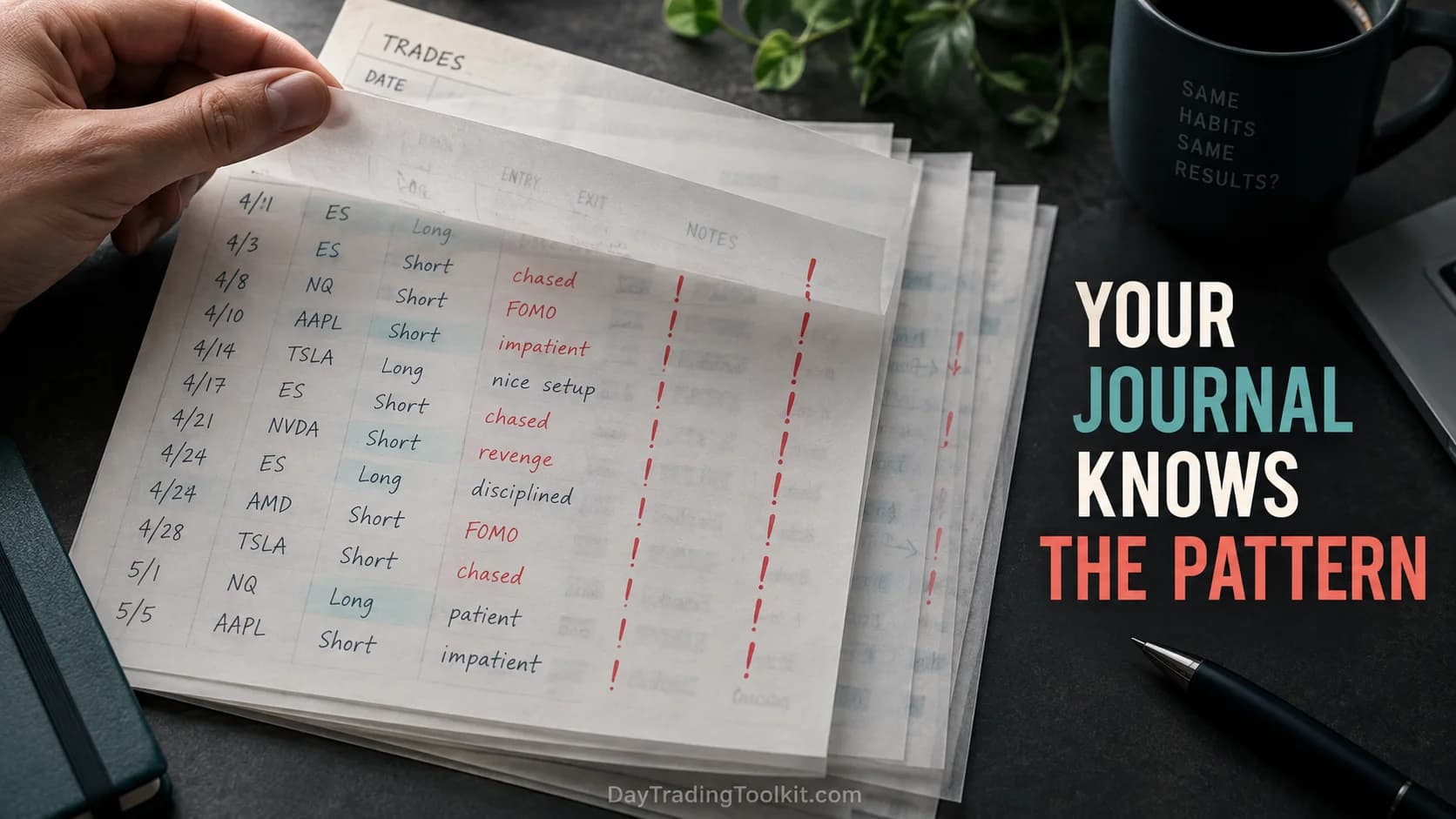
The Trading Journal as Emotional Mirror – Track not just your trades but your emotional state. “Felt confident” or “Felt FOMO” next to each entry tells you more than you think. Patterns emerge. You’ll notice you take your worst trades when feeling a specific way.
Pre-Trading Centering Rituals – The most disciplined traders we know have routines. Meditation. Breathing exercises. Physical activity before market open. These aren’t woo-woo. They’re practical tools that shift your nervous system from reactive to responsive.
Physical Foundation – Sleep-deprived traders make impulsive decisions. Stressed traders overtrade. Traders who skip meals get shaky and reactive. Your physical state directly impacts your emotional control. This isn’t optional.
Mental Rehearsal – Before the trading day, visualize scenarios. “If I take three losses in a row, I will…” Having pre-programmed responses prevents in-the-moment panic.
Circuit Breakers – When emotions run hot, take a break. Walk away. Five minutes of not looking at screens can reset your entire mental state. Build these breaks into your routine, especially after wins and losses.
The goal isn’t to become a robot. It’s to build the self-awareness to notice “I’m feeling greedy right now” and have systems that prevent that feeling from turning into a blown account. That’s emotional discipline.
The Psychology Behind Discipline Failures
Let’s talk about why your brain actively sabotages your trading discipline. Understanding the enemy is half the battle.

Why Your Brain Works Against You
Your brain developed over millions of years to keep you alive in a world of physical threats—predators, starvation, tribal conflict. It did not develop for trading. In fact, the traits that kept your ancestors alive are the exact traits that destroy trading accounts.
Here’s the disconnect: your brain craves certainty, but the market offers only probabilities. Your brain wants to avoid losses at all costs (loss aversion), but trading requires accepting losses as part of the process. Your brain seeks patterns even where none exist (the gambler’s fallacy), but market outcomes are independent events.
Behavioral finance research identifies three core psychological frameworks that undermine discipline:
Overconfidence Bias – After a few wins, you start to believe you’ve “figured it out.” You trade larger. You deviate from your plan because “you can feel the market.” Then you get humbled. Hard. Research shows traders increase position sizes after wins, even when their strategy doesn’t warrant it.
Extrapolation Bias – “This stock went up yesterday and today, so it’ll go up tomorrow.” Your brain loves linear thinking. Markets love reversals. This bias makes you chase momentum and hold losers thinking they’ll bounce back.
Prospect Theory (Loss Aversion) – Psychologically, losses hurt about twice as much as equivalent gains feel good. This is why traders hold losing positions too long (hoping to avoid the pain of realizing the loss) while selling winners too fast (locking in the pleasure of gains). The disposition effect is real—research shows traders sell winners 50% faster than losers.
These aren’t character flaws. They’re hardwired. Discipline is the conscious system you build to override these unconscious patterns.
The “Justified vs. Unjustified Wins” Problem
Here’s something that trips up even experienced traders: random wins damage your discipline more than losses do.
Think about it. You break your rules, take a trade that doesn’t meet your criteria, and it works. You make money. Your brain releases dopamine. Suddenly, breaking rules feels rewarding. This is what Babypips calls an “unjustified win”—you got paid for the wrong behavior.
The problem compounds over time. You start to think “maybe the rules aren’t that important.” You trust your gut more. You execute your plan less. And because some of those undisciplined trades work (randomness ensures this), you keep getting intermittent reinforcement for bad habits.
It’s like a slot machine. The occasional random payout keeps you pulling the lever.
Contrast this with a “justified win”—you follow your plan, execute every rule, and profit. This is the good kind of reinforcement. It builds trust in your system. It strengthens discipline.
The discipline solution? Track it. In your journal, mark which trades followed your plan and which didn’t. Over time, you’ll see that plan-based trades outperform random trades. The data breaks the dopamine spell.
And here’s the hard truth: trading is about getting the law of averages to work in your favor. If you have an edge—a legitimate statistical advantage—it only manifests over many trades. Maybe 100. Maybe 500. You need consistent execution across that sample size for your edge to show up in your equity curve.
If you follow the plan sometimes and wing it other times, you throw off the probabilities. You’ll lose overall, even with a profitable strategy.
The Five Critical Discipline Breakpoints (And How to Fix Them)
Our team has identified five specific moments where discipline breaks down. These are the pressure points where traders go from “I know what to do” to “I just did the exact opposite.” Let’s address each one with specific solutions.

Breakpoint 1: Emotional Trading (Fear, Greed, FOMO)
The Breakdown: You’re in a trade. It goes against you. Fear screams “GET OUT NOW!” even though your stop hasn’t been hit. Or you’re watching a stock rip higher. FOMO shouts “CHASE IT!” even though your entry criteria aren’t met. You act on emotion, not rules.
The Cost: Emotional trades lead to 25% higher losses than plan-based trades, according to behavioral finance research. Think about that. The same strategy executed emotionally vs. disciplined shows a 25% performance gap.
The Fix:
- The Five-Second Rule – When you feel an impulse to act, count to five. Not “one-Mississippi” fast. Five slow breaths. This tiny pause lets your prefrontal cortex catch up to your amygdala. You’d be shocked how many impulsive trades die in those five seconds.
- The Pre-Trade Checklist – Before clicking the button, physically check off: Does this meet ALL my entry criteria? Is my stop-loss set? Is my position size correct? Is my emotional state calm? One “no” = no trade.
- Name the Emotion – Out loud, say “I’m feeling FOMO right now.” Naming it creates psychological distance. It’s no longer “THE TRUTH” but “a feeling I’m experiencing.” That shift changes everything.
- Daily Loss Limits – Set a maximum dollar loss or percentage for the day. When hit, you stop. No exceptions. This prevents revenge trading, which is emotional trading’s ugliest form.
Breakpoint 2: Overtrading and Impulse Execution
The Breakdown: The market is open. Your watchlist is full. Every pattern looks tradeable. You start taking marginal setups. Before you know it, you’ve taken 15 trades when your plan called for 3-5. Death by a thousand cuts.
The Cost: Overtrading destroys accounts through transaction costs, reduced focus, and statistical dilution. If you take 15 trades but only 5 meet your A+ criteria, you’re diluting your edge with random noise.
The Fix:
- Predefined Trade Count – Decide in advance: “I will take a maximum of X trades today.” This creates artificial scarcity. You become selective because you can’t waste your allocation on garbage setups.
- Setup Scorecard – Rate every potential trade 1-10 against your criteria. Only take 9s and 10s. This forces conscious evaluation instead of reactive clicking.
- Boredom Management – Most overtrading comes from boredom. If you’re trading to “do something,” you’re gambling. Have a plan for slow days: study charts, review trades, work on education. Trading is not entertainment.
- Trade Only Your Session – Pick your most profitable time window (maybe the first 90 minutes of market open) and only trade then. Close your platform after. This creates a container for discipline.
Breakpoint 3: Moving or Ignoring Stop-Losses
The Breakdown: You enter a trade with a stop at $48. Price drops to $48.10. You think “just a little more room” and move it to $47. Price hits $47.10. You move it again. Eventually you take a massive loss or get stopped out at the worst possible level.
The Cost: Research shows that traders who move their stop-losses experience 40% larger average losses than those who honor original stops. That’s not a typo. Forty. Percent.
The Fix:
- Hard Stops Only – No mental stops. Use limit orders that execute automatically. Remove the opportunity to interfere.
- The Stop-Loss Contract – Write this down and read it before trading: “My stop-loss represents where my analysis is wrong. If hit, my analysis was wrong. That’s not bad luck. That’s information. I accept this trade is over and move on.”
- One-Touch Rule – You set the stop once. After that, it can only move in your favor (trailing stop) or stay in place. Never wider.
- Position Size Buffer – If you’re tempted to move stops because they’re “too tight,” you’re trading too large. Reduce position size and set wider, logical stops. This removes the emotional pressure.
Breakpoint 4: Position Sizing Violations
The Breakdown: You’re confident in a setup. “This one’s different.” You risk 5% instead of your 2% rule. Or you’ve had three losses, and you double up to “make it back faster.” Both are discipline failures in position sizing.
The Cost: Unplanned position sizing is the fastest way to blow up. One bad trade with 10% risk can wipe out five good trades with 2% gains. The math doesn’t care about your confidence.
The Fix:
- Position Size Calculator – Use a calculator (or spreadsheet) before every trade. No mental math. Input: account size, risk percentage, stop distance. Output: share quantity. Follow it religiously.
- “Confidence” Doesn’t Change the Formula – Your subjective confidence is not a variable in the position size equation. Ever. The formula is: Position Size = (Account × Risk %) ÷ Stop Distance. That’s it. “Really confident” doesn’t make 5% okay.
- The Betting Unit System – Think of your risk as “units.” Every trade is 1 unit (1-2% of account). You never go above 1 unit. This creates psychological consistency. You’re not “betting big” or “betting small.” You’re always betting one unit.
- Track Actual vs. Planned Risk – In your journal, record planned risk and actual risk. If these diverge even once, it’s a red flag requiring immediate correction.
Breakpoint 5: Strategy Hopping and Plan Abandonment
The Breakdown: Your strategy has a bad week. You read about someone else’s amazing results with a different approach. You switch. Two weeks later, that one doesn’t work either. You switch again. You never give any strategy enough time to prove itself.
The Cost: Strategy hopping prevents statistical edge from manifesting. No strategy works 100% of the time. You need sample size—often 50-100+ trades—to evaluate performance. Switching after 10 trades is sabotage.
The Fix:
- Commitment Contract – Write this: “I will execute [strategy name] for [X trades] or [X months], whichever comes first, before making any changes.” Sign it. Date it. Review it when you feel the urge to switch.
- Performance Metrics Over Feelings – Don’t evaluate based on “this feels like it’s not working.” Evaluate based on data. Is your win rate within expected range? Is your average loss controlled? Is your risk-to-reward execution on target? Data tells truth. Feelings lie.
- Separate Testing from Trading – If you want to explore a new strategy, do it in a separate paper trading account or with backtesting. Don’t contaminate your live account with experiments.
- The 90-Day Rule – Give any strategy at least 90 days of consistent execution before judging it. Most traders quit right before their edge would have shown up in their results.
Building Unbreakable Trading Discipline: A System-Based Approach
Discipline isn’t willpower. It’s architecture. Here’s how to build the daily structure that makes disciplined execution automatic.

Pre-Market Preparation: The Foundation of Disciplined Execution
The traders who consistently execute their plans don’t start thinking about discipline when the market opens. They build it in the hours before.
Mental Preparation (20-30 minutes before market open):
Research shows that traders with established routines achieve 58% win rates compared to 42% for those without routines. That’s a massive edge that has nothing to do with chart patterns.
- Meditation or Breathwork (5-10 minutes) – This isn’t optional if you’re serious. Studies show mindfulness practices reduce impulsive trading decisions by 40%. You’re literally changing your brain’s reactivity.
- Emotional Check-In – Ask yourself: “How am I feeling right now? Anxious? Overconfident? Angry about yesterday?” If you’re not calm and neutral, address it before trading. Go for a walk. Journal. Don’t trade tilted.
- Review Your Trading Plan – Literally read through your rules. This primes your brain for execution. It’s like an athlete visualizing their routine before competition.
Physical Preparation:
Your body and mind aren’t separate. Physical state impacts decision quality dramatically.
- Hydration and Nutrition – Dehydration impairs cognitive function. Low blood sugar creates irritability and poor impulse control. Eat a balanced meal. Drink water. This sounds basic, but tired, hungry traders make expensive mistakes.
- Sleep Requirement – If you got less than 7 hours, consider sitting out or trading at half size. Sleep deprivation reduces self-control and increases emotional reactivity. That’s not discipline-friendly.
Market Analysis (30 minutes):
- Review Major News and Economic Data – What’s on the calendar? Any major catalysts today? Context matters for risk management.
- Scan Your Watchlist – Which setups are active? Which are developing? Make a prioritized list of A+ setups.
- Define Your Trade Bias – Based on your analysis, are you looking for longs, shorts, or standing aside? This prevents reactive trading.
- Set Alerts – Let technology do the monitoring. Set alerts for key price levels so you’re not glued to screens all day.
The goal is to walk into the trading session with clarity, calm, and a plan. You’re not figuring things out on the fly. You’re executing pre-made decisions.
The Trading Session: Execution Discipline
The market is open. Now your discipline system needs to run on autopilot.
The Pre-Trade Checklist (Every Single Trade):
- ✅ Does this setup meet ALL my strategy criteria?
- ✅ Have I calculated my stop-loss level?
- ✅ Have I calculated my position size using the formula?
- ✅ Is my risk-to-reward ratio at least 1:2?
- ✅ Am I within my daily trade count limit?
- ✅ Am I emotionally neutral (not angry, fearful, or greedy)?
If any box is unchecked, you don’t trade. Period.
During the Trade:
- Set and Forget – Once you’re in, your stop-loss is set (hard stop, not mental), your target is set, and you step back. Watching every tick creates emotional volatility.
- No Mid-Trade Changes – You don’t move stops. You don’t “give it more room.” You don’t exit before your target without cause. The plan is the plan.
- Real-Time Emotional Monitoring – If you notice anxiety, excitement, or anger while in a trade, acknowledge it. “I’m feeling anxious.” Then redirect to your rules. “My stop is set. My risk is managed. I trust my system.”
Daily Loss Limits and Circuit Breakers:
- Maximum Daily Loss – If you lose X% of your account in one day, you stop trading immediately. No discussion. This prevents revenge trading, which is where careers die.
- Three-Loss Rule – Some traders use a three-loss rule: after three consecutive losses, you step away for at least 30 minutes. This breaks the emotional spiral.
- No News Trading – Unless it’s explicitly in your plan, you don’t trade major news events. The whipsaws and volatility invite impulsive decisions.
The Only Job You Have:
Execute your plan. That’s it. You’re not trying to predict the market. You’re not trying to make money today. You’re executing your system. The money is a byproduct of disciplined execution over time.
Post-Market Review: The Accountability Loop
This is where discipline gets built. Most traders skip this step. The ones who master discipline never do.
The Trading Journal (15-30 minutes after market close):
Your journal is your accountability partner, your teacher, and your mirror. What you track:
- Trade Specifics – Entry price, exit price, size, strategy used, setup quality (1-10 rating).
- Execution Quality – Did you follow your plan? Rate 1-10. If below 10, why?
- Emotional State – How did you feel before, during, and after the trade?
- Market Conditions – Volatility, volume, any news events that impacted the trade.
- Rule Violations – Be brutally honest. Did you break any rules? Which ones? Why?
Pattern Recognition:
After 20-30 trades, patterns emerge. You’ll notice:
- “I take my best trades when feeling calm and prepared.”
- “I break rules most often after a winning streak.”
- “I overtrade on low-volume days when I’m bored.”
These insights are gold. They tell you where your discipline needs reinforcement.
The Weekly Review:
Every week, step back and analyze:
- Win/loss ratio
- Average win vs. average loss
- Risk-adjusted return (how much did you make per unit of risk taken?)
- Discipline score (what % of trades followed your plan?)
- Emotional trends (were you anxious, confident, tilted?)
Here’s the key insight: if your discipline score is high (80%+) but results are poor, it’s a strategy problem. If your discipline score is low but strategy is sound, it’s an execution problem. This clarity is invaluable.
Celebrate Discipline, Not Just Wins:
Did you follow your plan perfectly today even though you lost money? That’s a win. Seriously. You’re building the muscle that matters. Results will follow.
Did you make money but broke your rules? That’s a loss in disguise. It’s training bad habits.
This mindset shift—process over outcome—is the hallmark of professional discipline.
Discipline During Extreme Conditions
Your discipline system looks great on paper. Now let’s stress-test it.
Maintaining Discipline in Volatile Markets
Market volatility—when price swings get wild, volume spikes, and emotional intensity skyrockets—is where discipline gets tested hardest. And where most traders fail.
Here’s what changes in volatile markets:
Volatility-Adjusted Position Sizing:
When the VIX spikes or average true range (ATR) increases significantly, you reduce position size. Why? Because stop-losses need to be wider to avoid getting chopped out by noise, and wider stops mean smaller positions to maintain your 1-2% risk per trade.
- Low volatility: Normal position size, 1 ATR stop distance
- Medium volatility: 75% of normal position, 1.5 ATR stop distance
- High volatility: 50% of normal position, 2 ATR stop distance
Wider Stop-Losses:
In volatile markets, technical levels matter more, and tight stops get slaughtered. Use ATR (Average True Range) to set logical stops that account for the increased movement. Your stop distance should reflect current market conditions, not your desired risk amount.
Higher Confirmation Requirements:
In choppy, volatile conditions, add layers of confirmation. Don’t just take the breakout—wait for a retest. Don’t just trade the bounce—wait for volume confirmation. More criteria = fewer trades = better quality.
Psychological Tools for High-Stress Environments:
- Breathing Techniques – Box breathing (4 counts in, 4 hold, 4 out, 4 hold) before making any decision. This literally shifts your nervous system from sympathetic (fight-or-flight) to parasympathetic (calm and focused).
- Position Size Comfort Test – If your position size makes you anxious watching the price action, it’s too large. Cut it in half. Discipline requires emotional space, and you can’t have that if you’re white-knuckling every tick.
- Time-Based Exits – In extremely volatile conditions, some traders add time limits: “If this trade hasn’t resolved in X minutes/hours, I exit regardless of profit or loss.” This prevents getting trapped in extended chop.
Handling Winning and Losing Streaks
Streaks—both good and bad—are psychological minefields. They test discipline in opposite but equally dangerous ways.

The Winning Streak Trap:
You’ve just nailed five trades in a row. You feel invincible. Your brain is swimming in dopamine. This is when most traders blow up.
The dangers:
- Overconfidence – “I’ve figured out the market.” No, you got lucky. The market doesn’t get figured out.
- Position Size Creep – “I’m on a hot streak, let’s risk 5% instead of 2%.” This is how you turn five small wins into one massive loss.
- Plan Abandonment – “My gut is working great, I don’t need to follow every rule.” Your gut is not working. Variance is temporarily in your favor.
Winning Streak Discipline Protocol:
- Maintain Original Risk Per Trade – No increases. You don’t risk more because you’re winning. Your position size is driven by your account size and stop distance, not your confidence.
- Review for Luck vs. Skill – In your journal, analyze those wins. Were they plan-based A+ setups that happened to work? Or did you break rules and get lucky? Be honest.
- Take Profits Off the Table – After a strong month, consider withdrawing some profits. This psychologically separates gains from trading capital and prevents “house money” thinking (the false belief that profits are somehow less real than original capital).
- Increase Selectivity – When feeling overconfident, force yourself to be MORE selective, not less. Only take perfect setups. This counteracts the urge to overtrade.
The Losing Streak Reality:
Three losses in a row. Now five. Your confidence is shaken. Every setup looks dangerous. You’re either paralyzed or desperate to recover. Both destroy discipline.
The dangers:
- Revenge Trading – “I need to make it back NOW.” This leads to bigger position sizes, marginal setups, and emotional execution.
- Analysis Paralysis – “Nothing works anymore. I can’t trust my plan.” You stop taking valid setups because fear has taken over.
- Plan Abandonment – “This strategy is broken, let me try something else.” You quit right before variance would have normalized.
Losing Streak Discipline Protocol:
- Reduce Position Size (Optional) – Some traders cut position size in half after three consecutive losses. This doesn’t fix the strategy, but it reduces emotional pressure while you regain confidence.
- Return to Basics – Review your trading plan. Are you actually executing it, or have subtle deviations crept in? Often losing streaks stem from small execution errors compounding.
- Probability Check – If you have a 60% win rate strategy, three or even five losses in a row is mathematically normal. This is variance, not failure. Calculate the probability of your current losing streak. Often you’ll find it’s well within expected ranges.
- Process Review, Not Results Focus – Don’t ask “Why am I losing?” Ask “Am I following my rules?” If yes, keep going. If no, fix the execution errors.
- Take a Mandatory Break – After five consecutive losses (or whatever number is in your plan), take 24-48 hours off. Come back fresh. The market will still be there.
The Wisdom of George Soros:
Legendary trader George Soros said it perfectly: “It’s not whether you’re right or wrong that’s important, but how much money you make when you’re right and how much you lose when you’re wrong.”
This is the essence of streak management. Disciplined traders make their winners larger than their losers. They cut losses quickly (even during winning streaks) and let winners run (even during losing streaks). The individual win rate matters far less than this ratio.
Focus on process. Execute the plan. Let the law of averages do its work over a proper sample size. That’s discipline.
Advanced Discipline Tools: What Professional Traders Use
Let’s talk about the specific tools and techniques that separate amateurs from professionals. These aren’t theoretical. They’re battle-tested.
The Power of the Trading Journal
We’ve mentioned journaling repeatedly, but let’s get specific. Your journal isn’t a diary. It’s a data collection system for continuous improvement.
What to Track (Minimum):
- Date and time of trade
- Ticker/instrument
- Entry price, exit price, position size
- Strategy/setup used
- Market conditions (trending, ranging, volatile, quiet)
- Setup quality rating (1-10, was this an A+ setup?)
- Emotional state (before: calm/anxious/confident, after: satisfied/regretful/neutral)
- Rule adherence (did you follow every rule? If not, which ones did you break?)
- Notes (anything unusual, lessons learned, observations)
What to Track (Advanced):
- Screenshots of the chart at entry and exit
- Time in trade (how long from entry to exit)
- Maximum favorable excursion (MFE) – how far did it move in your favor?
- Maximum adverse excursion (MAE) – how far did it move against you?
- Comparison to similar past trades (pattern recognition)
The Monthly Deep Dive:
Once a month, analyze your journal looking for:
- Highest Quality Setups – Which setup types have the highest win rate and best risk-reward? Double down on these.
- Discipline Lapses – When do you most often break rules? After losses? During volatile markets? When bored? Knowing your weak points lets you build targeted defenses.
- Emotional Patterns – Do you perform better when calm vs. excited? Do certain emotions precede certain mistakes?
- Time-Based Performance – Do you trade better in the morning vs. afternoon? Certain days of the week?
This isn’t busywork. This is professional-grade performance optimization. Every elite trader we know keeps a detailed journal. Not because they love paperwork, but because it works.
Psychological Techniques That Work
Trading psychology isn’t soft science. It’s performance enhancement backed by research. Here are techniques with proven results.
Mindfulness and Meditation (40% Reduction in Impulsive Trades):
Studies show that traders who practice mindfulness meditation reduce impulsive trading decisions by 40%. That’s not a small edge—that’s transformational.
Why does it work? Meditation trains your brain to observe thoughts and emotions without immediately acting on them. You develop metacognition—thinking about thinking. In trading, this means noticing “I’m feeling FOMO” without immediately clicking the buy button.
How to start:
- 10 minutes before market open, sit quietly
- Focus on your breath (count: 1-inhale, 2-exhale, up to 10, repeat)
- When thoughts arise (they will), acknowledge them without judgment and return to breath
- Do this daily for 30 days and track your discipline score
Positive Self-Talk (50% Improvement in Plan Adherence):
Research shows positive self-talk improves trading plan adherence by 50%. The key is replacing destructive internal dialogue with constructive statements.
Examples:
- Destructive: “I always mess this up. I’m a terrible trader.”
- Constructive: “That trade didn’t work, but I followed my plan. I’m building discipline.”
- Destructive: “I can’t afford to be wrong on this one.”
- Constructive: “Every trade is one of many. This single outcome doesn’t define me.”
- Destructive: “If I miss this move, I’ll regret it forever.”
- Constructive: “There’s always another setup. I trade my plan, not my fear.”
Create a list of 5-7 positive trading affirmations and read them before each session. It sounds cheesy. It works.
Emotional Regulation Exercises:
When you feel strong emotions during trading:
- Name it – “I’m feeling greedy right now.”
- Locate it – “I feel tension in my chest and my heartbeat is elevated.”
- Accept it – “It’s okay to feel this. It’s just a feeling, not a command.”
- Redirect – “What does my trading plan say I should do right now?”
This four-step process (name, locate, accept, redirect) takes 10-20 seconds and massively reduces the likelihood of emotional override.
Accountability Systems
Discipline is easier when you’re not alone.
Trading Communities (Serious Ones):
Join or form a small group of traders (3-5 people) who are genuinely focused on process improvement, not hype or bragging. Weekly check-ins where you share:
- Did you follow your plan this week?
- What discipline challenges did you face?
- What lessons did you learn?
The key is mutual accountability. Knowing you’ll have to report to the group increases adherence.
Mentorship:
If possible, work with a mentor or coach who can review your trades and provide objective feedback. They see your blind spots. They catch the subtle discipline erosions you rationalize away.
Performance Tracking Tools:
Use software or spreadsheets that automatically calculate your key metrics:
- Win rate, average win/loss ratio, profit factor
- Maximum drawdown, Sharpe ratio, expectancy
- Discipline score (trades following plan vs. total trades)
When you can see your numbers objectively, it’s harder to lie to yourself about your discipline.
Measuring Your Discipline Progress
You can’t manage what you don’t measure. Here are the key performance indicators for discipline:
Primary Metrics:
- Plan Adherence Rate – (Trades following plan ÷ Total trades) × 100. Aim for 90%+. This is your discipline score.
- Stop-Loss Respect Rate – (Stops honored ÷ Total trades with stops) × 100. Should be 100%. Any number less reveals a major discipline problem.
- Average Risk Taken vs. Planned – Are you consistently risking 1-2% as planned, or are you creeping up to 3-5%? Track actual vs. intended.
- Overtrading Index – Planned trades per day vs. actual trades taken. If you’re consistently taking 2x your planned trade count, you’re overtrading.
Secondary Metrics:
- Emotional State Correlation – Win rate when calm vs. when emotional. This shows how much emotions impact performance.
- Revenge Trade Percentage – How many trades were taken immediately after a loss without meeting criteria? Should be 0%.
- Winning Streak Behavior – Does your position size increase during streaks? It shouldn’t.
- Time Between Rule Violation and Correction – How fast do you catch and fix discipline breaks?
The Quarterly Review:
Every 90 days, do a comprehensive discipline audit:
- Are you more disciplined than 90 days ago? Prove it with data.
- Which specific discipline areas have improved?
- Which areas still need work?
- What systems or tools helped most?
- What will you focus on improving next quarter?
Discipline isn’t binary. You don’t “achieve discipline” and stop working on it. It’s a practice. You’re always refining, always improving, always measuring.
Our Team’s Final Word on Trading Discipline
Look, we’re going to level with you. Trading discipline is hard. Really hard. If it were easy, 70-80% of traders wouldn’t be losing money. But here’s what we’ve learned after years in this business: discipline isn’t about perfection. It’s about having a system.
The best traders we know still break their rules occasionally. They still feel fear and greed. They still get tempted to chase setups that don’t meet their criteria. The difference? They have frameworks that catch those impulses before they become actions. They have routines that make discipline automatic. They have accountability that prevents small deviations from becoming destructive patterns.
You’re not trying to become a robot. You’re building a professional trading operation where discipline is the foundation of every decision. Where your written plan overrides your emotional impulses. Where you protect capital first and let profits take care of themselves.
The irony of trading discipline is this: it feels restrictive at first, but it’s actually liberating. When you trust your system, you stop agonizing over every decision. You stop second-guessing. You execute and move on. The mental freedom that comes from disciplined trading is what allows you to sustain this career long-term.
Start with the basics. Pick one area of discipline to focus on—maybe it’s journaling, or stop-loss respect, or emotional awareness—and master that before moving to the next. Build the muscle one step at a time.
And remember: the market will always be there tomorrow. This is a marathon, not a sprint. Discipline is what gets you to the finish line.

Frequently Asked Questions
What is trading discipline and why does it matter?
Quick Answer: Trading discipline is the ability to consistently follow your predetermined trading plan regardless of emotions, market noise, or temporary outcomes.
Trading discipline matters because it’s the primary factor that separates profitable traders from the 70-80% who lose money. Most traders fail not because they lack knowledge or strategy, but because they can’t execute what they know consistently. Research shows that disciplined traders achieve 55-65% win rates with controlled drawdowns of 10-15%, while undisciplined traders see 35-45% win rates with devastating drawdowns of 25-40%. Discipline transforms a profitable strategy on paper into actual profits in your account by ensuring you execute your edge over a large enough sample size for the statistics to work in your favor.
Key Takeaway: Without discipline, even the best trading strategy is worthless because you won’t execute it consistently enough for the edge to manifest.
How do I develop discipline in trading?
Quick Answer: Develop trading discipline by creating specific written rules, building consistent routines, tracking your execution in a journal, and using accountability systems.
Start by writing a trading plan with zero ambiguity—specific entry criteria, exit rules, position sizing formulas, and risk parameters. Then build three daily routines: a pre-market preparation session (market analysis, mental preparation, emotional check-in), an execution protocol (pre-trade checklist, hard stop-losses, circuit breakers), and a post-market review (journaling every trade, rating your discipline, identifying patterns). Track your “plan adherence rate” (percentage of trades that followed all rules) and aim for 90%+. Use tools like trading journals, meditation practices that reduce impulsive decisions by 40%, and trading communities for accountability. Most importantly, separate process from outcome—reward yourself for following the plan even when you lose money, because that’s building the habit that matters.
Key Takeaway: Discipline is built through systems and routines, not willpower—create a framework that makes good execution automatic.
What are the biggest challenges to trading discipline?
Quick Answer: The biggest challenges are emotional override (fear, greed, FOMO), psychological biases (overconfidence, loss aversion), random wins that reward bad behavior, and lack of accountability systems.
Emotional trading accounts for 25% higher losses than plan-based trading because fear makes you exit winners early while greed causes holding losers too long. Psychological biases are hardwired—overconfidence after wins leads to position size increases, while loss aversion causes traders to sell winners 50% faster than losers. The “unjustified win” problem is particularly insidious: when you break rules and profit anyway, your brain gets dopamine reinforcement for bad habits, gradually eroding discipline. Finally, trading alone without journaling or accountability means you don’t catch small discipline slips before they become catastrophic patterns. These challenges are universal, but they’re manageable with proper systems.
Key Takeaway: Your brain’s evolutionary wiring actively works against trading discipline—you need conscious systems to override unconscious patterns.
How do emotions affect trading discipline?
Quick Answer: Emotions override rational decision-making, causing you to act on impulse rather than plan, which destroys consistent execution and statistical edge.
Fear causes premature exits from winning positions and hesitation on valid entries. Greed leads to overleveraging and holding beyond profit targets. FOMO pushes you to chase price and abandon entry criteria. Revenge trading after losses creates dangerous position sizing violations. These emotions aren’t character flaws—they’re neurological responses. Your amygdala (fear center) triggers faster than your prefrontal cortex (rational planning), creating an emotional hijacking that feels like truth but is actually distortion. The solution isn’t eliminating emotions but building awareness and circuit breakers. Research shows mindfulness practices reduce impulsive trading by 40%, while positive self-talk improves plan adherence by 50%. The goal is noticing “I’m feeling FOMO” without immediately acting on it.
Key Takeaway: Emotions are information, not instructions—discipline means acknowledging feelings while following your plan anyway.
How can I stick to my trading plan consistently?
Quick Answer: Use pre-trade checklists, set hard stop-losses (not mental ones), track every rule violation in your journal, and implement consequences for plan abandonment.
Consistency comes from removing in-the-moment decision-making. Before any trade, use a physical or digital checklist: criteria met, stop set, position size calculated, emotional state neutral. If anything’s unchecked, don’t trade. Use hard stop-loss orders that execute automatically—this removes the temptation to “give it more room.” After each trading day, journal every trade and rate your discipline (did you follow all rules?). When you catch violations, implement immediate consequences: after three rule breaks, reduce position size by 50% for next 10 trades. This creates accountability. Additionally, commit to executing one strategy for at least 50-100 trades before judging it—this prevents strategy hopping, which is just plan abandonment disguised as optimization.
Key Takeaway: Make following your plan the path of least resistance through checklists, automation, and immediate consequences for deviations.
What role does a trading journal play in building discipline?
Quick Answer: A trading journal provides objective data on your discipline, reveals emotional patterns, enables accountability, and proves whether execution issues or strategy issues are causing problems.
Your journal tracks every trade’s specifics (entry, exit, size, strategy) plus qualitative factors (emotional state, rule adherence rating, setup quality). After 20-30 trades, patterns emerge: maybe you perform best when calm, worst when anxious; maybe you overtrade after wins; maybe you move stops most often on low-volume days. This insight is actionable. The journal also separates strategy problems from execution problems—if your discipline score is 90%+ but you’re losing money, the strategy needs work. If your discipline score is 50% with a proven strategy, execution is the issue. Professional traders review journals weekly, looking for the small discipline erosions that compound into account damage. The act of knowing you must record each trade honestly also creates psychological accountability that improves real-time decision-making.
Key Takeaway: Your journal is your accountability partner and diagnostic tool—it shows exactly where discipline breaks down so you can fix it.
How do professional traders maintain discipline?
Quick Answer: Professional traders use written rules, consistent routines, position sizing formulas, hard stop-losses, performance journaling, and peer accountability—discipline is their system, not their willpower.
Professionals treat trading like a business, not a hobby. They have detailed trading plans reviewed quarterly but never changed mid-session. They follow identical pre-market routines daily (market analysis, emotional check-in, physical preparation) that research shows creates 58% win rates vs. 42% without routines. They use quantitative position sizing based on ATR and account size, removing subjective decisions. They place hard stops immediately upon entry and never move them wider. They journal every trade within 30 minutes of market close, rating their discipline and analyzing emotional states. Many have trading coaches or peer groups providing external accountability. Most importantly, they focus on process metrics (plan adherence, risk management) rather than outcome metrics (daily P&L). Their identity is “disciplined executor” not “market predictor.”
Key Takeaway: Professionals don’t have superhuman willpower—they have superior systems that make discipline automatic through routine and accountability.
What happens when you lack discipline in trading?
Quick Answer: Lack of discipline leads to inconsistent execution, larger losses, emotional trading cycles, strategy hopping, and eventual account destruction—even with profitable strategies.
Without discipline, you follow your plan randomly—maybe 40-60% of the time. This throws off the probability calculations your edge depends on. Research shows undisciplined traders risk 5-10% per trade (vs. 1-2% for disciplined traders), move stop-losses (creating 40% larger losses), and overtrade (diluting statistical edge with noise). The typical pattern: emotional trading creates losses, losses trigger revenge trading, revenge trading creates bigger losses, bigger losses cause strategy abandonment. You hop from system to system, never giving any strategy enough sample size to prove itself. Meanwhile, your confidence erodes, stress compounds, and the psychological weight makes rational decisions impossible. The statistics are brutal: 70-80% of traders lose money, and lack of discipline is the primary cause. You can have the world’s best strategy, but if you only execute it when “it feels right,” you’re gambling, not trading.
Key Takeaway: Discipline isn’t optional—it’s the difference between trading and gambling, between a career and an expensive hobby.
How do you recover from breaking your trading rules?
Quick Answer: Acknowledge the violation immediately, analyze why it happened, implement a specific preventive measure, and refocus on perfect execution of the next trade—don’t spiral.
When you catch yourself breaking a rule (moved a stop, sized too large, took a marginal setup), stop. Don’t compound the error with more bad trades. First, acknowledge it honestly in your journal: “I moved my stop from $48 to $47 because I was hoping it would reverse. This violated my stop-loss discipline rule.” Second, analyze the trigger: was it emotional (felt fear/greed), situational (high volatility), or pattern-based (always happens after losses)? Third, implement a specific countermeasure: if you moved stops due to position size anxiety, trade smaller next 10 trades; if you overtrade when bored, close your platform after hitting trade count limit. Fourth—and this is critical—the next trade is a fresh start. You don’t try to “make up” for the violation. You execute your plan perfectly on the next setup. One rule break doesn’t mean your discipline is destroyed; it means you’re human and you caught it.
Key Takeaway: Recovery is about learning and adjusting your system, not self-punishment—catch it, analyze it, prevent it, move forward.
How does trading discipline affect profitability?
Quick Answer: Trading discipline directly determines profitability by ensuring you execute your statistical edge consistently, manage risk properly, and avoid the catastrophic mistakes that destroy accounts.
Profitability in trading is mathematical: (Win Rate × Average Win) – (Loss Rate × Average Loss) = Expectancy. Discipline affects every variable. It keeps your win rate stable by preventing impulsive, low-probability trades from diluting your edge. It maximizes your average win by letting winners run to targets instead of exiting early from fear. It minimizes your average loss by honoring stop-losses instead of moving them wider (which increases losses by 40%). Most critically, discipline prevents the one catastrophic trade that wipes out months of gains—the 10% risk “revenge trade” that obliterates capital. Research shows disciplined traders achieve 55-65% win rates with 10-15% max drawdowns, while undisciplined traders see 35-45% win rates with 25-40% drawdowns. The difference compounds exponentially over time. Discipline is literally the only factor that transforms theoretical edge into actual account growth.
Key Takeaway: Discipline doesn’t just improve profitability slightly—it’s the mechanism that converts strategy edge into money in your account.
Article Sources
This article was built on research from the following high-authority sources:
- National Bureau of Economic Research (NBER) – “Psychology-Based Models of Asset Prices and Trading Volume” by Nicholas Barberis. Comprehensive academic research on behavioral finance frameworks including overconfidence, extrapolation bias, and prospect theory. https://www.nber.org/system/files/working_papers/w24723/w24723.pdf
- Babypips.com – “Data Confirms Grim Truth: 70-80% of Retail Traders are Unprofitable.” Analysis of mandatory CFD broker disclosures across 28 major platforms showing 76% average loss rate. https://www.babypips.com/news/almost-80-percent-of-retail-traders-are-unprofitable
- U.S. Commodity Futures Trading Commission (CFTC) – Government regulatory data consistently showing 70-80% of forex and futures retail traders lose money. Referenced across multiple financial research publications.
- QuantifiedStrategies.com – “What Percentage of Traders Fail?” Statistical analysis and compilation of trader success rates showing 70-90% failure rate across markets. https://www.quantifiedstrategies.com/what-percentage-of-traders-fail/
- FXStreet – “Why do most retail traders fail?” Educational analysis of the four key factors: education, risk management, strategy, and psychology. https://www.fxstreet.com/education/why-do-most-retail-traders-fail
- Tradeciety – “Why Most Traders Lose Money – 24 Surprising Statistics.” Compiled academic research showing emotional and discipline failures in trading behavior. https://tradeciety.com/24-statistics-why-most-traders-lose-money
- Mark Douglas – “The Disciplined Trader” (1990) and “Trading in the Zone” (2000), published by Penguin Random House. Industry-standard books on trading psychology; Douglas co-founded the field of trading psychology.
- TradeFundrr – “Trading Discipline: 5 Keys to Consistent Market Success.” Research-backed analysis of discipline elements with specific performance metrics and statistics. https://tradefundrr.com/trading-discipline/
- Dr. Brett Steenbarger – “Enhancing Trader Performance: Proven Strategies from the Cutting Edge of Trading Psychology” (John Wiley & Sons, 2006). Academic and professional authority on trader psychology and emotional control.