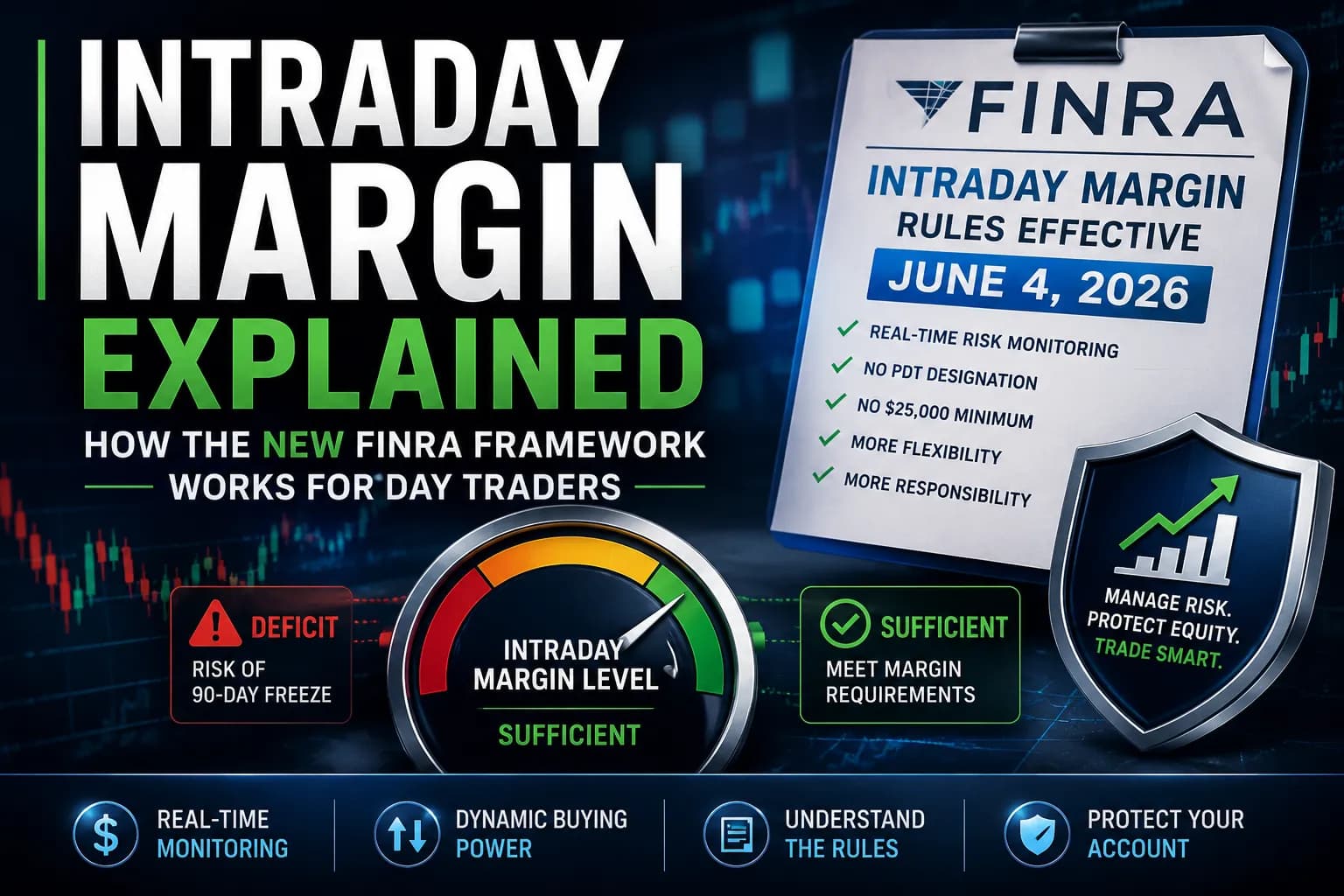


For the first time in 25 years, you can day trade a $5,000 MarginMargin is money borrowed from your broker, secured by the cash and securities in your account, that lets you hold a larger position than your own cash would allow. For example, with the standard 50% initial margin, $10,000 of equity can buyRead definition → account as many times as you want — and most of the coverage stops right there. The rule died on June 4, 2026. The headlines wrote themselves. What almost nobody has published is the part that actually matters: how to trade a small account under the framework that replaced it, without becoming one of the accounts that framework was designed to catch.
Because here's the uncomfortable truth buried under the celebration. The $25,000 wall didn't disappear into nothing. It was replaced by a real-time risk system that watches your account all day long — and a small account has far less room for error inside that system than a large one. The trade count is gone. The math is not.
This guide is the playbook: what changed, what didn't, how intraday buying power actually works on a sub-$25K account, the position sizing math that keeps you alive, which strategies genuinely open up, and the three specific ways small accounts blow up under the new rules.
What changed for small account day traders? As of June 4, 2026, FINRA eliminated the Pattern Day Trader rule — the $25,000 minimum and the four-trades-in-five-days limit are both gone. Small margin accounts can now day trade without restriction, but they must maintain enough equity to cover their real-time intraday exposure under new risk-based margin standards.
What Actually Changed (The 60-Second Version)
The SEC approved FINRA's amendments to Rule 4210 on April 14, 2026, and the new framework took effect on June 4, 2026. Three things were eliminated in one stroke: the $25,000 minimum equity requirement, the "pattern day trader" designation, and the entire practice of counting your day trades. Brokers no longer track whether you made four round trips in five business days, because the category that count fed into no longer exists.
In their place sits a single idea: your account must hold enough equity to SupportSupport is a price level where buying pressure has historically overcome selling pressure, causing price to stop declining and reverse — it's the floor where demand enters the market, and when it holds, it's a potential long entry; when it Read definition → the market exposure you're actually carrying at any point during the trading day. Brokers comply in one of two ways — real-time monitoring that blocks trades creating an intraday margin deficit, or an end-of-day calculation that triggers a margin call if a deficit occurred.
That's the summary. The full regulatory history, timeline, and broker-by-broker detail lives in our complete guide to the PDT rule elimination — this article assumes you know the rule is dead and focuses on what to do about it.
One date worth keeping in mind: brokers have until October 20, 2027 to fully implement the new system. The rules changed on a single day. The experience of trading under them will keep shifting, broker by broker, for the next year and a half.
The $2,000 Floor That Didn't Go Away
The most common misconception right now — and it's everywhere — is that all account minimums are gone.
They're not. Regulation T's $2,000 minimum equity requirement for margin accounts is still fully in force. If you want to trade with leverage (borrowed money), you still need at least $2,000 in the account. That floor predates the PDT rule, survives it, and isn't going anywhere.
What this means in practice:
- Below $2,000: You can day trade in a cash account (settled funds only, no leverage), or in a margin account using only your own cash. No borrowed buying power.
- $2,000 to $25,000: This is the newly unlocked zone. You can now hold a margin account, use intraday leverage, and day trade without any frequency limit. This RangeA range (or trading range) is a price zone where a stock oscillates between a defined support floor and resistance ceiling without making meaningful new highs or lows — price is consolidating rather than trending, and the dominant trade is Read definition → was effectively locked out of margin day trading for 25 years.
- Above $25,000: Honestly? Not much changed for you, except the mechanics of how your buying power is calculated — more on that next.
And one more wrinkle: $2,000 is the regulatory floor, not a promise. Brokers retain the right to set higher house minimums, and some will. Always check your specific broker's requirements rather than assuming the regulatory minimum applies.
How Intraday Buying Power Works Now
Under the old system, day trading buying power was a fixed formula — generally four times your prior day's closing margin excess, frozen in place for the whole session regardless of what happened during the day.
The new system is dynamic. Your buying power is calculated from your real-time intraday margin excess — the equity in your account above your maintenance margin requirement, updated continuously as your positions and the market move. Take a position, your excess shrinks. Close it at a profit, your excess grows. The number breathes with your account.
For a small account, this cuts both ways.
The good news: you're no longer rationing three day trades like water in a desert. A $5,000 account can scalp the open, fade a GapA gap is a price discontinuity on a chart where a stock opens significantly higher or lower than the previous session's close, leaving a visible empty space — gap-ups are driven by overnight buying pressure or positive news; gap-downs by seRead definition →, and take an afternoon setup all in the same session.
The less-discussed news: the system is watching your exposure, not your trade count. Stack three positions at once in a $5,000 account and you can create an intraday margin deficit even though every individual position looked reasonable. Under the new rules, that deficit must be resolved promptly — and an unmet deficit can freeze your account from receiving margin credit for up to 90 days.
Read that again. The old rule's penalty was a 90-day restriction for breaking the trade count. The new rule's penalty is a 90-day restriction for breaking the risk math. The punishment survived; only the trigger changed.
The full mechanics — deficit calculations, the two compliance models brokers use, what a freeze actually restricts — are covered in our intraday margin framework explainer. For this playbook, the operating rule is simple: know your maintenance requirement before you enter, and never let total open exposure push your equity below it.
The Risk Math: Sizing a $2,000–$25,000 Account
Here's where the new freedom gets dangerous, so let's be blunt about the baseline first.
Most day traders lose money. Multiple academic studies have found failure rates in the 70–95% range (Barber et al., 2014, among others), and nothing in the June 4 rule change altered the difficulty of the game. It changed who's allowed to play, not the odds. FINRA removed the wall, not the cliff on the other side of it.
The defense is position sizing, and on a small account the math is unforgiving because the numbers are small in dollars but enormous in percentages.
The standard professional baseline is risking 1% of account equity per trade. Run the numbers:
- Account Size
- $2,000
- 1% Risk Per Trade
- $20
- 2% Risk Per Trade
- $40
- Account Size
- $5,000
- 1% Risk Per Trade
- $50
- 2% Risk Per Trade
- $100
- Account Size
- $10,000
- 1% Risk Per Trade
- $100
- 2% Risk Per Trade
- $200
- Account Size
- $25,000
- 1% Risk Per Trade
- $250
- 2% Risk Per Trade
- $500
| Account Size | 1% Risk Per Trade | 2% Risk Per Trade |
|---|---|---|
| $2,000 | $20 | $40 |
| $5,000 | $50 | $100 |
| $10,000 | $100 | $200 |
| $25,000 | $250 | $500 |
A $20 risk budget feels absurd. It's supposed to. With a $0.10 stop, that's a 200-share position — workable on a $3 stock, impossible on a $300 one. The risk budget doesn't just size your position; it filters which stocks you can responsibly trade at all. That filter is a feature, not a bug.
The temptation the new rules create is to replace the old external limit (four trades) with no limit at all. The professional move is to replace it with an internal one: a daily max loss, typically 2–3% of equity. On a $5,000 account, that's $100–$150 — hit it, and you're done for the day, no exceptions. The new framework will let you keep trading right up until the margin system stops you. Your job is to stop long before it does.
Why so strict? Because of how DrawdownA drawdown is the peak-to-trough decline in account equity — it measures how far you've fallen from your high-water mark, either from a single losing trade or a series of losing trades.Read definition → math works against small accounts. Lose 20% of a $5,000 account and you need a 25% gain just to get back to even — and you'll be attempting that recovery with reduced buying power, since your margin excess shrank with your equity. The full survival math is in our risk of ruin breakdown, and the share-by-share formula is in our position sizing guide. If you read nothing else on this site before placing your first post-PDT trade, read those two.
Which Strategies Actually Open Up
The old rule didn't just limit trade frequency — it quietly banned entire strategy categories for small accounts. Four day trades per five days meant any approach requiring multiple daily round trips was off the table below $25,000. That ban is lifted. Here's an honest sorting of what that unlocks, and what it doesn't.
Genuinely unlocked:
Scalping. The most frequency-dependent style in existence — dozens of round trips a session — was mathematically impossible on a restricted account. It's now available. Whether it's advisable is a different question: scalping has the thinnest per-trade edge of any style, and commissions, spreads, and slippage hit small accounts proportionally hardest. Available is not the same as recommended for a first strategy.
Momentum trading with multiple entries. The old rule forced small accounts into a brutal choice: take the 9:35 setup or save the trade for something better later. That rationing psychology — forcing trades because you "saved" one, skipping A+ setups because you'd spent your count — distorted decision-making in ways traders rarely noticed. It's gone. You can now take the morning momentum trade, get stopped out, and re-enter on the reclaim without burning a scarce resource.
Same-day exits as risk management. This one is underrated. Under the old rule, a small-account trader who entered a position and watched it turn against them sometimes held overnight to avoid using a day trade. Think about that: the rule designed to protect small accounts incentivized them to hold losers longer. Cutting a loss the same hour you entered is now free. Use it.
Still off-limits — by math, not regulation:
High-priced stocks with wide stops, heavy multi-position layering, and anything requiring you to sit through large adverse moves. A $5,000 account trading NVDA with a $4 stop is risking 1.6% of equity per trade on a 20-share position before slippage. The regulator no longer stops you. Arithmetic still does.
For choosing a specific setup that fits your account size and temperament, the Strategies Hub is the library — the playbooks there include position sizing context for exactly this reason.
Margin vs. Cash: The Decision, Revisited
For years, the standard workaround for small accounts was the cash account: no PDT rule, unlimited day trades, with T+1 settlement as the constraint. An entire generation of small traders chose cash accounts purely to dodge a rule that no longer exists.
So does the cash account still make sense? Sometimes, yes — and the decision is cleaner now because it's finally about the right variables.
The margin account now offers: unlimited day trades (same as cash), intraday leverage, no settlement waiting — but with margin call risk, the new intraday deficit rules, and the 90-day freeze penalty hanging over mistakes.
The cash account still offers: zero leverage risk, no margin calls, no intraday margin framework to navigate at all — but your buying power is capped at settled cash, and Good Faith Violation rules still apply.
The honest framing: a cash account is now a choice about leverage, not a workaround for regulation. For a trader still learning — still figuring out whether their setup has an edge — the cash account's built-in inability to over-leverage is genuine protection, not a limitation. For a trader with a tested process who wants intraday flexibility, the margin account finally works at small size.
There's no urgency to switch either direction. Settlement mechanics, GFV rules, and the full decision framework are in our margin vs. cash account guide.
The Three Ways Small Accounts Blow Up Under the New Rules
The old rule produced one signature failure: the PDT flag and the 90-day lockout. The new framework has its own failure modes, and they're predictable enough to name in advance.
Failure mode one: trading frequency as a substitute for edge. The four-trade limit was a terrible rule with one accidental benefit — it forced selectivity. That forcing function is gone, and nothing replaces it automatically. A trader with a weak edge who made 4 trades a week lost slowly. The same trader making 40 trades a week loses ten times faster, with spreads and slippage compounding the bleed. The volume of your trading should be set by the number of A+ setups the market offers, which most days is small. If your trade count jumped 5x after June 4 but your process didn't change, the new rules didn't free you — they accelerated you.
Failure mode two: the intraday margin deficit spiral. New leverage plus real-time monitoring creates a trap the old system never had. A small account stacks positions during a fast morning, the market moves against the cluster, equity drops below maintenance requirements, and now the trader faces a deficit that must be resolved promptly — often by liquidating at the worst possible moment. Repeat offenders face the 90-day credit freeze. The prevention is boring: one position at a time until you've demonstrated — to yourself, with data — that you can manage more.
Failure mode three: scaling risk with buying power instead of equity. Real-time buying power grows as your trades work. A green morning expands what you can buy by midday. The trap is letting position size follow buying power instead of the 1% risk rule, so the day's largest position arrives exactly when overconfidence peaks. Size off equity. Always. Buying power is a ceiling, not a suggestion.
Notice the pattern: every failure mode is a discipline failure the old rule used to partially mask. The regulation outsourced restraint for 25 years. It just handed the job back to you.
Broker Readiness: Where the New Rules Are Live
The rules took effect June 4, but implementation is staggered — brokers have until October 20, 2027 to fully comply, which means the practical experience varies by platform right now.
As of this update, every major retail broker has confirmed its rollout is complete. Webull, Robinhood, Interactive Brokers, tastytrade, Lightspeed, Cobra Trading, and Fidelity implemented on or around June 4. Charles Schwab (including thinkorswim) went live June 8, using real-time monitoring. E*TRADE implemented June 9. TradeZero's specific date hasn't been independently confirmed as of this update, so check directly if that's your platform. Smaller or regional firms with older margin systems are the most likely candidates still using the extended phase-in, which runs through October 20, 2027.
Two practical implications. First, if your broker hasn't implemented yet, the old restrictions may effectively still apply to your account — confirm directly with your broker rather than assuming. Second, brokers are implementing the same regulation with different risk engines, so intraday buying power for an identical account can differ across platforms. If you're choosing a broker partly on this basis, the reviews hub covers the major day trading brokers and platforms in detail.
Tools That Fit a Small Account
A quick word on tooling, because the rule change shifts the workflow problem for small accounts in a specific way.
Under the old regime, a restricted trader needed to find one or two great setups per week. Now the constraint is flipped: with unlimited trades, the scarce resource is selectivity — filtering a market of thousands of tickers down to the handful of setups worth your tightly-budgeted risk. That's a scanning problem.
This is the use case where Trade Ideas is built to operate. It's a comprehensive trading platform — real-time scanning with 500+ filters, Holly AI signals generated from nightly backtesting, built-in charting, OddsMaker backtesting, and Brokerage Plus execution through supported brokers — and the two features most relevant to a small account are the filtering depth (you can scan specifically for lower-priced, liquid stocks where your risk budget produces workable position sizes) and the paper trading mode, which lets you pressure-test a higher-frequency approach before risking real capital under the new margin rules. No tool produces an edge by itself — results depend entirely on the trader's process and discipline — but for a small account whose entire survival depends on trade selection, decision-support infrastructure is the category that earns its cost first. The full breakdown is in our Trade Ideas review, and current discounts are on our deals page.
If you're not ready for a paid platform, that's a legitimate position too — the reviews hub covers free and lower-cost screening options worth starting with.
FAQs
Can I day trade with $2,000 now?
The $25,000 PDT minimum and the four-trades-in-five-days limit were both eliminated by the amendments to FINRA Rule 4210. The $2,000 Reg T floor for margin accounts remains, and your broker may set a higher house minimum. Your buying power will be calculated from your real-time intraday margin excess, so a $2,000 account has a thin cushion — a single oversized position can create an intraday margin deficit. Below $2,000, you can still day trade in a cash account using settled funds.
Key Takeaway: $2,000 is the new regulatory entry point for margin day trading — see our guide on how much money you actually need for realistic capital planning.
Is there any limit on how many day trades I can make now?
Brokers no longer count day trades, and the pattern day trader designation no longer exists. The practical limit is your intraday margin excess: every open position consumes part of it, and trades that would create a margin deficit can be blocked (under real-time monitoring) or trigger a margin call (under end-of-day calculation). The constraint moved from "how often you trade" to "how much exposure you carry."
Key Takeaway: Trade count is unlimited; exposure is not — the mechanics are covered in our intraday margin explainer.
What happens if my small account gets an intraday margin deficit?
Under the amended Rule 4210, brokers either block deficit-creating trades in real time or calculate deficits at end of day and issue margin calls. An account that fails to satisfy deficits can be restricted from receiving extensions of credit for up to 90 days — functionally similar in pain to the old PDT lockout, but triggered by risk math instead of trade counting. Small accounts hit this faster because their equity cushion above maintenance requirements is thinner.
Key Takeaway: The 90-day penalty survived the rule change — it just watches your exposure now instead of your trade count.
Do cash accounts still make sense now that the PDT rule is gone?
Cash accounts were never subject to the PDT rule, so the elimination doesn't change their mechanics — T+1 settlement and Good Faith Violation rules still apply. What changed is the reason to choose one. A cash account now makes sense if you want a hard, structural cap on risk: you cannot over-leverage money you don't have. For newer traders still proving out a strategy, that built-in restraint has real value.
Key Takeaway: Choose based on leverage tolerance, not regulation — our margin vs. cash guide walks through the decision.
How is my buying power calculated on a small account now?
The old system fixed your day trading buying power at the open based on the prior day's close. The new system recalculates as your positions and the market move: open positions consume excess, closed winners restore it, and adverse moves shrink it. Some brokers also now include eligible swept cash balances in the calculation. Because the number is dynamic, a small account's buying power can change meaningfully within a single hour.
Key Takeaway: Buying power now breathes with your account — size positions off your equity and risk rules, never off the buying power number itself.
Which strategies should a small account avoid even though they're now legal?
All three are now permitted and all three are statistically punishing at small size. Scalping's thin per-trade edge gets consumed by spreads and slippage that hit small accounts proportionally hardest. High-priced stocks force either oversized risk or positions too small to matter. Multiple simultaneous positions multiply exposure against a thin margin cushion and invite the intraday deficit spiral. Legality changed on June 4; the arithmetic didn't.
Key Takeaway: Pick one setup, trade it small, and prove the edge before adding frequency — the Strategies Hub playbooks are built for exactly this.
Did the rule change make day trading easier to profit from?
Academic research has consistently found that the large majority of day traders are unprofitable, with documented failure rates in the 70–95% range across multiple studies. Nothing about real-time margin calculation improves anyone's edge — if anything, easier access to higher trade frequency lets a losing process lose faster. The traders most likely to benefit are those who already had a tested, selective process and were artificially constrained by the trade count.
Key Takeaway: The rule change is opportunity for disciplined traders and acceleration for undisciplined ones — risk management remains the entire game.
My broker still shows PDT restrictions on my account. Why?
The regulation took effect June 4, 2026, but FINRA granted an 18-month phase-in window for firms that need time to rebuild their margin systems. As of this update, every major retail broker has confirmed implementation: Robinhood, Webull, Interactive Brokers, tastytrade, Lightspeed, Cobra Trading, and Fidelity moved on or near June 4; Schwab followed June 8 and E*TRADE June 9. Smaller or regional brokers with older systems are the ones most likely to still be transitioning. Until your specific broker implements, their old restrictions effectively govern your account.
Key Takeaway: Confirm implementation status directly with your broker — every major retail broker has completed its transition well ahead of the October 2027 deadline.
Disclaimer
Article Sources
- FINRA Regulatory Notice 26-10 - The official notice adopting the new intraday margin standards and confirming the June 4, 2026 effective date and October 20, 2027 phase-in deadline.finra.org
- Charles Schwab: SEC Approves Scrapping $25,000 Day Trader Minimum - Broker-level summary of the rule change and its history.schwab.com
- Charles Schwab: Schwab Changes Rules Around Day Trading - Schwab's own implementation timeline and account treatment under the new framework.schwab.com
- E*TRADE: Pattern Day Trader (PDT) Rule Change - Detailed before/after comparison of buying power calculation, including real-time intraday margin excess.us.etrade.com
- NerdWallet: The $25,000 Pattern Day Trading Rule Is No More - Reporting on broker implementation dates and the surviving $2,000 Regulation T minimum.nerdwallet.com
- WilmerHale Client Alert: SEC Approves Amendments to FINRA Rule 4210 - Legal analysis of the intraday deficit monitoring requirements and the 90-day credit freeze provision.wilmerhale.com