
For the second time this year, the Fed's rate decision and Big Tech's EarningsAn earnings report is the quarterly financial disclosure a public company files with the SEC, revealing revenue, earnings per share (EPS), profit margins, and forward guidance — it's the most significant regular catalyst for individual stocRead definition → are landing in the same 24 hours. It happened April 28–29, when the FOMCThe Federal Open Market Committee (FOMC) is the Federal Reserve committee that sets U.S. monetary policy — most importantly, the target federal funds rate — at eight scheduled meetings per year.Read definition → meeting collided with a wave of Magnificent Seven reports. It's happening again on July 29 — Microsoft and Meta both report the same day the Fed announces its rate decision, and this time the Fed is leaning HawkishHawkish describes a monetary policy stance favoring higher interest rates, reduced money supply, or tighter financial conditions to control inflation — the opposite of dovish.Read definition → instead of DovishDovish describes a monetary policy stance that favors keeping interest rates low, accommodating economic growth, or signaling tolerance for inflation — as opposed to hawkish, which favors tighter conditions.Read definition →.
That's the headline collision. It's not the only one. Fifteen days earlier, on July 14, the June Consumer Price Index report and the first wave of bank earnings — Citigroup, Wells Fargo, Goldman Sachs, Bank of America, Morgan Stanley, and JPMorgan Chase — all land on the same morning. Two of the highest-VolumeVolume is the total number of shares (or contracts) traded during a given time period — it's the primary confirmation tool for all price action, because a price move accompanied by high volume indicates genuine market participation, while tRead definition → trading days of the entire quarter, both stacked with more than one market-moving event apiece.
Here's the full calendar, why the stakes are higher than a typical earnings season, and how to actually prepare instead of just reacting.
What is corporate guidance, and why does it move stocks more than the earnings themselves? Guidance is a company's own forecast for future revenue, earnings, or spending — typically given alongside quarterly results. Markets are forward-looking, so a stock can beat its past-quarter numbers and still fall if its guidance for the next quarter disappoints, or miss and still rally if guidance beats expectations.
The Calendar: Every Date That Matters This Season
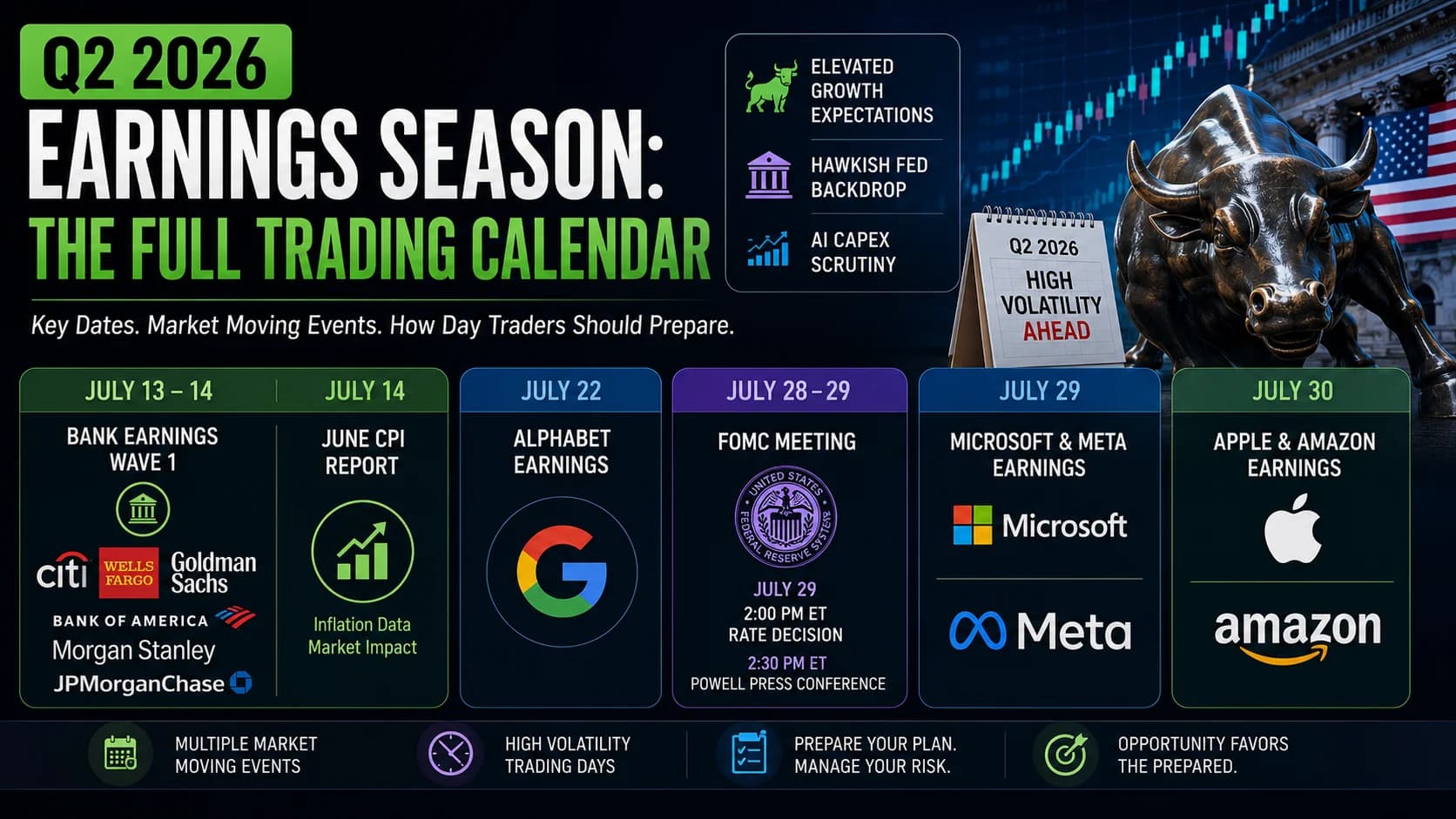
Monday, July 13 – Tuesday, July 14: The banks lead off. Citigroup, Wells Fargo, Goldman Sachs, Bank of America, and Morgan Stanley are expected to report on July 14, with JPMorgan Chase reporting the same day or the following morning depending on the tracker — company IR calendars are the final word as the date approaches. The June CPI report, covering the month's inflation data, is scheduled for release that same morning.
Wednesday, July 22: Alphabet reports, the first of the Magnificent Seven names and typically a bellwether for ad spending and cloud/AI infrastructure commentary.
Tuesday, July 28 – Wednesday, July 29: The FOMC meets, with the rate decision announced at 2:00 PM ET and Fed Chair Kevin Warsh's press conference at 2:30 PM ET. This meeting does not include a new Summary of Economic Projections — the Fed's quarterly "dot plot" — which only accompanies the March, June, September, and December meetings. That matters: the market gets a statement and a press conference this time, not fresh multi-year rate projections.
Wednesday, July 29: Microsoft and Meta Platforms are both expected to report after the close — the same day as the Fed decision.
Thursday, July 30: Apple and Amazon are both expected to report, closing out the Big Tech cluster.
One name worth flagging by its absence: Nvidia. Despite being the most-watched single earnings report in the market most quarters, Nvidia runs on an offset fiscal calendar and isn't expected to report until late August — a separate, later event, not part of this cluster. Don't build a late-July plan around it.
All dates above reflect the most recently reported schedules as of this guide's publication. Companies confirm exact dates and times closer to the event, and dates can shift — check the company's own investor relations page in the days beforehand if you're planning around a specific report.
Why This Earnings Season Carries More Weight Than Usual
Two things are stacking on top of each other this quarter, and each one independently raises the stakes.
First, the growth bar is high and still rising. The most recent FactSet estimate puts S&P 500 Q2 earnings growth at roughly 22%, up from an already-strong 18.7% estimate at the start of the quarter — with revenue growth projected near 12.1%, the fastest pace since Q2 2022. Roughly half of that earnings growth is expected to come from companies benefiting from AI infrastructure spending, according to Goldman Sachs Research — mostly semiconductor names, with tech hardware, industrials, and utilities picking up a share of the halo effect. When that much of the growth story rests on one theme, any hint that AI capex commentary is softening carries outsized weight, especially from the Big Tech names that are doing most of that spending.
Second, the market's patience for disappointment has thinned. Companies that have missed Q2 estimates so far have seen their stocks fall by an average of 4.2%, compared with a historical average closer to 2.9%. At current valuations — the S&P 500's forward P/E has been running above its 10-year average most of this year — there's less room for a company to miss and shrug it off.
Layer the Fed backdrop on top of that. The Fed has held its benchmark rate at 3.50%–3.75% across its last several meetings, but June's dot plot shifted the median year-end 2026 projection higher, to 3.8%, and markets have been pricing meaningful odds of a hike later this year rather than the cut that was expected earlier in 2026 — a genuine reversal in tone. Fed funds futures pricing moves in real time, so check the current odds close to July 29 rather than relying on a snapshot from today.
Put together: elevated growth expectations, a market that's punishing misses harder than usual, and a Fed that's turned more hawkish than dovish. None of those three conditions guarantee volatility on any specific day — but they're the reason this particular stretch of the calendar deserves more preparation than a typical earnings season.
July 14: The Day CPI and the Banks Report Together
This is the first of the season's two stacked days, and it's worth understanding why the order of events matters.
The CPI report typically drops at 8:30 AM ET — before the market open, and before the banks' own pre-market reports and conference calls get fully digested by traders. That means the first reaction in bank stocks on July 14 may be responding to two different inputs at once: the bank's own quarterly numbers, and a fresh read on inflation that directly affects the rate outlook those banks operate under. A hot CPI print reinforcing the Fed's hawkish tilt can overwhelm an otherwise solid quarter from Citigroup or Wells Fargo — and a cooler-than-expected print can do the opposite.
This isn't a new pattern — CPI mornings have their own well-documented mechanics, and this guide's CPI report playbook covers the setup in detail for traders who want the full framework. What's different about July 14 specifically is the earnings overlay riding on top of it.
July 29: The Fed and Big Tech Collide — Again
The mechanics of a standalone FOMC day are well established: the 2:00 PM statement, the initial market reaction, and then the real move that often comes during — or after — Warsh's 2:30 PM press conference, when the market weighs his tone against the statement's language. This guide's FOMC trading playbook breaks down that structure if you haven't traded a Fed day before.
What makes July 29 different is that Microsoft and Meta report after the close the same day. A trader gets almost no time to fully digest the Fed's tone before shifting focus to two of the largest companies in the index reporting hours later — and both are squarely in the AI capex conversation this guide covered above. Guidance language from either company on data center spending, cloud growth, or advertising demand lands into a market that's already been repriced once that day by the Fed.
Apple and Amazon following the next morning, July 30, extends the stretch rather than closing it. A trader who treats July 29–30 as a single 48-hour event — rather than two separate, unconnected days — has a more realistic picture of what's actually happening to positioning and volatility across that window.
How to Prepare Before the Season Starts
Preparation here isn't about predicting direction. It's about not being surprised by the structure of the calendar.
Confirm dates in the days before, not weeks before. Earnings dates shift, sometimes by a day, occasionally by a week. The dates above are accurate as of publication — treat them as a planning framework, not a locked schedule, and verify against each company's investor relations page as the date approaches.
Know which of your positions actually report during this window. It's easy to assume a stock isn't reporting soon simply because you haven't seen a date confirmed yet. Run your open positions and watchlist against the calendar above before July 13, not after.
Separate the Fed day from the earnings days in your head, then recombine them. Trading a standalone FOMC day and trading a standalone earnings gap are two different skill sets with different risk profiles. July 29 asks for both in the same session — plan position sizing accordingly rather than treating it like an ordinary Wednesday.
Watch implied volatility levels heading into July 29 specifically. Options pricing on Microsoft and Meta will reflect both the earnings report and the same-day Fed decision, which can make single-stock IV levels read higher than they would around a standalone report. A stock scanner that lets you track relative volume and unusual options activity across a watchlist in real time — Trade Ideas is this guide's top pick for that kind of monitoring — is more useful here than checking each name manually, especially with five to six major reports landing across a 48-hour window. This guide's full Trade Ideas review covers the rest of the platform if you want the complete feature breakdown.
What to Watch For After the Season Peaks
The season doesn't end when Apple and Amazon report on July 30 — it shifts into a different phase.
Post-earnings drift is real and well documented: stocks that beat and raise guidance often continue trending in that direction for days or weeks afterward, not just on the report day itself, and the same is true in reverse for misses. That makes the days immediately following July 30 worth watching even if you didn't trade the reports themselves.
Guidance commentary on AI capex specifically deserves a second look about a week out, once the initial reaction has settled and analysts have had time to update models. If multiple Big Tech names guided capex higher for the second half of the year, that reinforces the growth story behind this year's earnings estimates. If commentary comes in more cautious than the market expected, that's a meaningfully different setup heading into Q3.
On the Fed side, the next scheduled meeting is September 15–16 — the next one that includes a fresh Summary of Economic Projections. Between July 29 and then, the data that will shape that meeting's dot plot (inflation prints, jobs reports) starts accumulating almost immediately. This guide's ongoing Market Insights coverage tracks how Warsh's Fed has handled that transition so far.
Where This Stacks the Risk
Trading news events is already a structurally difficult game for retail traders — this guide's own research on the topic covers why market makers and institutional desks generally have an information and execution speed advantage on exactly these kinds of scheduled events. Stacking two catalysts into one session doesn't just add risk — it compounds the specific disadvantage retail traders already face on single-catalyst days.
The bigger the expected move, the bigger the potential loss from being wrong about direction, and options and stocks around the July 29 cluster are likely to carry elevated implied volatility precisely because more than one major, unpredictable input is landing in the same session. A move that would be unremarkable on a normal Wednesday can be amplified when the market is simultaneously repricing Fed policy and a mega-cap's growth trajectory.
There's also a subtler risk: assuming the two catalysts will reinforce each other. A hawkish Fed statement and strong Big Tech guidance can just as easily pull a stock in opposite directions within the same session as they can align. Don't assume the setup resolves cleanly in one direction just because two big events are landing together.
FAQs
When exactly does Q2 2026 earnings season start?
Some companies with fiscal quarters ending in May technically report earlier and get counted toward the broader Q2 tally, but the widely recognized "start" of the season — the point where market attention actually shifts to earnings — is the mid-July bank cluster. That's the date to build a calendar around.
Key Takeaway: Treat July 14 as the practical start date, even though a handful of off-cycle companies report before it.
Why does it matter that the Fed and Big Tech report on the same day?
That sequencing means the market has almost no time to fully process the Fed's tone before shifting attention to two of the largest companies in the S&P 500. Volatility from one event can bleed into positioning for the other, and options pricing on both companies is likely to reflect the added uncertainty of the same-day Fed decision. This isn't unprecedented — the same collision happened around the April 28–29 FOMC meeting this year.
Key Takeaway: Plan July 29 as a single, extended risk window rather than two unrelated events on the same calendar square.
Does the July FOMC meeting include a new dot plot?
That means the July 28–29 meeting produces a policy statement and a press conference, but not fresh multi-year rate projections. Traders looking for the Fed's next formal signal on where rates are headed for 2026 and 2027 will need to wait until the September 15–16 meeting for that.
Key Takeaway: Expect Warsh's tone and word choice — not new projections — to be what actually moves markets on July 29.
Why is this earnings season getting more attention than usual?
Those two conditions combine to raise the stakes on both sides of every report: a beat that also delivers strong AI capex guidance can extend the rally that's driven most of this year's gains, while a miss or a cautious guidance tone lands on a market with less tolerance for disappointment than in a typical year.
Key Takeaway: The size of the expected earnings-day reaction, not just the earnings themselves, is elevated this season.
Is Nvidia part of this earnings cluster?
It's an easy mistake to make given how closely Nvidia's results are watched most quarters, but building a late-July trading plan around an Nvidia report that isn't actually happening yet is a scheduling error worth avoiding.
Key Takeaway: Nvidia's report is a separate, later event — don't fold it into your July 29–30 planning.
How should I position size around the July 29 cluster specifically?
Implied volatility on Microsoft and Meta options heading into July 29 is likely to price in both the earnings event and the same-day Fed decision, which can make single-stock volatility levels read higher than usual for an earnings report alone. Sizing a position as though only one catalyst is in play, when two are landing in the same session, understates the actual risk.
Key Takeaway: Treat July 29 as carrying compounded event risk, not the risk profile of a single catalyst day.
What happened the last time the Fed and Big Tech earnings collided?
That overlap is a function of the FOMC's roughly six-week meeting cycle periodically lining up with the Big Tech reporting calendar, not a one-off coincidence. It's a pattern worth recognizing rather than treating each occurrence as a novel setup.
Key Takeaway: Expect this kind of Fed-and-earnings overlap to recur roughly once or twice a year going forward, not just this quarter.
Should I expect a rate cut or a rate hike at the July meeting?
June's Summary of Economic Projections showed the median year-end 2026 rate projection moving higher, and Fed officials have been split on the path ahead. Because the July meeting doesn't include a new dot plot, the clearest read on rate expectations heading into that meeting comes from market-based tools like the CME FedWatch Tool rather than from anything the Fed itself publishes in July.
Key Takeaway: Check real-time Fed funds futures pricing close to July 29 rather than relying on any single point-in-time estimate, including this one.
How is this different from the earnings-season basics I should already know?
If you're comfortable with the basic mechanics already, this guide's calendar and risk sections above are built to be used alongside that foundational knowledge, not in place of it.
Key Takeaway: Pair this guide's calendar with the fundamentals guide if earnings-day mechanics themselves are still new to you.
Article Sources
- Federal Reserve — FOMC Meeting Calendars - official 2026 meeting schedule, including which meetings include the Summary of Economic Projections.federalreserve.gov
- FactSet Insight — S&P 500 Earnings Season Updates - quarterly earnings and revenue growth estimates for the S&P 500.insight.factset.com
- Goldman Sachs — The S&P 500 Is Forecast to Climb as Earnings Growth Powers Stocks Higher - AI capex contribution to 2026 S&P 500 earnings growth.goldmansachs.com
- CNBC — Fed Interest Rate Decision, June 2026 - June FOMC outcome, dot plot shift, and market rate-hike pricing.cnbc.com
- CME Group — CME FedWatch Tool - live, real-time market-implied probabilities for upcoming Fed rate decisions.cmegroup.com