
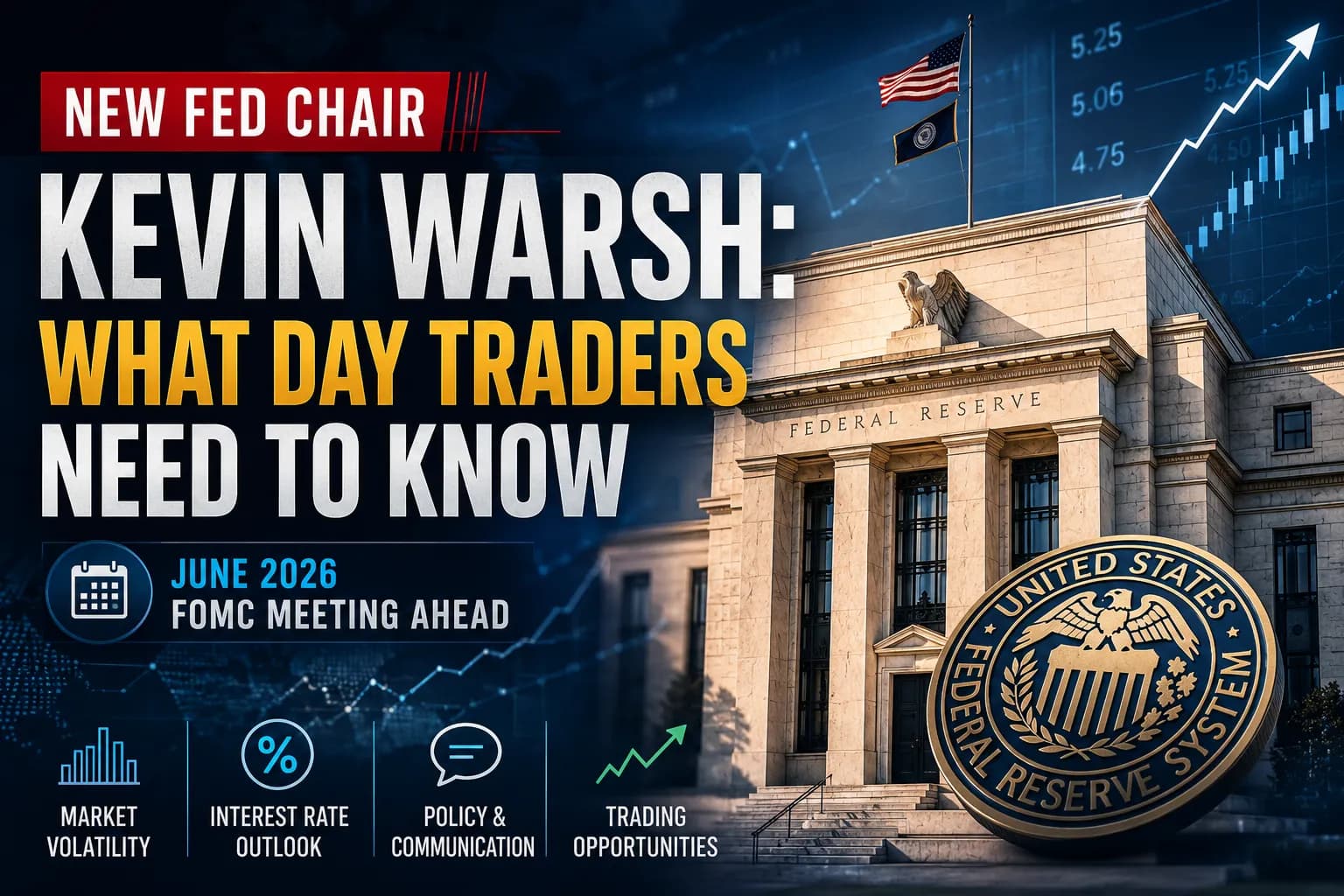
The Federal Reserve has a new boss — and the transition is anything but routine.
Kevin Warsh was confirmed to the Federal Reserve's Board of Governors on Tuesday, May 12, in a 51-45 Senate vote, with a separate chairmanship confirmation expected this week. Jerome Powell's eight-year run as Fed Chair ends officially on May 15. By the time the Fed's next policy meeting opens on June 16, Warsh will be running the room — presiding over his first Summary of Economic Projections, his first press conference, and almost certainly his first major market-moving statement.
For most investors, a change in Fed leadership is background noise. For day traders, it is anything but. The Fed chair sets the tone for forward GuidanceGuidance is forward-looking financial projections that a company's management provides for upcoming periods — typically covering expected revenue, earnings, or margins — and the market's reaction is often driven more by guidance than by theRead definition →, press conference communication style, and — most importantly — the market's uncertainty premium. Transitions breed volatility. Volatility creates opportunity. And right now, this transition comes loaded with more moving parts than any handoff since Paul Volcker gave way to Alan Greenspan in 1987.
Here is everything day traders need to understand about what just changed, what Warsh has signaled, and how to position your Trading PlanA trading plan is a written document that defines your strategy, the specific setups you trade, entry and exit rules, risk management parameters, daily loss limits, market conditions required to trade, and psychological rules — it's the difRead definition → heading into June.
What is the FOMCThe Federal Open Market Committee (FOMC) is the Federal Reserve committee that sets U.S. monetary policy — most importantly, the target federal funds rate — at eight scheduled meetings per year.Read definition →?
The Federal Open Market Committee (FOMC) is the policy-making body of the Federal Reserve. It meets eight times per year to set the federal funds rate — the benchmark interest rate that ripples through everything from mortgage costs to stock market valuations. The Fed chair leads each meeting, delivers the post-decision statement, and holds a press conference. Markets react to every word.
The Handoff: What Just Happened and Why It's Unusual
Fed chair transitions are typically smooth, well-telegraphed, and institutionally boring by design. This one is not.
The confirmation process for Warsh was complicated by a Department of Justice investigation into Jerome Powell over cost overruns in a Federal Reserve building renovation project. That probe effectively froze Senator Thom Tillis's vote, putting the nomination at risk. The DOJ ultimately dropped the investigation, Tillis came on board, and the Senate Banking Committee approved Warsh's nomination on April 29 — along party lines, 13-11.
The full Senate confirmed Warsh to the Fed Board on May 12. The chairmanship vote was expected within days. Under normal circumstances, a departing Fed chair simply leaves. Powell is not doing that. He plans to remain on the Board of Governors — whose term runs through 2028 — citing what he described as "a series of legal attacks on the Fed which threaten our ability to conduct monetary policy without considering political factors."
That means two things for traders. First, the political atmosphere surrounding the Fed right now is unusually charged. Second, the FOMC table Warsh will sit at includes his predecessor — a dynamic with essentially no modern precedent.
Who Is Kevin Warsh? A Trader's Briefing
Warsh, 56, is not a conventional choice for Fed chair. He is not an economist. He holds a law degree from Stanford and built his career in investment banking and White House economic policy, serving on the Fed's Board of Governors from 2006 to 2011. During that tenure, he was in the room for the 2008 financial crisis and the extraordinary interventions that followed — though he was a notable skeptic of the aggressive quantitative easing measures that came after.
A few things traders should know about where Warsh stands:
He is skeptical of large Fed balance sheets. Warsh has argued for years that the Fed's multi-trillion-dollar asset holdings distort markets and crowd out private investment. He believes a smaller balance sheet is not just possible but necessary — and that shrinking it over time would paradoxically allow for a lower policy rate. This is a more HawkishHawkish describes a monetary policy stance favoring higher interest rates, reduced money supply, or tighter financial conditions to control inflation — the opposite of dovish.Read definition → structural position than the Fed has held in recent years.
He wants closer coordination with the Treasury Department. This is the most politically charged piece. During his Senate confirmation hearing, Warsh said the Fed should be more transparent about how its decisions interact with fiscal policy. Critics — and there were many — interpreted this as signaling a willingness to align Fed policy with the White House's preference for lower rates.
He is familiar with digital assets. Warsh's pre-confirmation financial disclosures revealed investments in crypto and blockchain infrastructure firms, which he pledged to divest. This positions him as a Fed leader with firsthand familiarity with digital markets at a moment when the central bank is actively working through stablecoin regulation, bank crypto custody rules, and digital payment research.
He calls it "regime change." That was his phrase, used in public statements before and during confirmation. He means a fundamental shift in how the Fed operates — not just rate policy, but communication, transparency, and its relationship with other government institutions.
"Regime Change" — What Warsh Said and What It Means in Practice
The phrase "regime change" is unusual language for a central banker. Warsh used it intentionally, and traders should take it seriously.
In practice, it appears to mean at least four things:
1. A shift in communication style. Powell became known for plain-language press conferences and careful, consensus-driven messaging. Warsh's style in his earlier Fed tenure and in public remarks since has been more direct, at times more willing to express dissent from consensus. Whether his press conference communication as chair matches that tone will become clear on June 16.
2. A tighter Fed-Treasury relationship. Warsh has suggested the Fed should be more forthcoming with the Treasury about its thinking on non-monetary issues — financial stability, regulation, international coordination. The practical trading implication: more potential for coordinated government signals that move markets.
3. An accelerated balance sheet rundown. The Fed has already been reducing its portfolio of Treasury and mortgage-backed securities since 2022. Warsh favors continuing and potentially accelerating that process. A faster QT (quantitative tightening) pace tends to put modest upward pressure on long-term interest rates.
4. Eventual lower rates — but not immediately. This is the counterintuitive part of Warsh's argument. He believes that structural DisciplineTrading discipline is the consistent application of your predefined rules — entries, stops, targets, position sizing, maximum daily loss — regardless of what you're feeling in the moment.Read definition → — smaller balance sheet, more credible inflation targeting — creates the conditions for sustainably lower rates over time. In the near term, he is not signaling a rate-cutting cycle. He is inheriting an economy where that path is blocked by inflation.
The Divided FOMC: Why Four Dissents Matter to Traders
The April 29 FOMC meeting produced something markets almost never see: four dissents.
To put that in context — four dissents from a single meeting is the highest number since late 1992. In normal times, the Fed chair manages the committee to near-consensus. Four dissents signals that Warsh is walking into a fractured policy table.
Here is how the dissents broke down:
- Stephen Miran dissented in favor of a rate cut. Miran, whose tenure on the board ends as Warsh joins, has been the dovish outlier throughout 2026, arguing that slowing growth and inconsistent payroll data warrant easing.
- Beth Hammack, Neel Kashkari, and Lorie Logan dissented in the opposite direction — not against the rate decision itself, but against the "easing bias" language included in the statement. They did not want the statement to signal that rate cuts are eventually coming.
Think about what that means structurally: Warsh's committee contains significant hawkish resistance to any easing language, while economic conditions remain uncertain enough that at least one voting member wanted a cut. This is not a committee that moves together easily.
For day traders, a divided FOMC is actually important information. It means:
- Press conferences will be scrutinized for any hints about which faction Warsh aligns with
- Any policy shift — in either direction — will be a surprise to at least part of the market
- Dot plots and SEP projections will show internal disagreement, which historically drives more volatility around FOMC releases
The Inflation Problem Warsh Inherits
Warsh does not get to start with a clean slate. The inflation picture he is walking into is genuinely complicated.
April 2026 CPI came in at 3.8% year-over-year — up from 3.3% in March. Core CPI (which strips out food and energy) sits at 2.8%, running above the Fed's 2% target. Nonfarm payrolls added 115,000 jobs in April with unemployment holding steady, giving the Fed no employment-side justification for emergency cuts.
And then there is the geopolitical layer. The FOMC's April 29 statement specifically noted that "developments in the Middle East are contributing to a high level of uncertainty about the economic outlook." Energy prices remain elevated, which creates persistent upward pressure on headline inflation.
Markets are currently pricing roughly a 97% probability of no rate change at the June 16-17 meeting — a near-certainty, based on CME FedWatch data. But further out, something unusual is happening: market participants are beginning to price some probability of a rate hike by December. That is not the base case, but it is being discussed, and it reflects the genuine uncertainty about whether inflation continues to reaccelerate.
Warsh will have to decide — at his very first meeting — how to communicate policy direction in an environment where rates are probably on hold, inflation is running hot, geopolitical risk is elevated, and his committee is internally divided.
What to Watch at the June 16–17 FOMC Meeting (His First)
Mark your calendar. June 16-17 is the most important market event of the early summer for day traders, and it lands just 12 days after the PDT rule effective date — a separate major shift already reshaping the retail trading landscape, which we covered in detail in our complete PDT rule elimination guide.
Here is what to watch specifically at the June meeting:
The Rate Decision (June 17): The decision itself is almost certainly a hold at 3.50%–3.75%. No surprise there. The drama is entirely in the surrounding language and projections.
The Dot Plot (SEP): This is where Warsh's first meeting gets genuinely important. The Summary of Economic Projections — updated quarterly and released at this meeting — includes the "dot plot," which shows where each FOMC member expects rates to go over the next one to three years. With a divided committee and inflation running hot, the dot plot could show fewer projected cuts than market consensus expects, pushing rates higher across the yield curve in the immediate aftermath. Or Warsh could surprise with a more dovish stance, triggering a relief rally. Either outcome represents a tradeable move.
The Press Conference: This is Warsh's debut. The market will spend an enormous amount of energy trying to decode his communication style, his word choices, and whether his answers suggest he leans toward the hawkish or dovish camp on his fractured committee. Pay attention to how he handles the "easing bias" question — whether he defends it, removes it, or equivocates on it will set the tone for the rest of 2026.
June 10 — May CPI Release: One week before the FOMC meeting, the May CPI report drops. If it shows continued acceleration above 3.8%, it hardens the "hold or hike" narrative and increases volatility heading into the meeting. If it cools, rate-cut expectations revive and markets could rally into June 16. This data point is arguably more important than the meeting itself for short-term positioning.
For a detailed breakdown of how to trade around Fed Chair press conferences specifically — including the three-phase entry framework this guide uses — see our strategy guide for trading Fed Chair speeches.
The Powell Overhang: Why He's Staying and Why It Matters
The fact that Powell is remaining on the Board of Governors is genuinely unprecedented in the modern Fed era. He will be one of seven votes on the Board — and while the chair sets the agenda and tone, a former chair sitting at the same table creates an awkward dynamic that has no recent parallel to draw on.
A few practical implications:
Powell staying signals he intends to protect the Fed's institutional independence. His stated reason is the ongoing uncertainty about whether the DOJ probe gets reopened. His implicit message is that he does not trust the political environment well enough to simply walk away.
From a market structure perspective, this means Warsh cannot fully claim the microphone as "the Fed" in the way new chairs typically do. Every major decision will implicitly carry the question: where does Powell stand? Markets that are accustomed to parsing a single Fed voice now have two credible voices — one with the podium, one with decades of institutional memory and policy credibility.
For traders, this creates an environment where Fed communication ambiguity is elevated. When ambiguity rises, volatility typically follows.
Here is the practical part.
Expect elevated volatility around Fed events through Q3 2026. New Fed chair, divided FOMC, hot inflation, and geopolitical uncertainty are the ingredients for larger-than-normal price swings on FOMC days, CPI days, and any days where Warsh speaks publicly. This creates genuine opportunity — but also elevated risk. Our high-VIX trading strategy is specifically designed for these conditions.
Pay close attention to bond markets and the dollar. The relationship between Fed policy expectations and the 10-year Treasury yield is how macro players signal their read on rate direction. A rising 10-year typically pressures growth stocks and can create intraday momentum in financial sector names. A falling dollar can lift commodity-adjacent equities and gold. Understanding these relationships — known as intermarket analysis — can give you a macro edge on FOMC days. Our intermarket analysis guide covers these correlations in detail.
Know the news event calendar cold. The critical dates between now and the June 17 decision:
- Date
- June 4, 2026
- Event
- PDT Rule effective date
- Why It Matters
- Retail trading landscape shifts
- Date
- June 10, 2026
- Event
- May CPI release
- Why It Matters
- Key inflation data point before FOMC
- Date
- June 16–17, 2026
- Event
- FOMC Meeting (Warsh's first)
- Why It Matters
- Rate decision + dot plot + press conference
- Date
- June 19, 2026
- Event
- Quadruple Witching
- Why It Matters
- Options/futures expiration, elevated volume
| Date | Event | Why It Matters |
|---|---|---|
| June 4, 2026 | PDT Rule effective date | Retail trading landscape shifts |
| June 10, 2026 | May CPI release | Key inflation data point before FOMC |
| June 16–17, 2026 | FOMC Meeting (Warsh's first) | Rate decision + dot plot + press conference |
| June 19, 2026 | Quadruple Witching | Options/futures expiration, elevated volume |
Size down on FOMC day itself. Regardless of your view, the actual announcement window — roughly 2:00 PM ET to 3:00 PM ET on the decision day — is whipsaw territory. Experienced traders often reduce position sizes ahead of the announcement and re-enter after the initial knee-jerk reaction settles. Before you size any position going into a major catalyst, use our reward/risk calculator to make sure the math supports the trade.
Focus on what Warsh says, not just what happens. His press conference language will be dissected for months. Phrases like "patient," "data dependent," "gradual," or any departure from those standard Fed terms will move markets. Build your watchlists before the conference. Have your levels set. And read our guide to trading news events before you sit down at the keyboard — because FOMC press conferences are among the most dangerous environments for retail traders to operate in without a clear plan.
Frequently Asked Questions
Who is Kevin Warsh and why does he matter to day traders?
Warsh served on the Fed Board from 2006 to 2011, was present for the 2008 crisis response, and has since been publicly skeptical of large Fed balance sheets. His appointment comes during elevated inflation, geopolitical uncertainty, and an unusually fractured FOMC — a combination that makes his first decisions and communications especially high-stakes.
Key Takeaway: Warsh is not a conventional economic academic in the Yellen or Bernanke mold — his background is law and banking, and traders should expect a different communication style from the Fed starting June 16.
What does "regime change at the Fed" mean for markets?
In practice, "regime change" signals a move toward a smaller Fed balance sheet (which marginally pressures long-term rates), tighter coordination with the Treasury (which introduces more fiscal-monetary interaction into market pricing), and a different press conference communication style. None of these shifts happen overnight, but they collectively increase uncertainty — and uncertainty is the engine of volatility.
Key Takeaway: The impact is not a single rate decision but a gradual repricing of how predictable and consistent Fed communication will be under new leadership.
When is Warsh's first FOMC meeting?
This is the meeting that matters most for near-term positioning. It includes the rate decision, updated economic projections from all 19 FOMC participants, a dot plot showing rate expectations through 2028, and Warsh's inaugural press conference. Markets will try to decode his communication style in real time, which typically generates volatility throughout the session.
Key Takeaway: June 16-17 is the single most important trading event of early summer 2026 — put it in your calendar now and build your plan around it well in advance.
Will Warsh cut rates in 2026?
Warsh has signaled that his long-term vision involves lower rates achieved through structural discipline, not immediate policy loosening. With inflation running above 3%, no credible Fed chair — regardless of political pressure — can cut rates without severely damaging the institution's inflation-fighting credibility. The markets agree: CME FedWatch data shows roughly 97% probability of no change at the June meeting.
Key Takeaway: Rate cuts in 2026 appear off the table based on current inflation data. Traders should plan for a sustained hold — with elevated volatility from meeting to meeting as the rate path debate continues internally.
What is the dot plot and why does it matter?
When the dot plot shows fewer projected rate cuts than markets anticipated — or projects higher rates for longer — it typically drives stocks lower and Treasury yields higher in the immediate aftermath. The reverse is also true. With a divided committee heading into June 16, there is genuine uncertainty about where the median "dot" will land, making the dot plot potentially the most important single piece of data released at Warsh's first meeting.
Key Takeaway: Watch the median dot for 2026 and 2027 on June 16 — any shift toward fewer cuts or higher sustained rates is likely to move markets sharply, especially in rate-sensitive sectors like technology and real estate.
Why is Powell staying on the Fed after his chairmanship ends?
Specifically, Powell cited the DOJ investigation into the Fed headquarters renovation as a reason he did not want to leave entirely — even after the DOJ dropped the probe, uncertainty remains about whether it could be reopened. By staying on the Board, Powell maintains a platform to defend the institution's independence. For markets, this creates an unusual dual-voice dynamic where the former chair still has a formal vote on the FOMC.
Key Takeaway: Powell's continued presence on the Board is without modern precedent. It adds a layer of institutional complexity to every Warsh communication, because markets will inevitably wonder — where does Powell stand on this?
How should I adjust my trading around the June FOMC meeting?
The three-phase approach this guide uses for major Fed events: (1) pre-event — build watchlists, set key levels at obvious technical areas, size smaller than normal; (2) announcement — stand aside during the initial 2:00–2:15 PM ET window unless you have specific experience trading this; (3) press conference — re-engage as Warsh's communication tone becomes clear, focusing on momentum setups that develop as the market interprets his language.
Key Takeaway: The press conference often produces the larger and more sustained move compared to the initial rate decision — especially with a new chair whose communication style the market is still learning to decode.
What sectors are most affected by a new hawkish-leaning Fed Chair?
In practical trading terms: if Warsh's first meeting signals a higher-for-longer rate path, expect pressure on high-multiple tech stocks (which are discounted more heavily at higher rates) and a potential bid in regional banks and energy names. Gold is a wild card — it often sells off initially on hawkish signals but can rally if the "safe haven" bid from geopolitical uncertainty overrides the rate narrative.
Key Takeaway: Sector rotation is a major tool around FOMC events — understanding the macro playbook before June 16 gives you a significant framework advantage over traders who are reacting rather than preparing.
Disclaimer
This article is published for educational and informational purposes only and does not constitute financial or investment advice. Trading during major Federal Reserve events — including FOMC meetings, CPI releases, and Fed Chair press conferences — involves elevated risk, including potential for rapid and substantial losses. Market reactions to Fed policy can be unpredictable and can move against even well-reasoned positions within seconds of a statement's release. Any historical examples or market observations presented in this article are provided for educational context only and are not predictive of future outcomes. Never risk capital you cannot afford to lose. For our full terms, please review our disclaimer.
Article Sources
- CNBC — "Senate confirms Kevin Warsh as Fed governor, clears way for chair vote" (May 12, 2026): https://www.cnbc.com/2026/05/12/senate-confirms-kevin-warsh-as-fed-governor-clears-way-for-chair-vote.html
- Al Jazeera — "Kevin Warsh confirmed to US Federal Reserve board in close Senate vote" (May 12, 2026): https://www.aljazeera.com/economy/2026/5/12/kevin-warsh-confirmed-to-us-federal-reserve-board-in-close-senate-vote
- Charles Schwab — "FOMC Meeting Summary: April 2026 — Four Dissents, Warsh Transition": https://www.schwab.com/learn/story/fomc-meeting
- Wells Fargo Investment Institute — "FOMC Meeting Summary" (April 29, 2026): https://www.wellsfargoadvisors.com/research-analysis/reports/fed-rate.htm
- Federal Reserve — FOMC Meeting Calendars and Information (2026 Schedule): https://www.federalreserve.gov/monetarypolicy/fomccalendars.htm
- CoinDesk — "Senate confirms Kevin Warsh to Fed board ahead of expected Chair vote" (May 12, 2026): https://www.coindesk.com/policy/2026/05/12/senate-confirms-kevin-warsh-to-fed-board-ahead-of-expected-chair-vote