
Trader Tax Status: What the Tax Court Cases Actually Show

In this article14 sections
Picture two traders. The first moves seven million dollars through the market in a year, ramps up to over a thousand trades by his third year, and still gets denied Trader Tax Status by a judge. The second moves thirty-three million dollars in a single year and loses too. Meanwhile, a third trader with a far smaller account, but a clean daily routine and careful records, gets through an audit without a fight.
If that sounds backwards, it's because most explanations of Trader Tax Status get the story wrong. They turn it into a numbers game: hit 720 trades, trade on 75% of market days, and you're in. The real test, the one actual judges apply, is less about hitting numbers and more about whether your whole pattern of activity looks like a business to someone who's already watched a dozen traders make this exact argument and lose. This guide walks through that test the way it actually gets applied, not the simplified checklist version.
What is Trader Tax Status? Trader Tax Status (TTS) is an IRS classification that treats an active trader's activity as a business rather than an investment portfolio, unlocking business expense deductions and eligibility for further tax elections. It isn't a form you file or a box you check. It's a status you earn through your actual trading pattern, and if the IRS challenges it, a judge decides whether that pattern holds up.
Why This Status Exists, and What You're Stuck With Without It
Every trader starts out as an "investor" by default. The tax code assumes your goal is long-term appreciation, dividends, and interest, the classic buy-and-hold picture, even if that's nothing like what you actually do all day. That default status comes with real costs: the wash sale rule can disallow losses on positions you re-enter quickly, a $3,000 annual cap limits how much of a losing year you can deduct against other income, and none of your trading expenses, not the platform subscription, not the extra monitors, not the market data feed, are deductible.
Trader Tax Status exists to fix the mismatch between that default and what an active trader actually does. Qualify for it, and you're recognized as running a business: your expenses become deductible, and you become eligible for further elections that fix the wash sale and loss-limit problems too. The catch is that nobody hands you this status. You have to earn it through your activity, and prove it if asked.
The Test Nobody Wrote Down
Here's the part that surprises most people: search the entire Internal Revenue Code for a definition of "trader in securities," and you won't find one. Congress never wrote a bright-line trader test into the tax code. What exists instead is decades of Tax Court decisions, judges answering the same underlying question over and over for different traders with different facts: does this activity rise to the level of an actual trade or business?
The test those judges use traces back to a 1983 federal court decision called Moller v. United States, and it comes down to three things: what you intended to profit from, what kind of income you were actually seeking, and how frequent, extensive, and regular your trading really was. Every major trader case since has applied some version of that same three-part question to a different trader's year, and reached a different verdict. That's why there's no single number that guarantees qualification. There's a story your trading activity tells, and judges decide whether it's a convincing one.
Two Stories That Show How This Actually Plays Out
The clearest way to understand this test is to see it applied to real traders, because the outcomes aren't what you'd guess.
Take a trader named Endicott. Over three years, he traded with real intensity, 204 times the first year, 303 the next, and 1,543 by the third, moving roughly $7 million total. By pure activity level, that looks like a serious trading business. He lost anyway, for every single year, and got hit with penalties on top. Two details did him in. His average holding period worked out to around 35 days, just past the line examiners actually use, and he was also collecting meaningful dividend income the whole time. To the court, that dividend income was the tell: a real trading business doesn't usually look like it's also quietly holding dividend-paying positions for the long haul. It looked like an investor's portfolio with some active trading layered on top, not the other way around.
Then there's a trader named Nelson, who makes an even sharper point about what actually matters. She traded $33 million in one year and $24 million the next, genuinely enormous numbers. But out of roughly 250 trading days available each year, she'd actually been active on less than half of them the first year, and barely a quarter of them the second. The court's reasoning was almost blunt: a trader needs to be showing up and transacting close to daily. Thirty-three million dollars spread across a handful of months isn't that, no matter how big the number looks on paper.
The lesson from both: dollar volume is close to irrelevant. What a judge is actually looking for is a daily, continuous rhythm, uncontaminated by long-term holdings, sustained across the whole year. A trader with modest account size but a clean, consistent, well-documented daily pattern has a stronger claim than someone moving eight figures in scattered bursts.
How the Case Law Actually Breaks Down
Beyond those two, several other cases fill out the picture, and it's worth seeing them side by side rather than one after another, since the pattern only becomes obvious in comparison.
- Case
- Endicott (2013)
- What happened
- ~204 to 1,543 trades/year over 3 years, ~$7M moved
- Why it failed (or, for Poppe, what it actually decided)
- Average holding period ~35 days, plus dividend income signaling investor behavior
- Case
- Nelson (2013)
- What happened
- $33M and $24M traded across two years
- Why it failed (or, for Poppe, what it actually decided)
- Active on less than half the year's trading days despite huge dollar volume
- Case
- Assaderaghi (2014)
- What happened
- 535 trades in a year, full-time engineering job
- Why it failed (or, for Poppe, what it actually decided)
- Activity was clustered and irregular, not sustained; holding periods poorly documented
- Case
- Holsinger (2008)
- What happened
- 289 trades in a year
- Why it failed (or, for Poppe, what it actually decided)
- Too few trades to show the regularity and continuity a business needs
- Case
- Chen
- What happened
- 3 months of part-time trading around a full-time job
- Why it failed (or, for Poppe, what it actually decided)
- Duration and continuity too thin to support a business claim; case was conceded
- Case
- Poppe (2015)
- What happened
- ~60 trades/month, 4-5 hours/day, on paper a strong activity level
- Why it failed (or, for Poppe, what it actually decided)
- Lost not on activity level but on failing to properly file the Section 475 election paperwork
| Case | What happened | Why it failed (or, for Poppe, what it actually decided) |
|---|---|---|
| Endicott (2013) | ~204 to 1,543 trades/year over 3 years, ~$7M moved | Average holding period ~35 days, plus dividend income signaling investor behavior |
| Nelson (2013) | $33M and $24M traded across two years | Active on less than half the year's trading days despite huge dollar volume |
| Assaderaghi (2014) | 535 trades in a year, full-time engineering job | Activity was clustered and irregular, not sustained; holding periods poorly documented |
| Holsinger (2008) | 289 trades in a year | Too few trades to show the regularity and continuity a business needs |
| Chen | 3 months of part-time trading around a full-time job | Duration and continuity too thin to support a business claim; case was conceded |
| Poppe (2015) | ~60 trades/month, 4-5 hours/day, on paper a strong activity level | Lost not on activity level but on failing to properly file the Section 475 election paperwork |
That last row matters more than it might look. Poppe gets cited constantly as the textbook example of a trader who qualified for TTS, and his activity level genuinely was solid. But the case didn't actually turn on whether his trading was substantial enough. It turned on whether he'd validly completed the separate paperwork for a different election (mark-to-market accounting), and he hadn't filed the required form. Poppe is really a warning about following through on election paperwork, not proof that "60 trades a month" is a magic number. Most trader tax content repeats the simplified version anyway.
What "720 Trades" and "31 Days" Actually Mean
With those cases as context, the commonly quoted benchmarks make a lot more sense as guardrails than as a pass line. Roughly 720 trades a year, about 60 a month, mirrors the volume in Poppe's case. Trading on at least 75% of available market days directly answers the problem that sank Nelson, who had the dollars but not the days. Keeping your average holding period at or under 31 days answers Endicott directly, since his 35-day average was found too long. And spending four or more hours a day on research, execution, and trade management reflects the time commitment these cases assume a real trading business requires.
None of these numbers exist in the tax code itself. They're patterns pulled from how specific cases turned out, which is exactly why Assaderaghi is worth remembering: 535 trades sounds comfortably above the usual benchmark, and it still wasn't enough once the court looked at how those trades were actually distributed across the year.
How to actually calculate your own average holding period: take every round-trip trade (a buy paired with its matching sell, or vice versa for a short) for the year, calculate the number of days each position was open, and average those numbers across all your trades. A trader who closes 700 positions same-day and holds three positions for two months can still end up with a higher average than expected if those few long holds are large enough or numerous enough to skew the math meaningfully. This is a number worth actually running once a year, not estimating.
Partial-year qualification is real and often overlooked. You don't need a full calendar year of activity to claim TTS for part of one. A trader who scales into serious daily trading in April, after starting the year slowly, can potentially claim TTS starting from when the activity actually became substantial, regular, and continuous, not from January 1st. The flip side also applies: if your activity tapers off partway through the year, your claim for the later stretch weakens even if the earlier months were solid.
The Mistake That Quietly Sinks More Claims Than Low Volume Does
Look back at Endicott, Nelson, and Holsinger, and a theme shows up that most guides skip entirely: the traders who lost often had investment activity mixed into the same account as their active trading, and the IRS used that mixing against them. Dividend income, a handful of long-term core positions sitting alongside the day trades, a margin account that blends both activities together, all of it drags your average holding period up and muddies the profit-seeking story you're trying to tell.
The fix is straightforward, even if it takes some discipline: keep your active trading in its own account, completely separate from any long-term holds. If you want to own an index fund for the long run, do it somewhere else. A trading account with a clean, consistent, short-holding-period pattern and zero dividend-paying core positions tells a much simpler story than a mixed account does, and simpler stories hold up better under examination.
Four Habits That Will Sink a Claim No Matter How Many Trades You Log
A few patterns work against a TTS claim regardless of your trade count. Trading inside a retirement account like an IRA or 401(k) doesn't count toward TTS at all, since that activity happens in a non-taxable wrapper entirely separate from your taxable trading business. Running a mostly automated system with minimal hands-on involvement looks like passive fund ownership to an examiner, not a business you're actively running yourself. Handing trades off to a money manager or copying another trader's signals fails for the same reason: the activity has to genuinely be yours. And sporadic trading, a hot streak for a few months followed by long stretches of inactivity, reads as a hobby no matter how profitable those active months were, which is close to what sank Chen's three-month stretch.
Can You Do This Around a Full-Time Job?
The honest answer, based on the actual cases, is that it's genuinely difficult. Chen held a full-time software engineering job and traded for three months; the whole claim fell apart. Assaderaghi held a full-time engineering job alongside 535 trades in a year; the claim still failed on consistency grounds. It's not that having a job automatically disqualifies you. It's that your trading activity, judged entirely on its own, still has to clear the same bar a full-time trader would need to clear: daily presence, real volume, tight holding periods. Fitting that into evenings and lunch breaks is a hard case to build, and there's direct case law showing the IRS successfully challenging exactly that setup.
What TTS Actually Gets You (And What It Doesn't)
It's worth being precise here, since two distinct benefits get conflated constantly. The first is expense deductibility. As a recognized business, you file a Schedule C to deduct software, market data, equipment, a qualifying home office, education, and professional fees. Here's the detail that trips people up: your Schedule C reports these expenses, not your trading income. Your actual gains and losses still flow through Schedule D, or Form 4797 if you've also elected mark-to-market, never through Schedule C itself. TTS gives you a place to deduct the cost of running the business. It doesn't move your trading profit onto a different form.
The second benefit is eligibility, not automatic entry, into the Section 475(f) mark-to-market election. TTS by itself does nothing to the wash sale rule or the $3,000 loss limit. Only the separate mark-to-market election, available only once TTS is already established, removes both. Given how much work it takes just to secure TTS itself, it's worth remembering the election on top of it is an additional, separate step, not something that happens automatically.

The Deduction Almost Nobody Mentions: QBI
Here's something most day trading tax content leaves out entirely. If you have TTS and elect mark-to-market, the resulting ordinary trading income can qualify for the 20% Qualified Business Income deduction under Section 199A, made permanent by the One Big Beautiful Bill Act. Straight capital gains under the default accounting method get none of this benefit, only income actually converted to ordinary income through the 475(f) election qualifies.
There's a real income ceiling on it, though. Trading counts as a specified service business under Section 199A, so the deduction phases out at higher income. For 2026, under Revenue Procedure 2025-32, that phase-in starts around $201,750 of taxable income for single filers and $403,500 for married couples filing jointly, disappearing entirely by roughly $276,750 and $553,500. Under those thresholds, a qualifying trader gets the full 20% deduction with no additional tests. Above them, it shrinks and eventually vanishes.
Do You Pay Self-Employment Tax on Trading Profits?
No, and this is worth stating plainly since it's one of the most common points of confusion in day trading tax content. Gains from the sale of a capital asset are excluded from self-employment income under IRC Section 1402(a)(3)(A), and that exclusion holds even for TTS traders who've elected mark-to-market and converted their gains to ordinary income. Filing a Schedule C for your business expenses doesn't create self-employment tax exposure on your actual trading profits; those stay separate. The full explanation, including why this myth persists, lives in the capital gains guide.
Building a File That Actually Survives a Challenge
Every case discussed above turned on documentation as much as on activity. There's no form that grants TTS. You claim it by filing as a business, and that filing is a representation the IRS can challenge years later, so your records are the entire defense if it comes to that.
Keep a complete trade log with dates, share or contract counts, and holding periods for every position, not a rough summary. Keep a time log, ideally maintained daily rather than reconstructed months later, since "I spent four hours a day on this" is an easy claim to make and a hard one to prove without contemporaneous notes, and it's often the single hardest factor to substantiate in an audit. Keep expense receipts tied directly to whatever you're deducting on Schedule C. And given how often mixed accounts sank the cases above, keep clear records showing your trading account is genuinely separate from any long-term holdings.
The traders who lose these challenges usually don't lose because their trading, in some absolute sense, wasn't active enough. They lose because their story has a specific, identifiable gap once a judge lays it out: a stretch of inactive months, dividend income sitting next to day trades, a holding period nudged past 31 days by a few longer trades, or, in Poppe's case, an election that was never properly filed. Closing those specific gaps matters far more than chasing any single round number.
Editorial Verdict: Is This Worth Pursuing Right Now?
If you're new, trading part time, or working with a small account, hold off. The record-keeping burden is real, the IRS actively litigates and wins these challenges, and the payoff, deducting a few hundred dollars of software, doesn't justify the exposure yet. Getting consistently profitable matters more right now than optimizing a status you probably can't sustain or defend. Start with the beginner's overview of day trading taxes.
If your trading is genuinely daily, kept clean and separate from any long-term holdings, and backed by real contemporaneous records, TTS stops being optional. It's the foundation that makes the mark-to-market election possible, and by extension the QBI deduction above, and it's the step that comes before forming a trading LLC or S-Corp. See how all of these pieces connect in the complete guide to day trading taxes.
Frequently Asked Questions
Is there an official number of trades required for Trader Tax Status?
Assaderaghi made 535 trades in a year and still lost, because the activity was clustered rather than steady. Nelson traded $33 million in a year and still lost, because those trades were concentrated in under half the year's trading days. The distribution of your activity across the year matters as much as the total count.
Key Takeaway: Treat any trade-count number as a guardrail to stay well clear of, not a target that guarantees qualification on its own.
How do I actually calculate my average holding period?
A trader who closes hundreds of positions the same day but holds a handful of positions for two months can still end up with a surprisingly high average, since a small number of long holds can skew the calculation significantly. Run this number once a year rather than estimating it.
Key Takeaway: A few forgotten long-term holds can push your average holding period past the line that matters, even if the vast majority of your trades closed same-day.
Can I qualify for Trader Tax Status for only part of a year?
A trader who ramps into serious daily trading partway through the year can potentially claim TTS starting from that point. The reverse is also true: activity that tapers off later in the year weakens your claim for that later stretch.
Key Takeaway: TTS qualification tracks your actual activity pattern through the year, not the calendar year as a fixed unit.
Why did a trader who moved $7 million still lose his Trader Tax Status case?
This is the Endicott case, and it's the clearest illustration that dollar volume alone doesn't establish a business. Holding period and account composition mattered more than the size of the numbers.
Key Takeaway: A large trading volume doesn't protect a claim if the holding periods or account mix look like investing rather than trading.
Is the Poppe case proof that a specific level of trading activity guarantees Trader Tax Status?
He never filed the required form to perfect his mark-to-market election, and that failure, not his trading activity, is what the case decided.
Key Takeaway: Citing Poppe as "here's the exact number that qualifies you" misreads what the case actually held.
Does mixing long-term investments with active trading hurt a Trader Tax Status claim?
Dividend income and longer holding periods on core positions pull your averages toward investor territory and complicate the profit-seeking story you're trying to establish.
Key Takeaway: Keep active trading in a dedicated account, completely separate from any buy-and-hold positions.
Can I claim Trader Tax Status while working a full-time job?
Your trading activity has to independently meet the same daily, high-volume, tight-holding-period standard a full-time trader would need to meet, which is hard to build around evenings and lunch breaks.
Key Takeaway: A job doesn't automatically disqualify you, but it significantly raises the bar for what your records need to prove.
Do Trader Tax Status traders pay self-employment tax on their profits?
Filing a Schedule C for business expenses is a separate matter from your actual trading profits, which are never treated as self-employment income under current law.
Key Takeaway: A Schedule C filing for expenses doesn't expose your trading profits to the 15.3% self-employment tax.
Can I get the QBI deduction as a Trader Tax Status trader?
Once trading gains convert to ordinary income under Section 475(f), that income can qualify for the 20% QBI deduction, subject to a phase-out beginning around $201,750 for single filers and $403,500 for joint filers in 2026.
Key Takeaway: QBI eligibility comes from the mark-to-market election layered on top of TTS, not from TTS by itself.
What records actually protect me if my Trader Tax Status claim gets challenged?
Every major case turned on some combination of these being provable or not. The time log is typically the hardest to reconstruct convincingly after the fact.
Key Takeaway: Build these records as you go. A log reconstructed after an audit notice arrives carries far less weight than one kept in real time.
Disclaimer
Article Sources
- Nelson v. Commissioner, T.C. Memo. 2013-259 - the judicial three-factor test and the trading-days analysis
- Poppe v. Commissioner, T.C. Memo. 2015-205 - the Section 475 election failure often mischaracterized as a TTS qualification win
- IRS Topic 429, Traders in Securities - the official facts-and-circumstances framework
- IRS Instructions for Schedule C (Form 1040) - how trading business expenses are reported
- IRS: Qualified Business Income Deduction - the Section 199A framework mark-to-market trading income can qualify under
- Cornell Law School, 26 U.S. Code Section 1402 - the statutory exclusion of capital asset gains from self-employment income
Was this helpful?
Be the first to weigh in

Written by
Kazi Mezanur RahmanFounder, independent researcher, and editor of DayTradingToolkit. A one-person publication focused on risk-first trading education and documented tool research. He trades his own capital as a retail trader and combines personal market experience with systematic primary-source research.
Keep Reading
Day Trading Basics
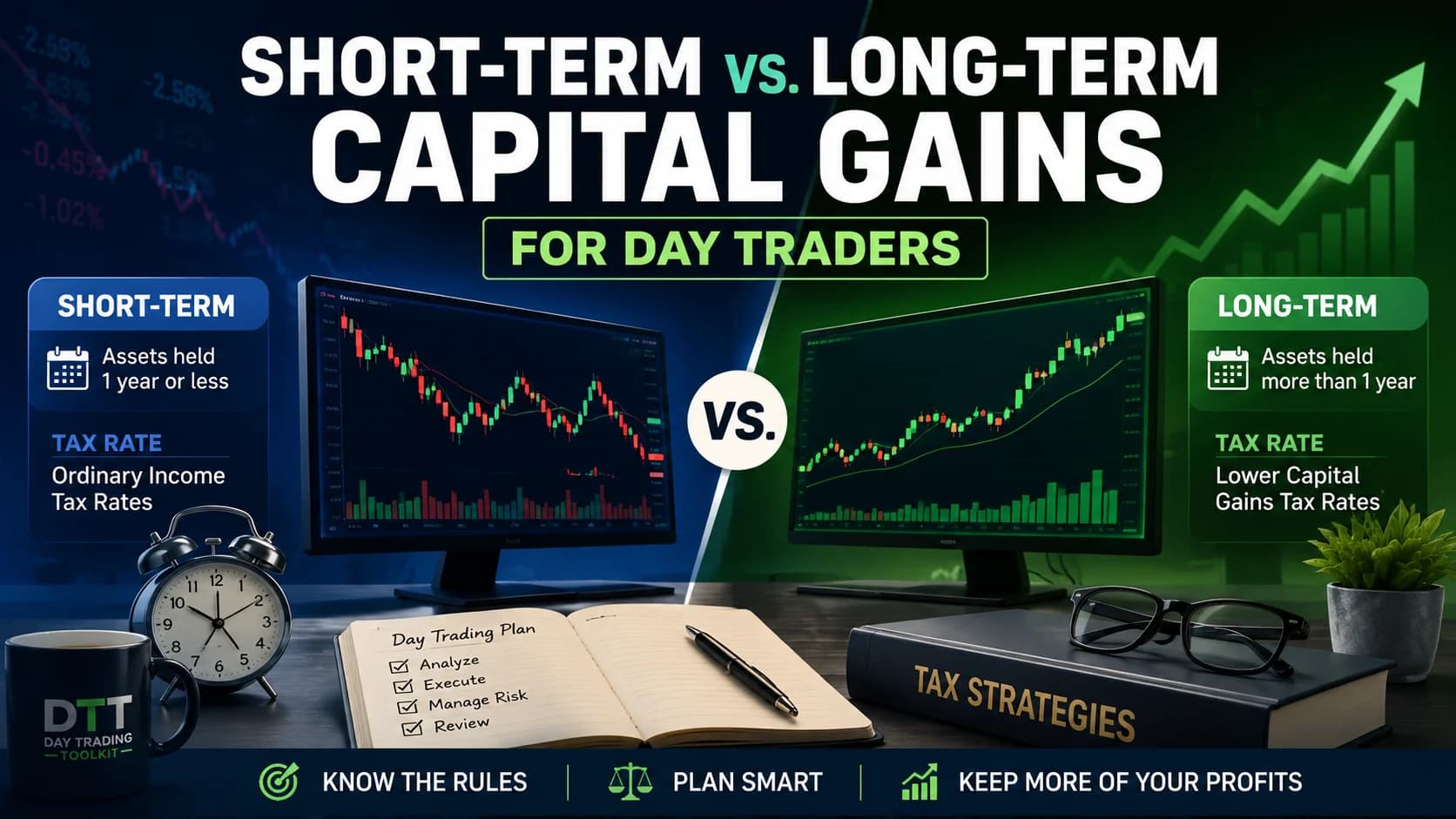
Short-Term vs. Long-Term Capital Gains for Day Traders
Two traders can make an identical $10,000 profit and owe a meaningfully different tax bill, purely from how many days they held the position. Almost every day trade lands on the expensive side of that split. Here's the holding-period rule, the full 2026 bracket numbers, the netting process, and the self-employment tax myth that sends traders toward the wrong strategy.
Day Trading Basics
LLC for Day Trading: Choosing the Right Business Structure to Optimize Taxes
An S-Corp doesn't save day traders money on self-employment tax the way it does for other small businesses, because trading gains were never subject to that tax in the first place. Here's what an S-Corp actually does for a trader, why the standard "reasonable salary" advice can cost you thousands for nothing, and the entity decision framework that gets this right.
Day Trading Basics
Mark-to-Market Trading (Section 475(f)): The Ultimate Day Trader Tax Tool
A trader named Poppe had a $1 million loss and a qualifying trading pattern, and still lost the mark-to-market tax treatment because he couldn't prove he'd properly filed the election. Here's how the election actually works, the trade-off table for deciding if it fits your trading style, and exactly how to avoid Poppe's mistake.
Day Trading Basics
The Wash Sale Rule Explained: How to Avoid This Costly Trading Trap
A wash sale inside your IRA doesn't defer your loss, it destroys it permanently, and it can happen through an automatic contribution you forgot you set up. Here's the full 61-day mechanism, the real IRS ruling behind the IRA trap, and the current 2026 answer on crypto.
Comments
No comments yet. Be the first to share your thoughts.