5 Signs You're NOT Ready for Trade Ideas (Save Your Money)


In this article11 sections
Look, we need to talk about the elephant in the room. Every year, thousands of traders shell out $2,136 for Trade Ideas Premium, convinced it's the missing piece that will finally make them profitable. Most of them—and we're talking about the overwhelming majority here—waste every penny.
This isn't the article where we convince you to buy. If you're looking for that, we've already written our complete Trade Ideas review. This is the article where we do something most affiliate sites won't do: tell you exactly when you should NOT buy Trade Ideas and save your money instead.
Why would we do this? Simple. Research and trader accounts show too many undercapitalized, underprepared traders buy premium tools they're not ready for, lose money, and then blame the tool. Is Trade Ideas worth it? Absolutely—but only if you meet specific criteria first. If you don't, you're just lighting money on fire with extra steps.
Here's the brutal reality check: if you recognize yourself in two or more of the signs we're about to discuss, you need to close this tab, work on your foundation, and come back in six months. Let's dig in.
Why We're Writing the "Don't Buy" Article
The Harsh Truth About Premium Trading Tools
Here's what nobody tells you about expensive trading software. Trade Ideas, TrendSpider, Benzinga Pro—these aren't magic bullets. They're force multipliers. And here's the thing about force multipliers: when you multiply zero by anything, you still get zero.
If you don't have an edge in the market yet, no scanner will create one for you. If you can't manage risk manually, automation won't fix your discipline. If you're still figuring out support and resistance levels, Holly AI's signals will just confuse you faster.
Buying Trade Ideas Premium too early can create an expensive distraction. A beginner may spend more time clicking through scanners and windows than learning to read a chart, leaving them overwhelmed without improving their results.
The truth is, most traders buy premium tools way too early. They're seduced by the idea that professional tools will make them professional traders. But professionals didn't become professionals because they had the tools—they earned the tools after they became professionals. That's the sequence most people get backwards.
So this article exists to save you from that expensive mistake. If you're not ready, we'll tell you. When you are ready, we'll show you exactly how to get the maximum discount and make the most of your investment.
Let's start with the most common reason traders aren't ready: their account is too small.
Sign #1: Your Trading Account Is Under $10,000
The Math That Nobody Talks About
Let's run some numbers that most sales pages conveniently skip. Trade Ideas Premium costs $2,136 per year when paid annually. That's $178 per month. To justify this cost, you need to generate enough additional profit to cover the subscription AND beat the opportunity cost of that capital.
Here's the break-even calculation this guide uses:
If you're starting with a $5,000 account and you're following proper risk management (risking 1-2% per trade), you're risking $50-$100 per trade. Let's say you have a solid 55% win rate with a 1.5:1 reward-to-risk ratio—already better than most traders ever achieve.
With those numbers, you'd need to take about 50-70 trades to generate $2,136 in additional profits just to break even on the software. That's not profit for you—that's profit to pay for Trade Ideas. For a $5,000 account risking 1% per trade, that could take months or an entire year of consistent winning to justify the cost.
Now add in the reality that between 80-95% of day traders fail, according to research compiled by Quantified Strategies. Among those who do trade actively, only 1.6% are profitable in an average year, per data from Barber, Lee, and Odean's seminal study on day trader performance. The math gets uglier fast.
But here's where it gets even more complicated for US traders: the Pattern Day Trading Rule.
If you're trading in the United States with a margin account, FINRA Rule 4210 requires you to maintain a minimum of $25,000 in equity if you execute four or more day trades within five business days. Fall below that threshold, and you're restricted from additional margin trades for 90 days or until you deposit enough to reach the minimum.
This rule was implemented in 2001 after the dot-com crash specifically to protect undercapitalized retail traders from rapid losses. While FINRA approved amendments in September 2025 to eliminate this fixed minimum (pending SEC approval), as of now, the $25,000 requirement still stands for pattern day traders.
What does this mean for you? If you're trying to actively day trade with Trade Ideas on a sub-$25K account in the US, you're either:
- Limited to three day trades per five-day period (severely restricting your ability to act on signals)
- Trading in a cash account (which comes with its own settlement restrictions)
- Violating PDT rules and risking account restrictions
Neither scenario justifies paying $178/month for a real-time scanner.
What to Do Instead
If your account is under $10,000 (or under $25,000 for US pattern day traders), your capital is better spent growing your account through consistent execution with free or low-cost tools.
Start with what your broker already provides. Most platforms like TD Ameritrade's thinkorswim, E*TRADE, or Interactive Brokers include basic scanning functionality at no additional cost. Use those. Learn to identify opportunities manually using volume and liquidity patterns.
For additional scanning power without the premium price tag, explore Finviz. The free version gives you end-of-day scanning capabilities, and even the Elite version costs $39.99/month—less than 25% of Trade Ideas' cost. We break down this comparison in detail in our Trade Ideas vs Finviz guide.
Your focus right now shouldn't be on finding more opportunities—it should be on executing the opportunities you do find with proper risk management and consistent discipline. Save that $2,136 and add it to your trading capital instead. A $7,000 account with solid execution beats a $5,000 account with a premium scanner any day of the week.
Sign #2: You Trade Less Than 3 Times Per Week
The Cost-Per-Trade Reality Check
Here's another calculation that should make you pause. If you're paying $178/month for Trade Ideas and you're only taking 2-3 trades per week, that's roughly 10 trades per month. Your software cost per trade is $17.80.
Think about that. Before you even enter a trade, you're in the hole $17.80 just from your scanner subscription. For a trader risking $100 per trade, that's nearly 18% of your risk amount going to software costs before you even factor in commissions, spreads, or market impact.
DayTradingToolkit calls this the "gym membership syndrome." You sign up with the best intentions, convinced that having access will motivate you to use it more. But trading frequency isn't about access to tools—it's about market conditions aligning with your strategy and having the time to actually trade.
If you're working full time, you might realistically only be available for the opening bell or pre-market. If your strategy is swing trading that holds positions overnight, you're definitely not maximizing Trade Ideas' real-time intraday capabilities.
The math is brutal: occasional traders simply cannot generate enough trades to justify premium real-time scanning tools. You're essentially paying for a Ferrari to drive to the grocery store once a week.
Better Alternatives for Swing Traders
Look, Trade Ideas can absolutely work for swing trading—we've covered this in our main review. The scanners can identify multi-day setups, and the OddsMaker is valuable for backtesting longer-timeframe strategies. But do you really need real-time, tick-by-tick data for positions you're holding for days or weeks?
Probably not.
For swing traders who check the market once or twice a day, end-of-day scanning tools make infinitely more sense. TradingView's premium plans start at $14.95/month and provide excellent charting plus end-of-day screening capabilities. TC2000 offers powerful scanning for around $50/month. Both are dramatically cheaper than Trade Ideas and better suited to the swing trading workflow.
If you're trading less frequently, your money is better spent on education, better charting tools, or simply saving it for larger positions. Check out our comprehensive Trade Ideas alternatives guide for options that better match lower-frequency trading styles.
The honest truth? If you're not actively day trading at least 3-5 times per week, Trade Ideas Premium is overkill. Come back to it when your trading frequency justifies the investment.
Sign #3: You Don't Have a Proven, Rules-Based Strategy Yet
Tools Amplify Strategy, They Don't Create It
This is the big one. The sign that eliminates probably 70% of the people reading this article right now.
You know what Trade Ideas is brilliant at? Finding stocks that match specific, objective criteria at lightning speed. You know what it's terrible at? Telling you what those criteria should be or what to do once a stock appears on your screen.
Holly AI can generate signals all day long. She can tell you "Buy XYZ at $47.85 with a stop at $47.20 and a target at $49.15." That's fantastic... if you understand why that's a high-probability setup, how to manage the position if it moves against you, when to scale out, and what to do if the overall market conditions shift.
If you don't have those answers, Holly's signals are just expensive noise.
Here's what we see happen constantly: A new trader buys Trade Ideas, gets overwhelmed by the fire hose of information, starts jumping between different scanners and strategies, cherry-picks the setups that "feel right," ignores the ones that don't, and then wonders why their results are inconsistent.
The platform isn't broken—the trader's foundation is. They're using a professional tool without professional preparation.
DayTradingToolkit knows this because we've all been there. One of our senior traders likes to joke that Trade Ideas is like handing a fighter jet to someone who just got their driver's license. Sure, the jet works great—but the pilot has no business being in the cockpit yet.
What You Need to Learn First
Before you spend a single dollar on Trade Ideas, you need to be able to write down your trading strategy in a simple, clear trading plan. We're talking about something this specific:
"I trade momentum breakouts on stocks gapping up 5%+ on relative volume above 2x average, with a float under 50M. My entry is the break of the first 5-minute high after 9:45 AM, with a stop below the 5-minute low. My target is the next major resistance level or a 2:1 reward-to-risk ratio, whichever comes first."
Can you do that? Can you define your setup, your entry trigger, your stop-loss placement, your profit target, and your position sizing rules without hesitation?
If not, you're not ready for Trade Ideas. Full stop.
What you need to do instead is develop and test your strategy using paper trading. Track at least 50-100 trades in a trading journal to understand your strategy's true win rate, average profit, average loss, and maximum drawdown.
Only after you have that data—only after you know your edge exists—should you even consider premium scanning tools. At that point, Trade Ideas becomes what it's supposed to be: a tool that helps you find your setup faster. Not a tool that creates your setup for you.
If you can't articulate your strategy in clear, objective terms, save your money. Work on your foundation. Come back when you have something proven to amplify.
Sign #4: You're Still Learning Basic Technical Analysis
The Steep Learning Curve Problem
Let's be honest about what Trade Ideas is. It's a complex, professional-grade platform with hundreds of pre-configured scanners, three different AI systems, customizable alert windows, backtesting modules, and broker integration for automated trading.
When you first open the desktop application, you're greeted with multiple windows, channel bars, configuration settings, and options that assume you already know what you're looking for. There's a reason experienced traders love it—and a reason beginners are completely overwhelmed by it.
DayTradingToolkit estimates it takes 20-30 hours of dedicated learning just to become comfortable with the interface and core features. That's not even using it effectively yet—that's just learning where everything is and what it does.
Now imagine you're still trying to understand the difference between support and resistance, how to read candlestick patterns, or why volume matters. You're simultaneously trying to learn market structure AND trying to learn a complex software platform. It's cognitive overload, and it leads to paralysis.
This plays out dozens of times. A trader buys Trade Ideas, spends the first week clicking through scanners without understanding what they're looking at, gets frustrated, falls back to watching CNBC for stock picks, and then lets their subscription auto-renew for months while barely using it.
The platform isn't too hard—the trader just isn't ready for it yet.
The Right Learning Sequence
Here's the path DayTradingToolkit recommends, and it's the same path this guide outlines:
Phase 1: Master Chart Reading (1-3 months) Learn to identify trend direction, support and resistance levels, volume patterns, and basic candlestick patterns. Use free charting tools or your broker's platform. Your goal is to look at any chart and immediately understand what's happening.
Phase 2: Develop and Test a Strategy (3-6 months) Pick one setup type—breakouts, pullbacks, reversals, whatever speaks to you. Define your entry and exit rules. Paper trade it consistently for at least 50 trades. Track everything.
Phase 3: Manual Scanning Practice (1-2 months) Use your broker's basic scanner or a free tool like Finviz to manually find stocks that fit your criteria. Learn what makes a stock "in play" versus just noise. This manual practice is crucial—it teaches you what to look for.
Phase 4: Upgrade to Premium Tools (When Ready) Only now—after you have proven your strategy works and you're consistently finding and executing trades—does it make sense to upgrade to real-time professional scanning. At this point, Trade Ideas becomes a time-saver, not a teacher.
If you're still in Phase 1 or early Phase 2, you're not ready for Trade Ideas. Use TradingView instead—it costs $14.95-$59.95/month depending on the plan, provides world-class charting, and has a much gentler learning curve. We detail this comparison extensively in our Trade Ideas vs TradingView guide.
Remember: successful traders don't become successful by using premium tools. They earn the right to use premium tools by first becoming successful with basic ones.
Sign #5: You're Not Willing to Trade During Market Hours
Real-Time Data Requires Real-Time Action
Here's a reality check about Trade Ideas that gets glossed over in most reviews: the platform's biggest advantage—real-time, server-side scanning with AI-generated signals—is completely wasted if you're not actually at your computer during market hours.
Holly AI doesn't send you an email saying "Hey, check out this trade when you get a chance." She fires signals in real-time that are often valid for minutes, not hours. When a stock breaks out of a pattern at 9:47 AM with massive volume, the opportunity window is measured in seconds.
This happens repeatedly—traders pay for Trade Ideas Premium, set up alerts on their phone, try to monitor it while at their day job, and then wonder why they keep missing entries or entering too late. The answer is simple: you can't effectively day trade part-time with real-time tools while working full-time.
And here's something most reviews don't mention: the "crowded trades" problem. Because Trade Ideas has thousands of users all seeing the same Holly AI signals simultaneously, the initial moves can be very aggressive as everyone piles in. If you're not there within the first 30-60 seconds, you're often buying at the peak of the initial spike.
This isn't a flaw in Trade Ideas—it's just the reality of shared signals. To capitalize on them, you need to be present, focused, and ready to execute immediately.
Alternatives If You Can't Trade Live
Look, we get it. Not everyone can sit in front of their computer from 9:30 AM to 4 PM EST every day. Day trading while working full time is incredibly difficult, and that's okay.
But if you can only trade during lunch breaks or after work, paying for real-time intraday scanning makes no sense. You need tools matched to your actual availability.
For traders who can only check markets once or twice a day, consider:
- TradingView Premium: Excellent end-of-day scanning and alerts at a fraction of the cost
- Finviz Elite: End-of-day screener with extended hours data for $39.99/month
- TC2000: Powerful scanning with real-time data available but optimized for swing traders
These platforms excel at finding multi-day setups and don't require you to be glued to your screen during market hours. Your money goes further, and the tools actually match your trading schedule.
If you are available during market hours—at minimum, the critical first hour from 9:30-10:30 AM EST—then Trade Ideas starts to make sense. But be honest with yourself about your actual availability. Buying real-time tools when you can't use them in real-time is just burning money.
When You ARE Ready for Trade Ideas: The Honest Checklist
Green Light Criteria (All Must Be Met)
Let's flip this around. After walking through all the reasons you might NOT be ready, here are the specific criteria that signal you ARE ready for Trade Ideas:
Account Size: Minimum $10,000 (US traders: $25,000) Your account needs to be large enough that the annual subscription cost represents less than 5% of your capital, and you're not constrained by the Pattern Day Trading Rule. If you're still building your account to these levels, focus on growing capital first.
Trading Frequency: 3-5+ Trades Per Week You're actively trading multiple times per week because market conditions are aligning with your strategy, not because you're forcing trades to justify your subscription. The software cost per trade is negligible relative to your position sizes.
Proven Strategy with Positive Expectancy You have a clearly defined, rules-based strategy that you've tested over at least 50-100 trades. You know your win rate, your average profit, your average loss, and your maximum drawdown. Most importantly, the math works—you have positive expectancy.
Available During Market Hours You're able to be at your computer for at minimum the opening hour (9:30-10:30 AM EST) and ideally through the morning session. You can act on real-time signals within seconds to minutes, not hours.
Completed the Learning Curve on Basics You can read charts fluently, understand market structure, identify support and resistance levels without hesitation, and know why volume matters. You're not using Trade Ideas to learn technical analysis—you're using it to find your setups faster.
If you checked all five boxes, congratulations. You're ready.
The Smart Entry Path
Even if you're ready, don't just subscribe at full price like a rookie. Here's the strategic approach DayTradingToolkit recommends:
Step 1: Start with the Test Drive Trade Ideas periodically offers a 2-week "test drive" for around $11-19. This is the absolute best way to evaluate the platform without committing to a full year. We've written an entire guide on how to maximize the test drive to ensure you're using those two weeks effectively.
Step 2: Use the Trial Period Strategically Don't treat the test drive as a toy. Treat it like a $2,000 business decision, because that's exactly what it is. Set up the specific scanners that match your strategy, paper trade every signal, track the results, and objectively evaluate whether the platform found opportunities you would have missed otherwise.
Step 3: Get Maximum Discount When Ready If you decide to subscribe after the test drive, never pay full price. Trade Ideas always has some discount available. We maintain an updated list of current promotions on our coupon code page. You can save anywhere from 15% to 30% off, which is $320-$640 in annual savings.
Additionally, commit to the annual plan if you're serious. The monthly plan costs $254/month ($3,048/year), while the annual plan is $2,136/year—saving you $912. When you combine annual billing with a promo code, you're looking at legitimate savings that make the investment much more palatable.
For a complete breakdown of all pricing tiers and discount strategies, check our guide on how to get maximum Trade Ideas discounts.
What to Use Instead (Right Now)
Free and Low-Cost Alternatives by Trader Type
If you've realized you're not ready for Trade Ideas yet—and remember, that's most traders at most stages—here's exactly what you should use instead based on your trader type:
Beginner Day Traders (First 6-12 Months) Use your broker's built-in scanners (TD Ameritrade, E*TRADE, Interactive Brokers all have them) and Finviz free. Your focus should be on learning to read charts and developing your first strategy, not on finding the maximum number of opportunities. Less is more at this stage.
Swing Traders (Multi-Day Holds) TradingView (Essential+ plan at $14.95/month) gives you excellent charting and end-of-day scanning that's perfectly suited to swing trading timeframes. TC2000 ($50/month) is another solid option with powerful scanning capabilities. Both are dramatically cheaper than Trade Ideas and better matched to your workflow.
News Traders (Event-Driven) If your edge comes from trading catalysts like earnings or FDA approvals rather than technical setups, consider Benzinga Pro. The Squawk audio feed keeps you informed of breaking news in real-time, and it's cheaper than Trade Ideas. We compare these directly in our Trade Ideas vs Benzinga Pro analysis.
Chart Analysis Focused If you're manually analyzing charts and primarily need charting tools rather than scanning, TradingView is the clear winner. Better charting, massive community, social features, and costs 80-90% less than Trade Ideas. See our Trade Ideas vs TradingView comparison for the full breakdown.
For a comprehensive comparison of all major alternatives across different trading styles, check our complete Trade Ideas alternatives guide.
Building Your Skill Foundation First
Here's the honest progression DayTradingToolkit recommends:
Months 1-3: Learn to Read the Market Focus entirely on understanding candlestick charts, identifying chart patterns, and getting comfortable with basic indicators. Use free tools. Don't spend money on software yet.
Months 3-6: Develop Your First Strategy Create a simple trading plan and test it extensively through paper trading. Your goal is 50-100 trades that prove you have positive expectancy. Master position sizing and risk management fundamentals.
Months 6-12: Transition to Live Trading (Small Size) Take your proven strategy live with small position sizes. Continue using free or low-cost tools. Focus on executing your plan with discipline and managing the psychological challenges of real money. Work on managing fear and greed.
Month 12+: Consider Premium Tools Only after you've proven consistent profitability for multiple months with basic tools should you even consider upgrading. At this stage, premium scanners like Trade Ideas become efficiency tools, not learning tools.
This progression might seem slow, but it's the path that actually produces consistently profitable traders. The alternative—buying premium tools immediately—is the path that produces the 95% failure rate you've probably heard about.
The $2,136 Question: Will Trade Ideas Make You Profitable?
What Trade Ideas Actually Does
Let's clear up a massive misconception. Trade Ideas does not make you profitable. It never has, and it never will. What it does is amplify your existing edge.
Think of it this way: Trade Ideas is the world's best metal detector. If you're hunting for gold in a field that has no gold, even the best metal detector won't help you. But if you know where the gold is likely to be buried and what signals to look for, a professional metal detector lets you find it dramatically faster than digging random holes.
The platform excels at three specific things:
- Finding Opportunities Faster: Instead of manually scrolling through thousands of stocks, Trade Ideas scans the entire market in real-time and surfaces only the stocks matching your criteria.
- Providing Data Edge: The platform gives you access to institutional-grade data speed and processing power that you simply cannot replicate on a home computer.
- Systematic Consistency: By automating your scanning criteria, you ensure you see every opportunity that matches your rules, eliminating the human tendency to cherry-pick or miss setups.
Notice what's not on that list? "Creates a winning strategy for you." "Tells you when to buy and sell." "Guarantees profitability."
Trade Ideas is a tool. The most sophisticated, powerful trading tool available to retail traders, but still just a tool. And tools are only as effective as the person using them.
The Real ROI Equation
Here's the only ROI calculation that matters:
Your Proven Edge × Trade Ideas Speed/Efficiency = Additional Profit
If the first part of that equation is zero or negative, multiplying it by anything won't help. You can't automate your way out of a losing strategy. You can't scan your way into profitability if you don't know what you're looking for.
But if you have a proven edge—even a modest one—Trade Ideas can absolutely help you execute it more efficiently. Finding setups in 30 seconds instead of 30 minutes means more time to focus on execution. Seeing every stock that meets your criteria means never missing an opportunity because you were looking at the wrong sector.
For a trader who already makes money, Trade Ideas can:
- Increase the number of quality setups found per day
- Reduce the time spent searching for opportunities
- Provide backtesting data to refine strategies
- Automate execution for 100% consistency
For a trader who doesn't make money yet, Trade Ideas can:
- Overwhelm them with information
- Encourage overtrading by presenting too many opportunities
- Create false confidence in signals they don't understand
- Cost $2,136/year that could be better spent elsewhere
The difference is entirely in the trader, not the tool.
Our Final Recommendation: Should You Wait?
If You Checked 2+ Warning Signs
Close this tab. Seriously.
If you recognized yourself in two or more of the signs we discussed—small account, infrequent trading, no proven strategy, still learning basics, or can't trade during market hours—you are not ready for Trade Ideas. Period.
That's not an insult. It's not a judgment. It's just an honest assessment that will save you $2,136 and a lot of frustration.
What should you do instead? Work on your foundation. Focus on the basics we've outlined throughout this article. Give yourself a realistic 3-6 month timeline to:
- Build your account to at least $10,000 ($25,000 for US pattern day traders)
- Develop and test a clear, rules-based strategy over 50+ trades
- Master the fundamentals of technical analysis and chart reading
- Prove you can execute with discipline using basic tools
- Establish a consistent trading schedule that aligns with market hours
Then—and only then—come back and revisit this decision. Bookmark this article. Set a calendar reminder for six months from now. Do the work. Then reassess.
The money you save by waiting will either grow your trading account or fund your subscription when you're actually ready. Either way, you win.
If You're Borderline Ready
Maybe you checked one warning sign, or you're close on a couple of criteria. You have $8,000 in your account (almost there). You trade 2-3 times per week (close). You have a strategy you're testing but haven't hit 50 trades yet (getting there).
In this case, our recommendation is clear: try the test drive first.
The Trade Ideas test drive gives you two weeks of full Premium access for around $11-19. This low-risk evaluation period lets you:
- Test the platform with your actual strategy
- See if it genuinely finds setups you would have missed
- Experience the learning curve firsthand
- Determine if your trading schedule actually works with real-time tools
- Get a feel for whether the cost is justified by the value
Approach the test drive with specific goals and objective criteria. Don't fall for the "shiny object" trap where you're dazzled by features you don't need. Focus on whether it improves your specific trading workflow.
If after two weeks you're convinced it's worth it, great. Subscribe and get the maximum discount. If you're unsure, that's your answer—wait longer.
And if you prefer to ease in gradually, consider starting with the Standard plan instead of Premium. At $1,068/year ($89/month), it's 50% cheaper and includes real-time scanning and broker integration. You lose Holly AI and the OddsMaker, but you can always upgrade later when you're certain you need those features.
If You're Definitely Ready
Congratulations. If you checked all five green-light criteria—sufficient capital, frequent trading, proven strategy, market hours availability, and solid fundamentals—then you're in the small minority who can genuinely benefit from Trade Ideas Premium right now.
Here's your action plan:
- Get the Best Discount: Never pay full price. Visit our Trade Ideas coupon code page for current promotions. Stack the annual billing discount with a promo code to save $900+.
- Commit to Learning the Platform: Block out 20-30 hours in your first month to properly learn Trade Ideas. Watch the tutorials, set up your scanners, configure your workspace, and actually use the features you're paying for.
- Set Performance Benchmarks: Before subscribing, document your current performance metrics—average trades per week, win rate, average profit per trade. After three months with Trade Ideas, measure again. The platform should demonstrably improve your results. If it doesn't, reevaluate.
- Read the Complete Review: Our full Trade Ideas review walks through every feature, explains how to use Holly AI effectively, breaks down the OddsMaker backtesting tool, and provides realistic performance expectations. Read it before subscribing.
Trade Ideas is an exceptional tool—when used by traders who are ready for it. If that's you, it can absolutely give you an edge. Just make sure you're honest with yourself about your readiness first.
Frequently Asked Questions
Is Trade Ideas worth it for beginners?
Here's the reality: Trade Ideas is a professional-grade platform designed for traders who already know what they're looking for. If you're still learning basic technical analysis, struggling to read candlestick charts, or haven't developed a proven strategy yet, spending $2,136/year on Trade Ideas is premature.
The platform has a steep learning curve that requires 20-30 hours just to become comfortable with the interface. You'll be simultaneously trying to learn market structure AND complex software, which leads to cognitive overload and poor results. Research shows that 40% of day traders quit within the first month, and 85% fail in their first year—adding an overwhelming tool to that equation only increases those failure rates.
Beginners are better served using free broker scanners, Finviz free, and TradingView's basic plan ($14.95/month) while they focus on developing foundational skills through paper trading and building their first 50-100 tracked trades.
Key Takeaway: Master the basics with simple tools first. Trade Ideas becomes worth it only after you've proven you can profit consistently with basic scanners—at that point, it's an efficiency upgrade, not a learning tool.
How much money do you need to use Trade Ideas profitably?
The math is straightforward: Trade Ideas Premium costs $2,136/year ($178/month). To justify this cost, you need sufficient capital that the subscription represents less than 5% of your account value. With a $5,000 account, that's over 40% of your capital going to software—completely unsustainable.
Beyond the software cost, US traders face the Pattern Day Trading Rule. FINRA Rule 4210 requires pattern day traders (those executing 4+ day trades within 5 business days) to maintain minimum equity of $25,000 in their margin account. Fall below this threshold, and you're restricted from making additional day trades for 90 days.
While FINRA approved amendments in September 2025 to eliminate this fixed minimum (pending SEC approval), as of now, the rule still stands. Trading on a sub-$25K account means you're either limited to three day trades per five-day period—severely restricting your ability to act on Trade Ideas signals—or violating PDT rules and risking account restrictions.
Additionally, with proper risk management (risking 1-2% per trade), a $10K account allows risk of $100-$200 per trade. This gives you enough room for the subscription cost to be negligible relative to your position sizes and potential profits.
Key Takeaway: Don't buy Trade Ideas until you have at least $10K in your account, and if you're a US-based pattern day trader, wait until you have the full $25K to avoid PDT restrictions.
Can you make money with Trade Ideas if you have a small account?
Even if you have a profitable strategy, the economics of using Trade Ideas with a small account are brutal. Let's say you have a $5,000 account and maintain a respectable 55% win rate with 1.5:1 reward-to-risk ratio. To break even on the $2,136 annual subscription cost, you'd need to generate that amount in ADDITIONAL profit beyond what you'd make without the tool.
With proper position sizing risking 1% per trade ($50 per trade on a $5K account), you'd need roughly 50-70 winning trades just to pay for the software—that's not profit for you, that's profit for Trade Ideas. This could take months or an entire year depending on your trading frequency.
Compare this to a trader with a $25,000 account risking 1% per trade ($250 per trade). They can recoup the subscription cost in 10-15 winning trades, making the investment far more justifiable relative to their capital base and potential returns.
Here's what happens in practice: small account traders, desperate to justify their subscription cost, start overtrading, taking marginal setups, and increasing risk per trade beyond proper risk management guidelines. This typically leads to faster account depletion, not growth.
Key Takeaway: Save the $2,136 subscription fee and add it to your trading capital instead. A $7,000 account with free broker scanners will outperform a $5,000 account with Trade Ideas Premium every single time.
What should I learn before buying Trade Ideas?
Before spending a dollar on Trade Ideas, you need to be able to write down your complete trading strategy in clear, objective terms. This means defining your specific setup criteria, entry triggers, stop-loss placement, profit targets, and position sizing rules without hesitation.
Specifically, you should be proficient in:
Reading candlestick charts and understanding price action
Identifying support and resistance levels
Recognizing common chart patterns
Understanding volume and liquidity implications
Implementing proper risk management consistently
Most importantly, you need to have tested your strategy through paper trading for at least 50-100 trades and proven positive expectancy. Your trading journal should show clear win rates, average profits, average losses, and maximum drawdown data.
If you can't look at your data and confidently say "I have an edge," you're not ready for Trade Ideas. The platform amplifies existing edges—it doesn't create them. Buying it before you have a proven strategy is like buying a race car before you have a driver's license.
Key Takeaway: Develop and prove your strategy with basic free tools first. Only upgrade to Trade Ideas once you've demonstrated consistent profitability and the platform becomes an efficiency tool rather than a learning tool.
Is Trade Ideas good for swing trading or only day trading?
Trade Ideas was designed primarily for active day traders who need real-time, tick-by-tick data and instant signals. The platform's biggest advantages—Holly AI's intraday signals, real-time scanning, and server-side processing—are most valuable for traders taking multiple positions per day based on momentum and volatility.
For swing traders holding positions overnight or for several days, you don't need real-time scanning. End-of-day data is sufficient for identifying multi-day setups, and paying $178/month for capabilities you're not utilizing is financially inefficient.
That said, Trade Ideas does offer value for swing traders in two specific scenarios:
The OddsMaker backtesting tool is excellent for testing longer-timeframe strategies
The scanners can identify strong multi-day setups during earnings seasons or market rotations
However, you can get similar or better functionality for swing trading from alternatives like TradingView ($14.95-$59.95/month) or TC2000 (~$50/month), which are purpose-built for longer timeframe analysis and cost 60-85% less than Trade Ideas.
If you're checking the market once or twice per day and holding positions for multiple days, your money is better spent on tools matched to your timeframe.
Key Takeaway: Unless you're actively day trading 3-5+ times per week, Trade Ideas Premium is expensive overkill. Swing traders should explore Trade Ideas alternatives better suited to longer timeframes and lower-frequency trading.
How long does it take to learn Trade Ideas?
Trade Ideas is a complex professional platform, and the learning curve is steep. When you first open the desktop application, you're greeted with multiple windows, dozens of pre-configured scanners, three different AI systems, customizable alert configurations, backtesting modules, and broker integration options.
DayTradingToolkit's experience: expect to spend your first week just figuring out where everything is and what each feature does. The channel bar alone has 30+ different pre-configured layouts. The alert window has hundreds of potential configurations. Holly AI has three separate systems with different risk profiles.
Here's a realistic timeline:
Week 1: Basic navigation, understanding window layouts, exploring channel bar options (5-10 hours)
Weeks 2-3: Configuring scanners for your specific strategy, learning alert customization (10-15 hours)
Month 2: Understanding Holly AI signals, OddsMaker backtesting, optimizing your workspace (5-10 hours)
Months 3-6: Fine-tuning configurations, discovering advanced features, achieving efficiency (ongoing)
The complexity is part of why we emphasize that beginners shouldn't buy Trade Ideas. You're adding 20-30 hours of software learning on top of the hundreds of hours needed to master trading itself. It's cognitive overload that typically ends in frustration and unused subscriptions.
Experienced traders who already understand what they're looking for can navigate the learning curve more quickly because they know their requirements. Beginners who don't know what they're looking for get lost in the noise.
Key Takeaway: If you're still learning basic technical analysis, adding a 20-30 hour software learning curve on top is a recipe for overwhelm. Master the basics first with simpler tools like TradingView.
Do I need $25,000 to use Trade Ideas?
Trade Ideas itself has no account minimum requirement—you can subscribe with any amount of capital. However, if you're a US-based trader planning to actively day trade (the primary use case for Trade Ideas), FINRA's Pattern Day Trading Rule creates an effective minimum.
Under FINRA Rule 4210, if you execute four or more day trades within five business days in a margin account, you're classified as a pattern day trader and must maintain minimum equity of $25,000. Fall below this threshold, and your account is restricted from making additional day trades for 90 days or until you deposit enough to reach the minimum.
This means:
With less than $25K, you're limited to three day trades per five-day period
This severely restricts your ability to act on real-time Trade Ideas signals
You're paying $178/month for a tool you can't fully utilize
The PDT rule was implemented in 2001 after the dot-com crash specifically to protect undercapitalized traders from rapid losses. While FINRA approved amendments in September 2025 to eliminate this fixed minimum (pending SEC approval), as of now, the rule remains in effect.
For traders outside the US or those trading in cash accounts or non-pattern day trading strategies, the $25K rule doesn't apply. However, our recommendation for minimum account size ($10K+) still stands based purely on the economics of justifying the subscription cost relative to trading capital.
Key Takeaway: If you're a US-based trader planning to actively day trade, you effectively need $25K to use Trade Ideas properly without PDT restrictions. If you have less, wait until you've grown your account or consider cheaper alternatives better suited to lower-frequency trading.
Should I buy Trade Ideas or a cheaper scanner first?
This question reveals you're still evaluating whether premium scanning is worth it for your trading, which means you're not yet at the stage where Trade Ideas makes sense. Here's our recommendation based on years of team experience:
Phase 1: Start with Free Tools (Months 1-6) Use your broker's built-in scanner (thinkorswim, E*TRADE, Interactive Brokers all include them) and Finviz free. These provide more than enough functionality to develop your first strategy and prove you can execute it consistently. Focus on learning, not tools.
Phase 2: Upgrade to Low-Cost Tools (Months 6-12) If you've proven profitability with free tools and need better real-time scanning, consider TradingView Essential+ ($14.95/month) or Finviz Elite ($39.99/month). These offer dramatically better features than free versions at a fraction of Trade Ideas' cost. Use them to scale your trading and further prove your edge.
Phase 3: Consider Premium Tools (Month 12+) Only after you've been consistently profitable for multiple months with mid-tier tools should you consider Trade Ideas. At this stage, the subscription becomes an efficiency upgrade that helps you find your proven setups faster.
Most traders who jump straight to Trade Ideas Premium skip these crucial development phases. They burn $2,136 learning lessons that free or cheap tools could have taught them, all while convincing themselves that the expensive tool will somehow make them profitable.
The progression isn't just about cost—it's about matching tool complexity to skill level. Free tools force you to learn market structure. Cheap tools help you refine your process. Premium tools amplify your existing edge. Skipping steps doesn't accelerate your progress—it just wastes money.
Key Takeaway: Start with free broker scanners and Finviz. Upgrade to TradingView or Finviz Elite if you outgrow them. Only consider Trade Ideas after you've proven consistent profitability with cheaper alternatives. The progression saves you thousands while ensuring you're ready when you do upgrade.
Can Trade Ideas make me a profitable trader?
This is the most important misconception to clear up, and it's worth being blunt about: Trade Ideas is not a money-printing machine. It's a tool. A sophisticated, powerful, professional-grade tool, but still just a tool.
Here's what Trade Ideas does:
Finds stocks matching your criteria faster than manual scanning
Provides institutional-grade data processing and speed
Automates your scanning process for consistency
Generates AI signals based on historical pattern recognition
Here's what Trade Ideas does NOT do:
Create a winning strategy for you
Teach you proper risk management
Make you disciplined about following your rules
Guarantee profitable trades
The formula for trading success is: Proven Strategy + Discipline + Consistency = Profitability. Trade Ideas can help with the first part (finding setups that match your proven strategy), but it cannot create that strategy, and it absolutely cannot provide the discipline and consistency required to execute it.
Research from Barber, Lee, and Odean shows that only 1.6% of day traders are profitable in an average year, and only 1% achieve long-term success over five years. Trade Ideas' user base presumably has similar statistics. The software doesn't change the fundamental challenge of trading—it just changes how quickly you can find opportunities.
If your strategy has negative expectancy, Trade Ideas will help you lose money faster by finding more losing trades more efficiently. If your strategy has positive expectancy but you lack discipline, Trade Ideas won't fix your execution issues. The tool amplifies whatever edge or lack thereof you bring to the market.
Key Takeaway: Don't buy Trade Ideas hoping it will make you profitable. Only buy it after you've already proven you can profit consistently with basic tools, at which point it becomes an efficiency multiplier for your existing edge. The trader makes the difference, not the tool.
What is the minimum account size for day trading with Trade Ideas?
The minimum account size for effectively using Trade Ideas isn't determined by the software itself—it's determined by economics and regulations.
From a pure cost-benefit perspective, Trade Ideas Premium costs $2,136/year. Financial best practices suggest trading software expenses should represent no more than 5% of your trading capital to be economically justified. Using this guideline:
5% of $10,000 = $500/year (Trade Ideas exceeds this significantly)
5% of $25,000 = $1,250/year (Trade Ideas still high but more manageable)
5% of $50,000 = $2,500/year (Trade Ideas cost is appropriate)
From a regulatory perspective, US-based pattern day traders face FINRA's $25,000 minimum equity requirement under Rule 4210. Without this minimum, you're restricted to three day trades per five-business-day period, which severely limits your ability to capitalize on real-time signals from Trade Ideas.
From a practical trading perspective, account size determines your position sizing ability. With a $5,000 account risking 1% per trade, you're risking just $50 per trade. The subscription cost represents 43% of your annual account value—financially unsustainable even if you're profitable.
DayTradingToolkit's recommendation hierarchy:
Under $10K: Definitely not ready for Trade Ideas
$10K-$25K: Borderline; try the test drive first
$25K-$50K: Economically justifiable if actively day trading
$50K+: Cost is appropriate relative to capital base
Key Takeaway: Don't subscribe to Trade Ideas until you have at least $10K in your account, and ideally $25K to avoid PDT restrictions and make the cost economically sensible relative to your position sizes and profit potential.
Was this helpful?
Be the first to weigh in

Written by
Kazi Mezanur RahmanFounder, independent researcher, and editor of DayTradingToolkit. A one-person publication focused on risk-first trading education and documented tool research. He trades his own capital as a retail trader and combines personal market experience with systematic primary-source research.
Keep Reading
Tools & Tutorials
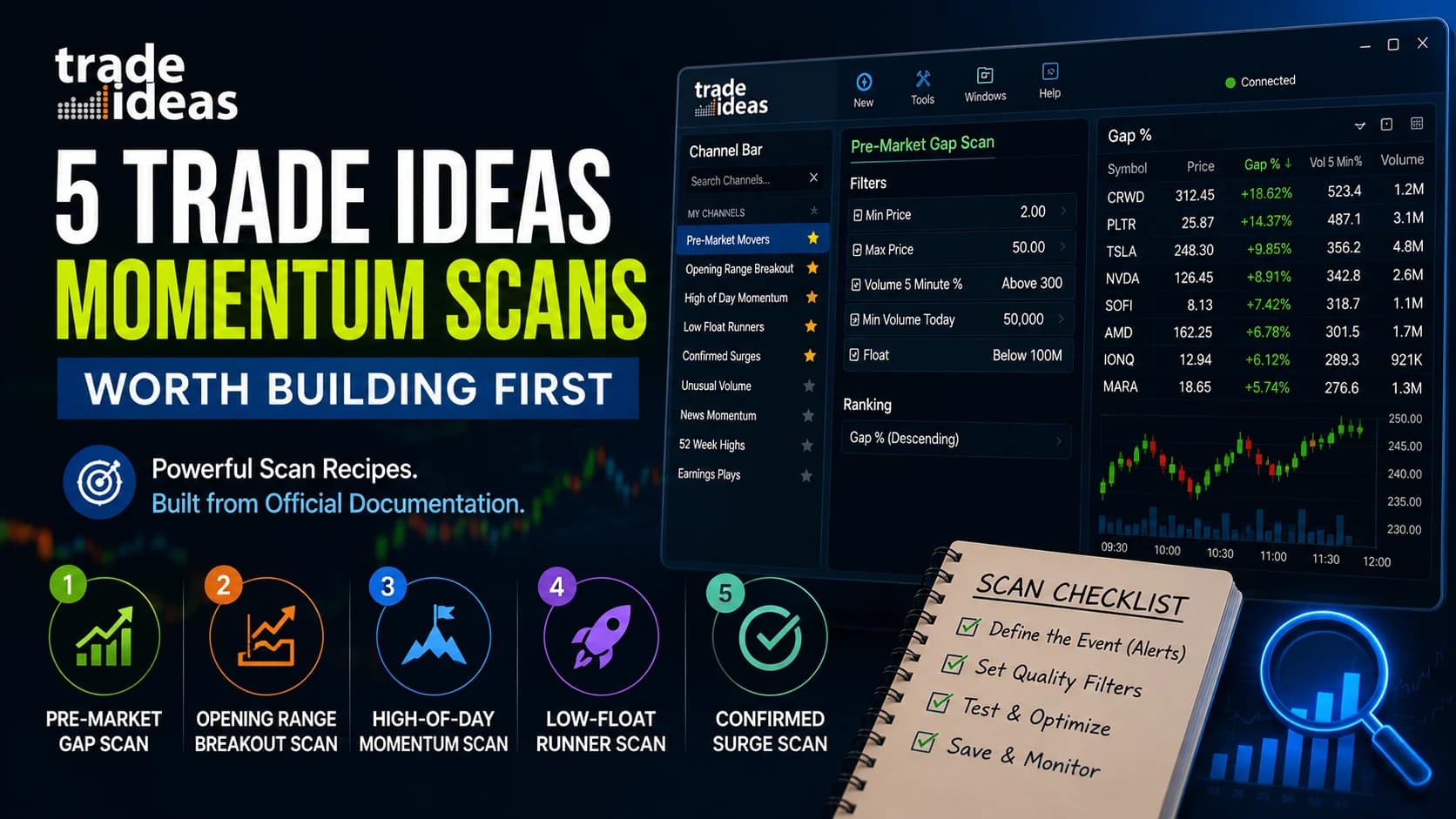
Best Trade Ideas Scans for Momentum Traders: 5 Recipes Worth Building First
Five complete momentum scan recipes for Trade Ideas — exact alerts, filters, and starting values built from the official documentation, plus the OR/AND logic that breaks most beginner scans, the Multi-Strategy consolidation setup, and how to validate any scan before trading it.
Tools & Tutorials
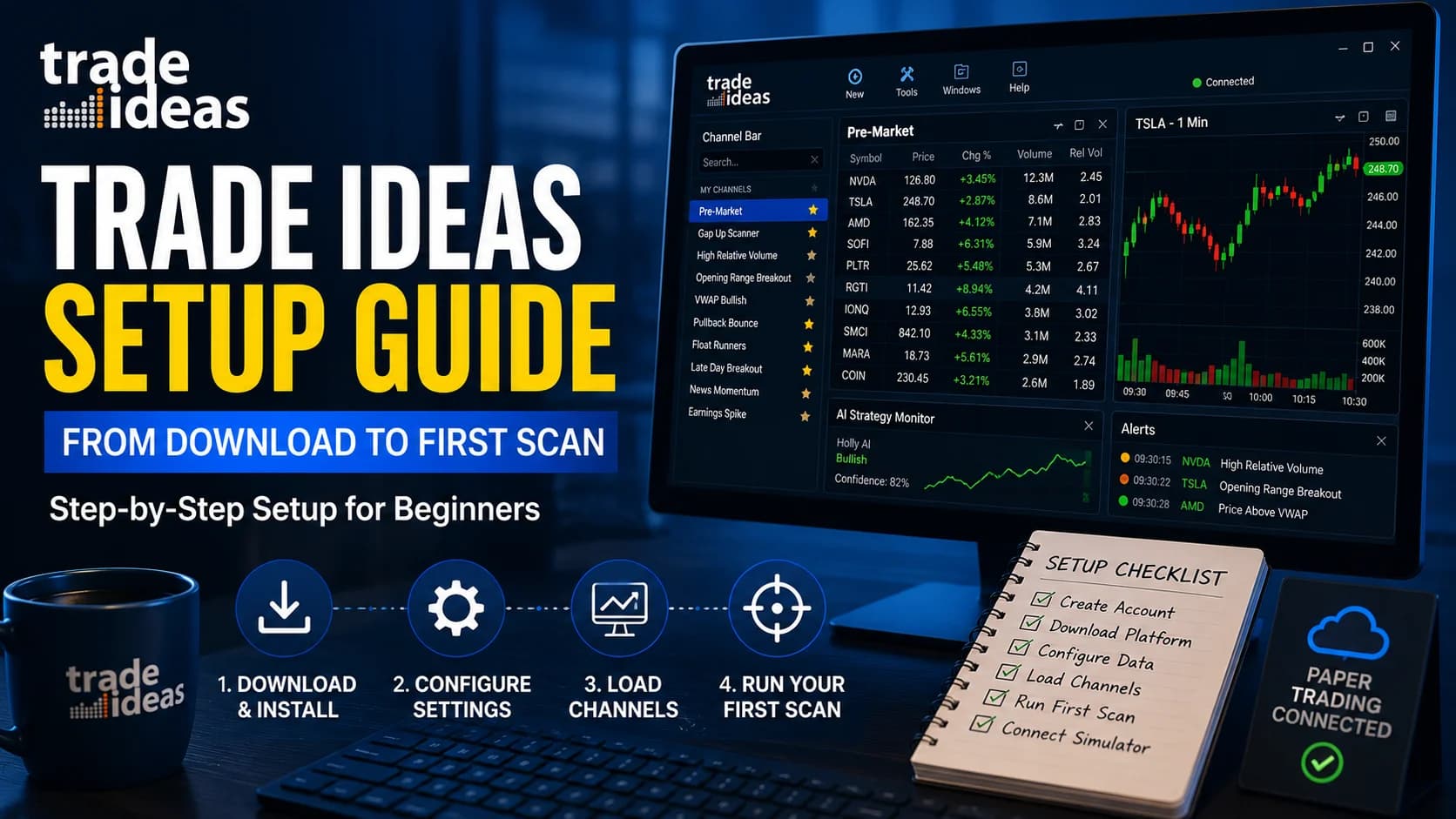
Trade Ideas Setup Guide for Beginners: From Download to Your First Scan
A step-by-step Trade Ideas setup guide built from the official documentation: account decisions, system requirements and Mac options, install gotchas, the Channel Bar quick start, your first custom scan, and the paper-trading connection to make before anything else.
Tools & Tutorials
Trade Ideas Brokerage Plus Review: One-Click Orders, Auto-Trading, and the Simulator
A complete review of Trade Ideas Brokerage Plus: how the four broker connections actually work (including the documented quirks), why the built-in simulator is the module's most valuable component, the auto-trading workflow and its safety rails, and who integrated execution genuinely fits.
Tools & Tutorials
Trade Ideas OddsMaker Review: No-Code Backtesting, Honestly Explained
An honest review of OddsMaker, Trade Ideas' no-code event-based backtester: how to run and read a backtest, the optimization loop and its overfitting trap, and the documented limits — 1-minute candles, no spread modeling, ~64 days of history — that determine when its results can be trusted.
Comments
No comments yet. Be the first to share your thoughts.