
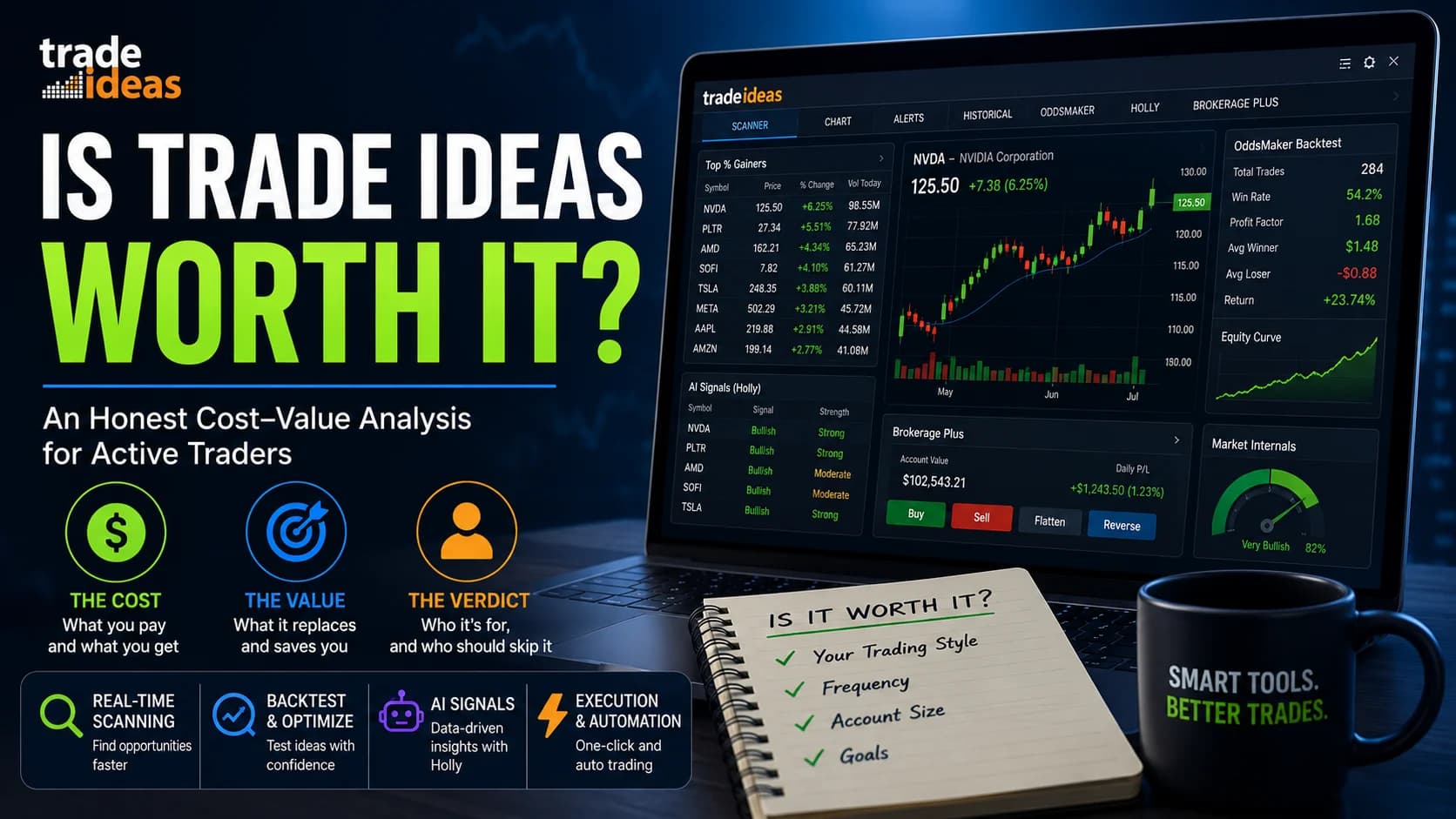
Whether Trade Ideas is worth it has no universal answer, because the same subscription is cheap for one trader and absurd for another. What decides it is how often you trade, what you trade, and how big your account is. This guide gives you the short answer, then the numbers to check it against your own trading.
Is Trade Ideas worth it? Trade Ideas is worth it for active U.S. stock traders who trade several sessions a week and use its real-time scanner, Holly AI signals or BacktestingThe process of running a defined trading strategy against historical price data to evaluate how it would have performed before risking real capital. A well-constructed backtest gives you a statistical baseline — win rate, profit factor, maxRead definition → as daily tools. At $89 to $178 a month billed annually, that's under $9 per trade for anyone making 20 or more trades a month. It's not worth it for beginners, occasional traders, non-U.S. or non-stock traders, or anyone whose subscription would be a large share of their account.
Last verified: October 7, 2026, using Trade Ideas' current published prices.
Disclosure: DayTradingToolkit is a Trade Ideas affiliate partner and may earn a commission if you subscribe through our links. This guide spends as much time on who shouldn't buy as on who should.
Is Trade Ideas Worth It for You? The Quick Verdict
- Your trading
- Active day trader, several sessions a week
- Verdict
- Worth it
- Plan
- The Core, or The Apex if you'll use Holly
- Your trading
- Rules-based trader who wants to backtest and automate
- Verdict
- Worth it
- Plan
- The Apex
- Your trading
- Serious part-timer, about two sessions a week
- Verdict
- Borderline: test it monthly first
- Plan
- The Core
- Your trading
- Swing trader (multi-day holds)
- Verdict
- Usually not; a cheaper screener often covers you
- Plan
- The Core at most
- Your trading
- Beginner still learning entries, stops and sizing
- Verdict
- Not yet
- Plan
- Free tools
- Your trading
- Trades a few times a month
- Verdict
- Not worth it
- Plan
- Free tools
- Your trading
- Trades futures, forex, options or crypto
- Verdict
- Not worth it (no coverage)
- Plan
- None
- Your trading
- Subscription would be over 10% of your account
- Verdict
- Not yet
- Plan
- Free tools
| Your trading | Verdict | Plan |
|---|---|---|
| Active day trader, several sessions a week | Worth it | The Core, or The Apex if you'll use Holly |
| Rules-based trader who wants to backtest and automate | Worth it | The Apex |
| Serious part-timer, about two sessions a week | Borderline: test it monthly first | The Core |
| Swing trader (multi-day holds) | Usually not; a cheaper screener often covers you | The Core at most |
| Beginner still learning entries, stops and sizing | Not yet | Free tools |
| Trades a few times a month | Not worth it | Free tools |
| Trades futures, forex, options or crypto | Not worth it (no coverage) | None |
| Subscription would be over 10% of your account | Not yet | Free tools |
What Does Trade Ideas Cost per Trade?
Trade Ideas costs about $4.45 per trade on The Core and $8.90 on The Apex at 20 trades a month, billed annually. Trade frequency is the variable that does almost all the work: the subscription costs the same whether you trade 5 times a month or 100.
- Trades per month
- 10
- The Core (annual, $89/mo)
- $8.90
- The Apex (annual, $178/mo)
- $17.80
- The Apex (monthly, $254/mo)
- $25.40
- Trades per month
- 20
- The Core (annual, $89/mo)
- $4.45
- The Apex (annual, $178/mo)
- $8.90
- The Apex (monthly, $254/mo)
- $12.70
- Trades per month
- 40
- The Core (annual, $89/mo)
- $2.23
- The Apex (annual, $178/mo)
- $4.45
- The Apex (monthly, $254/mo)
- $6.35
- Trades per month
- 60
- The Core (annual, $89/mo)
- $1.48
- The Apex (annual, $178/mo)
- $2.97
- The Apex (monthly, $254/mo)
- $4.23
- Trades per month
- 100
- The Core (annual, $89/mo)
- $0.89
- The Apex (annual, $178/mo)
- $1.78
- The Apex (monthly, $254/mo)
- $2.54
| Trades per month | The Core (annual, $89/mo) | The Apex (annual, $178/mo) | The Apex (monthly, $254/mo) |
|---|---|---|---|
| 10 | $8.90 | $17.80 | $25.40 |
| 20 | $4.45 | $8.90 | $12.70 |
| 40 | $2.23 | $4.45 | $6.35 |
| 60 | $1.48 | $2.97 | $4.23 |
| 100 | $0.89 | $1.78 | $2.54 |
Do your own version: divide the plan's monthly cost by your honest monthly trade count, then compare that overhead with your typical Risk Per TradeRisk per trade is the maximum dollar amount you're willing to lose on a single position if your stop is hit — typically expressed as a percentage of your total account equity (commonly 0.5%–2% per trade) and used as the foundation for calcuRead definition →. If the number makes you wince, frequency is telling you the answer. Billed annually, Trade Ideas also works out to about $4.24 (The Core) or $8.48 (The Apex) per trading day.
How Much of Your Account Would Trade Ideas Cost?
On a $10,000 account, The Core costs 10.7% of your capital a year and The Apex 21.4%. That's a hurdle your trading must clear before its first profitable dollar, every year.
- Account size
- $5,000
- The Core ($1,068/yr)
- 21.4%
- The Apex ($2,136/yr)
- 42.7%
- Account size
- $10,000
- The Core ($1,068/yr)
- 10.7%
- The Apex ($2,136/yr)
- 21.4%
- Account size
- $25,000
- The Core ($1,068/yr)
- 4.3%
- The Apex ($2,136/yr)
- 8.5%
- Account size
- $50,000
- The Core ($1,068/yr)
- 2.1%
- The Apex ($2,136/yr)
- 4.3%
- Account size
- $100,000
- The Core ($1,068/yr)
- 1.1%
- The Apex ($2,136/yr)
- 2.1%
| Account size | The Core ($1,068/yr) | The Apex ($2,136/yr) |
|---|---|---|
| $5,000 | 21.4% | 42.7% |
| $10,000 | 10.7% | 21.4% |
| $25,000 | 4.3% | 8.5% |
| $50,000 | 2.1% | 4.3% |
| $100,000 | 1.1% | 2.1% |
There's no official threshold, but the pattern is clear: on larger accounts the subscription is background noise, and on small accounts it's a serious drag. Trade Ideas itself tells people not to subscribe if they can't comfortably afford the cost as risk capital. FINRA's replacement of the $25,000 Pattern Day Trader minimum in June 2026 made it legal to day trade much smaller accounts (see our PDT elimination guide), but it didn't change this math. If anything, it makes matching tools to account size more important.
What Are You Actually Paying For?
You're paying for a complete workflow, not a screener: real-time scanning, AI signals, backtesting, a simulator and broker execution in one platform. Comparing Trade Ideas with a free broker screener compares a whole workflow with one of its parts.
- Real-time scanning. Every market tick processed on Trade Ideas' servers across 500+ alerts and filters, so alerts fire the moment conditions are met rather than on a refresh timer. This is the core product, and the part with no free equivalent.
- Real-time market data, included for non-professional subscribers.
- Holly AI signals (The Apex). Ready-made intraday trade ideas with entries, stops and targets, re-selected every night. See our Holly AI explainer.
- Backtesting (The Apex). No-code testing of any scan before you trade it. See our OddsMaker review.
- Simulator and execution. Real-time paper trading on both plans, plus one-click and automated trading through Interactive Brokers, E*TRADE, TradeStation or Alpaca. See our Brokerage Plus review.
None of this makes the price automatically worth it. The right question is how much of this stack you'd actually use, and that's what separates the profiles below.
Who Is Trade Ideas Worth It For?
Trade Ideas is clearly worth it for two kinds of traders: active discretionary day traders and systematic, rules-based traders.
- The active discretionary day trader is at the screens most sessions, trades U.S. stocks on speed-sensitive setups, and makes several trades a week or more. Real-time scanning is the daily workhorse, integrated execution catches entries a slower workflow misses, and the per-trade cost shrinks to a few dollars. The Core is enough if you build your own scans; The Apex makes sense if you'll trade Holly's signals.
- The systematic scan-builder thinks in rules and wants to build a scan, backtest it, simulate it on live data and then automate it. That no-code loop is rare in retail software, which is why The Apex is strongest value for this profile.
Who Should Skip Trade Ideas?
Skip Trade Ideas if you're a beginner, trade only occasionally, trade outside U.S. stocks, or would spend a large share of your account on it.
- Beginners still learning fundamentals. A real-time scanner speeds up a process you already have; it can't replace one. Free tools teach the same early lessons. Our 5 signs you're not ready checklist is the self-test.
- Occasional traders. A few trades a month means $25 or more of overhead per trade, and the setups you take don't need tick-by-tick discovery.
- Futures, forex, options or crypto traders. Trade Ideas covers U.S. stocks and ETFs only.
- Small accounts. When the subscription is a double-digit percentage of your capital, it's a hurdle, not a tool. Trade Ideas will still be there when your account grows into it.
When Is Trade Ideas Borderline?
Swing traders and serious part-timers are the honest borderline cases, and both should test before committing to annual billing.
- Swing traders don't need tick-by-tick scanning for multi-day holds, which removes Trade Ideas' headline advantage. If you use it at all, The Core is the right plan, and only after checking whether a cheaper screener already covers you.
- Serious part-timers with a defined strategy but only two or so sessions a week face close math: the cost per trading day you actually use is roughly double a full-timer's. Start The Core on monthly billing, track for a month or two whether it changes your results, and upgrade or cancel on evidence.
Is There a Cheaper Alternative to Trade Ideas?
Yes. Finviz Elite costs $24.96 to $39.50 a month and covers traders who screen for ideas and execute without time pressure, and Trade Ideas' own free tools cover the learning phase.
If you shortlist stocks in the evening and trade them the next day, you're paying Trade Ideas for speed you won't use, and a cheaper screener is simply the right tool (see is Finviz Elite worth it). The broader field, including what each alternative does better and worse, is in our Trade Ideas alternatives roundup.
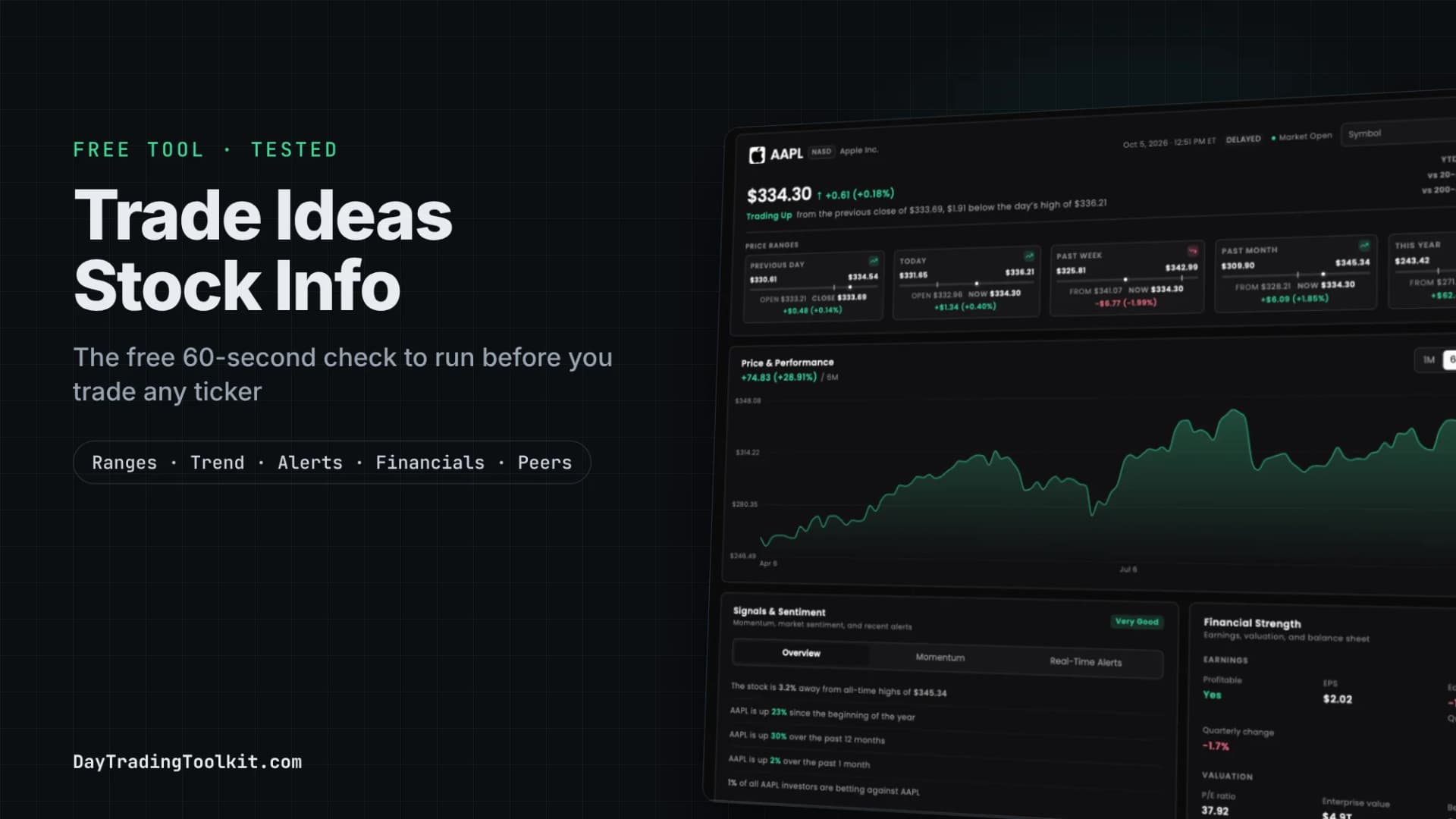
The free route is better than ever: Trade Ideas Stock Info for researching tickers, the free live trading room, the free market dashboard, plus free broker screeners and free AI tools. The signal that it's time to pay is specific: your tested process keeps finding good setups too late with free tools.
How to Find Out If Trade Ideas Is Worth It Without Risking Much
Because Trade Ideas' billing policy is all sales final, the order you evaluate in matters more than usual.
The low-risk path to deciding on Trade Ideas
4 stepsWatch it work for free
Join the free live trading room for a few sessions and use Stock Info on tickers you already follow.
Check yourself honestly
Run the 5 warning signs checklist. If it flags you, wait and revisit in a few months.
Take a Test Drive
When Trade Ideas runs one, a small one-time fee unlocks the full Premium platform for a limited period. Build your real scans and judge the results on your own trading. The fee is final, but there's no auto-renewal.
Start monthly, earn your way to annual
Pick The Core or The Apex with the one-question test (will you use Holly and backtesting?), check the deals page for a live sale or use code DTT15, and switch to annual only after the tool has proven itself.
Current sales and codes are on our Trade Ideas deals page, the Test Drive guide explains how the events work, and when you're ready you can explore Trade Ideas here. For the full feature-by-feature picture, see our Trade Ideas review.
Frequently Asked Questions
Is Trade Ideas worth it for beginners?
The sensible order is free tools first, The Core once a tested strategy needs real-time data, and The Apex only when AI signals or backtesting are the specific GapA gap is a price discontinuity on a chart where a stock opens significantly higher or lower than the previous session's close, leaving a visible empty space — gap-ups are driven by overnight buying pressure or positive news; gap-downs by seRead definition →. Our 5 warning signs checklist shows when you're ready.
How many trades a month make Trade Ideas worth it?
Divide your plan's monthly cost by your honest monthly trade count and compare it with your typical risk per trade. Traders active several sessions a week usually land in comfortable territory; traders making a handful of trades a month don't.
Is Trade Ideas worth it compared to Finviz Elite?
If you shortlist stocks tonight and trade them tomorrow, Finviz Elite is the right tool. Our Trade Ideas alternatives roundup compares the wider field.
Is Trade Ideas Premium worth it over Standard?
Traders who upgrade "to have everything" and then trade their own scans by hand pay double for unused features. Systematic traders who use the full scan, backtest and automate pipeline get the best value on the platform. Our pricing guide lists every plan feature.
Is Trade Ideas worth it for a small account?
The end of the $25,000 Pattern Day Trader minimum in June 2026 made small-account day trading legal, but it didn't change this percentage. Grow the account with free tools first, then add Trade Ideas when its cost becomes a small share of your capital.
Can Trade Ideas pay for itself?
The subscription is a certain cost set against an uncertain benefit. Buy it to amplify an edge you've already shown, not to create one you're hoping for.
Is Trade Ideas worth it for swing trading?
If you do choose Trade Ideas for swing trading, The Core is the right plan rather than The Apex, since Holly's signals are intraday and close before the bell.
Is Holly AI worth paying for?
Trade Ideas doesn't publish an overall Holly win rate publicly; subscribers can review every past signal, losers included, in Holly's History view. A Test Drive is the cheapest way to see whether Holly's signals suit your schedule before paying for The Apex. Our Holly AI explainer covers how the signals work.
What's the cheapest way to find out if Trade Ideas is worth it?
This order matters because Trade Ideas' billing policy is all sales final, and promo-code purchases get no credit or exchange either. Our Test Drive guide explains how the events work.
What We Updated
- October 7, 2026: Rebuilt the guide around direct answers. Added a verdict table by trader profile, cost-per-trade and percentage-of-account tables at current prices, the Finviz Elite price comparison and a step-by-step evaluation path. Removed unsupported market-data and signal-service price estimates and outdated add-on references, and updated the billing terms to the current policy.
Article Sources
- Trade Ideas pricing - plan prices used in every calculation, verified October 7, 2026trade-ideas.com
- Trade Ideas billing and cancellation policy - all-sales-final terms, promo purchases and Test Drivestrade-ideas.com
- Trade Ideas Stock Info - free research pagestrade-ideas.com
- Holly AI history documentation - how subscribers view past signalstrade-ideas.com