
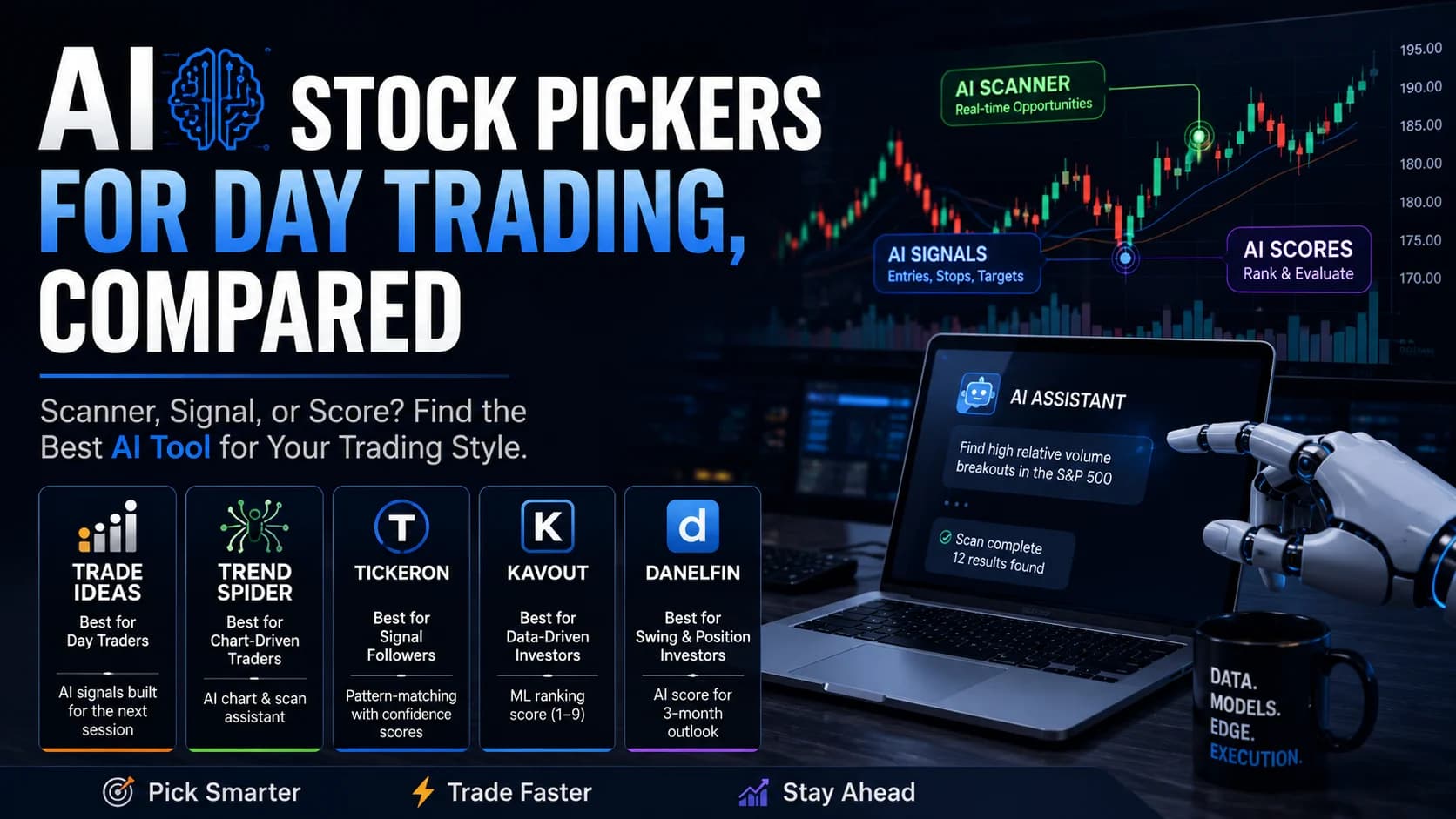
Search "best AI stock picker" and you'll land on a roundup ranking Danelfin, Kavout, and a handful of similar tools against each other on the same criteria: how well they predict which stocks outperform over the next month or quarter. Every one of those tools is built for that job. None of them is built for finding a trade you'll be in and out of before lunch.
Nobody tells you that up front. "Stock picker" has quietly turned into an umbrella term stretched over three genuinely different products: a long-horizon ranking score, a real-time scanner, and a signal engine that hands you an entry and a stop. They solve different problems, and the tool that wins the general "best AI stock picker" search is rarely the one built for an intraday workflow.
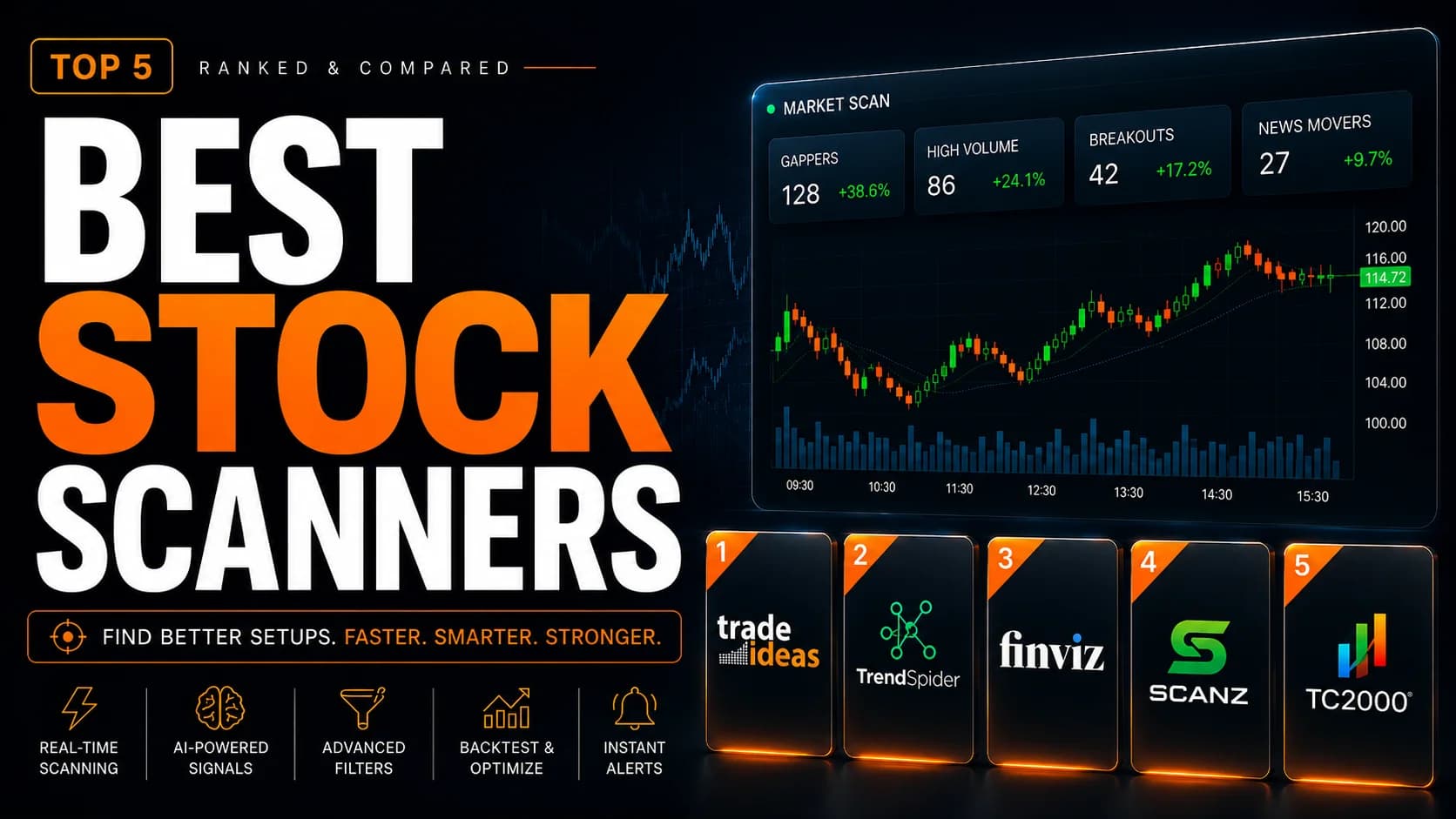
This guide sorts out which is which. It names the tools that lead each category, and it's specific about where Trade Ideas and TrendSpider actually fit an "AI stock picker" search, and where a tool like Danelfin or Kavout is doing real, honest work on a clock that just isn't a day trader's clock.
What is an AI stock picker? An AI stock picker is any tool that uses machine learning or a large language model to rank, score, or surface stocks worth a closer look. That definition covers three genuinely different products: a scanner that finds intraday setups in real time, a signal engine that issues specific trade ideas, and a long-horizon ranking score built for multi-week or multi-month holds. Which one is "best" depends entirely on your holding period.
The short version: Holly, Trade Ideas' AI engine, works like a floor trader clocking in before the bell. It re-tests its playbook overnight and comes in with fresh picks built for that specific session. Danelfin and Kavout work more like a quarterly report card: a score updated daily but aimed at a much longer clock, telling you how a stock is likely to do over the next month or three. If you're closing positions the same day, Trade Ideas is this guide's pick for that job. If your process leans on chart-driven analysis over raw signal-following, TrendSpider's Sidekick is the stronger fit, and current TrendSpider pricing is on the deals page. Keep reading for how each actually works, and why "AI stock picker" ended up covering all of them anyway.
- Tool
- Trade Ideas (Holly)
- Best For
- Active day traders
- Time Horizon
- Intraday, next session
- Starting Price
- $127/mo ($254/mo for Holly)
- AI Approach
- Nightly-backtested ML signals
- Day-Trading Fit
- Strong
- Tool
- TrendSpider (Sidekick)
- Best For
- Chart-driven active traders
- Time Horizon
- Intraday to swing
- Starting Price
- $89/mo
- AI Approach
- LLM chart and scan assistant
- Day-Trading Fit
- Strong
- Tool
- Tickeron
- Best For
- Multi-asset signal followers
- Time Horizon
- Mixed, varies by agent type
- Starting Price
- Tiered, see review
- AI Approach
- Pattern-matching with confidence scores
- Day-Trading Fit
- Partial
- Tool
- Kavout (Kai Score)
- Best For
- Data-driven investors
- Time Horizon
- Traditionally next-month; has a newer intraday option
- Starting Price
- Free to paid tiers
- AI Approach
- ML equity ranking, 1 to 9
- Day-Trading Fit
- Weak to Partial
- Tool
- Danelfin (AI Score)
- Best For
- Swing and position investors
- Time Horizon
- 3-month forward
- Starting Price
- $22 to $134/mo
- AI Approach
- Explainable AI score, 1 to 10
- Day-Trading Fit
- Weak
| Tool | Best For | Time Horizon | Starting Price | AI Approach | Day-Trading Fit |
|---|---|---|---|---|---|
| Trade Ideas (Holly) | Active day traders | Intraday, next session | $127/mo ($254/mo for Holly) | Nightly-backtested ML signals | Strong |
| TrendSpider (Sidekick) | Chart-driven active traders | Intraday to swing | $89/mo | LLM chart and scan assistant | Strong |
| Tickeron | Multi-asset signal followers | Mixed, varies by agent type | Tiered, see review | Pattern-matching with confidence scores | Partial |
| Kavout (Kai Score) | Data-driven investors | Traditionally next-month; has a newer intraday option | Free to paid tiers | ML equity ranking, 1 to 9 | Weak to Partial |
| Danelfin (AI Score) | Swing and position investors | 3-month forward | $22 to $134/mo | Explainable AI score, 1 to 10 | Weak |
Trade Ideas: The AI Stock Picker Built for the Same Session
Every night after the close, while most tools sit idle, Holly is running dozens of strategies back through the day's data, checking which ones actually worked in that specific tape. By morning she's narrowed it to a handful of session-specific ideas, each with an entry, a stop, and a target already attached. That's the whole difference between Holly and a monthly ranking score in one sentence: Holly answers "what's worth trading today." A ranking score answers "what's worth holding for a quarter." Neither one is wrong. They're just not the same question.
Trade Ideas backs Holly with real-time scanning across 500+ filters, a July 2026 AI Assistant that builds those scans from a plain-language description instead of manual configuration, no-code BacktestingThe process of running a defined trading strategy against historical price data to evaluate how it would have performed before risking real capital. A well-constructed backtest gives you a statistical baseline — win rate, profit factor, maxRead definition → through OddsMaker, and direct broker execution through Brokerage Plus. The full platform picture is in this site's Trade Ideas review. One catch worth flagging before anyone gets excited: Holly's signals sit behind the $254/mo Premium tier, not the $127/mo entry price. And the whole platform covers U.S. stocks and ETFs only. Nothing outside that.
TrendSpider: The AI Pick for Chart-First Traders
AskThe ask is the lowest price a seller is currently willing to accept. When you buy with a market order, you pay the ask.Read definition → TrendSpider's Sidekick to find something and it won't hand you a signal the way Holly does. It's a conversational layer sitting on top of the platform: describe a setup in plain English, and it builds the scan, then draws the trendlines, SupportSupport is a price level where buying pressure has historically overcome selling pressure, causing price to stop declining and reverse — it's the floor where demand enters the market, and when it holds, it's a potential long entry; when it Read definition →, and ResistanceResistance is a price level where selling pressure has historically overcome buying pressure, causing price to stall, reverse, or consolidate — it's the ceiling where supply enters the market and where breakout traders watch for either a coRead definition → around whatever it finds, automatically rather than by eye. Its AI Strategy Lab goes further still, letting a trader train a custom machine-learning model on whatever mix of indicators and outcome they define, without writing a line of code.
That makes TrendSpider the stronger pick for someone who wants to interrogate a setup rather than be handed one. The trade-off: it's more research-and-automation platform than pure signal generator, and pricing starts around $89/month. The full breakdown is in this site's TrendSpider review.
Danelfin, Kavout, and Tickeron: Real AI, Different Job
These three show up constantly on general "best AI stock picker" lists, and none of them deserve to be waved off as irrelevant. They're just answering a longer question than the one a day trader is actually asking.
Danelfin is the most explicit about it. Every U.S. and European stock gets an AI Score from 1 to 10, built from roughly 10,000 daily data points across technical, fundamental, and sentiment indicators, and the score is designed specifically to estimate the odds of beating the market over the next three months. That's not a limitation buried in fine print. It's the stated design goal, printed right on the product. Pricing runs from a limited free tier up to $134/month for the API-access tier at the top.
Kavout's Kai Score, also called K Score, works the same way on a shorter leash: roughly 7,000 U.S. equities ranked 1 to 9 on a probability-of-outperformance model, traditionally over a one-month horizon. Give Kavout credit where it's due: it added an Intraday Kai Score in 2026, tucked into its Market Movers and Watchlist tools, a real step toward same-day relevance. It's still a narrow feature bolted onto a platform whose core product is built for longer holds, not the platform's whole personality.
Tickeron sits in the middle of the other two. It runs pattern-recognition signals with confidence scores across stocks, crypto, and forex, plus bot-style "agents," some of which run on higher-frequency, shorter timeframes than the rest of the lineup here. The methodology reads closer to statistical pattern matching than the kind of adaptive, nightly re-evaluation Holly runs, and results shift meaningfully depending on which agent is doing the work. This site's Tickeron review covers where its faster tools hold up and where they don't.
None of that makes Danelfin or Kavout bad products. Hold a position for a few weeks and an explainable, sourced probability score is genuinely useful. It's just not what shows up when someone types "AI stock picker for day trading" into Google expecting a same-day answer.
Stock Picker vs. Scanner vs. Signal: The Terms That Get Blurred Together
Part of why this search is confusing is that "AI stock picker" gets stretched over two other things that aren't the same product at all.
A scanner watches the market continuously and alerts the moment a stock meets criteria: a GapA gap is a price discontinuity on a chart where a stock opens significantly higher or lower than the previous session's close, leaving a visible empty space — gap-ups are driven by overnight buying pressure or positive news; gap-downs by seRead definition →, a volume spike, a breakout. It doesn't rank stocks against each other; it just tells you the instant something matches. Trade Ideas and TrendSpider are both scanners first, with AI layered on top of that real-time engine.
A signal engine goes a step further: it doesn't just flag a match, it hands over a specific trade idea, entry, stop, target, done. Holly is a signal engine sitting on top of Trade Ideas' scanner. Most of what gets marketed as a "stock picker" in the Danelfin or Kavout mold is closer to a ranking score: a number sorting stocks by predicted performance over a stated future window, with no specific entry or exit attached anywhere.
Here's the practical test: if a tool calls itself a "stock picker" and never mentions a holding period, assume it's the report-card kind, not the floor-trader kind, until proven otherwise. Silence on timeframe almost always means the number is calculated over weeks or months, not hours.
Which One Should You Actually Use
Closing every position before the bell? A monthly or quarterly ranking score is solving a problem that isn't yours. Holly's nightly-tested signals or a scanner-first workflow through TrendSpider are the tools built for that exact day. Holding from a few days to a few months instead? Danelfin's or Kavout's scoring approach is a legitimate research input, as long as it's read for what it is: probability of outperformance over that stated window, not a trade to take this morning. Trading across stocks, crypto, and forex, and want pattern-based signals with a stated confidence level? Tickeron's agents are worth the closer look in this site's dedicated review.
None of these tools, including the ones recommended here, replace a tested strategy and real risk management. An AI stock picker of any kind narrows the search faster than scrolling a screener by hand. It doesn't decide the trade. No version of any of these products, at any price, can promise the pick will work.
Match the Tool to Your Holding Period, Not the Marketing
For day traders specifically, Trade Ideas' Holly is the AI stock picker actually built for a same-session timeframe, with TrendSpider's Sidekick the stronger choice for a chart-first workflow. Danelfin and Kavout are legitimate tools doing real machine-learning work, just on a multi-week to multi-month horizon most "best AI stock picker" searches don't specify up front.
Active day traders who want an AI-generated pick built for the same session, not the same quarter.
Frequently Asked Questions
What is the best AI stock picker for day trading?
Danelfin and Kavout are built around a multi-week to multi-month outperformance window, a different job entirely from finding a same-day setup. Holly, and TrendSpider's Sidekick for a more chart-driven approach, are the two tools here actually designed around an intraday clock.
Key Takeaway: Check the stated holding period before assuming any "AI stock picker" fits a day-trading workflow. See the Trade Ideas review for how Holly's signals actually work.
What's the difference between an AI stock picker and an AI scanner?
Trade Ideas and TrendSpider are scanners at their core, with AI layered on top for signal generation or chart automation. Danelfin and Kavout don't scan for real-time conditions at all. They publish a daily or periodic score based on their own model, independent of what's happening in the market that minute.
Key Takeaway: A scanner reacts to live conditions; a ranking-style stock picker publishes a periodic score regardless of intraday movement.
Is Danelfin good for day trading?
None of that makes Danelfin a weak tool. It's a legitimate, sourced research input for swing or position-style holds. It just isn't answering the question a day trader is asking when they search for something to trade today.
Key Takeaway: Use Danelfin-style scores for longer-horizon research, not for finding today's trade.
Does Kavout work for intraday trading?
That newer feature is a genuine step toward same-day relevance, but it sits on top of a platform whose primary product remains built around longer holding periods. Traders whose entire process is intraday will likely find a purpose-built scanner and signal engine like Holly more directly useful.
Key Takeaway: Kavout's intraday option is worth knowing about, but it's a narrower feature on a longer-horizon platform, not the platform's core design.
Is Tickeron a good AI stock picker for day traders?
Tickeron's pattern-recognition and confidence-score methodology is a different technical approach than Holly's nightly-backtested signals, and results vary by which agent type is in use. This site's Tickeron review breaks down where its faster tools hold up and where they don't.
Key Takeaway: Tickeron is mixed by design. Check the specific agent or feature against your actual holding period before subscribing.
Can an AI stock picker guarantee profitable trades?
That's a pattern, not a promise. Risk management and position sizing still decide the outcome, not the score.
Key Takeaway: Treat every AI stock-picking tool as a probability estimate, never a guarantee. See this site's AI trading risks guide for the fuller picture.
Why do "best AI stock picker" lists rarely mention day trading?
The search term "stock picker" evolved mostly around longer-horizon investing tools, which is why general roundups rank tools on 3-month or 1-month outperformance rather than same-session results. Day-trading-specific AI, like Holly, tends to show up in scanner and signal-engine comparisons instead.
Key Takeaway: A generic "best AI stock picker" search and a "best AI for day trading" search surface mostly different products. Search the more specific term if intraday is your actual timeframe.
How much does an AI stock picker cost?
Longer-horizon ranking tools like Danelfin ($22 to $134/month) and Kavout tend to cost less because they're not maintaining real-time market-data infrastructure the way an intraday scanner does. Trade Ideas and TrendSpider cost more in part because real-time data, execution integration, and nightly model retraining are genuinely more expensive to run.
Key Takeaway: Price generally reflects infrastructure. Real-time, execution-ready tools cost more than periodic ranking scores. Current Trade Ideas and TrendSpider pricing is on the deals page.
What should a beginner use instead of a paid AI stock picker?
An AI stock picker amplifies an existing process; it doesn't create one. This site's free AI tools guide maps a genuinely useful zero-cost stack for the research and learning phase, before any paid AI tool is worth considering.
Key Takeaway: Build the fundamentals before paying for any AI-generated stock pick, fast or slow horizon.
Is Trade Ideas' Holly the same as an AI stock picker like Danelfin?
Holly is closer to a signal engine than a ranking score: it's telling you what to trade and roughly how, not just which stocks look statistically strong over a longer window. That structural difference is exactly why Holly fits a day trader's workflow more directly than a Danelfin-style score does.
Key Takeaway: "AI stock picker" covers both products, but they answer different questions. Match the tool to your actual holding period.