

Three major brokers spent 2026 racing toward the same headline feature: let an AI agent trade on your behalf. Robinhood, Public, and eToro all shipped a version of it this year, and the marketing across all three sounds nearly identical. The actual products aren't. One requires you to build your own agent. One puts a confirmation screen between every permission grant and the AI. One is still in beta and limited to equities. Choosing between them without understanding those differences is choosing blind.
This guide breaks down what each platform actually does, not just what its press release claims. For the mechanics of how this technology works under the hood, including the real security risks worth understanding before connecting any account, see Connecting Claude or ChatGPT to Your Brokerage first.
- Launched
- Robinhood Agentic Trading
- 2026, beta
- Public AI Agents
- March 31, 2026
- eToro Agent Portfolios
- 2026
- Autonomy model
- Robinhood Agentic Trading
- Fully autonomous within user-defined parameters
- Public AI Agents
- Fully autonomous, with an explicit permissions screen before access
- eToro Agent Portfolios
- Bring-your-own agent, connected via scoped API key
- Account structure
- Robinhood Agentic Trading
- Dedicated agentic trading account, separate from main holdings
- Public AI Agents
- Dedicated account, separate from personal holdings
- eToro Agent Portfolios
- Dedicated sub-portfolio
- Minimum to start
- Robinhood Agentic Trading
- Not separately disclosed beyond standard account minimums
- Public AI Agents
- Not separately disclosed
- eToro Agent Portfolios
- $200
- Asset coverage at launch
- Robinhood Agentic Trading
- Equities only; options, crypto, event contracts, and futures planned for later 2026
- Public AI Agents
- Equities only at launch
- eToro Agent Portfolios
- Depends on the connected agent's configuration
- Who builds the agent
- Robinhood Agentic Trading
- Robinhood's own AI, via MCP connection to models like Claude and GPT
- Public AI Agents
- Public's own AI, via natural-language strategy description
- eToro Agent Portfolios
- You do, or a third party you choose; eToro provides the connection layer
- Best fit
- Robinhood Agentic Trading
- Traders who want a turnkey experience inside an existing app they already use
- Public AI Agents
- Traders who want explicit, granular control over what the agent can touch
- eToro Agent Portfolios
- Technically confident users who want to build or import a custom strategy
| Robinhood Agentic Trading | Public AI Agents | eToro Agent Portfolios | |
|---|---|---|---|
| Launched | 2026, beta | March 31, 2026 | 2026 |
| Autonomy model | Fully autonomous within user-defined parameters | Fully autonomous, with an explicit permissions screen before access | Bring-your-own agent, connected via scoped API key |
| Account structure | Dedicated agentic trading account, separate from main holdings | Dedicated account, separate from personal holdings | Dedicated sub-portfolio |
| Minimum to start | Not separately disclosed beyond standard account minimums | Not separately disclosed | $200 |
| Asset coverage at launch | Equities only; options, crypto, event contracts, and futures planned for later 2026 | Equities only at launch | Depends on the connected agent's configuration |
| Who builds the agent | Robinhood's own AI, via MCP connection to models like Claude and GPT | Public's own AI, via natural-language strategy description | You do, or a third party you choose; eToro provides the connection layer |
| Best fit | Traders who want a turnkey experience inside an existing app they already use | Traders who want explicit, granular control over what the agent can touch | Technically confident users who want to build or import a custom strategy |
Robinhood Agentic Trading
Robinhood's version is built directly into the app 27.5 million existing customers already use. You open a dedicated agentic trading account, separate from your regular holdings, connect it through Robinhood's MCP-based infrastructure, and define the parameters you want the agent to trade within. At launch, the feature covers equities only, with options, crypto, event contracts, and futures slated for a later rollout.
The appeal here is convenience. There's no separate platform to learn, no external agent to configure, and the account isolation means a problem with the agent doesn't touch your existing holdings. The tradeoff is that you're trusting Robinhood's specific implementation choices, and as a beta product, some of those choices are still being worked out in public.
Public AI Agents
Public was the first major brokerage to formally brand itself around this feature, calling itself an "Agentic Brokerage" when it released AI Agents on March 31, 2026. Instead of manually placing orders, you describe a strategy in plain language and the agent monitors conditions and executes within those bounds.
What sets Public apart is the permissions layer. Before an agent gets any access, the platform shows an explicit confirmation screen where you set individual, tool-level permissions rather than granting blanket access. Combined with a dedicated account separate from personal holdings, that's a meaningfully more granular consent model than a single "yes, connect my AI" toggle. Coverage is equities only at launch, matching Robinhood's initial scope.
eToro Agent Portfolios
eToro takes a fundamentally different approach: instead of building and offering its own agent, it gives you the connection layer to bring your own. You link a custom AI agent, one you've built or sourced from a third party, to a dedicated sub-portfolio through a scoped API key, with a minimum investment of $200 to fund it.
This is the option built for a more technically confident user. Strategies can RangeA range (or trading range) is a price zone where a stock oscillates between a defined support floor and resistance ceiling without making meaningful new highs or lows — price is consolidating rather than trending, and the dominant trade is Read definition → from scheduled rebalancing to signal-reactive trading tied to specific events like EarningsAn earnings report is the quarterly financial disclosure a public company files with the SEC, revealing revenue, earnings per share (EPS), profit margins, and forward guidance — it's the most significant regular catalyst for individual stocRead definition → releases, but building or evaluating that agent is entirely on you. eToro isn't vouching for the agent's quality the way Robinhood or Public are vouching for their own; it's providing the pipe and letting you decide what runs through it.
The Safer Alternative Worth Knowing About: Interactive Brokers
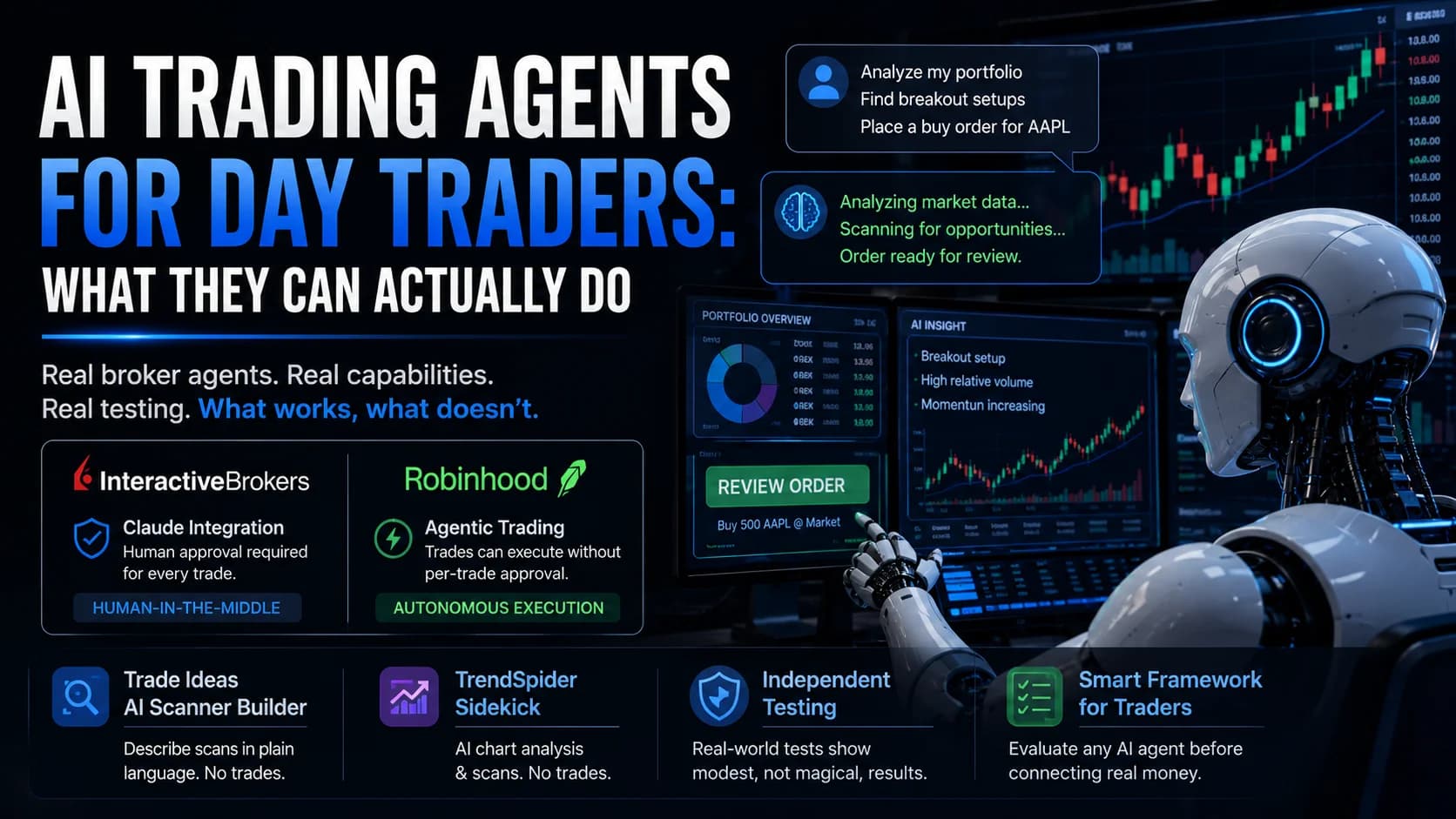
Interactive Brokers took a deliberately more conservative path when it introduced its AI feature in June 2026. Rather than autonomous execution, IBKR built a semi-automated "human in the middle" system: the AI researches, analyzes live market conditions, and recommends, but every single trade requires your explicit approval before it executes. Coverage is limited to equities and ETFs.
If the idea of an AI placing trades without your direct sign-off makes you uneasy, and for most traders it reasonably should, IBKR's approval-required model is worth serious consideration over any of the three fully autonomous options above. It captures much of the research and monitoring benefit of an AI agent while keeping a human as the last checkpoint before capital actually moves.
Who Should Choose Which
Robinhood is the stronger choice if you're already a Robinhood customer, want the AI feature built into an app you use daily, and are comfortable being an early user of a beta product as Robinhood works out the rough edges.
Public is the stronger choice if granular, explicit permission control matters more to you than convenience, and you want to see exactly what you're authorizing before the agent can act.
eToro is the stronger choice if you already have, or are capable of building, your own trading agent and want a broker that will connect it to real capital without imposing its own agent's logic on top of yours.
Interactive Brokers is the stronger choice if you want the research and monitoring benefits of an AI system without giving up final say on every trade, which, for most active traders, is the more defensible starting point.
For most day traders reading this, that last option deserves more weight than the marketing around "fully autonomous" trading tends to suggest. Removing yourself entirely from the execution decision is a significant step, and it's worth taking only after you've validated how an AI agent actually behaves with real money on the line, in an approval-required setting first.
What None of Them Solve
Choosing the right platform doesn't eliminate the underlying risk this entire category carries. All three broker-built agents, and the eToro bring-your-own-agent model most of all, run on MCP-based connections that inherit the same documented security weaknesses covered in Connecting Claude or ChatGPT to Your Brokerage: permission scoping that varies wildly by implementation, limited standardized activity logging, and an attack surface that security researchers have flagged as actively exploited elsewhere in the MCP ecosystem. Account isolation and confirmation screens reduce the blast radius of a problem. They don't eliminate the underlying protocol-level risk.
Frequently Asked Questions
Which broker's AI trading agent is safest?
Robinhood, Public, and eToro all allow some form of execution without per-trade approval, which removes a checkpoint that IBKR's design keeps in place. That doesn't make the other three unsafe outright, but it does mean the burden of catching a bad decision shifts more heavily onto the account isolation and permission settings you configure upfront.
Key Takeaway: If per-trade oversight matters to you more than convenience, IBKR's human-in-the-middle design is currently the strongest option among these.
Can I use more than one of these platforms at the same time?
Each platform's agent operates independently within its own dedicated account or sub-portfolio, so there's no technical conflict in maintaining accounts on more than one. The practical cost is attention: more platforms means more permission settings, more activity logs, and more places something could go wrong without you noticing quickly.
Key Takeaway: Running multiple agentic accounts is possible, but treat each one as requiring the same level of monitoring, not divided attention across all of them.
Do any of these support options or futures trading?
Interactive Brokers' semi-automated tool is also currently limited to equities and ETFs. If your trading centers on options or futures, none of these agentic features currently cover your core activity.
Key Takeaway: Confirm asset coverage matches your actual trading focus before assuming any of these platforms fits your strategy.
What happens if the AI agent makes a bad trade?
This is the core tradeoff of autonomous execution versus IBKR's approval-required model. A dedicated sub-account or agentic account caps your downside to whatever capital you've allocated there, but within that account, a poor decision by the agent plays out the same as a poor decision you'd made yourself.
Key Takeaway: Size whatever you allocate to an autonomous agentic account as capital you're prepared to lose entirely, not just capital you're comfortable risking.
Is eToro's Agent Portfolios feature good for beginners?
Unlike Robinhood or Public, where the broker builds and stands behind the agent's logic, eToro's model puts that responsibility entirely on you. A beginner connecting an unvetted third-party agent to real capital is taking on risk that's difficult to assess without real trading and technical experience first.
Key Takeaway: Beginners are better served by Robinhood or Public's broker-built agents, or by Interactive Brokers' approval-required model, before considering eToro's bring-your-own-agent approach.
How much does it cost to use an agentic trading feature?
Robinhood and Public haven't published a distinct fee specifically for agentic trading access beyond standard account requirements as of this writing. Confirm current terms directly with each platform, since agentic trading features are new enough that pricing details are still being finalized in places.
Key Takeaway: Don't assume agentic trading access is free just because a specific fee isn't advertised; confirm directly with the platform.
Which of these uses Claude or ChatGPT specifically?
The specific AI model matters less than the platform's permission and oversight controls, covered in the full MCP security breakdown, since the documented vulnerabilities concentrate in the implementation layer rather than in any particular model.
Key Takeaway: Evaluate a platform's permission scoping and account isolation before treating the underlying AI model as the deciding factor.
Will more brokers add agentic trading features?
The category is expanding quickly enough that this comparison will need revisiting as more platforms launch and existing ones expand beyond equities into other asset classes.
Key Takeaway: Expect this list of options to grow; recheck each platform's current feature set before making a final decision, since capabilities are changing month to month.
Disclaimer
Article Sources
- More Brokers Let AI Agents Place Trades, AI Street - industry count of brokerages offering AI agent account connections.ai-street.co
- Fintechs Put AI in the Driver's Seat with Agentic Trading, Corporate Insight - details on Public's and eToro's permission models and account structures.corporateinsight.com
- Public launches AI Agents for autonomous trading, Global Fintech Edge - Public's own launch announcement and feature details.globalfintechedge.com
- Robinhood launches AI trading agents, SaaS News - details on Robinhood's Agentic Trading beta and customer scale.saasrise.com
- Brokerages Accelerate Rollout of AI Trading Tools as Automated Investing Expands, Yahoo Finance / Jefferies - industry-wide overview including Interactive Brokers' human-in-the-middle model and Coinbase's automated agents.finance.yahoo.com