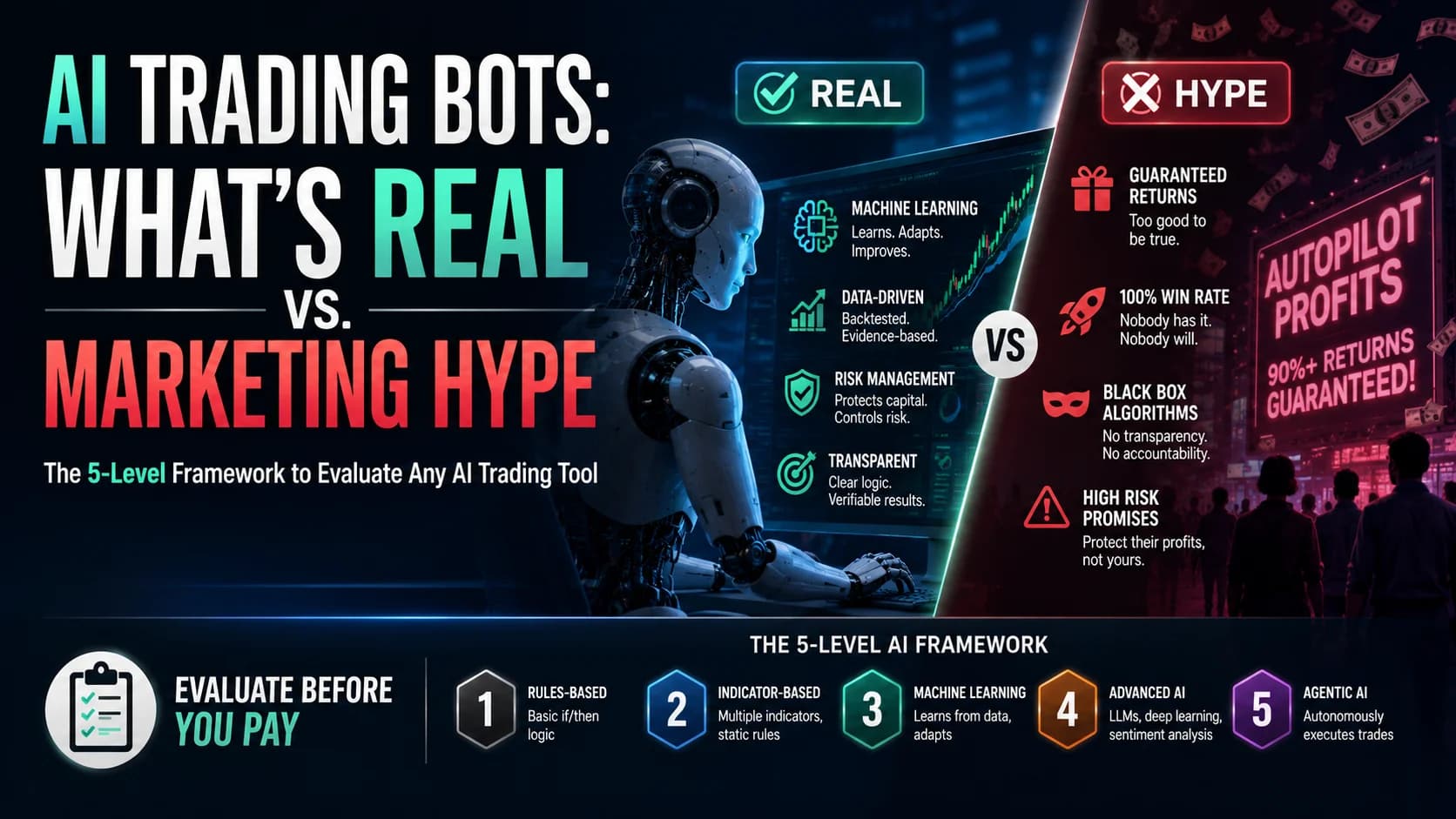

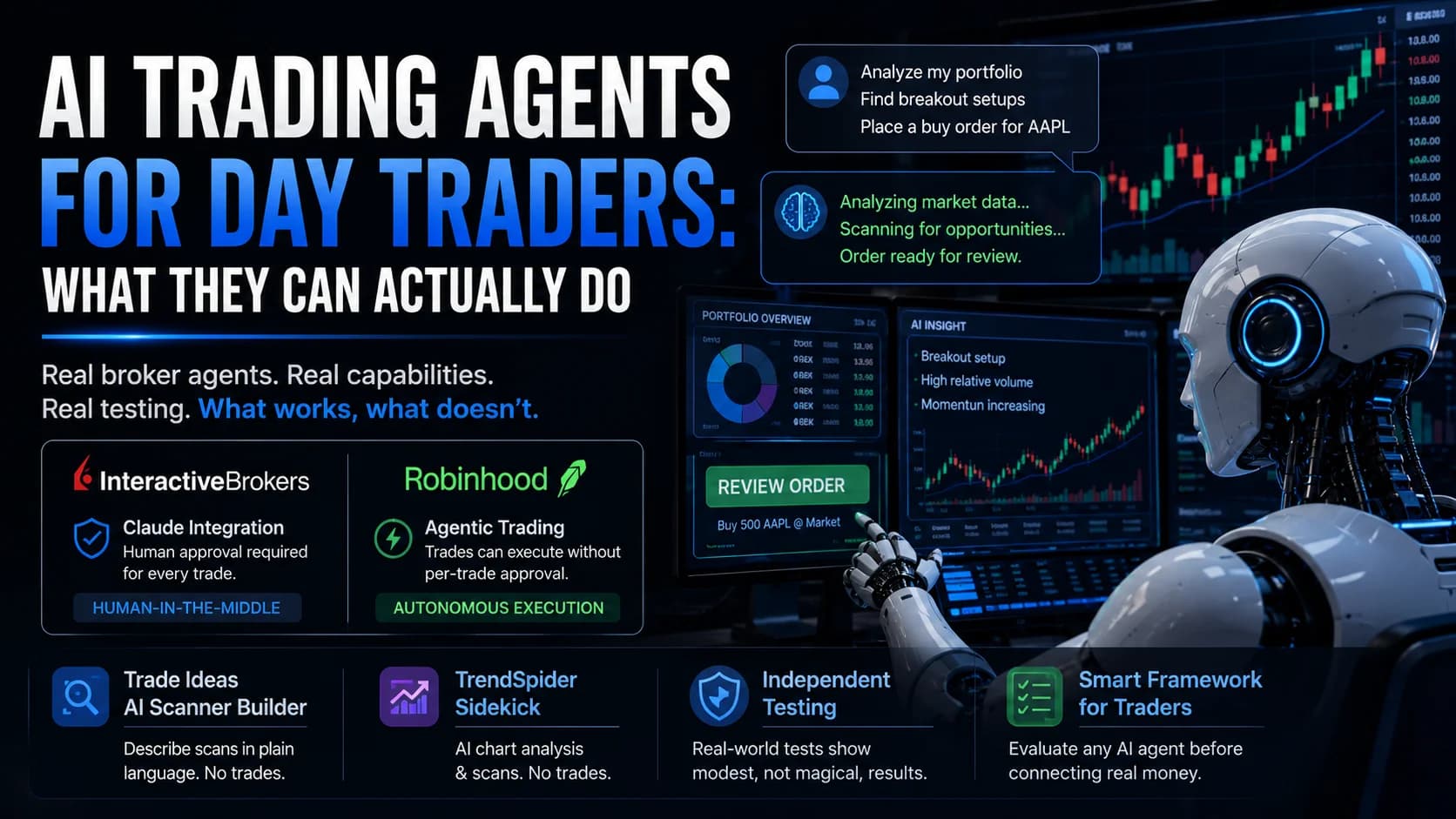
Somewhere on the internet right now, a blog post is promising that its "Agentic AI stacks" will deliver 88% returns by trading for you while you sleep. It has a chart. It has a proprietary simulation. It has no verifiable live track record, and it never will, because that's not a real number. It's marketing dressed up in the same "agentic" language Interactive Brokers and Robinhood are using for products that actually exist.
The real thing and the vaporware use identical vocabulary, and that's exactly what makes this confusing to research. This guide separates them. It covers what a trading agent actually is, which real products day traders can use today, what independent testing has found when the return claims get checked, and a practical framework for evaluating any agent before you connect one to real money.
What is an AI trading agent? An AI trading agent is software, typically built on a large language model like Claude, ChatGPT, or Gemini, that can research markets, analyze a portfolio, and generate or place trade orders based on plain-language instructions, rather than a fixed set of if/then rules. The critical distinction between products marketed this way is whether a human approves every trade before it executes, or the agent can act without that checkpoint.
The short version: two mainstream brokers shipped real agentic trading in 2026, and they built it like two different professions. Interactive Brokers made Claude a research assistant who drafts the paperwork and waits for a signature. Robinhood made its agent more like a junior trader with actual discretion inside a capped account. Trade Ideas' AI Scanner Builder and TrendSpider's Sidekick sit in a calmer category entirely: they build and configure scans or charts from plain language and never touch an order ticket. Trade Ideas' AI Assistant is the scan-building version of this, and current TrendSpider pricing covers Sidekick's tier. Independent academic testing on agentic trading performance has been considerably less impressive than the marketing around it, covered in full below.
The Two Real Brokerage Agents: IBKR and Robinhood Aren't Built the Same Way
Two mainstream, regulated brokers launched actual agentic trading products in 2026, within weeks of each other, and they made meaningfully different design choices worth understanding before either one gets near your account.
Interactive Brokers integrated directly with Claude in June 2026, accessible through Claude's certified connector marketplace using a client's existing IBKR login, with no separate account and no additional fees. The design is explicitly "human-in-the-middle": Claude can research positions, analyze portfolio concentration, and draft trade instructions in plain language, but every instruction lands in a dedicated review tab across IBKR's platforms where a human has to manually approve it before it becomes a real order. Think of it as a research assistant who can prep the trade down to the last detail, but has no authority to actually place it. The AI cannot execute a trade on its own under any circumstance in this implementation.
Robinhood took a different approach with Agentic Trading, launched May 27, 2026, in beta for stock trading, with options, crypto, and futures planned. Customers connect a third-party agent (Claude, ChatGPT, or Gemini) through Robinhood's own Model Context Protocol server to a separate, isolated "Agentic Account" funded specifically for that purpose. Inside that account, the agent gets real discretion: trades can execute without per-trade approval, and the account holder gets a push notification after the fact rather than a request beforehand. Robinhood's own documentation doesn't dress this up. Agents can hallucinate, misinterpret instructions, or act on outdated information, and the company explicitly disclaims responsibility for losses that result.
Whether a human reviews every trade before it happens is the whole risk conversation here, and it isn't the same answer at both brokers.
Trade Ideas and TrendSpider: A Narrower, More Contained Kind of Agent
Not every product using "AI agent" language is trying to place trades autonomously, and the narrower version deserves its own look, because it solves a real problem with far less exposure attached.
Trade Ideas' AI Scanner Builder, released July 2026 as part of its broader AI Assistant, lets a trader describe a scan in plain language or by voice, something like "stocks under $20, up at least 4% today, on three times normal VolumeVolume is the total number of shares (or contracts) traded during a given time period — it's the primary confirmation tool for all price action, because a price move accompanied by high volume indicates genuine market participation, while tRead definition →," and the agent configures the actual filter logic. It generates no trade signals and places no orders; its entire job is translating a description into a working scanner. That's meaningfully lower-stakes than a brokerage agent with order authority, and this site's AI Assistant guide covers exactly what it does and doesn't do.
TrendSpider's Sidekick pushes further into genuinely agentic territory without crossing into order authority: it can analyze charts, review a watchlist, suggest backtest adjustments, and, per TrendSpider's own materials, operate with meaningful autonomy inside a trader's workspace rather than functioning as a simple chatbot bolted onto the interface. It still doesn't place live trades on its own. The TrendSpider review covers where Sidekick's agentic behavior actually shows up versus where a human is still doing the work.
Neither one can move money without a separate, deliberate step from the trader. That single fact puts them in a different risk category entirely from IBKR's or Robinhood's brokerage-connected agents.
Does Agentic Trading Actually Work? What the Testing Shows
The return-percentage blog posts skip this part, and it matters more than any feature comparison.
A widely cited 2026 academic test out of Tsinghua University found an AI trading agent generating an apparently spectacular 85% return on Chinese equities over two years, dramatically outperforming the market's roughly 37%. That result made headlines. Then it fell apart under a more rigorous version of the same test: when researchers hid the stock names and specific dates so the model couldn't lean on memorized outcomes from its training data, the advantage largely disappeared. The lesson travels well past that one study. An AI agent's apparent edge is only as real as the test that produced it, and a backtest run on data the model may have already seen during training isn't a backtest. It's a memory exercise wearing a lab coat.
Regulators have taken notice. FINRA's 2026 Annual Regulatory Oversight Report specifically flagged AI agents acting autonomously without human validation as an emerging risk area firms need to govern, the same concern that separates IBKR's human-approval design from Robinhood's autonomous-execution option. This isn't theoretical, either: in June 2026, a group of congressional lawmakers raised concerns directly with brokers offering autonomous AI trading access, which says this space is drawing regulatory attention now, not after something goes wrong.
None of this makes agentic trading fraudulent, and IBKR's and Robinhood's real products aren't scams. They're legitimate, disclosed, regulated offerings from real broker-dealers. The claim worth watching for is a return percentage with no methodology attached. If a source can't say whether its backtest accounted for the model already having seen the outcome during training, the number is unverified, full stop.
How to Evaluate Any AI Trading Agent Before Connecting One
A short, practical checklist, built around the questions the research above actually answers:
Does a human approve every trade, or can the agent act alone? This is the single biggest risk-profile variable. IBKR requires approval on every order. Robinhood's Agentic Trading does not, by design, inside its isolated account. Know which one is which before connecting anything.
Is the account isolated from your main portfolio? Both IBKR's and Robinhood's implementations keep agentic activity contained to specific, funded scopes rather than giving an AI blanket access to an entire account. Never connect an agent to a product that skips this separation.
Where does your account data go once it's shared? Robinhood is explicit that once data leaves its security environment for a third-party AI provider, that provider's terms govern it, not Robinhood's. Read that handoff before authorizing it.
Is there a kill switch, and have you actually tested it? Both real products offer one. Disconnect the agent once during a quiet market period, before you find out the hard way whether it works during a volatile one.
Is the return claim backed by a checkable methodology, or just a number? The single strongest tell separating a legitimate product from marketing hype is whether a claimed result explains its own testing conditions. "88% returns" with no stated methodology isn't evidence. It's copy. This site's guide to AI trading scams covers the broader pattern in detail.
Is the broker actually regulated? IBKR and Robinhood are both SEC-registered broker-dealers and FINRA members. Verify any product through FINRA BrokerCheck before connecting an agent to real money, especially on a platform that didn't exist before this year.
None of this means staying away from agentic trading tools. It means knowing exactly which kind is sitting in front of you. A scan-building agent like Trade Ideas' Assistant carries almost none of the risk profile above. A brokerage agent with standing order authority carries all of it, and it earns the same scrutiny as any other decision to hand a system access to real capital.
Frequently Asked Questions
What is the best AI trading agent for day trading?
Interactive Brokers' Claude integration requires human approval on every trade, making it the more contained brokerage option. Robinhood's Agentic Trading can execute without per-trade approval inside an isolated account, which is more autonomous and carries more risk. Trade Ideas and TrendSpider's agents skip order authority entirely; they build the scans and analysis a trader still acts on manually.
Key Takeaway: Match the agent to how much autonomy you're actually comfortable granting. They are not interchangeable products.
Is AI agentic trading safe?
"Safe" isn't really the right frame. Both products can lose money, and Robinhood's own terms state the company doesn't control, supervise, or audit the third-party AI agents connecting to its platform. The safeguards cap how much damage a malfunctioning agent can do. They don't evaluate whether any given trade is a good one.
Key Takeaway: Isolation and kill switches limit downside. They don't validate the agent's decisions.
Can AI trading agents really make 80%+ returns?
Watch for this pattern broadly. An AI agent's backtested return only means something if the test accounts for the model potentially having already seen the outcome during training. Return percentages published without that methodology, the "88% returns" style common on smaller trading-tool blogs, should be treated as unverified until proven otherwise.
Key Takeaway: AskThe ask is the lowest price a seller is currently willing to accept. When you buy with a market order, you pay the ask.Read definition → what the backtest controlled for before trusting any agentic trading return claim.
What's the difference between Interactive Brokers' and Robinhood's AI trading agents?
Both launched within weeks of each other in 2026, and both connect major AI models (Claude, ChatGPT, Gemini) to a real brokerage account. The design GapA gap is a price discontinuity on a chart where a stock opens significantly higher or lower than the previous session's close, leaving a visible empty space — gap-ups are driven by overnight buying pressure or positive news; gap-downs by seRead definition → is the entire risk conversation: IBKR's approach means an agent can be wrong without it costing anyone money, since nothing executes without sign-off. Robinhood traded that checkpoint for genuine autonomy.
Key Takeaway: Read which model each broker uses before assuming "agentic trading" means the same thing everywhere.
Does Trade Ideas have an AI trading agent?
That's a meaningfully different, lower-risk product than a brokerage-connected trading agent. Holly, Trade Ideas' separate signal engine, issues trade ideas for a human to evaluate and act on manually. Neither Holly nor the AI Assistant executes a trade autonomously. The Trade Ideas AI Assistant guide covers the mechanics in full.
Key Takeaway: Trade Ideas' agent builds your scans; it doesn't trade for you.
Is TrendSpider's Sidekick an AI trading agent?
That distinguishes it from Interactive Brokers' or Robinhood's brokerage-connected agents, which do carry standing order authority in at least some configurations. Sidekick's scope stays in research and workflow automation, never execution.
Key Takeaway: Sidekick automates the analysis; a human still pulls the trigger on the trade. See the full TrendSpider review.
What happens if an AI trading agent makes a bad trade?
Robinhood's own terms are plain about this: the company does not control, supervise, or audit third-party AI agents, and losses from agent-generated trades land on the customer. Isolation and the funding cap limit how bad it can get. They don't create any recourse once the agent has traded poorly within that cap.
Key Takeaway: Fund an agentic account with only what you could lose entirely, since neither the broker nor the AI provider is on the hook for a bad trade.
Are AI trading agents regulated?
FINRA's 2026 Annual Regulatory Oversight Report specifically flagged autonomous AI agent activity as an area member firms need to govern, which signals this is an active regulatory focus, not a settled question. Verify any broker offering this kind of product through FINRA BrokerCheck before connecting an agent, particularly on a platform that isn't a household name yet.
Key Takeaway: The broker is regulated; nobody is independently vetting the agent's trading decisions.
Can I use ChatGPT or Claude directly to trade stocks?
ChatGPT and Claude have no native brokerage access and no default ability to place real trades. The agentic trading products in this guide exist because Interactive Brokers and Robinhood specifically built the connectors and account structures that let an AI model touch a real trading account under defined rules.
Key Takeaway: The AI model supplies the reasoning; the broker's specific integration is what actually lets a trade happen.
Should a beginner use an AI trading agent?
Building fundamentals first, entries, stops, position sizing, with free tools, is the safer starting point, well before any AI agent enters the picture. This site's beginner's guide is the place to start.
Key Takeaway: Skill and risk management come first; an AI agent only makes whatever process already exists run faster.
Disclaimer
Article Sources
- Interactive Brokers: Integrates AI into Client Portfolios - . Primary source for IBKR's Claude integration, human-approval design, and connection mechanics.businesswire.com
- Robinhood Newsroom: Robinhood is Now Open to Agents - . Primary source for Robinhood's Agentic Trading terms, risk disclosures, and data-sharing disclaimers.robinhood.com
- Robinhood Support: Agentic Trading Overview - . Official documentation of autonomous execution and risk warnings.robinhood.com
- TechCrunch: Robinhood now lets your AI agents trade stocks - . Independent reporting on the May 2026 launch and MCP-based connection model.techcrunch.com
- Finder: Robinhood Agentic Trading Review - . Independent analysis citing FINRA's 2026 Annual Regulatory Oversight Report and academic research on AI trading agent failure modes.finder.com
- AlgoTrader: Robinhood Agentic Trading, the Catch - . Source for the 2026 Tsinghua University study methodology and results on AI trading agent backtesting.algotrader.ch
- Trade Ideas: AI Scanner Builder announcement - . Official feature description for Trade Ideas' scan-building agent.trade-ideas.com