Tickeron Review 2026: Does the AI Actually Deliver?

In this article8 sections
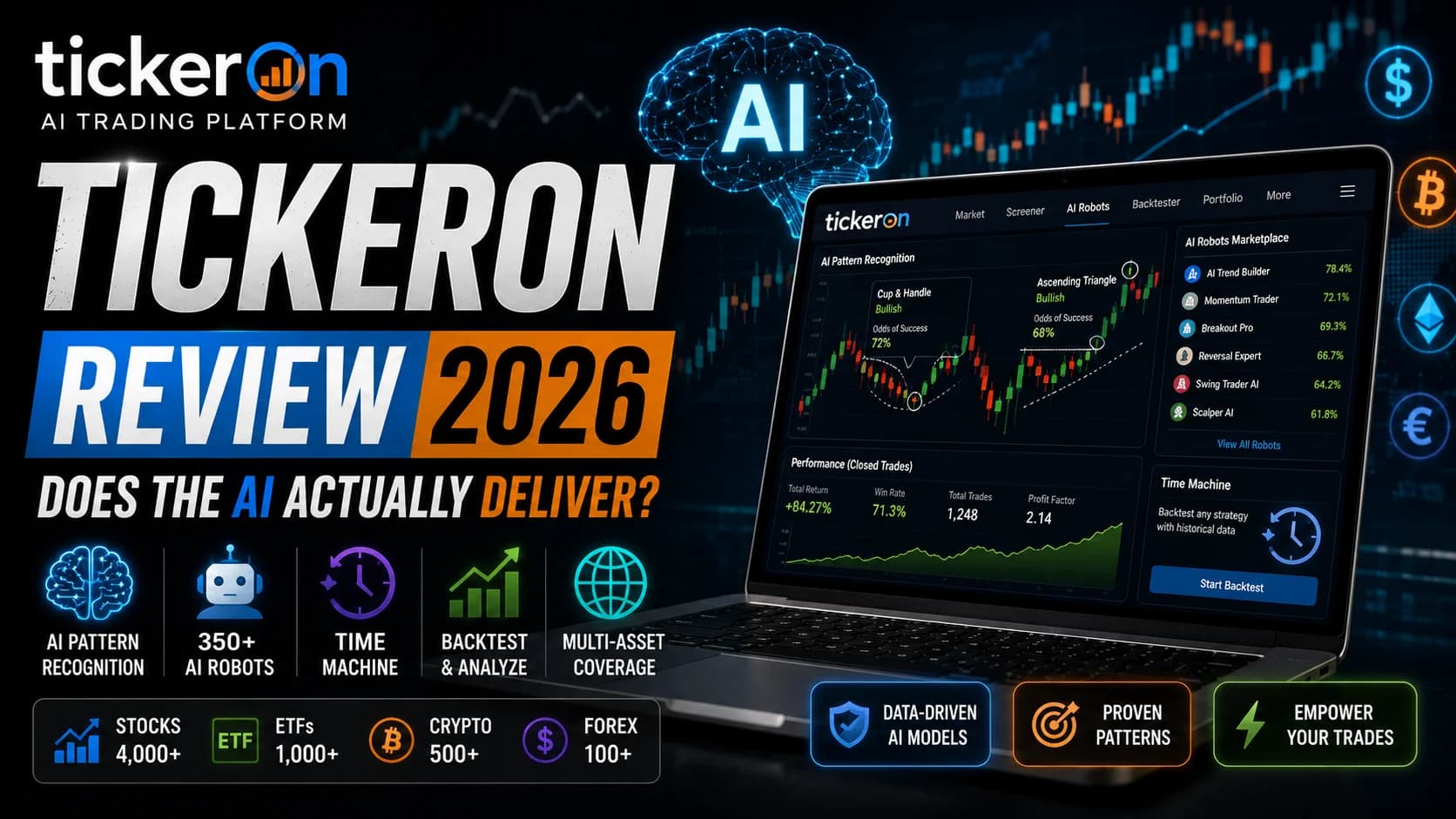
The appeal of Tickeron is easy to understand. A marketplace of 350+ AI trading robots, each with a published performance history. Real-time pattern recognition scanning thousands of stocks, ETFs, crypto, and forex pairs simultaneously. A Time Machine that backtests your conditions against years of historical data. For a retail trader who's spent hours manually scanning for chart patterns, the pitch is obvious: let the AI do the heavy lifting.
This independent review evaluates whether Tickeron delivers on that pitch — working through the robot marketplace, pattern recognition engine, pricing structure, and execution model to show where the gap between promise and practice shows up.
Tickeron Review 2026
Tickeron delivers genuinely impressive AI-powered pattern recognition and a one-of-a-kind robot marketplace with transparent performance data. Its limitations are equally real: a complex, confusing pricing structure, no direct live broker integration for automated execution, and a steep learning curve that makes the full platform accessible only to committed users.
Pros
Strengths- Pattern Search Engine scans stocks, ETFs, crypto, and forex simultaneously for real-time chart patterns with published odds-of-success statistics
- Robot marketplace contains 350+ AI bots with publicly visible closed-trade histories — transparency that most automated signal services don't offer
- Financial Learning Models (FLMs) operate on 5-minute, 15-minute, and 60-minute timeframes, making the platform increasingly relevant for shorter-term traders
- Multi-asset coverage spans 4,000+ stocks, 1,000 ETFs, 500 cryptocurrencies, and 100 forex pairs in a single platform
- Time Machine historical replay lets you test strategy conditions against past market data before committing capital
Cons
Trade-offs- No direct live brokerage integration for automated execution — robots operate in paper trading by default; live copying requires manual action
- Pricing structure is genuinely confusing: multiple membership tiers, à la carte add-ons, and credit systems layer together in ways that obscure actual cost
- 14-day free trial excludes the most valuable features (AI Robots, Expert Membership, Buy/Sell Signals)
- Mobile app has documented issues — notification delays during volatility, occasional crashes, high battery drain on older devices
- UI can feel data-dense to the point of overwhelming, particularly for traders newer to quantitative tools
What Is Tickeron?
What is Tickeron? Tickeron is an AI-powered trading and investing platform founded in 2017 by Sergey Savastiouk, Ph.D., and wholly owned by SAS Global, a data analytics firm whose technology serves most Fortune 500 companies. It applies machine learning — specifically proprietary Financial Learning Models (FLMs) — to detect chart patterns, generate trend predictions, and power a marketplace of over 350 automated trading robots across stocks, ETFs, forex, and cryptocurrency.
The SAS Global parentage is worth knowing. Unlike platforms built by solo developers or small fintech teams, Tickeron sits inside a parent organization with serious data infrastructure. That institutional backing is visible in the platform's analytical depth — the pattern recognition engine, the multi-asset coverage, and the rate at which the platform has evolved. It's also a signal about the company's longevity that smaller AI trading platforms can't match.
Tickeron positions itself differently from traditional stock screeners. Where a screener finds stocks meeting criteria you defined, Tickeron's FLMs are trained on market data and generate pattern identifications and predictions that the system surfaces — criteria the machine learned, not criteria you built. That distinction shapes everything about how the platform is used and who benefits from it.
Tickeron Key Features
Pattern Search Engine (PSE) is the feature most traders discover first, and for good reason. It scans stocks, ETFs, crypto, and forex pairs in real time, identifying classic chart formations — head and shoulders, cup and handle, triangles, wedges, pennants, and dozens more — as they develop. Each identified pattern comes with a calculated Odds of Success score, a projected price target, and historical statistics on how that pattern has performed in similar conditions.
The depth of coverage is the differentiator. Running a manual pattern scan across thousands of securities is a full-time job. Tickeron's PSE does it continuously and surfaces candidates ranked by confidence. For traders who trade chart patterns as their primary setup type, having that search automated at scale is a legitimate workflow improvement. The patterns cover bullish and bearish formations across all supported asset classes, and you can filter by direction, timeframe, and confidence threshold.
A critical note on interpreting PSE output: the Odds of Success figures are statistical — they reflect historical frequency, not future certainty. A pattern showing 75% historical accuracy has failed 25% of the time. Our guide to AI trading risks every day trader should know covers why treating AI confidence scores as guarantees is one of the most common and expensive mistakes traders make.
Trend Prediction Engine runs AI models against price action, volume, news sentiment, and macroeconomic indicators to identify developing momentum and generate directional forecasts. The output gives traders a probabilistic read on where a stock or asset may be headed, along with the factors the model weighted most heavily. It operates across the same broad asset universe as the PSE and can be filtered by timeframe from five-minute intervals up to daily views.
AI Robots Marketplace is the most distinctive feature on the platform — and the one that requires the most careful evaluation. The marketplace contains over 350 pre-built automated trading robots, organized by trading style (swing, day, gap, volume), asset class, and AI timeframe. Three robot types exist: Signal Agents (which generate trade signals without account balance restrictions), Virtual Agents (which add money management logic and adjustable position sizing), and Brokerage Agents (which copy signals from Tickeron's own brokerage accounts into your paper trading account).
What sets this marketplace apart is transparency. Every robot publishes its closed-trade history — entry prices, exit prices, holding periods, and the underlying signal logic. You can evaluate the actual track record before following any robot. For a signal service category that often operates as a black box, that transparency is meaningful.
What you need to understand about "automated execution": Tickeron's robots do not currently connect directly to your live brokerage account for autonomous trading. When you follow a robot, its signals go to your Tickeron paper trading account by default. To execute live trades based on robot signals, you copy them manually to your broker. A Brokerage Agent connection exists in development, with limited availability — but for most users, execution remains a manual step between signal and trade. This distinction matters significantly for traders who want true set-and-forget automation.
Time Machine is Tickeron's historical backtesting tool. It lets you apply the AI screener's filters and conditions against historical market data and replay how those criteria would have performed. For traders evaluating a strategy before risking capital, the ability to stress-test conditions against real past market behavior is valuable. The tool works across the same multi-asset universe the live screener covers.
The important nuance here mirrors what we'd say about any backtesting tool: performance in the Time Machine reflects how conditions looked in historical data. It doesn't account for slippage, market impact, liquidity variations at execution, or the fact that patterns that worked in one regime may not work in another. Time Machine is a useful research input — it's not validation of live profitability.
AI Screener aggregates the platform's analytical outputs into a filterable universe of buy and sell suggestions across stocks, ETFs, mutual funds, crypto, and forex. Each suggestion carries a confidence score and the underlying signal rationale. The screener can be customized by asset class, direction, timeframe, and signal type, and outputs can feed into watchlists or robot-following workflows.
AI Portfolios are thematic, AI-managed model portfolios covering strategies like growth, income, value, and specific sector exposures. They come with audited track records rather than backtested projections — an important distinction that Tickeron advertises specifically. For traders interested in a more passive, portfolio-level approach to AI-generated ideas, these are a separate product from the active trading robots.
Financial Learning Models (FLMs) are Tickeron's proprietary AI architecture — conceptually similar to large language models for text, but trained on market data. The platform now operates FLMs on 5-minute, 15-minute, and 60-minute timeframes, with 2025–2026 updates reportedly improving processing speeds by approximately 40%. The shorter timeframes represent meaningful progress for intraday traders who previously found Tickeron more suited to swing and multi-day setups.
Who Tickeron Is Best For
Tickeron fits a specific trader profile well. Understanding who that is — and who it isn't — is the most useful thing this review can tell you.
Pattern traders who want AI-powered discovery at scale. If your strategy relies on classic chart patterns and you currently spend significant time scanning charts manually, the Pattern Search Engine genuinely changes that workflow. It automates the screening task across thousands of securities simultaneously and surfaces candidates ranked by historical confidence. For a trader who knows what they're looking for and just needs help finding it, this is a real tool.
Swing and multi-day traders who can tolerate the signal-to-execution gap. Most of Tickeron's value lives in signals that lead to trades over hours, days, or weeks. The platform's architecture — signal generated, reviewed, manually executed at your broker — suits traders who have time to evaluate a signal before acting. Day traders who need to be in a position within seconds of a signal have a structurally difficult workflow with the current execution model.
Quantitatively curious traders who want to evaluate AI robots transparently. The marketplace's track record transparency is a rare feature in the signal service space. If you want to review a robot's actual closed-trade history, compare win rates across different strategies, and make an informed selection — Tickeron gives you that data. That's worth something in a category full of black-box systems making unverifiable performance claims.
Multi-asset traders who want one AI research platform. Covering stocks, ETFs, mutual funds, crypto, and forex in a single analytical environment is genuinely difficult to replicate elsewhere. For traders who move across asset classes and want consistent pattern recognition logic applied everywhere, the breadth is meaningful.
Tickeron is probably not the right primary tool for intraday momentum day traders. The current execution model requires manual order entry at your broker. For traders chasing moves that develop and resolve in minutes, the signal-to-execution gap is a structural problem that the platform hasn't fully solved at the retail level. There is also no integrated charting terminal — you receive signals and then switch to your own charting platform for analysis. The workflow stitching required is real.
Tickeron is not the right fit for beginners in their first six months. The platform is dense, the pricing is confusing, and the full value requires understanding how to evaluate robot performance, interpret confidence scores, and integrate AI signals into a broader trading framework. Beginners who don't yet have those foundations will find the feature overload more disorienting than helpful.
Tickeron Pricing
Tickeron's pricing is, genuinely, one of the most confusing structures we've encountered in this category. It involves four membership tiers, a marketplace of à la carte add-on services, a credit system that offsets marketplace purchases, monthly and annual billing with 40–50% savings on annual, and selective trial availability.
The broad shape of the tiers:
A free Member tier provides portfolio creation, basic AI investment ideas, watchlists, and a diversity score calculator. It's a genuine preview of the platform's interface, but doesn't include the tools that differentiate Tickeron.
Intermediate-level plans range from roughly $80/month to $120/month and provide access to AI Robots at specific timeframe levels (60-minute ML at the lower tier; 15-minute and 60-minute at the higher), plus credits usable toward other marketplace services. These plans are where most active traders would operate if using Tickeron as a supplementary research and signal layer.
The Expert plan at $250/month (approximately $125/month on annual billing) includes everything: all AI Robots across all timeframes including 5-minute, all platform features, and no additional credits needed for marketplace services. For traders who use Tickeron as a primary research environment and actively use multiple robots and AI tools daily, the Expert plan is the one that makes financial sense.
Separately, à la carte options include the Pattern Search Engine at roughly $30/month, Daily Buy/Sell Signals at $5/month, and various crypto, swing trading, and options-specific bundles at different price points.
The 14-day free trial is available on select plans and individual tools — but notably does not cover AI Robots, the Expert Membership, AI Portfolios, or Buy/Sell Signals. These are the features most traders want to evaluate before committing. Testing Tickeron on a free trial means testing a subset of the product.
For current pricing across all tiers and any available discounts, check our deals page. Given how often Tickeron's pricing structure changes, always verify against the current official page before subscribing.
What Works Well
The robot marketplace's transparency is genuinely rare. Most signal services and trading bots show you marketing performance numbers. Tickeron shows you actual closed-trade logs — every position the robot opened, held, and closed, with prices and dates. You can evaluate whether a robot's published track record was generated in a trending market, whether it has survived choppy conditions, and whether the win rate holds across different volatility environments. That transparency is the right way to evaluate automated systems, and it's unusual in this space.
Multi-asset coverage at depth is real. Most pattern recognition tools are equity-focused with crypto and forex as afterthoughts. Tickeron applies the same FLM-based analysis across all four asset classes with genuine depth. For traders with a multi-market approach, this is an analytical layer that would otherwise require multiple tools.
The Time Machine is the responsible version of backtesting for retail traders. Rather than simply showing you optimized parameters on historical data, Time Machine lets you explore how specific conditions played out in real market environments — including periods of volatility, trend reversal, and low-volume chop. Using it critically — testing conditions across multiple market regimes, not just finding a period where they worked — gives you meaningful research data.
FLM updates have made the platform materially more useful for shorter timeframes. The addition of 5-minute and 15-minute AI Trading Agents in 2025 addressed the biggest knock on the platform for active traders. The platform is now genuinely more capable for intraday work than it was 18 months ago.
Limitations
The execution gap is the most significant structural issue for day traders. Tickeron generates signals. It does not automatically execute live trades in your brokerage account. The current workflow is: signal arrives → you review it → you manually place the order at your broker. For swing trades and longer timeframes, this gap is manageable. For intraday setups that develop and close in minutes, it is not. Brokerage Agent connections — where robots copy Tickeron's own live brokerage positions into your account — exist in limited availability, but full direct-to-your-brokerage automation remains incomplete at the retail level.
The pricing structure punishes casual evaluation. The 14-day trial excludes AI Robots, the Expert plan, and Buy/Sell Signals — the three product areas most traders want to test. What you can trial is the screener, pattern search, and trend prediction tools, which is useful but incomplete. Making an informed decision about the full Expert plan at $250/month requires a financial commitment before you've experienced the platform's most differentiated features.
Complexity is a real accessibility problem. Tickeron is feature-rich to the point that new users regularly describe the experience as overwhelming. The pricing is complicated. The robot types (Signal vs. Virtual vs. Brokerage) require understanding. The credit system adds a layer. The marketplace has 350+ robots to choose from. Navigating all of this productively requires dedicated learning time that some traders won't find worthwhile given the workflow friction elsewhere in the platform.
AI performance claims require careful reading. Tickeron's marketing materials reference backtested pattern accuracy rates in the 85–92% range and annualized return figures for specific robot strategies. These numbers come from backtesting and simulation, not audited live-account performance. Live trading results differ from backtest results in every market environment, for every system. The AI Portfolios — which Tickeron specifically distinguishes as carrying audited rather than backtested track records — are the exception. For everything else, treat published performance figures as historical reference points, not performance predictions. Our overview of how to identify AI trading scams and misleading claims provides a useful framework for evaluating any AI trading platform's performance narrative.
Mobile limitations matter if you need on-the-go monitoring. The mobile app receives consistently mixed reviews: notification delays during volatile market periods, occasional crashes, and heavy battery drain are the most frequently cited issues. For a platform built around real-time signal delivery, a mobile experience that lags during exactly the conditions when you most need it is a meaningful limitation.
How It Fits a Day Trader's Workflow
The clearest way to describe Tickeron's place in a day trader's workflow is as an AI research layer rather than an execution engine. It excels at telling you what to look at — identifying patterns with historical precedent, surfacing robots with transparent track records, and providing a systematic AI lens across an asset universe too large to scan manually. What it doesn't do well, yet, is completing the loop from signal to live executed trade without manual intervention.
For active intraday traders, the primary gap is real-time scanning integrated with live execution. Tickeron's signals are sophisticated — but the workflow between signal and fill involves switching to your brokerage, sizing the position, and entering the order while the setup is potentially already moving. For that use case, platforms built specifically for the scan-to-execute workflow serve the need more directly. Our full head-to-head on how these tools compare across the key decision factors is in our Trade Ideas vs. Tickeron comparison.
For traders interested in AI tools more broadly — what's real, what's hype, and where these tools actually earn their keep — our complete guide to AI day trading covers the full landscape. And for a deeper look at how Holly AI operates as an example of a signals-based system built specifically for intraday momentum trading, see our Holly AI explainer.
Innovative AI Research Platform, Still Closing the Execution Gap
Frequently Asked Questions
Is Tickeron a legitimate trading platform?
That said, legitimacy and profitability are separate questions. Tickeron generates AI-powered signals and pattern identifications — the quality of trading outcomes depends heavily on market conditions, which signals you use, how you execute, and your own risk management framework. The platform has been reviewed by mainstream financial media, has a documented corporate parent, and publishes more performance transparency than most competitors. Approach the AI performance figures in marketing materials with appropriate skepticism — they reflect backtested or simulation results, not guaranteed live outcomes.
Key Takeaway: Tickeron is a real company with a legitimate AI trading platform — but treat performance figures as research reference points rather than outcome projections, and verify claims independently.
What are Tickeron AI Robots and how do they work?
The marketplace contains over 350 robots organized by style (swing, day, gap), asset class, and AI timeframe (5-minute, 15-minute, or 60-minute Machine Learning intervals). Three robot types exist: Signal Agents generate signals with no balance restrictions; Virtual Agents add money management and position sizing logic; Brokerage Agents copy signals from Tickeron's own live brokerage positions. Each robot publishes its full closed-trade history, which is the key transparency feature. To follow a robot, you subscribe to the relevant plan tier, select your robot, and enable notifications — or enable Autopilot to copy trades to your paper account automatically.
Key Takeaway: AI Robots are signal and pattern systems with transparent track records — but the live execution step remains manual for most users, which matters significantly for intraday traders where timing is critical.
How much does Tickeron cost?
The broad tiers: free Member access for basic portfolio tools and previews; Intermediate-level plans from ~$80 to ~$120/month covering AI Robots at specific timeframes; Expert at ~$250/month (or ~$125/month annually) for full platform access including all robots and tools. à la carte add-ons include the Pattern Search Engine (~$30/month) and Daily Signals ($5/month). The 14-day free trial doesn't apply to AI Robots, the Expert plan, or Buy/Sell Signals. Always verify current pricing directly — the structure changes. Check our deals page for the most current offer information.
Key Takeaway: Budget for the Expert plan ($250/month, or ~$125 annual) if you want full access to the platform's most differentiated features — lower tiers unlock meaningful functionality but leave the most powerful tools behind paywalls.
Does Tickeron work for day trading?
Tickeron has moved meaningfully toward intraday capability with shorter ML timeframes and real-time pattern scanning. For day traders who build watchlists pre-market and take setups within the hour, the pattern search and trend prediction tools are useful research inputs. For traders who need to move from signal to filled order in seconds — where real-time scanning and integrated execution are the primary workflow requirements — the current Tickeron architecture adds friction at exactly the wrong moment. Most pure momentum day traders find platforms with integrated scanning and execution better suited to that specific need.
Key Takeaway: Tickeron is more capable for day trading in 2026 than in prior years, but the execution gap between signal and live broker order still limits its fit for fast-moving intraday setups.
What is the Tickeron Time Machine?
The tool covers Tickeron's full asset universe and allows you to set a date range, choose a strategy or filter set, and see which signals triggered historically and what the outcomes were. It's most useful for evaluating whether a pattern or signal type has historically performed across different market conditions — trending, ranging, volatile, and quiet. The important caveat: Time Machine reflects how conditions appeared in historical data, not how they'll perform live. Slippage, execution quality, and changing market dynamics all affect live results in ways historical testing can't fully capture. Use it as one research input among several, not as definitive strategy validation.
Key Takeaway: Time Machine provides valuable historical research capability, but treat its outputs as reference data rather than performance guarantees — live trading conditions differ materially from backtested environments.
How does Tickeron compare to other AI trading platforms?
The platform occupies a specific niche: AI-driven research and signal generation with transparent robot track records, across a broader asset universe than most competitors. It's more comparable to an AI-powered research service than to a real-time trading terminal. For pure intraday momentum trading, platforms with scan-to-execute integration — where signals connect directly to broker execution — provide a faster workflow. For traders who want to incorporate AI pattern research into a discretionary trading process, Tickeron's capabilities are genuine. The full comparison on the key decision factors for day traders specifically is covered in our Trade Ideas vs. Tickeron analysis.
Key Takeaway: Tickeron leads on AI research transparency and multi-asset coverage; dedicated intraday scanning platforms lead on real-time execution integration — the right choice depends on where in your workflow AI assistance matters most.
Is Tickeron good for beginners?
Tickeron's Trader Educational Academy covers trading fundamentals alongside platform-specific training, which helps. The paper trading environment lets beginners follow robot signals and see outcomes without risking capital. The challenge is that getting genuine value from the platform requires understanding how to evaluate robot track records, interpret confidence scores critically, and integrate AI signals into a broader decision-making process — skills that take time to develop. Beginners who haven't yet built basic trading foundations will likely find the feature overload more disorienting than helpful. Our AI day trading complete guide covers how to build those foundations before adding AI tools.
Key Takeaway: Tickeron's free tier and paper trading are reasonable for beginners to explore — but the full platform's value is only accessible to traders who already have a baseline trading framework to integrate AI signals into.
What's the difference between Tickeron's Signal Agents, Virtual Agents, and Brokerage Agents?
Signal Agents are the entry point: unlimited signals, transparent trade history, no balance requirements. They're best for traders who want a signal feed to evaluate manually before executing. Virtual Agents model a complete position management workflow — including stop loss and take profit logic — in a virtual account environment, making them more useful for evaluating full strategy performance including risk management. Brokerage Agents are the most advanced type, copying from Tickeron's own live trading activity, providing the closest approximation to an audited live track record. All three currently function within Tickeron's platform environment — live brokerage execution at your own broker remains a manual step for most users.
Key Takeaway: Signal Agents for signal evaluation, Virtual Agents for full strategy modeling, Brokerage Agents for the closest thing to a live-audited track record — and understand that live execution in your own brokerage account still requires manual action for most subscribers.
Disclaimer
Was this helpful?
Be the first to weigh in

Written by
Kazi Mezanur RahmanFounder, independent researcher, and editor of DayTradingToolkit. A one-person publication focused on risk-first trading education and documented tool research. He trades his own capital as a retail trader and combines personal market experience with systematic primary-source research.
Keep Reading

Comparisons
Trade Ideas vs. Tickeron: The Ultimate AI Trading Software Showdown
A deep-dive comparison of Trade Ideas vs. Tickeron. Discover if you need AI that provides risk-managed setups (TI) or directional predictions (Tickeron).
Reviews
Warrior Trading Review: The Track Record and the FTC Case
Ross Cameron's audited trading results and comprehensive curriculum are genuine strengths — but the steep price and 2022 FTC settlement are real factors to weigh. Here's who Warrior Trading actually fits.
Reviews
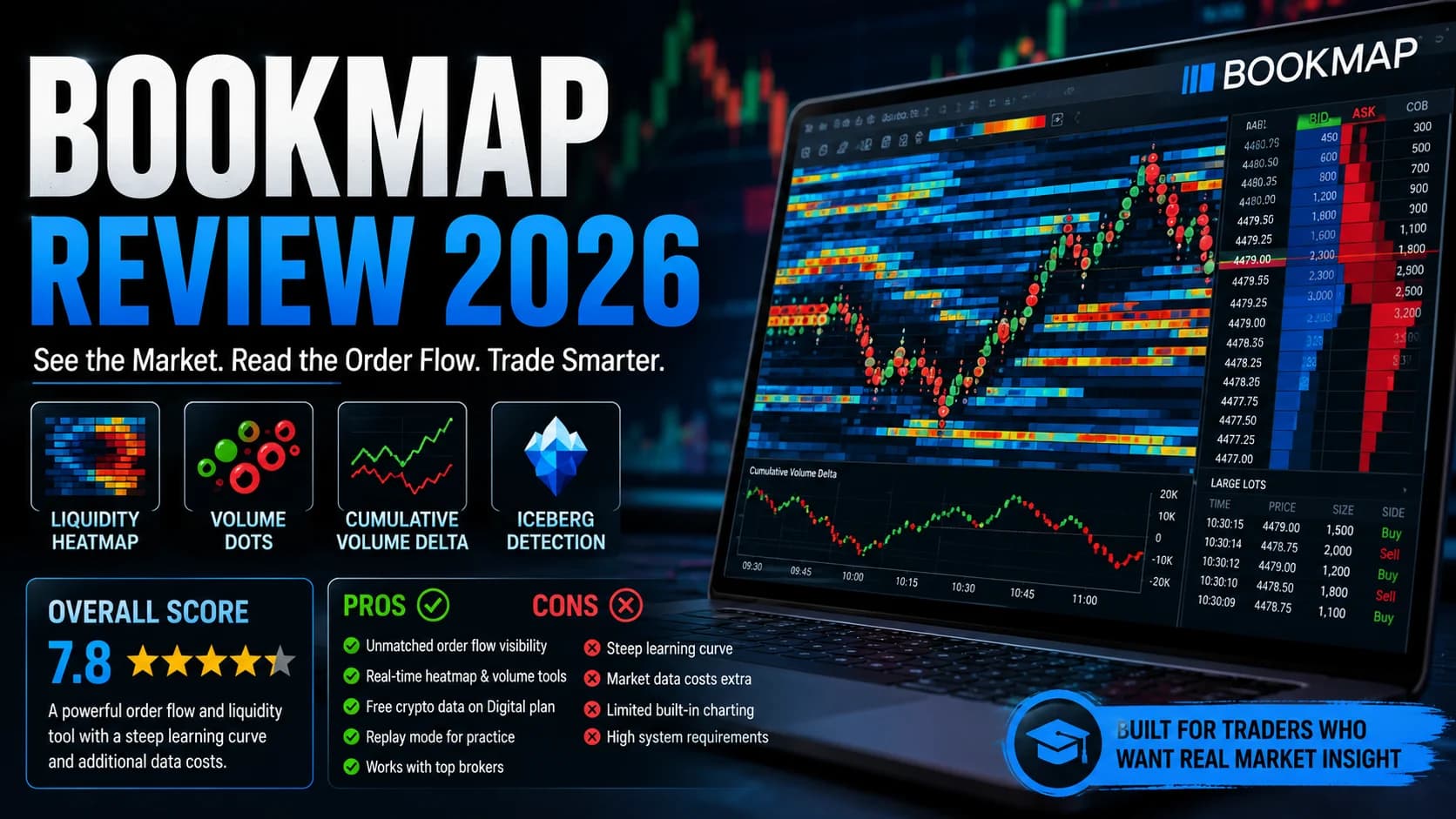
Bookmap Review 2026: Worth the Learning Curve?
An independent, research-based look at Bookmap's order flow heatmap, pricing tiers, and learning curve — and who it's actually built for.
Reviews
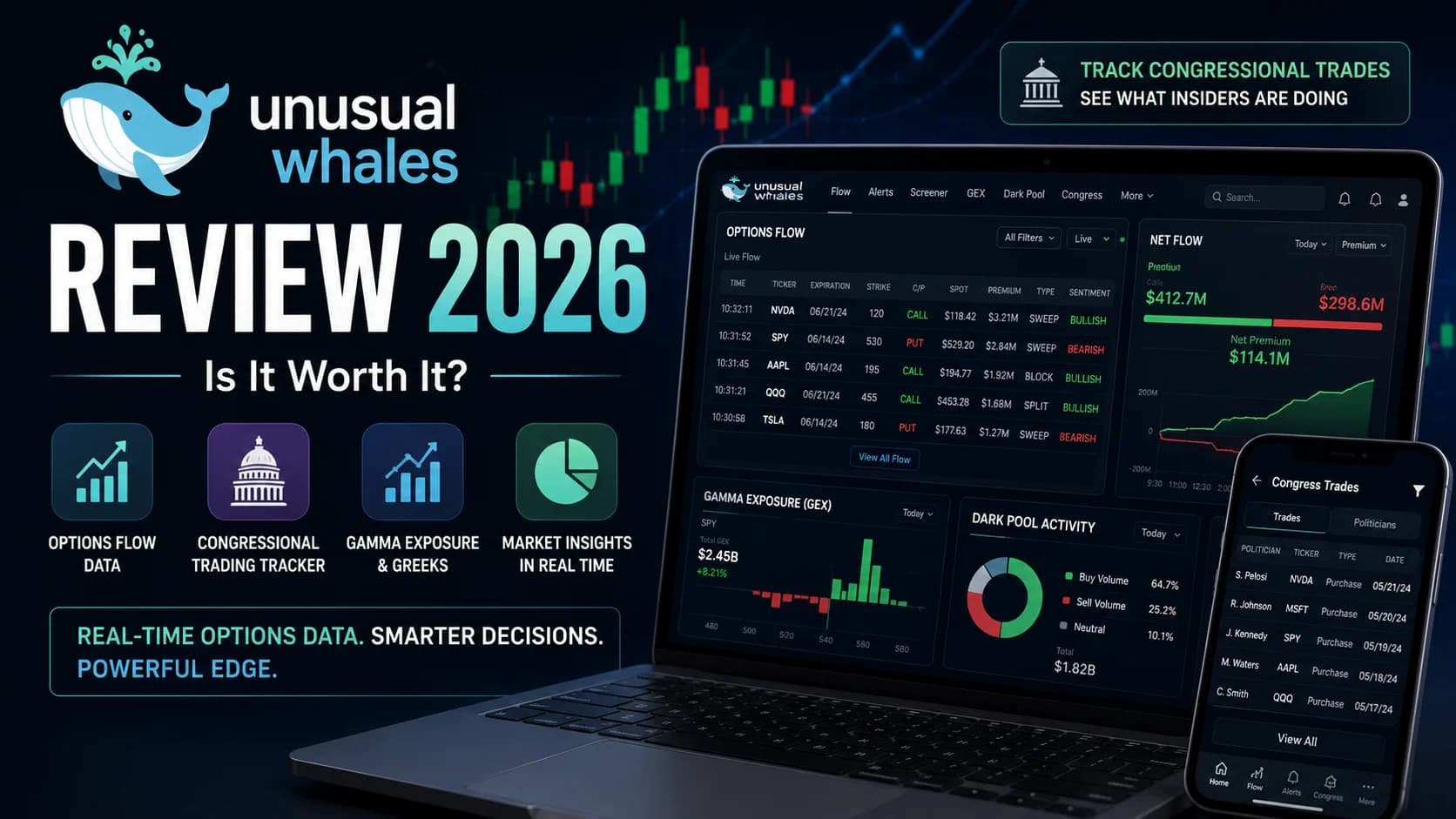
Unusual Whales Review 2026: Is It Worth It?
An independent research review of Unusual Whales: options flow data, the congressional trading tracker, pricing tiers, and whether the platform earns its cost for active options traders.
Comments
No comments yet. Be the first to share your thoughts.