
You close out the month up or down, and if someone asked exactly which setup made the money and which one bled it, could you answer with real numbers — or just a feeling? That GapA gap is a price discontinuity on a chart where a stock opens significantly higher or lower than the previous session's close, leaving a visible empty space — gap-ups are driven by overnight buying pressure or positive news; gap-downs by seRead definition → between a P&L figure and actually knowing why it happened is what a trading journal exists to close, and it's a large part of why traders who skip journaling tend to stay stuck at the same skill level for years.
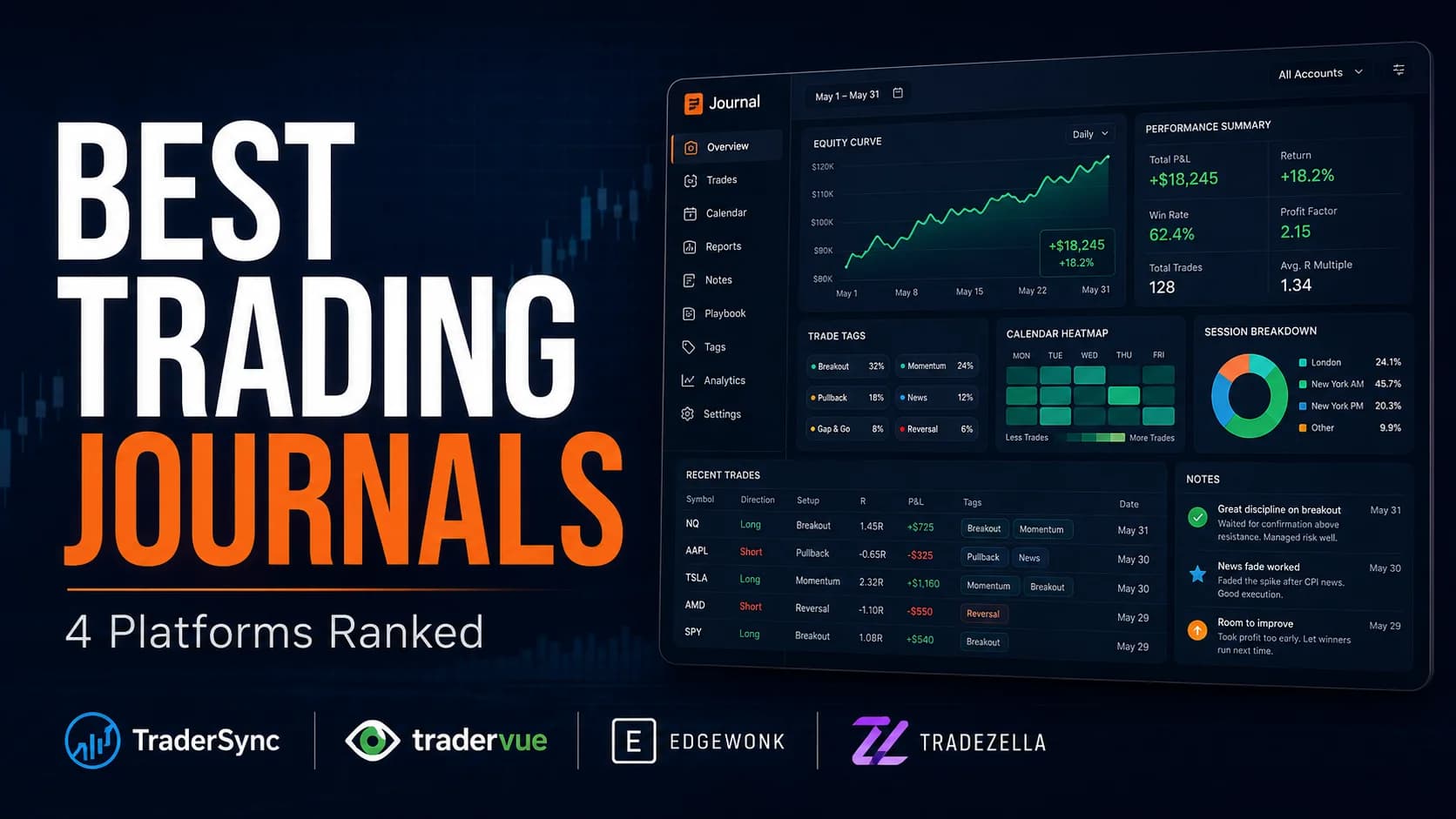
This guide ranks four of the best trading journal options for 2026 — TraderSync, Tradervue, Edgewonk, and TradeZella — based on analytics depth, broker compatibility, AI features, and price. Where a platform earns its reputation, that gets said plainly. Where it's the wrong fit for a specific kind of trader, that gets said just as plainly.
What is a trading journal? A trading journal is a tool that logs your trades — automatically from your broker or manually — and turns that history into reports on Win RateWin rate is the percentage of your trades that result in a profit — calculated as (number of winning trades ÷ total trades) × 100 — and while commonly cited as a measure of trading success, it means very little without also knowing the averRead definition →, risk-reward, and which setups actually make you money. The best trading journals go further, tagging emotional state, testing alternative strategies against your real trades, or replaying exactly how a trade unfolded.
For the fuller case on why this habit matters before you compare specific tools, see our guide on why the trading journal is your most powerful improvement tool.
The short version: TraderSync is the best trading journal for day traders overall if you want the widest broker SupportSupport is a price level where buying pressure has historically overcome selling pressure, causing price to stop declining and reverse — it's the floor where demand enters the market, and when it holds, it's a potential long entry; when it Read definition → and AI-driven coaching — try TraderSync free for 7 days. Tradervue is the best free trading journal if you trade stocks or ETFs at moderate VolumeVolume is the total number of shares (or contracts) traded during a given time period — it's the primary confirmation tool for all price action, because a price move accompanied by high volume indicates genuine market participation, while tRead definition → and don't want to pay anything — read the full Tradervue review. Edgewonk is the pick if psychology and behavioral tracking matter more to you than trade replay, at a flat $197/year — read the full Edgewonk review. TradeZella is the strongest option for prop firm traders and anyone who wants tick-by-tick trade replay — read the full TradeZella review. Keep reading for the full breakdown.
Here's how all four stack up at a glance:
- Journal
- TraderSync
- Best For
- Best overall
- Starting Price
- $29.95/mo (Pro)
- AI Features
- Cypher AI coach
- Free Option
- 7-day trial, no card
- Get It
- Try Free →
- Journal
- Tradervue
- Best For
- Best free option
- Starting Price
- Free (limited)
- AI Features
- None
- Free Option
- Yes — unlimited duration
- Get It
- Read Review →
- Journal
- Edgewonk
- Best For
- Best for psychology
- Starting Price
- $197/yr flat
- AI Features
- Edge Finder (weekly)
- Free Option
- 14-day money-back
- Get It
- Read Review →
- Journal
- TradeZella
- Best For
- Best for trade replay
- Starting Price
- $29/mo (Basic)
- AI Features
- Zella AI
- Free Option
- No
- Get It
- Read Review →
| Journal | Best For | Starting Price | AI Features | Free Option | Get It |
|---|---|---|---|---|---|
| TraderSync | Best overall | $29.95/mo (Pro) | Cypher AI coach | 7-day trial, no card | Try Free → |
| Tradervue | Best free option | Free (limited) | None | Yes — unlimited duration | Read Review → |
| Edgewonk | Best for psychology | $197/yr flat | Edge Finder (weekly) | 14-day money-back | Read Review → |
| TradeZella | Best for trade replay | $29/mo (Basic) | Zella AI | No | Read Review → |
How We Ranked the Best Trading Journal Software 2026 Has to Offer
Four criteria decide where each platform lands: analytics depth (does it just show win rate, or actually surface which setups and conditions drive your results), broker compatibility (how easily your trades actually get into the platform), whether AI features add real value or just summarize what you could already see, and price relative to what a trader actually needs. None of these four is "best" for every trader — a disciplined trader who wants deep manual analytics and zero subscription cost needs something completely different from a trader who wants AI flagging patterns for them automatically.
That's the lens for everything below. Most searches for the best trading journal for day traders turn up the same four names — the comparison table above breaks down which of these plays which role.
TraderSync: Best Overall Trading Journal
TraderSync takes the top spot for the same reason it's one of the more established names in the category: no other journal on this list matches its combination of broker breadth, AI coaching, and genuine trade replay in one platform. With 700+ broker and platform integrations — the widest of any trading journal — most traders can auto-sync trades without ever touching a CSV file, and multi-leg options strategies get classified automatically rather than requiring manual input.
Cypher, TraderSync's AI coach, answers natural-language questions about your own data ("what's my win rate on VWAPVWAP (Volume Weighted Average Price) is the average price a security has traded at throughout the session, weighted by volume — it's the most important intraday indicator for day traders, serving as a real-time measure of fair value and theRead definition → bounce setups in the first hour?") and proactively flags statistical patterns. Trade Replay uses real historical market data rather than a reconstructed price line, with resolution scaling by tier — 1-minute candles on Pro, 1-second on Premium, and 250 milliseconds with Level II data on Elite for scalpers who need it.
Pricing runs Pro at $29.95/month, Premium at $49.95/month, and Elite at $79.95/month, each with a 7-day free trial requiring no credit card. The honest limit: interactive chart visualization is U.S. equities only, and Elite's $834/year is real money for scalpers who need that tier's replay precision. The full TraderSync review covers every tier and Cypher's actual capabilities in depth.
Tradervue: Best Free Trading Journal
If you want to journal seriously without paying anything, Tradervue's free tier is the most genuine offer in the category — unlimited-duration access to core reporting for stocks and ETFs, not a time-limited trial that quietly expects a credit card.
What you give up at the free tier: options, futures, and forex support (Silver and Gold unlock those), and — across every tier, paid or not — any AI features at all. Tradervue has zero trade replay and zero automated pattern detection; the platform's entire philosophy is manual, self-directed analysis through more than 100 built-in reports, which genuinely rivals AI-summarized competitors for traders willing to do the interpretive work themselves. Its TradingView-powered charts automatically plot entries and exits on the candlestick chart, and a rare social trade-sharing and mentorship feature lets you get community feedback on specific trades — something almost no modern competitor still offers.
Silver runs $29.95/month and Gold $49.95/month if you outgrow the free tier's scope. The honest limits: a dated interface, no mobile app, and documented billing and cancellation complaints worth reading current terms against before subscribing. The full Tradervue review covers the free tier's exact limits and the Silver/Gold upgrade path.
Edgewonk: Best Trading Journal for Psychology and Behavioral Tracking
Edgewonk skips tiers entirely — one $197/year price gets you the complete platform, including the Tiltmeter, its signature feature and the deepest psychology-tracking tool in this category at any price. Instead of vaguely knowing you trade worse when tired or frustrated, the Tiltmeter connects mood, fatigue, and concentration directly to dollar outcomes from your actual trade history.
Alternative Strategy Testing runs "what-if" scenarios against your real logged trades rather than generic simulated data — a narrower but more precise tool than a full backtest for evaluating your own specific decisions. Checklist-adherence tracking correlates how closely you followed your own trade criteria with actual performance, directly answering whether your discipline is costing you money. Edge Finder, Edgewonk's AI layer added in January 2026, scans your journal weekly and emails a structured report rather than offering real-time chat.
The tradeoffs are deliberate: no trade replay at all (a stated product philosophy, not an oversight), and broker auto-sync that's less consistent than TraderSync's, pushing many users toward manual CSV import at high trade volume. A 14-day money-back guarantee functions as a genuine risk-free evaluation period. The full Edgewonk review covers the Tiltmeter and every feature in complete detail.
TradeZella: Best for Trade Replay and Prop Firm Traders
TradeZella's standout feature is Trade Replay — reconstructing the price chart exactly as it looked in real time with your actual entries and exits overlaid, tick by tick. Replay 2.0, added in December 2025, extends this to full-session review, layering an entire day's trades onto one timeline instead of reviewing them one at a time.
The Playbook system separates strategy quality from execution quality, which matters most in exactly the scenario that confuses traders: a losing month where the underlying strategy actually had a strong win rate, but execution deviated from the plan. PropFirm Sync, bundled free into every plan, tracks days-traded minimums and daily loss limits across multiple funded accounts simultaneously — a genuine, uncommon differentiator for traders running prop firm evaluations.
Pricing runs Basic at $29/month and Pro at $49/month, with Trade Replay itself gated to Pro only. The honest limits: no free trial or published refund policy, and documented broker-sync friction on certain platforms (Schwab and thinkorswim connections requiring weekly OAuth re-authentication, Interactive Brokers' Flex Query setup taking real patience). The full TradeZella review covers Zella AI and the complete pricing breakdown.
Pair Your Journal With a Scanner
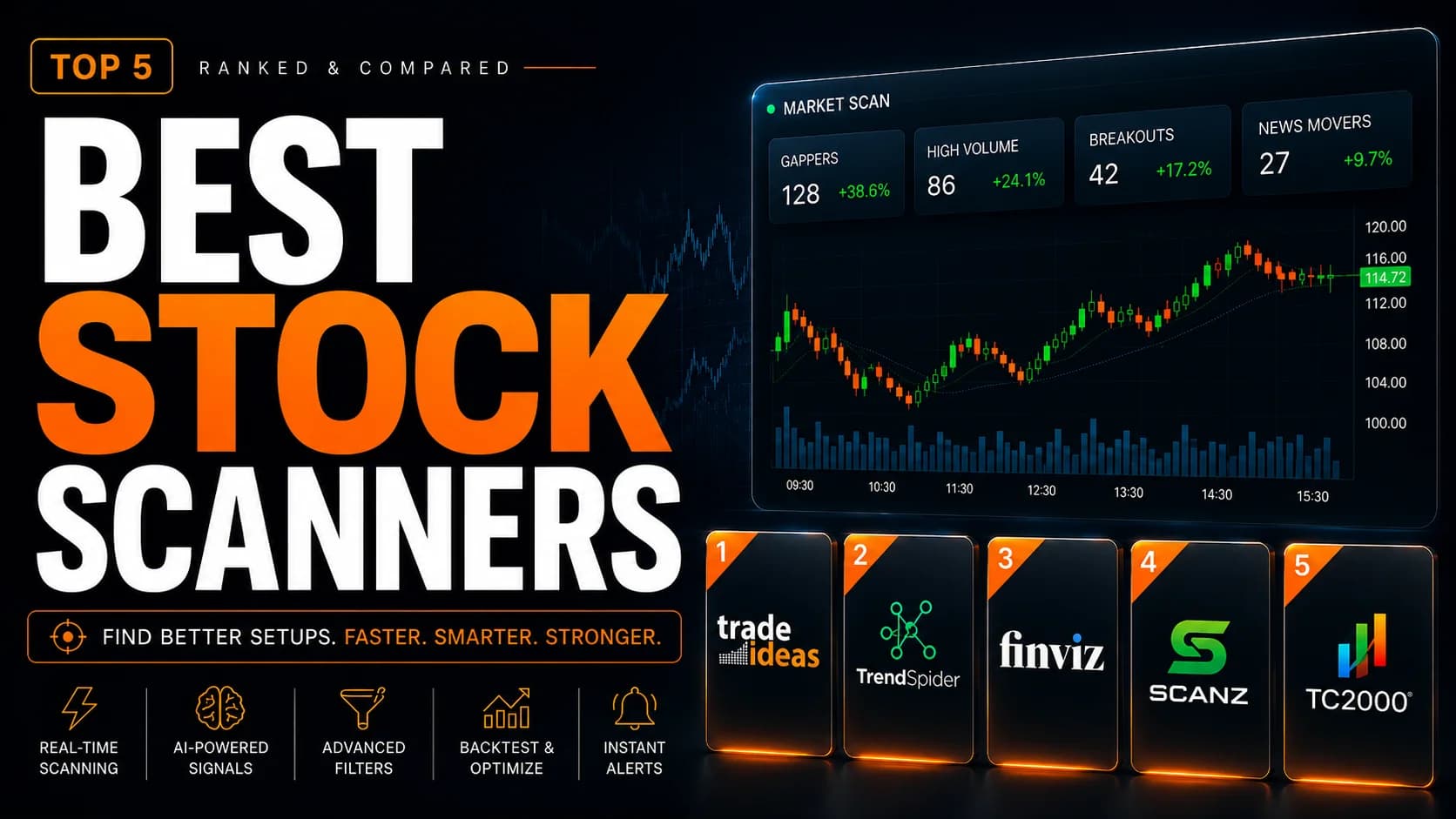
A journal tells you what already happened. It doesn't help you find the next trade — that's a completely different tool category, and pairing a journal with a real-time scanner closes the loop from finding a setup to reviewing how it actually played out. Trade Ideas is the strongest scanner pick to pair with any journal on this list, and our full stock scanner comparison covers five options if you don't have one yet.
Trading Journal Apps: Do You Need Something on Your Phone?
Among trading journal apps specifically, TraderSync is the standout — native iOS and Android apps with full feature access, not a stripped-down mobile version, which matters if your review habit includes logging notes immediately after a trade rather than waiting until you're back at a desk. TradeZella and Edgewonk are usable through a mobile browser but don't offer dedicated apps, and Tradervue's interface isn't optimized for mobile at all.
If reviewing trades on your phone between sessions is part of how you actually work, that alone is a reasonable tiebreaker toward TraderSync over a platform that otherwise scores similarly on paper.
Also Worth a Look: Three More Trading Journals
The four ranked picks above cover different needs. These three alternatives are worth a look if they fit the way you trade.
Dojiwise: For Crypto and MetaTrader Traders
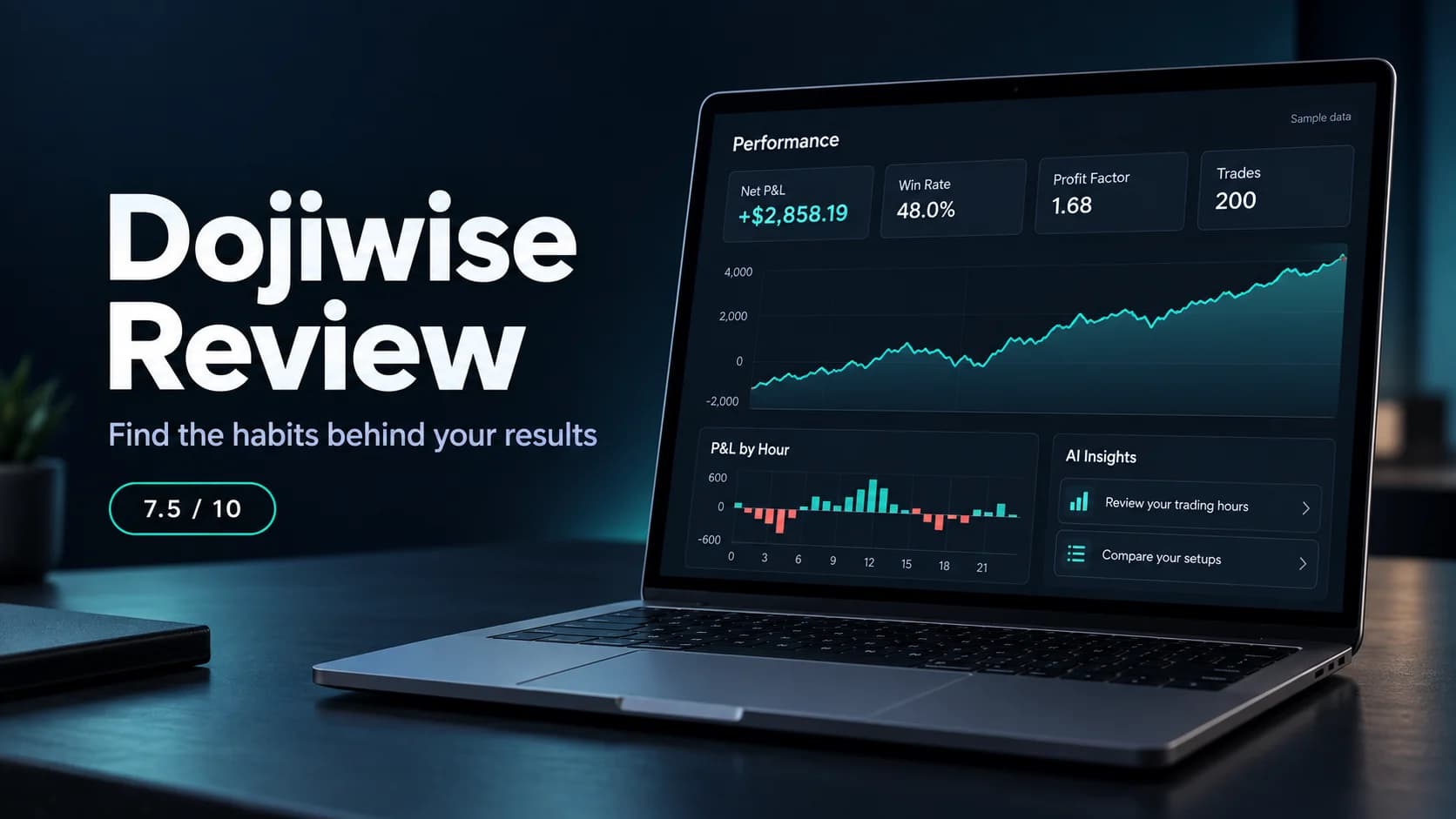
Most journals show you charts and leave the detective work to you. Dojiwise does some of it for you. Import your history from Bybit (read-only), MetaTrader 4 or 5, or a CSV, and it breaks your results down by setup, session, hour and emotion. Its AI report then points out patterns, like a losing two-hour window inside a profitable month, with the supporting numbers shown right under each observation so you can check every claim.
It's in a free public beta with every feature unlocked and no card required, which makes now a great time to try it. It isn't ranked yet only because it's still in beta. Our full Dojiwise review covers what it does well and who it fits best.
NeoTLog: For Budget-Minded Futures Traders
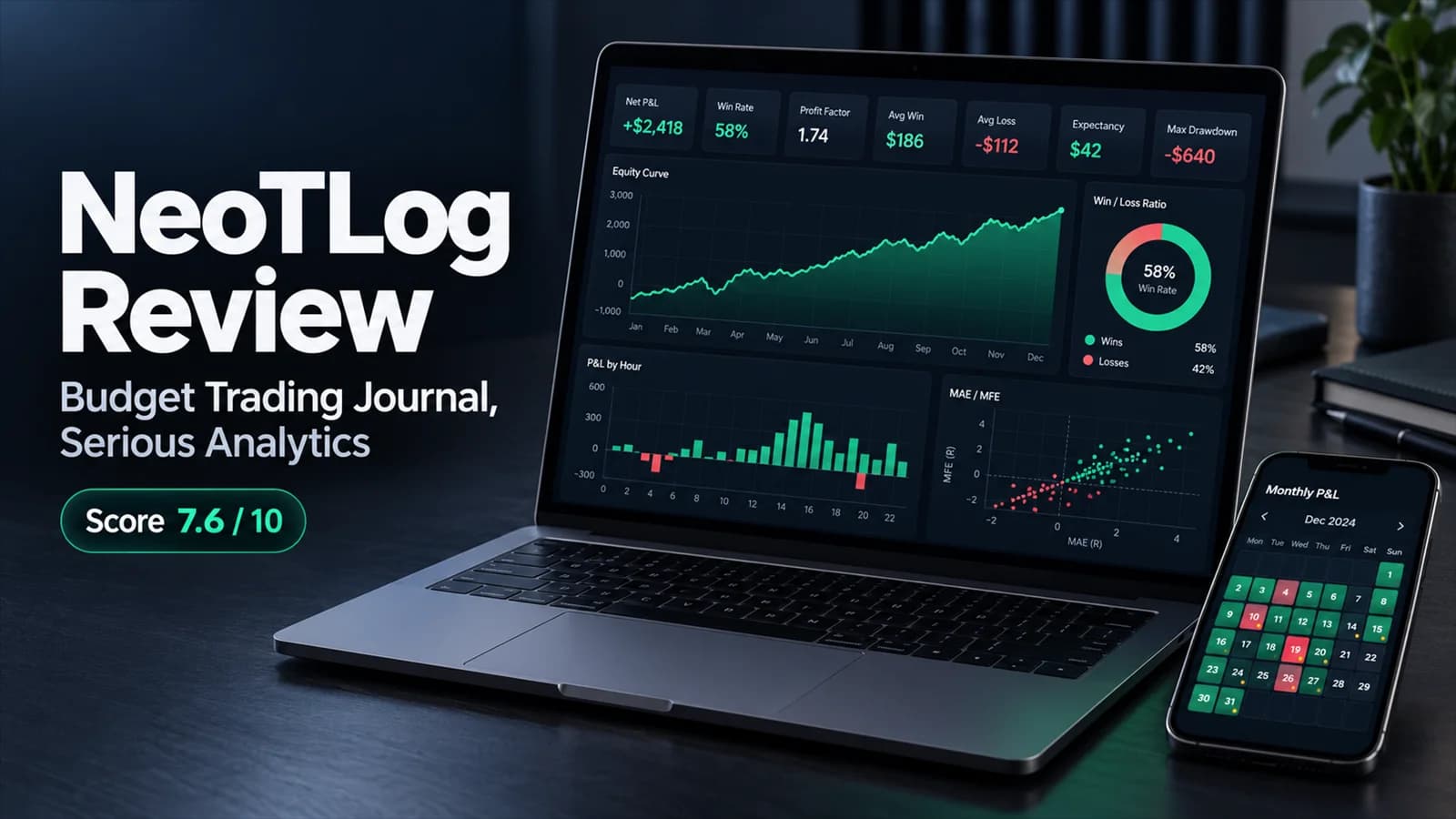
If you trade futures or juggle a few prop accounts, you shouldn't have to pay $30 a month just to see what's working. NeoTLog turns export files from Tradovate, NinjaTrader, TopstepX and 50+ other platforms into a clean dashboard, a P&L calendar with major news days marked, and a rule-tracking report that shows what following your plan is actually worth in dollars.
Its big draw is price. The Free plan is genuinely usable, and Plus costs $9 a month billed annually with unlimited accounts and MAE/MFE analysis, which shows how much heat each trade took and how much profit you left on the table. Our full NeoTLog review covers what it does well and who it fits best.
TraderPier: For Stock Traders Who Want to Replay Their Trades
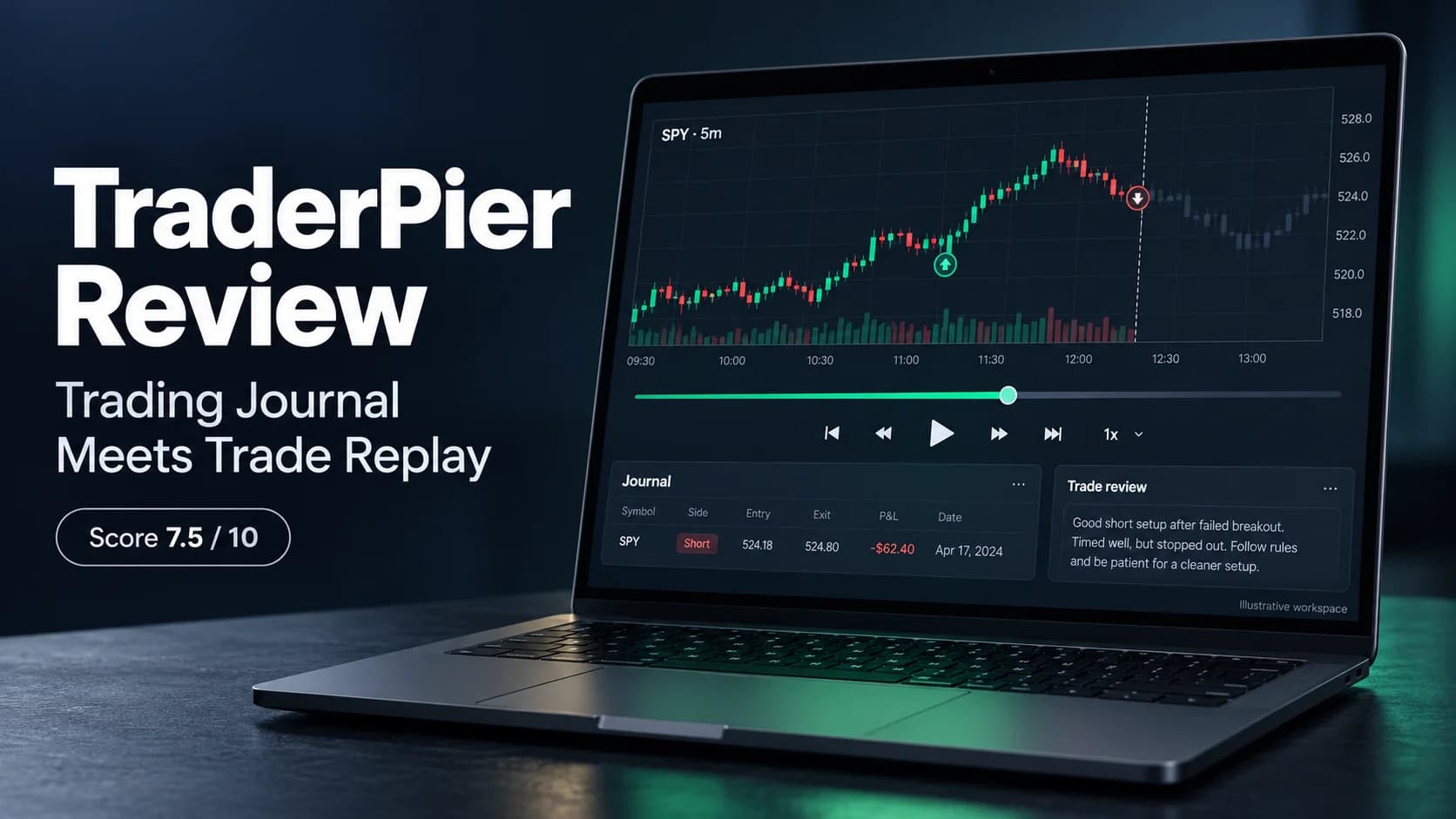
A losing trade is easy to judge once you can see the rest of the chart. TraderPier lets you open a recorded trade from your journal and replay the price action bar by bar, so you can revisit what was happening around your entry and exit. It's built for US stocks and ETFs, with broker CSV imports, notes, an equity curve and a P&L calendar.
The Free plan includes trade replay and storage for up to 10,000 trades, with no card required. Paid plans add Spyglass AI and deeper analysis. It's worth a look if you want chart context beside your trade records and are comfortable importing broker exports. Our full TraderPier review walks through the workflow, pricing and who it suits.
Which Trading Journal Should You Actually Choose
If you want the most complete platform — broad broker support, AI coaching, and genuine trade replay — TraderSync is the strongest overall pick, and the 7-day free trial makes it easy to confirm it fits your workflow before paying anything. If cost is the deciding factor and you trade stocks or ETFs at moderate volume, Tradervue's free tier is a genuinely complete answer, not a crippled trial.
If your biggest leak is behavioral rather than strategic — tilt, revenge trading, abandoning your own rules under pressure — Edgewonk's Tiltmeter is built specifically to quantify that in dollars, at the lowest flat price in this comparison. And if you're a prop firm trader managing multiple funded accounts, or you learn best by watching a trade rebuild itself tick by tick, TradeZella's PropFirm Sync and Trade Replay are hard to match.
There's no single best trading journal for every trader. There's a correct pick for how you review your trading, and the four breakdowns above should make that call obvious.
TraderSync Is the Best Overall Pick — Tradervue Is the Best Free Option
For most active day traders, TraderSync's combination of 700+ broker integrations, Cypher AI coaching, and real-data trade replay makes it the strongest all-around trading journal on this list. Tradervue remains the smartest free starting point for stock and ETF traders, and traders with a specific priority — behavioral tracking (Edgewonk) or tick-by-tick replay and prop firm tools (TradeZella) — should weigh those against their own workflow first.
Active day traders who want broker-synced trade import, AI-assisted analytics, and trade replay in a single platform.
Frequently Asked Questions
Which trading journal should I use?
The right journal depends on what's actually costing you money — a lack of broker data, a behavioral pattern you can't see, or not knowing exactly how a trade unfolded. Match the platform to that specific gap rather than the highest-rated overall option.
Key Takeaway: Identify your actual review gap first, then match the journal to it using the full comparison above.
What is the best free trading journal?
The tradeoff is scope: the free tier covers stocks and ETFs only, with a monthly trade cap, and none of Tradervue's tiers include AI features or trade replay. For a stock or ETF trader at moderate volume who doesn't need those features, it's a genuinely complete long-term solution rather than a limited trial.
Key Takeaway: Start with Tradervue free if cost is the deciding factor — upgrade to a paid platform only once a specific missing feature actually costs you.
Do day traders need a trading journal?
Even a free spreadsheet is a legitimate starting point. Dedicated tools add broker syncing, behavioral tracking, and analytics depth once manual tracking starts feeling like a chore rather than before you've built the habit.
Key Takeaway: Start journaling in any form immediately — upgrade to a dedicated platform once manual tracking becomes the bottleneck.
What is the best AI trading journal?
TradeZella's Zella AI and Edgewonk's Edge Finder both offer AI-assisted review too, but with real trade-offs: Zella AI reads more as automated summarization, and Edge Finder works on a weekly email cadence rather than real-time chat. Tradervue has no AI features at all.
Key Takeaway: For real-time, conversational AI coaching specifically, TraderSync's Cypher is the strongest option reviewed here.
What is the best trading journal for day traders specifically?
Swing traders and lower-frequency traders may find Tradervue's manual depth or Edgewonk's flat pricing a better fit, since replay speed and AI cost less relative to their trading frequency. Day traders reviewing multiple sessions a week get the most out of TraderSync's automation.
Key Takeaway: Trading frequency should drive this choice as much as feature lists — active day traders get the most from TraderSync's automation specifically.
How much does a trading journal cost?
TraderSync Pro runs $29.95/month ($312/year with annual billing). TradeZella runs $29–$49/month. Tradervue's paid tiers run $29.95–$49.95/month if you outgrow the free plan. Edgewonk is a flat $197/year with everything included.
Key Takeaway: Compare what each price actually includes — replay resolution, AI depth, broker breadth — not just the sticker price.
Can a trading journal replace a backtesting tool?
Journal-based simulators are narrower by design: they test variations on trades you already took, not a strategy across the entire market's history. For genuine strategy-level backtesting before you've traded a setup live, a dedicated charting platform is the better tool.
Key Takeaway: Use a journal to refine trades you've already made — use a dedicated backtesting platform to validate a strategy before risking capital on it.
Is it worth paying for a trading journal instead of using a spreadsheet?
A trader logging a handful of trades a month may find a free template does the job. A trader logging dozens of trades a week gets real value from automatic import, tagging, and reports that would take hours to rebuild manually every week.
Key Takeaway: Match the journal's cost to your trading frequency — the busier you are, the faster a paid tool pays for itself in saved time.