
You close out a red month, open your broker's statement, and realize you have no idea which of your setups actually lost the money. Was it the morning GapA gap is a price discontinuity on a chart where a stock opens significantly higher or lower than the previous session's close, leaving a visible empty space — gap-ups are driven by overnight buying pressure or positive news; gap-downs by seRead definition → plays? The afternoon reversals? A specific emotional state that kept showing up right before the bad trades? A spreadsheet can tell you the number. It can't tell you the pattern. That's the gap trading journals exist to close, and TradeZella has spent the last few years becoming one of the more talked-about tools trying to close it.
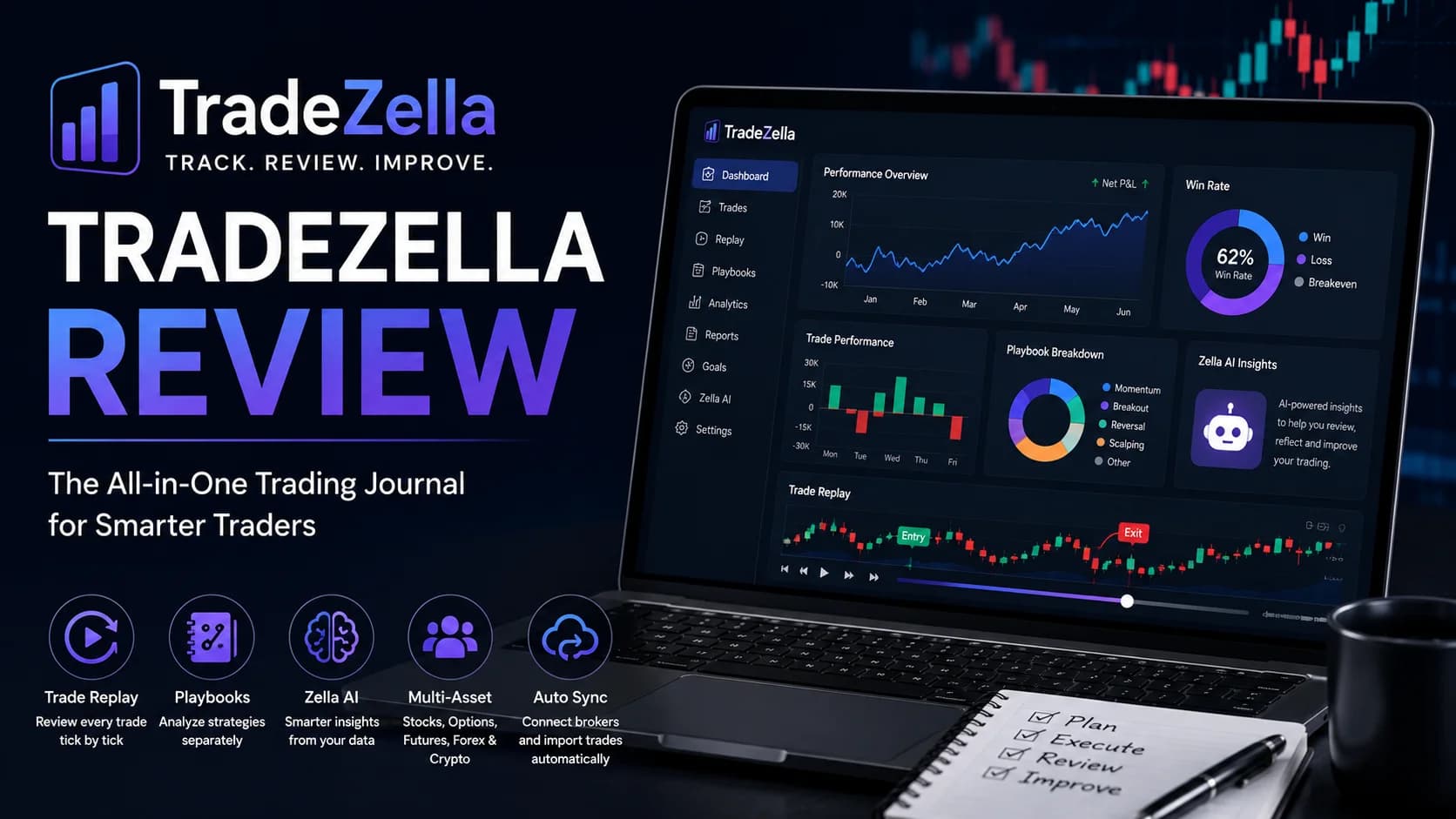
What is TradeZella? TradeZella is a subscription-based trading journal and analytics platform that automatically imports trades from supported brokers and turns them into performance reports, playbook-based strategy breakdowns, and a tick-by-tick trade replay feature. It's built for stock, options, futures, forex, and crypto traders who want to understand why they're winning or losing, not just that they are.
This review evaluates TradeZella against the criteria active traders actually care about — how deep the analytics go, how reliable the broker sync is, what the replay feature really shows you, and whether the $29–$49 monthly price is defensible against the rest of the trading journal market. It's based on documented research into TradeZella's official feature set, pricing pages, and independently published user feedback — not a claimed personal trading history with the tool.
What's good
- Trade Replay lets you step through a trade tick-by-tick against the actual chart, and Replay 2.0 added multi-trade session replay for full-day debriefs.
- The Playbook system separates strategy quality from execution quality, so a losing month can still reveal that the underlying setup had a real edge.
- PropFirm Sync tracks days-traded minimums and daily loss limits across multiple funded accounts, and it's included at no extra cost.
- Zella AI ships with every plan, including Basic, giving even the entry tier 500 monthly AI credits for trade reviews and performance reports.
- The dashboard is genuinely clean, which matters more than it sounds like for a habit most traders quit within a month.
Trade-offs
- No free trial and no clearly published refund policy, so you're committing to a monthly charge before confirming your broker syncs cleanly.
- Broker connections aren't uniformly smooth — Schwab and thinkorswim users have reported OAuth tokens that expire roughly every week, and Interactive Brokers' Flex Query setup takes real PatiencePatience in trading is the discipline to wait for your exact setup criteria to be met before entering — resisting the urge to force trades in suboptimal conditions, sit out chop, and skip marginal setups in favor of the high-probability setRead definition → to configure correctly.
- Basic caps you at one trading account and three playbooks, which is workable for a single-strategy trader but tight for anyone testing multiple approaches at once.
- No dedicated mobile app, so journaling on the go means using a browser rather than a purpose-built app.
What Is TradeZella? A Closer Look
TradeZella is a web-based trading journal that connects to your broker, pulls in your trade history, and organizes it into a dashboard built around one central idea: your raw P&L tells you what happened, but it takes structured review to find out why. The platform supports stocks, options, futures, forex, and crypto, and it works whether trades come in through automatic broker sync or manual CSV upload.
Every trade gets logged with entry, exit, size, and — this is where TradeZella diverges from a basic spreadsheet — an emotional tag (confident, fearful, impulsive, neutral), a strategy or playbook attribution, and space for notes. Over weeks and months, that tagging turns into a searchable behavioral record. You can filter your entire trading history by mood, by setup, by time of day, or by account, and see which combinations are actually making you money.
The company has iterated steadily since launch, and the two additions that matter most for 2026 are Replay 2.0 (multi-trade session replay, released December 2025) and Zella AI, a trading assistant layer added across both plans this year that generates daily prep notes, trade reviews, and performance summaries from your own data.
Key Features
Trade Replay. This is TradeZella's signature feature, and it earns the attention it gets. Instead of just showing you the final P&L on a trade, Replay reconstructs the chart as it looked in real time and overlays your actual entries and exits on it, second by second. You can watch a trade unfold exactly as it did — including the moments where a stock ripped in your favor before you exited early, or chopped sideways right before you got stopped out. Replay 2.0 extended this to full sessions, so you can review an entire day's trades layered onto one chart instead of jumping between individual trade replays one at a time.
Strategies (formerly Playbooks). Most journals let you tag a trade with a strategy name and call it a day. TradeZella's Playbook system goes further — it treats each strategy as its own mini-system with defined rules, then reports on that strategy's standalone performance across every trade tagged to it. The practical value shows up in exactly the scenario that confuses most traders: a losing month where the strategy actually had a 60% Win RateWin rate is the percentage of your trades that result in a profit — calculated as (number of winning trades ÷ total trades) × 100 — and while commonly cited as a measure of trading success, it means very little without also knowing the averRead definition → over the last 100 signals, but execution deviated from the plan on 40% of those trades. Separating strategy quality from execution DisciplineTrading discipline is the consistent application of your predefined rules — entries, stops, targets, position sizing, maximum daily loss — regardless of what you're feeling in the moment.Read definition → is the single most useful distinction a trading journal can make, and it's the area where TradeZella's Playbooks hold up well against competitors.
Zella Score. A single 100-point number that blends consistency, win/loss ratio, and average trade quality into one quick read on how your trading is trending. It's not a substitute for the deeper reports, but as a glance-and-go metric it does its job.
Zella AI. Launched in 2026, this is TradeZella's AI assistant layer — it can generate a "Start My Day" prep note, review individual trades, summarize performance over a chosen period, and run basic sentiment analysis on your notes. Basic subscribers get 500 monthly AI credits; Pro subscribers get 1,000. The AI here reads more like automated summarization of your own data than independent behavioral pattern detection — it will tell you your win rate dropped last week, but it's less reliable at proactively flagging why (a specific emotional tag, a specific time of day) without you asking the right question first.
PropFirm Sync. A free tool bundled into every plan that tracks prop firm rules — days-traded minimums, daily loss limits, trailing DrawdownA drawdown is the peak-to-trough decline in account equity — it measures how far you've fallen from your high-water mark, either from a single losing trade or a series of losing trades.Read definition → — across multiple funded accounts simultaneously. For a trader running two or three evaluation accounts at once, this is a genuine differentiator most competing journals don't offer at all, let alone for free.
Backtesting. Available on both plans (more fully-featured on Pro), letting you test a defined strategy against historical price data before committing capital to it live.
Broker Auto-Sync. TradeZella connects to a wide range of brokers and platforms, covering stocks, options, futures, forex, and crypto. Coverage is broad, but connection reliability varies meaningfully by broker — more on that in Limitations below.
Who TradeZella Is Best For
TradeZella earns its price for a specific kind of trader, not every trader who journals occasionally.
It's a strong fit if you're an active trader taking enough trades per week that manual spreadsheet entry has become a chore, and you learn best by watching a trade unfold rather than just reading a stat line. If your post-market routine already includes some form of review — and you want that review to be faster, more visual, and easier to search — the Trade Replay and Playbook combination genuinely speeds that process up.
It's also a strong fit for prop firm traders. Managing days-traded counts and daily loss limits by hand across two or three funded accounts is tedious and error-prone; PropFirm Sync automates exactly that, and it's included rather than upsold.
It's a weaker fit if you're trading a handful of times a month, still deciding whether journaling is a habit you'll stick with, or working with a strict monthly budget. At $29–$49 a month with no free trial, TradeZella asks you to commit before you've confirmed the broker sync works cleanly with your specific setup — a real risk given the documented connection issues with certain platforms.
TradeZella Pricing
TradeZella runs two paid tiers, billed monthly or annually, with no free plan and no free trial:
- Plan
- Basic
- Monthly
- $29/mo
- Annual (effective monthly)
- ~$24/mo ($288/yr)
- Accounts
- 1
- Playbooks
- 3
- AI Credits
- 500/mo
- Plan
- Pro
- Monthly
- $49/mo
- Annual (effective monthly)
- ~$33/mo ($399/yr)
- Accounts
- Up to 20
- Playbooks
- Unlimited
- AI Credits
- 1,000/mo
| Plan | Monthly | Annual (effective monthly) | Accounts | Playbooks | AI Credits |
|---|---|---|---|---|---|
| Basic | $29/mo | ~$24/mo ($288/yr) | 1 | 3 | 500/mo |
| Pro | $49/mo | ~$33/mo ($399/yr) | Up to 20 | Unlimited | 1,000/mo |
Trade Replay, in its current form, is a Pro-only feature — if the replay function is the reason you're considering TradeZella at all, budget for the higher tier. Annual billing brings meaningful savings on both plans, but because there's no trial period, that annual commitment means locking in a full year before confirming your broker connects the way you expect. If you're comparing costs across the trading journal category more broadly, DayTradingToolkit's review of TraderSync covers a similarly priced alternative worth weighing against TradeZella's feature set.
What Works Well
TradeZella's biggest strength isn't any single feature — it's how well the pieces fit together into an actual review habit. The dashboard is clean enough that opening it after a trading session doesn't feel like a chore, which matters more than any spec sheet suggests, because most traders who start a journal quit within weeks.
Trade Replay specifically deserves its reputation. Watching a trade rebuild itself tick by tick, rather than staring at a static chart with your fill prices marked on it, changes what you notice. It's the difference between knowing you exited early and seeing exactly how much move you left on the table and at what point your hand got shaky. Replay 2.0's session view makes the daily debrief faster by putting every trade from the day on one timeline instead of clicking through them individually.
The Playbook architecture is the other standout. Most journals are backward-looking — they tell you what happened. Playbooks reframe the question: is the strategy sound, independent of how well you executed it that day? That distinction is exactly the kind of insight a serious trader needs and a beginner usually doesn't know to look for yet.
Limitations
No product is without real tradeoffs, and TradeZella has three worth taking seriously before subscribing.
The subscription model is the most obvious one. There's no free plan and no free trial, which means the only way to confirm TradeZella's broker sync works cleanly with your specific setup is to pay first. For most brokers this goes smoothly. For a documented subset — thinkorswim and Schwab connections that require OAuth re-authentication roughly every week, and Interactive Brokers connections that need careful Flex Query configuration — new subscribers have reported enough friction that it's worth checking current compatibility notes for your specific broker before committing to an annual plan.
The AI layer, while a genuine 2026 addition, is better described as automated summarization than independent behavioral coaching. Zella AI will tell you what your data shows when you ask it a direct question. It's less reliable at surfacing a pattern you didn't think to look for — a revenge-trading tendency after a loss, or a specific session where your discipline consistently slips — without you prompting it first. If proactive behavioral pattern detection is your main reason for wanting an AI-powered journal, treat this as a feature still maturing rather than a finished product.
Basic-tier limits are real limits, not just upsell framing. One trading account and three playbooks is workable if you trade one account with one or two core setups. It gets tight fast for anyone running a second brokerage account or testing several strategies in parallel — and Trade Replay itself, the platform's signature feature, isn't available on Basic at all.
How TradeZella Fits a Day Trader's Workflow
A trading journal doesn't replace the thinking that goes into a trade — it structures the thinking that happens after the trade, which is exactly where most traders skip steps. TradeZella's Playbook system pairs naturally with the broader habit of defining setups before you trade them; if you haven't built that foundation yet, DayTradingToolkit's guide to the trading journal as your most powerful improvement tool and a look at the psychology a journal actually surfaces are useful starting points regardless of which platform you end up choosing.
If you're weighing TradeZella's AI layer specifically, it's worth reading how AI-assisted journal review works in practice before assuming it will catch things a disciplined manual review wouldn't — see using AI to analyze your trading journal for a platform-agnostic breakdown. And if backtesting is part of what you want from a journal, DayTradingToolkit's strategy backtesting guide covers the process fundamentals that make any platform's backtesting tools more useful once you understand them.
TradeZella Is Worth It for Active, Replay-Driven Traders
TradeZella's Trade Replay and Playbook system are genuinely strong tools for traders who review every session and learn best by watching execution unfold in detail. The subscription-only model with no trial makes it a bigger commitment for traders who journal occasionally or are still deciding whether the habit will stick, and broker-sync friction on certain platforms is worth checking before you subscribe. Prop firm traders managing multiple funded accounts get real, no-extra-cost value from PropFirm Sync.
Active traders and prop firm traders who review every session in detail and want tick-by-tick replay alongside setup-based playbook analytics.
Frequently Asked Questions
Is TradeZella worth the monthly cost for an active day trader?
TradeZella's value scales with trading frequency. A trader logging a handful of trades a month will likely find a free or low-cost spreadsheet template does the job just as well. A trader logging dozens of trades a week, across multiple setups, gets real value from automatic import, playbook segmentation, and the ability to replay a full session in minutes instead of reconstructing it from memory.
Key Takeaway: Frequency of trading, not account size, is the better predictor of whether TradeZella's price makes sense for you.
What's the difference between TradeZella's Basic and Pro plans?
The gap between tiers isn't cosmetic. Trade Replay — the platform's most distinctive feature — is Pro-only, so traders specifically drawn to TradeZella for replay functionality need to budget for the $49/month tier (or its discounted annual equivalent) rather than Basic. Pro also doubles the monthly Zella AI credit allowance and removes the account and playbook caps entirely.
Key Takeaway: If Trade Replay is the reason you're considering TradeZella, Basic won't get you there — plan for Pro.
Does TradeZella offer a free trial or free plan?
This is a meaningful difference from some competing journals, several of which offer at least a short trial period or a permanently free tier with limited features. TradeZella's absence of a trial means the only way to confirm broker-sync compatibility with your specific setup is to subscribe first — worth factoring in given documented sync friction with certain brokers.
Key Takeaway: Verify your broker's current sync compatibility with TradeZella before committing to a monthly or annual plan, since there's no trial period to test it risk-free.
Can I try TradeZella before paying?
Because there's no published refund policy to fall back on, the responsible move before subscribing — especially to an annual plan — is checking current broker-sync notes for your specific platform (particularly Schwab, thinkorswim, or Interactive Brokers, where users have reported the most setup friction) rather than assuming a smooth connection.
Key Takeaway: Treat broker compatibility verification as a pre-subscription step, not a post-subscription discovery.
How does TradeZella's Trade Replay actually work?
Replay 2.0, released in December 2025, extended this into multi-trade session replay — instead of reviewing one trade at a time, you can layer an entire day's trades onto a single timeline for a full-session debrief. This is Pro-tier only.
Key Takeaway: Trade Replay is the clearest reason to choose TradeZella over a purely stat-based journal, but it requires the Pro subscription.
Is TradeZella good for prop firm traders?
For traders juggling two or three prop firm evaluations simultaneously, manually tracking each firm's specific rule set is tedious and a single missed rule can disqualify an otherwise profitable challenge. PropFirm Sync automates that tracking across accounts, which is a genuine, uncommon differentiator in the trading journal category.
Key Takeaway: Prop firm traders running multiple funded accounts get some of the clearest, most practical value from TradeZella of any user segment.
Does TradeZella's AI actually improve my trading?
If you ask Zella AI directly about a specific stretch of trades, it can summarize performance clearly. It's less reliable at proactively surfacing a pattern you didn't think to ask about — a tendency to revenge-trade after a loss, for instance — without prompting. Treat it as a reporting accelerant rather than a replacement for your own review discipline.
Key Takeaway: Zella AI speeds up the reporting side of journaling; the interpretive work of why a pattern exists still depends on you.
Is TradeZella better than TraderSync for day traders?
Neither tool is a clear universal winner. Traders who prioritize visual, tick-by-tick trade review tend to prefer TradeZella's Replay feature; traders who want deeper standard reporting at a similar price point may find TraderSync's approach more suited to their style. DayTradingToolkit's TraderSync review covers the comparable feature set in detail.
Key Takeaway: The decision comes down to whether tick-by-tick replay or broader analytics depth matters more to your specific review habit.
Does TradeZella work for options, futures, and forex traders, not just stock day traders?
The core journaling, Playbook, and Replay features apply across asset classes. Traders working in futures or forex through platforms like MetaTrader tend to report smoother sync than traders on certain stock brokers with more complex authentication requirements, so it's worth checking current compatibility for your specific broker and asset class combination before subscribing.
Key Takeaway: TradeZella's feature set is multi-asset by design, but broker-specific sync quality is worth verifying ahead of time regardless of which market you trade.
Is TradeZella suitable for a beginner who just started trading?
A trader in their first few months, still trading small and infrequently, will get more value from a simple manual journal that builds the habit of review before paying for automation. TradeZella becomes worth its price once trade volume and the resulting manual workload actually justify it.
Key Takeaway: Build the journaling habit first; add TradeZella once trade frequency makes manual tracking genuinely burdensome.