Bookmap Review 2026: Worth the Learning Curve?

In this article8 sections
A stock stalls three cents below a level that should have given way an hour ago. Nothing on the candlestick chart explains why. The volume bar looks normal. The price just... stops. That's the exact moment Bookmap was built for — the moment where a standard chart runs out of answers and the order book still has them.
This review takes an independent, research-based look at Bookmap: what the platform actually shows you, what it costs once market data fees are added in, who genuinely benefits from the heatmap, and where the learning curve becomes a real obstacle rather than a minor inconvenience.
Disclosure: This review references DayTradingToolkit's affiliate relationship with TradingView, which is mentioned later as a complementary charting tool. Bookmap is not currently a DayTradingToolkit affiliate partner — nothing in this review is influenced by commission, because there isn't one to earn from Bookmap directly.
Bookmap Review
A genuinely unique window into order flow and liquidity, held back from a higher score by a real learning curve and data costs that aren't obvious on the pricing page.
Pros
Strengths- The liquidity heatmap shows resting orders directly on the price ladder, instead of forcing you to guess support and resistance from price action alone
- Volume dots and Cumulative Volume Delta make it easy to see whether aggressive buyers or aggressive sellers are actually driving a move
- The free Digital tier includes live crypto order flow data, so you can learn the heatmap before spending a dollar
- Replay mode lets you rehearse reading liquidity on historical sessions instead of burning live data subscriptions on practice
- Connects to brokers day traders already use, including TradeStation, Interactive Brokers, and the Rithmic network
Cons
Trade-offs- The learning curve is steep — this is not a tool that clicks in an afternoon, even for traders who are otherwise experienced
- Real-time futures and stock data isn't included in the subscription price; BookmapData, dxFeed, or Rithmic fees stack on top of whatever plan you pick
- Built-in charting and traditional indicators are thin — most traders end up running Bookmap next to a separate charting platform, not instead of one
- The heatmap's refresh rate is demanding on older hardware, and a sluggish setup undercuts the entire point of the tool
What Is Bookmap?
What is Bookmap? Bookmap is a market visualization platform that displays a real-time liquidity heatmap of the limit order book, alongside volume and order flow tools like Cumulative Volume Delta, large lot tracking, and iceberg detection. It covers stocks, futures, and crypto, and was built specifically to make institutional order flow visible to retail traders. ---
The company behind it has been around since 2014, and the product has stayed narrowly focused the entire time: show traders what's actually sitting in the order book, in something close to real time, instead of asking them to infer it from candle wicks. That focus is both Bookmap's biggest strength and the reason it isn't for everyone — more on that shortly.
Key Features
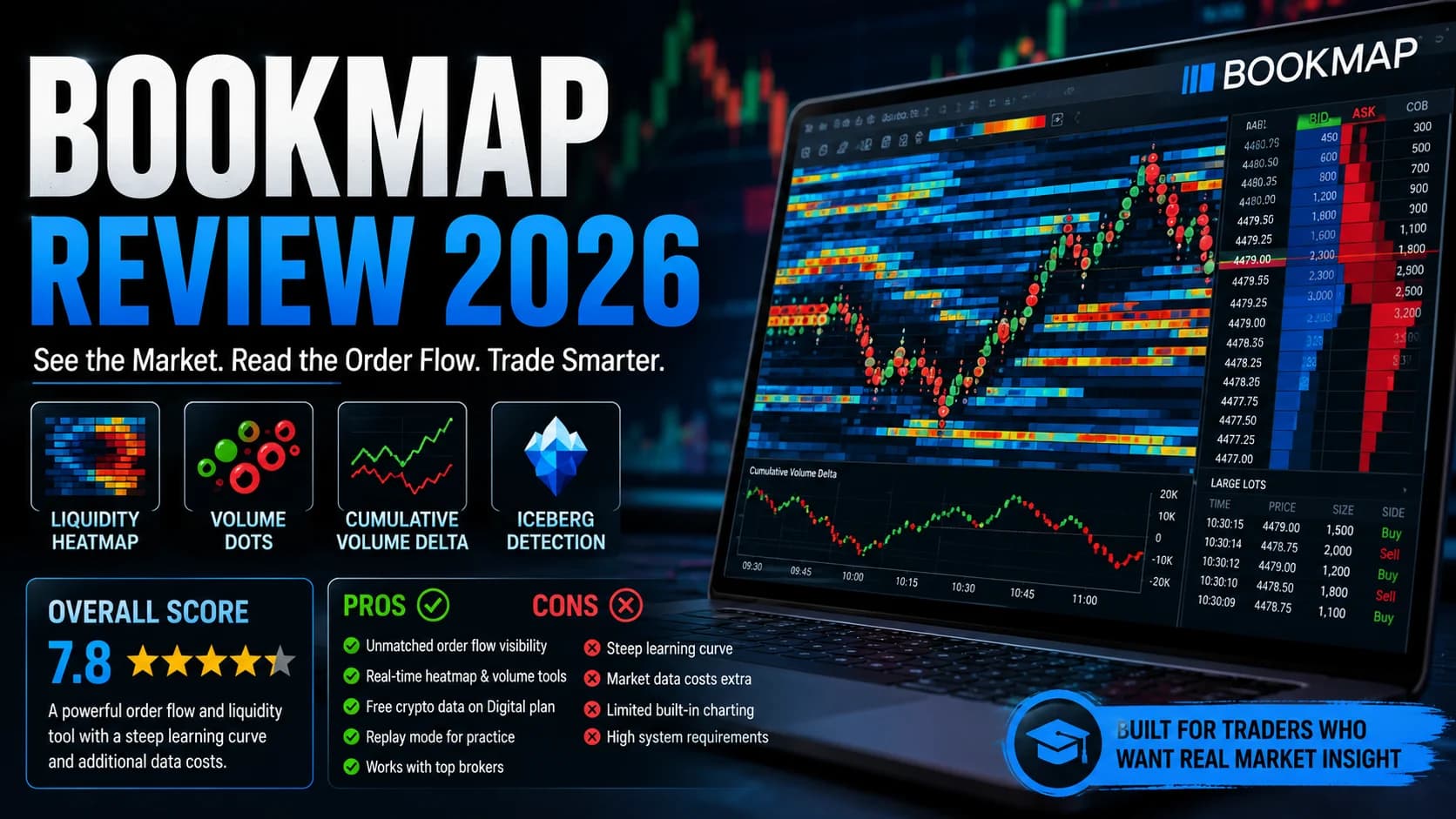
The Heatmap. This is Bookmap's signature feature and the reason most traders go looking for it in the first place. Every resting limit order in the book gets plotted directly on the price ladder, color-coded by size — in the default heatmap, brighter or redder colors indicate more displayed liquidity, while darker or bluer colors indicate less. Watch what happens when price approaches a thick band of color: does it absorb the incoming flow and hold, or does the liquidity pull away the moment price gets close? That single behavior — hold versus pull — is the entire premise of order flow trading, and it's something a candlestick chart simply cannot show you.
Volume Dots and Bubbles. Layered on top of the heatmap are colored dots marking executed trades — green for buy-side aggression at the ask, red for sell-side aggression at the bid. The size of each dot scales with trade size, so a wall of large green dots slamming into a resistance level tells a very different story than a handful of small ones. This is where Bookmap earns the "x-ray" comparison that shows up constantly in trader forums: it's not a new indicator layered on price, it's a different way of seeing the same transaction data.
Cumulative Volume Delta (CVD). CVD tracks the running difference between aggressive buying and aggressive selling over a session. Rising price on a falling CVD — buyers pushing price up while sellers are actually winning the net volume battle — is one of the more reliable divergence signals order flow traders watch for, and it's nearly invisible without a tool built to track it tick by tick.
Large Lot Tracker and Iceberg Detection. Institutional traders routinely break large orders into smaller pieces to avoid moving the market — an iceberg order. Bookmap's detection tools flag repeated fills at the same price level that suggest a hidden order is being worked, giving retail traders a rare glimpse of size that's deliberately being hidden from the tape.
Replay Mode. Live market data costs money from the moment you subscribe. Replay mode sidesteps that by letting you load historical sessions and practice reading the heatmap at your own pace — pausing, rewinding, and re-running the exact moment a level broke or held. For a tool with a learning curve this real, replay is arguably as valuable as the live feed itself.
Multi-Asset Coverage. Bookmap covers crypto for free through its Digital tier, with stocks and futures unlocked on paid plans. Connectivity runs through BookmapData (Bookmap's own data service), dxFeed, and Rithmic, and the platform pairs with brokers including TradeStation, Interactive Brokers, and the wider Rithmic-connected broker network for order routing.
What Bookmap doesn't do is worth stating plainly: it isn't a scanning platform, and it isn't built for finding stocks to trade. Level 2 quotes and time & sales are foundational concepts worth understanding before Bookmap makes much sense, and traders who haven't yet built that base should start there first.
Who Bookmap Is Best For
Bookmap is built for traders who already have a watchlist and a thesis, and want a sharper lens on execution — not traders looking for their first tool to find ideas.
Bookmap is the right fit if you:
- Trade futures intraday — particularly /ES and /NQ — and want to see liquidity directly instead of inferring it from price alone
- Scalp short timeframes where the difference between an absorbed level and a level about to break genuinely changes the trade
- Already understand order flow concepts like the bid-ask spread, aggressive versus passive orders, and basic tape reading, and want a visual upgrade rather than an introduction
- Trade for a prop firm and need to refine entries and stop placement around real liquidity, not just chart patterns
Bookmap is probably not the right fit if you:
- Are in your first year of trading and still building a foundation in Level 2 and tape reading basics — the heatmap will be noise before it's signal
- Mostly swing trade or invest on daily and weekly timeframes, where order book microstructure has little bearing on your holding period
- Need a single all-in-one platform for charting, scanning, and execution — Bookmap does one thing extremely well and several other things not at all
Traders working an ES and NQ futures strategy built around key levels are a particularly natural fit, since the heatmap shows in real time whether those levels are actually being defended by resting size.
Bookmap Pricing
Bookmap runs on four tiers, and the headline prices only tell part of the story.
Digital is free and includes live crypto data with the core heatmap and order flow tools — genuinely usable, not a stripped-down teaser, though it's limited to one symbol and crypto markets only. Digital Plus runs $19 per month and extends access to delayed stock and futures data alongside the crypto feed. Global, priced at $49 per month (or $39 with annual billing), is where things get serious — it adds real-time futures and stock connectivity, supports up to ten symbols, and unlocks replay mode. Global+ tops the lineup at $99 per month ($79 annual), adding cross-asset trading, the full large lot and iceberg detection suite, and access to live educational sessions.
Here's the part that catches new users off guard: none of those prices include actual market data. Real-time futures and stock feeds are sold separately through BookmapData, dxFeed, or Rithmic, and those fees vary by exchange — a single futures exchange connection through BookmapData runs in the $30-and-up monthly range, with full multi-exchange bundles costing meaningfully more. A trader budgeting $49 for Global and stopping there is going to be surprised by the actual monthly total once data is added in. Lifetime licenses are also available on the Global and Global+ tiers for traders who'd rather pay once than monthly.
What Works Well
The single best thing Bookmap does is make liquidity legible. Most traders spend years developing a rough intuition for where support and resistance "feel" strong based on how price has reacted historically. Bookmap replaces that intuition with something closer to direct observation — you can watch, in real time, whether a level is backed by genuine resting size or whether it's about to give way the moment real volume arrives.
The replay function deserves specific credit here, because it solves a problem most trading software ignores entirely: how do you practice reading a live, time-sensitive data stream without paying for live data while you're still learning? Loading a volatile historical session and rewinding through it repeatedly is a legitimately useful way to build the pattern recognition the heatmap demands.
Broker connectivity is also a genuine strength relative to niche order flow tools. Plenty of specialized platforms in this category require an unusual or expensive data stack to function. Bookmap's compatibility with TradeStation, Interactive Brokers, and the broader Rithmic network means most active futures and stock traders won't need to rebuild their entire execution setup just to add it.
Limitations
The learning curve is real, and it's worth being honest about rather than soft-pedaling it. Order flow reading is a skill that takes months of focused screen time to develop, not a feature you toggle on. Traders coming from a pure price-action or indicator-based background should expect a genuine adjustment period — Bookmap's free tier and replay mode exist specifically to shorten that runway, but they don't eliminate it.
The separation between subscription cost and data cost is a fair criticism of the platform's pricing transparency. A trader comparing Bookmap's $49 Global tier against a competitor's all-in price isn't making an apples-to-apples comparison unless they price in the data feed too. This isn't unique to Bookmap — most professional-grade order flow software unbundles data for good technical reasons — but it does mean the real monthly cost runs noticeably higher than the plan price suggests.
Bookmap also isn't trying to be a charting platform, and traders expecting a full technical analysis suite — moving average ribbons, drawing tools, a deep indicator library — will find it thin in that department by design. TradingView's review covers what a dedicated charting platform brings to the table; pairing the two is a more realistic setup for most traders than expecting Bookmap to replace a charting platform outright.
How Bookmap Fits a Day Trader's Workflow
Bookmap and a traditional charting platform solve different problems, and the strongest workflows tend to run both side by side rather than picking one. A charting platform handles the bigger picture — trend, structure, multi-timeframe context, the technical setup that put a symbol on the watchlist in the first place. Bookmap handles the moment of execution: is the level actually being defended right now, or is that support about to evaporate the second real size shows up?
For traders who already lean on order flow and market maker behavior to time entries, that pairing closes a real gap. A charting platform tells you where to look. Bookmap tells you what's actually happening when you get there. Traders building out a full charting and automation stack alongside an order flow tool like Bookmap may find it worth comparing against TradingView's feature set directly.
A Genuine Edge for Order Flow Traders — Not a Starter Tool
Bookmap FAQs
Is Bookmap worth it for futures day traders specifically?
Futures markets like /ES and /NQ tend to have deep, liquid order books where institutional size genuinely moves price, which is exactly the environment Bookmap's heatmap was built to visualize. A trader watching for a level to hold or break gets a direct read on resting orders instead of guessing from how price has reacted historically.
Key Takeaway: Bookmap's clearest value case is futures scalping built around a defined key-level strategy like /ES and /NQ.
What's the difference between Bookmap's Global and Global+ plans?
Global is the tier most active day traders settle on, since it covers the core heatmap, real-time connectivity, and practice tools. Global+ exists for traders who specifically want the advanced institutional-activity detection features and don't mind paying roughly double for them.
Key Takeaway: Most traders should start on Global and only move up to Global+ once they've identified a specific feature gap it solves.
Does Bookmap replace a charting platform like TradingView?
Bookmap's indicator library and drawing tools are intentionally thin compared to a dedicated charting platform. It excels at showing liquidity and execution in real time but isn't designed to handle multi-timeframe trend analysis or a deep technical indicator stack.
Key Takeaway: Pairing Bookmap with a charting platform like TradingView covers both structure and microstructure rather than asking one tool to do both.
Can I use Bookmap with Interactive Brokers or TradeStation?
This matters because it means most active futures and stock traders won't need to switch brokers or rebuild an existing execution setup just to add Bookmap to their workflow.
Key Takeaway: Broker compatibility is one of Bookmap's stronger practical selling points relative to more niche order flow tools.
Is Bookmap's free Digital plan actually usable, or just a teaser?
Stock and futures traders will find the free tier useful mainly for learning the heatmap's mechanics before committing to a paid plan, since real-time equity and futures data require an upgrade.
Key Takeaway: Use the free tier to learn the interface, then evaluate whether the Global plan's live futures and stock data justifies the upgrade for your specific market.
How much do market data fees add to the real cost of Bookmap?
Bookmap's subscription tiers don't include real-time futures or stock data — that's billed separately through BookmapData, dxFeed, or Rithmic, and pricing scales with the number of exchanges connected.
Key Takeaway: Budget for data fees as a separate line item before comparing Bookmap's sticker price against an all-in-one platform.
Is Bookmap better than Sierra Chart for order flow trading?
Both serve the order flow trading niche, but they're built around different priorities: Bookmap leads with visual clarity on liquidity, while lower-cost alternatives in this category tend to lean more heavily on traditional footprint charting and DOM execution speed.
Key Takeaway: Traders who prioritize seeing liquidity directly tend to prefer Bookmap; traders optimizing for cost and execution speed often look elsewhere.
Does Bookmap work for stock day trading, or is it futures-only?
Stock data runs through dxFeed connectivity on the Global and Global+ tiers, and the heatmap and order flow tools work the same way across asset classes, with liquidity patterns simply differing by market.
Key Takeaway: Equity day traders can use Bookmap effectively, though the deep, centralized liquidity of futures markets like /ES and /NQ tends to make the heatmap especially legible there.
How steep is Bookmap's learning curve compared to a standard charting platform?
This isn't a knock on the software's design; reading liquidity and order flow is simply a different skill than reading candlesticks and indicators, and it takes deliberate, repeated screen time to build.
Key Takeaway: Budget real practice time, ideally using replay mode, before expecting the heatmap to meaningfully change your trade execution.
Can beginners use Bookmap, or does it require trading experience first?
Without an understanding of concepts like the bid-ask spread, aggressive versus passive orders, and basic Level 2 quotes, the heatmap risks becoming visual noise rather than an edge.
Key Takeaway: New traders are better served learning order book fundamentals first, then adding Bookmap once those concepts are second nature.
Disclaimer
Was this helpful?
Be the first to weigh in

Written by
Kazi Mezanur RahmanFounder, independent researcher, and editor of DayTradingToolkit. A one-person publication focused on risk-first trading education and documented tool research. He trades his own capital as a retail trader and combines personal market experience with systematic primary-source research.
Keep Reading
Reviews
TradingView Review: Is the All-in-One Charting Platform Worth It?
An independent, research-based review of TradingView — charting depth, Pine Script, the screener, broker integration, current pricing across all five tiers, and who gets the most value from each.
Reviews
Warrior Trading Review: The Track Record and the FTC Case
Ross Cameron's audited trading results and comprehensive curriculum are genuine strengths — but the steep price and 2022 FTC settlement are real factors to weigh. Here's who Warrior Trading actually fits.
Reviews
Unusual Whales Review 2026: Is It Worth It?
An independent research review of Unusual Whales: options flow data, the congressional trading tracker, pricing tiers, and whether the platform earns its cost for active options traders.
Reviews
Koyfin Review: Bloomberg-Grade Data at a Retail Price
Koyfin brings genuinely institutional-grade macro and fundamental data — yield curves, Capital IQ financials — at a fraction of Bloomberg's cost. But charting is basic, there's no mobile app, and none of it applies to day trading. Here's the honest breakdown.
Comments
No comments yet. Be the first to share your thoughts.