
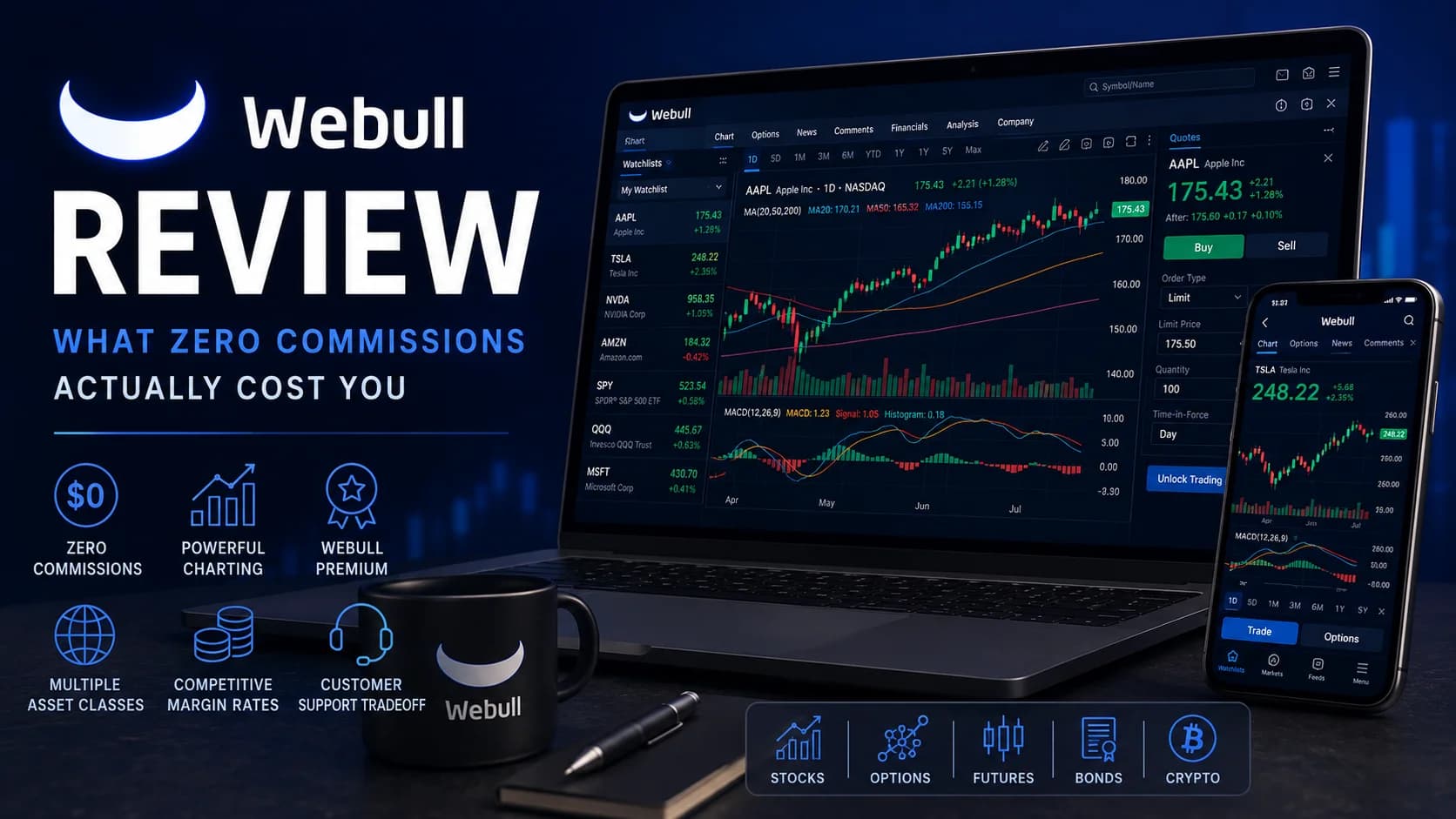
Webull built its reputation the same way most commission-free brokers did — by making the actual cost of trading close to zero and betting the rest of the experience would be good enough to keep you there. For a mobile-first, self-directed day trader, that bet mostly pays off: the charting is genuinely strong for a broker app, and the MarginMargin is borrowed capital from your broker that lets you control a larger position than your cash balance would otherwise allow — a $25,000 account with 4:1 intraday margin can control up to $100,000 in positions, amplifying both profits aRead definition → rates are competitive. Independent reviews consistently note one recurring weak spot, though — customer SupportSupport is a price level where buying pressure has historically overcome selling pressure, causing price to stop declining and reverse — it's the floor where demand enters the market, and when it holds, it's a potential long entry; when it Read definition → that doesn't match the polish of the trading interface.
What is Webull? Webull is a commission-free brokerage founded in 2016, offering stock, ETF, options, futures, fractional share, bond, and cryptocurrency trading through desktop, web, and mobile platforms. It's built around a self-directed, mobile-first trading experience, with an optional Webull Premium subscription unlocking Level 2 DataLevel 2 data shows the full order book — all the bids and asks queued at multiple price levels beyond the inside bid and ask — giving traders visibility into where supply and demand are stacking up before price gets there.Read definition →, better margin rates, and other active-trader perks.
This review evaluates Webull against the criteria that matter most for a day trading broker — commission structure, charting and platform tools, market access, and customer support quality — using Webull's official pricing pages and independently published reviews and testing data, not a claimed personal account history.
What's good
- Genuinely $0 commissions across stocks, ETFs, and options, with no account minimum and no inactivity fee.
- Charting tools punch above their weight for a mobile-first broker — 50+ technical indicators, a Replay Mode for reviewing past price action, and precision drawing tools rare at this price point.
- Webull Premium is a rare case of a broker subscription genuinely worth considering for active traders — Level 2 data, better margin rates, and IRA match benefits for a low monthly cost.
- Fractional shares, bonds, futures, options, and a modest cryptocurrency selection all sit inside one account alongside standard equities.
- Now operating under the same post-PDT intraday margin framework as the rest of the industry, removing the old $25,000 day-trading minimum for margin accounts.
Trade-offs
- Customer support is a documented weak point in independent reviews — slow response times and unhelpful resolutions show up repeatedly despite advertised 24/7 availability.
- No mutual funds outside select IRA accounts, and OTC/pink-sheet stock access is limited and fee-based, which rules Webull out as a sole broker for some investors.
- Paper trading uses live market data but doesn't let you replay or step through specific historical sessions, limiting its value as a practice tool compared to dedicated trade-replay simulators.
- Execution speed and hotkey flexibility lag dedicated day trading platforms like DAS Trader or Lightspeed, a real consideration for very active scalpers.
What Is Webull? A Closer Look
Webull launched in 2016 with a straightforward pitch: commission-free trading wrapped in a more capable charting and data experience than the earliest zero-commission apps offered. Since then, it's expanded well beyond stocks and ETFs into options, futures, fractional shares, bonds, and a modest cryptocurrency lineup, all accessible through desktop, web, and mobile platforms that stay meaningfully in sync with each other.
The platform's identity is still mobile-first, and it shows in the design choices — dense, information-rich screens that pack real trading depth into a small form factor, alerts that sync instantly between devices, and a screener built to filter fast-moving stocks by VolumeVolume is the total number of shares (or contracts) traded during a given time period — it's the primary confirmation tool for all price action, because a price move accompanied by high volume indicates genuine market participation, while tRead definition →, technical indicators, and market cap rather than just fundamentals. That density is a genuine strength for an experienced trader and a real adjustment period for a newer one; independent reviews consistently describe the interface as powerful but "noisy" for beginners used to a stripped-down app.
Webull Premium is the platform's answer to the question of how a $0-commission broker can still offer meaningfully better service to its most active users: for a low monthly or annual fee, it unlocks Level 2 market depth data, discounted index options and futures commissions, tiered margin rates that undercut the standard rate, and a higher IRA matching percentage — genuinely useful upgrades rather than a paywall on core functionality.
Key Features
Commission-Free Trading. Stocks, ETFs, and options all trade at $0 commission, with no per-contract fee on standard equity options — though standard regulatory and exchange pass-through fees (SEC fees on sells, FINRA trading activity fees, options exchange fees) still apply, as they do at every US broker. There's no account minimum and no inactivity fee.
Charting and Replay Mode. Webull's charting punches above its weight for a broker app — over 50 technical indicators, a full suite of drawing tools with a precision "magnifying glass" feature for exact TrendlineA trendline is a straight line drawn connecting two or more swing highs (in a downtrend) or swing lows (in an uptrend) that defines the slope and trajectory of a price trend — price bouncing off a trendline is a potential entry signal, whilRead definition → placement, and a genuinely useful Replay Mode that lets you watch a time-lapse of a stock's past price action. It's a meaningfully deeper charting experience than most commission-free competitors offer at the same price.
Webull Premium. For a modest monthly or annual fee, Premium unlocks real-time Level 2 market depth data, discounts on index options and futures commissions, tiered margin rates as low as the high-4% range, and an enhanced IRA match on rollover contributions. For an active trader who'd otherwise pay for Level 2 data separately, Premium often pays for itself.
Margin Rates. Webull's margin rates are genuinely competitive, generally cited in the high-4% to high-5% range depending on balance and Premium status — among the more competitive rates in the retail broker category, though still worth comparing directly against your specific balance tier before assuming the lowest advertised rate applies to you.
Multi-Asset Access. Beyond stocks and options, Webull offers fractional shares, bonds (including fractional bonds from as little as $100), futures, and a defined list of major cryptocurrencies with a flat percentage fee per trade. Portfolio Blueprint (formerly Wefolio) lets you choose up to 30 eligible securities, set their allocations, and review the portfolio's market orders before submission — a genuinely useful feature for anyone managing a diversified watchlist as one unit.
Paper Trading. Webull's paper trading account uses live market data, which is useful for practicing current-session decision-making, but it doesn't let you rewind and step through a specific historical session the way a dedicated trade-replay tool does. It's a solid sandbox for real-time practice, not a substitute for historical scenario training.
Webull's charting and screener are genuinely capable for a broker-native toolset, but many active day traders still find they eventually want a dedicated charting platform or scanner with more depth than any broker builds in-house. TradingView, for instance, is widely used alongside a brokerage account specifically for its charting depth and social/idea-sharing features, and Finviz is a common pairing for traders who want more powerful pre-market screening than Webull's built-in filters offer. DayTradingToolkit's TradingView review and Finviz review cover both in detail if you're considering pairing either with a Webull account.
Who Webull Is Best For
Webull earns its following for a specific kind of trader, and it's worth being clear about who that is.
It's a strong fit if you're a self-directed, mobile-first trader who wants genuinely capable charting and a well-designed screener without paying commissions, and you're comfortable managing your own research rather than leaning on a broker's advisory services. It's also a strong fit for a trader who wants meaningful account depth — margin, options, futures, fractional shares — without needing IBKR-level global market access.
It's a weaker fit if you specifically need mutual funds, broad OTC/pink-sheet access, or forex trading, none of which Webull covers well. It's also worth pausing if you expect to need customer support regularly, since independent reviews consistently describe response times and resolution quality as a real weak point relative to the platform's otherwise polished experience.
Webull Pricing
Webull's core pricing is straightforward, with an optional subscription tier for active traders:
- Account Type
- Standard
- Stock/ETF/Options Commissions
- $0
- Crypto Fee
- 1% per trade
- Margin Rates
- Standard tiered rate
- Monthly Cost
- Free
- Account Type
- Webull Premium
- Stock/ETF/Options Commissions
- $0
- Crypto Fee
- 1% per trade
- Margin Rates
- Discounted tiered rate (high-4% range at top tier)
- Monthly Cost
- ~$3.99/month or ~$40/year
| Account Type | Stock/ETF/Options Commissions | Crypto Fee | Margin Rates | Monthly Cost |
|---|---|---|---|---|
| Standard | $0 | 1% per trade | Standard tiered rate | Free |
| Webull Premium | $0 | 1% per trade | Discounted tiered rate (high-4% range at top tier) | ~$3.99/month or ~$40/year |
Beyond the core commissions, expect standard regulatory pass-through fees on every US broker, a modest fee for select OTC stock access, a $75 fee to transfer securities out to another broker, and free ACH deposits and withdrawals. For most active traders, Webull Premium's Level 2 data and improved margin rate alone tend to justify its low cost.
What Works Well
The charting experience is Webull's clearest strength, and it's not a small thing for a $0-commission broker to get right. Replay Mode specifically stands out — being able to time-lapse a stock's past price action inside the same app you trade from, rather than needing a separate charting subscription, is a genuinely useful study tool that few competitors at this price point match.
Webull Premium is also worth real credit as a subscription model done reasonably well. Rather than gating core trading functionality behind a paywall, it adds real, active-trader-relevant upgrades — Level 2 data, better margin rates, IRA match — for a genuinely low monthly cost, which is a fairer structure than some competing "premium" broker tiers.
The breadth of account types under one roof — fractional shares, bonds, futures, a modest crypto lineup, and standard equities and options — means many traders can consolidate what might otherwise be several separate accounts into one Webull login.
Limitations
Two limitations are worth weighing seriously.
Customer support is the most consistently cited weakness across independent reviews, and the gap between Webull's polished trading interface and its support experience is genuinely notable. Reports of slow response times and unresolved account or transfer issues show up repeatedly in independent testing and user feedback, despite the platform advertising 24/7 support availability. This matters more for a newer trader likely to run into account questions early on, and less for a self-sufficient trader who rarely needs to contact support.
Market access has real, defined limits. No mutual funds outside select IRA accounts, limited and fee-based OTC stock access, and no forex trading mean Webull isn't a complete one-broker solution for every trader. A trader whose strategy might expand into asset classes Webull doesn't cover well should factor that into the decision now rather than discovering the gap later.
Verdict
Webull Is Worth It for Self-Directed Traders Who Want Strong Charting Without Commissions
Webull delivers genuinely strong charting tools, a fair Premium subscription model, and zero-commission trading across stocks, ETFs, and options. Customer support quality is a real, well-documented weak point, and market access has defined limits — no mutual funds, limited OTC, no forex — that matter for some traders more than others. Self-directed, mobile-first traders who manage their own research and rarely need hands-on support get the most from Webull; traders who need broader market access or reliable phone support may be better served by a different broker.
Self-directed, mobile-first day traders who want strong native charting and zero commissions, and who are comfortable managing their own research and support needs.
Frequently Asked Questions
Is Webull good for day trading?
Webull's Replay Mode, 50+ indicators, and real-time screener give active traders genuine tools built into the broker itself. Traders who need institutional-grade execution speed or hotkey customization may still find dedicated day trading platforms a better fit for pure execution speed. Key Takeaway: Webull covers charting and cost well; traders prioritizing raw execution speed above all else may want to compare it against dedicated execution platforms.
How much does Webull actually cost?
Beyond commissions, expect a 1% fee on cryptocurrency trades, a $75 fee if you transfer securities to another broker, and a modest fee for select OTC stock access. Core trading costs are genuinely low regardless of whether you subscribe to Premium. Key Takeaway: Most active traders will find Webull Premium's low annual cost easily justified by the Level 2 data and margin rate improvements alone.
What is Webull Premium, and is it worth it?
For an active trader who would otherwise pay separately for Level 2 data, Premium's cost is easy to justify. For a lower-frequency trader who doesn't use margin or need order-book depth, the standard free tier may already cover what you need. Key Takeaway: Premium's value scales with how actively you trade and whether you use margin — evaluate it against your actual trading frequency rather than subscribing by default.
Does the old $25,000 day trading rule still apply to Webull?
This is a regulatory change that applies across the entire brokerage industry, not something specific to Webull's own policy. DayTradingToolkit's complete guide to the PDT rule elimination covers exactly what changed and what the new framework requires. Key Takeaway: The $25,000 threshold no longer applies at Webull or any other US broker, though margin trading still carries real risk regardless of account minimum.
Is Webull's customer support reliable?
This matters more for a newer trader likely to have account or platform questions early on, and less for an experienced, self-sufficient trader who rarely contacts support. Factor this in specifically if fast, reliable phone support is a priority for you. Key Takeaway: Traders who anticipate needing frequent support should weigh this documented weakness carefully against Webull's other strengths.
Can I day trade cryptocurrency on Webull?
The crypto selection is smaller than a dedicated crypto exchange's offering, and features like staking or withdrawing crypto to an external wallet aren't currently available on the platform. It's a reasonable option for trading major coins alongside your stock and options activity, not a replacement for a dedicated crypto platform. Key Takeaway: Webull's crypto access is convenient for major coins within your existing account, but it's not built for traders who want a full crypto-native feature set.
Does Webull pair well with TradingView or Finviz?
Webull's own charting and screener are genuinely capable for a broker-native toolset, but dedicated platforms built specifically around charting or screening tend to go further for a trader whose strategy depends heavily on either. DayTradingToolkit's TradingView review and Finviz review cover how each pairs with a broker like Webull. Key Takeaway: Webull's native tools are a strong starting point; traders with more specific charting or screening needs commonly add a dedicated platform on top.
Is Webull good for beginners?
Free paper trading with live data helps a beginner practice before using real capital, and Webull Premium's low cost means active-trader tools are accessible early if wanted. That said, the interface's density is a real adjustment for someone used to a simpler app, and customer support limitations matter more for a newer trader likely to have basic account questions. Key Takeaway: A beginner comfortable with a data-rich interface can grow into Webull's depth quickly; one who wants maximum simplicity may prefer to start with a more stripped-down app.
Does Webull offer mutual funds or OTC stocks?
This is a genuine gap for a trader who wants full OTC market access or broad mutual fund selection inside a single account. Traders specifically needing either should confirm current availability directly with Webull before assuming full coverage. Key Takeaway: Webull isn't a complete one-broker solution for OTC-heavy or mutual-fund-focused strategies — check current coverage against your specific needs.
What is Webull's Replay Mode, and how does it help day traders?
It's a genuinely useful built-in study tool, though it's more of a visual review feature than a full historical paper-trading simulator that lets you practice executing trades tick by tick within a past session. For that kind of granular historical practice, a dedicated trade-replay simulator goes further. Key Takeaway: Replay Mode is a strong built-in review tool for studying past price action, not a substitute for a dedicated historical trade-practice simulator.