
Every trading journal on the market wants to sell you a tier. Basic, Pro, Gold, Premium — pick your feature set, pick your price, upgrade later if you outgrow it. Edgewonk does the opposite: one plan, one price, every feature included, no upsell screen waiting for you after checkout. In a category that's spent 2026 adding AI layers and subscription complexity, that simplicity is either refreshingly honest or a sign the product stopped evolving — this review looks at which one it actually is.
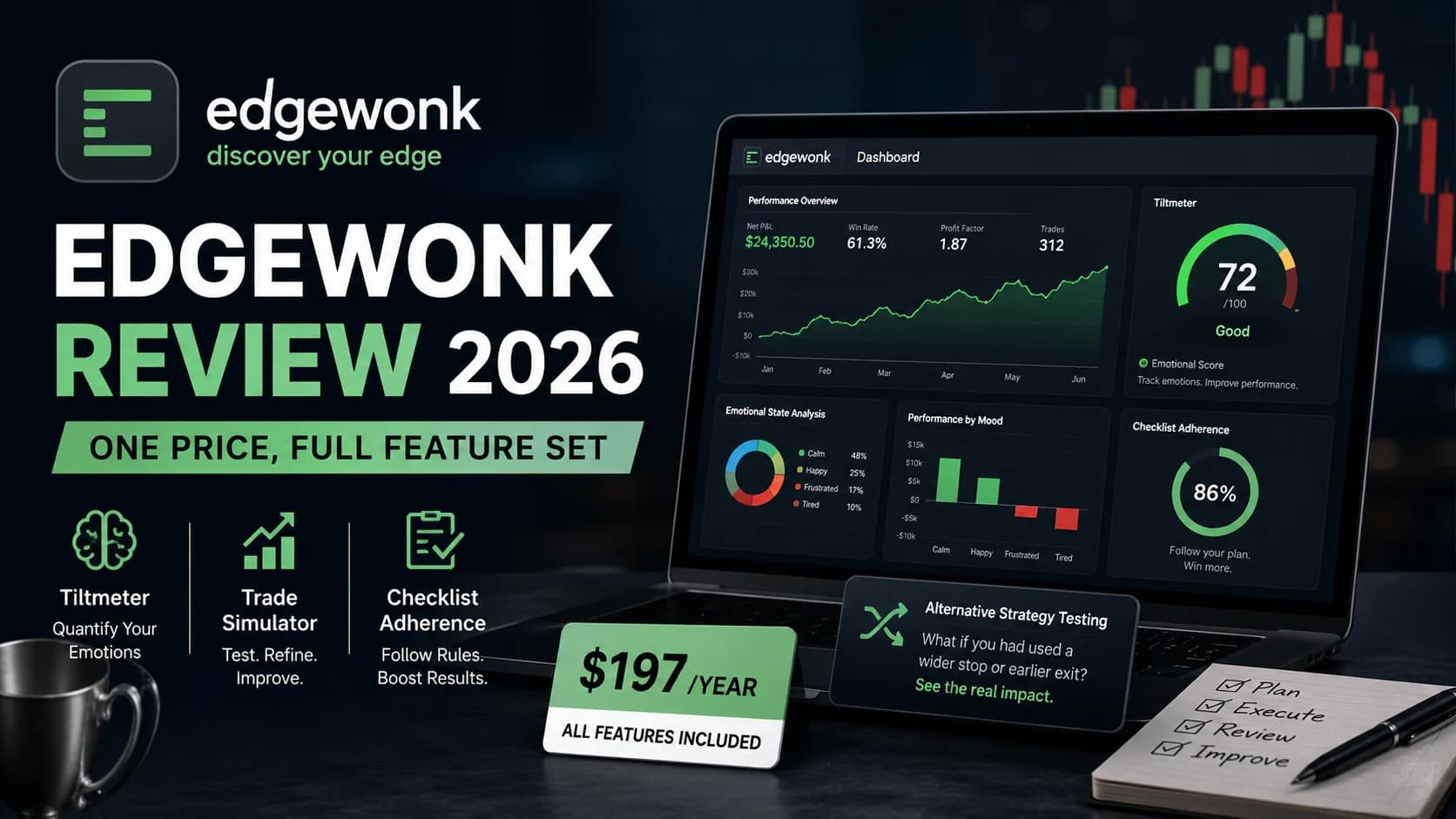
What is Edgewonk? Edgewonk is a trading journal built around behavioral and psychological analysis as much as raw performance statistics. It logs your trades — manually, via CSV, or through broker import templates — and layers on emotional tracking, checklist-adherence scoring, and a trade simulator that tests alternative strategies against your actual historical trades, all for a single annual price with no feature tiers.
This review evaluates Edgewonk against the criteria active traders actually weigh — analytical depth, broker compatibility, how its psychology tools compare to competitors, and whether $197/year holds up against journals charging considerably more for a narrower or wider feature set depending on the comparison. It's based on documented research into Edgewonk's official pricing and feature pages alongside independently published user feedback — not a claimed personal trading history with the platform.
What's good
- A single $197/year price includes every feature with no tiers, no upsells, and no feature gating — among the cheapest full-featured journals in the category.
- The Tiltmeter assigns a dollar value to emotional trading mistakes like revenge trades and OvertradingOvertrading is taking too many trades — whether from boredom, greed, frustration, or an inability to sit on your hands — leading to degraded selectivity, inflated commission costs, and decision fatigue that compounds losses well beyond whatRead definition →, a depth of psychology tracking no direct competitor matches.
- Alternative Strategy Testing runs "what-if" scenarios against your actual historical trades rather than generic simulated data, showing how a different exit or sizing rule would have changed real outcomes.
- Checklist-adherence tracking correlates rule-following with performance directly — a genuinely unique feature not offered by Tradervue, TraderSync, or Trademetria.
- A 14-day, no-questions-asked money-back guarantee gives you a real risk-free evaluation period even without a permanent free tier.
Trade-offs
- No trade replay — a deliberate product decision the company defends on principle, but a real GapA gap is a price discontinuity on a chart where a stock opens significantly higher or lower than the previous session's close, leaving a visible empty space — gap-ups are driven by overnight buying pressure or positive news; gap-downs by seRead definition → for active day traders and scalpers who use visual replay as a primary review tool.
- Broker auto-sync is limited and can be finicky in practice; many users end up relying on manual CSV import, which becomes a genuine time cost at high trade VolumeVolume is the total number of shares (or contracts) traded during a given time period — it's the primary confirmation tool for all price action, because a price move accompanied by high volume indicates genuine market participation, while tRead definition →.
- The interface is functional but dated next to newer cloud-native competitors, and the learning curve reflects its desktop-software origins.
- No native options chain or Greeks tracking, so multi-leg options strategies have to be logged manually rather than imported automatically.
What Is Edgewonk? A Closer Look
Edgewonk was built by the team behind Tradeciety, a trading education platform, with a specific thesis: most journals measure what happened, but almost none measure why it happened psychologically. That thesis shows up in nearly every corner of the product. Alongside standard trade logging — entry, exit, size, stop, target, commissions, and swap fees — every trade can carry mood ratings, sleep quality, concentration level, and notes on why you entered or exited, building toward a searchable behavioral record rather than just a P&L log.
The pricing model reinforces the same philosophy: rather than segmenting features across tiers to upsell active users, Edgewonk charges one annual price for the complete platform. Every subscriber gets the Tiltmeter, the trade simulator, the full statistics suite, and all future updates for the subscription term — no premium add-ons waiting behind a paywall.
That focus comes with a tradeoff, and it's one Edgewonk makes deliberately rather than as an oversight: no trade replay and no full strategy-level BacktestingThe process of running a defined trading strategy against historical price data to evaluate how it would have performed before risking real capital. A well-constructed backtest gives you a statistical baseline — win rate, profit factor, maxRead definition → engine. The company's own position is that generic trade replay doesn't add meaningful analytical value compared to structured, data-driven review — a defensible stance for swing and forex traders, and a real limitation for scalpers who rely on visual replay specifically.
Key Features
The Tiltmeter. Edgewonk's signature feature tracks emotional state across your trading history — mood, fatigue, concentration, and rule adherence — and connects those inputs to actual dollar outcomes. Instead of vaguely knowing you "trade worse when tired," the Tiltmeter can show you the specific dollar cost of trades taken in a documented TiltTilt is a trading state of emotional dysregulation — usually triggered by a string of losses, a missed trade, or a violation of your plan — where you begin making impulsive decisions driven by frustration or desperation rather than your defRead definition → state versus a calm one. No direct competitor in this price bracket offers psychology tracking with this level of quantified specificity.
Alternative Strategy Testing (Trade Simulator). Rather than a conventional backtest running a strategy against abstract historical price data, Edgewonk's simulator starts from your actual logged trades and models what would have happened under different rules — a wider stop, an earlier exit, a different position size. Because the underlying entries are real, the output is a hypothetical estimate based on your logged trades and the changed rule, not a record of what actually happened. It's a narrower tool than a full backtesting engine, but a more precise one for evaluating your own execution specifically.
Checklist Adherence Tracking. Edgewonk reports on how closely you followed your own predefined trade criteria on a setup-by-setup basis, then correlates that adherence directly with performance. Trades taken with full checklist compliance get measured against trades where criteria were skipped — a direct, quantified answer to whether your discipline (or lack of it) is actually costing you money.
MAE/MFE and Best Exit Analysis. Every trade gets maximum adverse excursion and maximum favorable excursion tracking — how far the trade moved against you before recovering, and how far it moved in your favor before you exited. Best Exit Analysis takes this further, showing what percentage of the total available move you actually captured on each trade, which is the same category of insight TradeZella and Tradervue Gold charge extra for.
Edge Finder (AI). Added in January 2026, Edge Finder is Edgewonk's AI layer — but it works on a scheduled cadence rather than on-demand chat. It scans your full journal weekly and emails a structured report of patterns it finds. That's a meaningfully different workflow than real-time AI chat interfaces on competing platforms, and it suits traders who want a defined weekly review ritual more than instant answers to specific questions.
Broad Statistics Suite. Edgewonk ships with 50+ pre-built statistics and roughly 20 custom stat slots you can configure yourself, across 17 different chart and graph types. Between the built-in reports and the custom slots, most traders will find the exact cut of their data they're looking for without needing a separate spreadsheet.
Multi-Asset Support. Edgewonk works across stocks, forex, futures, crypto, options, and CFDs. Support is genuine but uneven: forex traders using MetaTrader get relatively smooth import, while options traders working complex multi-leg spreads will find no native options chain or Greeks tracking, meaning those positions have to be logged manually rather than pulled in automatically.
Who Edgewonk Is Best For
Edgewonk earns its price for a specific kind of trader — and it's honest to say it isn't trying to be everything to everyone the way some competitors are.
It's a strong fit if psychological and behavioral analysis is genuinely your priority, not an afterthought bolted onto a stats dashboard. The Tiltmeter and checklist-adherence tracking exist nowhere else at this depth, and if self-sabotage or inconsistent rule-following is the thing actually costing you money, Edgewonk is built specifically to surface that. It's also a strong fit for a trader who's tired of tiered pricing and wants one price for one complete product, and for anyone who values a real money-back guarantee over a free trial with limited features.
It's a weaker fit if visual trade replay is central to how you review sessions, if you're trading complex multi-leg options and want automated Greeks tracking, or if you're a very high-volume trader whose broker doesn't have a clean auto-sync path — manual CSV import at 50+ trades a week becomes real friction.
Edgewonk Pricing
Edgewonk runs a single plan at $197/year, with no separate tiers and no feature gating between subscribers:
- Plan
- Single Plan
- Price
- $197/year
- Features Included
- Full platform: Tiltmeter, Trade Simulator, all 50+ stats, custom stat slots, Edge Finder AI
- Trial/Guarantee
- 14-day money-back guarantee
| Plan | Price | Features Included | Trial/Guarantee |
|---|---|---|---|
| Single Plan | $197/year | Full platform: Tiltmeter, Trade Simulator, all 50+ stats, custom stat slots, Edge Finder AI | 14-day money-back guarantee |
There's no monthly billing option — payment is a single annual sum — but the flat structure means there's no upgrade pressure once you're in, and no wondering whether a feature you need is locked behind a higher tier. Compared to competing journals, the annual cost undercuts several full-featured alternatives by a meaningful margin, though the comparison depends heavily on which specific features matter to your workflow. DayTradingToolkit's TraderSync review covers a differently-priced alternative with a broader broker-sync footprint worth weighing against Edgewonk's psychology-first approach.
What Works Well
The Tiltmeter is the standout, and it's not close. Most journals let you tag a trade's emotional state as an afterthought; Edgewonk treats it as core data, connecting mood, fatigue, and concentration directly to dollar outcomes. For a trader who suspects their biggest leak is behavioral rather than strategic, this is the single most useful tool reviewed across DayTradingToolkit's trading journal coverage.
Alternative Strategy Testing deserves real credit too. It answers a question most traders ask themselves constantly — "would a wider stop have actually helped, or does it just feel that way?" — using your real trade history rather than an abstract simulation. That specificity is genuinely rare.
The pricing model itself is a quiet strength. There's no tier-comparison spreadsheet to build before subscribing, no wondering if the feature you actually want is one plan up. You pay once, you get everything, and the 14-day guarantee means the risk of that commitment is real but bounded.
Limitations
Three limitations are worth weighing seriously before subscribing.
The absence of trade replay is a deliberate choice, not an oversight, but it's still a real gap for a specific type of trader. If your review process depends on visually watching a trade unfold tick by tick — the way scalpers and high-frequency day traders often review sessions — Edgewonk's data-driven approach won't replace that, and no feature elsewhere in the platform compensates for it.
Broker connectivity is the more practical friction point. While Edgewonk supports a wide range of import templates, auto-sync reliability varies, and a meaningful share of users end up on manual CSV import as their primary workflow. At low-to-moderate trade volume this is a minor inconvenience; at 30+ trades a week it becomes a real time cost that automated-sync competitors don't impose.
The interface reflects the platform's desktop-software origins. Edgewonk 3.0 is cleaner than earlier versions, but next to fully cloud-native competitors, navigation can feel a step behind — functional, but not the polished experience newer entrants in the category have built toward.
How Edgewonk Fits a Day Trader's Workflow
A trading journal's real value is the review habit it supports, and Edgewonk's specific contribution to that habit is forcing an honest look at behavior, not just outcomes. That pairs naturally with having a defined trading plan and setup criteria to check adherence against in the first place — DayTradingToolkit's guide to the trading journal as your most powerful improvement tool and a deeper look at the psychology a journal actually surfaces are useful starting points regardless of which specific platform you choose.
If checklist adherence and rule-following are part of what you want a journal to measure, it's worth first having a clearly defined trading plan to measure against — DayTradingToolkit's guide to building your first trading plan covers that foundation. And since Edgewonk's Alternative Strategy Testing is a narrower tool than a full backtesting engine, DayTradingToolkit's strategy backtesting guide is a useful companion resource for understanding what a complete strategy-level backtest actually validates that a trade-level simulator does not.
Edgewonk Is Worth It for Psychology-Focused, Budget-Conscious Traders
Edgewonk's Tiltmeter and checklist-adherence tracking offer a depth of behavioral analysis no competitor matches at this price, and the single flat $197/year fee with no tiers is a genuine relief from the upsell pressure common elsewhere in the category. The lack of trade replay and inconsistent broker auto-sync are real limitations for high-volume, visually-driven day traders, and traders who need those specific features will be better served by a more comprehensive platform.
Process-driven traders who prioritize behavioral and psychological analysis over trade replay or full backtesting, and who want one flat price with no tier confusion.
Frequently Asked Questions
Is Edgewonk worth the $197/year price?
Edgewonk's value case rests almost entirely on the Tiltmeter and checklist-adherence tracking, which have no direct equivalent at this price point or arguably any price point in the category. Traders who specifically need trade replay or automated Greeks tracking for options will find better value in a platform built around those features instead.
Key Takeaway: The price is easy to justify if psychology tracking is your priority; less so if replay or options automation matter more to your workflow.
What's included in Edgewonk's single plan?
Unlike tiered competitors where features like exit analysis or advanced reporting sit behind a higher-priced plan, Edgewonk's single $197/year subscription includes the complete product. There's no upgrade path to worry about because there's nothing higher to upgrade to.
Key Takeaway: One price gets you the full platform — there's no hidden tier holding back a feature you might need later.
Does Edgewonk have AI features?
This scheduled cadence is a meaningfully different workflow than competitors offering instant AI analysis whenever you ask. Some traders prefer a defined weekly review ritual over on-demand querying; traders who want to ask specific questions about a specific stretch of trades in real time may find this less flexible.
Key Takeaway: Edge Finder suits a weekly review habit more than instant, on-demand analysis.
Does Edgewonk have trade replay?
This is a genuine gap for scalpers and high-frequency day traders who rely on watching a trade unfold tick by tick as a primary review method. For swing traders and traders who review primarily through statistics rather than visual playback, the absence is less consequential.
Key Takeaway: If trade replay is central to your review process, this is Edgewonk's clearest limitation.
Is Edgewonk good for options traders?
Traders running spreads, condors, or other multi-leg structures will need to log those positions manually rather than relying on automatic import, since Edgewonk was built primarily with a stock and futures mindset rather than a chain-aware options workflow.
Key Takeaway: Simple directional options logging works fine; complex multi-leg strategies require more manual effort than a dedicated options journal.
How does Edgewonk's Tiltmeter actually work?
Rather than a vague sense that trading tired or frustrated hurts performance, the Tiltmeter quantifies it directly against your real trade history. This is the deepest psychology-tracking feature reviewed among the trading journals covered on this site.
Key Takeaway: The Tiltmeter turns a feeling ("I trade worse when tilted") into a specific, dollar-denominated finding from your own data.
Is Edgewonk better than TradeZella or Tradervue?
None of the three is a universal winner. Traders who prioritize the Tiltmeter's behavioral depth and a single flat annual price tend to prefer Edgewonk; traders who want trade replay, wider broker auto-sync, or a more comprehensive all-in-one platform tend to prefer TradeZella. DayTradingToolkit's TraderSync review covers a comparable mid-priced alternative worth weighing as well.
Key Takeaway: The decision comes down to whether psychology-tracking depth and price or trade replay and broker breadth matter more to your workflow.
Does Edgewonk support forex, futures, and crypto trading?
Forex traders using MetaTrader tend to report smoother import than traders on brokers without a dedicated Edgewonk template, and options traders working multi-leg strategies will need to log those positions manually rather than relying on automated chain import.
Key Takeaway: Multi-asset support is genuine, but check your specific broker's import compatibility before subscribing.
Is there a free trial for Edgewonk?
This functions similarly to a trial in practice — you get complete access to every feature for two weeks, and if it isn't the right fit, you can request a full refund without needing to justify the decision.
Key Takeaway: Treat the 14-day guarantee as a genuine risk-free evaluation period rather than a standard refund policy.
Is Edgewonk good for high-volume day traders?
The analytical depth holds up regardless of volume, but the practical friction of manual data entry scales with how many trades you're logging. Traders at very high frequency should weigh that time cost against the analytical benefits before committing to an annual plan.
Key Takeaway: High trade volume amplifies both Edgewonk's analytical value and its broker-sync friction — weigh both before subscribing.