
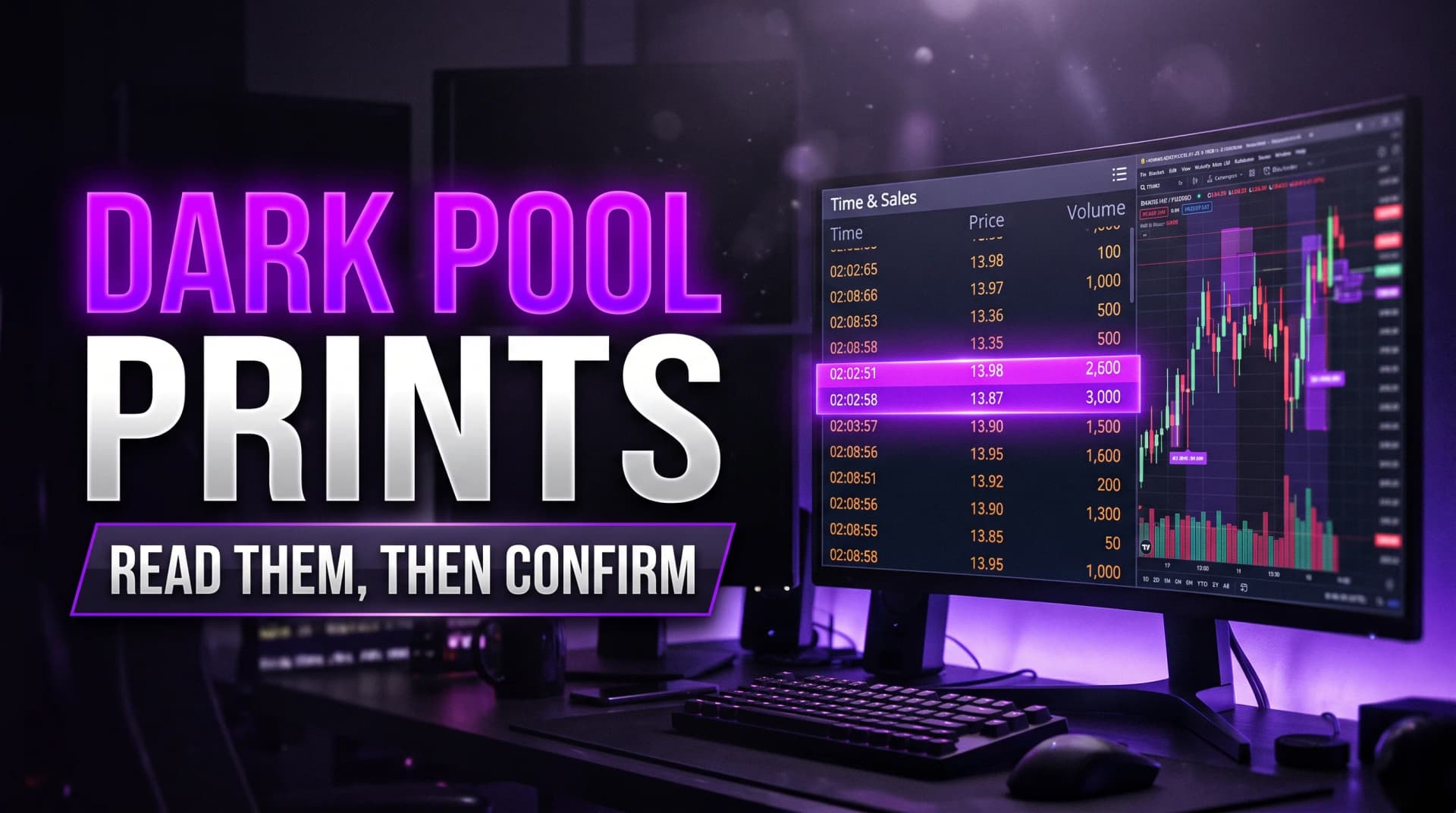
A "dark pool scanner" flashes an alert: 400,000 shares just printed off-exchange in a mid-cap stock, well above its typical block size. The trader who sees it makes a common leap: a big institution is clearly buying, so buying alongside them should be smart money following smart money.
Except the alert doesn't actually say who was buying and who was selling. It doesn't say when the underlying trade was actually agreed to, only when it was reported. And depending on the scanner, it may not even be showing a genuine institutional block trade at all, it could be a chunk of ordinary retail order flow that got internalized by a wholesale market maker and reported through the same off-exchange reporting pipe. Treating that print as a clear directional signal is exactly the kind of confident-sounding misread this article exists to prevent.
What is a dark pool print? A dark pool print is a trade report from an off-exchange venue, an Alternative Trading System (ATS) or a wholesale market maker's internalized order flow, that executed without a public, pre-trade order book and gets reported to the public tape after the fact, typically showing the execution price and size but not the identity or clear directional intent of the parties involved.
What a "Dark Pool Print" Actually Is (and What Retail Scanners Often Get Wrong)
This is the single most important thing to understand before trading off this data at all: the term "dark pool print" gets used loosely by most retail-facing tools to describe any trade reported through the off-exchange reporting pipeline, which lumps together several genuinely different things. A true dark pool trade, executed on a registered Alternative Trading System with no pre-trade transparency, is one category. Internalized retail order flow, where a broker routes a customer's order to a wholesale market maker under a payment-for-order-flow arrangement and that market maker fills it from its own inventory rather than sending it to a lit exchange, is a separate, much larger category that also gets reported through the same general off-exchange mechanism.
A large print showing up on a retail dark pool scanner is far more likely, in aggregate, to reflect routine wholesale market maker activity, including the cumulative effect of many small retail orders being internalized and periodically reported in batches, than a single institution placing one deliberate, directional block bet. Some prints genuinely are large institutional trades. Many are not, and most retail-facing tools don't reliably distinguish between the two categories for a trader in real time.
Dark Pools vs. Lit Exchanges vs. Internalization: Three Different Things
A lit exchange, like the Nasdaq or NYSE, displays its order book publicly before trades execute; anyone can see the bids and offers waiting to be matched. A dark pool, formally an Alternative Trading System, matches buyers and sellers without displaying that book publicly beforehand, reporting completed trades afterward rather than showing intent in advance. Internalization is a third, distinct mechanism: a broker-dealer or wholesale market maker fills a customer's order directly from its own inventory rather than routing it to either a lit exchange or a dark pool at all.
All three categories of trades ultimately get reported to the consolidated tape, and depending on the specific reporting facility and the trade's size, that reporting can be immediate or subject to permitted delays. A trader looking at a stream of "dark pool prints" is typically seeing a mix of all three, with no simple way to separate genuine ATS block trades from internalized retail flow without more sophisticated tools than most scanners provide by default.
When Dark Pool Print Data Is Actually Worth Watching
Given the ambiguity described above, this data is most useful as a filter for genuinely unusual activity, not as a direct buy or sell signal. A single print that's dramatically larger than that stock's typical block size, several multiples above what routine internalized retail flow would produce, is more likely to represent a genuine, deliberate institutional trade than the steady background noise of smaller off-exchange prints that most liquid stocks show constantly throughout the session.
This data works best as a screening layer applied to liquid, actively traded stocks where a trader can compare an unusual print against that stock's own normal off-exchange VolumeVolume is the total number of shares (or contracts) traded during a given time period — it's the primary confirmation tool for all price action, because a price move accompanied by high volume indicates genuine market participation, while tRead definition → pattern, rather than treating every print above an arbitrary fixed threshold as equally meaningful across every ticker.
The Large Block Print Follow-Through Setup
- Component
- Market Conditions Required
- Rule
- RVOL at 1.5 or higher on the stock in question at the time of the print
- Component
- Time of Day
- Rule
- 9:30–11:00 AM ET or 3:00–4:00 PM ET (prints outside these windows carry a higher risk of reflecting batch-reported, non-time-sensitive internalized flow)
- Component
- Stock Selection Criteria
- Rule
- Print size at least 5x the stock's typical off-exchange block size for that ticker specifically, not a fixed threshold applied across all stocks
- Component
- Entry Trigger
- Rule
- A qualifying large print, followed within the next 5 to 10 minutes by confirming lit-market price movement and elevated volume in the same apparent direction
- Component
- Stop Loss
- Rule
- Below (long) or above (short) the swing point that formed just before the confirming lit-market move
- Component
- Initial Profit Target
- Rule
- The most recent significant swing level in the confirmed direction, or a 1:1 R-multiple
- Component
- Trade Management
- Rule
- Hold while lit-market volume and price continue confirming the same direction; trail using each new confirming swing point
- Component
- Invalidation Criteria
- Rule
- Lit-market price action fails to confirm within the 5 to 10 minute window, or moves opposite to the print's apparent direction
| Component | Rule |
|---|---|
| Market Conditions Required | RVOL at 1.5 or higher on the stock in question at the time of the print |
| Time of Day | 9:30–11:00 AM ET or 3:00–4:00 PM ET (prints outside these windows carry a higher risk of reflecting batch-reported, non-time-sensitive internalized flow) |
| Stock Selection Criteria | Print size at least 5x the stock's typical off-exchange block size for that ticker specifically, not a fixed threshold applied across all stocks |
| Entry Trigger | A qualifying large print, followed within the next 5 to 10 minutes by confirming lit-market price movement and elevated volume in the same apparent direction |
| Stop Loss | Below (long) or above (short) the swing point that formed just before the confirming lit-market move |
| Initial Profit Target | The most recent significant swing level in the confirmed direction, or a 1:1 R-multiple |
| Trade Management | Hold while lit-market volume and price continue confirming the same direction; trail using each new confirming swing point |
| Invalidation Criteria | Lit-market price action fails to confirm within the 5 to 10 minute window, or moves opposite to the print's apparent direction |
The entry trigger is deliberately built around requiring lit-market confirmation, not the print alone, because a print by itself doesn't reliably establish direction or convey genuine forward-looking intent. What it can do, when it's genuinely unusual in size relative to that stock's normal pattern, is flag a name worth watching closely for the next several minutes.
Walking Through a Live Dark Pool Print Trade
Picture a mid-cap stock with a typical off-exchange block size in the RangeA range (or trading range) is a price zone where a stock oscillates between a defined support floor and resistance ceiling without making meaningful new highs or lows — price is consolidating rather than trending, and the dominant trade is Read definition → of 5,000 to 15,000 shares on a normal session. At 10:05 AM ET, a print reports at 95,000 shares, roughly eight times the stock's typical block size, well above the setup's 5x qualification threshold.
Rather than acting on the print alone, a trader would watch the lit market closely over the following minutes. At 10:09 AM, the stock begins trading up on the lit exchanges with RVOL climbing and price breaking through the session's prior high on above-average one-minute volume, confirmation arriving within the setup's 5 to 10 minute window.
That's the entry trigger: an unusually large print followed by genuine, confirming lit-market activity. A trader would enter long as that lit-market BreakoutA breakout is when price moves decisively beyond a defined level — a resistance zone, a consolidation boundary, a chart pattern boundary, or a prior high — suggesting that the previous supply at that level has been overcome.Read definition → confirms, with a stop below the swing low that formed just before the confirming move, and a target at the next meaningful ResistanceResistance is a price level where selling pressure has historically overcome buying pressure, causing price to stall, reverse, or consolidate — it's the ceiling where supply enters the market and where breakout traders watch for either a coRead definition → level, sized using the same risk/reward DisciplineTrading discipline is the consistent application of your predefined rules — entries, stops, targets, position sizing, maximum daily loss — regardless of what you're feeling in the moment.Read definition → applied throughout this module.
Managing a Dark Pool Print Trade
Once in the trade, the lit market, not the original print, should drive ongoing management, since the print already did its job by flagging the name worth watching. Continued volume and price confirmation in the trade's favor supports holding toward the target; the appearance of additional large prints in the same direction can add confidence but shouldn't substitute for continued lit-market confirmation.
Scale partial size at the first target, and treat a failure of the lit-market confirmation to continue, price stalling or reversing despite the earlier large print, as reason to manage the position more conservatively regardless of what the original print suggested.
Where Dark Pool Print Trading Breaks Down
The most fundamental limitation is that a print's reported side, whether it was categorized as buyer-initiated or seller-initiated, is frequently an estimate made by the data vendor rather than a directly reported fact, since off-exchange trade reports don't always include a clear, verified aggressor flag the way some other market data does. A trader treating a vendor's "buy" or "sell" label on a dark pool print as a confirmed fact is often trusting an inference, not a certainty.
Reporting delays add a second layer of uncertainty. Depending on the specific reporting facility and trade characteristics, an off-exchange trade can be reported with a meaningful lag after it was actually agreed to, which means a print appearing on a scanner "now" may reflect a decision made minutes earlier, information that's already partially stale by the time a retail trader sees and reacts to it.
Large dark pool volume doesn't automatically imply directional conviction at all. A substantial share of off-exchange volume reflects mechanical activity, index fund rebalancing, ETF creation and redemption baskets, and large orders deliberately sliced and routed off-exchange specifically to minimize market impact and trading costs, none of which necessarily reflects a strong directional view about where the stock is headed. Treating all large prints as evidence of "smart money" conviction ignores how much off-exchange volume exists for reasons that have nothing to do with a directional bet.
Finally, the retail market for "whale alert" and dark pool scanning tools includes services with varying data quality and varying methodology for what counts as significant, and a trader evaluating any specific paid tool should understand exactly what data source and classification method it uses rather than assuming all such tools are showing the same, equally reliable thing.
Dark Pool Activity Across Different Stocks
The share of total volume trading off-exchange varies meaningfully by stock, and large, heavily institutionally-owned names generally see a higher proportion of off-exchange activity as a share of their total volume than smaller, more retail-dominated names. This means the "typical block size" benchmark central to this article's setup genuinely needs to be calibrated per stock rather than applied as a single fixed number across very different tickers, echoing the same per-instrument calibration principle that runs through tape reading, Level 2, and the other tools in this module.
Index ETFs and heavily arbitraged products tend to show especially high off-exchange volume relative to their float, largely reflecting the mechanical creation and redemption process rather than discretionary institutional positioning, which makes dark pool print data considerably less informative on those products than on individual equities.
Tools for Tracking Off-Exchange Activity
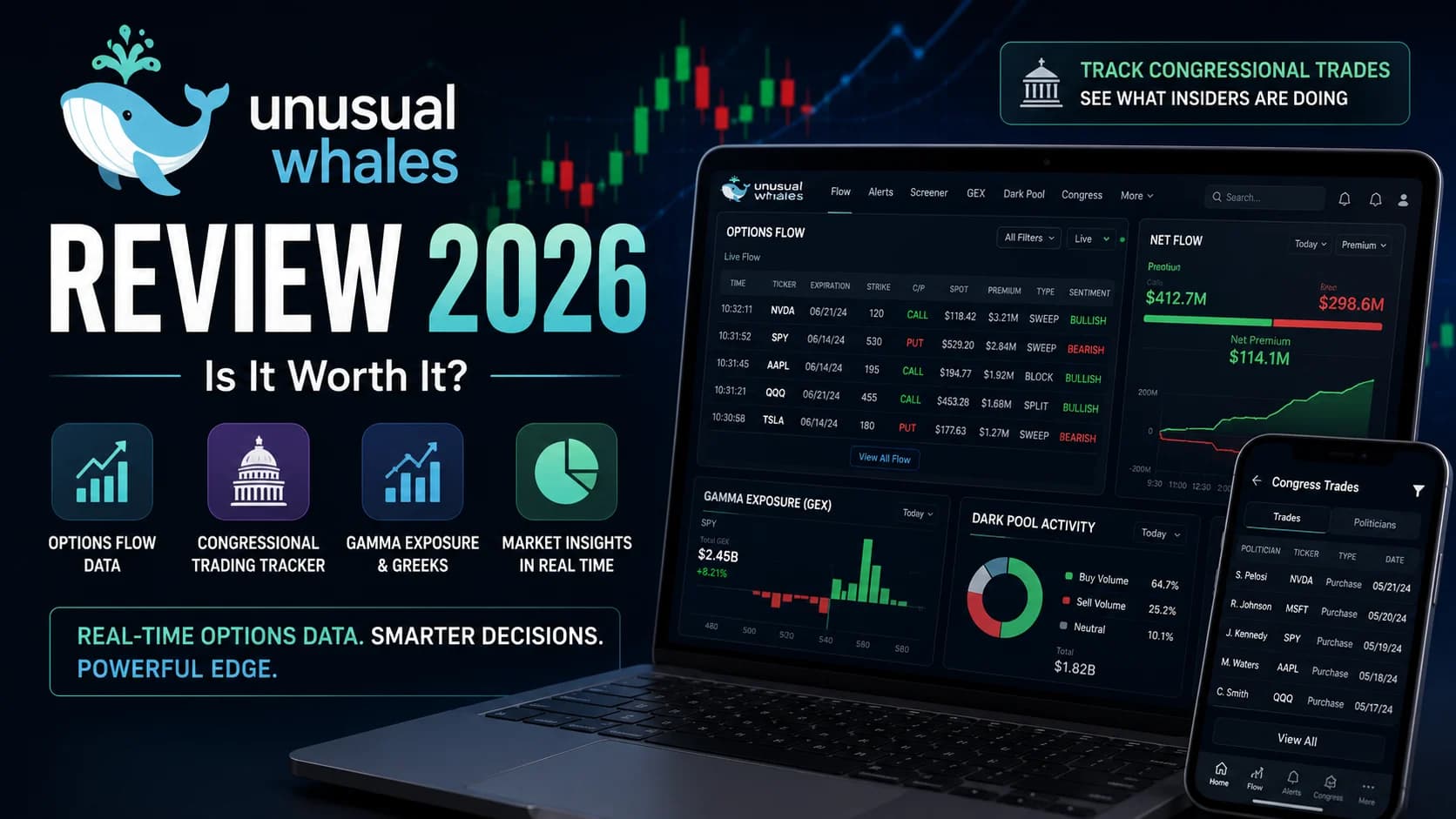
DayTradingToolkit's review of Unusual Whales covers a platform built specifically around surfacing unusual options and off-exchange flow data, relevant for traders building this kind of screening into their process. DayTradingToolkit's review of Bookmap also covers order-flow visualization tools relevant to confirming lit-market reaction once an unusual print has been identified. As with any data source in this category, understanding exactly what a specific tool is measuring and how it classifies trade direction matters more than the tool's marketing claims about "following smart money."
Where Dark Pool Print Trading Fits Inside a Complete Trading Plan
Dark pool print data works best as an initial screening signal, a way of flagging which stocks deserve closer attention on a given session, rather than as a direct, standalone entry trigger. Combined with required lit-market confirmation, disciplined position sizing, and a clear understanding of what this data can and can't tell a trader, it adds one more useful filter to a broader process. Acting on a large print alone, without confirming that the lit market is actually moving in the apparent direction, risks trading on an ambiguous signal whose true meaning, genuine institutional conviction versus routine internalized flow versus mechanical index activity, simply can't be determined from the print itself.
Frequently Asked Questions
Do most "dark pool prints" shown on retail scanners represent genuine institutional block trades?
This is the most important honest caveat in this entire topic. A trader should assume that not every large print represents what it superficially appears to represent, and should weight genuinely unusual, stock-specific outliers more heavily than routine background off-exchange volume.
Key Takeaway: Treat most off-exchange prints as a mix of institutional and routine internalized flow, and reserve real attention for prints that are dramatically larger than that specific stock's normal pattern.
Can a trader reliably tell whether a dark pool print was a buy or a sell?
This uncertainty is a major reason the setup in this article requires lit-market confirmation rather than acting on the print's labeled direction alone. The lit market's actual subsequent price and volume behavior is more reliable evidence of direction than a vendor's inferred label on the original print.
Key Takeaway: Don't trust a print's labeled buy or sell direction as confirmed fact; require independent lit-market confirmation before acting.
Why does off-exchange volume not automatically indicate institutional conviction?
Assuming every large off-exchange print represents deliberate conviction ignores how much of that volume exists for cost-minimization and mechanical reasons that have nothing to do with a directional view.
Key Takeaway: Recognize that a meaningful share of dark pool volume is mechanical, not conviction-driven, before assuming a print signals institutional intent.
How much of a delay can there be between when an off-exchange trade happens and when it's reported?
This reporting lag is part of why the setup in this article requires confirming lit-market activity within a defined window after the print, rather than treating the print itself as a precisely timed, real-time signal.
Key Takeaway: Treat print timestamps as approximate rather than precisely real-time, and weight lit-market confirmation timing more heavily than the print's exact reported time.
Does dark pool print data work the same way across all stocks?
This is why the setup's qualification threshold is defined relative to each stock's own typical block size rather than as a single fixed share count applied universally.
Key Takeaway: Calibrate what counts as an unusual print to each specific stock's own normal off-exchange volume pattern, not a universal threshold.
Is dark pool print data useful for index ETFs like SPY and QQQ?
The same caution that applies to tape reading and CVD on index products applies here: mechanical arbitrage-driven volume dilutes the signal value of what would otherwise look like a significant print on an individual stock.
Key Takeaway: Weight dark pool print signals on index ETFs less heavily than the same signal on an individual equity.
Are paid "dark pool scanner" or "whale alert" services worth subscribing to?
Different services vary in data quality, update frequency, and how they classify trade direction and significance. Evaluating a specific tool's actual methodology, and testing its signals against the confirmation-based approach in this article rather than trusting alerts blindly, is a more defensible approach than assuming every service is equally reliable.
Key Takeaway: Evaluate any paid dark pool data service by its specific methodology, and always require independent lit-market confirmation regardless of how the service presents its alerts.
Why does this setup require lit-market confirmation instead of just trading the print directly?
Requiring the lit market to actually move and confirm in the apparent direction within a defined window adds independent, real-time evidence on top of an inherently ambiguous data point, which meaningfully improves the setup's reliability compared to acting on the print in isolation.
Key Takeaway: Treat the print as a screening tool that flags attention, and let the lit market's actual subsequent behavior provide the real confirmation.
Disclaimer
Article Sources
- SEC: Rules to Enhance Transparency and Oversight of Alternative Trading Systems - official SEC announcement of Form ATS-N and Regulation ATS transparency requirements for dark pools.sec.gov
- SEC: Form ATS-N Filings and Information - official source for individual dark pool operators' disclosed operational details.sec.gov
- Do Dark Pools Harm Price Discovery? (Zhu, SSRN) - academic research examining how dark pool trading activity relates to price discovery and informed trading.papers.ssrn.com
- FINRA ATS Quarterly Statistics - official data on off-exchange trading volume by venue.finra.org
- SEC Rule 606 FAQ - staff guidance on order routing disclosure, including how retail order flow is routed to off-exchange venues.sec.gov