
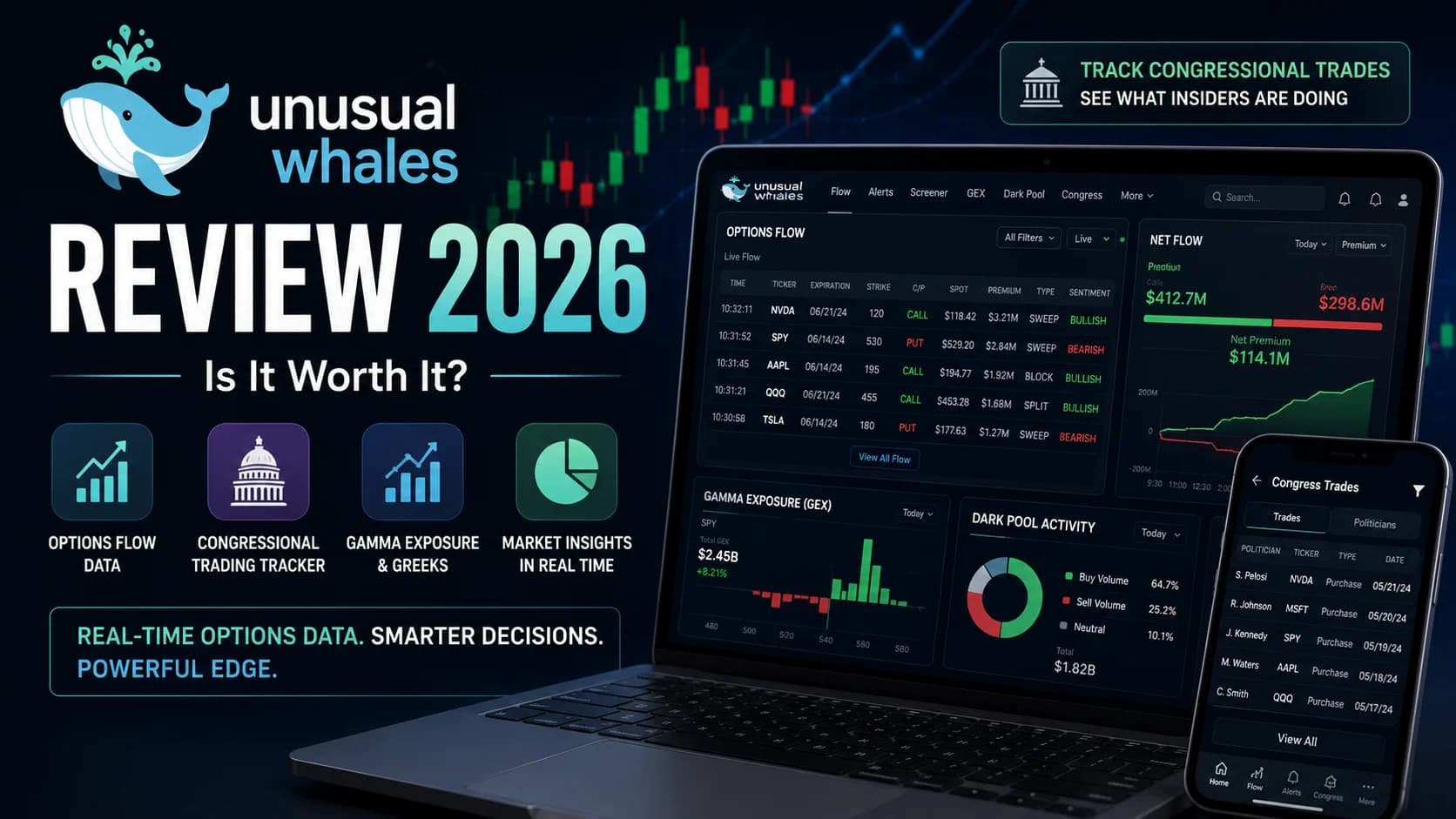
Every few months, a screenshot goes viral on social media. A member of Congress files a stock trade disclosure — calls on a semiconductor ETF, three days before a major defense bill passed a committee. Then Unusual Whales posts it. Then the replies flood in. That's the moment most people first hear about this platform, and it's a reasonable summary of why it became popular.
But Congress trades are only one piece of what Unusual Whales actually is. This review examines the full product: the options flow tools, the data depth, the GEX and dark pool features, the pricing, and — critically — the GapA gap is a price discontinuity on a chart where a stock opens significantly higher or lower than the previous session's close, leaving a visible empty space — gap-ups are driven by overnight buying pressure or positive news; gap-downs by seRead definition → between having access to this data and knowing what to do with it.
What's good
- Real-time options flow from every U.S. exchange, with granular filtering by size, type, SectorA broad grouping of companies that operate in the same segment of the economy — such as Technology, Healthcare, Energy, or Financials. Stocks within a sector tend to move together in response to shared economic, regulatory, and sentiment faRead definition →, expiration, and sentiment — among the most customizable flow feeds available at this price point
- The congressional trading tracker is a genuine differentiator — no other retail platform aggregates STOCK Act filings and politician portfolios as cleanly or as comprehensively
- Free tier available for learning the interface before committing to a paid plan, which removes the biggest risk of flow platforms: paying for data you can't yet interpret
- GammaGamma is the options Greek that measures the rate of change in delta for every $1 move in the underlying stock — high gamma means delta shifts rapidly as price moves, making the option increasingly sensitive to further price movement, and iRead definition → exposure (GEX), Vanna, and DeltaDelta is an options Greek that measures how much an option's price is expected to change when the underlying stock moves $1 — a call with a 0.50 delta should gain roughly $0.50 if the stock rises $1.Read definition → Exposure (DEX) data at a retail subscription price is genuinely unusual — most competing tools don't include Greeks-based market structure data
- The ~$48/month paid tier undercuts most comparable options flow platforms significantly while covering more data types
Trade-offs
- The platform's depth is a double-edged sword — navigating the full feature set takes real time, and traders who aren't already comfortable with options flow will hit the learning curve quickly
- Congressional trade disclosures have a statutory reporting window of up to 45 days, which limits the direct trading value of political activity data significantly
- Unusual Whales is a data and analytics layer, not a signal service — there are no automated recommendations, no scoring of which flow is actionable, and no built-in framework for deciding what to do with what you see
- The free tier is deliberately limited enough that it serves mainly as a product preview rather than a genuinely useful trading tool
What Is Unusual Whales?
What is Unusual Whales? Unusual Whales is a real-time options flow analytics platform that aggregates and visualizes every options trade across U.S. exchanges, alongside dark pool activity, gamma exposure data, congressional trading disclosures, and market heatmaps. Founded in 2020, it gives retail traders access to institutional-grade options data at a fraction of what professional terminal access costs. ---
The platform launched during the early pandemic era of retail trading and grew rapidly through social media — particularly through its congressional trade tracker, which surfaces mandatory stock disclosure filings from members of the U.S. Congress in near-real time. That feature drove enormous public interest, but it's only one corner of what is now a substantially broader financial data platform.
Today, Unusual Whales covers options flow from every U.S. exchange, dark pool and off-exchange transaction data, Greeks-based market structure analysis (GEX, DEX, Vanna), a stock screener built around options flow signals rather than price-and-VolumeVolume is the total number of shares (or contracts) traded during a given time period — it's the primary confirmation tool for all price action, because a price move accompanied by high volume indicates genuine market participation, while tRead definition → fundamentals, and a companion mobile app. The platform does not generate trading signals, execute trades, or tell you what to buy — it shows you what others are trading, and leaves interpretation to you.
That distinction matters enormously for understanding whether Unusual Whales belongs in your workflow.
Key Features
The Flow Feed. This is the core product. Every options trade across U.S. exchanges appears in real time, with contract details — ticker, strike, expiration date, premium paid, volume, open interest, order type, and sentiment tag — available for each entry. Traders can filter by expiration range, premium size, order type (sweep, block, split), sector, index, or individual ticker. The volume versus open interest filter is particularly useful: volume exceeding the prior open-interest snapshot can flag unusual activity, but it does not establish whether trades opened or closed positions or reveal their directional intent.
Pre-built flow views reduce the initial overwhelm. The 0DTE Flow feed isolates contracts expiring that day — useful for traders working same-day momentum setups. The Net Flow view tracks cumulative premium spent on calls versus puts across the session, giving a macro read on whether options participants are positioned bullishly or bearishly overall.
Gamma Exposure, DEX, and Vanna. This is where Unusual Whales separates itself from most retail flow tools. GEX — gamma exposure by strike — shows where market makers are likely to hedge, creating natural price support or resistance zones around expiration. DEX (delta exposure) and Vanna data give traders visibility into how dealer hedging activity might shift with changes in volatility. These are the tools quant traders and professional options desks use to model market structure. Finding them bundled into a retail subscription at this price point is genuinely unusual — which is, to be fair, rather on-brand.
The Congressional Trading Tracker. Politicians subject to the STOCK Act must disclose stock trades within 30-45 days of execution. Unusual Whales aggregates these filings and presents them as a searchable, filterable feed showing individual lawmakers' purchases and sales, the tickers involved, and how those positions have performed since disclosure. You can follow specific legislators, sort by sector, or pull portfolio-level views. The feature is well-built and presents data that's cumbersome to access through raw government filing systems.
The honest caveat: because the statutory disclosure window runs up to 45 days, many congressional trades appear in the system well after any associated price move has already played out. The congressional tracker is best understood as a transparency and research tool rather than a direct trading signal.
Dark Pool Scanner. Off-exchange institutional block transactions appear in the dark pool feed with ticker, print size, price level, and timing. Dark pool data can help identify where large participants have been accumulating or distributing, adding context to resistance and support levels on a price chart. Unusual Whales shows dark pool data across 50+ off-exchange venues, which is considerably broader coverage than most comparable retail tools.
Market Heatmaps. Interactive heatmaps visualize daily price change, options flow sentiment, and volume patterns across sectors, industries, and individual stocks. They're useful for fast-gauging market breadth at the open, and for identifying which sectors are attracting the most institutional flow attention before drilling into individual tickers.
Mr. Whale AI Assistant. Available on paid plans, Mr. Whale is an AI assistant that answers questions about options concepts, market structure, and the platform's own data. It's more of a guided analysis companion than a signal generator — useful for traders still building their flow interpretation skills, less so for experienced practitioners who already know what they're looking for.
Options Profit Calculator. The built-in profit and loss modeler lets you define potential options positions and visualize outcome scenarios at different price levels and expiration times before entering a trade. This is basic functionality compared to dedicated options analysis tools, but having it within the same interface reduces context-switching for traders who want to quickly size up a setup triggered by the flow feed.
It's worth spending a bit more time here because this feature drives a significant portion of Unusual Whales' search traffic — and the reality is more nuanced than the viral clips suggest.
When a trade disclosure lands, the platform surfaces the filing quickly. The presentation is clean: you see which lawmaker bought or sold, in what security, the reported value range, the date of the transaction, and the date of disclosure. Historical portfolios are available, and you can track individual legislators who have a reputation for well-timed moves.
The systematic problem is the lag. Disclosure deadlines under the STOCK Act allow up to 45 days for reporting. In practice, many filings come in well before that — but many don't. By the time the trade appears on Unusual Whales, the stock may have already moved significantly. The data is interesting from a market transparency and research standpoint. As a direct trade trigger, it warrants significant skepticism.
For traders who arrived specifically for the congress tracker, this context matters.
Who Unusual Whales Is Best For
Options flow platforms are not general-purpose trading tools, and Unusual Whales is more narrowly specialized than most. It fits a specific type of trader well, and a large category of traders poorly.
The platform is a strong fit if you:
- Trade options actively and already understand how to distinguish between directional flow, hedging activity, and speculative positioning — the data supports sophisticated interpretation, not beginner pattern-matching
- Want the broadest possible coverage of U.S. options flow at a price point that doesn't require an institutional budget — Unusual Whales' combination of data types at ~$48/month is genuinely competitive
- Need Greeks-based market structure data (GEX, DEX, Vanna) as part of your analytical toolkit and don't want to subscribe to a separate platform for it
- Are a swing trader or intraday options trader who uses flow data as a confirmation layer alongside your own technical analysis, rather than as a primary signal source
- Want to research political trading disclosures for market transparency purposes, academic interest, or as one data input among many
The platform is not a strong fit if you:
- Are new to options trading and expect the flow data to tell you which trades to make — the platform surfaces data; what you do with it requires interpretive skill that takes months to develop
- Primarily trade equities and don't regularly work with options — you'd be paying for a sophisticated options data infrastructure that has limited relevance to your workflow
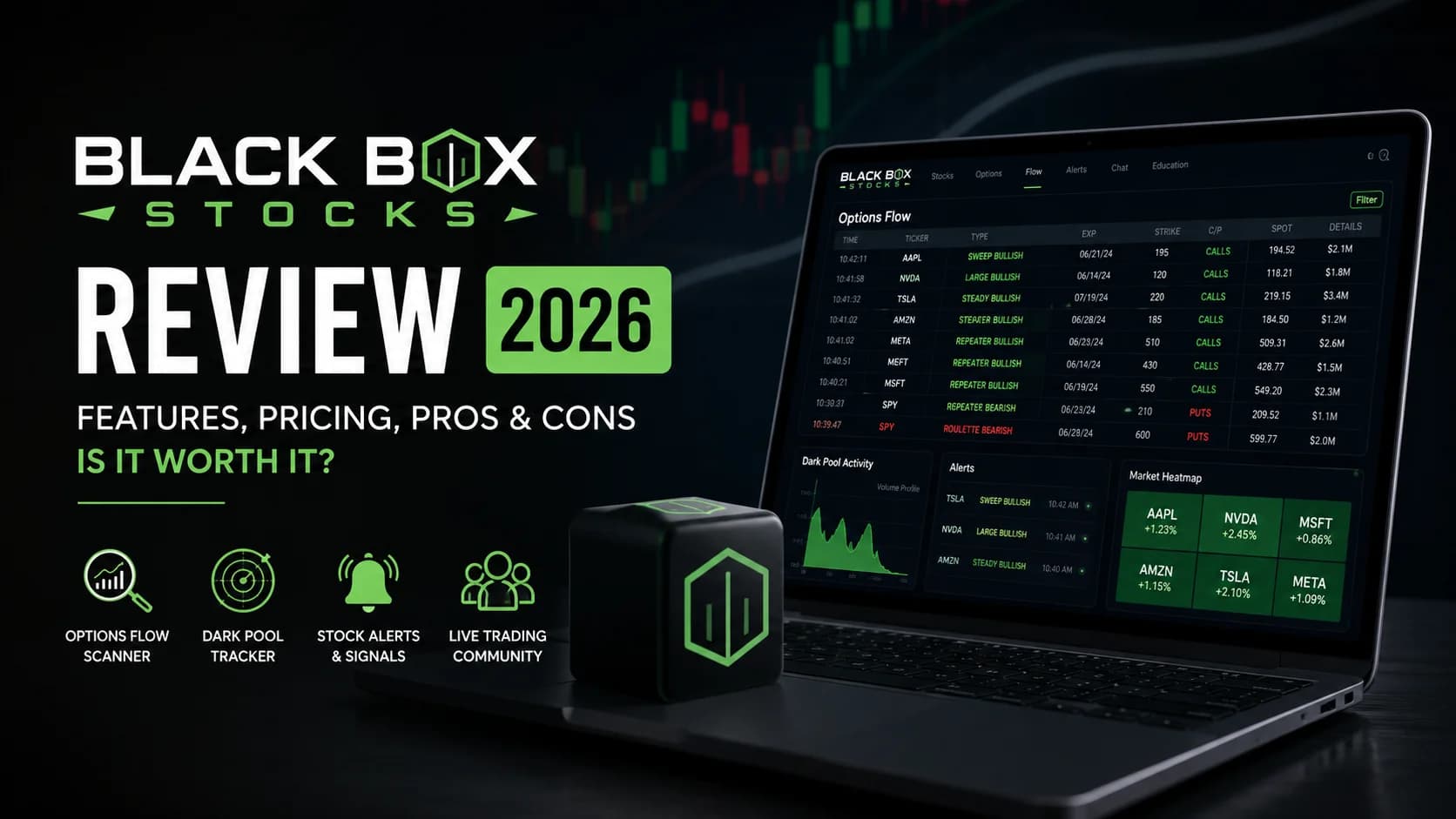
- Want a platform that bundles flow data with live trade commentary, moderated community rooms, or educational scaffolding alongside the data (our Black Box Stocks review covers a platform that takes that more community-forward approach)
- Need an all-in-one setup covering charting, scanning for equity setups, and execution — Unusual Whales handles none of that
Pricing: What You Actually Pay
Unusual Whales offers a free tier and paid subscription plans, with the paid tier sitting around $48 per month on a monthly basis or $528 annually ($44 per month effective). A higher-tier plan — Retail Pro — runs closer to $99 per month with additional features including faster alert delivery, advanced filtering depth, and additional historical data access.
The free tier deserves a realistic assessment: it's limited enough in data speed and flow visibility that it functions primarily as a product preview rather than a genuinely useful trading tool. But it's a meaningful advantage over platforms with no trial period at all — traders can explore the interface, understand the layout, and assess whether flow data is the kind of tool their workflow actually needs before spending a dollar.
The ~$48 monthly price point compares favorably against most comparable options flow platforms. FlowAlgo runs approximately $149 per month; Cheddar Flow ranges from $85 to $99 per month. At roughly a third of FlowAlgo's price while covering more data types — including the GEX data that FlowAlgo doesn't provide — Unusual Whales' pricing is one of its clearest competitive advantages.
Check the deals page for any current promotions before subscribing.
What Works Well
The data breadth at this price point is the headline. Real-time options flow from every U.S. exchange, dark pool activity across 50+ venues, GEX and Vanna data for market structure analysis, congressional disclosures, sector heatmaps, and a dedicated 0DTE feed — the fact that all of this comes bundled into a single subscription under $50/month is legitimately impressive relative to what professional options desks pay for comparable data stacks.
The filtering system is genuinely powerful. The ability to isolate flow by order type (sweep versus block), by volume-to-OI ratio, by sector, by sentiment, and by premium size lets experienced traders narrow a wall of incoming data down to the specific signal types that matter to their strategy. This is where the platform earns its reputation among serious options traders — not because the data is unique, but because the interface for cutting through it is well-built.
The free tier access is worth acknowledging specifically. In the options flow space, where the learning curve for interpreting data is steep, being able to spend real market sessions navigating the interface before committing to a paid plan removes a meaningful barrier. Traders who subscribe blindly to flow tools often find themselves staring at a feed they can't yet read — the free tier gives you time to find out whether that's you before paying for it.
The platform's pace of development has been notable too. The native mobile app, expanded dark pool feeds, and the Mr. Whale AI companion all arrived within the past couple of years, suggesting active investment in the product rather than stagnation.
Where Unusual Whales Falls Short
The learning curve is real and worth stating clearly. Unusual Whales presents an enormous amount of data across a significant number of tabs, feeds, and view types. An experienced options trader who arrives knowing what gamma exposure means, what a sweep versus a block trade implies, and how to filter for volume-exceeds-OI setups will feel at home quickly. A trader who is still building that vocabulary will spend significant time in the interface before the data becomes actionable rather than overwhelming.
This isn't a design criticism — it's a structural reality of what the platform is. Unusual Whales was built to present complex data clearly, not to simplify complex data into beginner-friendly signals. The distinction matters when evaluating whether the tool fits your current skill level.
The congressional tracker's disclosure lag has already been noted, but it's worth being explicit: if the political trading data is your primary reason for considering Unusual Whales, the 45-day reporting window significantly limits its direct trading utility. Trades that moved stocks by 20-30% often show up in the filing feed well after that move has played out. The tracker is better understood as a research and transparency tool than as a front-running mechanism — which is also the more legally and ethically appropriate framing.
There is also a deeper limitation that applies to options flow data generally, not just to Unusual Whales. Institutional options activity is not inherently directional. A large sweep of calls might represent a hedge against a short equity position, a synthetic long replacing a stock position for capital efficiency, or a speculative directional bet. The data shows the trade; it doesn't tell you which interpretation is correct. Academic research on whether following unusual options activity generates excess returns is mixed — most studies suggest the edge, if it exists, is modest and requires skillful interpretation to capture. Treating flow data as a signal, rather than one piece of evidence among several, is a common and costly mistake among newer options traders.
How Unusual Whales Fits a Day Trader's Workflow
Most traders who get real value from Unusual Whales use it as a confirmation and context layer rather than a primary signal generator. The general pattern: develop a thesis through your own technical or fundamental analysis, then check the flow feed to see whether institutional options activity aligns or contradicts that thesis before entering.
A stock setting up technically for a breakout looks different if the flow feed shows aggressive call buying at near-the-money strikes in the same name that morning. It looks different still if that call buying is concentrated in very short expirations — which tends to suggest directional speculation — versus longer expirations with high open interest already present, which might indicate existing position management. That kind of overlay is where Unusual Whales earns a place in an experienced trader's toolkit.
Pairing Unusual Whales with a separate charting platform is essentially required for this workflow. The platform includes its own charts, but they're not the reason to subscribe — a dedicated charting tool handles technical analysis, and Unusual Whales handles the options data layer. Many traders who use Unusual Whales regularly run it alongside TradingView or a comparable charting platform during market hours.
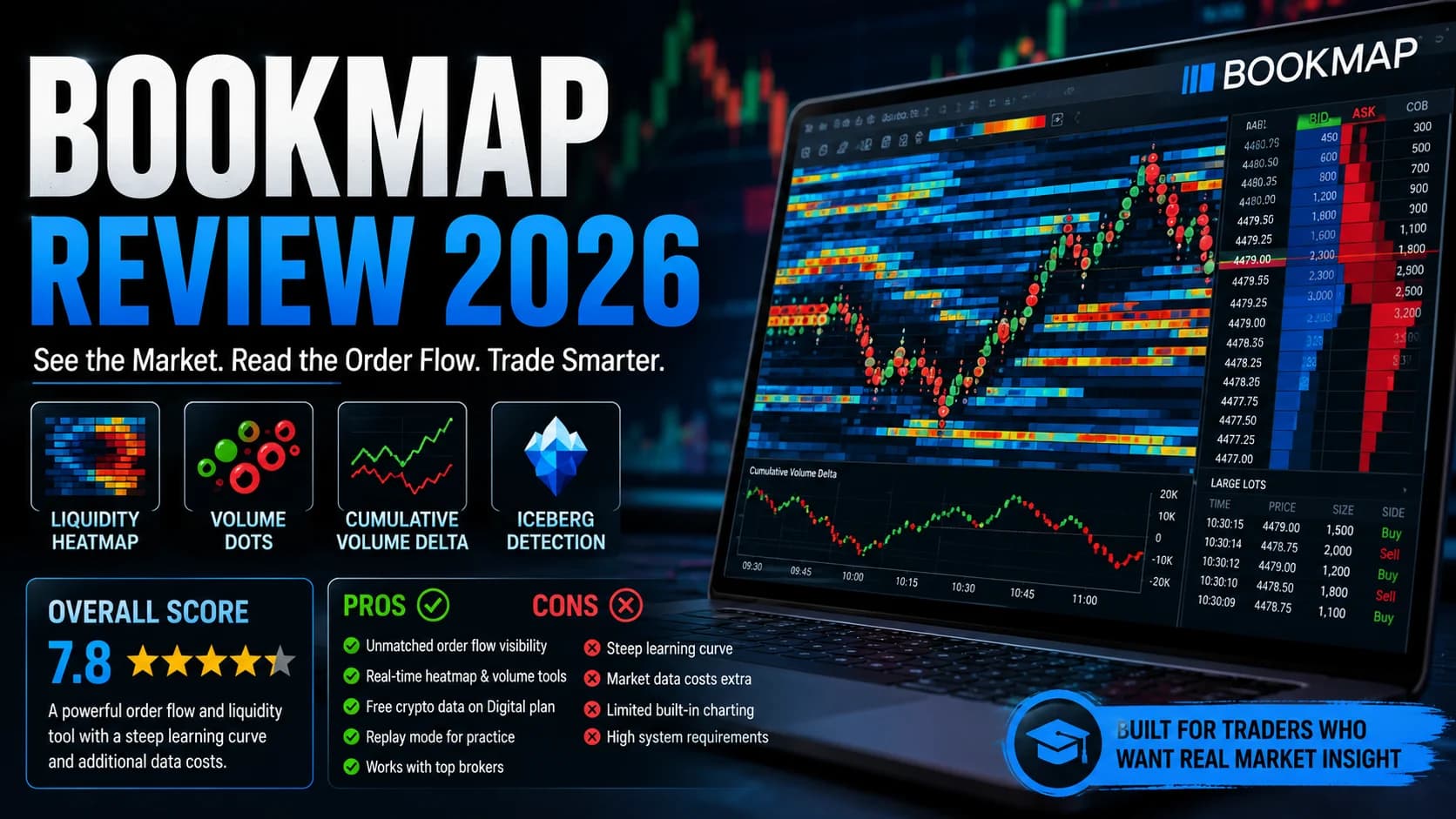
For day traders specifically interested in order flow broadly — not just options flow but also level 2 and DOM — our Bookmap review covers a platform that approaches market microstructure from a futures and equity order book angle rather than the options side.
The Most Data-Rich Options Flow Platform at Its Price — For Traders Who Can Use It
Unusual Whales delivers more options data types — flow, dark pool, GEX, congressional tracking — at a lower price than most alternatives, and the free tier means you can assess fit before spending anything. That combination makes it easy to recommend to options traders who already have the foundational skills to make the data actionable. For traders still developing those skills, the learning curve is real enough that starting with the free tier and building interpretive ability before upgrading is the honest path forward. The platform's limitation is the same as any data tool's limitation: data without interpretation is noise. Unusual Whales gives you better data, not a shortcut past that requirement.
Intermediate-to-advanced options traders who want real-time institutional flow, market structure data (GEX/DEX/Vanna), and a comprehensive dark pool feed — and who already have enough options experience to interpret what they're seeing.
Unusual Whales FAQs
Is Unusual Whales worth it for active options traders?
The platform's combination of real-time options flow, dark pool coverage, GEX data, and the congressional tracker is genuinely difficult to replicate through a competing single subscription at this price point. The caveat that applies to every flow platform applies here too: the data is valuable in proportion to your ability to interpret it correctly. Unusual Whales gives you better data — not a substitute for options knowledge.
Key Takeaway: The ~$48/month paid tier is one of the more cost-effective entries into serious options flow data available to retail traders.
What is the congressional trading tracker and how useful is it for trading?
The tracker is well-built and genuinely unique. You can follow specific legislators, filter by sector, and pull historical portfolio views. The practical limitation: disclosure deadlines allow up to 45 days for reporting, meaning trades often appear in the feed after the associated price move has already happened. The tracker is most useful as a transparency and research tool, not as a trade trigger.
Key Takeaway: The congressional tracker is Unusual Whales' most distinctive feature, but it's better understood as a research tool than a timing signal given the statutory reporting lag.
Does Unusual Whales have a free trial?
The free tier is deliberately limited in data speed and flow visibility, making it less useful as a functional trading tool. But it's genuinely valuable for evaluating whether the interface makes sense to you and whether options flow data fits your workflow before committing to a monthly fee.
Key Takeaway: Use the free tier to learn the platform's navigation and assess fit — not as a replacement for the paid plan once you're ready to use flow data in live trading.
How does Unusual Whales compare to Black Box Stocks?
Both serve the options flow use case, but from different angles. Unusual Whales is built for data-savvy traders who want to configure their own filters and work with the raw flow feed. Black Box Stocks wraps flow data in a more guided structure with live moderator rooms and preset algo-based alerts, making it more accessible to traders earlier in the learning process. The right choice depends on whether you want granular data control or community scaffolding. Our Black Box Stocks review covers the platform in full.
Key Takeaway: Unusual Whales wins on data depth and pricing; Black Box Stocks wins on community and guided structure — the better fit depends on where your options flow skill level sits.
What do GEX, DEX, and Vanna mean, and why does it matter that Unusual Whales includes them?
Gamma exposure (GEX) by strike shows where market makers must buy or sell the underlying as price moves through specific levels, creating self-reinforcing price behavior near expiration. DEX and Vanna show how changes in volatility would shift dealer hedging requirements. These data types are used by professional options desks to model near-term price dynamics. Finding them bundled into a retail subscription at ~$48/month is genuinely unusual, and they add a layer of market structure analysis most comparable retail tools don't offer.
Key Takeaway: GEX and related data help experienced options traders understand why price behaves as it does near key strikes — they're a meaningful differentiator in Unusual Whales' feature set.
Can beginners use Unusual Whales?
The free tier removes financial commitment from early exploration, which helps. But navigating the flow feed, filtering meaningfully, and distinguishing directional flow from hedging activity all require a base level of options knowledge that takes time to build. Most experienced options traders recommend developing solid fundamentals — options pricing, greeks, order types — before adding a flow platform to the mix.
Key Takeaway: Start with the free tier to explore the interface, but expect a real learning investment before Unusual Whales becomes a tool you can trade from rather than just watch.
Is the flow data on Unusual Whales real-time?
The paid tiers unlock live exchange data from every U.S. options exchange. The higher Retail Pro tier includes faster alert delivery for traders who need the tightest possible latency on incoming signals. The free tier's delayed data is sufficient for learning the interface but not for acting on time-sensitive flow information.
Key Takeaway: Real-time access requires a paid plan — the free tier's delayed data is for evaluation and learning, not live trading.
Does Unusual Whales cover 0DTE options specifically?
0DTE options have become a significant portion of U.S. options volume, and flow in same-day expiry contracts often reflects the most urgent directional positioning from institutional participants. The dedicated 0DTE feed lets you filter out the longer-dated noise and focus on what's happening in the immediate session — a meaningful feature for day traders who want to use flow as a same-day setup confirmation tool.
Key Takeaway: The 0DTE Flow feed is one of Unusual Whales' more practically useful pre-built views for intraday options traders.
What broker do I need alongside Unusual Whales?
The platform handles analytics, flow monitoring, and research. Execution is entirely separate. Any broker supporting options trading works alongside Unusual Whales; the platform doesn't have preferred broker partnerships or integration requirements that would limit your choice.
Key Takeaway: Choose your broker independently — Unusual Whales doesn't dictate or limit broker selection.
How reliable is Unusual Whales' data feed?
The platform covers all major U.S. options exchanges and serves tens of thousands of subscribers, suggesting the infrastructure is functional at scale. Like Black Box Stocks, Unusual Whales doesn't disclose its specific underlying data feed provider — meaning traders can't independently verify feed reliability against a known benchmark. In practice, user feedback on data quality and latency has been generally positive for the paid tiers.
Key Takeaway: Data reliability appears solid based on user feedback, but the undisclosed feed provider means independent verification isn't straightforward — evaluate during the free tier if data speed matters to your strategy.