
The Catalyst Momentum Strategy: News-Driven Intraday Trading

In this article12 sections
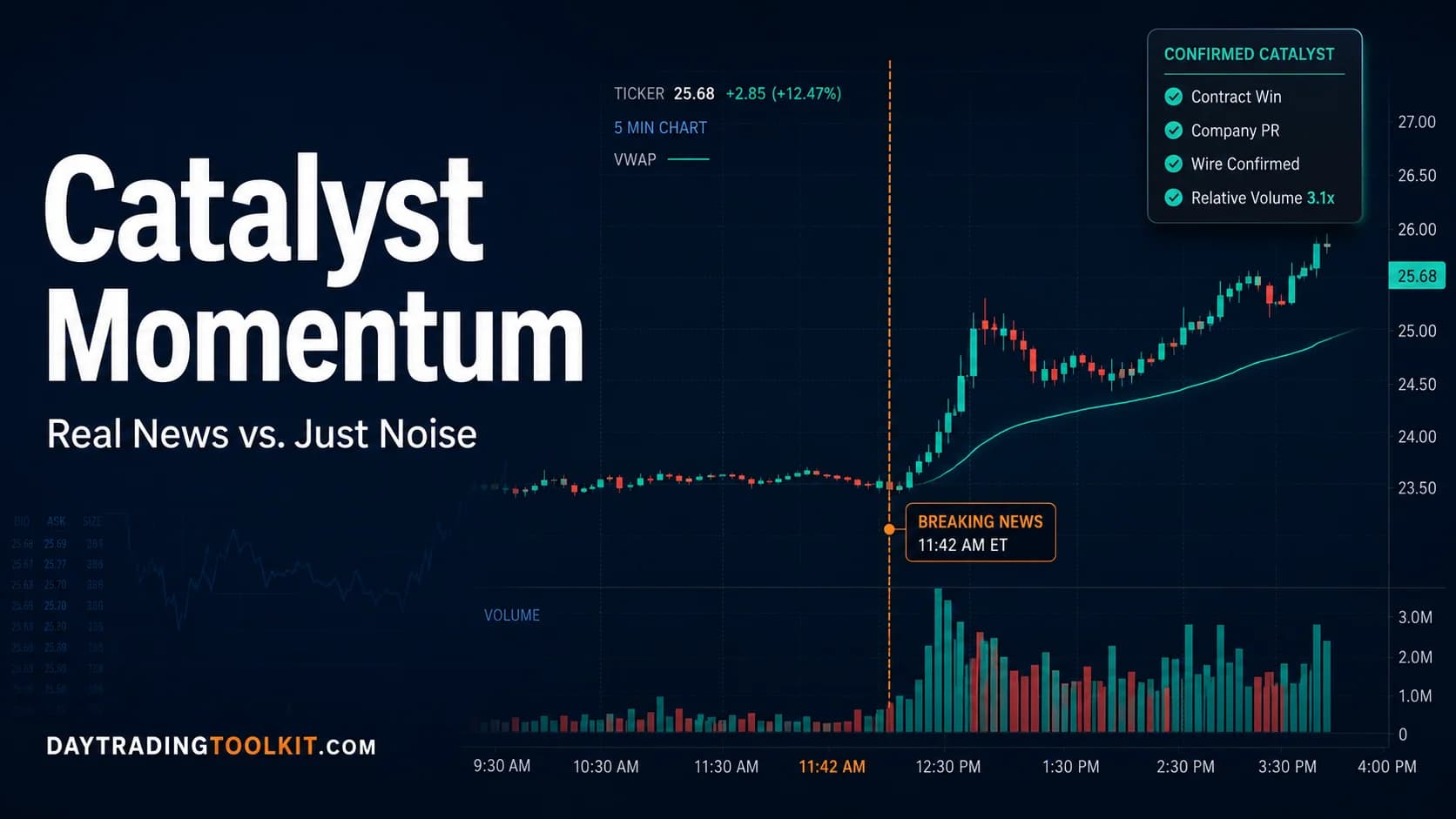
A mid-cap stock trades dead flat all morning, then rips 12% in four minutes on a wire headline nobody saw coming. Some traders chase the print itself. Research on how markets actually process news points somewhere else: confirm the headline is real, watch how the stock behaves in the first few minutes after it, and treat that behavior, not the headline, as the actual signal worth trading.
What is the catalyst momentum strategy? The catalyst momentum strategy trades a stock's directional move following a fresh, verifiable news event, such as a contract win, a regulatory decision, or an analyst action, based on research showing that price moves tied to genuine public news tend to continue rather than reverse. Unlike setups anchored to the opening bell, it can trigger at any point in the session.
Not the Same Trade as a Gap, an Earnings Drift, or a Squeeze
This hub covers several setups that can look similar to catalyst momentum on the surface, and it's worth being precise about how each one differs before going further. Gap and Go is specifically anchored to an overnight gap and the opening bell. The earnings momentum strategy trades the multi-day drift that follows an earnings surprise specifically, grounded in a different body of research built around quarterly reports. The general momentum framework covered elsewhere on this hub can apply to a stock that's simply moving on technical structure, with no identifiable news behind it at all.
Catalyst momentum sits in its own lane. It requires an identifiable, verifiable news event, but that event isn't limited to earnings and isn't limited to the opening bell. A contract announcement at 11:40 AM, a downgrade published mid-session, a litigation ruling that crosses the wire at 2 PM: all of these can trigger this setup, at whatever point in the trading day they actually happen. The common thread is a specific, sourceable piece of news, not a chart pattern and not a scheduled earnings date.
The Research: Why a Real Headline Behaves Differently Than a No-News Spike
Wesley Chan's 2003 study, published in the Journal of Financial Economics, is the clearest empirical case for treating catalyst-driven moves differently from other price spikes. Chan compared stocks that had a large price move accompanied by identifiable public news to stocks with a similarly sized move but no identifiable news behind it at all. The two groups behaved in opposite ways afterward. Stocks with real, sourced news tended to keep drifting in the direction of the initial move, consistent with investors underreacting to the new information. Stocks with no identifiable news behind a comparable move tended to reverse instead.
The effect was strongest after bad news specifically, and Chan found evidence that trading frictions, including constraints on short selling, play a role in why negative catalysts in particular tend to keep drifting rather than getting arbitraged away quickly. The pattern also concentrated more heavily in smaller, less liquid stocks, which lines up with the same limits-to-arbitrage logic covered elsewhere on this hub for other research-backed setups: the harder a mispricing is for institutions to trade against, the longer it tends to survive.
This is the core reason this guide treats "the headline is real and sourced" as a hard requirement rather than a nice-to-have. A big move with a genuine, verifiable catalyst behind it has research-based reason to keep going. A big move with no identifiable source behind it, just price and volume with no clear explanation, is statistically closer to the population of moves that reverse.
Grading the Catalyst: Which Headlines Carry Real Follow-Through
Not all catalysts carry the same weight, and treating them as interchangeable is a mistake. Kent Womack's 1996 study on analyst recommendation changes offers one of the more striking, specific findings applicable here. Buy recommendations produced a modest post-event drift, averaging around 2.4% and fairly short-lived. Sell recommendations produced a much larger drift, averaging around negative 9.1% and extending for roughly six months. That's a meaningful asymmetry: a downgrade, historically, has carried substantially more documented follow-through than an upgrade of comparable prominence.
That asymmetry matters for how this setup gets weighted in practice. A downgrade or other negative catalyst on a stock isn't just a mirror image of a positive one; the research suggests it may carry more reliable continuation, at least historically and at the institutional timeframe Womack studied. That doesn't mean upgrades are untradeable, only that they deserve less automatic confidence than a comparably sized negative catalyst.
Beyond analyst actions, the broader category of tradeable catalysts includes contract wins and partnership announcements, litigation and regulatory outcomes, executive departures or appointments, and confirmed M&A activity. Confirmed activity is the operative phrase. An M&A rumor sourced to unnamed people familiar with the matter carries meaningfully less reliability than a company's own press release or an official regulatory filing, and this guide treats unconfirmed rumors as a lower-confidence category, not a disqualifying one, but one that demands more caution before sizing a position normally.
Confirming the Move Before You Chase It: Volume, Spread, and Timing
The gap between a genuine catalyst and an attention-driven pop isn't always obvious from the headline alone. It shows up in how the stock actually trades in the first few minutes.
Zhi Da, Joseph Engelberg, and Pengjie Gao's 2011 study on investor attention, measured through Google search volume, found that spikes in retail attention to a stock predict higher prices over the following two weeks, followed by a reversal over the following year, an effect strongest in exactly the kind of smaller, retail-heavy stocks this setup often targets. Attention alone, without a genuine information event behind it, produces a pattern that looks like a catalyst in the moment and behaves like noise afterward.
The practical filter is watching relative volume and spread behavior alongside the headline itself, not instead of it. A genuine catalyst tends to bring real size through the tape immediately, with the bid-ask spread tightening as real buyers and sellers show up rather than widening on thin, jumpy quotes. A move that's mostly social-media chatter or a single unconfirmed post making the rounds tends to show choppier price action on lighter real volume relative to how large the percentage move looks on a chart. Checking whether the news is confirmed by the company itself, a regulatory filing, or a credible wire service, rather than a screenshot or a forum post with no clear origin, is the single fastest version of this filter available in the moment.
The Catalyst Momentum Setup Specification
Every component below assumes a specific, sourceable news event has already hit the tape. This setup does not trade unconfirmed rumors or unexplained price spikes.
- Component
- Market Conditions Required
- Rule
- A specific, verifiable catalyst (company release, regulatory filing, credible wire report, or confirmed analyst action) within the current or immediately prior session; broad market not in extreme, single-stock-swamping volatility.
- Component
- Time of Day
- Rule
- Not anchored to the open. Can trigger any time a catalyst crosses, though liquidity and follow-through generally read cleaner during the regular session than in thin pre-market or after-hours trading.
- Component
- Stock Selection Criteria
- Rule
- Small or mid-cap names show the clearest version of this effect; the catalyst should be sourced to the company, a regulator, or a credible wire service rather than an unconfirmed post or rumor.
- Component
- Entry Trigger
- Rule
- A break above the high of the brief pullback or consolidation that follows the initial spike, on continued relative volume, rather than chasing the first vertical print itself.
- Component
- Stop Loss
- Rule
- Below the low of that same pullback or consolidation, not the full distance back to the pre-catalyst price.
- Component
- Initial Profit Target + Scaling
- Rule
- Scale a portion at the next meaningful level (a prior intraday level where the stock previously stalled, a round number), trail the remainder behind the developing structure.
- Component
- Trade Management
- Rule
- Watch relative volume and price action through the following 30 to 60 minutes; genuine continuation shows fresh highs on sustained volume, not just a single spike followed by silence.
- Component
- Invalidation Criteria
- Rule
- Volume collapses back toward normal without a new high, the news gets clarified or walked back in a way that weakens the original catalyst, or price fully retraces back through the pre-catalyst level.
| Component | Rule |
|---|---|
| Market Conditions Required | A specific, verifiable catalyst (company release, regulatory filing, credible wire report, or confirmed analyst action) within the current or immediately prior session; broad market not in extreme, single-stock-swamping volatility. |
| Time of Day | Not anchored to the open. Can trigger any time a catalyst crosses, though liquidity and follow-through generally read cleaner during the regular session than in thin pre-market or after-hours trading. |
| Stock Selection Criteria | Small or mid-cap names show the clearest version of this effect; the catalyst should be sourced to the company, a regulator, or a credible wire service rather than an unconfirmed post or rumor. |
| Entry Trigger | A break above the high of the brief pullback or consolidation that follows the initial spike, on continued relative volume, rather than chasing the first vertical print itself. |
| Stop Loss | Below the low of that same pullback or consolidation, not the full distance back to the pre-catalyst price. |
| Initial Profit Target + Scaling | Scale a portion at the next meaningful level (a prior intraday level where the stock previously stalled, a round number), trail the remainder behind the developing structure. |
| Trade Management | Watch relative volume and price action through the following 30 to 60 minutes; genuine continuation shows fresh highs on sustained volume, not just a single spike followed by silence. |
| Invalidation Criteria | Volume collapses back toward normal without a new high, the news gets clarified or walked back in a way that weakens the original catalyst, or price fully retraces back through the pre-catalyst level. |
The entry trigger's insistence on a pullback and confirmation, rather than the initial print, exists specifically because the first minute or two after a fresh headline is often the most volatile and least informative part of the move. Waiting for the market to digest the news briefly, then confirming which way it actually wants to go, filters out a meaningful share of the moves that spike and immediately fail.
A Walkthrough: Trading a Midday Contract-Win Headline in a Hypothetical Stock
Consider a hypothetical mid-cap stock, ticker QRV, to show the mechanics. None of the prices, times, or events below describe an actual company.
QRV trades quietly between $9.30 and $9.45 through the first two hours of the session, on unremarkable volume. At 11:42 AM ET, a wire headline crosses confirming QRV has signed a multi-year supply contract with a major manufacturer, sourced directly to the company's own press release. Within two minutes, QRV spikes to $10.80, with relative volume jumping to roughly eight times its normal pace for that time of day and the bid-ask spread tightening as real size trades through both sides.
Over the next six minutes, QRV pulls back to $10.35 as some of the initial spike's buyers take quick profits. It stabilizes there, then reclaims strength and breaks back above the brief consolidation's high of $10.60 around 11:52 AM, on volume still running about four times normal. That break is the entry trigger. A stop goes in just below $10.35, the low of the consolidation that preceded the break.
QRV extends through the early afternoon, reaching $11.20 by 12:20 PM, a level where the stock had previously stalled intraday earlier in its trading history. A portion of the position is scaled off there, with the remainder trailing behind the pattern of higher lows that has formed since the entry.
By 1:15 PM, relative volume has faded back toward normal, and QRV is chopping between $10.90 and $11.15 without printing a fresh high. That combination, normal volume and no new structure, is the invalidation signal. The remaining position closes near $11.00. The trade captured the bulk of its move in the roughly 90 minutes following confirmed follow-through, and exited once that follow-through stopped showing up in the tape.
Managing the Trade After the Headline Fades From the Ticker
The hardest part of managing this setup isn't the entry. It's recognizing the difference between a market that's still actively absorbing genuine news and a stock that's simply gone quiet because the move is already over.
Genuine continuation, consistent with the research this setup is built on, tends to show fresh highs alongside sustained, above-normal volume through the minutes and sometimes hours following the initial reaction. A stock that's done reacting tends to show the opposite: volume settling back toward its normal baseline while price goes sideways, even if it hasn't given back much of the initial move. That second pattern is a signal to tighten up or exit, not a reason to assume the position just needs more time.
Especially strong catalysts occasionally show meaningful follow-through into the next session as well, echoing the same underreaction logic covered in this hub's earnings momentum guide. That's worth a quick premarket check on a name that closed strong the day before, but it's the exception rather than the default here; this setup is built primarily around the same-session reaction, not a multi-day hold.
Where This Strategy Fails: Rumor Reversals and the Attention Trap
Every setup on this hub gets an honest look at how it breaks, and this one has a few specific failure modes worth naming directly.
The most damaging failure is trading a rumor that turns out to be wrong. A headline sourced to unnamed people familiar with the matter, or a claim circulating on social media with no company confirmation, can move a stock just as sharply as a real catalyst in the first few minutes, and then evaporate entirely once the company denies it or nothing further materializes. Requiring a verifiable, sourced catalyst before entry, rather than reacting to the price action alone, is the direct defense against this failure mode.
The second failure mode is the attention trap covered above: a stock that's popping mainly because of social media buzz or search-driven attention, without a genuine information event behind it, is statistically closer to the population of moves that reverse than the population that drifts. A big percentage move with thin, choppy real volume behind it and no clearly sourced explanation is a warning sign, not a reason to assume something must be happening that hasn't been reported yet.
The third is a mechanical one: a sharp enough catalyst-driven spike can trigger a volatility halt, freezing the stock mid-move and reopening it at a meaningfully different price in either direction. That risk concentrates in exactly the small, thinly-traded names this setup often targets, and it's worth understanding before it happens rather than while staring at a frozen quote.
The fourth is simply picking the wrong stock for this setup. A single headline about a heavily covered large-cap, already swimming in analyst coverage and institutional attention, rarely moves the stock the way the same headline would on a smaller, less-followed name. The research behind this setup concentrates in exactly the part of the market that isn't already saturated with information and attention.
Adapting the Setup Across Catalyst Types and Directions
The setup works in reverse for negative catalysts using identical logic: a downgrade, a disappointing regulatory outcome, or negative litigation news that drives a stock down, followed by a brief bounce and then a break back to new lows on renewed volume, is the mirror-image short version. Given Womack's finding on the size and persistence of the drift following analyst downgrades specifically, this side of the trade carries a meaningful amount of specific research behind it, not just symmetry with the long version.
A catalyst that hits pre-market and produces an overnight gap shifts into Gap and Go's territory for the opening-bell trade itself; this setup's mechanics still apply for any fresh follow-through move later in that same session, once the opening reaction has already played out. A catalyst hitting midday or in the final hour of trading has no gap to speak of at all, and this setup applies to it directly without any opening-bell component.
One specific catalyst-driven pattern gets its own dedicated treatment elsewhere on this hub: a sharp short-covering spike following a squeeze-triggering catalyst is covered in full in this hub's short squeeze playbook, which addresses the specific mechanics of high short interest and forced covering that a general catalyst framework doesn't capture on its own.
Screening for Fresh Catalysts Without Missing the Move
News crosses continuously throughout the session, on thousands of tickers, and manually monitoring wire feeds across the whole market isn't realistic without a dedicated tool built for exactly that job.
Trade Ideas works as a comprehensive scanning and research platform here, surfacing stocks with fresh news catalysts alongside relative volume in real time, so a genuine spike with real size behind it stands out from routine chart noise. Its Holly AI signals, built on nightly backtested criteria, can also flag momentum names worth a second look as a session develops. The scan does the work of surfacing candidates; confirming the actual entry trigger on the setup specification above still governs whether a position gets taken.
Sizing a Catalyst Trade Inside a Broader Plan
Beyond the mechanics, understanding how relative volume behaves is close to a prerequisite for trading this setup well, since so much of the entry and invalidation logic above depends on reading volume correctly rather than price alone.
The psychological trap specific to this setup is the urge to buy the initial vertical print the instant a headline crosses, before there's been any confirmation the move is genuine or that the market has actually digested the news. This guide's coverage of FOMO in trading applies directly: the entry trigger's insistence on a pullback and confirmation exists specifically to interrupt that impulse, not to slow a trader down for its own sake. This strategy belongs on the Strategies Hub as the momentum module's broadest tool, the one that applies whenever a real, sourced piece of news moves a stock, regardless of what time the headline happens to cross.
Common Questions About Trading Catalyst Momentum
How is this different from the Gap and Go strategy covered elsewhere on this hub?
A catalyst that breaks pre-market and produces a gap becomes a Gap and Go candidate for the opening-bell trade specifically. The same catalyst's follow-through later in that session, or a fresh catalyst hitting midday or in the afternoon, is catalyst momentum's territory instead.
Key Takeaway: Gap and Go is a time-anchored subset of catalyst-driven moves; catalyst momentum is the broader framework that applies any time a real headline hits.
How is this different from the earnings momentum strategy?
Both setups share a similar underlying idea, that markets underreact to genuine information, but they're grounded in separate studies with separate selection criteria, and an earnings-specific catalyst is better handled with the dedicated earnings momentum framework.
Key Takeaway: If the catalyst is an earnings report, use the earnings momentum guide; for any other verifiable news event, this framework applies.
Why do negative catalysts like downgrades tend to show stronger follow-through than positive ones?
That doesn't mean positive catalysts don't work, only that the historical evidence for continuation is stronger and more persistent on the negative side, which is worth factoring into how much confidence gets placed in either direction.
Key Takeaway: A downgrade or negative catalyst has more specific research behind its follow-through than a comparably sized positive one.
How can you tell a real catalyst from social media hype before entering?
Checking the actual source before entering, not just the size of the move on a chart, is the fastest version of this filter available in real time.
Key Takeaway: No verifiable source behind the move is a reason to stay out, regardless of how big the initial spike looks.
Does this setup only work at certain times of day?
Liquidity and follow-through tend to read more cleanly during the regular session than in thin pre-market or after-hours trading, but the core mechanics don't depend on a specific time window the way Gap and Go does.
Key Takeaway: The trigger is the news itself, not the clock.
What happens if the news behind the move turns out to be false or gets retracted?
This is the single most damaging failure mode for this strategy, and it's specifically why the setup specification requires a sourced, verifiable catalyst before an entry trigger is even considered.
Key Takeaway: An unverified rumor is not a catalyst in this framework, no matter how sharply the stock is moving on it.
Why does this setup tend to work better on smaller stocks?
A heavily covered large-cap already has so much information flowing through it that a single new headline rarely creates the same durable, tradeable reaction it can create in a smaller, less-followed name.
Key Takeaway: Coverage and liquidity work against this setup's edge, not in its favor.
Can this be combined with the short squeeze strategy covered elsewhere on this hub?
Checking a stock's short interest before entering a catalyst trade is a reasonable habit, since a squeeze dynamic can accelerate a move well beyond what the news alone would typically produce.
Key Takeaway: A squeeze is catalyst momentum with an extra structural accelerant layered on top.
What tool or filter would actually help catch a fresh catalyst as it happens?
Trade Ideas, covered earlier in this guide, handles this job directly, combining real-time news catalysts with relative volume filtering so a genuine spike stands out from routine noise as it develops.
Key Takeaway: The scan surfaces the candidate; the setup specification's entry trigger still governs whether a position gets taken.
Is this a same-day-only strategy, or can it carry into the next session?
That next-day follow-through is the exception here, not the default. A trader looking for a setup specifically built around multi-day continuation should use the dedicated earnings momentum framework instead.
Key Takeaway: Plan for a same-session trade by default, and treat next-day continuation as a bonus rather than something to expect.
Disclaimer
Article Sources
- Chan, W. (2003), "Stock Price Reaction to News and No-News: Drift and Reversal After Headlines," Journal of Financial Economics - finds that stocks with genuine identifiable news drift afterward, while comparably sized moves with no identifiable news tend to reverse
- Womack, K. (1996), "Do Brokerage Analysts' Recommendations Have Investment Value?," The Journal of Finance - documents a much larger and longer-lasting post-event drift following sell recommendations than buy recommendations
- Da, Z., Engelberg, J. & Gao, P. (2011), "In Search of Attention," The Journal of Finance - finds that spikes in retail investor attention predict short-term price pressure followed by reversal, without requiring a genuine news event
- Bernard, V. & Thomas, J. (1989), "Post-Earnings-Announcement Drift: Delayed Price Response or Risk Premium?," Journal of Accounting Research - the foundational underreaction-to-information research this guide's broader framework builds on, applied here to non-earnings catalysts
Was this helpful?
Be the first to weigh in

Written by
Kazi Mezanur RahmanFounder, independent researcher, and editor of DayTradingToolkit. A one-person publication focused on risk-first trading education and documented tool research. He trades his own capital as a retail trader and combines personal market experience with systematic primary-source research.
Keep Reading
Strategies
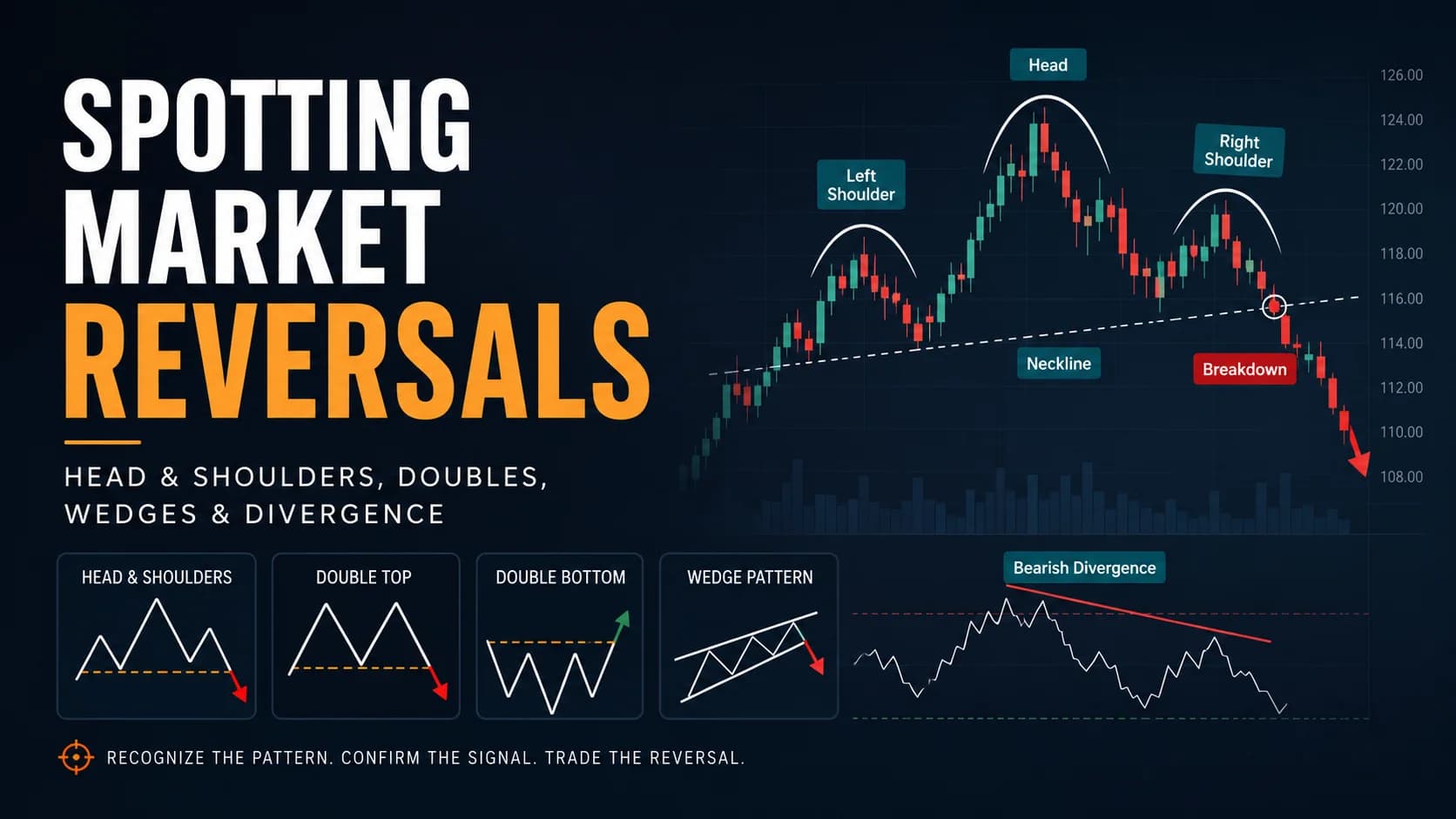
Calling the Turn: Spotting Market Reversals Using Patterns & Divergence
Every reversal pattern tells the same story of failing momentum. This guide covers the anatomy, entry mechanics, and stop placement for each major setup.
Strategies
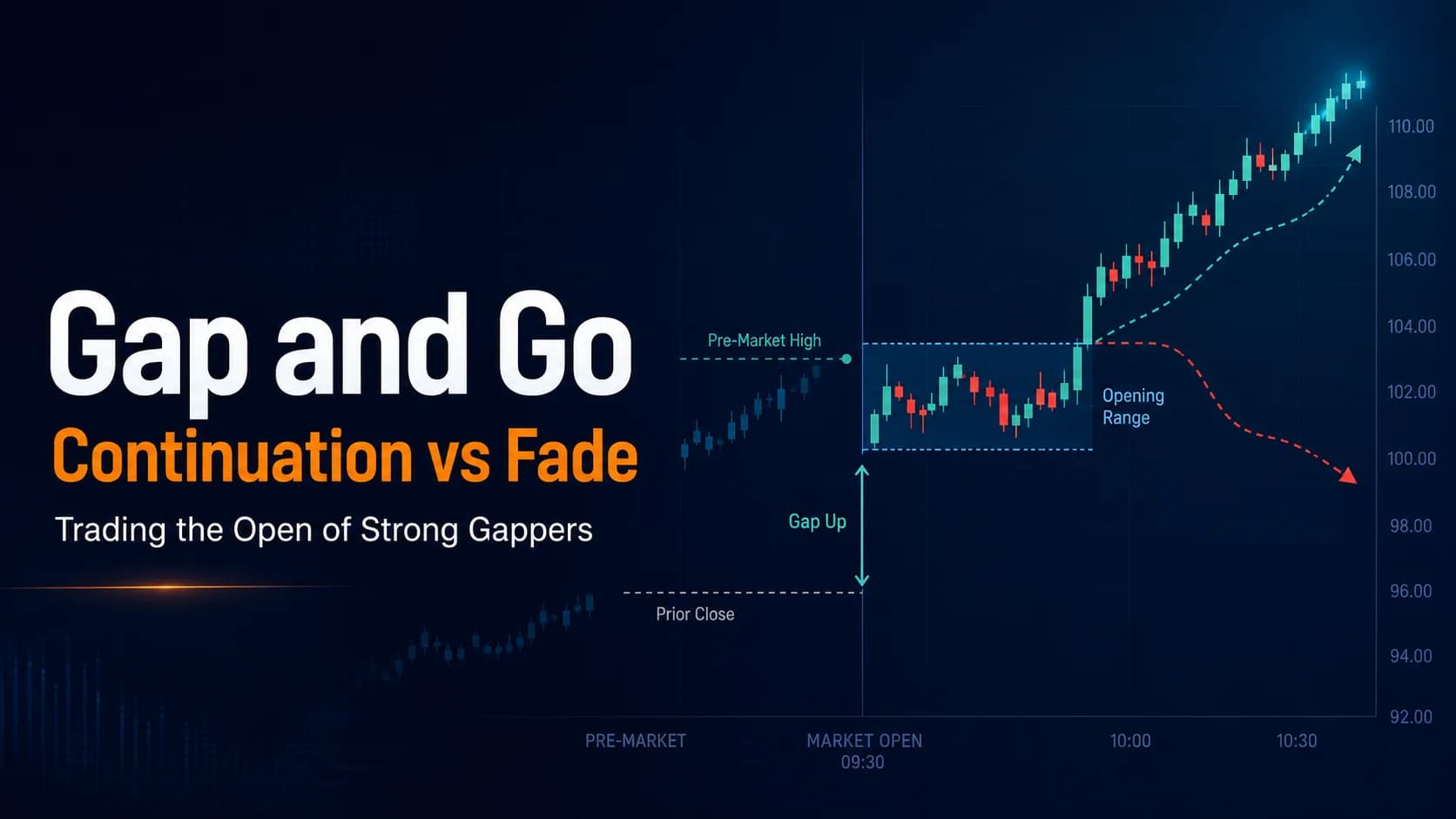
The Gap and Go Strategy: Trading the Open of Strong Gappers
Research shows most gaps reverse during the day, not continue. This guide covers how to spot the ones that genuinely keep going, and how to trade them.
Strategies
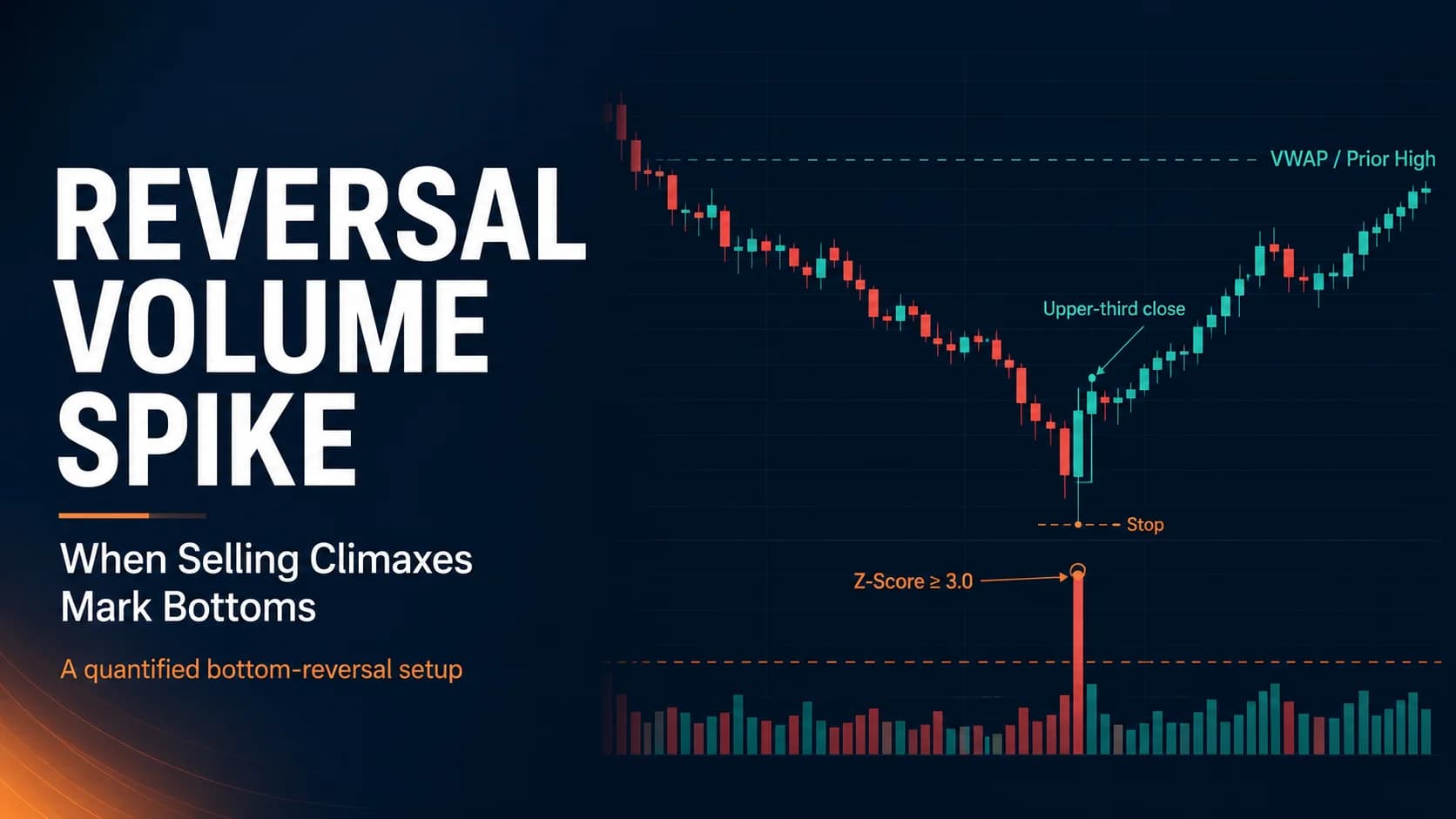
The Reversal Volume Spike Strategy: When Selling Climaxes Mark Bottoms
Not every volume spike marks a real bottom, and not every bottom needs full capitulation. This guide covers the statistical setup for trading the difference.
Strategies
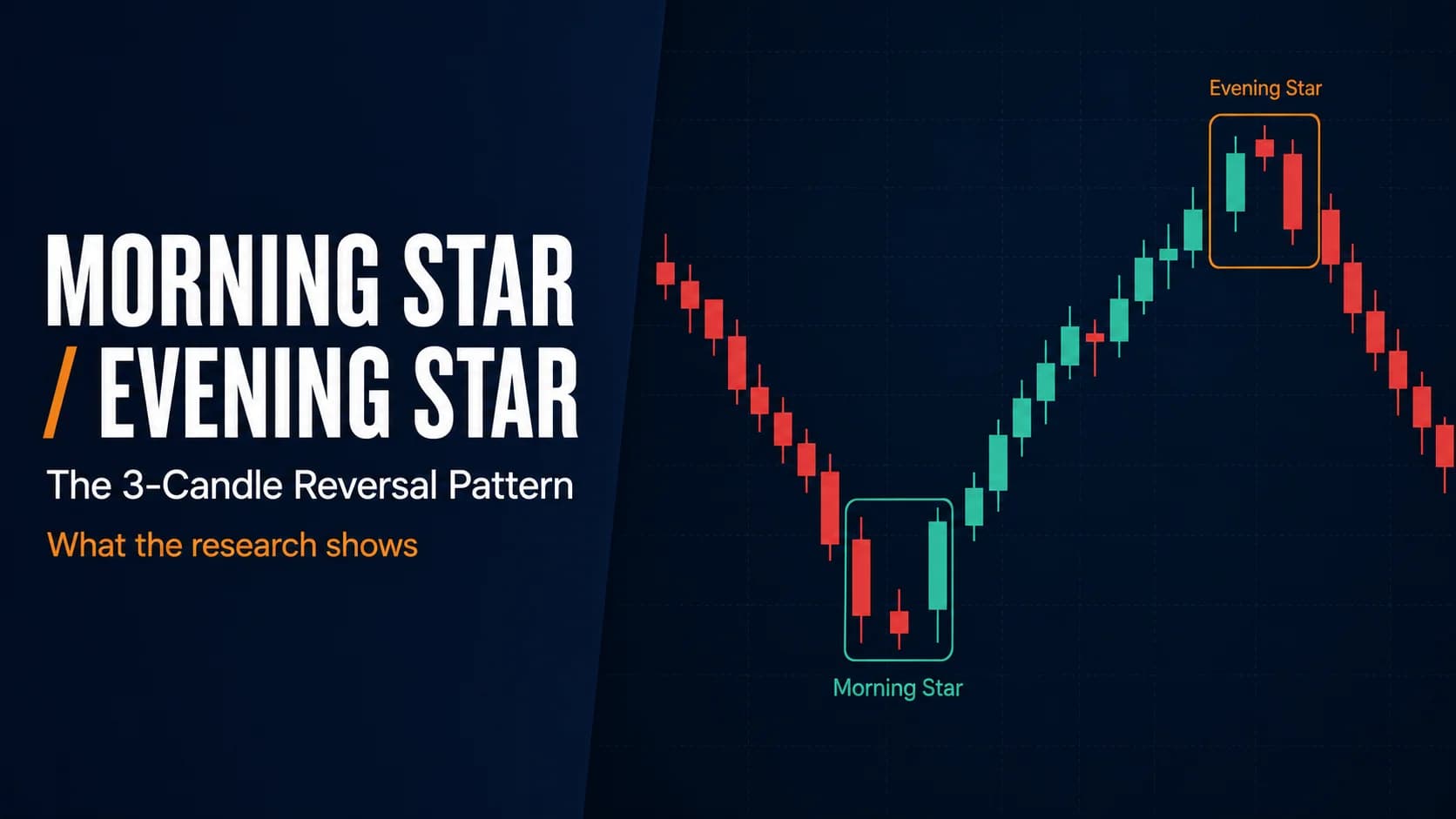
The Morning Star / Evening Star Reversal Strategy
Candlestick research is genuinely split on these patterns. This guide covers the classic 3-candle setup, the real evidence, and how to trade it honestly.
Comments
No comments yet. Be the first to share your thoughts.