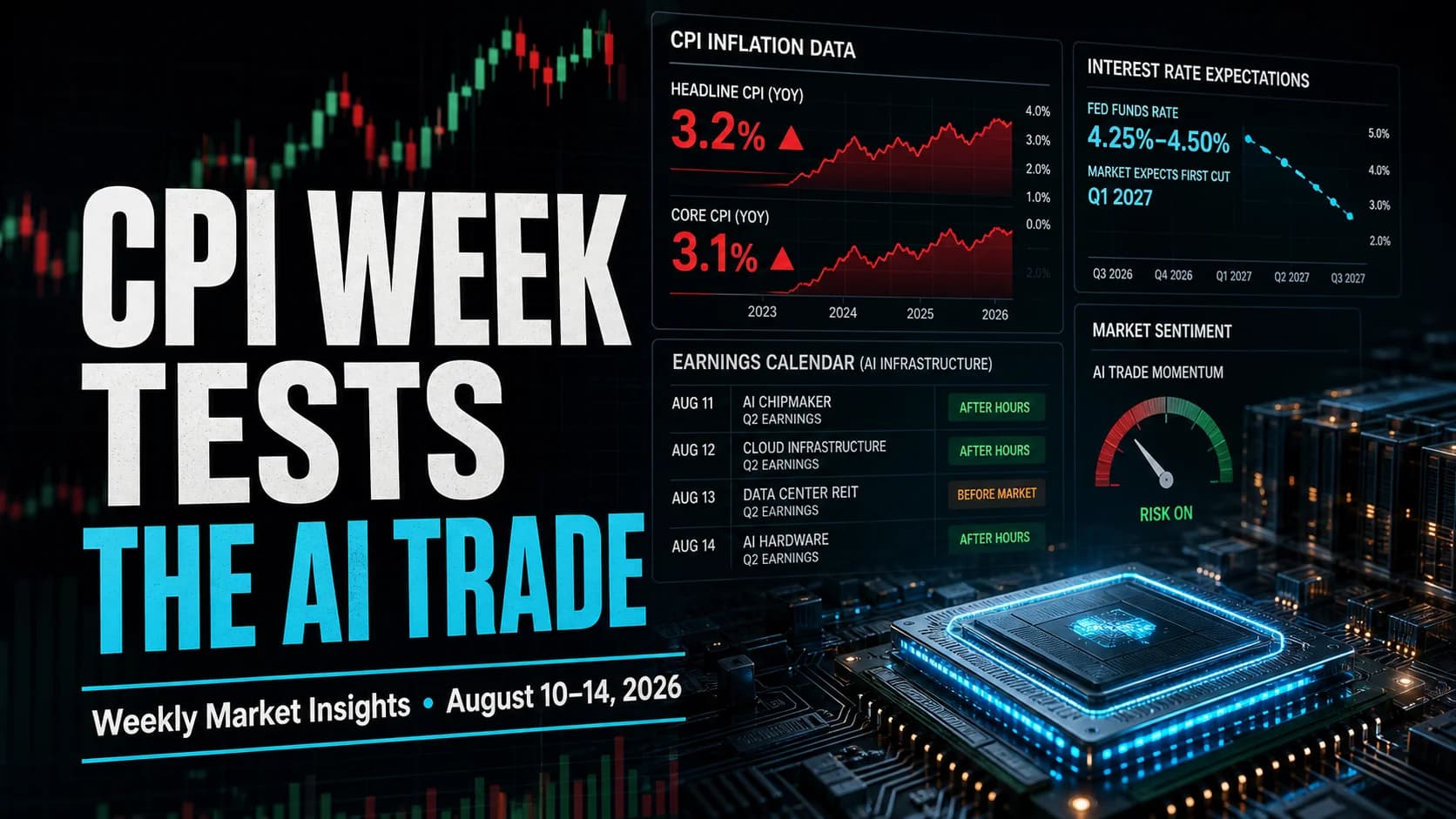
Weekly Market Insights August 10-14, 2026: A Weak Jobs Report Bought the Fed Room to Wait. CPI and a Wall of AI Earnings Decide If It Holds.

In this article8 sections
Research cutoff: Monday, August 10, 2026, before the opening bell, Eastern Time. Market levels below reflect Friday, August 7's regular session close, the most recently completed session, along with Monday premarket data where noted.
Last week, this space flagged four things worth watching: Palantir's earnings, AMD's earnings, SpaceX's earnings-into-lockup double header, and Friday's jobs report. All four landed. None of them did what the simple version of the story predicted.
Palantir beat and rose 12%. AMD beat and fell 7% anyway. SpaceX cratered 14% the day after its own earnings, then rose 6% the day its lockup dumped more than 900 million new shares onto the market, close to the opposite of what a supply shock is supposed to do. And Friday's jobs report showed the economy losing jobs for the first time in months, which sent the S&P 500 to a fresh record high, because a weaker labor market now reads as permission for the Federal Reserve to stay on hold.
If last week proved anything, it's that the headline number isn't the story anymore. The market is grading something underneath it: forward guidance, positioning, and how much of the news was already priced in before it printed. This week hands it another round of the same test, on a bigger scale. Eight companies report earnings between Monday night and Thursday, most of them tied to the same AI capital-spending argument, while a divided, newly led Fed waits on Wednesday's CPI and Thursday's PPI to find out whether one soft jobs report was a warning sign or a blip.
Week at a Glance: August 10-14, 2026
All times are Eastern.
- Day
- Monday
- Date
- August 10
- Time ET
- After close, 5:00 p.m. call
- Event
- Rocket Lab (RKLB) earnings
- Relevance
- High
- Why It Matters
- The week's first report, and the only one with nothing to do with the AI-cloud story dominating the rest of the calendar.
- Day
- Tuesday
- Date
- August 11
- Time ET
- 8:15 a.m.
- Event
- ADP employment change
- Relevance
- Medium
- Why It Matters
- A private-sector labor check one week after the shock BLS payrolls miss.
- Day
- Tuesday
- Date
- August 11
- Time ET
- 10:00 a.m.
- Event
- Existing home sales (July)
- Relevance
- Low-Medium
- Why It Matters
- Rate-sensitivity context, not a standalone catalyst.
- Day
- Tuesday
- Date
- August 11
- Time ET
- After close, 5:00 p.m. calls
- Event
- Lumentum (LITE), Super Micro (SMCI), CoreWeave (CRWV) earnings
- Relevance
- Very High
- Why It Matters
- Three AI-infrastructure reports land within roughly the same hour: optics, servers, and pure-play cloud.
- Day
- Wednesday
- Date
- August 12
- Time ET
- 8:00 a.m.
- Event
- Nebius (NBIS) earnings release
- Relevance
- Very High
- Why It Matters
- The first earnings test since Michael Burry disclosed a short position against the stock on August 6.
- Day
- Wednesday
- Date
- August 12
- Time ET
- 8:30 a.m.
- Event
- July CPI, headline and core
- Relevance
- Very High
- Why It Matters
- The week's clearest test of whether disinflation can offset the labor-market scare.
- Day
- Wednesday
- Date
- August 12
- Time ET
- After close
- Event
- Cisco (CSCO), Coherent (COHR) earnings
- Relevance
- High
- Why It Matters
- A networking-demand read plus a second photonics report, both AI-buildout proxies.
- Day
- Thursday
- Date
- August 13
- Time ET
- 8:30 a.m.
- Event
- July PPI and weekly initial jobless claims
- Relevance
- Very High
- Why It Matters
- Pipeline inflation, plus a fresher labor read after last week's shock.
- Day
- Thursday
- Date
- August 13
- Time ET
- After close
- Event
- Applied Materials (AMAT) earnings
- Relevance
- Very High
- Why It Matters
- The semiconductor capital-equipment bellwether; options were pricing a double-digit post-earnings move.
- Day
- Friday
- Date
- August 14
- Time ET
- 8:30 a.m.
- Event
- July retail sales
- Relevance
- High
- Why It Matters
- The first consumer-spending read since the payrolls miss.
- Day
- Friday
- Date
- August 14
- Time ET
- 10:00 a.m.
- Event
- Preliminary University of Michigan consumer sentiment (August)
- Relevance
- Medium
- Why It Matters
- Confirmation data, not a standalone catalyst.
| Day | Date | Time ET | Event | Relevance | Why It Matters |
|---|---|---|---|---|---|
| Monday | August 10 | After close, 5:00 p.m. call | Rocket Lab (RKLB) earnings | High | The week's first report, and the only one with nothing to do with the AI-cloud story dominating the rest of the calendar. |
| Tuesday | August 11 | 8:15 a.m. | ADP employment change | Medium | A private-sector labor check one week after the shock BLS payrolls miss. |
| Tuesday | August 11 | 10:00 a.m. | Existing home sales (July) | Low-Medium | Rate-sensitivity context, not a standalone catalyst. |
| Tuesday | August 11 | After close, 5:00 p.m. calls | Lumentum (LITE), Super Micro (SMCI), CoreWeave (CRWV) earnings | Very High | Three AI-infrastructure reports land within roughly the same hour: optics, servers, and pure-play cloud. |
| Wednesday | August 12 | 8:00 a.m. | Nebius (NBIS) earnings release | Very High | The first earnings test since Michael Burry disclosed a short position against the stock on August 6. |
| Wednesday | August 12 | 8:30 a.m. | July CPI, headline and core | Very High | The week's clearest test of whether disinflation can offset the labor-market scare. |
| Wednesday | August 12 | After close | Cisco (CSCO), Coherent (COHR) earnings | High | A networking-demand read plus a second photonics report, both AI-buildout proxies. |
| Thursday | August 13 | 8:30 a.m. | July PPI and weekly initial jobless claims | Very High | Pipeline inflation, plus a fresher labor read after last week's shock. |
| Thursday | August 13 | After close | Applied Materials (AMAT) earnings | Very High | The semiconductor capital-equipment bellwether; options were pricing a double-digit post-earnings move. |
| Friday | August 14 | 8:30 a.m. | July retail sales | High | The first consumer-spending read since the payrolls miss. |
| Friday | August 14 | 10:00 a.m. | Preliminary University of Michigan consumer sentiment (August) | Medium | Confirmation data, not a standalone catalyst. |
The sequencing matters as much as any single event. Rocket Lab reports before the week's macro data even starts. Tuesday stacks three AI-infrastructure names into one after-hours window. Wednesday opens with Nebius before the market even opens, then CPI thirty minutes later, then two more earnings reports that evening. Thursday pairs PPI with the week's largest single earnings reaction risk. By the time Friday's retail sales print lands, the market will have already absorbed a full week of both macro and company-specific evidence on the same underlying question.
Last Week's Watchlist, Resolved: What Palantir, AMD, SpaceX, and Sandisk Actually Did
Palantir beat, and the market believed it. Second-quarter revenue came in at $1.94 billion against a roughly $1.80 billion consensus, up 93% year over year, with adjusted earnings of 41 cents per share against 35 cents expected. Management raised full-year U.S. commercial revenue guidance to above $3.42 billion, up from a prior $3.22 billion. The stock rose nearly 12% on the report. That matters because Palantir had fallen after each of its previous four earnings reports despite beating estimates every time. This time, the guidance raise was large enough to change the answer.
AMD beat, and the market didn't care. Data-center revenue and the headline numbers came in ahead of expectations, and third-quarter guidance landed above consensus too. The stock fell about 7% anyway, pressured further by news that SpaceX had selected Nvidia as its sole AI hardware supplier, a direct hit to confidence in AMD's data-center share gains. Two strong reports, two opposite reactions. The difference wasn't the number. It was whether the number changed anyone's mind about the next twelve months.
SpaceX managed both reactions in the same week. The company's debut earnings report as a public company landed Tuesday. By Wednesday, the stock had sunk almost 14% to an all-time low of $108.27, its second-worst single session on record. Then Thursday arrived, and with it the first tranche of the company's post-IPO lockup: 911.5 million shares, more than 43% above the entire float that had been trading, suddenly eligible for sale. Conventional wisdom says a supply shock that size pressures a stock. SpaceX rose 6.1% instead. It rose again Friday, closing the week up close to 19%. Eligible to sell and actually sold turned out to be two different things, and the market spent Thursday figuring out which one was true. DayTradingToolkit's explainer on the unlock mechanics breaks down why that distinction mattered more than the headline share count.
Sandisk beat on every number that usually decides these things, and still fell. Fiscal fourth-quarter earnings of $39.25 per share beat the roughly $34.45 to $34.59 analysts expected, on record revenue of $8.97 billion and a gross margin of 84.6%. None of it held once management guided fiscal first-quarter revenue to $10.3 billion to $10.8 billion, below the roughly $11.16 billion Wall Street wanted. Shares fell further into Thursday's session. Between AMD and Sandisk, this earnings season has now produced the same shape twice: a real beat, undone by forward guidance that didn't clear the bar the market had already set.
That pattern, a strong quarter that isn't enough without a matching outlook, is the exact lens this week's eight earnings reports need to be read through. It's also the lens Michael Burry used when he picked his newest short targets on August 6, a thread this week's Nebius report runs directly into.
Stocks to Watch: Eight Earnings Reports Carrying the AI Capex Argument
Every name below reports this week and can move on its own merits. Together, they touch nearly every layer of the AI infrastructure stack, which makes the group more useful as a set than any single report is on its own. DayTradingToolkit's guide to building a day-trading watchlist is worth a look if eight names in one week feels like too many to hold in your head at once; the point of a watchlist is to remove decisions, not add them.
Rocket Lab (RKLB): the one report with nothing to do with the AI-cloud argument. Rocket Lab reports after Monday's close, with a call at 5:00 p.m. ET, the same day this article publishes. The Zacks consensus calls for a loss of 3 cents per share, a 70% year-over-year improvement, on revenue near $231.6 million, up more than 60%. The stock has gained over 46% since its last report. Watch progress on the Neutron rocket program, which has faced execution-risk questions from analysts, and any update on the $397 million Space Force contract the company secured this summer. A clean report here says something about launch-sector demand independent of whatever the AI trade does the rest of the week.
Lumentum (LITE): the optics name with the highest bar in the group. Lumentum reports fiscal fourth-quarter results Tuesday after the close, call at 5:00 p.m. ET. Analysts expect $2.99 per share, up more than 700% from 32 cents a year ago, on revenue near $988.6 million, more than double the year-ago quarter. Growth like that comes from cloud and AI demand for optical components: narrow-linewidth laser shipments were already up more than 120% year over year last quarter, and management has said several product lines are effectively sold out for now. The number worth watching isn't the beat itself. It's whether 1.6-terabit transceiver shipments are ramping on schedule, since a company already growing this fast has little room for a soft answer on the next leg.
Super Micro (SMCI): the report that already told you part of the answer. Super Micro reports Tuesday as well, call also at 5:00 p.m. ET. A preliminary update in July flagged fourth-quarter revenue landing near the low end of its $11.0 billion to $12.5 billion guidance range, but gross margin coming in at 15% to 17%, well above the 8.2% to 8.4% originally guided, on more than $60 billion in new orders for the quarter. The report itself should mostly confirm those numbers. What it can't confirm in advance is the other half of the Super Micro story: the company is operating under an independent board investigation tied to a March DOJ indictment alleging former employees, including a co-founder, illegally diverted roughly $2.5 billion in AI servers to China. Super Micro itself hasn't been charged, but expect analysts to spend real time on the call asking whether the legal overhang has changed customer or supplier behavior, not just whether the margin number holds.
CoreWeave (CRWV): the most direct test of the AI-infrastructure argument all week. CoreWeave closes out Tuesday's earnings window with a call at 5:00 p.m. ET. CoreWeave doesn't build chips or components, it rents out the AI compute those chips go into, which makes it about as pure a read on AI-demand pricing and utilization as this list has. The stock has underperformed recently on industry overbuild and capacity-delay concerns, worries some analysts have called overblown given what they describe as a roughly four-to-one industry-wide supply-demand imbalance. Watch whether Tuesday's reaction spreads into Wednesday's Nebius report or stays contained to CoreWeave alone. If both AI-cloud names move the same direction for the same underlying reason, that's a sector signal. If they diverge, the market is drawing a line between specific companies rather than the theme.
Nebius (NBIS): the earnings report Michael Burry picked a fight with. Nebius releases results before Wednesday's open, call at 8:00 a.m. ET, thirty minutes ahead of CPI the same morning. Analysts expect revenue near $576 million to $583 million and continued progress toward a $7 billion to $9 billion full-year exit ARR target already more than half contracted. Under normal circumstances that would be the whole story. It isn't this time. On August 6, Michael Burry disclosed a direct equity short in Nebius at $211.77, choosing a straight short over options because, in his words, the puts were priced too expensively to bother with. His stated thesis: AI infrastructure companies may be depreciating GPUs too slowly relative to how fast that hardware actually loses value, which would mean today's reported profits look better than they really are. Nebius shares came under renewed pressure in the days around the disclosure, adding to a rough stretch for the stock since late July. Wednesday's report won't settle an accounting debate like that in one sitting, but capital-expenditure pacing, the timeline for its new Nvidia Vera Rubin hardware to start generating billable revenue, and any commentary on lease obligations will all get read through Burry's thesis whether management addresses it directly or not.
Cisco (CSCO): the legacy name still writing the AI-buildout story. Cisco reports fiscal fourth-quarter results Wednesday after the close. The stock recently broke out above a level it hadn't touched since the dot-com era, on the strength of networking demand tied to AI data-center buildouts. Analysts are looking for networking-segment growth to accelerate to around 26% annually, even as overall product growth is expected to decelerate from last quarter's decade-best pace, with persistently high component costs expected to keep gross margin capped near 66%. Cisco isn't a pure AI-infrastructure story the way CoreWeave or Nebius is, which is exactly what makes it useful this week: a strong number here says the AI buildout is showing up in demand for the unglamorous plumbing underneath it, not just the headline compute names.
Coherent (COHR): the second photonics name, telling a different story than Lumentum's. Coherent releases fiscal fourth-quarter and full-year results Wednesday after the New York Stock Exchange closes, webcast at 4:30 p.m. ET, with consensus near $1.62 per share. Where Lumentum's story is almost entirely about optical growth velocity, Coherent's is about diversification: alongside its networking and datacenter optics business, the company runs a silicon-carbide semiconductor unit that recently locked in $1 billion in joint investment from Denso and Mitsubishi Electric, plus a strategic optics partnership with Nvidia announced earlier this year. That mix means Coherent's report can move on a different axis than Lumentum's even though both sell into the same AI-networking buildout. Watch whether the market treats them as one trade or two.
Applied Materials (AMAT): the week's biggest number, arriving last. Applied Materials closes out the earnings calendar Thursday after the close, the same session as PPI and jobless claims. The stock has roughly doubled this year, and the options market has been pricing a post-earnings move north of 10%, larger than anything else on this week's calendar. As the largest supplier of chip-fabrication equipment to foundries like TSMC and Intel and memory makers like Micron and SK Hynix, Applied Materials sits one level removed from the AI trade the rest of this list sits inside of: it doesn't sell compute or optics, it sells the machines that build the chips those products depend on. A confident outlook here reads as evidence that semiconductor capital spending still has room to run. A cautious one, arriving after CoreWeave, Nebius, and both photonics names have already reported, lands as the week's final word on whether AI-capex skepticism spread to the equipment layer or stayed contained to the cloud names carrying the newer debt.
The Confirmation Board: Software, Memory, Oil, and Rates
The watchlist above explains what individual companies can reveal. The board below helps determine whether a reaction is broad, company-specific, or driven by something outside any single earnings call.
- Theme
- AI-infrastructure skepticism
- Instrument or Comparison
- Oracle (ORCL) alongside Nebius and CoreWeave
- Observable Confirmation
- Whether Burry's two short targets, and the wider AI-cloud group, move together or split apart this week.
- Theme
- Memory sector
- Instrument or Comparison
- Micron (MU), Sandisk (SNDK)
- Observable Confirmation
- Whether last week's post-earnings weakness broadens or the sector stabilizes.
- Theme
- Rates and the dollar
- Instrument or Comparison
- 10-year yield, dollar index
- Observable Confirmation
- Confirms whether Wednesday's CPI is read as disinflationary independent of the equity reaction.
- Theme
- Oil and the Hormuz deadline
- Instrument or Comparison
- WTI, Brent crude
- Observable Confirmation
- The Iran-Oman toll-free transit window is due to expire around mid-August; a spike here reintroduces energy-inflation risk.
- Theme
- Small-cap participation
- Instrument or Comparison
- Russell 2000 versus the S&P 500
- Observable Confirmation
- Whether Friday's broad rally keeps including small caps or narrows back to megacap tech.
| Theme | Instrument or Comparison | Observable Confirmation |
|---|---|---|
| AI-infrastructure skepticism | Oracle (ORCL) alongside Nebius and CoreWeave | Whether Burry's two short targets, and the wider AI-cloud group, move together or split apart this week. |
| Memory sector | Micron (MU), Sandisk (SNDK) | Whether last week's post-earnings weakness broadens or the sector stabilizes. |
| Rates and the dollar | 10-year yield, dollar index | Confirms whether Wednesday's CPI is read as disinflationary independent of the equity reaction. |
| Oil and the Hormuz deadline | WTI, Brent crude | The Iran-Oman toll-free transit window is due to expire around mid-August; a spike here reintroduces energy-inflation risk. |
| Small-cap participation | Russell 2000 versus the S&P 500 | Whether Friday's broad rally keeps including small caps or narrows back to megacap tech. |
Oracle is worth watching even though it doesn't report this week. Burry's August 6 disclosure paired the new Nebius short with a fresh Oracle short at $144.63, built on similar leverage-and-depreciation logic, and Oracle carries its own separate overhang: an S&P Global downgrade of its long-term credit rating to BBB- on July 9, one notch above speculative grade, citing Oracle's roughly $638 billion contract backlog and its heavy concentration in OpenAI, which S&P estimated accounts for close to half of that total. If Nebius's Wednesday report reassures the market on capital discipline and Oracle rallies in sympathy, that suggests the market is treating Burry's thesis as company-specific. If both stay pressured regardless of what Nebius actually reports, the thesis itself is what's trading, not the fundamentals underneath either company.
Memory is the sector to watch for continuation rather than reversal. Micron and Sandisk both slid in the days after Sandisk's Wednesday report, and Citi trimmed its Micron price target around the same time on concerns that memory pricing could peak next year rather than keep climbing. Nothing about CPI or PPI directly confirms or denies that, but a memory sector that keeps sliding through a week of otherwise-positive AI-infrastructure earnings would say the market has drawn a specific line around pricing risk, not around enthusiasm for AI hardware broadly.
Several of this week's names, Rocket Lab aside, share the same underlying macro driver even though they sell entirely different products. DayTradingToolkit's guide to correlation risk is worth a look before treating four or five separate earnings reactions as four or five independent trades.
Can "The Fed Can Wait" Survive a Week of CPI, PPI, and Eight Earnings Reports?
Friday's jobs report bought the market a specific, narrow kind of relief: permission to believe the Fed doesn't need to hike in September. That relief rests on an assumption that hasn't been tested yet, that a one-month contraction in payrolls means the same thing for policy as a genuine slowdown. This week is where the assumption gets tested twice: once by the inflation data, and once by whether AI-infrastructure earnings can survive the same scrutiny that just took down AMD and Sandisk despite both companies beating estimates.
Start with the more mechanical branch. If Wednesday's CPI and Thursday's PPI come in at or below consensus, roughly 0.2% to 0.3% on the core monthly reads, the disinflation story stays intact, and the Fed's July hold looks less like the start of an argument and more like a reasonable pause. In that world, this week's earnings reports get judged on their own terms rather than as referendums on interest-rate policy, and a rally that's already broadened past megacap tech, Friday's session included gains across SPY, QQQ, and the Russell 2000, has room to keep including small caps rather than narrowing back to a handful of names.
The harder branch is a hot print. Markets went into the weekend pricing something in the neighborhood of a mid-40s percentage chance of a September hike, down sharply from the high 50s before Friday's jobs number. A CPI or PPI surprise to the upside would push that back toward where it sat a week ago, at the worst possible moment for this week's earnings calendar: companies like Nebius and CoreWeave are asking investors to be patient with heavy, multi-year capital spending on the promise of future AI revenue, a story that gets harder to tell at a higher discount rate. Rate-sensitive growth names don't need bad news to fall in that scenario. They just need the market to start pricing their future cash flows differently.
Then there's the branch that has nothing to do with the Fed at all. Layer last week's pattern back in. AMD beat and fell 7%. Sandisk beat and fell into Thursday. Palantir beat and rose 12%, but only because the guidance raise was large enough to change the multi-year story, not just the trailing quarter. This week's eight reports face the same test regardless of what CPI and PPI do. A cooperative inflation print doesn't automatically rescue an earnings call that doesn't clear the bar on capital-expenditure pacing, customer concentration, or forward demand visibility, the exact questions Burry's Nebius and Oracle shorts are built around. It's entirely possible for the macro data to come in fine and for one or two of this week's AI-infrastructure names to fall anyway, for the same reason AMD and Sandisk did.
The wildcard sits outside both the calendar and the earnings reports.
None of these branches are mutually exclusive, and the honest answer is that this week probably delivers pieces of more than one. The evidence worth tracking in real time: whether Wednesday's 10-year yield reaction to CPI agrees with the equity reaction, whether Tuesday's and Wednesday's AI-infrastructure earnings get judged on guidance rather than the trailing quarter, and whether oil headlines stay quiet enough to let the inflation data do the talking on its own.
What Can Be Safely De-Prioritized
Tuesday's secondary data matters for context, not as a standalone trigger. ADP's private payrolls read and existing home sales are useful cross-checks against Friday's jobs report and the rate backdrop, but neither is likely to move the tape the way Wednesday's CPI or Thursday's PPI will.
Chart-only setups without a scheduled catalyst don't earn a spot on the primary list this week just because a ticker has been active. This is a calendar-heavy week; let the calendar do the filtering rather than chasing a chart that happens to be moving.
Leveraged single-stock products tied to any of this week's earnings names carry their own compounding and liquidity considerations on top of whatever the underlying stock does. DayTradingToolkit's guide to single-stock leveraged ETFs covers the mechanics if one of these products exists for a name on this week's list. The underlying company should stay the primary object of analysis either way.
Friday's Michigan sentiment print is confirmation data at best. By the time it lands at 10 a.m., CPI, PPI, and retail sales will have already done most of the week's work.
A Day-by-Day Plan for the Week
A Day-by-Day Plan for the Week
- 1Before Monday's closeNote where SPY, QQQ, and IWM sit heading into Rocket Lab's report, and set a reference level for RKLB itself.
- 2Before Tuesday's closeThree earnings reports land within roughly the same hour. Keep separate notes for Lumentum, Super Micro, and CoreWeave rather than one combined reaction; they're different businesses even when the stocks tend to move together.
- 3Before Wednesday morningRecord the 10-year yield and dollar index ahead of 8:00 a.m. Nebius and 8:30 a.m. CPI. Both land within thirty minutes of each other.
- 4Before Wednesday's closeSeparate Cisco and Coherent into different notes too. A weak Cisco reaction alongside a strong Coherent reaction, or the reverse, is more informative than treating them as one AI-optics story.
- 5Before Thursday morningCompare the PPI reaction to Wednesday's CPI reaction. Two consistent readings in the same direction carry more weight than either alone.
- 6Before Thursday's closeRevisit the AMAT options market's implied move one more time before the report lands, so a double-digit swing doesn't come as a surprise regardless of which direction it goes.
- 7Before Friday at 8:30 a.m.Record where oil, gold, and the dollar sit. If the Hormuz toll-window deadline has produced a headline by Friday, it will likely show up here before it shows up in retail sales.
- 8Through the whole weekKeep the earnings beat separate from the guidance in every note. This earnings season has already shown the two can point in opposite directions, and mixing them together makes the next decision harder, not easier.
For a broader framework on separating scheduled-event windows that deserve preparation from the ones that only add noise, DayTradingToolkit's guide to how economic reports move the market and its companion CPI trading playbook cover the mechanics in more depth than this article has room for.
Frequently Asked Questions
What is the single most important event on this week's calendar?
CPI lands at 8:30 a.m. ET Wednesday and is the clearest test of whether disinflation can offset the labor-market scare from Friday's jobs report. Thursday's PPI print and the eight earnings reports spread across Tuesday through Thursday all carry real weight of their own. Treat CPI as the anchor for the week's macro read, not as the only thing worth preparing for.
Key Takeaway: CPI sets the macro tone Wednesday morning, but the earnings calendar can move individual names just as sharply on its own schedule.
Why did stocks rally on a jobs report that showed the economy losing jobs?
July payrolls fell by 23,000, far below the roughly 80,000 to 95,000 economists had expected, and May and June were revised down a combined 103,000. Fed funds futures pushed September hike odds down from roughly 58% to the low 40s the same day. The market's reaction said more about interest-rate expectations than about the labor market itself.
Key Takeaway: This is the good-news-is-bad-news, bad-news-is-good-news dynamic in action, and it can reverse just as fast if this week's inflation data changes the rate math again.
What's the difference between what CoreWeave, Nebius, and Applied Materials each tell you about the AI trade?
CoreWeave and Nebius both rent out AI compute directly to customers, making them a fairly direct read on AI-demand pricing and utilization. Applied Materials sells the equipment chipmakers use to build the hardware in the first place, a layer removed from end-customer AI demand. Cisco and the photonics names, Lumentum and Coherent, sit in between, selling the networking and optical components AI data centers depend on.
Key Takeaway: Treat these as separate, related tests rather than one combined verdict on "AI stocks."
Why does Michael Burry's short position on Nebius matter for Wednesday's earnings reaction?
Because the thesis is about accounting and capital structure rather than demand, Wednesday's earnings numbers alone won't settle it either way. Watch instead for how management addresses capital-expenditure pacing, lease commitments, and depreciation schedules on the call, the specific areas the short thesis targets.
Key Takeaway: A single high-profile short doesn't determine how a stock trades, but it does tell you which questions analysts are likely to ask on the call.
Why did SpaceX's stock rise the day its lockup released nearly a billion shares?
SpaceX stock had already fallen almost 14% the day before the unlock, which may have priced in much of the expected supply shock ahead of time. When the unlock arrived and heavy selling didn't immediately follow, the stock rose instead of falling.
Key Takeaway: A scheduled supply event and the market's prior positioning into that event are two separate things, and the second one often matters more than the headline number.
What would have to happen for the Strait of Hormuz situation to affect this week's inflation data?
Cheap oil has been a meaningful reason inflation readings have looked tamer in recent weeks. If shipping through the Strait of Hormuz becomes more expensive or less reliable, that shows up in energy prices first and in the inflation data with a lag. Watch crude oil headlines through the week, not just the scheduled economic releases.
Key Takeaway: This is a risk that can arrive without warning on any day of the week, unlike the scheduled data releases sitting on the calendar.
What's the pattern connecting AMD's and Sandisk's post-earnings drops last week, and does it apply to this week's reports?
AMD's data-center numbers beat expectations, but the stock fell 7% regardless. Sandisk beat on revenue and earnings but guided next-quarter revenue below consensus, and the stock slid further. In both cases, the trailing quarter wasn't the deciding factor.
Key Takeaway: For this week's eight reports, watch what management says about the next quarter and the next year, not just whether the number they just reported beat estimates.
Disclaimer
Article Sources
- U.S. Bureau of Labor Statistics, Employment Situation, July 2026 - , the primary source for July payrolls, the unemployment rate, and wage data
- U.S. Bureau of Labor Statistics, CPI news release - , confirming the Wednesday, August 12 CPI release date and time
- Federal Reserve, July 29, 2026 FOMC statement - , source for the rate decision, vote count, and dissenting members
- CoreWeave Investor Relations, Second Quarter 2026 earnings announcement
- Nebius Group newsroom, Second Quarter 2026 results announcement
- Super Micro Computer Investor Relations, Fourth Quarter Fiscal 2026 preliminary business update
- Coherent Corp., FY2026 fourth-quarter earnings timing announcement
- CNBC, Stock market next week: outlook for Aug. 10-14, 2026 - , for the consolidated economic and earnings calendar
- S&P Global Ratings downgrade coverage, Oracle credit rating to BBB-
- The National, Strait of Hormuz transit-fee negotiations
Was this helpful?
Be the first to weigh in

Written by
Kazi Mezanur RahmanFounder, independent researcher, and editor of DayTradingToolkit. A one-person publication focused on risk-first trading education and documented tool research. He trades his own capital as a retail trader and combines personal market experience with systematic primary-source research.
Keep Reading
Market Analysis & Insights
Calm Markets, Cracking Consumer: Weekly Market Insights, August 17-21
Records sit atop a divided Fed (9-3, most split since 2016), rising oil, and cracking consumer data. This week's five retail earnings, FOMC minutes, and an active Hormuz standoff will test whether the calm is justified.
Market Analysis & Insights
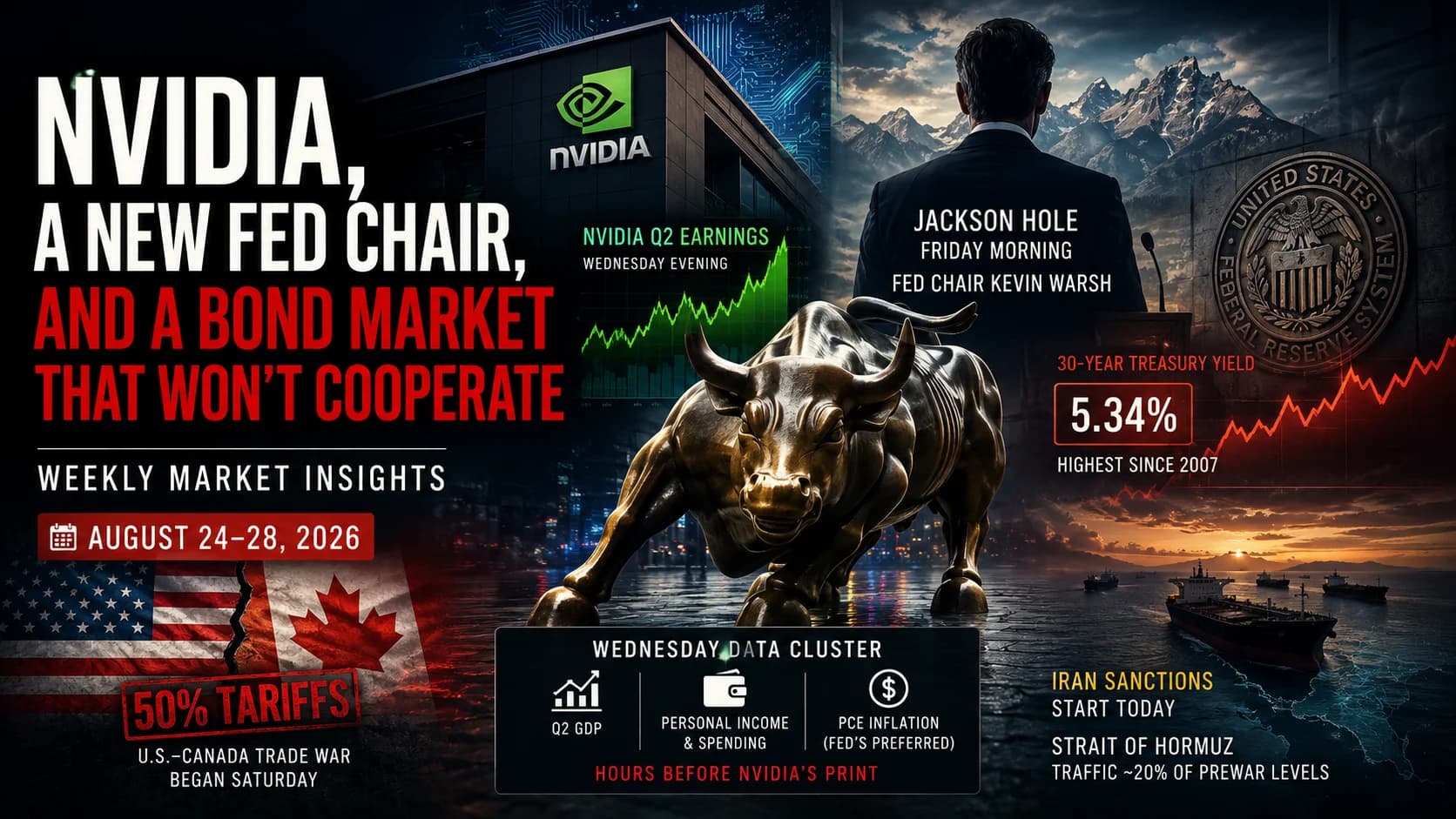
Nvidia, a New Fed Chair, and a Bond Market That Won't Cooperate: Weekly Market Insights, August 24-28
Warsh's first Jackson Hole speech, Nvidia's earnings, and fresh Iran and Canada shocks collide this week. The full Aug 24-28 catalyst map, stock watchlist, and scenario tree for traders.

Market Analysis & Insights
Two Wars, a Trade Fight, and CPI Still Has to Land Clean: Weekly Market Insights, September 7-11
A blowout jobs report already pushed rate-hike odds above 58%. Now a widening Middle East war and a new US-Canada trade fight collide with the last inflation data before the Fed's September 15-16 decision, while Nokia, Compass Pathways, Qualcomm, and Amgen all move on stories the calendar never saw coming.

Market Analysis & Insights
An AI Slowdown Call, a Live Fed Hike, and $108 Oil Collide in One Week: Weekly Market Insights, September 14-18
CME FedWatch has Wednesday's hike odds near 90 percent after a weekend AI slowdown call from Anthropic's CEO hit chip stocks, oil spiked past $107 on a Saudi pipeline shutdown, and Friday's quad witching sets up next Monday's S&P rebalance.
Comments
No comments yet. Be the first to share your thoughts.