
Single-Stock Leveraged ETFs: What Day Traders Need to Know Before Trading NVDL, TSLL, and the Rest

In this article11 sections
In 2022, a leveraged ETF tracking a single company's stock, rather than an index, barely existed as a category. By the middle of 2026, more than 400 single-stock ETFs trade on U.S. exchanges, and the largest of them holds over $4 billion in assets. That's not a niche product anymore. That's a new instrument class, and a growing number of day traders are using it as a substitute for options.
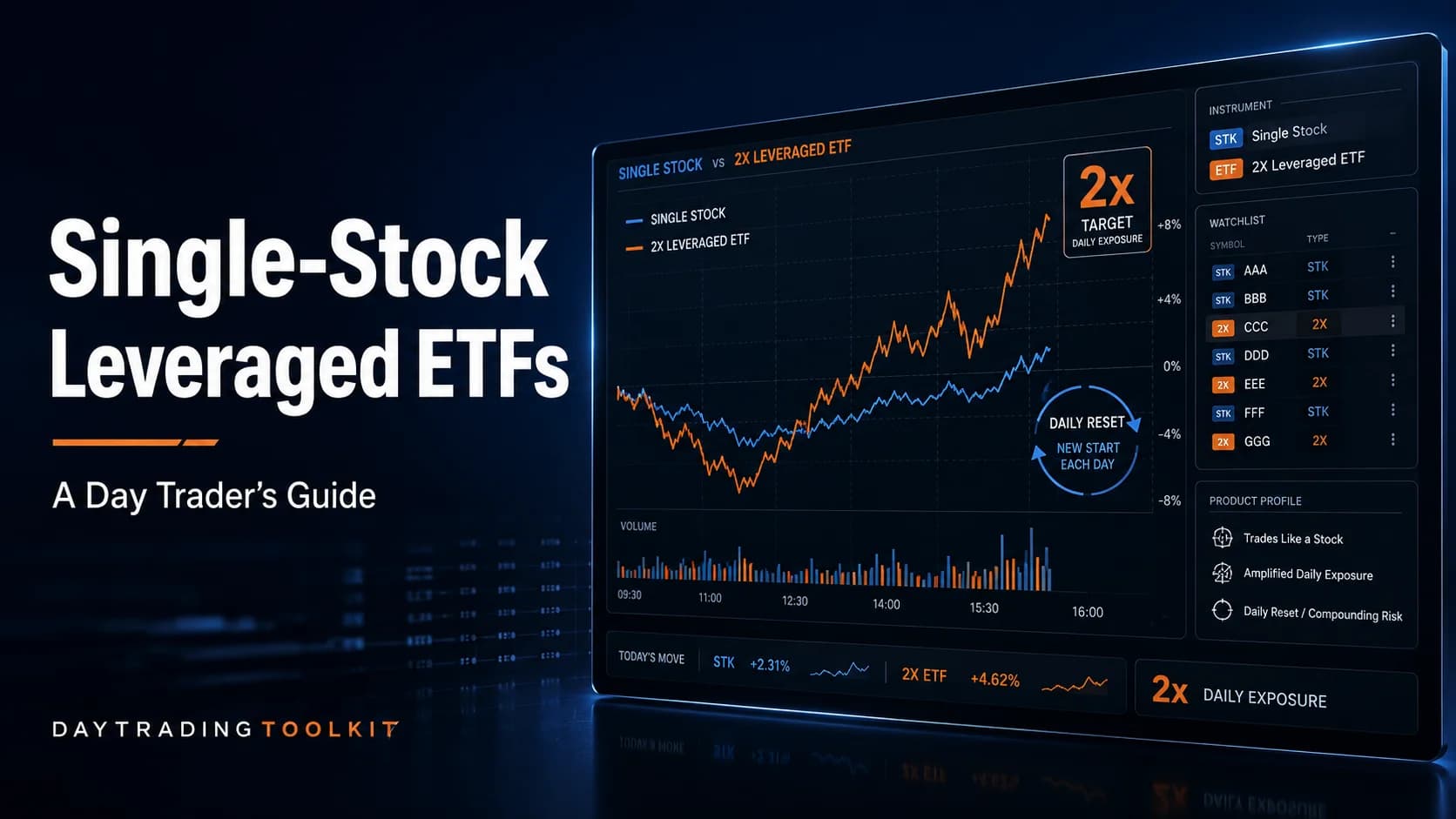
What is a single-stock leveraged ETF? A single-stock leveraged ETF is a fund designed to deliver a multiple, typically 2x, of one company's daily stock return rather than tracking an index. A 2x fund on a stock that gains 5% in a session aims to gain roughly 10% that same day. The fund resets its exposure every day using swaps and other derivatives, which means its return over any period longer than a single session can diverge sharply from twice the stock's actual move.
How a curiosity became a real trading category
The first wave of leveraged ETFs, products like TQQQ and SOXL, tracked entire indexes or sectors. Single-stock leveraged exposure was a much harder regulatory and structural problem, and issuers didn't solve it at scale until relatively recently. GraniteShares, Direxion, and T-Rex have since built out full rosters: NVDL for 2x Nvidia exposure, TSLL for 2x Tesla, AMDL for AMD, MULL for Micron, GGLL for Alphabet, MSTU for MicroStrategy, and dozens more, with inverse counterparts for traders who want to bet against a name without borrowing shares to short it.
The growth curve is steep by any measure. Total U.S. leveraged and inverse ETF assets crossed $170 billion in 2026, and roughly a quarter of all new ETF filings over the past year have been for leveraged or inverse products. TSLL alone is now the largest single-stock ETF in the country by net assets. None of this existed as a mainstream retail product four years ago.
What's driving it is simple: a single-stock leveraged ETF trades in a normal brokerage account like any other share, with no options approval tier, no expiration date, and no margin account required to access 2x exposure. For a day trader who wants amplified exposure to one name without learning options pricing, that's a genuinely lower barrier to entry than a call option ever was.
Why this is happening now, specifically
Three things converged to make this category viable at scale. Regulation 6c-11, the ETF rule the SEC finalized in 2019, streamlined how quickly issuers can bring a new fund to market, cutting months out of what used to be a slow, custom exemptive-relief process. Swap-based structuring matured to the point where issuers could deliver a clean daily multiple on a single name's return without the fund itself needing to short shares or borrow stock directly. And retail demand for amplified exposure without an options approval tier turned out to be much larger than issuers originally assumed, once traders realized a leveraged ETF ticker works exactly like buying more shares in a normal brokerage account.
That combination is why the timeline looks the way it does: a handful of experimental single-stock products around 2022, then an accelerating wave of launches through 2025 and 2026 as issuers like GraniteShares, Direxion, and T-Rex competed to cover every heavily-traded name retail traders already wanted amplified exposure to. Roughly a quarter of all new ETF filings industry-wide over the past year have been for leveraged or inverse products, which tells you this isn't a fading trend. It's where a meaningful share of new product development is actually happening.
What you're actually buying
A single-stock leveraged ETF isn't a loan against the stock and it isn't a derivative you hold to expiration. The fund itself holds swaps and other derivative contracts designed to deliver its stated multiple of the underlying stock's return for that trading day only. At the end of each session, the fund rebalances its exposure back to the target multiple for the next day.
That daily reset is the single most important mechanical fact about these products, and it's the part most new traders skip past. It means the fund is contractually built to be accurate for one day at a time, not for a week or a month. Holding it longer doesn't just add risk. It changes what you're actually holding.
The math that decides whether this works
FINRA has been warning about this exact mechanism since 2009, back when leveraged and inverse ETFs were almost entirely index products. The regulator's guidance walks through a simple illustration: take an index that starts at 100, rises 10% on day one, then falls 10% on day two. A naive read says the index is back near where it started. In reality it lands slightly below 100, because the 10% loss on day two is calculated against the larger day-one balance. Run a 2x leveraged version of that same index through the identical two days and the gap widens considerably, and FINRA's own modeling shows the effect growing sharply worse as daily volatility increases, even when the underlying index ends up completely flat.
That's the mechanism, not a worst-case edge scenario. It's simple compounding arithmetic, and it applies to every daily-reset leveraged product, single-stock or index. The practical takeaway is almost the opposite of what the marketing implies: these funds are most reliable for a single session and least reliable the longer you hold them, and choppy, directionless price action does more damage to a leveraged position than a straight decline ever does.
Single-stock exposure makes this worse in one specific way. An index fund's daily volatility is smoothed by dozens or hundreds of underlying names moving somewhat independently. A single-stock fund inherits all of that one company's volatility with none of the smoothing, which means the compounding math in FINRA's example plays out faster and harder on a name like Tesla or MicroStrategy than it does on a diversified index product.
Single-stock leverage versus the alternatives
Day traders reaching for a single-stock leveraged ETF are usually choosing it over one of three other ways to get amplified exposure to one name, and the comparison is worth being honest about.
- Instrument
- Single-stock leveraged ETF (e.g. NVDL)
- Expiration
- None
- Leverage source
- Daily-reset swaps inside the fund
- Main added risk
- Compounding decay on multi-day holds
- Instrument
- Equity option
- Expiration
- Fixed date
- Leverage source
- Contract premium and strike
- Main added risk
- Time decay and implied volatility changes
- Instrument
- CME single-stock futures
- Expiration
- Fixed date
- Leverage source
- Futures margin
- Main added risk
- Basis risk and thinner liquidity
- Instrument
- Broad-index leveraged ETF (e.g. TQQQ)
- Expiration
- None
- Leverage source
- Daily-reset swaps across an index
- Main added risk
- Sector-wide, not single-name, volatility
| Instrument | Expiration | Leverage source | Main added risk |
|---|---|---|---|
| Single-stock leveraged ETF (e.g. NVDL) | None | Daily-reset swaps inside the fund | Compounding decay on multi-day holds |
| Equity option | Fixed date | Contract premium and strike | Time decay and implied volatility changes |
| CME single-stock futures | Fixed date | Futures margin | Basis risk and thinner liquidity |
| Broad-index leveraged ETF (e.g. TQQQ) | None | Daily-reset swaps across an index | Sector-wide, not single-name, volatility |
The appeal of the single-stock ETF is that it's the only row in that table without an expiration date or a Greeks-driven pricing model to learn. The tradeoff is that the decay problem never goes away just because there's no expiration forcing the issue. An option's time decay is visible and priced into the contract every day. A leveraged ETF's decay is invisible until you check the fund's return against the stock's actual move over the same stretch and notice they don't match.
The liquidity problem sitting under the growth numbers
The launch boom hides a less flattering statistic. Roughly 70% of leveraged single-stock ETFs hold under $25 million in assets, and the average leveraged or inverse ETF that gets liquidated survives less than two years before closing. Issuers can launch these funds cheaply and quickly, which means dozens get filed on any stock with active retail interest, and only a handful in each name actually gather enough volume to trade with a tight spread.
That matters directly for execution. A thinly traded single-stock leveraged ETF can carry a bid-ask spread wide enough to erase a meaningful chunk of an intraday move before you ever get to the compounding problem. Before trading any ticker in this category, checking actual average daily volume and typical spread, not just the multiple and the underlying name, is a five-minute step that prevents a real cost. The largest, most liquid names in the category (NVDL, TSLL, and a handful of others) trade tens of millions of shares most sessions. Plenty of the newer, smaller launches trade a small fraction of that.
Where these fit in an actual day trading plan
Treat a single-stock leveraged ETF as a same-day instrument, full stop. The FINRA guidance above isn't a compliance formality. It's a direct description of how the product is engineered to behave, and it argues for a specific, narrow use case: expressing a conviction about a stock's move within a single session, not building a position to hold through a catalyst or over multiple days.
That narrows the practical use case considerably. A trader who already has a defined intraday thesis on a name like Nvidia or Tesla, based on a scanner-flagged momentum move, a relative volume spike, or a technical setup, can use the 2x version to size that specific trade more efficiently than buying twice the shares outright, without the strike selection and implied volatility judgment options require. That's a meaningfully different use case than treating the ETF as a leveraged way to invest in a company you like.
Trade Ideas is one way to build the pre-market screen this category actually requires, since these products only make sense when there's already a genuine catalyst or momentum move in the underlying stock. Screening the underlying shares for volume and volatility first, then checking whether a liquid leveraged version of that name exists, is a more disciplined process than scanning the ETF tickers directly, most of which don't show up on a standard momentum scan the way their underlying stocks do. For current pricing on scanning tools like this, check this site's deals page.
Position sizing deserves extra care here specifically because the leverage is already built into the instrument. A trader applying their normal share-count math to a 2x product is unknowingly doubling their intended risk. Running position size through the same per-trade and daily risk limits used for any other setup, adjusted for the embedded multiple, is not optional with these products the way it might feel optional with a small position in an unleveraged stock.

Reading the tape before you trade one
Two checks take less than a minute and matter more than picking the multiple. First, look at the underlying stock's own relative volume and price action before looking at the leveraged version at all. A leveraged ETF doesn't create a setup. It amplifies one that already exists in the stock itself, so the research still starts with the same volume, level, and momentum reads used for any other intraday trade.
Second, pull up the fund's own bid-ask spread and recent volume, not just the underlying stock's. A tight, one-cent spread on a name like NVDL behaves nothing like the same multiple on a fund trading a few hundred thousand shares a day with a spread several times wider. On the smaller, newer launches in this category, that spread alone can consume a meaningful share of an intraday move before compounding decay ever enters the picture. Treat spread and volume on the ETF itself as a separate, mandatory check, not something the underlying stock's liquidity guarantees for you.
Where this goes wrong
The two failure modes worth naming directly both come from ignoring what the product actually is.
The first is holding overnight into an earnings report or other binary catalyst. A single-stock leveraged ETF doesn't just amplify the next day's price move. It amplifies a gap, and a 2x fund on a stock that gaps 15% against you opens the next session down roughly 30%, with no circuit breaker at the fund level to soften that. This risk is structurally similar to the gap risk this site covers in choppy, low-volatility stretches, except leverage turns an ordinary overnight gap into a proportionally larger one.
The second is chasing whichever single-stock leveraged ETF posted the biggest headline return over the past month. That number almost always reflects a strong, sustained trend in the underlying stock, exactly the condition under which daily compounding works in a trader's favor rather than against it. The same fund can look completely different during the next choppy stretch in that stock, and a trader who bought based on last month's return without understanding why it happened is buying the outcome, not the setup.
What to watch as this category keeps growing
The launch pace shows no sign of slowing, and neither does the closure pace. Expect both numbers to keep climbing together: more single-name tickers covering more of the actively-traded stock universe, and a steady churn of thinly-capitalized funds shutting down within a year or two of launch. That combination means the research step described above, checking the specific fund's own liquidity rather than assuming it inherits the underlying stock's, gets more important with time, not less.
It's also worth watching whether regulators revisit their 2009-era guidance now that single-stock products have pushed the compounding math described above into instruments with far less internal diversification than the index funds that guidance was originally written for. Nothing suggests an imminent rule change, but the FINRA notice cited throughout this guide predates the entire single-stock category by more than a decade, and a product-specific update wouldn't be surprising as assets in this corner of the ETF market keep climbing.
Common Questions About Single-Stock Leveraged ETFs
What does a 2x leveraged ETF actually track?
The fund resets its exposure at the end of each day so it's positioned to deliver the stated multiple again the next session. Because of that reset, a 2x fund's return over a week or a month can be meaningfully higher or lower than twice the underlying's return over the same stretch, depending on how choppy or trending that stretch was.
Key Takeaway: "2x" describes a daily target, not a guarantee over any period longer than one trading day.
Are single-stock leveraged ETFs the same thing as options?
Options decay predictably as expiration approaches based on time and implied volatility, and that decay is priced into the contract from the start. A leveraged ETF's decay comes from daily rebalancing and only shows up when you compare the fund's actual return to a simple multiple of the stock's move over the same period.
Key Takeaway: Different mechanism, same underlying lesson: both instruments punish traders who hold longer than the setup that got them in was actually good for.
Why do single-stock leveraged ETFs lose money even when the stock is flat?
FINRA's own regulatory guidance on these products walks through this with a simple two-day example: a security that rises then falls back to its starting point still produces a small loss when reset daily, and that loss grows substantially larger as daily volatility increases. A single stock chopping sideways with high day-to-day volatility is close to the worst-case environment for a daily-reset leveraged product.
Key Takeaway: Chop, not direction, is what actually damages a leveraged position over time.
Which single-stock leveraged ETFs are the most liquid?
Liquidity drops off quickly outside the handful of largest names. With roughly 70% of leveraged single-stock ETFs holding under $25 million in assets, many newer launches trade with wide bid-ask spreads that can cost a meaningful chunk of an intraday move before the compounding issue even becomes relevant.
Key Takeaway: Check actual volume and spread on the specific ticker before trading it. The multiple and the underlying name don't tell you whether the fund itself is liquid.
Can a single-stock leveraged ETF go to zero?
The bigger practical risk for most traders isn't a single-day wipeout. It's the slower value erosion from holding a daily-reset product through a choppy multi-day stretch, or getting caught in a fund that closes and forces an unplanned exit.
Key Takeaway: The realistic risk with these products is decay and closure risk, not an overnight collapse to zero, though the leverage does make an extreme single-session move more dangerous than it would be in the underlying stock.
How is a single-stock leveraged ETF different from a broad-index leveraged ETF like TQQQ?
TQQQ's daily moves reflect the blended behavior of the Nasdaq-100's roughly 100 constituent stocks, which tends to dampen single-day volatility relative to any one name in the index. A single-stock fund like NVDL has no such smoothing. Whatever Nvidia does on a given day, NVDL does at twice the magnitude, with nothing offsetting it.
Key Takeaway: Single-stock leverage is a more concentrated, faster-moving version of the same compounding risk that applies to index-level leveraged ETFs.
Do single-stock leveraged ETFs pay dividends or have tax implications?
This is worth confirming with a tax professional before treating one of these funds like a routine trading vehicle, since the tax treatment can differ meaningfully from owning the underlying shares directly, particularly given how often these funds rebalance internally.
Key Takeaway: Don't assume the tax profile matches the underlying stock. Confirm it for the specific fund you're trading.
Should a beginner day trader use single-stock leveraged ETFs?
A trader still building the skill of reading a stock's price action is better served practicing on the underlying shares first, where a mistake costs the actual move rather than twice the actual move. Once a trader has a demonstrated, repeatable process for identifying intraday setups, adding leverage through one of these products is a sizing decision, not a strategy.
Key Takeaway: Learn to read the setup on the unleveraged stock before adding a multiplier to your mistakes as well as your wins.
Disclaimer
Article Sources
- FINRA Regulatory Notice 09-31 - the original regulatory notice on daily-reset leveraged and inverse ETF suitability and compounding risk
- FINRA Non-Traditional ETFs FAQ - FINRA's plain-language explanation of the daily reset mechanism
- Investor.gov: Updated Investor Bulletin on Leveraged and Inverse ETFs - joint SEC and FINRA investor guidance on costs, tax treatment, and risk
- ETF.com: Leveraged ETFs in 2026 - current data on fund performance and the single-stock leveraged ETF category
- ETF.com: Single-Stock ETFs Boom, But Assets Stall - data on the growth in single-stock ETF launches and asset concentration
- EBC Financial Group: New ETF Launches Hit Record Pace - data on 2026 ETF launch volume and closure rates
Was this helpful?
Be the first to weigh in

Written by
Kazi Mezanur RahmanFounder, independent researcher, and editor of DayTradingToolkit. A one-person publication focused on risk-first trading education and documented tool research. He trades his own capital as a retail trader and combines personal market experience with systematic primary-source research.
Keep Reading

Market Analysis & Insights
Jackson Hole Aftermath: What Warsh Changed for Traders
Warsh did not promise a September rate hike at Jackson Hole. He made inflation the Fed's dominant concern, and the bond market repriced the next meeting immediately.
Market Analysis & Insights
Cboe Premarket Options Trading Is Delayed: What Changed and What to Watch For
Cboe's C1 exchange postponed its planned 7:30-9:25 a.m. ET premarket options session past its August 17, 2026 target, with the new date still TBD. Here's what changed, why it matters, and what the eventual launch will look like.

Market Analysis & Insights
SpaceX Lockup Expiration: The $123B Unlock Explained
SpaceX's Q2 earnings on August 4 triggered a staggered lockup release starting August 6, freeing up to $123B in insider shares. Here's what actually happened, the schedule still ahead, and how day traders approached it.
Market Analysis & Insights
September's Trading Calendar: FOMC, Quad Witching, and the Rebalance All Land in One Week
Three major structural events land in the same five trading days this September: the FOMC's dot-plot meeting, quadruple witching, and the Nasdaq-100/S&P 500 quarterly rebalance. Here's how they interact and how to prepare.
Comments
No comments yet. Be the first to share your thoughts.