
CME Single-Stock Futures Are Live—But Liquidity Will Decide Whether They Matter

In this article15 sections
CME Group has opened a new route into some of the most heavily traded U.S. stocks.
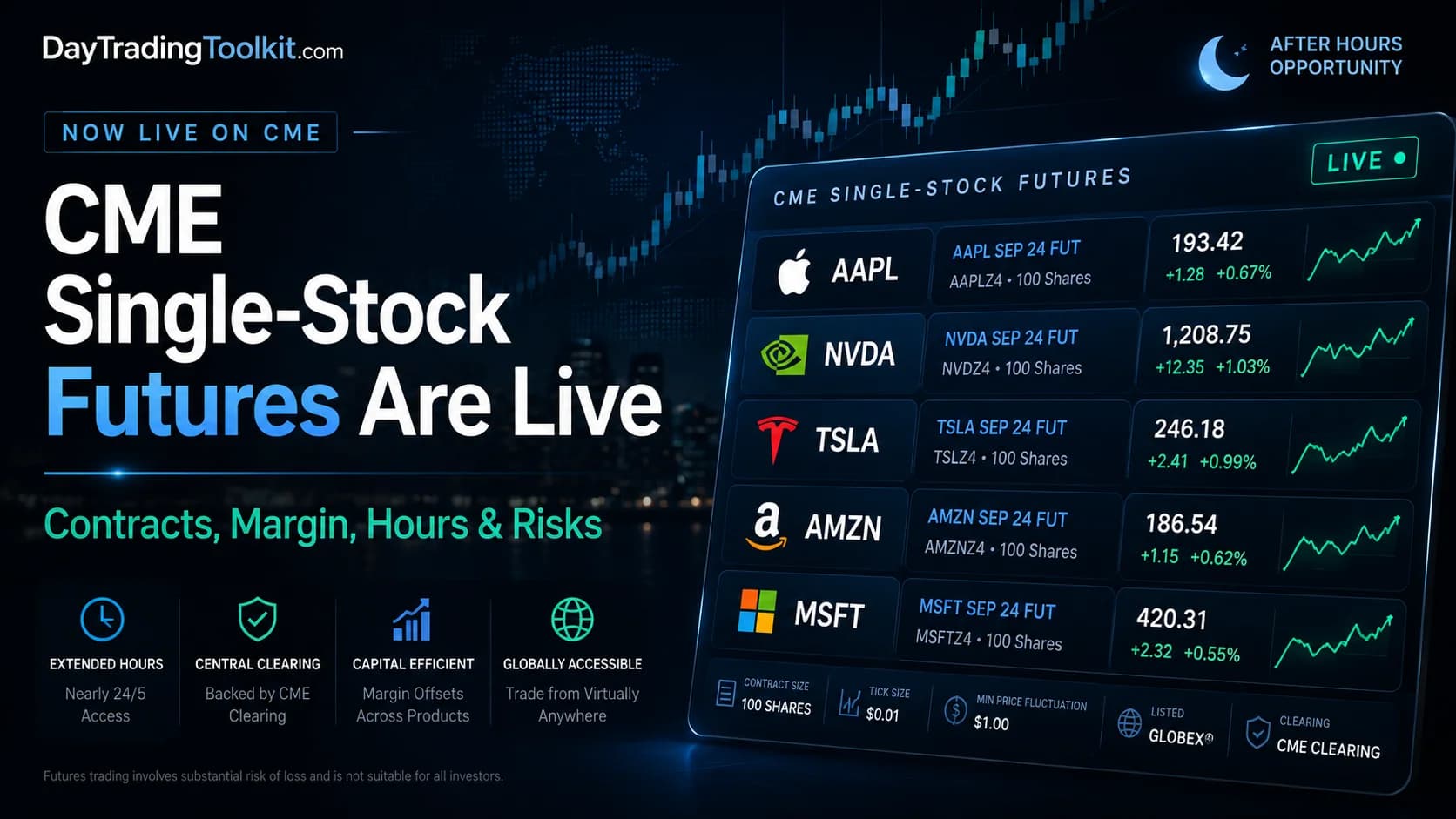
Since Monday, July 27, 2026, traders have been able to buy or sell futures tied to 55 individual companies, including Apple, Amazon, Alphabet, Meta, Microsoft, Nvidia and Tesla. The standard contract represents 100 shares. A smaller Micro version, available on 22 names at launch, represents 10. Both trade for nearly 23 hours on most weekdays and settle in cash.
The headline is easy to understand: stock-like exposure, futures margin and a much longer trading session.
The harder question is whether the contracts are useful once you reach the order book.
A famous underlying stock does not automatically create a liquid future. A low margin figure does not make the position small. An overnight quote does not guarantee a fair price. And the contract still has an expiration date, even when your view on the company does not.
That is the real story of CME’s launch. The exchange has created the market. Traders and market makers now have to prove that the market works.
Contract details and CME market disclosures in this article were reviewed on August 2, 2026.
The Contract Looks Familiar Until You Calculate the Position
CME’s new lineup includes 55 standard contracts and 22 Micro contracts. The quote looks like a stock price, but the multiplier determines the actual exposure.
- Feature
- Contract size
- Standard contract
- 100 shares
- Micro contract
- 10 shares
- Feature
- Value of a $1 move
- Standard contract
- $100
- Micro contract
- $10
- Feature
- Value of a $0.01 move
- Standard contract
- $1.00
- Micro contract
- $0.10
- Feature
- Listed expirations
- Standard contract
- Two consecutive quarterly contracts
- Micro contract
- Two consecutive quarterly contracts
- Feature
- Settlement
- Standard contract
- Cash
- Micro contract
- Cash
- Feature
- Trading hours
- Standard contract
- 6:00 p.m.–5:00 p.m. ET, Sunday–Friday
- Micro contract
- Same
| Feature | Standard contract | Micro contract |
|---|---|---|
| Contract size | 100 shares | 10 shares |
| Value of a $1 move | $100 | $10 |
| Value of a $0.01 move | $1.00 | $0.10 |
| Listed expirations | Two consecutive quarterly contracts | Two consecutive quarterly contracts |
| Settlement | Cash | Cash |
| Trading hours | 6:00 p.m.–5:00 p.m. ET, Sunday–Friday | Same |
Suppose the September future is quoted at 200.00.
One standard contract controls $20,000 of notional exposure. A one-dollar move in the futures price changes the position by $100.
The Micro controls $2,000. The same one-dollar move changes the position by $10.
That smaller multiplier gives the Micro an obvious advantage for position sizing. It does not make the contract harmless. A $10 move in the stock still means a $100 change per Micro contract, and several Micro contracts can quietly rebuild the same exposure as one standard contract.
The useful number is not the cash shown beside the order ticket. It is the full exposure created by the multiplier.
Readers comparing the basic structure with shares, index futures or other markets can start with DayTradingToolkit’s guide to stocks, forex, futures and crypto.
The Margin Number Is the First Place Traders Can Misread the Product
CME promotes capital efficiency, and the contracts do require less upfront cash than buying the equivalent number of shares outright.
That benefit comes from leverage.
CME says outright long and short positions are subject to initial and maintenance margin of at least 15% of current notional value under the security-futures framework. A broker can require more. In some securities accounts, FINRA’s rules point to a 20% minimum for qualifying outright positions.
Return to the contract quoted at $200:
- Position
- One standard contract
- Notional exposure
- $20,000
- 15% illustration
- $3,000
- 20% illustration
- $4,000
- Position
- One Micro contract
- Notional exposure
- $2,000
- 15% illustration
- $300
- 20% illustration
- $400
| Position | Notional exposure | 15% illustration | 20% illustration |
|---|---|---|---|
| One standard contract | $20,000 | $3,000 | $4,000 |
| One Micro contract | $2,000 | $300 | $400 |
Those are illustrations, not broker quotes.
The important part is what happens next. If the standard future falls from $200 to $190, the long position loses $1,000. That is a 5% move in the underlying price, but it removes one-third of a hypothetical $3,000 margin deposit.
The position was never a $3,000 trade. It was a $20,000 exposure supported by $3,000 of collateral.
Security futures are marked to market as prices change. Losses do not wait politely for expiration. If account equity falls below the required level, the broker can demand more funds or reduce the position. House margin can also rise during volatile conditions, which means a trader may need more collateral at exactly the moment the market becomes hardest to manage.
This is the same distinction that matters across every leveraged account: buying power tells you what the broker permits. It does not tell you what the account can safely absorb. DTT’s margin-versus-cash account guide explains that difference in more detail.
Nearly 23-Hour Trading Solves the Waiting Problem, Not the Pricing Problem
The long trading session is the most interesting part of the launch.
CME single-stock futures trade from 6:00 p.m. to 5:00 p.m. ET, Sunday through Friday, with a one-hour maintenance break. That places the contracts around evening earnings releases, overseas market hours and overnight news that would otherwise leave a U.S. stock trader waiting for the next equity session.
That access can matter. It does not create liquidity by itself.
Imagine a company reports earnings at 4:05 p.m. The stock reacts in after-hours trading, and the CME future also moves. A trader now has another place to express a view or reduce exposure.
The quote still has to be judged on its own terms.
How wide is the spread? How many contracts are displayed? Does the next price sit close behind the best quote, or is there a gap in the book? Can the position be closed at 2:00 a.m. without giving back most of the expected edge in slippage?
A contract can be open and still be unattractive.
That distinction is already familiar in the wider move toward longer U.S. trading hours. More access gives the market more time to process information, but the quality of that price depends on participation. DTT’s guide to 23-hour stock-market trading reaches the same conclusion from the equity side: the session exists before the liquidity fully arrives.
The Futures Price Can Move With the Stock Without Matching It
A single-stock future should generally move in the same direction as its underlying shares. It does not have to display the same price.
The difference between the futures price and the stock price is called the basis.
That basis reflects several things at once: financing costs until expiration, expected dividends, time remaining on the contract and the balance of orders in the futures market.
Dividends are the easiest part to see. A shareholder may receive the company’s ordinary dividend. A futures holder does not. The expected payment is reflected in the relationship between the two prices instead.
Financing pushes the calculation in the other direction. The futures trader is gaining exposure without paying the full stock value upfront, so the cost of carrying that exposure also matters.
In an active market, those forces should keep the future reasonably connected to the stock. In a thin market, the visible basis can also reflect something less elegant: a wide spread and very little competition between orders.
That becomes more important overnight. The future may be trading while the stock’s primary exchange is closed and the wider equity market is producing less reliable price discovery. The futures quote is then a live estimate of where the shares may belong when deeper trading returns.
Sometimes that estimate will be informative. Sometimes it will simply be expensive to trade.
The First Week Says “New Market,” Not “Finished Product”
CME chose well-known companies because those names already attract attention in shares and options. That was the logical place to begin.
It was not a shortcut to mature futures liquidity.
CME’s customer-position disclosure for July 30, 2026 still showed a small and uneven market. Adding the reported long quantities produced 2,093 Micro contracts and 423 standard contracts across the listed rows. Apple led the standard group with 64 contracts, while several standard contracts showed only one or two.
Those figures are not trading volume, and they do not capture every part of the order book. They should not be used to declare the launch a success or failure after four sessions.
They do make one point clear: traders cannot look at the liquidity of Apple or Nvidia shares and assume the related future will behave the same way.
The exact contract matters. So does the expiration.
The nearby September contract may have activity while December remains quiet. The Micro may attract more customers than the standard version. A contract that looks usable around the U.S. open may become much thinner during the overnight session.
This is why “CME single-stock futures are liquid” is the wrong question. The useful questions are narrower:
- Is this company’s contract active?
- Is this contract month active?
- Is the spread acceptable at the time I may need to exit?
- Is there enough depth for my size?
- Does the Micro or standard contract have the better market?
A new contract earns trust one order book at a time.
Update, Early September: Volume Picks Up, Concentrated in a Few Names
CME has not published aggregate customer-position data past July 30 in the same format cited above, but trade-press reports citing exchange volume figures pointed to a single session topping 50,000 contracts within the product's first two weeks, concentrated in the Micro contracts on Nvidia, Intel and Amazon. That is a meaningful jump from the low hundreds of standard contracts and low thousands of Micro contracts shown in the July 30 snapshot above, and it lines up with CME's broader equity-derivatives trend of futures volume running roughly 12% above last year. It does not resolve the liquidity question for the other 50-plus names in the lineup, several of which likely remain thin weeks after launch. The four-question checklist above—contract, month, spread, depth—still has to be answered name by name before trading it.
The new contracts overlap with two markets traders already use for single-company exposure.
- Feature
- Ownership
- Shares
- Yes
- CME single-stock future
- No
- Long option
- No
- Feature
- Dividend received
- Shares
- Usually, if eligible
- CME single-stock future
- No
- Long option
- No
- Feature
- Expiration
- Shares
- None
- CME single-stock future
- Quarterly
- Long option
- Yes
- Feature
- Upfront capital
- Shares
- Full purchase or stock margin
- CME single-stock future
- Futures/security-futures margin
- Long option
- Premium paid
- Feature
- Long-position maximum loss
- Shares
- Amount invested
- CME single-stock future
- Can exceed initial margin
- Long option
- Usually limited to premium paid
- Feature
- Short exposure
- Shares
- May require borrow
- CME single-stock future
- Sell the future
- Long option
- Put or options structure
- Feature
- Pricing complication
- Shares
- Relatively direct
- CME single-stock future
- Basis and expiration
- Long option
- Strike, time decay and implied volatility
- Feature
- Overnight availability
- Shares
- Broker and venue dependent
- CME single-stock future
- Nearly 23 hours
- Long option
- Limited exchange sessions
| Feature | Shares | CME single-stock future | Long option |
|---|---|---|---|
| Ownership | Yes | No | No |
| Dividend received | Usually, if eligible | No | No |
| Expiration | None | Quarterly | Yes |
| Upfront capital | Full purchase or stock margin | Futures/security-futures margin | Premium paid |
| Long-position maximum loss | Amount invested | Can exceed initial margin | Usually limited to premium paid |
| Short exposure | May require borrow | Sell the future | Put or options structure |
| Pricing complication | Relatively direct | Basis and expiration | Strike, time decay and implied volatility |
| Overnight availability | Broker and venue dependent | Nearly 23 hours | Limited exchange sessions |
The future is simpler than an option in one important way. There is no strike selection and no time-decay curve to interpret. A one-dollar move is worth a fixed amount based on the multiplier.
That simplicity should not be confused with defined risk.
A long option buyer generally knows the most that can be lost at entry: the premium. A futures position has no equivalent boundary. The contract keeps gaining or losing as the quoted price moves, and leverage can make an ordinary stock move feel much larger inside the account.
Shares solve a different problem. They do not expire, they may pay dividends and they provide ownership rights. They also require more capital, while short selling can involve borrow availability and fees.
Single-stock futures remove the operational need to borrow shares before opening a short position. That may be useful in a hard-to-borrow name. It does not cap the loss if the stock keeps rising.
The best instrument depends on the job. The future makes the strongest case when a trader specifically values extended hours, direct long-or-short exposure, a smaller Micro multiplier or a temporary hedge. It makes a weaker case when the main priority is ownership, fixed maximum loss or a market with years of established liquidity.
Expiration Is Easy to Ignore Until the Position Reaches It
CME lists the contracts on the March, June, September and December quarterly cycle, initially with two consecutive quarters available.
Trading in an expiring contract ends at 4:00 p.m. ET on the third Friday of the contract month. CME then settles it in cash using the official closing price of the underlying stock on its primary listing exchange.
No shares arrive. There is no delivery process to manage.
There is still a deadline.
A trader approaching expiration can close the contract, hold through settlement or move the exposure into the next quarter. Rolling requires closing one contract and opening another. If the next quarter is thin, the roll can add spread and slippage even when the underlying view has not changed.
The two expirations can also carry different dividend and financing assumptions. The price difference is not necessarily an error. It may be the market accounting for what happens between one settlement date and the next.
The return of actively listed U.S. single-stock futures also changes the background of DTT’s quadruple-witching playbook. The fourth contract category is back. Whether it becomes large enough to create a meaningful expiration effect will depend on open interest, not the label alone.
Corporate Actions Can Change More Than the Stock Chart
Ordinary dividends generally influence the basis rather than producing a cash payment to the futures holder.
More unusual corporate actions can change the contract itself.
A stock split, reverse split, special dividend, spinoff, rights distribution, merger or reorganization may require CME to adjust the contract quantity, price or symbol. The goal is to preserve the economic exposure through the event.
There is an operational detail worth noticing. CME says good-till-canceled and good-till-date orders in an affected contract may be removed while the adjustment is processed.
A trader can therefore carry a position into a corporate event believing that a resting order is still protecting it, then discover that the contract has changed and the old order is gone.
The company calendar matters even when the trade is not based on the company event. Earnings, dividends, splits and merger terms can affect basis, volatility, liquidity and how the contract is handled.
Broker Access Will Be Uneven for a While
A product can be live at the exchange and absent from a retail account.
CME’s broker directory currently names firms including Charles Schwab, NinjaTrader and Plus500, while warning that the list is informational and may not be complete. Schwab has separately published educational material on the contracts for futures-approved clients.
That does not mean every broker offers every contract in both sizes.
Security futures sit across the securities and futures regulatory systems. Depending on the firm, the position may be held in a futures account, a securities account or not supported at all. Margin, permissions, market-data charges and overnight rules can differ.
Before planning around the product, confirm the exact symbol and expiration rather than asking whether the broker offers “single-stock futures” in general.
Check:
- whether the standard and Micro versions are both supported;
- where the position is carried;
- the current initial and maintenance margin;
- whether house margin changes overnight or around earnings;
- which order types are available;
- what happens after a margin shortfall;
- whether market data is real time;
- how the platform labels the expiration month.
CME’s directory is a starting point. DTT’s day-trading broker checklist covers the wider questions around execution, support and account protections.
The Tax Treatment Should Not Be Assumed From the Word “Futures”
Many U.S. traders associate futures with Section 1256 treatment and its blended 60/40 capital-gain split.
A single-stock future is a security future. That distinction matters.
CME does not promise that every customer position receives the standard tax treatment associated with broad futures contracts. The result can depend on the taxpayer, the account and how the position is used, including whether it forms part of a hedge or another combined transaction.
The practical answer is not very exciting, but it is safer than a confident shortcut: check how the broker reports the contract and obtain qualified tax advice before building a strategy around an assumed benefit.
DTT’s Section 1256 guide explains the general framework. It should not be treated as proof that every product carrying the word “futures” qualifies in the same way.
Who Has a Real Reason to Watch This Market?
The strongest early use case may belong to traders who already understand futures mechanics and have a specific problem to solve.
An evening earnings release is one example. A Micro contract could provide smaller company-specific exposure while the regular stock market is closed. A temporary hedge against an existing share position is another. The contracts can also create a direct long-short pair between two companies without borrowing the short leg.
Each use case still depends on the market being tradable.
The spread has to be sensible. The contract must have enough depth for the intended size. The trader has to know what a $5 or $10 stock move means in account dollars. Margin must remain manageable if volatility rises. The position also needs a plan for expiration.
The product is a poor starting point for someone still learning notional exposure, mark-to-market or margin calls. It is also a poor fit for a trader who sees a Micro label and assumes the position cannot become large.
Long-term investors give up several things they may care about: ownership, ordinary dividends, voting rights and the ability to hold indefinitely without rolling.
There is no need to decide immediately whether these contracts will become important. The market will answer that through spreads, depth, volume, open interest and broker adoption.
The Four Numbers Worth Checking Before Any Order
The company name is the least useful part of the order ticket. Before entering, check four numbers.
1. Full notional exposure. Multiply the quoted price by 100 for a standard contract or 10 for a Micro.
2. Dollar impact of a realistic move. A $1 move is worth $100 on the standard contract and $10 on the Micro. Use the company’s actual event-driven range, not a comfortable round number.
3. Current broker margin. CME’s minimum framework is not a promise of the house requirement shown in your account.
4. Live spread and available depth. Look at the contract during the session when you may actually need to close it. A good daytime market does not guarantee a good overnight exit.
Then check the expiration and company calendar.
That may feel cautious for a product attached to familiar stocks. Familiarity is exactly what makes the contract easy to underestimate.
CME Has Launched the Market. Now the Market Has to Earn Trust.
Single-stock futures add something genuinely new to the U.S. trading landscape.
The standard and Micro sizes create direct company exposure without buying shares. The long session can be useful around earnings and overnight news. Short positions do not require a stock borrow, and financial settlement removes share delivery.
None of those features can rescue a poor order book.
For now, the right approach is to separate the product from the promotion. Calculate the full exposure. Treat margin as leverage rather than a discount. Compare the live contract with the shares and options available for the same job. Watch how liquidity develops across companies, expirations and sessions.
The launch matters. Whether the contracts become practical day-trading tools will be decided by what happens after the launch.
Frequently Asked Questions
What is a CME single-stock future?
The standard contract represents 100 shares and the Micro represents 10. The futures holder receives price exposure without owning the shares, collecting ordinary dividends or receiving voting rights.
Key Takeaway: The contract tracks a stock economically, but it is not stock ownership.
When did CME single-stock futures begin trading?
The first group included 55 standard contracts and 22 Micro contracts. The exchange can expand the lineup as the market develops.
Key Takeaway: July 27, 2026 marks the return of an exchange-listed U.S. single-stock-futures market through CME.
How much stock does one contract represent?
At a quoted price of $200, the standard contract creates $20,000 of notional exposure and the Micro creates $2,000. The broker’s margin requirement may be much lower than those figures.
Key Takeaway: Size the position from the multiplier and notional value, not the upfront margin alone.
Can a loss exceed the initial margin deposit?
The contract is marked to market as prices change. A large adverse move can create a margin call, forced liquidation or a loss greater than the amount first posted.
Key Takeaway: Capital efficiency increases leverage; it does not cap risk.
Do CME single-stock futures pay dividends?
Expected dividends influence the basis between the futures and stock prices. Special dividends and other corporate actions may also require a contract adjustment.
Key Takeaway: Dividend expectations affect pricing, but the trader is not a dividend-receiving shareholder.
Can traders short the contract without borrowing shares?
That removes the need to locate and borrow the underlying shares. The financial risk remains open-ended if the company’s price rises sharply.
Key Takeaway: The shorting process may be simpler, but the loss potential is still substantial.
What happens when the contract expires?
The final settlement uses the official closing price of the underlying stock on its primary listing exchange. No shares are delivered.
Key Takeaway: Cash settlement removes delivery, not the need for an expiration plan.
Are Micro single-stock futures safer than standard contracts?
A one-dollar move is worth $10 on a Micro instead of $100 on the standard contract. Several Micros can still create a large leveraged position, and thin liquidity can make exits difficult.
Key Takeaway: The smaller multiplier improves sizing flexibility; it does not make the contract inherently safe.
Are the new contracts liquid enough for day trading?
Early CME disclosures showed activity concentrated in a limited number of contracts, with some standard contracts holding very small customer quantities. Traders need to check the exact company, expiration, spread, depth and session.
Key Takeaway: Judge the live contract—not the popularity of the underlying stock.
Are single-stock futures taxed under the usual 60/40 futures rule?
These are security futures, and tax treatment can depend on the taxpayer, account and use of the position. CME directs customers to legal or tax professionals rather than promising one outcome.
Key Takeaway: The word “futures” does not settle the tax question.
Disclaimer
Article Sources
- CME Group — CME Group to Launch Single Stock Futures on July 27
- CME Group — Single Stock Futures Product Page and Contract Specifications
- CME Group — Single Stock Futures FAQ
- CME Group — Special Executive Report 9974: Initial Listing and Fees
- CME Group — Single-Stock-Futures Corporate-Action Adjustments
- CME Group — Daily Aggregate Customer Positions for Single-Stock Futures
- CFTC — Certified Designated Contract Market Product Filings
- FINRA — Security Futures Risk Disclosure Statement
- FINRA — Rule 4210 Margin Requirements
- Charles Schwab — Single Stock Futures: What They Are and How They Work
Was this helpful?
Be the first to weigh in

Written by
Kazi Mezanur RahmanFounder, independent researcher, and editor of DayTradingToolkit. A one-person publication focused on risk-first trading education and documented tool research. He trades his own capital as a retail trader and combines personal market experience with systematic primary-source research.
Keep Reading
Market Analysis & Insights
The PDT Rule Is Dead: Everything That Changed, When It Takes Effect, and What Every Trader Needs to Do Now
The SEC eliminated the $25K Pattern Day Trader rule on April 14, 2026. Effective June 4. Here's exactly what changed, the new margin rules, and what every broker is doing.
Market Analysis & Insights
Day Trading a Small Account: The Complete Playbook for the Post-PDT Era
The $25K rule is gone, but small accounts face new rules. Learn intraday buying power, position sizing, and the strategies that fit a $2K–$25K account.

Market Analysis & Insights
Jackson Hole Aftermath: What Warsh Changed for Traders
Warsh did not promise a September rate hike at Jackson Hole. He made inflation the Fed's dominant concern, and the bond market repriced the next meeting immediately.
Market Analysis & Insights
Cboe Premarket Options Trading Is Delayed: What Changed and What to Watch For
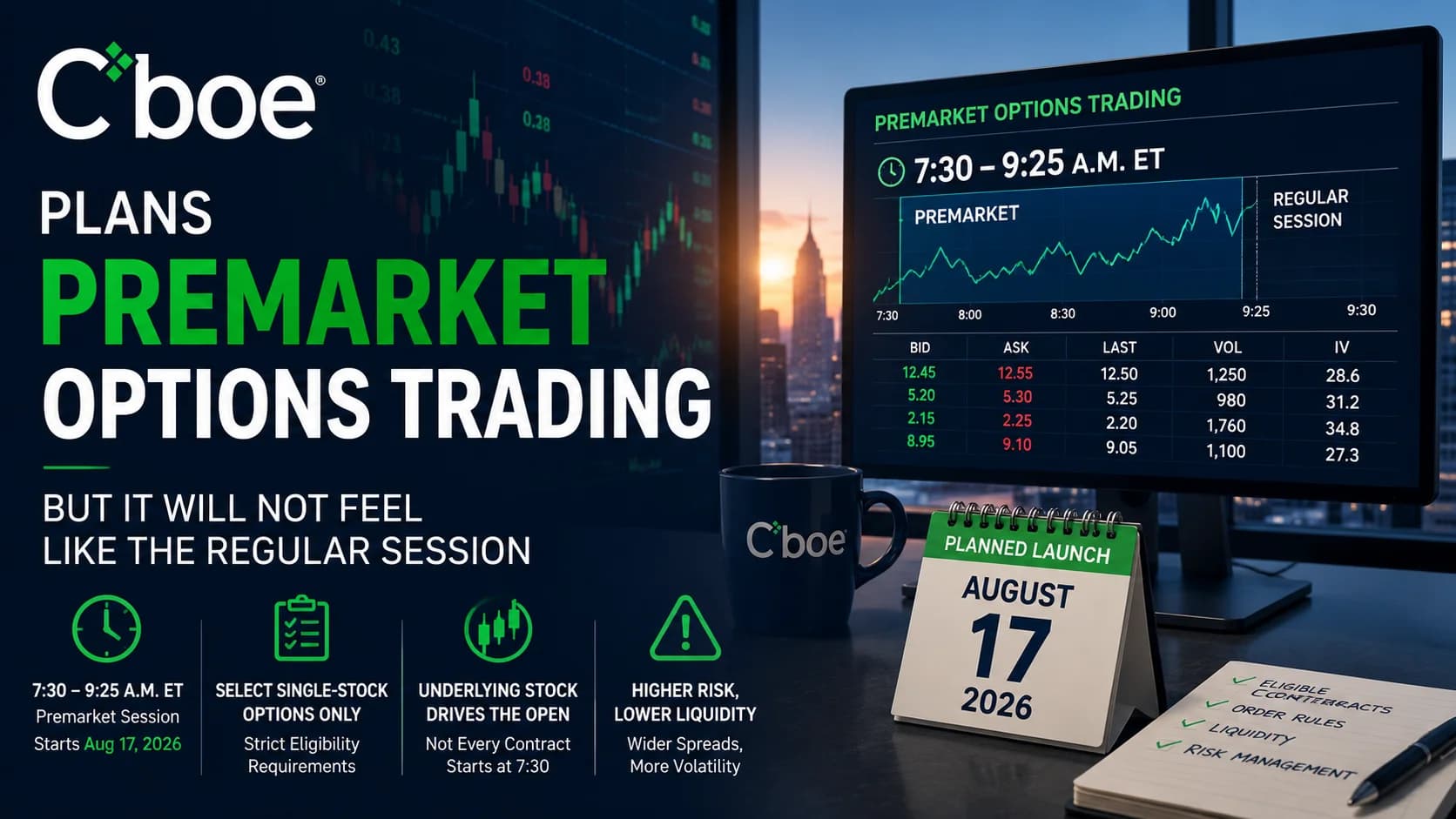
Cboe's C1 exchange postponed its planned 7:30-9:25 a.m. ET premarket options session past its August 17, 2026 target, with the new date still TBD. Here's what changed, why it matters, and what the eventual launch will look like.
Comments
No comments yet. Be the first to share your thoughts.