
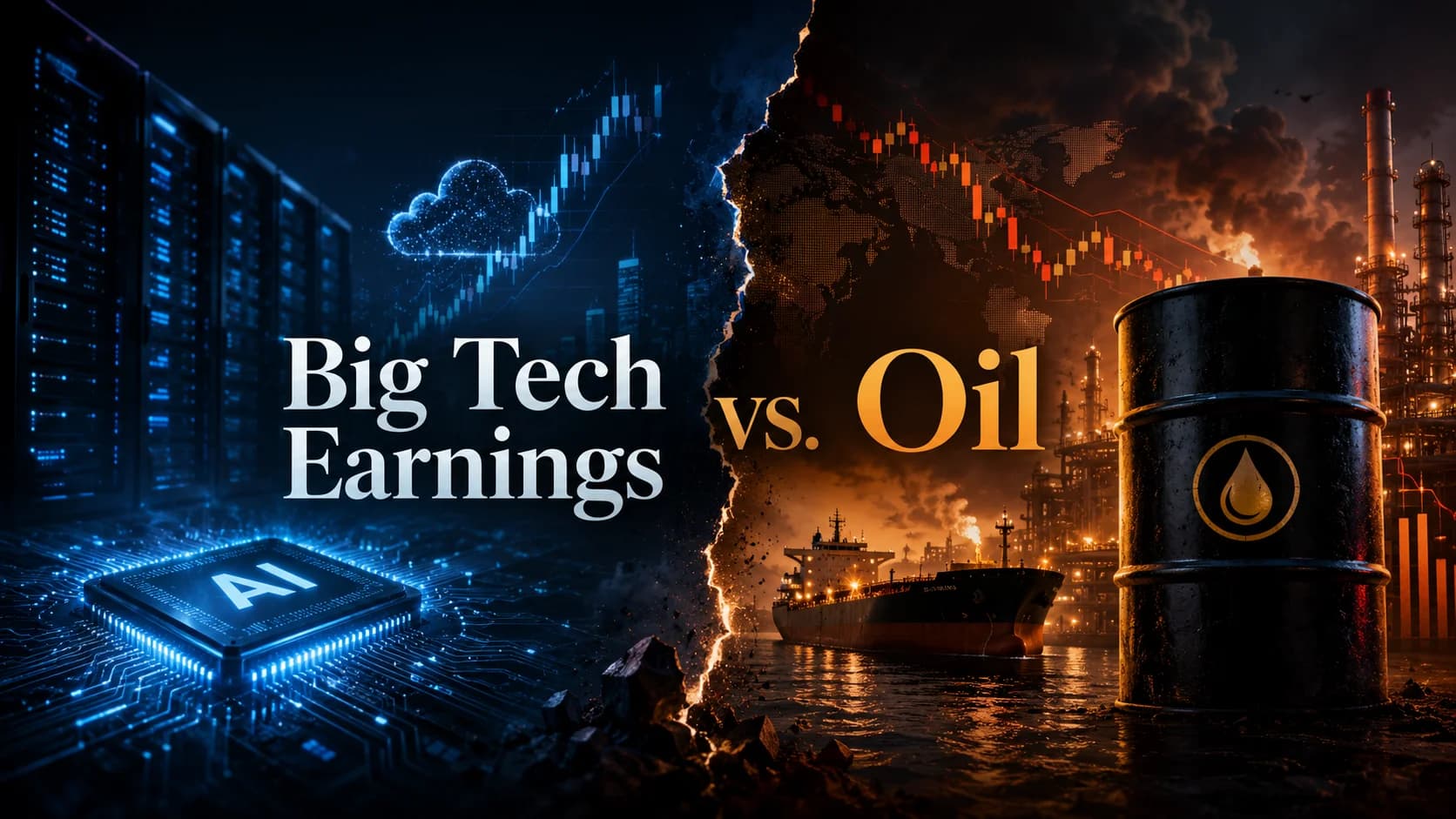
The Nasdaq fell 2.9% last week, more than the S&P 500, Dow, or Russell 2000, as investors questioned whether the returns from artificial-intelligence spending can keep pace with its cost. Monday has brought an early rebound in chips and selected AI names. It has not settled the argument.
The test arrives Wednesday afternoon. Alphabet, Tesla, IBM, and ServiceNow report after the close, followed by Intel on Thursday. Their numbers will land in a market still absorbing an oil shock, a 10-year Treasury yield near 4.58%, and an unresolved conflict affecting traffic through the Strait of Hormuz. The practical issue is not simply whether these companies beat estimates. It is whether their GuidanceGuidance is forward-looking financial projections that a company's management provides for upcoming periods — typically covering expected revenue, earnings, or margins — and the market's reaction is often driven more by guidance than by theRead definition → gives investors enough evidence to tolerate expensive valuations and a higher discount rate.
This week therefore has two clocks. The first counts down to the EarningsAn earnings report is the quarterly financial disclosure a public company files with the SEC, revealing revenue, earnings per share (EPS), profit margins, and forward guidance — it's the most significant regular catalyst for individual stocRead definition → calls. The second runs continuously through crude oil, Treasury yields, and geopolitical headlines. A technology rebound supported by improving guidance would mean something. A rebound driven only by relief after last week's decline would be much easier to reverse.
For active traders, the preparation job is to separate scheduled information from headline risk. Wednesday and Thursday have defined event windows. Oil does not.
The Week at a Glance: July 20–24, 2026
All times are Eastern. There is no scheduled U.S. equity-market closure this week. Monday's opening session was already underway at this article's research cutoff.
- Day
- Monday
- Date
- July 20
- Time ET
- During market hours
- Event
- AI rebound, oil headlines, and post-selloff price discovery
- Expected Relevance
- High
- Why It Matters
- The first question is whether strength broadens beyond the stocks that fell hardest last week.
- Day
- Tuesday
- Date
- July 21
- Time ET
- 10:00 a.m.
- Event
- State employment and unemployment data for June
- Expected Relevance
- Low
- Why It Matters
- Useful regional context, but unlikely to displace earnings or oil unless the details are unusually weak.
- Day
- Wednesday
- Date
- July 22
- Time ET
- After 4:00 p.m.
- Event
- Alphabet, IBM, ServiceNow, and Tesla results
- Expected Relevance
- Very high
- Why It Matters
- The week's most concentrated test of AI monetization, enterprise demand, capital spending, and consumer expectations.
- Day
- Thursday
- Date
- July 23
- Time ET
- 7:30 a.m.
- Event
- RTX earnings call
- Expected Relevance
- Medium to high
- Why It Matters
- A defense-and-aerospace read during an active Middle East conflict.
- Day
- Thursday
- Date
- July 23
- Time ET
- 8:15 a.m.
- Event
- ECB monetary-policy decision
- Expected Relevance
- High
- Why It Matters
- The decision and statement can move the euro, global bond yields, and the market's view of energy-driven inflation.
- Day
- Thursday
- Date
- July 23
- Time ET
- 8:30 a.m.
- Event
- U.S. initial jobless claims
- Expected Relevance
- Medium
- Why It Matters
- A timely labor-market check one week before the July 28–29 FOMC meeting.
- Day
- Thursday
- Date
- July 23
- Time ET
- 8:45 a.m.
- Event
- ECB press conference
- Expected Relevance
- High
- Why It Matters
- The explanation may matter more than the decision if policymakers address energy prices and future policy.
- Day
- Thursday
- Date
- July 23
- Time ET
- After 4:00 p.m.
- Event
- Intel results; 5:00 p.m. call
- Expected Relevance
- High
- Why It Matters
- A direct check on server demand, PC conditions, manufacturing execution, and semiconductor sentiment.
- Day
- Friday
- Date
- July 24
- Time ET
- 9:45 a.m.
- Event
- Flash U.S. manufacturing and services PMI
- Expected Relevance
- High
- Why It Matters
- The first broad July activity reading can reveal whether energy and financing costs are reaching business demand.
- Day
- Friday
- Date
- July 24
- Time ET
- 10:00 a.m.
- Event
- June new-home sales
- Expected Relevance
- Medium
- Why It Matters
- Housing remains sensitive to mortgage rates and gives a second read on rate pressure.
| Day | Date | Time ET | Event | Expected Relevance | Why It Matters |
|---|---|---|---|---|---|
| Monday | July 20 | During market hours | AI rebound, oil headlines, and post-selloff price discovery | High | The first question is whether strength broadens beyond the stocks that fell hardest last week. |
| Tuesday | July 21 | 10:00 a.m. | State employment and unemployment data for June | Low | Useful regional context, but unlikely to displace earnings or oil unless the details are unusually weak. |
| Wednesday | July 22 | After 4:00 p.m. | Alphabet, IBM, ServiceNow, and Tesla results | Very high | The week's most concentrated test of AI monetization, enterprise demand, capital spending, and consumer expectations. |
| Thursday | July 23 | 7:30 a.m. | RTX earnings call | Medium to high | A defense-and-aerospace read during an active Middle East conflict. |
| Thursday | July 23 | 8:15 a.m. | ECB monetary-policy decision | High | The decision and statement can move the euro, global bond yields, and the market's view of energy-driven inflation. |
| Thursday | July 23 | 8:30 a.m. | U.S. initial jobless claims | Medium | A timely labor-market check one week before the July 28–29 FOMC meeting. |
| Thursday | July 23 | 8:45 a.m. | ECB press conference | High | The explanation may matter more than the decision if policymakers address energy prices and future policy. |
| Thursday | July 23 | After 4:00 p.m. | Intel results; 5:00 p.m. call | High | A direct check on server demand, PC conditions, manufacturing execution, and semiconductor sentiment. |
| Friday | July 24 | 9:45 a.m. | Flash U.S. manufacturing and services PMI | High | The first broad July activity reading can reveal whether energy and financing costs are reaching business demand. |
| Friday | July 24 | 10:00 a.m. | June new-home sales | Medium | Housing remains sensitive to mortgage rates and gives a second read on rate pressure. |
The Federal Reserve is not the main scheduled speaker this week. Its next policy meeting is July 28–29, leaving markets to infer the U.S. policy implications from earnings, oil, yields, claims, and Friday's PMI.
The quiet parts of Tuesday and Wednesday morning may still produce movement, but they do not deserve equal attention. The calendar's center of gravity is Wednesday after the close through Thursday morning, then Friday's 9:45–10:00 a.m. data window.
Earnings and Corporate Catalysts That Can Move the Tape
This is a curated list, not a complete earnings calendar. DayTradingToolkit's Q2 2026 earnings-season calendar provides the broader schedule.
- Company
- Alphabet
- Ticker
- GOOGL
- Date
- Wednesday, July 22
- Session or Call
- Results before 4:30 p.m. call
- What the Market Needs to Learn
- Whether Search and Cloud growth can support AI spending; product execution and Gemini timing; the balance between capital expenditure and monetization.
- Company
- IBM
- Ticker
- IBM
- Date
- Wednesday, July 22
- Session or Call
- 5:00 p.m. call
- What the Market Needs to Learn
- Whether enterprise AI demand is translating into software growth, bookings, and durable cash flow rather than pilot-stage enthusiasm.
- Company
- ServiceNow
- Ticker
- NOW
- Date
- Wednesday, July 22
- Session or Call
- After close; 5:00 p.m. call
- What the Market Needs to Learn
- Whether businesses are expanding workflow and AI commitments despite higher energy and financing costs.
- Company
- Tesla
- Ticker
- TSLA
- Date
- Wednesday, July 22
- Session or Call
- After close; 5:30 p.m. call
- What the Market Needs to Learn
- Whether deliveries are converting into margins and cash flow, plus management's timetable for autonomy and robotaxi execution.
- Company
- RTX
- Ticker
- RTX
- Date
- Thursday, July 23
- Session or Call
- Before open; 7:30 a.m. call
- What the Market Needs to Learn
- Defense demand, commercial aerospace execution, supply constraints, and how management describes the current geopolitical environment.
- Company
- Intel
- Ticker
- INTC
- Date
- Thursday, July 23
- Session or Call
- After close; 5:00 p.m. call
- What the Market Needs to Learn
- Server demand, client-computing conditions, foundry costs, manufacturing milestones, and the credibility of forward guidance.
| Company | Ticker | Date | Session or Call | What the Market Needs to Learn |
|---|---|---|---|---|
| Alphabet | GOOGL | Wednesday, July 22 | Results before 4:30 p.m. call | Whether Search and Cloud growth can support AI spending; product execution and Gemini timing; the balance between capital expenditure and monetization. |
| IBM | IBM | Wednesday, July 22 | 5:00 p.m. call | Whether enterprise AI demand is translating into software growth, bookings, and durable cash flow rather than pilot-stage enthusiasm. |
| ServiceNow | NOW | Wednesday, July 22 | After close; 5:00 p.m. call | Whether businesses are expanding workflow and AI commitments despite higher energy and financing costs. |
| Tesla | TSLA | Wednesday, July 22 | After close; 5:30 p.m. call | Whether deliveries are converting into margins and cash flow, plus management's timetable for autonomy and robotaxi execution. |
| RTX | RTX | Thursday, July 23 | Before open; 7:30 a.m. call | Defense demand, commercial aerospace execution, supply constraints, and how management describes the current geopolitical environment. |
| Intel | INTC | Thursday, July 23 | After close; 5:00 p.m. call | Server demand, client-computing conditions, foundry costs, manufacturing milestones, and the credibility of forward guidance. |
The reporting times come from the companies' investor-relations announcements. Tesla has already reported that it produced 451,758 vehicles, delivered 480,126, and deployed 13.5 GWh of energy storage during Q2. Tesla itself cautions that deliveries are only one measure of performance; average selling prices, costs, foreign exchange, and other factors determine the financial result.
This edition does not quote options-implied moves. Those estimates can change quickly, and no single source was sufficiently reconciled by the research cutoff. Omitting an unstable number is more useful than presenting false precision.
Market Regime Snapshot: A Narrow Repair Attempt, Not a Clean Reset
- Indicator
- S&P 500 last week
- Latest Read at Research Cutoff
- -1.6%
- What It Suggests
- Broad pressure, but less severe than technology's decline.
- Indicator
- Nasdaq Composite last week
- Latest Read at Research Cutoff
- -2.9%
- What It Suggests
- Technology and AI sensitivity remained the market's main weak point.
- Indicator
- Dow last week
- Latest Read at Research Cutoff
- -0.9%
- What It Suggests
- Value and non-technology exposure reduced the damage.
- Indicator
- Russell 2000 last week
- Latest Read at Research Cutoff
- -0.5%
- What It Suggests
- Small caps held up better than the Nasdaq, showing the decline was not uniform.
- Indicator
- QQQ Monday, around 11:13 a.m. ET
- Latest Read at Research Cutoff
- About +0.7%
- What It Suggests
- Technology is attempting to recover, though the early high did not hold.
- Indicator
- SMH Monday, around 11:13 a.m. ET
- Latest Read at Research Cutoff
- About +1.3%
- What It Suggests
- Semiconductors are rebounding faster than the broad market after leading the selloff.
- Indicator
- VIX
- Latest Read at Research Cutoff
- 17.93
- What It Suggests
- Implied volatility is elevated enough to matter but does not indicate broad panic.
- Indicator
- Brent crude Monday morning
- Latest Read at Research Cutoff
- Roughly $88; intraday swings around $86–$91
- What It Suggests
- Oil remains a live inflation and headline-risk channel.
- Indicator
- U.S. 10-year Treasury yield
- Latest Read at Research Cutoff
- About 4.58%
- What It Suggests
- The discount rate remains restrictive for expensive growth shares.
| Indicator | Latest Read at Research Cutoff | What It Suggests |
|---|---|---|
| S&P 500 last week | -1.6% | Broad pressure, but less severe than technology's decline. |
| Nasdaq Composite last week | -2.9% | Technology and AI sensitivity remained the market's main weak point. |
| Dow last week | -0.9% | Value and non-technology exposure reduced the damage. |
| Russell 2000 last week | -0.5% | Small caps held up better than the Nasdaq, showing the decline was not uniform. |
| QQQ Monday, around 11:13 a.m. ET | About +0.7% | Technology is attempting to recover, though the early high did not hold. |
| SMH Monday, around 11:13 a.m. ET | About +1.3% | Semiconductors are rebounding faster than the broad market after leading the selloff. |
| VIX | 17.93 | Implied volatility is elevated enough to matter but does not indicate broad panic. |
| Brent crude Monday morning | Roughly $88; intraday swings around $86–$91 | Oil remains a live inflation and headline-risk channel. |
| U.S. 10-year Treasury yield | About 4.58% | The discount rate remains restrictive for expensive growth shares. |
The weekly index changes come from AP's July 17 market recap. Monday's broad-market direction, oil RangeA range (or trading range) is a price zone where a stock oscillates between a defined support floor and resistance ceiling without making meaningful new highs or lows — price is consolidating rather than trending, and the dominant trade is Read definition →, and Treasury yield were cross-checked against AP's July 20 market report. The approximate QQQ and SMH changes were recorded from live feeds at 11:13 a.m. ET and checked against Nasdaq quote data. Cboe displayed the VIXThe CBOE Volatility Index — a real-time measure of the market's expectation for 30-day volatility in the S&P 500, derived from the prices of S&P 500 options. Widely called the "fear gauge," a rising VIX indicates increasing uncertainty and Read definition → at 17.93 on July 20, down from Friday's 18.77 close.
DayTradingToolkit's editorial regime label is headline-driven, high-dispersion, and moderately volatile. Dispersion means different parts of the market are behaving very differently. QQQ and SMH were higher late Monday morning, while small caps and the Dow were lower. Alphabet was strong, Tesla was weak, and Apple was not confirming its recent reputation as a lower-AI-spending refuge.
That combination matters. If this were a clean risk-on recovery, strength would normally broaden beyond the most damaged AI names. If it were a market-wide breakdown, small caps, financials, and defensive groups would likely be falling together. Neither condition was present at the cutoff.
The more useful framework is to treat Monday as an attempted repair. Wednesday's guidance determines whether investors have evidence to continue that repair. Oil determines how generous they are willing to be.
If you need a broader framework for matching tactics to conditions, review DayTradingToolkit's guide to adapting to bull, bear, and choppy markets.
Stocks on the Radar
Each company below has a verified reporting CatalystA catalyst is the specific event or news item that triggers unusual price movement in a stock — earnings reports, FDA decisions, analyst upgrades, acquisition announcements, product launches, and short squeeze setups are all catalysts. WithRead definition → this week. These are observations about information flow and market reaction, not recommendations.
GOOGL — the clearest test of AI monetization
Alphabet reports Wednesday, with its conference call at 4:30 p.m. ET. The reaction to watch is not limited to headline revenue or earnings. Search advertising must remain resilient while Cloud growth and AI products show a credible path toward returns on capital. Investors will also listen for product-timing details after reports of a Gemini 3.5 Pro delay.
A strong report accompanied by firmer monetization evidence could help more than Alphabet. It would support the argument that large AI budgets are producing revenue rather than merely defending existing businesses. A positive headline with vague guidance would be less convincing, especially if Treasury yields and oil remain high.
TSLA — expectations meet operating economics
Tesla enters Wednesday with known delivery and storage figures but unknown profitability. The key mechanism is conversion: how much revenue, margin, and cash flow came from those volumes? Management's commentary on autonomy and robotaxi deployment can move the stock, but the financial statements will show how much room the company has to fund those ambitions.
The broader tape read is sentiment. Tesla's response can reveal whether investors still reward long-duration narratives when the 10-year yield is near 4.6%. A sharp reaction isolated to Tesla would be company-specific. A similar response across speculative growth shares would suggest the market is applying a wider valuation test.
IBM — enterprise AI beyond the demonstration stage
IBM's 5:00 p.m. Wednesday call provides a different AI signal from Alphabet. Alphabet speaks to hyperscale infrastructure and consumer platforms. IBM speaks to large organizations deciding whether AI projects become paid, recurring workloads.
The reaction to watch is whether software and consulting commentary supports durable adoption. Strong interest without improving bookings or forward demand would keep the enterprise-AI story in the experimental category. Evidence of wider deployment would help the market distinguish real spending from enthusiasm.
NOW — a cleaner read on business software demand
ServiceNow reports after Wednesday's close and begins its call at 5:00 p.m. ET. Its workflow platform sits close to corporate operating budgets, making its guidance useful when investors are debating whether higher energy and financing costs are changing business plans.
Watch the quality of demand, not just growth. Expanding commitments and steady guidance would suggest companies are protecting automation and AI projects even as costs rise elsewhere. Cautious guidance would pressure more than ServiceNow because it would question the depth of enterprise software demand.
INTC — where AI demand meets manufacturing cost
Intel reports Thursday after the close, with its call at 5:00 p.m. ET. It can confirm or challenge two separate stories: resilient server demand and the cost of rebuilding a competitive manufacturing operation.
The observable distinction is between product demand and foundry economics. Better server commentary can support semiconductor sentiment, but it will not erase concern about manufacturing losses or execution. Conversely, credible foundry progress with weak end demand would still leave an incomplete recovery case. Intel's response could therefore expose whether Monday's semiconductor rebound rests on improving fundamentals or relief from oversold conditions.
RTX — the earnings report closest to the geopolitical story
RTX reports before Thursday's open and holds its call at 7:30 a.m. ET. It is on the radar because the company spans defense and commercial aerospace while the Iran conflict remains active.
The reaction to watch is whether investors focus on new defense demand, program execution, supply constraints, or commercial aerospace margins. Conflict headlines can create immediate sector interest, but earnings determine whether that attention is supported by backlog, timing, and profitability. RTX can also show whether geopolitical risk is producing a selective defense response rather than a broad risk-off move.
Sectors and Stress Indicators on the Radar
- Theme
- Technology leadership
- Representative Instrument
- QQQ
- Current Evidence
- Nasdaq lost 2.9% last week but QQQ was higher Monday morning
- This Week's Catalyst
- Alphabet, Tesla, IBM, NOW, and Intel
- Observable Confirmation
- Strength that survives earnings and broadens beyond a few rebound names
- Theme
- Semiconductors
- Representative Instrument
- SMH
- Current Evidence
- Chips led the recent momentum unwind and are attempting a sharper rebound
- This Week's Catalyst
- Alphabet capital-spending commentary and Intel results
- Observable Confirmation
- Participation across equipment, memory, and compute—not only one or two leaders
- Theme
- Energy and inflation risk
- Representative Instrument
- USO / crude oil
- Current Evidence
- Brent traded around $86–$91 Monday after rising 4.6% Friday
- This Week's Catalyst
- Iran and Strait of Hormuz headlines; ECB language; Friday PMI
- Observable Confirmation
- Oil holding firm alongside rising yields would keep valuation pressure active
- Theme
- Memory and South Korea
- Representative Instrument
- SKHY, MU, SNDK, EWY
- Current Evidence
- Memory shares have shown unusually large, conflicting moves following SK Hynix's U.S. debut
- This Week's Catalyst
- AI-spending guidance and Intel's server commentary
- Observable Confirmation
- Similar reactions across SKHY, MU, and SNDK would confirm a sector signal; divergence would point to company-specific repricing
- Theme
- Relative megacap strength
- Representative Instrument
- AAPL, META
- Current Evidence
- Both had recently held up better than parts of the AI-infrastructure trade; Monday's tape was mixed
- This Week's Catalyst
- Alphabet's report and the market's response to AI capital spending
- Observable Confirmation
- Continued relative strength would support rotation; simultaneous weakness would indicate broader megacap pressure
- Theme
- Post-IPO momentum
- Representative Instrument
- SPCX
- Current Evidence
- SpaceX has continued unwinding after a rapid IPO and Nasdaq-100 inclusion
- This Week's Catalyst
- QQQ risk appetite and the week's AI-valuation verdict
- Observable Confirmation
- Stabilization with improving market breadth would be more informative than an isolated intraday rebound
| Theme | Representative Instrument | Current Evidence | This Week's Catalyst | Observable Confirmation |
|---|---|---|---|---|
| Technology leadership | QQQ | Nasdaq lost 2.9% last week but QQQ was higher Monday morning | Alphabet, Tesla, IBM, NOW, and Intel | Strength that survives earnings and broadens beyond a few rebound names |
| Semiconductors | SMH | Chips led the recent momentum unwind and are attempting a sharper rebound | Alphabet capital-spending commentary and Intel results | Participation across equipment, memory, and compute—not only one or two leaders |
| Energy and inflation risk | USO / crude oil | Brent traded around $86–$91 Monday after rising 4.6% Friday | Iran and Strait of Hormuz headlines; ECB language; Friday PMI | Oil holding firm alongside rising yields would keep valuation pressure active |
| Memory and South Korea | SKHY, MU, SNDK, EWY | Memory shares have shown unusually large, conflicting moves following SK Hynix's U.S. debut | AI-spending guidance and Intel's server commentary | Similar reactions across SKHY, MU, and SNDK would confirm a sector signal; divergence would point to company-specific repricing |
| Relative megacap strength | AAPL, META | Both had recently held up better than parts of the AI-infrastructure trade; Monday's tape was mixed | Alphabet's report and the market's response to AI capital spending | Continued relative strength would support rotation; simultaneous weakness would indicate broader megacap pressure |
| Post-IPO momentum | SPCX | SpaceX has continued unwinding after a rapid IPO and Nasdaq-100 inclusion | QQQ risk appetite and the week's AI-valuation verdict | Stabilization with improving market breadth would be more informative than an isolated intraday rebound |
The South Korea theme needs precision. SK Hynix's July 10 Nasdaq debut gave U.S. traders direct access to a major memory producer, but that does not make the entire Korean market structurally weak. AP reported that the Kospi was still up 77% for 2026 at the time of the debut despite recent volatility. The useful question is whether memory weakness spreads through SKHY, Micron, SanDisk, and EWY—not whether one volatile week proves a national economic thesis.
Apple's earlier relative strength has been linked to rotation away from the heaviest AI spenders. Monday's weakness is why this issue treats that behavior as a comparison to monitor, not a permanent “safe haven” label.
Crypto remains secondary. Bitcoin was still moving inside roughly a $63,000–$65,000 range on Monday, according to QCP's July 20 market note, so IBIT and Robinhood do not yet deserve the same weight as earnings, oil, or semiconductors. A decisive expansion from that range could change the ranking. Until then, it is a background liquidity signal rather than the week's organizing theme.
This is also a good example of why a top-down stock-selection framework helps. Start with the regime and sector. Then use individual companies to test the thesis.
The Big Question: Can Earnings Repair the AI Trade While Oil Keeps Yields High?
The AI trade is facing a harder standard than “good growth.” Investors already expect large companies to spend heavily and produce strong revenue. The open question is whether the next dollar of spending is generating enough incremental profit to justify valuations built during a low-volatility momentum run.
Oil complicates that test through the discount rate. When crude rises because supply routes may be disrupted, markets can expect more inflation pressure. Bond yields may rise or remain elevated because investors demand compensation for that inflation risk. A higher Treasury yield makes distant corporate cash flows worth less in today's dollars. That mathematical effect is especially important for companies whose valuation depends on profits expected many years ahead.
Think of earnings as an engine test and yields as the incline of the road. A strong engine may still move the vehicle uphill, but it needs to produce more power than it did on flat ground. In this market, ordinary beats may not be enough.
Scenario one: guidance validates the spending.
Alphabet reports resilient Search, accelerating Cloud or AI-related revenue, and a clearer connection between capital expenditure and monetization. IBM and ServiceNow show that enterprise projects are turning into paid deployments. Intel offers credible server-demand and manufacturing commentary. In this branch, technology strength broadens after the reports instead of fading at the opening bell.
The confirming evidence would be visible across layers. QQQ holds its gains, SMH participates, and the memory basket stops behaving like a collection of falling momentum names. Software and infrastructure shares respond together because the earnings suggest that demand exists from chips through applications.
Oil does not need to collapse for this outcome. It does need to stop forcing yields higher. If Brent remains volatile but the 10-year yield stabilizes, investors can separate earnings quality from geopolitical noise. The likely market behavior would be improving breadth and more company-specific discrimination rather than a return to indiscriminate AI enthusiasm.
Scenario two: the numbers are fine, but the return on spending stays unclear.
This may be the most difficult branch because it can initially look positive. Alphabet could exceed reported estimates while giving vague answers about AI margins. Enterprise software companies could describe strong interest but soften forward commitments. Intel could point to demand while foundry costs remain heavy. Tesla could emphasize long-term autonomy without resolving near-term margin questions.
In that case, the market may treat backward-looking results as already priced in. The reaction would matter more than the headline. If QQQ and SMH cannot hold strength after apparently respectable reports, investors are signaling that expectations were higher than the published consensus suggested.
Oil would amplify the problem. Brent holding near the upper end of Monday's range while the 10-year yield pushes higher would raise the hurdle for growth shares. That does not mean every technology company falls. It means the market becomes less willing to fund uncertain payoffs.
Scenario three: mixed earnings produce a stock-picker's tape.
Alphabet could reassure investors while Tesla disappoints, or enterprise software could hold up while semiconductor guidance remains uneven. This branch would leave the broad indexes hiding substantial dispersion.
The evidence would be divergence: GOOGL, IBM, NOW, and INTC would not respond as a single AI basket. SMH could move differently from QQQ. AAPL and META might resume relative strength even if infrastructure names remain weak. The memory complex could split according to margins, product exposure, or recent positioning.
For active traders, this would favor narrower preparation. It would also make index direction less informative. A green QQQ can coexist with difficult conditions in most of its components if a few large weights are carrying the move.
The branch that would invalidate the entire earnings-first framework is a material geopolitical escalation. New attacks on shipping or infrastructure, a further loss of passage through Hormuz, or a sudden oil spike could overwhelm company results. AP reported Monday that shipping through the strait remained largely stalled as Iran and the United States exchanged further attacks. The waterway carried roughly one-fifth of global oil supply before the war.
The cleanest conclusion is conditional: earnings can repair confidence, but only if guidance improves and the macro hurdle stops rising. Monday's bounce is the invitation to prove it, not the proof.
The Teaching Moment: Why a Company Can Beat and Still Fall
An earnings reaction compares at least three things: the reported result, the expectation built into the share price, and management's view of what comes next. Published analyst consensus measures only part of the second item.
Suppose a company reports earnings per share above the visible estimate. That is a beat. But if traders expected an even larger result, or if the stock had rallied sharply into the event, the good news may already be reflected in the price. A cautious revenue outlook can then matter more than the historical quarter.
Netflix provided a current example last week. Its quarterly profit exceeded the surveyed expectation, but revenue fell short and the shares declined 7.3% on Friday. The market was not claiming the company produced no profit. It was repricing the difference between what arrived and what investors had already assumed.
This is why the first move after earnings is not a verdict on whether a company is “good.” It is a rapid negotiation over expectations. Price can also change several times as participants read the release, hear the call, update models, and compare management's answers with prepared remarks.
For Wednesday's reports, separate four questions:
- Did the company exceed the published expectations?
- Did the most important operating metrics improve?
- Did management maintain or change the outlook?
- Did the reaction spread to peers and sector ETFs?
The fourth question helps distinguish company news from a market-theme decision. If Alphabet moves but SMH, enterprise software, and other megacaps do not, the information may be specific to Alphabet. If the whole AI complex moves together, the market is treating the report as a broader signal.
DayTradingToolkit's beginner guide to how earnings season affects day trading explains the event-risk mechanics in more detail.
What Can Safely Be De-Prioritized
Not every line on an economic calendar deserves equal preparation. Tuesday's state employment report and Wednesday's state-level job-openings material can add regional context, but neither is likely to outrank Wednesday's earnings cluster, Thursday's ECB decision, or Friday's flash PMI.
The same rule applies to ticker lists. Rocket Lab, Moderna, Dell, Oracle, Bloom Energy, Citigroup, and Goldman Sachs may produce technically interesting charts, but no sufficiently strong current-week catalyst was verified for this issue. Adding them would create the appearance of breadth while reducing the article's usefulness.
Crypto also stays in the second tier unless it leaves its recent range. A small weekend gain is not enough by itself to displace the week's stronger information events.
De-prioritizing does not mean declaring these assets irrelevant. It means assigning research time according to the probability that new information changes the broader tape.
Mindset for the Week: Do Not Confuse Relief With Confirmation
The behavioral trap is relief-chasing. After a sharp decline, the first rebound can feel like proof that the damage is over. Sometimes it is. More often, it is the market testing whether participants still want exposure at lower prices.
This week offers a simple preparation behavior: write down what would confirm the rebound before Wednesday's close. Possible observations include broader semiconductor participation, stable Treasury yields, and guidance that connects AI spending to revenue or margins. Then record what would weaken the case.
The purpose is not to predict every outcome. It is to prevent Monday's price action from silently becoming the entire thesis. When the evidence is incomplete, sitting out is a valid market decision.
Preparation Checklist
- Record Wednesday's four after-hours reports and each conference-call time.
- Mark Thursday's 8:15–8:45 a.m. ECB and U.S. claims window before the opening bell.
- Mark Friday's 9:45–10:00 a.m. PMI and housing window.
- Check crude oil and the 10-year Treasury yield before evaluating technology strength.
- Compare QQQ with IWM and DIA to see whether participation is broadening.
- Compare SMH with QQQ to see whether semiconductors are leading or lagging the recovery.
- Separate each earnings headline from guidance and the conference-call response.
- Note whether GOOGL, IBM, NOW, TSLA, and INTC move together or diverge.
- Treat SKHY, MU, SNDK, and EWY as a memory-sector diagnostic rather than four independent signals.
- Refresh the step-by-step pre-market routine before Thursday and Friday's compressed event windows.
Last Week's Scorecard
The scorecard grades observations from the July 13–17 Weekly Market Insights. These were editorial scenarios, not trades.
What the previous issue flagged: June CPI could cool while already describing an outdated energy backdrop.
What happened: Headline CPI fell 0.4% in June and slowed to 3.5% year over year, according to the Bureau of Labor Statistics. Stocks initially welcomed the report, but oil and AI repricing dominated the rest of the week.
Assessment: On target.
Lesson: Economic data can be accurate and still lag a fast-moving commodity shock. The release window matters as much as the number.
What the previous issue flagged: Chair Kevin Warsh's first congressional testimony could determine whether markets looked through cooler CPI.
What happened: Warsh emphasized that the Fed had no tolerance for persistent inflation but gave no direct signal about the next policy move, according to AP's testimony report.
Assessment: Partial.
Lesson: The testimony reinforced inflation discipline without resolving the July decision. Oil and yields remained the faster policy signals.
What the previous issue flagged: The memory complex would test whether recent weakness was a temporary dip or a damaged momentum trade.
What happened: SanDisk lost 29% last week, while semiconductor weakness spread broadly. SanDisk, Micron, and SK Hynix then rebounded Monday morning, leaving the longer-term question open but confirming the expected volatility.
Assessment: On target.
Lesson: A rebound after a large decline does not erase the information in the decline. Sector breadth and follow-through still need to confirm stabilization.
What the previous issue flagged: Netflix would be the first major technology earnings reaction of the season.
What happened: Netflix exceeded the surveyed profit estimate but missed revenue expectations; its shares fell 7.3% Friday.
Assessment: On target.
Lesson: This was a useful preview of the standard Alphabet and Tesla now face: respectable historical numbers may not satisfy embedded expectations.
What the previous issue flagged: Oil and the Iran conflict should remain genuinely two-sided rather than treated as resolved.
What happened: Brent rose 4.6% Friday, traded in a wide range Monday, and remained sensitive to attacks and shipping disruption around Hormuz.
Assessment: On target.
Lesson: Geopolitical risk should be framed through scenarios and observable conditions, not a comfortable base case disguised as certainty.
Frequently Asked Questions
What is the most important market event this week?
Alphabet, IBM, ServiceNow, and Tesla report inside a short window. Together they cover consumer platforms, cloud infrastructure, enterprise software, and speculative growth expectations. Their combined sector read is more important than any one headline.
Key Takeaway: Watch whether the reactions agree with one another and whether QQQ and SMH confirm them Thursday morning.
Why does oil matter so much for technology stocks?
That mechanism affects companies with expensive valuations and distant expected cash flows more than mature businesses valued mainly on current earnings. Oil also raises operating and transport costs, though the effects differ by company.
Key Takeaway: Oil matters to technology this week through both inflation expectations and valuation mathematics.
Is Monday's semiconductor rebound a reliable bottom signal?
A stronger confirmation would include breadth across chip designers, equipment suppliers, and memory producers, followed by gains that survive earnings guidance. A narrow one-day rebound can occur inside a continuing correction.
Key Takeaway: Treat Monday as an attempted repair and use Wednesday and Thursday for confirmation.
Why are AAPL and META discussed if they do not report this week?
Apple had attracted interest partly because its capital-spending profile differed from hyperscale peers, while Meta has remained central to the debate over AI infrastructure returns. Alphabet's report can change how investors price both comparisons.
Key Takeaway: AAPL and META are diagnostic peers in this issue, not primary event names.
What should traders watch in the ECB decision?
The ECB publishes its policy decision at 8:15 a.m. ET Thursday and begins the press conference at 8:45. Changes in the euro or European bond yields can feed into global rates and U.S. equity sentiment before the opening bell.
Key Takeaway: Monitor the market response to the language, not only the announced rate.
Why is Friday's flash PMI important before the FOMC meeting?
The manufacturing and services readings can show whether higher energy and financing costs are affecting output, demand, employment, or prices. S&P Global schedules the U.S. release for 9:45 a.m. ET Friday.
Key Takeaway: PMI can shape the final growth-and-inflation narrative entering the July 28–29 FOMC meeting.
Disclaimer
This article is for educational and informational purposes only and is not financial advice or a recommendation regarding any security, fund, commodity, cryptocurrency, or strategy. The watchlist identifies scheduled catalysts and observable market relationships; it does not provide personalized exposure instructions.
This week carries specific risks from earnings gaps, after-hours liquidity, rapid options repricing, data revisions, interest-rate changes, and geopolitical headlines affecting the Strait of Hormuz. Oil, index, yield, and volatility readings can change materially after the stated research cutoff. Company results may be released outside the expected minute, and conference-call commentary can reverse the initial response.
Confirm event times and current market data independently before making any financial decision. Past performance and prior market reactions do not guarantee future results. Read the full disclaimer
Article Sources
- Associated Press: July 20 market report - and July 17 index recap — Monday's setup and previous-week performance.apnews.com
- Associated Press: Iran conflict update - and SK Hynix debut — Geopolitical risk and memory-sector context.apnews.com
- Cboe Volatility Index - , Nasdaq QQQ, and Nasdaq SMH — Volatility and Monday ETF snapshot cross-checks.cboe.com
- Federal Reserve FOMC calendar - and ECB weekly calendar — Central-bank dates and times.federalreserve.gov
- S&P Global PMI calendar - , Census release schedule, Department of Labor claims releases, and BLS July calendar — This week's economic-data timing.pmi.spglobal.com
- Alphabet investor relations - , Kiplinger earnings calendar, and Tesla investor relations — Wednesday's reporting schedule, reported Gemini timing, and Tesla operating figures.alphabet2025ir.q4web.com
- IBM investor relations - and ServiceNow newsroom — Wednesday conference-call schedules.ibm.com
- Intel newsroom - and RTX newsroom — Thursday reporting sessions and conference-call times.newsroom.intel.com
- BLS June CPI release - and AP's Warsh testimony report — Previous-week macro results used in the scorecard.bls.gov
- Fidelity's July 17 market recap - , QCP's July 20 market note, and Apple rotation coverage — Netflix, crypto-range, and relative-strength context.fidelity.com